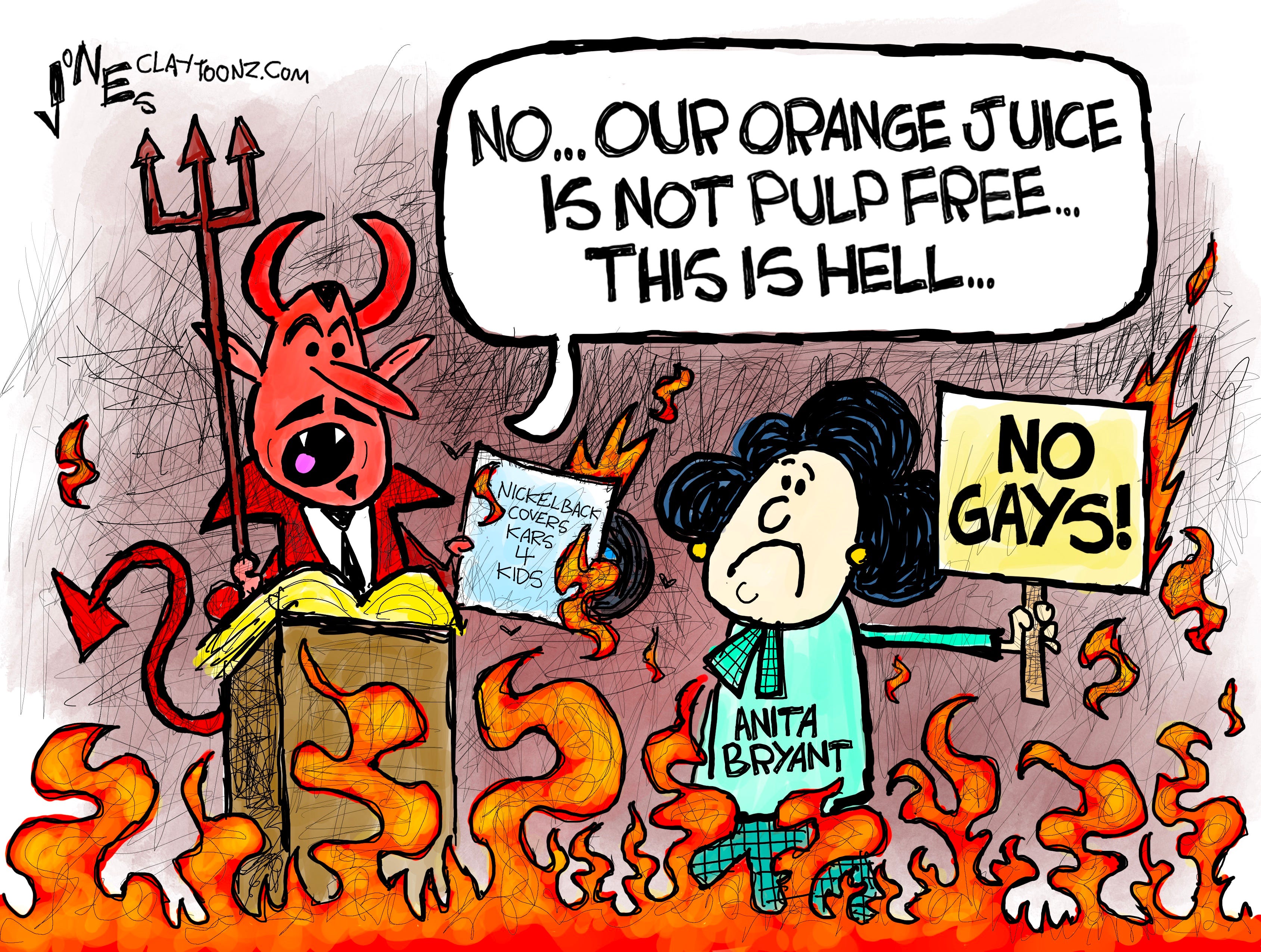
Anita Bryant was famous for being a singer and had several hits way back in the day. Then she was known for orange juice as she became a spokesperson for the Florida Citrus Commission. Finally, she was known for being a bigot.
Bryant conducted herself as a wholesome Christian years before she campaigned against gay rights. Among her endorsements and products was a cookbook with a Jesus theme. It’s just not breakfast without orange juice and Jesus. Bless this bacon.
In 1979, she tarnished her image and her endorsements started to evaporate. What happened?
Dade County, Florida passed an ordinance that prohibited discrimination on the basis of sexual orientation. This upset many bigots, one of them being Anita Bryant. Her fear was that LGBTQ people would be treated like human beings and the nation would stop discriminating and spitting on them. Bigots gotta spit. She led a highly publicized campaign against gay rights and gay people as part of a homophobic organization called Save Our Children. The organization later had to change its name as there was another group that had the name first, and who really wanted to save children and not just use them to push a homophobic agenda.
Bryant and her fellow homophobes feared gay meant pedophilia and LGBTQ people having equal rights would teach children to grow up and treat them like equal human beings. Bryant was against LGBTQ people working in schools and becoming role models. She believed gays were recruiting, which was true. Men all over the country were given free toasters in exchange for sleeping with other men, attending Broadway musicals, and being all-around fabulous.
Bryant said at the time, “What these people really want, hidden behind obscure legal phrases, is the legal right to propose to our children that theirs is an acceptable alternate way of life. I will lead such a crusade to stop it as this country has not seen before.”
During her anti-LGBTQ campaign, she said, “The recruitment of our children is absolutely necessary for the survival and growth of homosexuality… for since homosexuals cannot reproduce, they must recruit, must freshen their ranks.”
Here’s a fun fact: LGBTQ people are mostly born from straight parents.
She also said, probably while Jerry Falwell was standing beside her, “As a mother, I know that homosexuals cannot biologically reproduce children; therefore, they must recruit our children” and “If gays are granted rights, next we’ll have to give rights to prostitutes and to people who sleep with St. Bernards and to nail biters.” Nail biting is a sin? Was that the rejected 11th Commandment?
Also, the government needs to take my rights away because I used to sleep with a Beagle, and I’m not gonna lie. I miss sleeping with a Beagle.
Bryant was able to overturn the ordinance and continued her hate campaign throughout the nation. She galvanized America’s bigots but the LGBTQ community along with hetero friends conducted a campaign against Bryant and orange juice. Eventually, Bryant got pied. A civil rights supporter threw a banana cream pie right into Bryant’s face. Bryant responded with a homophobic slur, saying, “At least it was a fruit pie.”
I don’t know if I can condone or condemn the pieing as I’ve never had a banana cream pie.
Bryant said she loved homosexuals but hated their sins, which is bullshit.
Bryant eventually lost all her endorsements as she became toxic. Even other fundamentalist Christian organizations shunned her and stopped inviting her to their events. she stopped getting invites to singing events and even had a planned variety show canceled. Bryant eventually had to declare bankruptcy.
During the campaign against Bryant, bars stopped serving screwdrivers because of the orange juice and instead served Anita Bryant specials, which were made from vodka and apple juice which were hopefully served with a side of banana cream pie. Drag queens started impersonating Anita Bryant.
One of Bryant’s granddaughters came out and wasn’t sure about inviting her grandmother to her marriage to another woman. She should have invited her and not told her beforehand what was happening. That would have been fun.
Today, there are still bigots in government targeting the LGBTQ community and trying to suppress their rights. There are laws in places like Tennessee and Florida discriminating against drag shows. The should all be pied with banana cream pies.
I hope Anita Bryant, Ron DeSantis, that Duck Dynasty asshole, and every bigoted Republican likes pulp in their orange juice.
Thank you: To everyone who’s a subscriber, especially those who are PAID subscribers. You’re keeping me alive and free to focus on drawing cartoons, writing blogs, making videos, and creating my usual chaos for MAGAts. You rock! If you’re not a paid subscriber yet, please consider becoming one at $8 a month.
Music note: I listened to The Beatles’s Sgt. Pepper while coloring.
January 13, 1874 The depression of 1873-1877 left 3 million people unemployed. The depression began when railroad owner Jay Cooke was found to have issued millions of dollars of worthless stock. Investors panicked and banks closed. The unbalanced, overextended new economy collapsed. In the winter of 1873, 900 people starved to death, and 3,000 deserted their infants on doorsteps. A public meeting was called in New York City’s Tompkins Square Park to lobby for public works projects to provide jobs; the city’s unemployment rate was approaching 25% at the time. The Tompkins Park Massacre The night before, the City secretly voided the permit for the gathering. The next morning, mounted police charged into the crowd of 10,000, indiscriminately clubbing adults and children, leaving hundreds of casualties. Police commissioner Abram Duryee commented, “It was the most glorious sight I have ever seen . . . .” The Tompkins Square event was part of a wave of parades of the unemployed and bread riots across the nation. In Chicago, 20,000 people marched. Even under police attack, workers in New York, Omaha, and Cincinnati refused to disperse.
January 13, 1958 Linus Pauling presented the “Scientists’s Test Ban Petition” to the United Nations, signed by over 11,000 scientists (including 36 Nobel laureates) from 49 countries. It called for an end to nuclear weapons testing for its detrimental health, especially genetic, and ecological effects, among other reasons. In reaction to his efforts, Pauling was forced to resign as Chairman of the Division of Chemistry and Chemical Engineering at Caltech (California Institute of Technology) after having served in that role for 22 years. The petition Background – Linus Pauling & The Bomb
January 13, 1962 One hundred fifty members of the Scottish Committee of 100 (an anti-nuclear group) began a sit-down protest at the U.S. consulate in Glasgow, Scotland.
January 13, 1993 A vigil was held opposing the arrival of a ship bringing nearly two metric tons of plutonium for a pilot fuel reprocessing plant in Tokai, Japan. The specially constructed ship, the Akatsuki Maru, had carried it 25,000 km (15,500 miles) from Cherbourg, France. Akatsuki Maru The Voyage Of The Akatsuki Maru by Mario Uribe Many objected to the maritime transport of the highly radioactive material due to the risk of sinking, hijacking and the resultant risk of further nuclear proliferation. The original plan called for air transport over the United States. The Hottest Import To Hit Japan
January 12, 1954 Secretary of State John Foster Dulles announced U.S. would go beyond of President Harry Truman’s doctrine of “containing Communism” for a new policy: “. . . there is no local defense which alone will contain the mighty landpower of the Communist world. Local defenses must be reinforced by the further deterrent of massive [nuclear] retaliatory power.” More on Massive Retaliatory Action(We might check in on this in light of recent Republican rhetoric; some history need not be made nor repeated -A.)
January 12, 1957 The Southern Christian Leadership Conference (SCLC) was founded by Dr. Martin Luther King, Jr. and other African-American clergymen who wanted to press for civil rights long denied members of their community. Sixty black ministers from ten states went to Atlanta, Georgia, to set up the coordinating group. They elected King as its first president, with the Reverend Ralph David Abernathy as treasurer. SCLC history
January 12, 1962 Federal workers were guaranteed the the right to join unions and bargain collectively after President John F. Kennedy signed Executive Order 10988.“Employees of the Federal Government shall have, and shall be protected in the exercise of, the right, freely and without feel of penalty or reprisal, to form, join and assist any employee organization or to refrain from any such activity.” Eventually, regulation of labor-management relations in the federal government was codified under the Civil Service Reform Act of 1978. President Kennedy signing executive order
January 12, 1971 Reverend Philip F. Berrigan, founder of the Catholic Peace Fellowship anti-Vietnam War organization, was indicted along with five others on charges of conspiring to kidnap National Security Advisor Henry Kissinger, and to bomb the tunnels of federal buildings in Washington, D.C. They became known as the Harrisburg Seven. At the time, Berrigan was serving a six-year sentence at a federal prison in Connecticut with his brother, Daniel, for their destruction of military draft records in Maryland during 1967-68. The Berrigans’ ethic of nonviolence towards others made the charges questionable, and eventually all six were acquitted of the conspiracy charges. Phil Berrigan and Elisabeth McAllister, later his wife, were ultimately convicted and sentenced on just one count of smuggling mail out of a federal penitentiary, the only person in history to be prosecuted on such a charge. More about Philip Berrigan The Harrisburg Seven
January 12, 1971 “All in the Family” premiered on CBS-TV. The sitcom focused on the major social and political issues of the day such as racism, war, homosexuality and the role of women. In-depth background on the show
January 12, 1987 Twenty West German judges were arrested for blockading the U.S. Air Force base at Mutlangen, West Germany where Pershing II nuclear-armed cruise missiles were deployed. Judge Ulf Panzer stated: “Fifty years ago, during the time of Nazi fascism, we judges and prosecutors allegedly’did not know anything.’ By closing our eyes and ears, our hearts and minds, we became a docile instrument of suppression, and many judges committed cruel crimes under the cloak of the law. We have been guilty of complicity. Today we are on the way to becoming guilty again, to being abused again. By our passivity, but also by applying laws, we legitimize terror: nuclear terror.Today we do know…” More on “Judges and Prosecutors for Peace”
January 12, 2002 The “Refusenik” movement began when 53 Israeli soldiers signed an ad refusing to serve in the West Bank or Gaza Strip. Their letter concluded: • We shall not continue to fight beyond the 1967 borders in order to dominate, expel, starve and humiliate an entire people. • We hereby declare that we shall continue serving in the Israel Defense Forces in any mission that serves Israel’s defense. • The missions of occupation and oppression do not serve this purpose – and we shall take no part in them. [The term originally referred to Jews in the Soviet Union who had applied to emigrate but were delayed or refused by the Communist government, in one case for more than 22 years.] Video interview with Yonatan Shapira, refusenik and former captain in the Israeli Air Force
We live in a world where right-wing nationalism is on the rise and many governments, including the incoming Trump administration, are promising mass deportations. Trump in particular has discussed building camps as part of mass deportations. This question used to feel more hypothetical than it does today.
Faced with this reality, it’s worth asking: who would stand by you if this kind of authoritarianism took hold in your life?
You can break allyship down into several key areas of life:
Who in your personal life is an ally? (Your friends, acquaintances, and extended family.)
Who in your professional life is an ally? (People you work with, people in partner organizations, and your industry.)
Who in civic life is an ally? (Your representatives, government workers, individual members of law enforcement, healthcare workers, and so on.)
Which service providers are allies? (The people you depend on for goods and services — including stores, delivery services, and internet services.)
And in turn, can be broken down further:
Who will actively help you evade an authoritarian regime?
Who will refuse to collaborate with a regime’s demands?
These two things are different. There’s also a third option — non-collaboration but non-refusal — which I would argue does not constitute allyship at all. This might look like passively complying with authoritarian demands when legally compelled, without taking steps to resist or protect the vulnerable. While this might not seem overtly harmful, it leaves those at risk exposed. As Naomi Shulman points out, the most dangerous complicity often comes from those who quietly comply. Nice people made the best Nazis.
For the remainder of this post, I will focus on the roles of internet service vendors and protocol authors in shaping allyship and resisting authoritarianism.
For these groups, refusing to collaborate means that you’re not capitulating to active demands by an authoritarian regime, but you might not be actively considering how to help people who are vulnerable. The people who are actively helping, on the other hand, are actively considering how to prevent someone from being tracked, identified, and rounded up by a regime, and are putting preventative measures in place. (These might include implementing encryption at rest, minimizing data collection, and ensuring anonymity in user interactions.)
If we consider an employer, refusing to collaborate means that you won’t actively hand over someone’s details on request. Actively helping might mean aiding someone in hiding or escaping to another jurisdiction.
These questions of allyship apply not just to individuals and organizations, but also to the systems we design and the technologies we champion. Those of us who are involved in movements to liberate social software from centralized corporations need to consider our roles. Is decentralization enough? Should we be allies? What kind of allies?
This responsibility extends beyond individual actions to the frameworks we build and the partnerships we form within open ecosystems. While building an open protocol that makes all content public and allows indefinite tracking of user activity without consent may not amount to collusion, it is also far from allyship. Partnering with companies that collaborate with an authoritarian regime, for example by removing support for specific vulnerable communities and enabling the spread of hate speech, may also not constitute allyship. Even if it furthers your immediate stated technical and business goals to have that partner on board, it may undermine your stated social goals. Short-term compromises for technical or business gains may seem pragmatic but risk undermining the ethics that underpin open and decentralized systems.
Obviously, the point of an open protocol is that anyone can use it. But we should avoid enabling entities that collude with authoritarian regimes to become significant contributors to or influencers of open protocols and platforms. While open protocols can be used by anyone, we must distinguish between passive use and active collaboration. Enabling authoritarian-aligned entities to shape the direction or governance of these protocols undermines their potential for liberation.
In light of Mark Zuckerberg’s clear acquiescence to the incoming Trump administration (for example by rolling back DEI, allowing hate speech, and making a series of bizarre statements designed to placate Trump himself), I now believe Threads should not be allowed to be an active collaborator to open protocols unless it can attest that it will not collude, and that it will protect vulnerable groups using its platforms from harm. I also think Bluesky’s AT Protocol decision to make content and user blocks completely open and discoverable should be revisited. I also believe there should be an ethical bill of rights for users on open social media protocols that authors should sign, which includes the right to privacy, freedom from surveillance, safeguards against hate speech, and strong protections for vulnerable communities.
As builders, users, and advocates of open systems, we must demand transparency, accountability, and ethical commitments from all contributors to open protocols. Without these safeguards, we risk creating tools that enable oppression rather than resisting it. Allyship demands more than neutrality — it demands action.
Today the Department of Labor released the final jobs report of Joe Biden’s presidency. The nation added 256,000 new jobs in December, a number significantly higher than economists expected. That brings the total number of jobs created under Biden to 16.6 million and makes Biden’s the only administration in history to have created jobs every month. Under the Biden administration, the nation has also had the lowest average unemployment rate of any administration in 50 years, ending at 4.1%.
Dan Primack of Axios reported that the U.S. gained more jobs during Biden’s four years than it did under President Donald Trump, Barack Obama, or George W. Bush.
In a statement, Biden noted that when he took office, economic forecasts projected that it would take years for the country to recover fully from the effects of the coronavirus shutdown. In fact, the U.S. economy has grown faster and created more jobs than any other country with an advanced economy. Working-age women are now employed at record levels, and the gap in employment between Black Americans and their white counterparts is at the lowest level on record. The administration has brought the inflation of the early recovery back down almost to target levels, while incomes have increased about $4,000 more than prices. The administration, Biden said, has “achieved the soft landing that few thought was possible.”
CNBC economist Carl Quintanilla quoted Matt Peterson of Barron’s, who wrote: “It looks a lot like U.S. consumers are happy with the way things are…[a]nd so are the markets…. The only one who doesn’t seem to be happy with the way things are is Trump.”
Brian Platt of Bloomberg reports that Trump’s threats of tariffs against Canada already have Canadian officials drafting plans for retaliation. Canadian prime minister Justin Trudeau told CNN yesterday that Trump is talking about annexing Canada to divert attention from how significantly his tariff plans would raise consumer prices.
As Josh Marshall of Talking Points Memo noted late last year, MAGA was never an ideological movement so much as a vehicle to pull together different constituencies in order to get Trump elected president. Since members of those constituencies have little in common, that effort centers around creating a false world that demonizes Democrats and insists they have created a dangerous world that is biased against MAGA. The only one who can stand against them, the story goes, is Trump, who is being persecuted for his defense of his supporters. That narrative has helped MAGAs to find common ground in their defense of Trump and his cronies and their support for Trump’s vows to retaliate against those he considers his enemies.
That impulse appears to be stronger than ever after Judge Juan Merchan sentenced Trump today in the New York election interference case in which a jury found Trump guilty of 34 felonies for covering up payments to an adult film actress to keep her quiet about their sexual encounter before the 2016 presidential election. Merchan said that he could not impose a punishment without encroaching on the presidency, so in an unusually light sentence, he released Trump without restrictions. As legal analyst Joyce White Vance explained, Trump knew he would not get jail time or a fine, but wanted to avoid the sentencing itself because just a month after the sentencing, the designation of convicted felon will become permanent.
Although a unanimous jury convicted him, Trump insisted the trial was “a political witch hunt…done to damage my reputation so that I’d lose the election…. The fact is I’m totally innocent.” He seemed to think that ratings should override reality, telling the judge: “I got the largest number of votes by far by any Republican in history,” he said, “and won, as you know, all seven swing states—won conclusively all seven swing states.”
Trump’s version of the case appeared to be convincing to MAGA pundits and lawmakers, who echoed his calls for retribution. Trump’s lawyer Mike Davis warned: “Right now the Democrats think they’re the hunters. And guess what? On January 20th at noon, they’re going to become the hunted.” Representatives Marjorie Taylor Greene (R-GA), Nancy Mace (R-SC), and Ronnie Jackson (R-TX) all echoed Trump. “Trump will win in the end and America wins in 10 days when we get Trump back!!” Jackson posted on X.
MAGA supporters have embraced Trump’s attacks on Democrats and on the government, most notably with their fact-free attacks on the Biden administration’s handling of natural disasters—first the terrible flooding in North Carolina, when the right wing spread the lie that government officials were stealing people’s land, and now the terrible fires in Los Angeles that have been fueled in large part by the climate change that cut rainfall since last May and brought an unusually hot summer.
While local, state, and federal officials are doing their best to battle the Los Angeles fires in raging winds and dry conditions, Trump and his allies are lying to create the belief that the Democratic government is to blame for the fires. Trump lied that there is a shortage of water because Democratic governor Gavin Newsom refused to divert water to the area. Others claimed—falsely—that Democratic Mayor Karen Bass cut the budget for the Los Angeles Fire Department, when in fact a 7% increase in funding came through negotiations outside the budget.
They have blamed diversity, equity, and inclusion (DEI) efforts for the blazes because the Los Angeles Fire Department is headed by Kristin Crowley, an LGBT woman who came up through the ranks in the department over twenty years. And Trump sidekick Elon Musk agreed with conspiracy theorist Alex Jones that the fires are part of a “globalist plot” to trigger “total collapse” in the United States. “Gavin Newscum should resign. This is all his fault!!!” Trump posted.
In reality, firefighters are hard at work, with crews from both Canada and Mexico working along with Californians to suppress the fires.
Trump’s false version of reality has been a potent weapon against the Democrats, and he is promising to continue constructing that false reality: this week he has said he would replace the head of the National Archives and Records Administration (NARA), who is responsible for collecting the documents that establish the historical record of the actions of the national government. The archivist’s predecessor was the person who pursued the classified documents Trump took from the White House to Mar-a-Lago, and Trump told radio host Hugh Hewitt he would make sure that he had a loyalist in that position.
But it is an open question whether Trump’s false reality will be as convincing when he is back in the White House as it has been when he was sniping from outside. Trump has promised a number of conflicting things to the different constituencies in MAGA, and it is not clear that he can deliver them. And if he does, it’s not clear the American people will want what he is delivering.
Trump says he will nominate Robert F. Kennedy Jr. to head the Department of Health and Human Services; more than 18,000 physicians have signed a letter warning that he is “unqualified” and “actively dangerous” to the health of Americans. Trump’s plan to elevate him to a position that impacts Americans is “a slap in the face to every health care professional who has spent their lives working to protect patients from preventable illness and death.”
Trump has vowed mass deportations of undocumented immigrants and the reinstatement of Title 42 to close the border to migrants, but as Biden and others repeatedly pointed out when Trump complained about Biden’s ending it, Title 42 is part of a 1944 public health law that can be invoked only to stop disease from coming into the U.S. Once the government declared the coronavirus pandemic over, Title 42 had to go. Yesterday, Zolan Kanno-Youngs and Hamed Aleaziz of the New York Times reported that Trump’s advisors, led by Stephen Miller, are searching for a disease to invoke to reinstate Title 42. They have even considered invoking the old trope that immigrants might bring an unknown disease.
But, unlike non-emergency immigration law, Title 42 does not impose penalties for those who try to cross the border repeatedly, a reality Trump used to great effect against Biden as border encounters soared when people made multiple attempts. Now those numbers will be on Trump’s account if he uses Title 42 going forward.
In the meantime, the Biden administration today extended temporary protected status for about a million immigrants from El Salvador, Sudan, Ukraine, and Venezuela who meet certain criteria. Their protection will be extended for 18 months under a 1990 law that stops the deportation of immigrants to countries at war or suffering from natural disasters. The new protection does not cover immigrants from 13 other nations who currently have protected status.
Nick Miroff, Maria Sacchetti and Marianne LeVine of the Washington Post noted that when he was in office before, Trump tried to end protections for Salvadorans and others, saying they came from “sh*thole” countries, and that he is expected to let protections expire during his second term.
When he was running for office, Trump pledged he would end Russia’s invasion of Ukraine in 24 hours, a vow Russian president Vladimir Putin has dismissed. Yesterday, Trump told reporters that Putin wants to meet with him and that they are setting that meeting up; the Kremlin denied that statement was true and noted it would be more appropriate to meet after Trump takes office.
Today the Treasury Department under Biden imposed new sanctions on more than 180 vessels, many of them in Russia’s “shadow fleet” that carries oil, as well as on dozens of oil traders, oilfield service providers, insurance companies, and energy officials in an attempt to reduce the money Russia can realize from energy exports. The United Kingdom and Japan also imposed additional sanctions.
According to U.S. Ambassador to China R. Nicholas Burns, the Biden administration is also making a last effort to try to stop China from supplying Russia with equipment that it can use in its war against Ukraine. The U.S. is warning China that it is aligning “with the most unreliable agents of disorder in the international system.”
Trump may or may not be able to turn his promises into reality, but it is clear that some of his supporters’ plans will not go over well with the majority of Americans, especially as Trump fills his Cabinet with billionaires and spends his time next to the richest man in the world, who spent more than $250 million on Trump’s election.
Today, Ben Leonard, Meredith Lee Hill, and Kelsey Tamborrino reported in Politico that the Republicans on the House Budget Committee, chaired by Representative Jodey Arrington (R-TX), have made a list of more than $5 trillion in budget cuts they could make to fund Trump’s deportation plans as well as his tax cuts for the wealthy and corporations. Options include cuts to Medicaid, the Affordable Care Act (more commonly known as Obamacare), the Inflation Reduction Act’s investment in combating climate change, and the supplemental nutrition programs formerly known as food stamps.
For decades now, there has been enough wiggle room in our system to paper over the gulf between image and reality. That slack may continue.
But at least in some places, reality is catching up to the fake stories. During the 2016 presidential campaign, right-wing media spread the lie that leading Democrats were operating a child sex-trafficking wing out of Comet Ping Pong pizzeria in Washington, D.C. Those lies convinced a man to drive from North Carolina to the restaurant with an assault rifle to stop the crimes, only to discover the story was a hoax. He pleaded guilty to carrying a gun across state lines and assault with a deadly weapon and was sentenced to four years in prison. This week, two North Carolina police officers shot the same man after he pulled a gun on them during a traffic stop. He later died from his injuries.
Yesterday a New York State appeals court refused to dismiss the lawsuit brought by the electronic voting systems company Smartmatic against the parent company of the Fox News Channel for the lies that channel’s hosts told about Smartmatic rigging the 2020 presidential election. Smartmatic is suing for $2.7 billion.
And today the figure the “Pizzagate” conspiracy was designed to put into the highest office in the land, and that the Fox News Channel hosts’ lies were intended to keep there, officially became a convict.
January 11, 1952 The Peace Pledge Union organized “Operation Gandhi,” which became the first British protest against nuclear weapons. Ten members staged a “sit-down” at the War Office in London. =================================== January 11, 1998 Twenty-five thousand occupied the site of one of 30 dams to be built on the Narmada River in India. They objected to a World Bank-funded project to build 30 large, 135 medium and 3000 small dams to harness the waters of the Narmada and its tributaries to provide electrical power and irrigation to Gujarat and Rajasthan provinces.Local residents known as Narmada Bachao Andolan (Save the Narmada movement), organized as they became concerned about their livelihoods, the dams’ environmental impact and a host of other issues. The largest proposed dam, Sardar Sarovar, would submerge 61 villages and displace more than 320,000 people. A Brief Introduction to the Narmada Issue International Rivers project ===================================== January 11, 2002 The first of the detainees/enemy combatants arrived at Guantánamo Bay, the U.S. military base on the southeastern coast of Cuba. Detainees in a plane on their way to Guantanamo Detailed report of the status of Guantánamo detainees
Again Ethel is a woman I have been following since she was a teenager. She has gone through all the stages of transitioning, from doubt, trying to make it something else to finally admitting to herself and the world she is a woman and now living her life as one. The grand thing is she still fights so very hard for trans people despite the costs to her for taking on one of the growing popular atheist anti-trans people and others. She lost 2/3rd her income but never backed down, always telling the truth. She makes every video well researched and documents it, also she provides a transcript for those who would rather read than listen. I admit I admire her and her strength in her life struggles. But if you wish to learn more about those attacking trans stuff or the false idea that trans women are destroying female sports, I would watch her videos. Hugs
January 10, 1776 Thomas Paine Thomas Paine anonymously published his influential pamphlet, “Common Sense”. In it Paine questioned the fundamental legitimacy of the rule of kings, and advocated the doctrine of independence for Americans, and the rights of mankind. The entire text:
January 10, 1908 A prominent young Indian lawyer, Mohandas Gandhi, was jailed for the first time. He had refused to register as an Asian in Johannesburg, South Africa. He was released three weeks later. Gandhi, 1906 Gandhi and how his time in South Africa affected his life
January 10, 1917 The National Women’s Party began regular picketing of the White House, advocating the right to vote for women.
The first suffrage picket line leaving Congressional Union headquarters to march to the White House gates.
January 10, 1920 The League of Nations formally came into being when its Covenant (part of the Treaty of Versailles), ratified by 42 nations in 1919, took effect. In 1914, a political assassination in Sarajevo set off a chain of events that led to the outbreak of the most costly war ever fought to that date. As more and more young men were sent down into the trenches, influential voices in the United States and Britain began calling for the establishment of a permanent international body to promote international cooperation and to achieve international peace and security. Though strongly supported by President Woodrow Wilson (who served as Chairman of the Committee that developed the Covenant), the U.S. never joined.
January 10, 1930 In December 1928, Mohandas Gandhi attended a session of the Indian National Congress Party in Calcutta where it called for complete Indian independence from Great Britain. This was to be achieved through peaceful means, specifically complete noncooperation with the governmental apparatus of colonial British rule, known as the Raj. On this day, Gandhi drafted the declaration, which stated, in part: “The British government in India has not only deprived the Indian people of their freedom but has based itself on the exploitation of the masses, and has ruined India economically, politically, culturally and spiritually. . . . Therefore . . . India must sever the British connection and attain Purna Swaraj, or complete independence.”
January 10, 1940 Members of the Brethren, Mennonites and Friends religious groups sent a message to Presidend Franklin Roosevelt requesting alternative service in the event of war. Civilian Public Service workers Clark and Kriebel in the Duke University’s hospital sterilizer room. The Selective Training and Service Act of 1940 proclaimed that all persons who “by reason of religious training and belief were conscientiously opposed to all forms of military service, should, if conscripted for service, be assigned to work of national importance under civilian direction.” More on those who refused to serve in the “good war”
January 10, 1946 The first General Assembly of the United Nations convened at Westminster Central Hall in London, England, and included 51 nations.On January 24, the General Assembly adopted its first resolution, a measure calling for the peaceful uses of atomic energy and the elimination of atomic and other weapons of mass destruction.
January 10, 1966 Vernon Dahmer, a businessman and farmer in Hattiesburg, Mississippi, offered to pay the poll tax for those who couldn’t afford the fee that was then required before a citizen could vote (and which was made unconstitutional in federal elections by the 24th Amendment). Vernon Dahmer (foreground) former home of Vernon Dahmer Dahmer was known for saying, “If you don’t vote, you don’t count.” The night after a radio station broadcasted Dahmer’s offer, his home and store were firebombed. Dahmer died later from severe burns. The man responsible for the arson attack, Ku Klux Klan Wizard Sam Bowers, was not tried and convicted until 32 years later. The poll tax and other means of disenfranchising African Americans
January 10, 1971 The Peoples’ Peace Treaty between the citizens of the U.S. and Vietnam was endorsed by 130 organizations. Several million North Americans later signed it.
January 9, 1964 Anti-U.S. rioting broke out in the Panama Canal Zone, resulting in the deaths of 21 Panamanians and three U.S. soldiers. The immediate issue was whether both the U.S. and Panamanian flags would fly at Canal Zone facilities, as ordered by President John F. Kennedy. James Jenkins, a 17-year-old senior at Balboa High School in the Canal Zone: “I guess you could say I’m the guy that started this whole thing. I’m sort of the ringleader. I circulated the petition to keep our flag flying. Then me and the others raised the flag. The school authorities left it up because they knew we’d walk out.” On the third day, demonstrating Panamanian students entered the school grounds and sang their national anthem, but the Balboa students blocked them from raising their flag. there was a scuffle — and the Panamanians retreated in outrage, claiming that their flag had been ripped by the Zonians.
January 9, 1967 Julian Bond, elected more than a year before, was finally sworn in as a member of the Georgia House of Representatives.The legislature had refused to allow him to take his seat because of his opposition to the Vietnam War and specifically his endorsement of a Student Nonviolent Coordinating Committee (SNCC) statement accusing the United States of violating international law in Vietnam. Bond had been the director of SNCC. Following his election in 1965, the Georgia House refused to seat him. He was re-elected to his “vacant seat” and the House refused again. He was then elected to the same office for a third time. But not until the U.S. Supreme Court ruled unanimously in his favor was the legislature forced to relent. Julian Bond in 1966 waiting to be seated in the General Assembly
January 9, 1987 The White House released the presidential finding – signed by President Ronald Reagan on January 17, 1986 – which authorized the sale of arms to Iran (to encourage the release of hostages) and ordered the CIA not to tell Congress. This was done retroactively after several shipments, including 18 HAWK (Homing-All-the-Way-Killer) surface-to-air missiles, had already been transferred to the Iranians, then at war with Saddam Hussein’s Iraq. Read the actual document authorizing the arms sales More Outline, key players and selected Iran-Contra documents from the National Security Archive
January 9, 1991 Sam Day The day after the start of the U.S. bombing of Iraq, ten peace activists were arrested at Fort McCoy, Wisconsin, for handing out written warnings to military reservists about participation in war crimes. Long-time peace activist Sam Day was sentenced to four months for his participation. Remembering Sam Day
10th anniversary of the Charlie Hebdo killings by Ann Telnaes
On January 7, 2015 the editorial cartooning community suffered a horrible blow Read on Substack
The attack at the Paris offices of the satirical magazine Charlie Hebdo left 12 people dead, including five cartoonists, and set off a worldwide debate about free speech and satire.



 The first General Assembly of the United Nations convened at Westminster Central Hall in London, England, and included 51 nations. On January 24, the General Assembly adopted its first resolution, a measure calling for the peaceful uses of atomic energy and the elimination of atomic and other weapons of mass destruction.
 Vernon Dahmer (foreground)




