Again this shows that while the fundie Christians and republican right maga are trying hard to wipe out trans people to then start on the rest of the LGBTQ+, the voters do not support that. Voters support trans people! They keep showing it. The Democrats must come out in force to support the trans population to remain relevant. Look Harris was so very careful never to mention trans people, never voice support for DEI or the LGBTQ+ because they are afraid of the haters. But the DEI and LGBTQ+ supporters are far greater than the haters or fundamentalist Christian theocracies. Hugs
In a major victory for Democrats, first-time candidate Derek Tran defeated Republican Rep. Michelle Steel in a hotly contested Orange County congressional race that became one of the most expensive in the country.
Tran will be the first Vietnamese American to represent a district that is home to Little Saigon and the largest population of people of Vietnamese descent outside of Vietnam.
The race was the third-to-last to be called in the country. As Orange County and Los Angeles County counted mail ballots, Steel’s margin of victory shrank to 58 votes before Tran took the lead 11 days after the election. Tran was leading by 613 votes when Steel conceded Wednesday.
November 19, 1915 Joe Hill, a labor organizer for the Industrial Workers of the World (IWW) was assassinated by firing squad in the courtyard of the Utah State Penitentiary in Salt Lake City. The IWW, or Wobblies as they were known, were advocates of organizing all workers into One Big Union. It is reported that Joe had been framed for murder by copper bosses, the press and government forces. Just prior to his execution, as Joe stood before the firing squad he propelled himself him from organizer to labor martyrdom with these words: “Don’t waste any time in mourning. Organize!“ Joe Hill: The Man Who Didn’t Die, and more The IWW today
November 19, 1969 In an effort to undercut growing opposition to a draft made necessary by the Vietnam War, Congress passed a law requiring random selection of draftees through a lottery. The Selective Service System would call up young men based upon their birthday, first with 19-year-olds and those with expired college deferments.
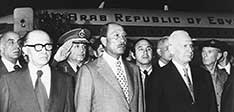
November 19, 1977 Sadat arrives in Israel In an unprecedented move for an Arab leader, Egyptian President Anwar el-Sadat traveled to Israel to seek a permanent peace settlaement with Egypt’s neighbor after decades of conflict. This action was extremely unpopular in the Arab World and especially among Muslim fundamentalists. Egypt and Israel had fought four wars since 1948.
Sadat on November 9: “ Israel would be astonished when they hear me say this. But I say it. I am ready to go even to their home … to the Knesset and discuss peace with them if need be.” Israeli Prime Minister Menachem Begin on November 11: “ Let us say to one another, and let it be a silent oath by the peoples of Egypt and Israel: no more wars, no more bloodshed and no more threats.” Together in Israel: Sadat: “ I wish to tell you today and I proclaim to the whole world: We accept to live with you in a lasting and just peace.” Begin: “ Everything must be negotiated and can be negotiated. We Jews appreciate courage, and we will know how to appreciate our visitor’s courage.” Sadat’s speech to the Israeli Knesset (parliament):
While the new President and new Congress will not take office until early next year, they have already put forward an agenda — through Project 2025, Republican budget plans, and campaign proposals — that would increase poverty and diminish opportunity. Their proposals would raise costs for basics like housing, food, and health care and take health coverage away from people; slash funding for schools where our children learn, roads and bridges we use to get to work, and scientific and medical research that improve our health and strengthen our economy; double down on tax giveaways for wealthy households and corporations while imposing tariffs that fuel inflation; and further widen already glaring differences in people’s well-being and opportunity across income, race, and ethnicity.
These policymakers campaigned on promises to make the economy work better for people without big bank accounts who are trying to get ahead. But their proposals to date seldom match those promises.
Instead, a policy agenda designed to advance economic opportunity and racial justice and help families make ends meet would:
Make it easier for people to afford housing, food, health care, and prescription drugs.
Support children and families with an expanded Child Tax Credit, especially for children who don’t get the full credit today because their families’ incomes are too low; more affordable child care; and investment in our schools so that all of our nation’s children get what they need to thrive.
Invest in the things that will keep the economy strong and growing, including basic building blocks like roads, bridges, and research, as well as protections that keep our communities’ food, air, water, and workplaces safe.
Support these investments with a fairer federal tax system that requires wealthy households and corporations to pay their fair share and strengthens our fiscal outlook.
Create an immigration system that recognizes the critical role that immigrants and their families play in our communities and the economy, eschewing harsh deportation regimes that separate families and embracing reforms that provide people with a workable opportunity to gain legal status and a pathway to citizenship.
This kind of policy agenda would build toward a nation whereeveryone — regardless of their income or their background — can get the health care they need, afford to put groceries on the table, live in safe homes and strong communities, and have the income, education, and child and home care they need throughout their lives. And it would reflect the truth that our nation succeeds only when all of us succeed.
We are eager to work with policymakers who put forward policies that advance this agenda and we — together with our partners — will work hard against policies that make people less economically secure, less healthy, and have less access to opportunity.
On Monday, Maryland Gov. Wes Moore honored one of his state’s most beloved military veterans, Harriet Tubman, by promoting Tubman posthumously to the rank of brigadier general in the state National Guard. Why yes, that’s General Harriet Tubman, who in addition to being a famous abolitionist and “conductor” on the Underground Railroad was also the first woman to lead a US military operation during wartime.
Tubman’s history of military service doesn’t get the same attention as her activities as an abolitionist and helper of those who freed themselves from enslavement, which was already plenty enough to make her a hero. But after her final expedition to guide escapees from slavery North, she put her skills of disguise, concealment, and familiarity with Southern territory to use for the US Army when the Civil War broke out in 1861, serving as a spy, scout, and eventually, as the joint leader of an 1863 Army raid on plantations in South Carolina, which freed nearly 800 enslaved people and burned several of the plantations.
Here’s a cool thing: A 2022 CIA website article acknowledges that well before she formally became a military operative, her work for the Underground Railroad “applied sophisticated tradecraft including the use of disguises, clandestine communication, and assets and allies, who provided safe houses, transportation, and funding” — genuine praise for an intelligence operative.
Tubman was recruited for the Union cause by Massachusetts Governor John Andrew and sent to Hilton Head, South Carolina, where she was assigned to work under Major General David Hunter, the head of Union operations there and in Georgia and Florida. As the CIA explains, she was trained as a nurse, and worked as one, but that also gave her the documents and funding necessary for her secret work, recruiting a spy ring of Black volunteers in the area, who gathered intelligence on plantations, commerce, Confederate troop positions, and the locations of “torpedoes” — barrels of gunpowder in rivers that could blow up any Union boats. Tubman was unable to read or write, but had an outstanding memory, making her a valuable spy without leaving any notes behind, encrypted or otherwise.
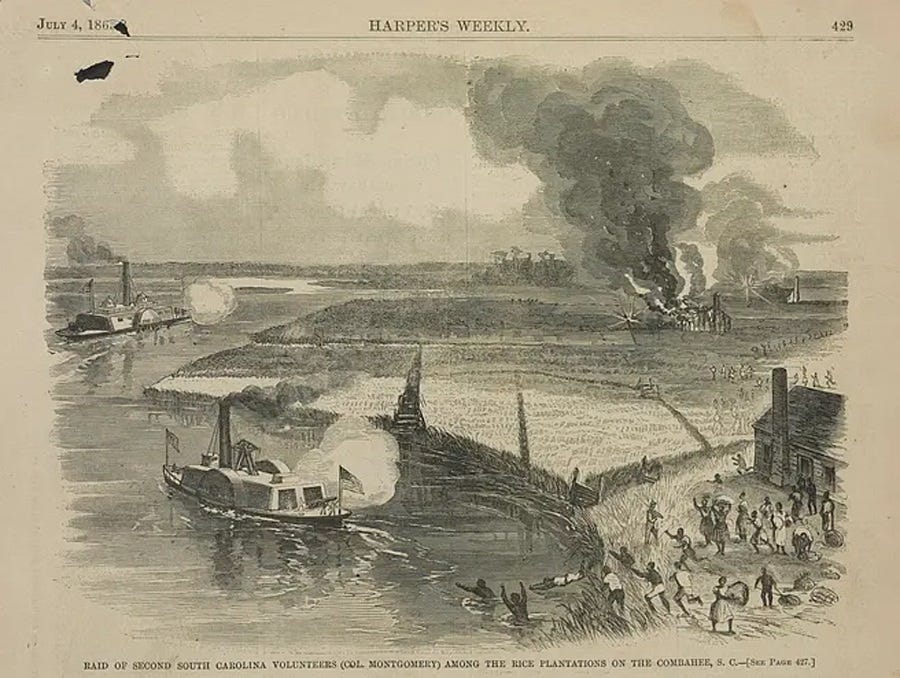
In 1863, Tubman moved from spying and reconnaissance to actually commanding Union troops in a raid on plantations along the Combahee River in South Carolina’s “Lowcountry” region. Although she was not a commissioned officer, she planned and shared leadership duties with Col. James Montgomery, an abolitionist in charge of a Black Army regiment, the Second Carolina Volunteers. The goal of the raid was to rescue enslaved people, recruit the freed men to join the Union Army if they were willing, and to wipe out the rice plantations in the area.
Montgomery commanded about 300 men, and to prepare for the raid, Tubman was in charge of a group of eight scouts who made maps of the area and helped her get news of the coming raid to enslaved people so they could be ready to run for the Union gunboats from which the attack would be launched.
“She was fearless and she was courageous,” said Kate Clifford Larson, historian and author of Bound for the Promised Land: Harriet Tubman, Portrait of an American Hero. “She had a sensibility. She could get Black people to trust her and the Union officers knew that they were not trusted by the local people.”
On the night of June 1, 1863, Tubman, Montgomery, and the troops boarded three Union gunboats to head up the river; on the way, however, one of the steamboats ran aground and the troops had to transfer to the remaining vessels. Tubman’s reconnaissance of the area proved invaluable in avoiding torpedoes in the river, and for guiding the ships close to shore, where they launched smaller boats full of raiders to attack the plantations.
Just before the raid got underway, the gunboats broke formation and headed to different parts of the river, with Montgomery commanding one, the Harriet A. Weed, and Tubman leading the 150 soldiers on the John Adams. Just want to underline this: Tubman wasn’t serving as an adjunct to Montgomery, she was in charge of half the attacking force. In the wee hours of June 2, they attacked their assigned plantations.
Tubman later recalled that when the signal to attack was given, she saw enslaved people running to escape toward the Union boats at the riverside, with women carrying their babies and children and whatever supplies they could take along, including chickens, pigs, and pots of rice. The enslavers tried to chase them down, firing guns on them, reportedly killing one girl. We’ll hand off the narrative here to History.com, and add that we’d watch this movie:
As the escapees ran to the shore, Black troops in rowboats transported them to the ships, but chaos ensued in the process. Tubman, who didn’t speak the region’s Gullah dialect, reportedly went on deck and sang a popular song from the abolitionist movement that calmed the group down.
More than 700 escaped slavery and made it onto the gunboats. Troops also disembarked near Field’s Point, torching plantations, fields, mills, warehouses and mansions, causing a humiliating defeat for the Confederacy, including the loss of a pontoon bridge shot to pieces by the gunboats.
After the raiding gunboats docked in Beaufort, South Carolina, the first press report of the raid didn’t name Tubman, but it did say that the raid was led by a “She-Moses” under the command of Montgomery, and that the raid came off without a single injury to the Union forces. A later report in a Boston newspaper named Tubman as the hero; the editor was a friend of hers. At least 100 men freed during the raid joined the US Army.
Illustration via Library of Congress.
For all the news the story made at the time, Tubman didn’t get paid, and even after the war her petitions to receive a soldier’s pay for the raid were turned down, because women simply weren’t allowed in the Army, you silly goose. She later received a military pension on behalf of her late husband, a Union soldier, but not for herself. But when she died in 1913, she was buried with military honors; the US Army’s Military Intelligence Corps also inducted Tubman into its Hall of Fame in 2021.
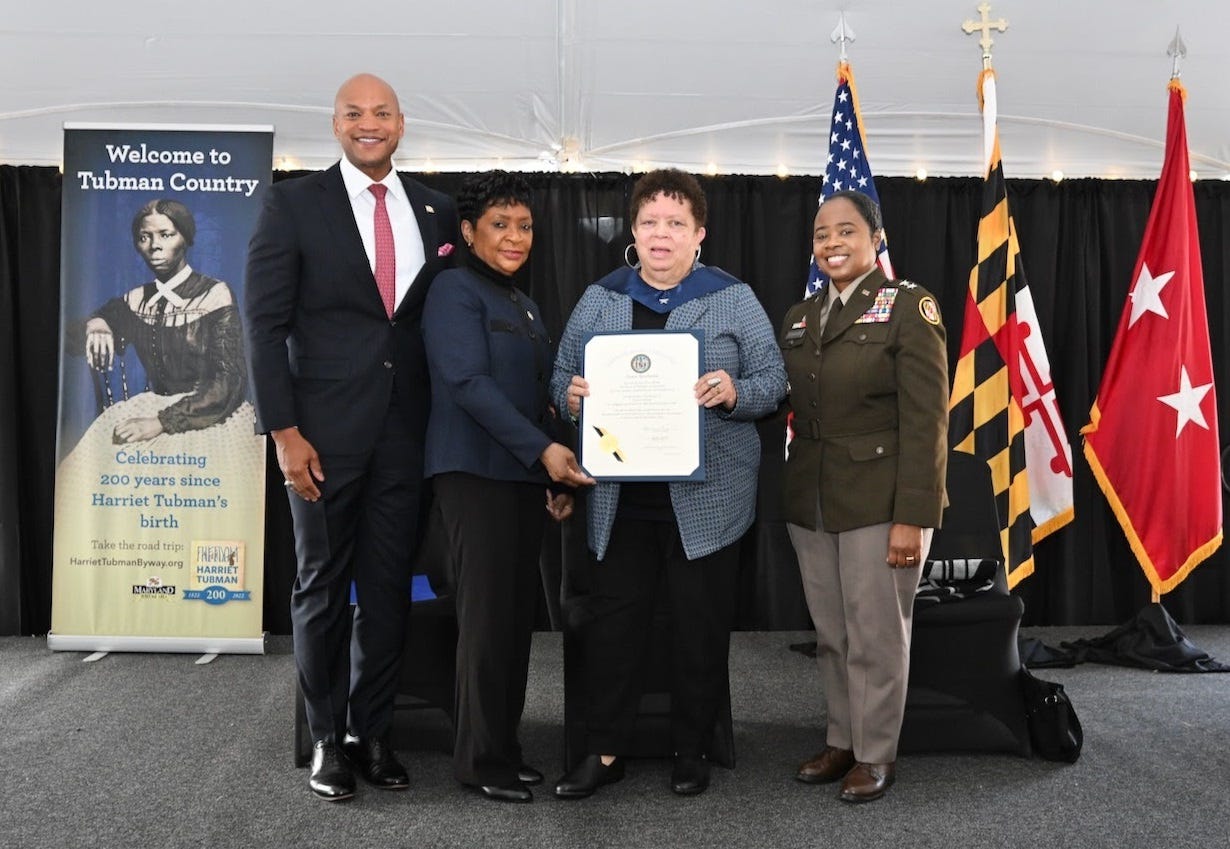
Prior to the war, in 1858, abolitionist and eventual insurrectionist John Brown met Tubman and nicknamed her “General” for her courage. That was made official by Gov. Moore’s Veteran’s Day proclamation Monday, naming her a one-star general in the Maryland National Guard.
After Moore read the official order promoting Tubman, he presented the proclamation to Ernestine “Tina” Martin Wyatt, Tubman’s great-great-great-grandniece, as a representative of Tubman’s family.
Thank you again for your service, General Tubman. Now if we can just get you on the $20 bill to replace that racist fuck-knuckle Andrew Jackson. (Snip)
Sen. Bernie Sanders (I-Vt.) joins Meet the Press to discuss his criticism of the Democratic Party and what’s next for Democrats after Kamala Harris’ projected loss.



 Scottie's Playtime