Enjoy some time on your Wednesday!
Josh Day Next Day
Enjoy some time on your Wednesday!

Enjoy some time on your Wednesday!
I’m copy-pasting it from my email.
Amazing news! We were in the middle of of a zoom press conference about the Gas Suffocation aspect of the planned execution of Sonny Burton in Alabama on Thursday when a reporter put into the chat:
And with that, the news was broken. Governor Ivey heard YOUR messages, received YOUR petitions, read the articles YOU sent, heard YOU ringing her phone off the hook, heard us tolling our bell outside her house…. and she acted. Amen! THANK YOU!
 Congratulations to Sonny and his legal team, his family, and to all who had a hand in creating this moment!
Governor Ivey has declared that “All Life is Precious,” which is why we made sure to bring along our 4×10 foot banner to the 24-hour vigil we helped coordinate in front of her house a few weeks ago. The banner could not be missed from any street-facing window of the Governor’s mansion. We know with certainty that the Governor was there…. NOW we know that she heard our message!
The other good news is that now we don’t have to drive all the way to Alabama. In fact, we had planned to go to Texas fiirst to toll the bell outside the prison in Huntsville at the execution of Cedrick Ricks on Wednesday, which is still on. Without our planned return through Alabama, making such a long drive makes less sense.
As you know, everything we do to support local activists working to halt executions is another expense. It’s not just the costs of being on the road that we must cover, but also the overhead…
Thank you. Yours in the Struggle,
–abe
PS: New execution dates are being set regularly. Click here to oppose every upcoming execution.
Hi every wonderful person who comes here. If you read my last post you might have noticed that Ron and I talk over what to cook for supper. Tonight we were going to eat up the few left overs and we got talking of what I wanted to cook tomorrow. I was planning to get the fryer out and then do french fries and deep fried chicken patties. Ron had already bought a bunch of cheese slices because he was thinking of me making another red tomato sauce to have chicken parmesan with spaghetti. But I suggested today doing the french fries and chicken patties with putting cheese on them while they were hot out of the fryer, and that way I wouldn’t have to make another red sauce, but we could have the thing Ron suggested later. He thought about it and he loves the idea. So I am off to cook supper. Making both my husband and me happy. Does this make me a traditional wife or just a happy partner in a same sex relationship? I don’t care really either way. It makes Ron really happy and he makes me really happy. Isn’t that what it is to be about? Hugs
Hi everyone. I really am so grateful for all of you and the support that you give me and others here. After I posted about the trigger event I think an important part got missed and today with all going on my wonderful husband offered to help me finish the dishes I was doing even though I knew he wanted to get on to other things. So I want to share this post with all of you.
I am happier than I can remember being in a long time.
For starters the triggering event was because Ron my husband who struggles to have the sexual desire I do was offering happily for us to … well have sex. But he was so wonderful with the way he handled it and when he got back up and made sure I was OK, he offered again. I said later.
Ron got home on the evening of the 2nd of March. Since then he has watched carefully to make sure I was not harming myself by taking on too much, instead softly forcing me to rest as he took over. On the personal side he has made it a daily routine and returned to the old normal of touching each other during the day and giving kisses and hugs. If he sees me struggling he intervenes right away.
But it goes both ways. Ron loves my cooking and with him home I have really been doing my best and in fact loving it. It gets to hurt so bad sitting in my desk chair and when we talk about what’s for supper and I provide a suggestion he asks if I would like to do it and I really want to. He does the chopping of vegetables and meats and I do the cooking / seasoning and set up the serving area.
Remember how I grew up. When I went out on my own I had no cooking skill at all. When Ron moved into my home I had eggs and hot dogs in the refrigerator. I simply had no clue how to make food. Ron first made food I fell in love with and started teaching me seasonings. I took to it like a fish to water and now he lets me take the lead on joint meal projects. And that is what the meals are, we work together on the idea and what we would like the outcome to be. He does any chopping because my eye sight is so bad and I have cut my self so badly at times. But then he lets me do my thing and comes to taste or add suggestions as I ask. He always does the cleanup as he understands how tired I am by then.
But it is more than meals. At night I struggle to sleep, and Tupac presses as hard to me as he can most of the time. Ron will reach out and touch me on the shoulder, arm, or back just to let me know he is there. If he knows or thinks I am struggling he will talk to me. If he knows I am awake he will ask if we can cuddle some more. I so love that but the issue there is Tupac. During the three months Ron was gone Tupac got very attached to me. He sleeps as close to me as he can get often laying his head on my folded arm. Ron says as long as I am able to sleep like that Tupac will stay asleep right there. If I shift he will move lower towards my belly and again push against me. If he doesn’t have paws touching me or himself he will lie with his head pointed at me and looking either up or down and his tail to Ron.
The few times I have moved him and set his stuff up so he was on the other side of us so Ron and I could cuddle he got very upset. So now I only do it if I have responded to his middle of the night need for food and while he is gone change the places of his sleep towels and blanket. He still doesn’t like it. The first night we did it in the morning Ron went to pet him and Tupac swatted at him.
I am sorry this is rambling, I guess I did not do a good job ordering my thoughts. I am just so happy which is an emotion I so rarely get to enjoy I wanted to share it all with everyone. Things seem so good, clear, wonderful, and grand, and Ron and I are more in tune with each other than we have been in a long time. They say absence makes the heart grow fonder. I don’t know, but the way he looks at me, the way his arms encircle me, and the way he gives me quick kisses are like it was half a decade ago and so wonderful. My body responds to him like in the old days and he enjoys it. That is new and I love it.
As for the bad events / the vortex. It has not been as bad since Ron has been home. I have had minor ones and have retreated to my “pink palace office” to cry quietly and try to deal. But the horrid nightmares reliving the events of my past have not happened since he came home. I have not needed to desperately cry out for help or in pain as I relive the things done to me. I know they will, but I also know he will be there. Listening and ready to help me face the demons and hurts that I will never totally make go away. I have noticed he is careful to not overload me mentally, emotionally, or physically. He will often tell me it is time for a break or that he would like to take over, or his favorite trick… I need a break do you mind if we rest for a while? I know he is doing it for me. But it still is grand. OK I don’t have a real ending here other than he just came into the office as I was writing this , leaned over me and gave me a kiss. I asked if he needed help with anything and his reply was not yet, I will let you know when. Maybe just possibly what they say about love is true, it can heal the wounds if you let it. Just know that now I am so very happy an emotion I have not felt in a long time. Hugs
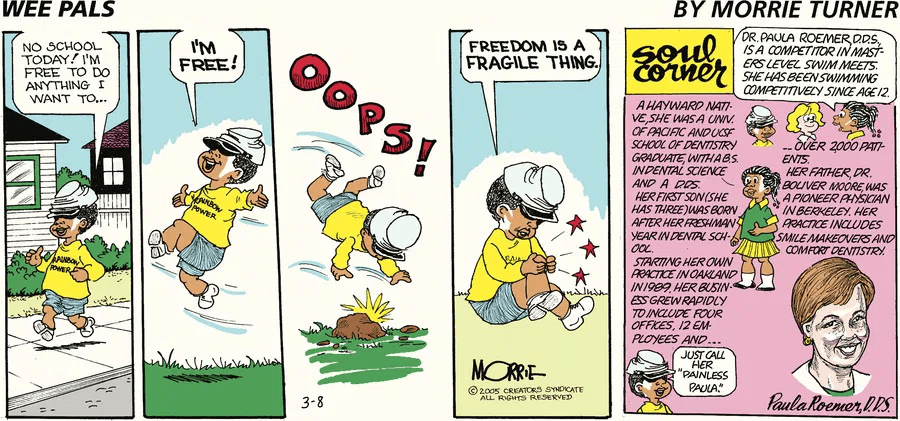
a Monday entry that isn’t toooo historical, but is a nice tidbit. Enjoy the comic; the Women’s History bit is in the Soul Corner: “Painless Paula.”
Also Known As: Tucanete Esmeralda (Spanish), Tucancillo Verde (Spanish)

Aptly named for its striking green plumage, the Northern Emerald-Toucanet is actually quite camouflaged in the leafy forests where it makes its home. With its tropical take on countershading — darker green on the back and wings, lighter yellow-green below — this bird beautifully matches the color palette of forest leaves, whether seen from above or from below. With its accents of chestnut, blue, and white, and a large black and yellow bill, this pigeon-sized bird is a true beauty.
Similar to other toucans, Northern Emerald-Toucanets eat mostly fruit, capitalizing on the wide diversity of fruit-bearing trees in the humid forests of their home in Central America. These birds mostly swallow their food whole, including some larger-seeded fruits, which they repeatedly regurgitate and swallow until the flesh is consumed. Whether by regurgitation or defecation, these birds spread the seeds of their food trees throughout the forest. Many tropical trees have evolved to bear fruit specifically for this purpose, taking advantage of birds’ wings to spread their seeds far and wide. In fact, the process of moving through the digestive tract of an animal actually helps the seeds of many of these trees to germinate. In effect, these toucanets, along with a cohort of other fruit-eating birds and mammals, are gardeners of their own food forests. (snip)
The Northern Emerald-Toucanet is indeed a beautiful, vibrant green, top and bottom, with the back a deeper, darker hue and the underparts lighter and slightly yellowish. The long tail is iridescent blue and green, with a rusty or chestnut tip matched by the vent feathers beneath the tail. The eight subspecies across its geographic range vary in the coloration of the throat, either blue or white, and the bill. In all subspecies, the lower mandible is black. The upper mandible has some black as well, but may be almost entirely yellow. Some subspecies also have a reddish to brown patch near the nostrils.

A safe baby, and record Girl Scout cookies sales for trans Scouts! I remember seeing the story about the young man saving the baby last week on local TV news (through a national network affiliate.) No mention of anything but his heroism and his humility about doing what anyone else would have done.

A Chicago comedian is speaking out about a daring rescue that left him in the freezing waters of Lake Michigan, and saving an infant from drowning.
Six days before his February 24 birthday, on a bright winter afternoon along Chicago’s Lake Michigan waterfront, Lio Cundiff had a thought that now reads like a setup to a joke. “I was on the phone with my friend, looking at the water, and I was like, ‘Man, that looks so beautiful. I just want to jump in,’” he told The Advocate in an interview on Friday. Little did he know.
Cundiff, 31, had arrived early for work on February 18 near Belmont Harbor and wandered down to the water, as he often does. He loves the lake. He loves floating in it in the summer — ideally, he says, “with a beer.” He had been taking phone calls, sitting on a bench, “vibing,” he said.
Then he heard screaming. “I just look up, and I’m like, ‘Oh my God.’ I just saw a stroller headed straight to the lake, just blown by the wind,” he recalled.
In that instant, the punchline vanished. There was no bit to craft, no self-deprecating aside about his baby face or his anxiety about sending emails, both staples of his stand-up. There was only motion. He threw down his jacket and phone and ran.
“I was like, ‘I guess I’m going in.’ And I jumped in and just tried to keep us afloat as much as possible,” he said.
Early media reports suggested that Cundiff did not know how to swim. He bristles at that characterization. “I can swim,” he said, explaining that in the hospital he told a reporter he wasn’t the strongest swimmer and preferred “to float with a beer in my hand.” “They ran with, ‘I can’t swim,’” he said.
“I can swim. I just prefer not to,” he said through a chuckle.
The baby, eight months old, was zipped inside the stroller. Cundiff had to keep the entire frame buoyant while treading freezing cold water. At one point, both of their heads went under. He describes the memory in fragments, as though replaying a film whose ending he already knows but still cannot quite believe.
“There were a few minutes where I didn’t know if we were going to be able to keep afloat,” he said. “I grabbed her hand for a second. Her tiny little fingers. I rubbed them for two seconds, and I was like, ‘Okay.’ … ‘All right, we got to keep going.’”
A bystander named Lou dropped a jacket; later, a life buoy arrived. They were about thirty feet from a ladder. Cundiff’s muscles were tightening. When they finally reached it, and the baby began to cry, he felt something like release.
“As long as she’s crying, when she gets out, that’s all I needed,” he said. (snip-MORE on the page)
Erin Reed Mar 05, 2026
Five years ago, as anti-trans legislation first began spreading across the United States, I kept thinking about the kids caught in the middle of it—transgender children suddenly facing a wave of hostility simply for existing. That year, I started something small in response: a trans Girl Scout cookie list. Only three scouts were on it. The internet responded immediately, helping them sell out their entire quota. Every year since, I’ve made the list again, and every year it has grown larger. Now, in 2026, the list has reached a staggering scale: 220 transgender Girl Scouts participating—and together they have already sold more than 330,000 boxes of cookies, with the number still climbing every minute.
One scout hoping to fund a troop trip to Alaska—and assemble backpacks for foster children—has sold 2,500 boxes of cookies, bringing those plane tickets within reach. Another scout, a competitive soccer player, was raising money so her troop could attend scouting camp without worrying about the cost; she has now sold 4,500 boxes, ensuring that trip is covered. One troop made up of transgender Girl Scouts set their sights on learning horseback riding and attending summer camp together—and sold 22,000 boxes to make it happen. And Pim, who simply wanted to go to Niagara Falls and to take her troop camping, has sold more cookies than the website can even track: more than 100,000 boxes.
And while we can’t know exactly how many of those sales came directly from our yearly list, we do know that these trans Girl Scouts have taken the internet by storm. Posts about them have racked up millions of impressions on Facebook and gone repeatedly viral on Bluesky. In the process, countless people looking for their next box of cookies discovered a cause worth supporting—and a group of scouts they were excited to cheer on.
The news about their staggering success comes during a broader regression around scouting organizations with respect to transgender people. In December, the United Kingdom’s Girlguiding—the British equivalent of the Girl Scouts—banned transgender girls from joining, reversing a policy that had been in place since 2018. In the United States, Defense Secretary Pete Hegseth forced Scouting America to agree to classify members by sex assigned at birth, eliminate diversity initiatives, and effectively out and segregate transgender scouts from their peers. Girl Scouts of the USA, however, has yet to see the same regression—the organization still stands by its transgender inclusion policy.
For these kids, that transgender inclusion policy has given them hope. At a time when thousands of anti-LGBTQ+ bills are being proposed and passed across the country, the cookie list is proof that people out there care. When every force in the world is acting against them, for once, their identity is not treated as a curse by society, but a blessing. Parents have told me that their children have been overwhelmed with joy watching the numbers climb, realizing that strangers across the country support them. And that’s worth protecting. (snip-MORE on the page)
This one’s a couple of months old, but good for Women’s History Month.
Painter William Merritt Chase opened an art school for a new generation of women, teaching them how to draw as well as how to advocate for themselves.
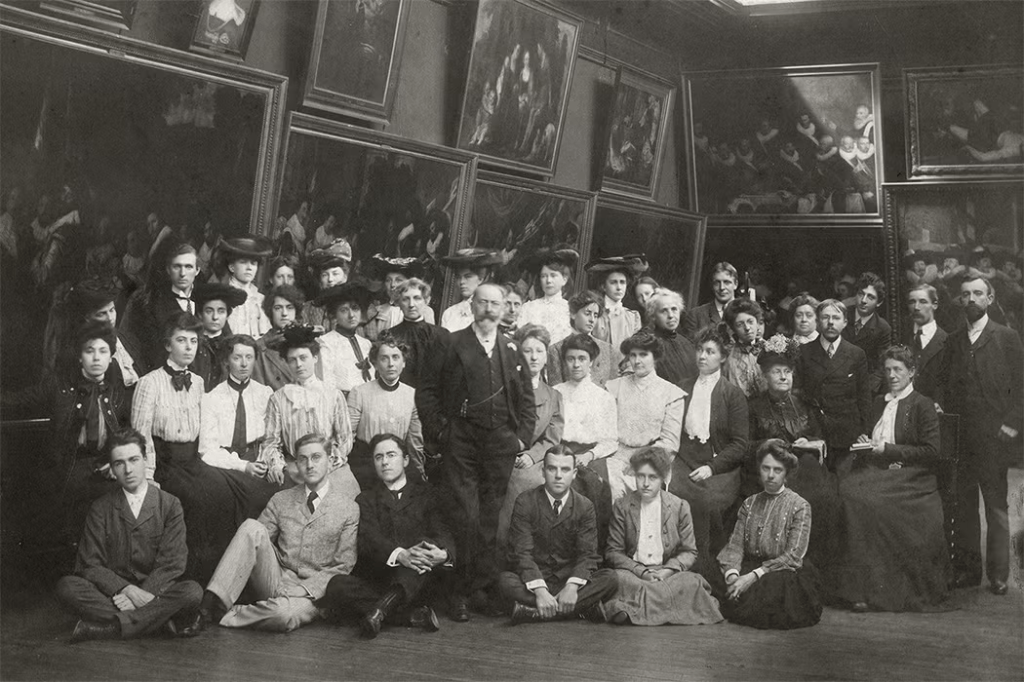
William Merritt Chase with Parsons School of Design students via Wikimedia Commons
The story of the establishment of the Chase School of Art, forerunner of the Parsons School of Design in New York, offers an unlikely object lesson in what happens when you seek to realize your creative aspirations in an era of political and cultural upheaval. In 1896, the Impressionist painter William Merritt Chase was ready to declare independence from the rigid hierarchies of the New York art scene and its dependence on European masters and methods. He dreamed of establishing what he considered an explicitly American school of art, one that encouraged artists to embrace and portray the unique character and energy of the young nation and its people, and he needed money. To get it, he founded an experimental new school for painting in Manhattan that would, ironically, thrive on the burgeoning hopes of women in an era of their growing liberty and opportunity.
Best remembered for society portraits, plein air paintings, pastel seascapes, dead fish still lifes, and depictions of dancing white clouds, Chase suddenly found himself in an unfamiliar role: he was, if not quite an equal rights leader, then an ambitious artist who, in pursuing his own interests, opened avenues for women artists and played a part in establishing a new era of American art beyond his own envisioning.
As June L. Ness writes in Archives of the American Art Journal, Chase stood among the most influential artists and art teachers in the country at the turn of the twentieth century. He was on the faculty at the Art Students League, the Brooklyn Art Association, and the Pennsylvania Academy of the Fine Arts; he instructed a cadre of private students in his home studios and abroad; he lectured in Connecticut, Chicago, and elsewhere; and he oversaw a summer art school outside the Long Island town of Southampton.
A man of his times, Chase and his wife, Alice Gerson, an amateur photographer, ran at the limits of their finances. In 1896, as parents to four children, they faced a turning point. Chase wanted to quit teaching altogether and devote himself to painting. Yet the couple also wanted to maintain luxury residences in both the city and the country while traveling extensively but lacked the resources to sustain such a lifestyle. (snip-MORE, plus art!)
==========
Cadged these snippets from my Naked Pastor email:
| So when someone says, “You’re okay,” it can feel naive. Or rebellious. Or even offensive. But what if it’s neither naive nor rebellious? What if it’s simply true? Cartoon: You’re not broken  Dad Joke: I’m confused  Quote: The illusion  Original: My Strength That Is Within Me  Merch of the Week: Jesus Eraser Sticker  |
Cartoon of the Week
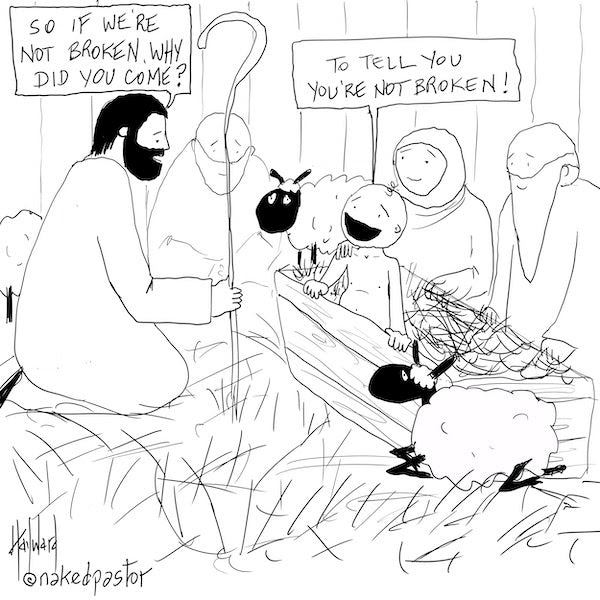
I mean it.
Dad Joke
I keep saying “It is what it is,” but what even is it???
Quote
I recently saw a clip from a Leonard Cohen interview. She asked him about him spending time with Roshi in a Zen monastery. He said it was like a hospital, and Roshi was the doctor. The interviewer asked what he cured him from. Cohen replied, “The illusion that you are sick. He cured me of the illusion that I needed his teachings.”
You’re Okay!
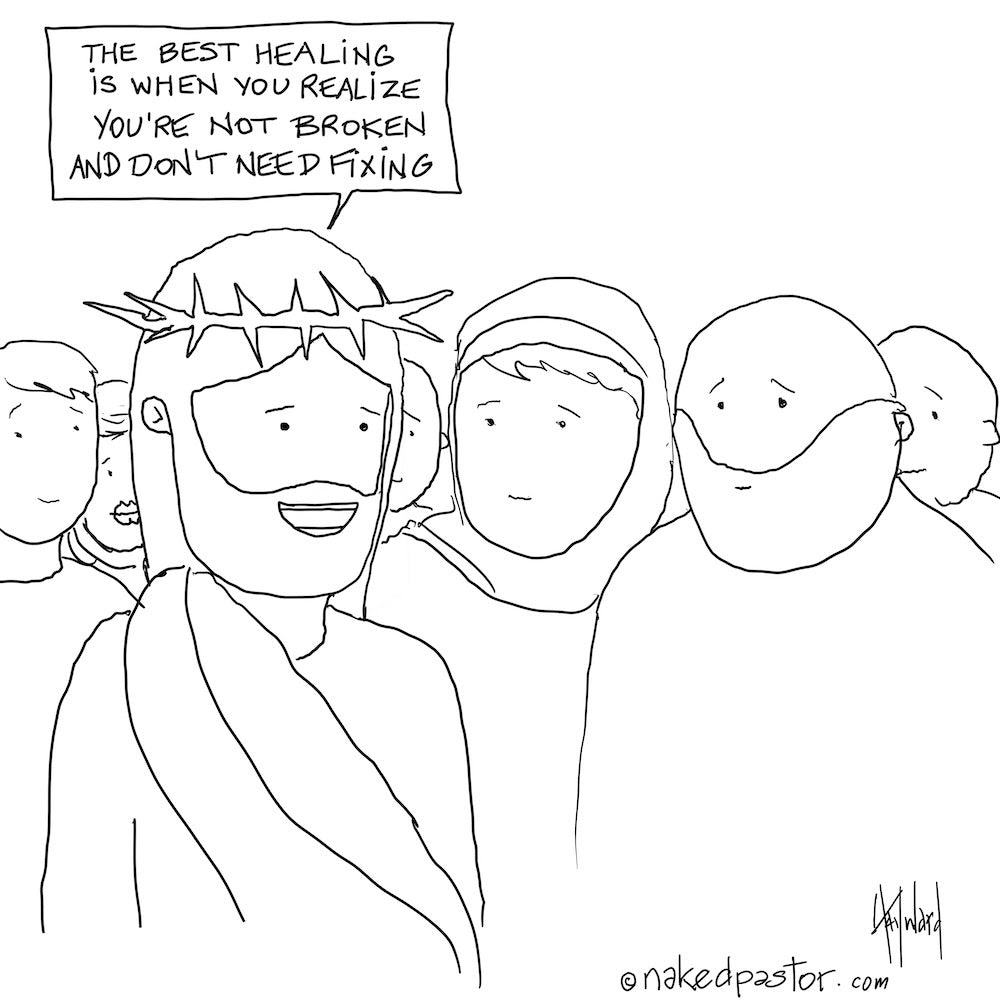
| Let’s make this one short and sweet. I agree with Cohen. I also agree with Sinéad O’Connor’s therapist, who told her the whole point of therapy was to help her realize she didn’t need therapy. The same with Gabor Maté, who said that I am not broken, but just wounded. Underneath the wounds and pain is wholeness. A wholeness already there, just waiting to be embraced. These all ring true to me. When I share cartoons like the one here, The Best Healing, I get some positive comments, but also a lot of angry and offended ones. And I understand why. I, too, was raised to believe that I was born a sinner, deeply broken and flawed and depraved, in need of a saviour to redeem me. The whole theological system and enterprise is founded upon the assertion that I am a vile sinner who needs to be saved by a divine being.I know how difficult it is to walk away from this belief, because it’s not just a belief, but a whole worldview, an entire paradigm, complete with its religion, institution, scriptures, and priests. It’s like leaving the universe to start over in a new one. One that says you’re okay. It’s a radical step, and maybe you have taken it. I’m proud of you for that. |
 Scottie's Playtime
