Morgan Armstrong.Credit : Image provided by Horwitz Law
Morgan Armstrong, then 18, filed a lawsuit last year against Tennessee Christian Preparatory School after being suspended over a social media post in which she came out as gay
On June 22 of this year, a final judgment order was entered into court stating that a settlement was reached between both parties
They agreed that Armstrong’s suspension has been rescinded, and that the school will pay her $10,000
Over a year after a student sued a private Tennessee high school for suspending and prohibiting her from attending graduation after she came out as gay on social media, the school will now pay her $10,000 as part of a resolution to the case.
A final judgment order was entered into the Chancery Court for Bradley County, Tenn., on Monday, June 22, stating that a settlement was reached between Morgan Armstrong and Tennessee Christian Preparatory School.
Armstrong, then an 18-year-old graduating senior at the school, made the social media post on April 23, writing, “cats outta the bag,” according to a complaint obtained by PEOPLE and filed on May 19, 2025.
A screenshot of the post, which was included in the complaint, showed Armstrong and her girlfriend kissing and holding hands.
Armstrong defended the post in a May 29, 2025, interview with The Washington Post. “Everyone else gets to post their boyfriend or girlfriend. So just because I have a girlfriend and I’m a girl, why does that mean that I shouldn’t be able to?” she asked. “I love my girlfriend and I wanted to show it.”
Days after making the post, Armstrong was summoned to the administrator’s office and given a suspension letter, according to the complaint.
The suspension letter, which was included in the complaint, stated that Armstrong would not be allowed on campus or at any school events, including but not limited to graduation, which took place on May 10, 2025.
Although the school said that her diploma would be mailed to her on June 15, 2025, the complaint alleged that the school “explicitly threatened to sabotage Morgan’s college admissions process and to withhold Morgan’s diploma” if there was any “online slander” about the school or anybody associated with it.
Additionally, the school alleged in the letter that Morgan’s social media posting included “a disparaging remark reflecting the people at Tennessee Christian,” a claim that Armstrong disputes.
The complaint claimed that her suspension letter mentioned a private message that the senior sent to some of her friends that read: “go like and comment on my post guys bc if no one on my socials knew I was gay then they sure as hell do now so this is a big thing tbh, also I’m kinda scared about the facebook comments bc i have some ruthless trump supporting ‘jesus’ mfs on there.”
However, according to the complaint, that message did not refer to the school, but instead referred to some of Armstrong’s relatives — people who, according to Armstrong, “profess but do not practice Christian principles of love, acceptance, and compassion.”
The complaint alleged that the real reason why the school suspended her “was the fact that she had come out as gay” — and that even if she had violated the school’s social media policy, it would have been a first-time offense, and the maximum policy should have been a one-day in-school suspension.
Armstrong and her parents, who were named co-plaintiffs in the suit, sought to expunge Armstrong’s suspension record and disciplinary violation, allow her to take her final exams, forbid the school from withholding her diploma and prohibit the school from “sabotaging” Armstrong’s college admissions process.
In Monday’s final judgment order — which PEOPLE reviewed — both parties agreed that Armstrong’s suspension has been rescinded, even though they disagreed on the extent of her violation of Tennessee Christian Preparatory School’s policies.
The order also stated that the school had not spoken with other colleges or universities for the purpose of disparaging Armstrong, and agreed to be prohibited from making such remarks to the institutions.
The school will have to pay a $10,000 money judgment to Armstrong, the order read, and the lawsuit is now over.
In a statement shared with ABC affiliate WTVC, Tennessee Christian Preparatory School said: “Tennessee Christian and the Armstrong family disagree regarding the extent to which Morgan Armstrong violated school policies. Both parties acknowledge that this disagreement remains unresolved and have mutually agreed to move forward. No further comments will be made regarding this matter.”
Daniel Horwitz, an attorney for Armstrong and her family, said in a statement shared with PEOPLE, “School is a place where every student is entitled to feel welcome, accepted, and supported.”
Horwitz continued, “It is not a place where any administrator should feel comfortable disciplining or threatening kids for being gay. We were proud to represent Morgan and her family in this righteous lawsuit, and we are thrilled to have prevailed on their behalf. We hopeMorgan’s bravery will inspire others to stand up for themselves the way that she did.”
Tennessee Christian Preparatory School did not immediately respond to PEOPLE’s request for comment on Tuesday, June 23.
Under a single spotlight, a tall figure in a hooded robe strutted onto the stage, their back to the audience. After a suspenseful beat, three words in large bolded lettering lit up the screen behind them: “NATURE IS GAY.”
With a twirl to the crowd, Pattie Gonia unveiled their ginger-red hair and matching mustache, dancing in an earthy blue-and-green crop top and skirt barely covering their chiseled body. The crowd of over a thousand broke into roaring applause.A 2019 video of Bill Nye the Science Guy, pulled from his appearance on John Oliver’s “Last Week Tonight,” punctuated the dramatic reveal. “By the end of the century, if emissions keep rising, the average temperature on Earth could go up another 4 to 8 degrees,” Nye said. “What I’m saying is, the planet’s on fucking fire.”
These are just the first few seconds of environmental activist and drag queen Pattie Gonia’s “Save Her” tour, a one-of-a-kind show that calls for the protection of the dolls — and the planet. The drag queens and kings who created and star on the tour aim to counter the exclusion of their communities by promoting the inclusion of everyone.
For eight years, Pattie Gonia, who goes by Wyn Wiley out of drag, has amassed an impressive following of over 2 million people across their social channels and through their environmental activism on and off the stage. They’ve pushed boundaries, set records and earned accolades, including being featured as one of TIME’s most influential creators in 2025, named as one of National Geographic’s 33 “agents of change” and invited to speak at TED Talk. They have also raised millions of dollars for environmental and social justice non-profits, co-founded the environmental equity organization Outdoorist Oath and a job board to help the queer community and allies find work in the environmental sector.
Last year, Pattie Gonia completed a 100-mile trek from Point Reyes National Seashore to San Francisco’s Golden Gate Bridge in full drag — hair, heels and all — to raise $1 million for non-profit environmental and social justice organizations.
Pattie Gonia performs at the “Save Her! Environmental Drag Show” during Climate Week, Tuesday, Sept. 24, 2024, in Brooklyn, New York. (Alyssa Goodman/AP Photo)
Last month, they did it again, completing a five-day hike at Yosemite.
As show attendee and D.C. drag king Lionel Bitchie said, “She’s not one of the most followed drag queens for no reason.”
But they haven’t done all this work without ruffling a few orange-tinted feathers — and sparking division even among their own fans. During the 2024 presidential campaign season, they were targeted in a Trump campaign ad. Most recently, Pattie Gonia has been in the news for getting sued by the clothing brand Patagonia.
The lawsuit arose after Pattie Gonia filed a trademark application for exclusive rights to use the Pattie Gonia brand on commercial products and events, a move that Patagonia claims would compromise its brand identity. The drag queen responded on social media, posting that suing a climate activist is a “betrayal” of Patagonia’s core mission. Patagonia, for its part, acknowledged their shared goal of caring for the planet and the outdoors, but has held firm on the conditions to end the litigation.
Online, people in Pattie Gonia’s own fanbase have expressed conflict. While some view the lawsuit as harmful to the queer community and stopped using Patagonia’s products as a result, others disagree the clothing brand unfairly sued the drag artist.
Pattie Gonia said the timing of the lawsuit, filed on January 21, hits especially hard because it has come at a time when marginalized communities have been under fire. Several climate, gender and equity-related terms have been erased and banned from federal agencies. The Trump administration has rolled back key protections and visibility for LGBTQ+ communities, including limiting access to gender affirming care, removing mentions of LGBTQ+ history in national parks and banning transgender service members in the military. It also has slashed environmental safeguards for clean air and water, gutted funding for national parks and public lands, and expanded the use of polluting fossil fuel industries.
All the while, Pattie Gonia has embraced their own form of protest in the national “Save Her” tour, focusing it on climate activism and partnering with local drag queens at each of the tour’s stops, in more than 20 cities. At the 9:30 Club in Washington, D.C. — a historically inclusive space for Black performers steps from U Street’s former Black Broadway and a 20-minute drive from the White House — artists and attendees weren’t afraid to get political.
“A lot of time drag can be escapist, and not confronting the reality of dealing with fascism and climate decline, so I like drag that is a call to action and inspiring,” local drag artist and attendee Brooke N. Hymen said. “Pride month can be a celebration and it should be, but it should also be resistance against the forces that want to see us eliminated. And I feel like climate activism goes hand in hand with trans and queer activism.”
“Drag is political, so in a way this is like a rally,” Lionel Bitchie added.
One by one, each act gave their own climate-themed performance, with the majority of them stripping down to their “Fuck Donald Trump” pasties and underwear. Between acts, a parodied Smokey the Bear logo on stage read: “Only you can prevent fascist liars.”
Drag artists Brooke N. Hymen (left) and Lionel Bitchie (right) attended Pattie Gonia’s 9:30 Club show. “Drag is political, so in a way this is like a rally,” Bitchie said. (Jenae Barnes for The 19th)
“It’s a fantastic outlet for joy and rage all in one,” said attendee Kirby Callaway, who works in the environmental space. She said when she saw Pattie Gonia perform at a previous drag show, her “cheeks were hurting because I was smiling so much.”
“It’s so unique, [and] so much of the way that I interact with it in the real world is very doom and gloom,” Callaway said. “I don’t feel like a lot of places get to celebrate and find joy and laugh at these issues.”
Co-headliner and drag queen Sequoia (yes, like the tree) donned an upcycled outfit made of clothing relics from their closeted past and did a performance about the gender fluidity of plants and animals. The screen behind them displayed the words, “Nature is queer, and so am I.”
Going for a wildly humorous take on the issue, drag king Uncle Freak shuffled on stage to perform a striptease as a geriatric man, complete with a fake white mustache and a receding hairline that even NASA couldn’t find on the Hubble telescope. The environmental theme? How climate change worsens the effects of aging.
“Climate change accelerates biological aging in older adults by increasing vulnerability to extreme heat, dehydration and air pollution,” read the screen they pointed at with their cane on the stage.
But the show wasn’t all fun, games and nipple tassels. D.C. drag royalty King Molasses performed to Phil Collins’ ‘80’s hit “In the Air Tonight,” using the tune’s famous crescendo of intensity to parallel the “rising tension” of the climate crisis.
“In the Air felt very correct, in the sense of this urgency that we are now as a people finding ourselves in when it comes to saving the planet. By saving, I mean the impact of technology, of data centers, the climate skewing hotter, the ice caps melting, storms getting more severe,” the inaugural winner of the “King of Drag” reality TV show told The 19th. “There are so many things that are becoming more and more pressing at an alarming rate. And there will be a point where the consequences of our actions will be impossible to ignore.”
King Molasses performs to Phil Collins’ ‘80’s hit “In the Air Tonight.” (Maya Lopez)
Pattie Gonia came on and sang a heartfelt “bird song” about resilience and visibility in times of hardship. “No one can erase us, we’re here and we’re staying, we sing cause we made it, we made it through the night,” they sang as the crowd softened during the piano-accompanied tune and several people melted with tears and hugs.
Co-headliners Sequoia and Vera! joined Pattie at the climax of the show to perform a piece on social justice in front of the backdrop of an American flag. Written on each stripe, a different call to action: “Eat the rich. Protect the dolls. Free Palestine. Black lives still matter. No one is illegal on stolen land.”
Amid rampant erasure, censorship and oppression of the queer community and environmental advocates, the tour is more than a late-night rendezvous; it’s a rallying cry, Molasses said.
“The opportunity that this tour gives all of us artists is that drag allows us to play and show something that feels like entertainment,” Molasses said. “But if we can do it in a particular way, we are able to not only entertain but are able to call our community to action.”
Trump’s failure with the Lincoln Memorial Reflecting Pool is a perfect example of how this regime operates.
He said he wants to beautify Washington DC, though the city is already beautiful. This is like when he came into office in 2017, and before the afternoon was over, he took credit for rebuilding the military. We were spending over $800 billion a year on our military before Donald Trump came into office, so trust me…. We already had a military. If anything, our military is weaker today because Donald Trump just wasted a lot of its armaments on his stupid chosen illegal war. It’s also being led by a chauvinistic, racist, white Christian nationalist with the brain of a moldy sponge.
Back to the pool. Trump wanted to beautify it before July 4, when our nation celebrates its 250th birthday, not to be confused with June 14, which is Donald Trump’s birthday, which will now be commemorated every year by having shirtless men pummel each other in your backyard. (snip-MORE)
The UFC event at the White House last Sunday was not supposed to be political, even though it was held on Donald Trump’s birthday. But after winning his fight, UFC fighter Josh Hokit was being interviewed by podcaster and ring announcer, Joe Rogan, when he grinned and looked into the camera, and said, “And lastly, Michelle Obama is a man! Am I right, America?”
Of course, he is not right, and his racist and sexist conspiracy theory shouldn’t be given the dignity of a defense because it is just too ridiculous and stupid. But what Hokit did wasn’t just disrespectful to Michelle Obama and President Obama, but also to the White House, where he made the comment (hasn’t that place suffered enough during Trump 2.0?), and the country, as this was supposed to be for America’s 250th birthday.
The event itself was disrespectful enough to the White House and the Oval Office without Hokit’s hateful comment. (snip-MORE)
his summer, we are spoiled for choice when it comes to queer movies. From the long-awaited adaptation of Hayley Kiyoko’s novel Girls Like Girls — which was itself an adaptation of the music video of the same name — to Jane Schoenbrun’s Teenage Sex and Death at Camp Miasma, every vibe is covered, from romance to horror to comedy and beyond. Rarely has a summer movie season felt this varied and interesting when it comes to LGBTQ+ fare. To help you keep track of it all, we’ve compiled this helpful list, complete with release dates and information about where you can catch each title. After all, there’s no better way to beat the heat than in an air-conditioned movie theater.
She’s the He (2026) — in select theaters now, VOD to follow
She’s the He is a gender swap comedy about two cisgender boys who pretend to be trans girls in order to get laid before high-school graduation. If that sounds like a horribly regressive premise, fear not. This is a movie made by and for trans people, with the sort of knowing, raunchy comedy we’ve long been denied in the name of Representation.™ It’s riot, and you should see it, if not at this current moment, then during the promised summer VOD release window.
Blue Film (2026) — June 12, VOD
Although it premiered in the U.S. in May, the controversial Blue Film was only shown in a smattering of theaters and will finally arrive on VOD June 12. The movie, directed by Elliot Tuttle, follows a queer fetish camboy who shows up to an older john’s house, only to discover that his client is his former English teacher. It’s a film unafraid to touch the third rail, diving deep into both men’s loneliness and insecurities. We called it the best queer film of the year so far back in May, and that distinction still holds up.
Stop! That! Train! (2026) — June 12, theaters
If you love Airplane! and the Naked Gun but wish they were (even) gayer, Stop! That! Train! should scratch an itch. Starring a who’s who of Drag Race girls on a runaway train, along with Crazy Ex Girlfriend’s Rachel Bloom and RuPaul herself as President Judy Gagwell, the film is filled with the sort of inane jokes and sight gags that we don’t see nearly enough of in contemporary comedies. We should note the film has become embroiled in controversy about whether it used generative AI for certain VFX shots. Director Adam Shankman has stated on Instagram that every shot is “made by human hands” and that there are no shots “conceived by AI.”
The bar she drank at, the bed she recuperated in, the canals she daytripped to, the studio she stormed out of, the easel she painted her final masterpiece at … ahead of a major Tate show, our writer finds Kahlo’s spirit alive in Mexico City
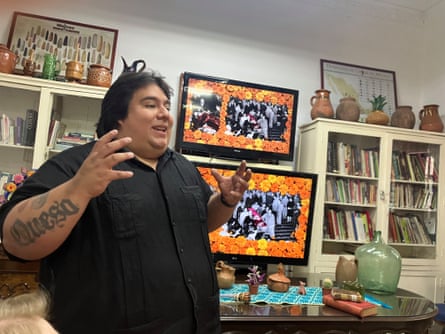
Today you’re going to eat art,” says Federico Valdez, a chef at the School of Mexican Cuisine and a man so passionate about food he has the word Queso (Cheese) tattooed on his forearm. “Today,” continues Valdez, “you’re going to eat history.” What unfolds, in a sun-filled dining room lined with Mexican flowers, books and artefacts, is a three-course feast inspired by Frida Kahlo, her life, her art and her loves, including her first lesbian affair.
The starter, rooted in her childhood fascination with revolution, is a lightly spiced Mexican take on Russian pirozhki. The main dish – served with pulque, an agave-derived drink Kahlo loved – taps into her rebellious spirit. “It’s called Frida Against the World,” says Valdez, as we are presented with a giant stuffed chilli that sits amid a nutty, beany sauce similar to the one eaten at Kahlo’s wedding to Diego Rivera, then the most famous artist in the world, now firmly in her shadow.
“I wanted this to be hot and horny,” says Valdez, explaining that halved figs were added to reference Kahlo’s sexuality. “Her first love, with a female teacher, happened at a time when Mexico wasn’t so open. I wanted to get in all that spicy gossip. I’m not a big fan of playing it safe.”
I’m in Mexico City with a Tate delegation just as the huge jacaranda trees are blooming purple and violet across its parks and boulevards – to follow in Kahlo’s footsteps ahead of Frida: The Making of an Icon, a show of more than 30 of her works at Tate Modern in London that seems destined to be a summer blockbuster, adding yet more fuel to Fridamania.
‘This is going to blow your mind’ … chef Federico Valdez. Photograph: Courtesy Andrew Gilchrist
One work, Self Portrait With Thorn Necklace and Hummingbird, was painted in 1940 after her painful divorce from Rivera. A spider monkey, similar to the one he gave her as a present, is pulling on her thorn necklace, drawing blood. The two soon remarried, Kahlo inscribing the clocks in their house with the years of their separation and reunion.
“The exhibition is like a movie,” says Tobias Ostrander, its curator. “Frida is the star but it’s also about her life, her people, her impact.” Charting Kahlo’s rise from unknown painter to global phenomenon, the show will also examine merch (expect a Kahlo Barbie) and gauge her influence on later artists.
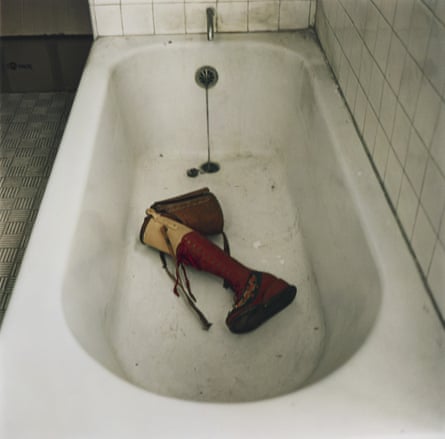
On display, too, will be many of the artist’s treasured possessions, including her brilliantly patternedtehuana dresses. Graciela Iturbide’s ghostly photographs of her crutches, customised medical corsets and prosthetic leg will also feature. These were taken 50 years after Kahlo’s death, when all her belongings were finally freed from the bathroom in which Rivera had ordered them to be locked away.
Unseen for 50 years … Kahlo’s prosthetic leg, captured in Graciela Iturbide’s photograph. Photograph: Courtesy of the artist
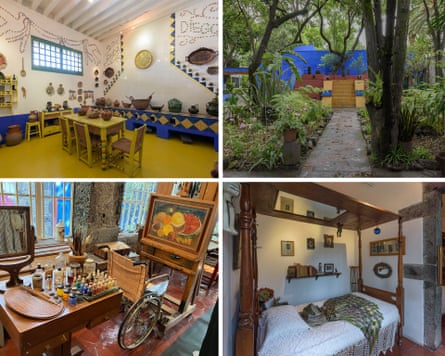
This took place at Casa Azul, the house in Coyoacán (The Place of the Coyote Owners) where Kahlo was born and spent most of her 47 years. It’s now a beautiful, beguiling museum with smooth exterior walls painted a gorgeous blue. These border shiny red concrete paths that thread through fountains and lush gardens bursting with palm, yucca, cactus and bougainvillaea. Off in a corner, seen through trees, a maroon pyramid with yellow steps displays on its ledges Rivera and Kahlo’s pre-Hispanic, Aztec and Toltec artefacts.
“We don’t know exactly where the blue came from,” says Perla Labarthe Álvarez, the museum director. “But in her diary, Frida expressed what the colour meant to her: purity, electricity and love. Because of her health – she had surgery all her life, more than 30 operations – she was at home a lot so it had to be a comfortable place where she could rest. Many of her still lifes were done in the garden. She called her home A Place Full of Places.”
It’s a perfect description. For this is a breathtakingly evocative location, even leaving aside the fact that Trotsky lived here for two years with his wife, having a brief affair with Kahlo.
‘A place full of places’ … Kahlo’s kitchen and garden at Casa Azul; her bed with its overhead mirror; and the easel adapted so she could paint on her back or in her wheelchair. Composite: Bob Schalkwijk/Andrew Gilchrist
Tours begin in the living room, with its hefty pyramid-style fireplace designed by Rivera and, as an old photo shows, once flanked by two of his macabre Judas dolls, papier-mache devils that are stuffed with fireworks and set alight at festivals. Opposite is Kahlo’s mesmerising portrait of her beloved photographer father, painted 15 years after he died, his eyes as captivating as hers.
On the walls, photos and texts detail the polio Kahlo contracted at the age of six, leaving her with one shorter leg, and the trolley-bus crash at 18 that impaled her on an iron handrail and left her in pain for much of her life, as well as unable to have children.
She could never paint this accident, even though what she did paint was often deeply painful and personal – and these works were largely created at Casa Azul, upstairs in her studio, where visitors can see the easel adapted to allow her to use brushes lying on her back or seated in her wheelchair.
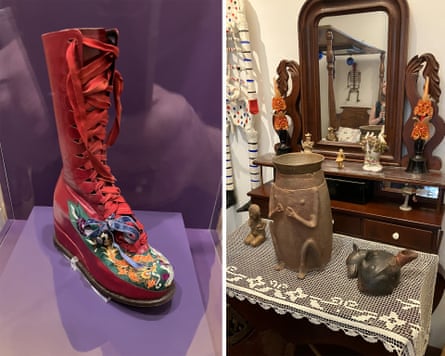
‘One kick and it could take the house down’ … Kahlo’s customised boot and her ashes in an urn. Composite: Courtesy Andrew Gilchrist
In the next room is the four-poster single bed in which her mother placed an overhead mirror, giving Kahlo, frequently confined there, both a distraction and a subject. “I paint myself,” she once said, “because I am so often alone and I am the subject I know best.”
As well as her corsets, she customised her orthopaedic footwear, turning one stepped-up mid-calf red boot into a work of art. Embroidered with patterns and adorned with a blue ribbon, the chunkily laced boot now proudly stands in its own case, extraordinarily alive, looking like it could take the whole house down with one kick. Meanwhile, on a dresser, Kahlo’s ashes sit in a delightfully playful ancient urn. Boasting cartoon-like arms and legs, it’s shaped like a toad, a nod to her affectionate term for Rivera. “You found me torn apart,” says a sign, “and you took me back full and complete.”
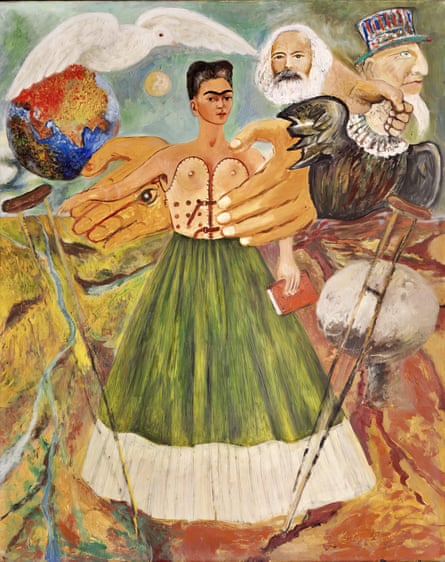
Across the courtyard, you can see Kahlo’s crutches and corsets, one decorated with a hammer and sickle. She painted herself in these corsets, too. In Marxism Will Give Health to the Sick, a 1954 work that hangs close by, the garment has morphed into her skin, her bare breasts. A bald eagle wearing an Uncle Sam hat is being throttled while Marx’s enormous hands reach out to cradle Kahlo. As ever, her penetrating, all-seeing eyes stare out beneath that monobrow.
Throttling Uncle Sam … Marxism Will Give Health to the Sick. Photograph: Artium/Alamy
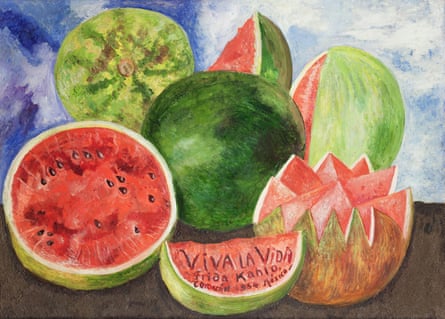
The most stunning work at Casa Azul, though, is the last one she ever painted, completed eight days before her death in 1954. Called Viva la Vida, or Long Live Life, it portrays several sun-drenched watermelons, the de facto national fruit of Mexico. In some places, their flesh is as red as blood. One has been cut in half in a crisscross pattern, echoing the Vs of the title, which appears in big black letters on another slice. It’s as if the fruit itself, life itself, is talking to you, imploring you. Live, live.
What you take from Casa Azul is an almost overwhelming sense of Kahlo’s talent, resilience and rebelliousness. “Tell us about the bomb,” someone says to Álvarez at one point, but she is out of earshot. “Is it true Frida bombed her school?” Actually, what she and her friends planted was more of a firecracker, albeit one powerful enough to blow out several windows. No one was hurt and, unlike some, Kahlo escaped expulsion.
‘It’s as if the fruit – life itself – is imploring you’ … Kahlo’s final painting, Viva la Vida. Photograph: The Artchives/Alamy
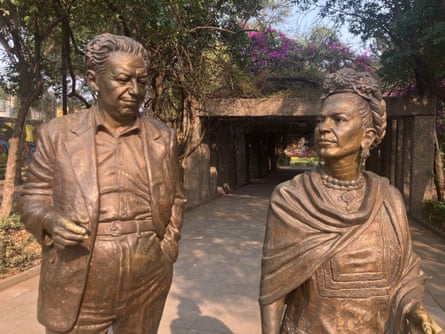
There’s a park not far off, now named after her, with a pyramid by a fountain and lifesize bronze statues of Rivera and Kahlo. She’s ahead of him, purposeful, her head half-turned, as he follows happily in her wake, smiling gently and clearly in awe of this woman, despite all his affairs. The bar they liked, La Guadalupana, still stands, a shrine to el toreo with the heads of bulls on its walls, as well as paintings and posters of fighters. Perhaps it’s more appealing if you’ve had, as Rivera and Kahlo sometimes did, “a tequila or 10”.
Downtown, we find, the streets are not so tranquil. Some are barricaded and hoarding has been placed around national monuments. These were erected in response to a recent march of 180,000 women, furious at the rates of femicide in Mexico. About 2,500 women are murdered a year, but less than a third are categorised as femicides even though there is evidence they should be. Less than a quarter of femicides are punished.
‘Clearly in awe of this woman’ … statues of Diego Rivera and Kahlo in the park named after her. Photograph: Courtesy Andrew Gilchrist
Would Kahlo have painted this outrage if she were alive today? She already did. In 1935’s Unos Cuantos Piquetitos, or A Few Small Nips, Kahlo recreates a story she read in the paper that left her incensed. A woman lies slashed and naked on a blood-splattered bed, murdered by her husband, who holds a knife and would later dismiss his crime to the police with the words of the title. Initially, Kahlo put the children in, as they witnessed the entire horror, but this was just too brutal and they have now gone.
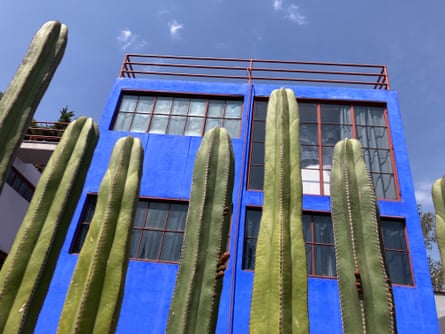
Kahlo also painted in a studio across town, in the bohemian neighbourhood of San Ángel. It’s a beautiful, boxlike, three-storey building painted that signature blue. A rooftop bridge links it to Rivera’s much bigger workplace, a white-and-ochre structure where he would often put in 15-hour days.
Built on modernist Le Corbusier lines and now part of a museum, these studios caused a sensation when they first appeared, unadorned constructivist creations sitting among the elaborate residences of San Ángel. They’re still ringed by a superb perimeter fence of tall, perfectly placed pole-like cactuses, this being a way for both artists to bring Mexico and nature into their workplaces.
At one with nature … Kahlo’s studio with its cactus fence. Photograph: Courtesy Andrew Gilchrist
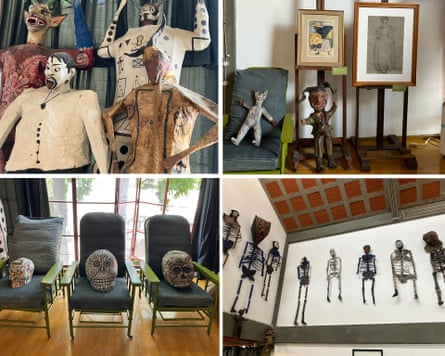
Rivera’s studio is magnificent, overflowing with ceramics and artefacts from his folk-art collection, all arranged alongside paintings and paintpots. There’s an almost party vibe: death masks sit grinning on chairs, crowds of Judas dolls leer conspiratorially around the windows, while chorus lines of strangely joyous skeletal figures dance wildly across the walls above. It feels appropriate: the parties here were legendary, attended by presidents, revolutionaries and exiles alike, as well as Hollywood stars such as Charlie Chaplin.
Over the bridge, above the bath in Kahlo’s studio toilet, you can see a copy of What the Water Gave Me, her 1938 painting of her feet as she bathed, with elements adrift on the water symbolising events in her life, from exotic plants to nude figures on a bed to an erupting volcano. There’s not a whole lot else to see in her studio, Kahlo having packed everything up and left after catching Rivera in bed with her sister. According to the museum guide, she told him: “I am going to get all my furniture and get out of here because I hate you.”
What the Water Gave Me is the favourite Kahlo painting of Helena Chávez Mac Gregor, writer of The Ribbon and the Bomb, a book about the artist’s continuing and even growing relevance. Its title refers to the words French surrealist André Breton used to describe Kahlo’s work – “a ribbon around a bomb” – although Mac Gregor thinks there’s “maybe no ribbon, only bombs” and they’re still exploding through times beyond her own, as new generations of (largely) women see themselves, their bodies, their sexualities and their struggles mirrored in her masterpieces.
“There’s the bomb of her illness,” says Mac Gregor, as she joins us for lunch at the fabulous San Ángel Inn, a former Carmelite monastery opposite the studios famed for its gardens and margaritas. “She’s vulnerable yet she’s strong and erotic, not what you might expect of someone so ill. And she was so ahead of her time, making the personal political, living on her own terms, playing with gender roles and cutting her hair. Then there are the bombs of femicide and abortion, her own.” This was chiefly to safeguard her damaged pelvis. “Frida painted these things people didn’t talk about. Even with this illness – and one year she managed only one work – she created such beauty.”
‘The parties were legendary’ … Judas dolls, paintings, skeletons and death masks at Rivera’s studio. Photograph: Courtesy Andrew Gilchrist
Clearly delighted, Mac Gregor adds: “Frida is more important than Diego Rivera now, which is weird because she was the artist she was because of him. He was a macho Mexican womaniser but he loved and supported her. And the essays he wrote about her work are amazing, talking about her representations of the interior and the exterior. He said she was going to be the most important artist in Mexico.” Kahlo didn’t stop there. When The Dream (The Bed) fetched $54.7m in 2025, this set a new world record for a female artist.
The Tate has been lucky to get any works at all, given how proud and protective Mexicans are of Kahlo, especially with the World Cup having just kicked off in their country. This was brought home to me at the Museo de Arte Moderno, where you can linger all you want in front of, say, a María Izquierdo – but gaze too long at a Kahlo and you’ll soon start to feel the pressure from other visitors to move on.
This happened to me twice: first in front of The Two Fridas, in which she explores her mixed heritage, dressing one self in European attire, the other in Mexican; and secondly at Self-Portrait with Monkeys (see top), in which Kahlo, faintly moustached, is seen with four of the creatures she kept as pets. They are often seen to represent the four pupils, nicknamed Los Fridos, who stuck with her even as her health made teaching harder and harder. Kahlo would also say that the monkeys in her work symbolised the children she could not have.
No visit to Mexico City is complete without a trip south to the floating gardens and canals of Xochimilco, for a voyage on one of the 500 colourful big gondola-like boats that ply its busy waterways. Kahlo loved to come with her family to these canals, which were created by the Aztecs. There’s a famous photo of her face hovering over the water, looking serene as she dips her arm in up to the elbow.
A song for £10 … the Axolotls board Rosamaria. Photograph: Courtesy Andrew Gilchrist
“Every boat has a female name,” says the captain of Rosamaria, our vessel, “because they are like flowers.” As we set off, smaller, faster boats speed by, bearing vendors of pulque and tacos. Before long, we are being pursued by two very loud mariachi bands, one called the Pintorescos, meaning the Picturesques, the other the Axolotls, named after the tiny, endangered and ridiculously cute species of salamander native to these waters. The Axolotls win, boarding our boat in seconds and performing for £10 a song, first Cielito Lindo (Lovely Sweet One) with its rousing singalong chorus, and then of course La Bamba.
As the Axolotls speed off in a blur of strings, brass and tight trousers, peace returns and we idle along as the afternoon sun beats fiercely down. I dangle my arm into the cool water, just like Kahlo did, and remember something Federico Valdez said as he unveiled the final course of his feast, a rice-pudding-like dish in a watermelon sauce, washed down with a liquor made from Chihuahua apples.
“This dessert is going to blow your mind,” he said, as a picture of Kahlo’s funeral appeared on the screen behind him. “Frida died – but she didn’t pass away. She was like a rocket. She just went up and up.”
David Wise’s new experimental play, “Fight Back,” opens a portal to an earlier era of organizing and spotlights the enduring power of slow-moving consensus building.
Imagine a murder mystery dinner party, where everyone sheds their true identity at the door and assumes a role to play in the night’s events — only instead of solving a crime, they must reenact a contentious activist meeting. That’s what artist David Wise tasks participants with in his immersive theater piece “Fight Back.” He recreates the AIDS Coalition to Unleash Power, or ACT UP, meeting on March 13, 1989 in the same room where it happened nearly 40 years ago.
It’s impossible to sit in the same room in New York City’s LGBT Community Center where their meetings happened nearly 40 years ago without feeling the echoes of today’s governmental failures, and the urgent need for both resistance and mutual aid.
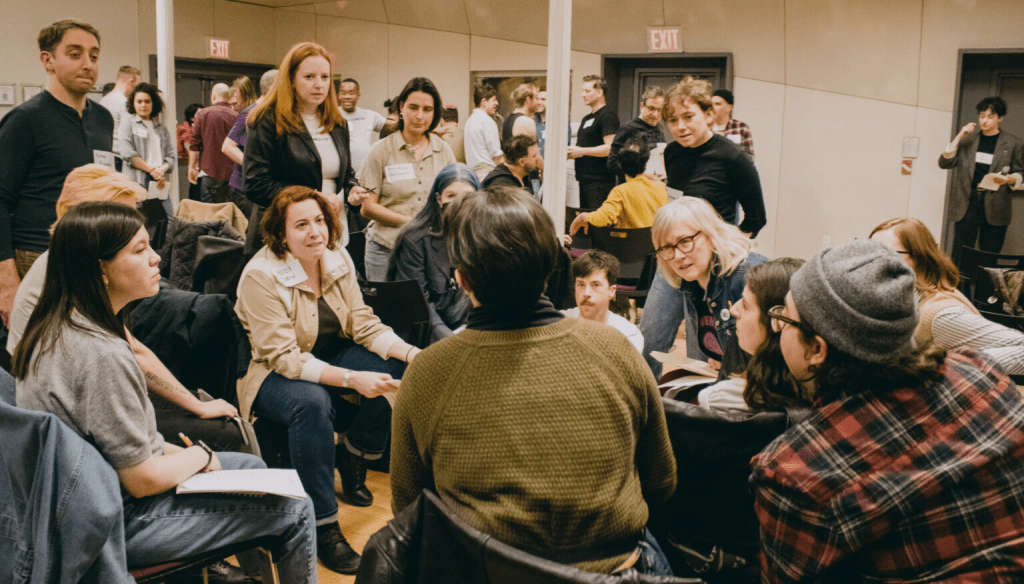
At the May 18 performance of “Fight Back” — which takes its title from ACT UP’s chant: “Act up! Fight Back! Fight AIDS!” — I did something we rarely have to do these days: relinquish checking and doomscrolling on my phone to spend uninterrupted time face-to-face with strangers, co-creating something from scratch. Nearly 40 of us had two and a half hours to make our way through a 26-item agenda, an education in ACT UP’s work.
ACT UP is a direct action group formed during the AIDS epidemic to fight for visibility, healthcare access and an end to the crisis. To mark the second anniversary of the group’s formation, they were in the midst of planning Target City Hall — the kind of creative, high-profile direct action for which the group had become known — to protest Mayor Ed Koch’s failure to adequately address the AIDS crisis in New York City.
By the beginning of 1989, more than 18,000 New Yorkers had been diagnosed with AIDS and over 12,500 had died. ACT UP was demanding affordable access to the highly toxic but potentially life-saving drug AZT, which had just come on the market a year earlier. They also demanded housing for people living with AIDS and changes to the Food and Drug Administration’s drug trial policy to give more patients hope. They demanded dignity for the living and the dead. In the midst of all this, members still found the time and space to plan fundraising parties and, more importantly, to flirt.
The 1980s was an era of phone trees and answering machines. We checked our cell phones at the door. The experience is an invitation to follow the advice writer Mira Jacob gave on Instagram earlier this year: “Stop scrolling. Do literally anything else … We’re going to prevail, but only if you don’t let this app scare you numb.” If you were mad in 1989 because your friends were dying at the hands of the government and you wanted to yell at someone about it, you had to show up to a meeting or participate in a phone zap or volunteer to surreptitiously print flyers at your office denouncing Mayor Koch as a closet case. (One attendee politely corrected our pronunciation of “Koch” — no relation to the present-day billionaire brothers who pronounce their last name “coke.”)
A smaller group within ACT UP gathers during David Wise’s experimental theater piece, a reminder that the organization was not a monolith. (Hong-An Tran)
The atmosphere in the room was tentative. Every question opened up a minefield that only the basic tenets of improv could answer: Say “yes, and” to help the scene unfold; make bold choices, even when you are unsure of them, and don’t “break” the illusion. Most of us had brought hastily scribbled notes about our assigned historical personas, pulled from summaries and the ACT UP oral history archive. This background helped with questions like, “What affinity groups are you in?” and “Is this your first meeting?” But they offered little to lean on when it came to more quotidian conversation starters, “Are you coming from work?” or “Are you out to your family?” Those we stumbled through, together.
I had been assigned the role of Bill Bahlman, my first part since a non-speaking role in the middle school production of “Schoolhouse Rock!” A lifelong New Yorker and a music journalist, Bill had been a part of the Gay Activists Alliance and the Gay and Lesbain Alliance Against Defamation, or GLAAD. A self-described anarchist, he sometimes found the groups to be too soft, particularly the Gay Activists Alliance’s discussions of whether to drink mixed drinks or soft drinks at their dances. He splintered off from GLAAD into the Lavender Hill Mob, a direct action group formed in 1986 and named after a British comedy film. The dozen members focused on AIDS activism and organized disruptive “zaps,” interrupting a CDC meeting, a Catholic mass and other high-profile events with leaflets and banners bearing slogans like, “Gays and lesbians will not be silenced!”
When ACT UP formed in March 1987, Bill and many other Lavender Hill Mob members joined, but their affiliation and camaraderie with one another remained. While ACT UP is often remembered as a monolith, it was in practice a true coalition under which many smaller groups coalesced, including affinity groups like Delta Queens, La Cocina or Wave 3 that demonstrated together at actions.
Bill was slated to speak late in the agenda. The items were laborious in their minutia. Should the flyers Wave 3 planned to wheat paste around the city to gather people for Target City Hall in two weeks be printed in color, or black and white? Should we send three or four people to the Lesbian and Gay Health Conference in San Francisco? We rose from our chairs for civil disobedience training, half of us playing cops and half of us playing protesters gone limp to resist arrest, but then it was butts right back in seats.
By the two-hour mark, I could no longer stifle my yawns. There may have been flirting at meetings, and even a little in our reenactment, but the agenda was a reminder that there is little instant gratification in organizing. It took much longer than an Amazon delivery or a ChatGPT response. This focus on consensus decision making has undergirded some of the most visible movements and organizations, like Occupy Wall Street, Jewish Voice for Peace and the Democratic Socialists of America. While they don’t offer an instant dopamine hit, the memorable actions and ballot wins delivered by these groups are clear evidence of their effectiveness.
There are no professional actors associated with the production. Every meeting member was a stranger assigned to play their role for one night only. That said, I recognized an actor from an old TV show who attended as a curious citizen. She had been assigned the role of our chant leader Ron Goldberg, and I expected that, given her background, she might be the one to voice the most objections. Or, I thought, they might come from the tall, brawny and bespectacled man who wore a Larry Kramer name tag, a historical figure whose outspoken anger and divisive politics had been a catalyst for ACT UP’s formation. Instead, the objections came from Karen Ramspacher, a 24-year old curatorial assistant played by a middle-aged white woman seated in the back row with a bun on top of her head. “People are dying and we can’t cobble together the money for color printing?”
The meeting’s facilitators, one of whom I assumed must be Wise himself, tried to keep us on track. I kept glancing at my watch, hoping that time would run out before it was my turn to speak. When my name was called, my hands shook. I stood at the front of the room and looked out at the gathered crowd, some in their 50s, some in their 20s, many filling out the ages in between. I held the mic and spoke about Steve Zabel, my friend who I had found murdered in his apartment at the beginning of the month. The police had done nothing. What could we do to put pressure on them? Steve was just one man, but we all knew a Steve. To my surprise, everyone had ideas. The Media Committee wanted to take it to the press. The woman with the bun wanted to agitate with the neighbors. They had Bill’s back.
When the bell rang to return us to 2026, I made my way over to the outspoken woman, who in real life looked closer to 54 than 24.
“You were great!” I said, relieved to speak as myself again. “Really channeled the anger of the time.”
“I was there,” she said.
“What?”
The woman who had interjected so many times during “Fight Back” had attended ACT UP meetings as a teenager. She had a job in the 80s in Philly calling men to let them know where they were on the wait list to see the only doctor in the city who would treat AIDS patients. Many had died before their turn came.
A little group gathered around to hear her story. One man shared that he had come to the center that night with a friend who had also been a part of ACT UP, but he had turned around at the door because she wasn’t ready to reopen the emotions of that time. Wise revealed himself to have been Iris Long from the Treatment and Data Committee, a cancer researcher determined to publicize the life-saving uses of aerosolized pentamidine. The reenactment of the meeting had, in fact, been facilitated by everyday people.
Later, the woman continued, she had worked as a social worker in New York City with young transvestites, as they called themselves then, and sex workers. At one point she was given one dose of AZT and had to choose who to give it to in her community. She didn’t realize at the time that the medication had to be taken once every 12 hours to be effective. Of course she was still angry.
After everyone else dispersed, I lingered. The woman pointed across the room at her adopted daughter, a young Black woman whose biological parents had died of AIDS in Africa. She had remained in the global AIDS fight her whole life.
“If the AIDS crisis happened in New York today, we’d all be dead already,” she told me. “You had to be out there, you had to be visible, you had to be risking arrest to make yourself heard. Today everyone is stuck at home. You know what you have to do?”
I leaned in closer.
“Host a dinner party of strangers. You don’t even have to cook. Tell everyone to bring their favorite dish. People love to show off their culinary skills. Think about the seating arrangements. You don’t even need to set an agenda. That’s where political action comes from, talking to people.”
Wise had laid the groundwork for such unexpected offline encounters. His theatrical experiment will take place again on June 15, but Wise hopes to make his impressive research on these figures widely available someday, so school groups and others can try to reenact the meeting on their own.
Art about AIDS abounds. For starters, there’s “Rent”and there’s “Angels in America,” there’s Sarah Schulman’s “People in Trouble,” Rebecca Makkai’s “The Great Believers,”and, more recently, Natalie Adler’s “Waiting on a Friend.” Those pieces invite sorrow and rage, empathy and memory in equal measure. “Fight Back” invites you to act.
Amelia Possanza is a writer and book publicist who lives in Brooklyn. Her book “Lesbian Love Story: A Memoir in Archives” was the winner of a 2023 Lambda Literary Award.

:max_bytes(150000):strip_icc():focal(664x255:666x257):format(webp)/Student-Banned-from-Graduation-at-Christian-School-After-Coming-Out-052925-b59993f838e54909ac4459183eb77e84.jpg)