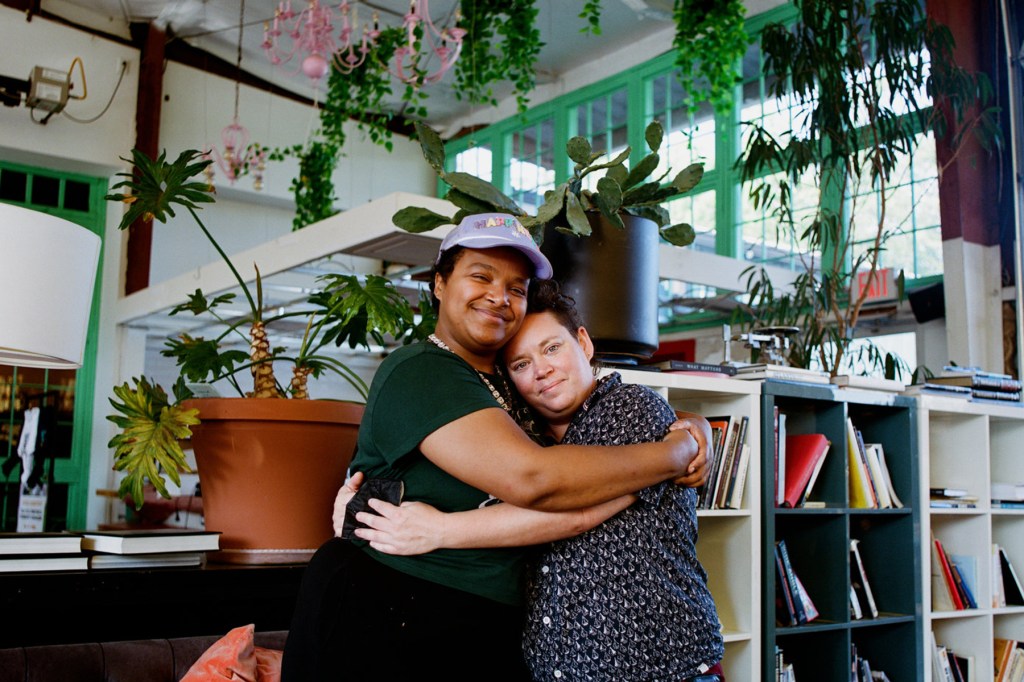
It happened just a few weeks ago: Jim Obergefell was moving things in his office when he came across the ashes of his late husband, John Arthur, now 12 years gone. Arthur had last wishes for his ashes. Obergefell had yet to fulfill them.
“And it struck me that, oh, I am actually now mentally, emotionally ready to take care of John’s ashes,” Obergefell told The 19th. “It was the first time that I had that feeling so clearly and so strongly.”
Obergefell, 58, is ready to move on. Not exactly from the love of his life or the history-making Supreme Court decision that came after Arthur died. But certainly from the insecurities straight America was grappling with a decade ago about same-sex unions.
Obergefell is that Obergefell: the named plaintiff in the landmark lawsuit that extended marriage equality to every state in the nation in 2015. Ten years later, he celebrates that win and the many ways it rewrote his life. And in a time when LGBTQ+ rights are again under assault, he is looking to the future — of the queer rights movement and also his own.
A journey to the Supreme Court
Obergefell’s journey to the Supreme Court was hardly destined. It began 12 years ago, on June 26, 2013, when the Supreme Court struck down the Defense of Marriage Act, a federal law that prohibited the government from recognizing same-sex marriages.
Obergefell and Arthur had been together for 21 years at the time. The two had discussed getting married before. But they wanted it to be legal, and their home state of Ohio didn’t offer same-sex marriages.
Arthur was gravely ill with ALS, a progressive neurodegenerative disease, and he barely left his home hospice bed.
After the ruling, Obergefell leaned over to Arthur, hugged, then kissed him.
“Let’s get married,” he said.
Arthur agreed.
The logistics were not easy. Arthur was in no shape to travel, and the couple could not wed in Ohio. Obergefell researched and found that Maryland would let him get a marriage license even with only one of them present. But both would need to arrive in the state for the ceremony.
When friends and family learned about their predicament, they pooled together money to charter a medical jet for Arthur. The two flew to Baltimore. Over the course of 45 minutes, they exchanged vows on the tarmac before flying home.
“In the days that followed, we said the word ‘husband’ hundreds of times a day,” Obergefell said on the Decidedly Podcast in 2023.
But just five days later, their joy was muted when civil rights attorney Al Gerhardstein informed them that because of Ohio’s ban on same-sex marriage, Arthur would be listed as single in death.
Arthur and Obergefell were angry. The couple sued the state of Ohio in federal district court and won. Three months later, Arthur died.
The following year, Obergefell, still in mourning, lost on appeal. But he refused to believe he might lose altogether.
“I just kept going,” Obergefell said. “It was the right thing to do.”
On June 26, 2015, he won. For the country, the win was immensely practical. Many told Obergefell it gave them so much hope it saved their lives. For Obergefell, it meant a legacy for the man he loved.
“I made promises to John to love, honor and protect him, and I was going to keep doing that,” he said.
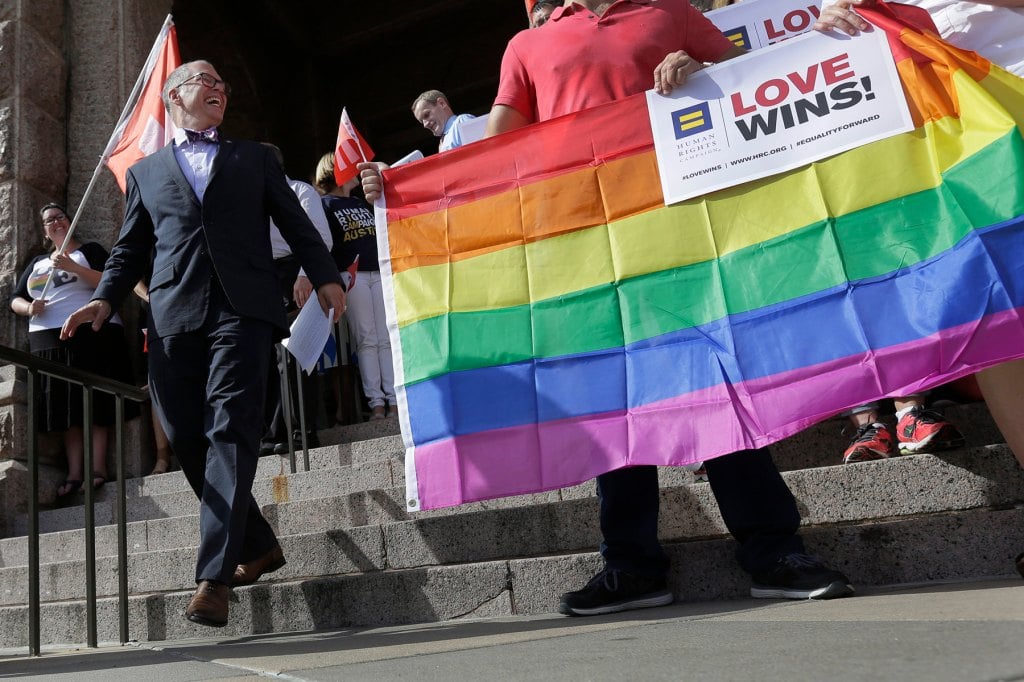
In the decade since Jim Obergefell won his Supreme Court case that made same-sex marriage federally legal, hundreds of thousands of same-sex couples have married in the U.S. (Eric Gay/AP Photo)
Changing history
It’s difficult to overstate the impact of Obergefell’s case on the nation or the world. Since the 2015 ruling, the Williams Institute at the UCLA School of Law estimates, 591,000 queer couples have wed, generating an estimated $5.9 billion in wedding spending for state and local economies.
It has also radically transformed Obergefell’s life. Introverted and unassuming, he has spent the last decade campaigning for LGBTQ+ rights. He helms Equality Vines, a wine company that donates its proceeds to advancing civil rights causes.
It’s a position that makes him deeply proud if not a little fatigued.
“I’m not tired of talking about it,” he said of the 10-year anniversary of the ruling. “I’m just physically tired from all of the interviews and the photographers and the speaking gigs and the events. Yes, I’m exhausted.”
For 12 years, Obergefell has kept Arthur alive through retelling their story countless times in courtrooms and for the media. That exercise, of telling and retelling, helped Obergefell process his profound loss.
But he has never recoupled. It wasn’t that Arthur didn’t want him to. In fact, Arthur told him regularly that he wanted him to find love again. He asked his friends and family to tell Obergefell that he wanted him to find love after he was gone.
“I know it was sincere, because he told me that he had other people tell me that,” Obergefell said.
It isn’t about the pressure he feels as the face of marriage equality, he said, though part of him wonders what it would be like to date after making history.
“I don’t know how to date,” he confessed. “I’m clueless when people flirt with me, and as much as I hate it, and I don’t go into any conversation or anything like this, but you know, there’s that part of me that sometimes wonders, you know, are they interested in me as a person, or are they interested in me as Jim Obergefell, named plaintiff?”
Obergefell’s name has become synonymous with marriage equality in the United States, an issue that has not always united the LGBTQ+ community. Some queer activists have argued that same-sex marriage was a misguided goal for the movement as queer youth continue to face high rates of homelessness and transgender people grapple with police violence and incarceration, among other issues.
More work to do
Obergefell, too, is worried that the needs of the community’s most vulnerable have gone unmet. He has watched horror-struck over the last five years as state legislatures have moved to restrict transgender rights.
“We need to fight for every marginalized community, because the queer community includes every marginalized community, and equality for one is pointless without equality for all,” he said. “I didn’t go to the Supreme Court just so White, cisgender, gay men like me could get married.”
Despite all of the setbacks in LGBTQ+ rights, and even threats to Obergefell’s game-changing victory, he is hopeful — and feels stronger than ever. People assume his case was difficult for him. It was, but the path was also obvious, to him and to Arthur. They loved each other.
“If we weren’t willing to fight for each other and for what was right, then what’s the point?”
I remember all this, plus it was Bill Moyers who, in the questioning concern over the passage of USA PATRIOT, reminded us that the US Flag is our (non-Bushies) flag, too. Though a good run, it’s a sad loss.
A Daily Reid: A good man has gone. (non-Bushies in peace, Bill Moyers by Joy-Ann Reid
A seminal broadcaster and a human rights champion, Bill Moyers was the best of the mainstream media Read on Substack
My mom used to watch Bill Moyers, so I did, too.
Philomena controlled The TV … meaning the television in the family room, which up until I was in high school was the only one we kids had access to. She had a small TV in her bedroom, which I can now admit I would sneak into her room and watch, sprawled out across her bed, which I carefully refluffed and reassembled when I was done. But when she was home, and not at one of her three jobs, The TV was made for the nightly news, the Sunday shows, her favorite primetime shows (Dallas, Knots Landing, Fantasy Island (I can still hear her giggling uncontrollably every time Ricardo Montalbán yelled “Tattoo! Tattoo!” as if she was hearing it for the first time) The Love Boat, The Jeffersons and All in the Family among them, plus any movie with Harry Belafonte or Sidney Poitier in it, and Nightline, which I got to watch with her, starting in the sixth grade.
And also PBS, where Bill Moyers was The Man and Bill Moyers’ Journal was must see TV. Here’s a part of his obituary from the Associated Press, as he has passed away at the ripe old age of 91.
Bill Moyers, the former White House press secretary who became one of television’s most honored journalists, masterfully using a visual medium to illuminate a world of ideas, died Thursday at age 91.
Moyers died in a New York City hospital, according to longtime friend Tom Johnson, the former CEO of CNN and an assistant to Moyers during Lyndon B. Johnson’s administration. He did not cite Moyers’ cause of death.
Moyer’s career ranged from youthful Baptist minister to deputy director of the Peace Corps, from Johnson’s press secretary to newspaper publisher, senior news analyst for “The CBS Evening News” and chief correspondent for “CBS Reports.”
But it was for public television that Moyers produced some of TV’s most cerebral and provocative series. In hundreds of hours of PBS programs, he proved at home with subjects ranging from government corruption to modern dance, from drug addiction to media consolidation, from religion to environmental abuse.
In 1988, Moyers produced “The Secret Government” about the Iran-Contra scandal during the Reagan administration and simultaneously published a book under the same name. Around that time, he galvanized viewers with “Joseph Campbell and the Power of Myth,” a series of six one-hour interviews with the prominent religious scholar. The accompanying book became a best-seller.
His televised chats with poet Robert Bly almost single-handedly launched the 1990s Men’s Movement, and his 1993 series “Healing and the Mind” had a profound impact on the medical community and on medical education.
In a medium that supposedly abhors “talking heads” — shots of subject and interviewer talking — Moyers came to specialize in just that. He once explained why: “The question is, are the talking heads thinking minds and thinking people? Are they interesting to watch? I think the most fascinating production value is the human face.”
What was great about Mr. Moyers, apart from his very human face and soothing voice, plus his eclectic work bio, which I can absolutely relate to, was his humanity. He never shied away from asserting it, for fear of being viewed as not “objective.” Here’s an example from way back in 2015:
And here he is in an excellent interview with the Great Lawrence O’Donnell, talking about the then-president, Donald Trump 1.0 and the deep, open sore that exists in place of his soul.
Bill Moyers was one of one. His crystal clear voice and integrity are an example for all of us who are toiling out here in these media streets.
Deepest condolences to Bill Moyers’ family. May his memory be a blessing … and a lesson.
A Ukrainian lawmaker nominated Donald Trump for a Nobel Peace Prize, and has now withdrawn it, saying he had ‘lost any sort of faith and belief” in Trump and his ability to secure a ceasefire between Moscow and Kyiv. The mystery here is why ever had “faith” or “beliefe” in Donald Trump in the first place?
To believe in Donald Trump, you either have to be a cultist who does not live in reality, or have previously taken a tack hammer to the head.
The Ukrainian official, Oleksandr Merezhko, said Trump is “evading—he is dodging—the need to impose sanctions on Russia.” That’s because he’s Putin’s beyotch. Has Merezhko not been paying attention all these years?
Pakistan submitted a formal recommendation for Trump to receive the Nobel Peace Prize after saying his “decisive diplomatic intervention and pivotal leadership” stopped its recent military spat with India over Kashmir. Although India stated there was no need for external mediation on the Kashmir issue, playing down Trump’s role. Factor in that India’s leader is a Trump fan.
But now, just a day after recommending TACO for the Nobel Peace Prize, it’s condemning him for attacking Iran, saying the strikes “constituted a serious violation of international law” and the statute of the International Atomic Energy Agency. Pakistani Prime Minister Shehbaz Sharif, in a phone call Sunday with Iranian President Masoud Pezeshkian, expressed his concern that the bombings had targeted facilities that were under the safeguards of the IAEA.
Today, Georgia GOP Rep. Buddy Carter has formally nominated Trump for a Nobel Peace Prize, writing to the committee that it’s “in recognition of his extraordinary and historic role in brokering an end to the armed conflict between Israel and Iran.”
But, Buddy…you don’t negotiate peace by bombing somebody. Also, the peace deal isn’t working. Israel accused Iran of violating the deal, and Trump got upset, probably because further escalation would ruin his pretend chances of winning a Nobel Peace Prize. Also, you don’t win a Nobel Peace Prize by bombing a nation that’s never attacked you.
Trump said, “We basically — we have two countries that have been fighting so long and so hard that they don’t know what the fuck they’re doing.” Oh, and you do, TACO?
Buddy didn’t nominate Trump for the Nobel Peace Prize because he believes it would be deserved. Like Pakistan and the Ukrainian guy, Buddy is using the prize to kiss Trump’s ass. Pakistan and Ukraine both turned around and said Trump doesn’t deserve it, which they already knew. Maybe they should buy him planes. Buddy, I don’t know what you want from Trump, but can you buy him a plane?
Of course, Republicans are praising Trump for a peace deal with Israel and Iran, but why? There are no conditions or terms. Neither nation has given any concessions to the other. Has Iran agreed to abandon its nuclear program? No. Even if they did, why would it be more trustworthy than the deal Obama already made with Iran that Trump destroyed, which was working? Did Israel give Iran any concessions, like maybe abandoning its nuclear program that nobody wants to talk about?
Trump’s peace treaty is like the TEMU of peace treaties. It’s going to break just as soon as you start playing with it. (snip-MORE)
=============================
NATO Making Careful Preparations To Keep Baby Trump Entertained During Tomorrow’s Big Summit by Rebecca Schoenkopf
Wouldn’t want him to get bored or stomp out and demand to go home or anything! Read on Substack
This morning, Donald Trump was angry. One would imagine that after ending all wars forever with his flawless execution of the ceasefire between Israel and Iran, he just wanted to have a nice celebratory night, while SecDef Pete Hegseth drunked and belched around the White House residence in a sexy teddy singing “Nobel Peaaaaaaace Biiiiiiiiirthday, Missssteerrrrr [HIC!] Prezzzzdinint!”
Alas.
Instead it appears Israel and Iran stopped shooting long enough to let President Dumbass get on Truth Social and declare flawless victory, before they got right back to shooting at each other. It’s gotta be tough pretending to be the leader of the free world when none of the world, free or otherwise, has any respect for your leadership. (snip-MORE, and it is good!)
With Trump’s strikes on Iran and all the other shitstorms his administration has caused, the anniversary of American women losing their reproductive rights isn’t going to get a great deal of press. Here’s just one link to what abortion bans mean for women after the Supreme Court decision. There are plenty more.
============
Inside the queer pop-up parties you’ll never want to leave
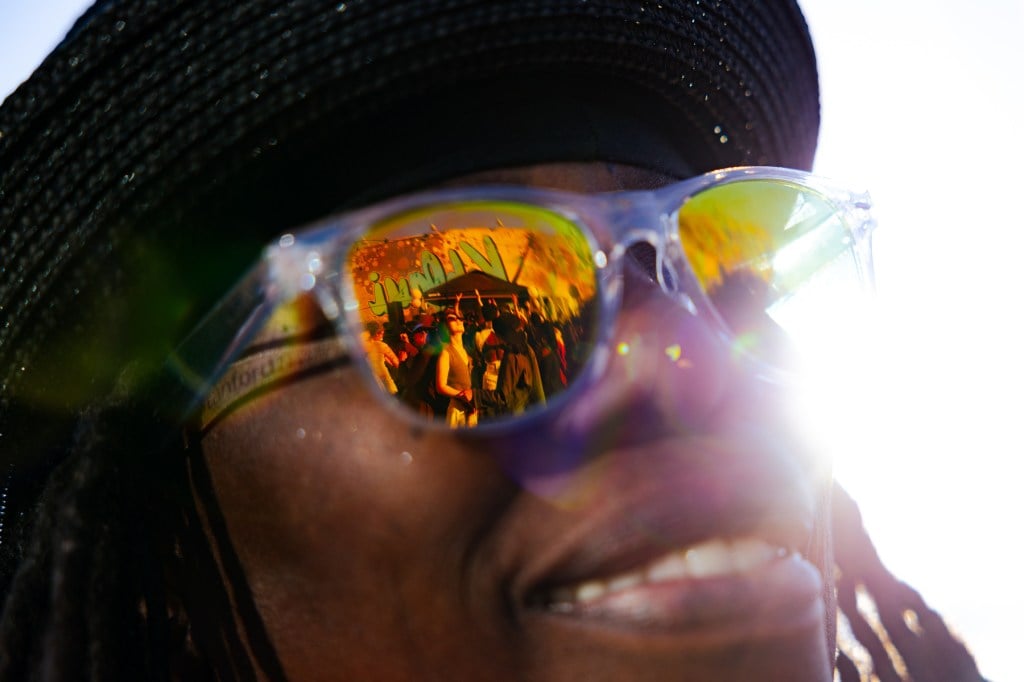
Glitter sparkles across people and surfaces, rainbow-colored acrylic nails snap in time to the Afrobeat, and boisterous cheers egg on the occasional dance floor death drop. These are moments that make up spaces created for and by queer and trans people of color (QTPOC). From Los Angeles to Philadelphia, New York City to Atlanta, queer community organizers, DJs, musicians and artists are producing monthly pop-up events that attendees and organizers say are reimagining queer liberation through collective joy.
Events range from underground warehouse raves like Hood Rave in Los Angeles to sunlit day parties and potlucks featuring patio yoga. Regardless of format, the trappings of queer life and culture are evident everywhere you look — necklaces made of popper bottles; chest harnesses as fashion; flags; fans; cheeky political statements across nails, hats and tees. The recognition of Black and Brown queer experiences is often apparent in event titles, like New York City’s notorious Papi Juice dance party and Los Angeles’ weekly Toxica event for sapphic Latine queers.
These parties also frequently double as advocacy work, where they highlight mutual aid campaigns, promote queer causes and spread political awareness. In recent years, DJ shouts of “Free Palestine” are frequently met with affirmative cheers from dance floors dotted with keffiyehs and watermelon imagery. QTPOC parties are also changing the tunes of gay nightlife from the pop/EDM/disco variety to a musical mix of hip-hop, trap, house, reggaeton, soca and Afrobeats.
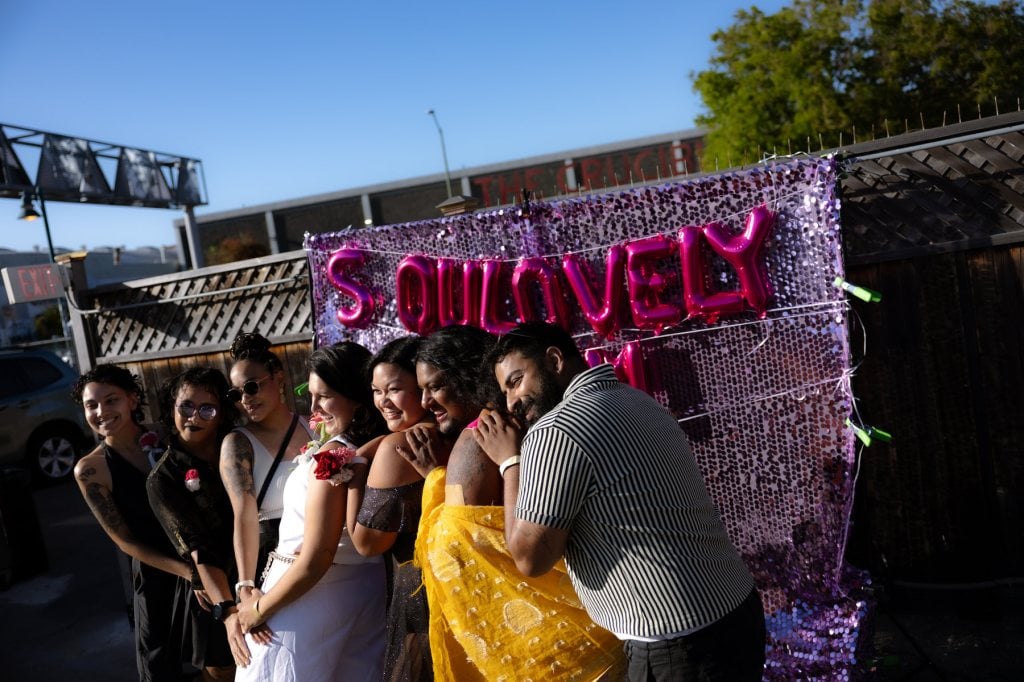
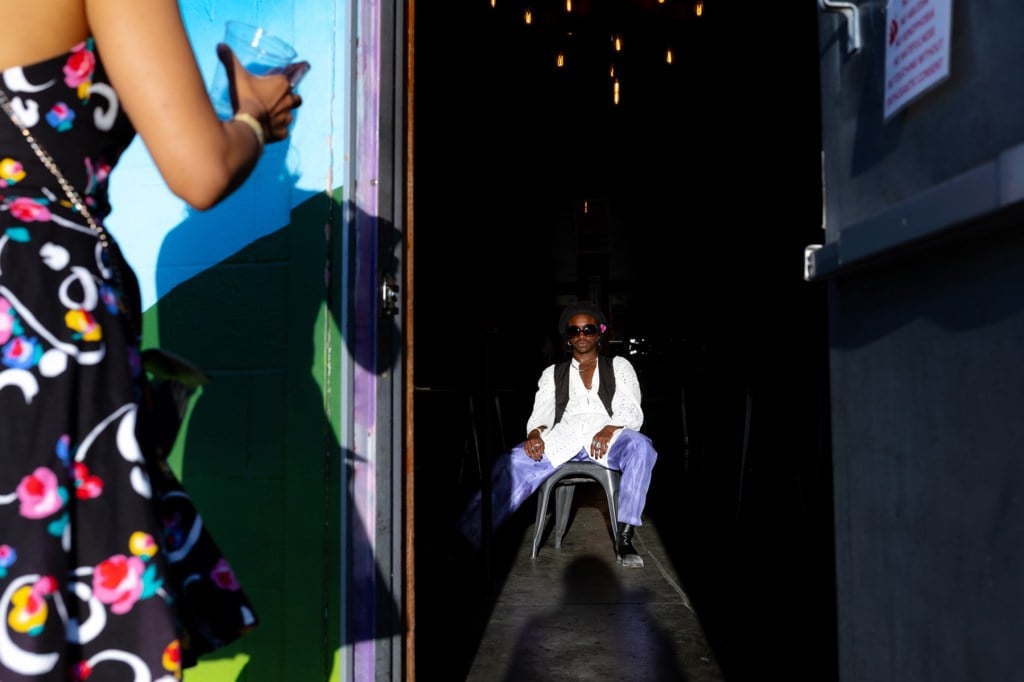
“Everybody is able to see themselves in the music and feel safe here,” said Terri Flamer, who attended the Soulovely prom in Oakland, California, in May. “That’s probably the best thing about it, is you’re safe to be yourself, you can party, you meet people that don’t look like you and it’s all love.”
Queer dance parties also enable the ecstatic experience of group dance, which can be understood as its own form of activism. Maya Bhardwaj, a scholar studying the global influx of such parties in the last decade, called them queer utopias that center: “healing, mental health, ancestral faith practices, queer Black and Brown music and dance traditions, and spaces for activists and cultural workers to gather beyond mainstream bars and nightlife.” Mission statements from QTPOC dance party organizations often invoke terms like “affirmation,” “celebration” and “sustaining.“
While queer nightlife as a space of resistance isn’t new — it has its roots in AIDS activism of the ’80s — the intersectional community building and intention brought to crafting these spaces makes the current slate of QTPOC parties feel fresh. Often exclusionary White male gay spaces are frequently the only options for LGTBQ+ nightlife, and the pop-up event has become a go-to to address a lack of gatherings that feel welcoming to QTPOC folks.
There’s this sense of pain shared among QTBIPOC […] and therefore the joy that is experienced at these parties feels more necessary, more dire and more of a relief.”Nicole Prucha
Pop-up spaces provide “a feeling of safety in being able to trust that the people who are there have experienced or understand what it is like to be othered, in a sense apart from our sexuality,” said performance studies scholar Nicole Prucha about her experience attending Los Angeles QTPOC parties. As a queer Arab person who has often struggled to find places where she feels truly seen, Prucha said parties like Casual, Hot Pot and its sister event HabibiPot fill a vital need for queer people of color: “A place of refuge and queer world-building” at a time when LGBTQ+ rights are under attack.
Terri Flamer attends Soulovely’s prom, held in the 14th season of Oakland’s QTPOC-centered monthly party. (Manuel Orbegozo for The 19th)
Event organizers are often working with limited resources amid challenging financial situations. Five queer BIPOC coordinators — Kike Ayorinde, Camryn Casey, Madi Dalton, dRi Guillén and Leslie Tellería — produce community-funded Lavender Evolutions (LE) events in D.C., and the ticket sales for each event contribute to the next event. In a collective statement, the organizers shared that they are largely unpaid but, “We do give core organizers small payments to cover things like gas, food during events, and the many hours of labor leading up to an event.” The LE organizers acknowledge that “money is a huge barrier and we could always use more of it, but for us, it’s more important that we have events that are financially accessible.”
They keep ticket prices below $25 to achieve that aim but struggle with the financial load of creating these pop-up spaces. The organizers say they are often unable to meet the market rates of DJs and other collaborators due to tight budgets, while logistical support frequently comes from community members willing to volunteer their time to assist with check-in and ticketing. Another challenge they face is making their work in building queer community attractive to funders. “Grant makers don’t always understand the scope of the work that we do and why it’s so important, especially in this moment,” organizers said.
Despite the challenges, organizers said the work is worthwhile. “We do experience burnout but we rely heavily on the collective,” the organizers said. “More than anything, we prioritize people. For our core organizers, it’s a delicate balance because our time and energy is limited. We’re all balancing our full-time jobs, life and Lavender, but the love of community keeps us going.”
They need us, we need them. It’s not always about the bottom dollar, sometimes it’s about building community and the dollars come after.Sgt. Die Wies
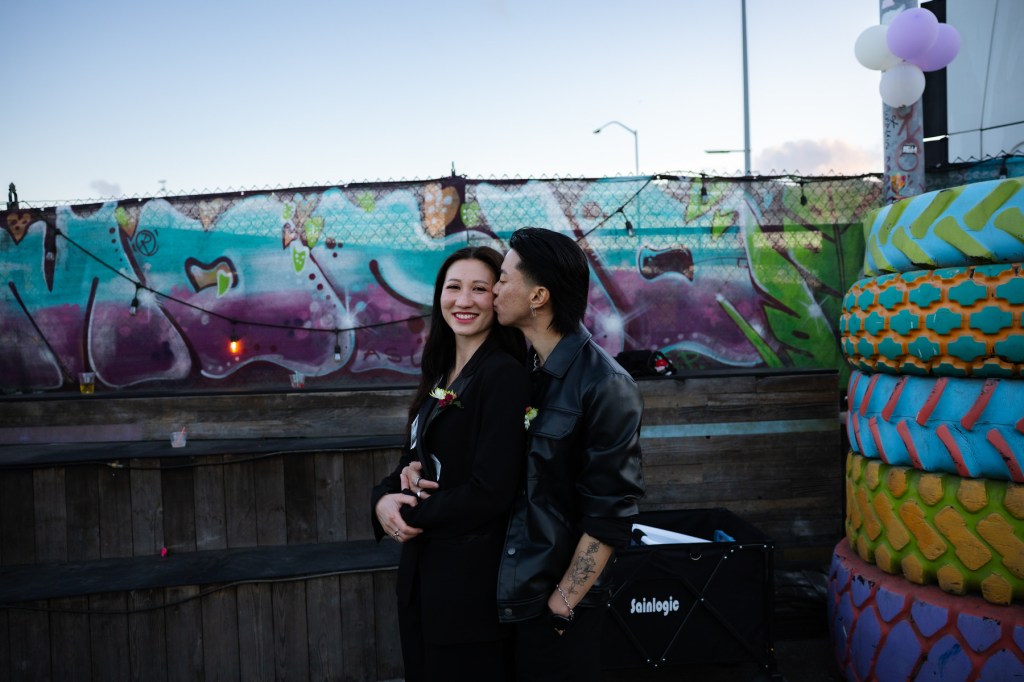
The 19th sent photographers to queer pop-up parties and events in Oakland, Washington, D.C., and Atlanta to show these spaces of radical queer joy in action and highlight the work that queer organizers are doing to build QTPOC community across the country.
OAKLAND
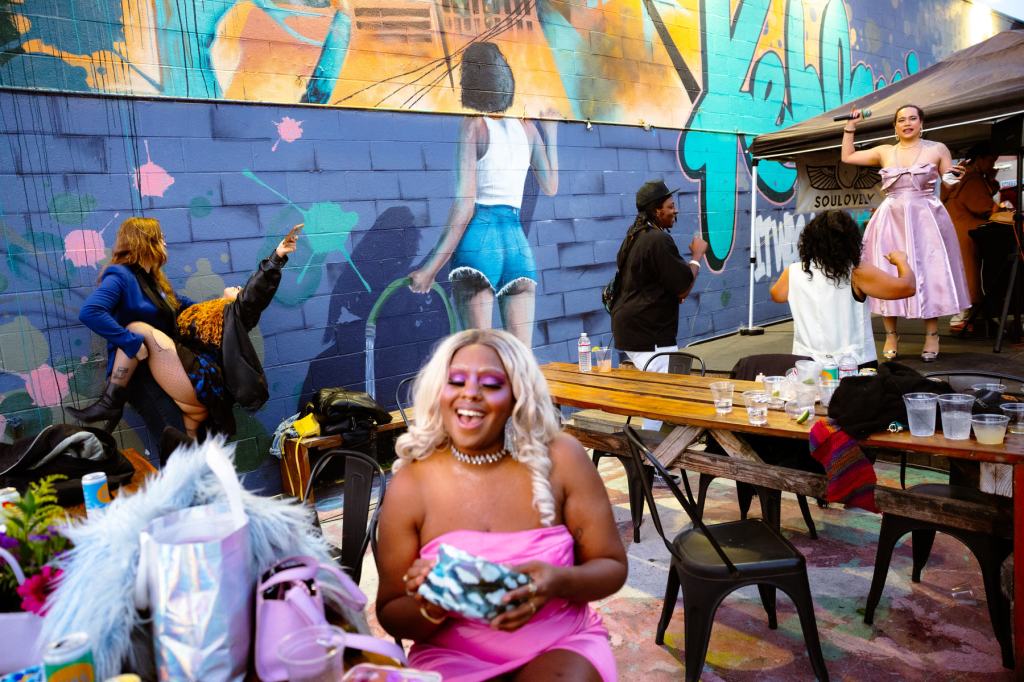
Soulovely has brought QTPOC-centered “cultural affairs” to the Bay Area for 14 years
Many attendees of Soulovely’s prom said it was a first for them, providing queer and trans people of color (QTPOC) an opportunity to attend a prom in a safe and community-based setting. (Manuel Orbegozo for The 19th)
Soulovely is a beloved and long-lasting pillar of queer life in the Bay Area. Since 2011, its monthly events have served as a safe haven for a predominantly BIPOC queer community to celebrate their identities and bodies through music and dance. “I actually just found out that a loved one passed. So coming here was kind of like in honor of them as well, because they love to dance, I love to dance, we met out dancing — it brings people together,” said Mello-Jahlil Travis, who attended Soulovely in May.
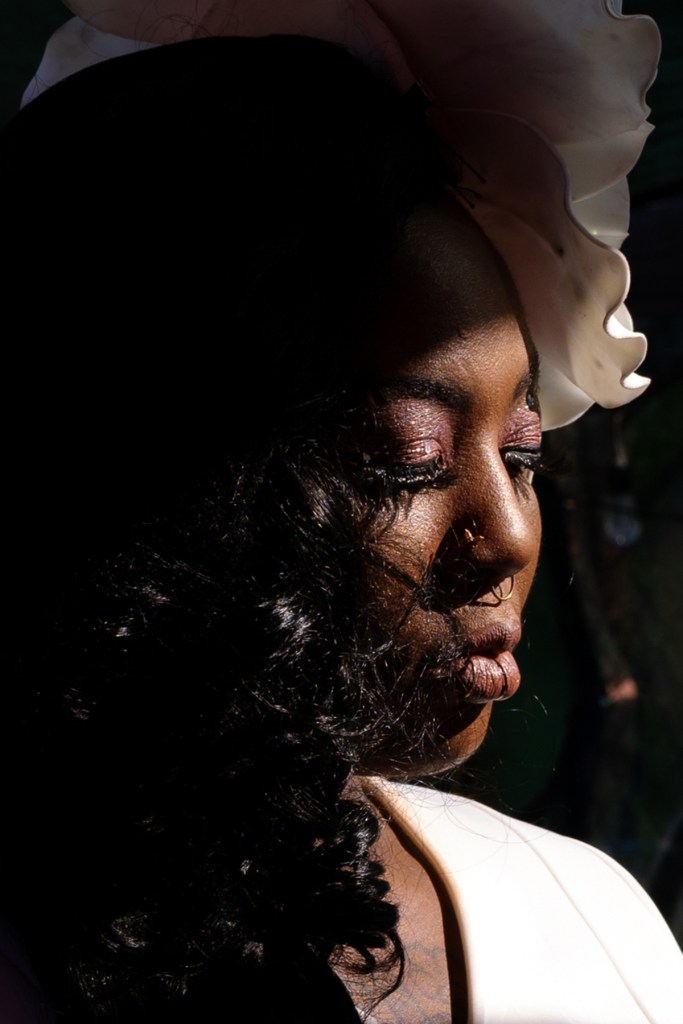
Burlesque producer and performer Sgt. Die Wies attended the Soulovely queer prom on May 11 and says she thinks the space provides an opportunity to be “solution-based versus just focusing on the negativity. “ (Manuel Orbegozo for The 19th)
Attendees and organizers both are often quick to point out these spaces are not about excluding White, straight or otherwise non-QTPOC people. Rather they are about radical inclusion and belonging. Sgt. Die Wies, a burlesque producer and performer who attended the Soulovely queer prom in May, said that the party is all ages with a variety of ethnicities coming out to be together:“It’s beautiful to see because there’s so much division in the world right now.”
Mello-Jahlil Travis (they/them) said the Soulovely Prom gave them an opportunity to have a different prom experience. “I’m stoked to be here amongst other beautiful queer people. It’s important to be able to see people who look like you be themselves and feel free. There’s not everywhere that I feel like I can have my nails painted and dress like this. It’s dope to be around people who can receive that.” (Manuel Orbegozo for The 19th)
While all are welcome, Jaycee Chang especially appreciates the way Soulovely centers queer and trans people of color. “It is both a space of joy and being a community but also, it’s a relatively politicized space where they’re very intentional about the artists that they bring in, the DJs, the themes,” Chang said.
And that can even extend to their families.
“One of the DJs who helped host HabibiPot [in Los Angeles], her mom was there to watch her first DJ set and she played Arab classics that my own mom had introduced me to,” Prucha said. “They’re both Palestinian, and her mom was there, standing on the tables with the rest of us, and she was crying because she was so happy that her daughter was there and had found community.”
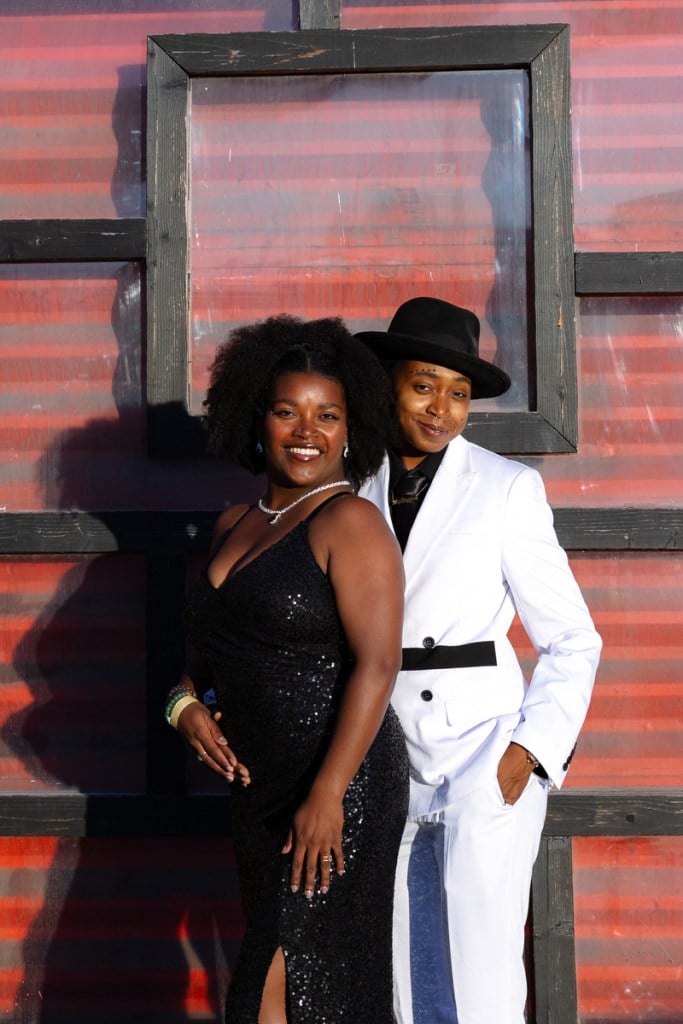
Tiara Reed (left) met her now-fiancée Chenelle Reed (right) at a Soulovely event and said “it’s so significant to have spaces where unapologetic joy and levity and freedom are welcome and everyone can just bask in it.” (Manuel Orbegozo for The 19th)
These spaces also provide opportunities for LGBTQ+ people to meet each other beyond dating apps. A 2020 Pew Research Center study reported that lesbian, gay and bisexual people were both more likely to use online dating and more likely to experience harassment through dating apps than their straight counterparts.
Soulovely is always part of our story.”Chenelle Reed
Ahn Lee feels safe at Soulovely parties because harassment is far less likely. “I feel like no one’s gonna try to come at me in a way that doesn’t feel comfortable,” Lee said.
Since 2011, Soulovely events have provided a safe haven for the queer BIPOC community in the Bay Area. (Manuel Orbegozo for The 19th)
And for others, like Tiara Reed and Chenelle Reed, Soulovely has become a character in their love story. Reflecting on the experience of meeting her now-fiancée, Tiara, at Soulovely and their future together, Chenelle said, “It’s going to be absolutely beautiful, because we have places like this … where you can connect and learn that anything is possible, family in all the ways is possible.”
Jaycee Chang (they/them, right) with their partner Ahn Lee (she/they, left), has been coming to Soulovely for over a decade. Chang said: “Even when the world is chaotic and there’s a lot of harm happening, we can come together as a community and create spaces that feel like refuge, like safety.” (Manuel Orbegozo for The 19th)
ATLANTA
Southern Fried Queer Pride builds QTPOC community through education and embodied healing
Grassroots collective Southern Fried Queer Pride (SFQP) — now in its 11th year — focuses its events toward “artivism” with a stated mission to fight narratives that confine Southern LGTBQ+ people to “stigma, statistics and struggle” instead aiming to uplift an “honest narrative of resilience, rich history and vibrance.” SFQP offers year-round programming, typically providing between 40 to 60 events that feature community education — like the upcoming trans health care workshop — as well as gallery shows, marches and dance parties, such as its June trans cabaret and open mic.
Maya Wiseman (left) and Magdalena (right) have both volunteered for SFQP for years and say organization offers a space of respite and community connection for them. (Piera Moore for The 19th)
Community organizer Maya Wiseman said the May 18 SFQP Community Potluck was an alcohol-free and masks-required event to further expand on their inclusiveness, which has become a hallmark of SFQP events. “Queer folks have been marginalized throughout time, but often queer folks, whether they know it or not, naturally end up creating safe spaces for everyone,” said Wiseman, who has worked with SFQP as a community organizer for six years. “We try to create spaces that say ‘come as you are,’ because we’re not having this at a club. If you want to come here in pajamas, in a tank top and shorts, it’s fine with us.”
Southern Fried Queer Pride offered yoga at its May 18 community potluck in Atlanta. (Piera Moore for The 19th)
Atlanta’s queer community is very easy to navigate, and SFQP is a big reason why.”Magdalena
WASHINGTON, D.C.
Lavender Evolutions and Alphabet Soup make space for QTPOC joy at summer day parties
Alphabet Soup Events uses a tiered ticket pricing system that recognizes the systemic financial issues queer and trans people of color face to increase racial diversity across its attendees. (Mariah Miranda for The 19th)
While not explicitly centering QTPOC, Alphabet Soup events, like the recent Daisy Dykes pool party, are “sapphic-focused” and find other ways to make their events inclusive and accessible for queer people of color. Tickets are available at different price tiers, with some lower-cost tickets allotted for BIPOC attendees.
A couple dances together at a pool party by Alphabet Soup Events. (Mariah Miranda for The 19th)
Adu Ogbagiorgis has witnessed a big shift in the racial makeup of Alphabet Soup parties after the organizer started this pricing practice, which they see as a welcome recognition that “Black queers have a different experience than White queers.” For Ogbagiorgis, this approach to ticketing shows they want people of color to come to the events. “So it’s really awesome to see that a lot of more predominantly White spaces are making space for Black queers,” they said.
Mackenzie Bolden said they can be themselves at Alphabet Soup events. “I feel like I can just embrace my skin, embrace my personality, embrace my queerness, embrace everything that is me. And that’s something I treasure and will never take for granted because of how often I don’t feel that way.”
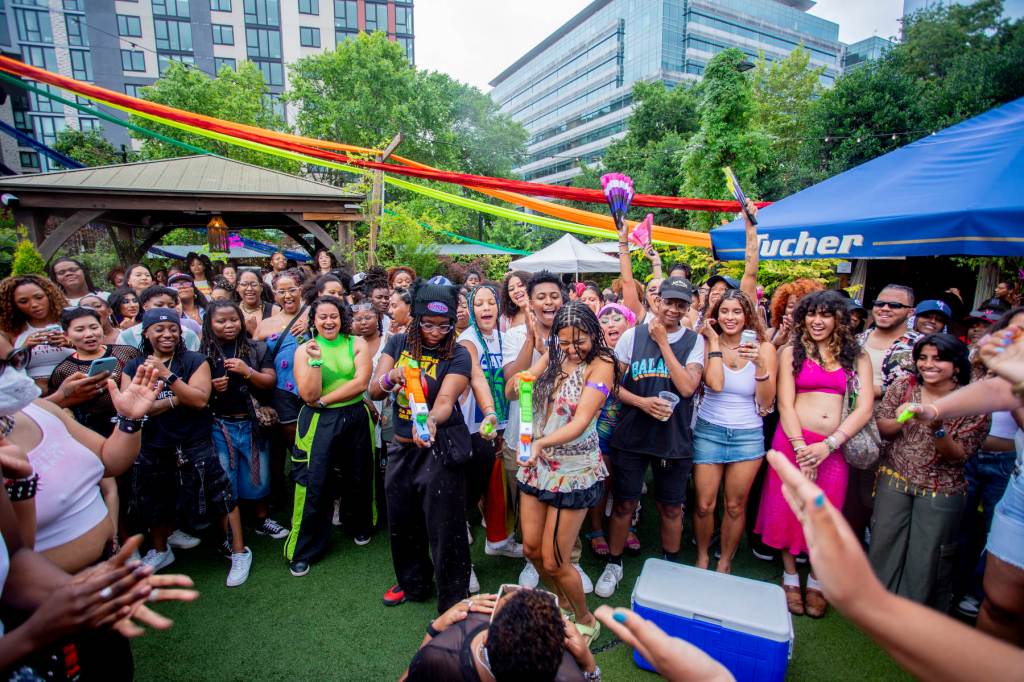
Lavender Evolution’s SWEAT party featured a wet t-shirt contest at on June 8 in D.C. (Mariah Miranda for The 19th)
Lavender Evolutions hosted a daytime beer garden pop-up called SWEAT on June 8 that featured a wet T-shirt contest, a water balloon toss and little cabanas filled with the sounds of multiple kikis.
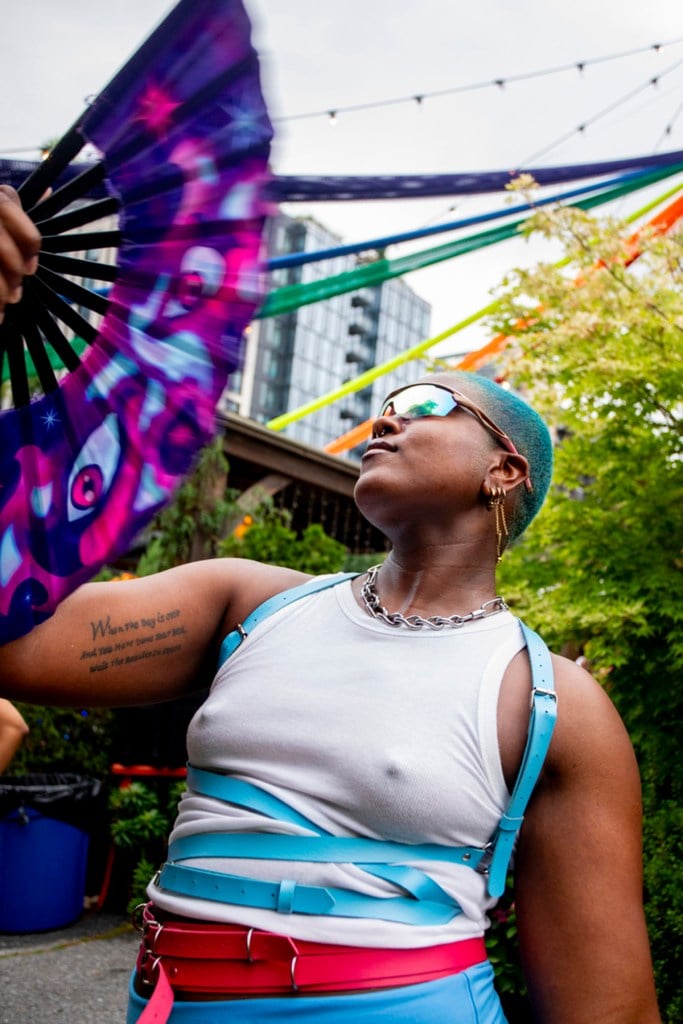
Ciara Bridges whips out their fan while attending Lavender Evolution’s SWEAT party in D.C. on June 8. (Mariah Miranda for The 19th)
Jojo Morinvil, who attended the SWEAT party, deeply values the way Lavender Evolutions has been intentional in their creation of space for queer BIPOC people to enjoy themselves. “They started out doing nature walks and book [clubs], then, as they grew, they really created safer spaces for folks to socialize, to get to know people and learn queer history, [along with] events where you can dance and party with your friends,” Morinvil said.
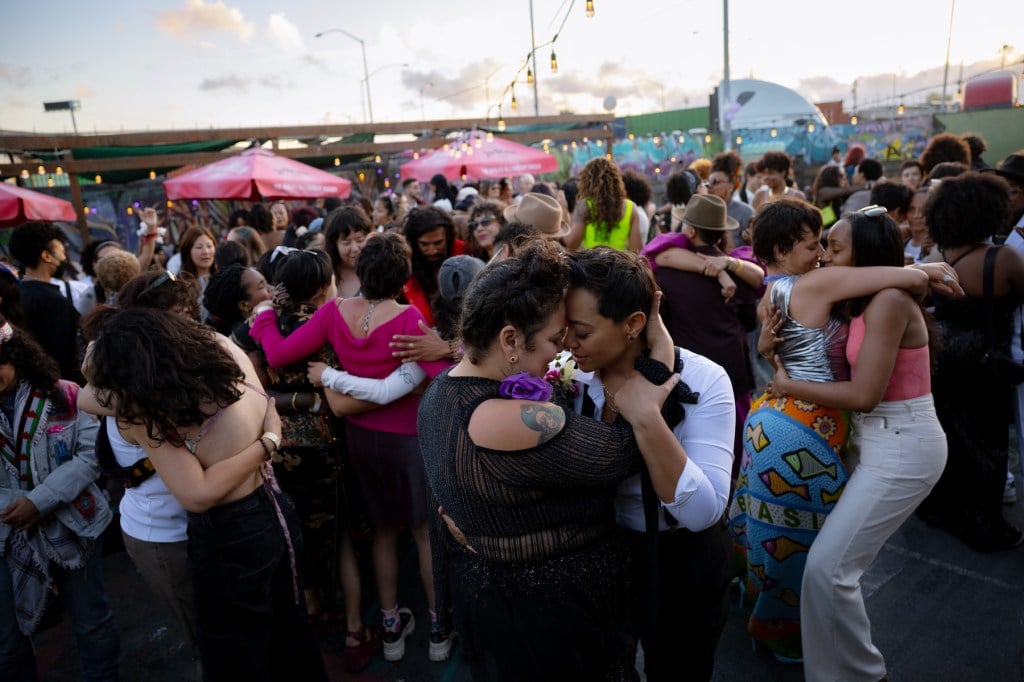
Couples and friends slow dance at Soulovely’s queer prom in Oakland on May 11. (Manuel Orbegozo for The 19th)
I truly believe that being whimsical will crush the patriarchy.”Sgt. Die Wies
Sgt. Die Wies points to the unabashed vibrance, love and joy experienced at parties like Soulovely as “things (that) are going to just crush the darkness. We’ve survived harder times than this. We’ve been bullied before. They ain’t got shit on us. There’s too many of us. There’s too much light and too much love and too much joy. We’ll be okay.”
Mariah Miranda, Piera Moore and Manuel Orbegozo contributed reporting.
June 25, 1948 The United States, Great Britain and France began the Berlin Airlift of food and supplies to the German city in defiance of the Soviet Union’s blockade of the roads. At the height of the Airlift, two groups of planes flew in four-hour blocks around the clock.While one group of aircraft was loaded and serviced, the other group was in the air. On the 264-mile route, 32 aircraft were in the air simultaneously. Supplies would be quickly unloaded and the aircraft would return for more food, fuel and other necessities for the 2.5 million West Berliners. It was the most ambitious aerial supply operation in history. The Soviet blockade was not lifted until the following May but the airlift continued for four months more. Berliners watch a plane involved in the Berlin Airlift bringing food and supplies About the Berlin Airlift
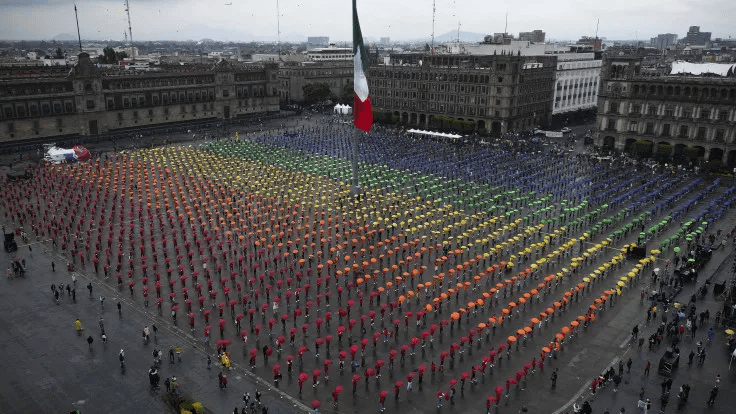
In celebration of Pride Week, more than five thousand LGBTQ+ activists converged on Mexico City’s Zócalo to form the world’s largest human LGBT flag. Under a shower of rain and brandishing vibrant umbrellas, the colorful formation draped the historic Plaza de la Constitución, capturing global attention and shattering previous records.
Mexico City Mayor Clara Brugada joined the crowd led the choreography. She said during the event that “Mexico City is and will continue to be the city of rights and freedoms. This monumental image we draw with our bodies and colors will be a powerful message to the country and the world. Mexico City is the capital of pride, diversity, peace, and transformation.”
Queer History 745: Patricia Highsmith – The Brilliant Fucking Architect of Queer Hope by Wendy🏳️⚧️🏳️🌈🌈 Read on Substack
In the suffocating landscape of 1950s America, when being queer could land you in a mental institution, prison, or worse, one woman sat down at her typewriter and decided to tell the truth. Patricia Highsmith didn’t just write a fucking love story—she carved out a piece of literary real estate where lesbian love could exist without punishment, where two women could find each other and actually keep each other. In a world determined to erase queer joy, she smuggled hope onto bookshelves disguised as pulp fiction.
But let’s not paint Highsmith as some sanitized literary saint. This woman was complicated as hell, brilliant as fuck, and carried enough psychological baggage to sink a goddamn ship. She was an alcoholic, a recluse, and often cruel to the people who loved her. She was also one of the most important queer voices of the 20th century, whether she wanted that label or not. Her story isn’t just about one woman’s struggle with her sexuality—it’s about the price we all pay when society forces us to live fractured lives, and the revolutionary act of refusing to let that fracture define us.
The Making of a Literary Badass
Mary Patricia Plangman was born in Fort Worth, Texas, on January 19, 1921, into a world that would spend the next several decades trying to convince her that everything she was constituted a crime against nature. Her parents, Jay Bernard Plangman and Mary Coates, divorced before she was born, and her mother married Stanley Highsmith when Patricia was three. The family moved to New York, where young Patricia would grow up surrounded by the kind of suffocating heteronormative expectations that could drive anyone to drink—and eventually did.
From childhood, Highsmith knew she was different, and not in the precious, special-snowflake way that adults like to romanticize. She was different in the way that made her feel like she was constantly walking on broken glass, knowing that one wrong step could cut her to pieces. She was attracted to women in an era when that attraction was classified as a mental illness, when “treatments” ranged from electroshock therapy to lobotomies. The psychological pressure of living with this secret would shape not just her personal relationships but every fucking word she ever wrote.
At Barnard College, Highsmith studied English literature and began to understand that stories could be weapons—tools for survival in a hostile world. She was already writing, already crafting the psychological precision that would make her famous. But she was also falling in love with women, conducting relationships in shadows and whispers, learning the exhausting choreography of the closet that would define her entire adult life.
After graduation, she moved to Greenwich Village, ostensibly to pursue her writing career but really to find some semblance of community among other artists and outcasts. The Village in the 1940s was one of the few places in America where queer people could exist with some measure of freedom, though even there, the threat of police raids and social destruction loomed constant. Highsmith found work writing for comic books, including scripts for Captain America and other superheroes—ironic, considering she was creating stories about characters who could live openly as their authentic selves while she remained trapped behind a mask of heterosexual respectability.
The Birth of Lesbian Literary Revolution
In 1951, while working at Bloomingdale’s during the Christmas rush—because even future literary legends had to pay rent—Highsmith had an encounter that would change queer literature forever. She served a beautiful blonde customer buying a doll for her daughter, and something about the interaction sparked what would become “The Price of Salt.” Later, walking through the city, Highsmith felt what she described as a “strange happiness” and knew she had to write this story.
But let’s be clear about what she was attempting: in 1952, lesbian novels ended one of two ways—with the queer character dying or going insane. Those were the only narratives society would tolerate. Happy queers were not allowed to exist in fiction because they weren’t allowed to exist in real life. Publishers, critics, and readers had been thoroughly conditioned to expect punishment for sexual deviance. A lesbian love story with a happy ending wasn’t just revolutionary—it was practically seditious.
Highsmith wrote “The Price of Salt” under the pseudonym Claire Morgan because she knew that attaching her real name to a lesbian novel would be career suicide. Even with the pseudonym, the book was relegated to the pulp fiction ghetto, sold alongside other “deviant” literature in bus stations and drugstores. The literary establishment wouldn’t touch it with a ten-foot pole, and most critics dismissed it as sensational trash designed to titillate straight male readers.
They were wrong, and they were missing the fucking point entirely.
“The Price of Salt” tells the story of Therese Belivet, a young woman working in a department store who becomes infatuated with Carol Aird, an elegant older woman going through a divorce. What follows is a love story that unfolds with the psychological complexity and emotional honesty that would become Highsmith’s trademark. But more importantly, it’s a love story where both women survive, where love is possible, where the ending doesn’t require sacrifice or punishment.
The novel found its audience despite the literary establishment’s best efforts to ignore it. Queer women passed dog-eared copies between friends, smuggled them in suitcases, hid them between mattresses. For the first time, they could read a story where people like them weren’t doomed, where lesbian love wasn’t portrayed as inherently tragic or destructive. The psychological impact was immeasurable—here was proof that queer happiness was possible, that their desires weren’t automatically poisonous.
The Psychological Architecture of Survival
Understanding Highsmith’s impact on LGBTQIA+ people requires understanding the psychological landscape they were navigating in mid-20th century America. This was an era of institutionalized homophobia so complete and systematic that it’s hard to imagine from our current perspective. Homosexuality was classified as a mental illness. Same-sex relationships were illegal in every state. Queer people were barred from government employment, discharged from the military, subjected to police harassment, and often rejected by their families.
The psychological effects of living under this kind of systematic oppression were devastating. Queer people internalized shame, developed elaborate systems of concealment, and often struggled with depression, anxiety, and suicidal ideation. The absence of positive representation in media and literature reinforced the message that queer love was inherently destructive, that happiness wasn’t possible for people like them.
Into this psychological wasteland, Highsmith dropped a fucking bomb of hope.
“The Price of Salt” didn’t just tell queer women that love was possible—it showed them what that love might look like. Carol and Therese weren’t tragic figures destroyed by their desires; they were complex, flawed, human women who found each other and fought to stay together. The novel’s ending, with Therese choosing Carol over societal expectations, was nothing short of revolutionary.
But Highsmith’s psychological insight went deeper than just providing positive representation. She understood the specific ways that homophobia warped relationships, the paranoia and secrecy that poisoned even the most genuine connections. Carol’s ex-husband uses their daughter as leverage, threatening to take the child away if Carol doesn’t renounce her “perversion.” The constant threat of exposure hangs over every tender moment, every stolen glance, every whispered conversation.
This wasn’t melodrama—this was documentary realism for queer people living in the 1950s. Highsmith captured the specific psychological toll of living in the closet, the way fear could poison love, the exhausting vigilance required to maintain a double life. But she also showed that despite all this, love could survive, relationships could endure, happiness was fucking possible.
The Ripple Effects: How One Book Changed Everything
The immediate impact of “The Price of Salt” was profound but largely invisible. Queer women didn’t write letters to newspapers praising the book—that would have been social suicide. Instead, they quietly bought copies, passed them along to friends, and felt something shift inside themselves when they read about Carol and Therese’s love story.
Dr. Eli Coleman, a sexologist who has studied the impact of literature on LGBTQIA+ identity formation, argues that positive representation in fiction serves a crucial psychological function for marginalized communities. “When people see themselves reflected positively in stories,” Coleman explains, “it validates their experiences and provides a roadmap for possibility. For queer people in the 1950s, who had almost no positive representation anywhere, a novel like ‘The Price of Salt’ could literally be life-saving.”
The psychological impact extended beyond individual readers to the broader cultural conversation about homosexuality. While the book didn’t immediately change mainstream attitudes—that would take decades—it planted seeds that would eventually bloom into the gay rights movement. Young people who read Highsmith’s novel grew up with the revolutionary idea that queer love didn’t have to end in tragedy, that happiness was possible for people like them.
This shift in narrative possibilities had profound philosophical implications. If queer love could be portrayed as beautiful, complex, and worthy of a happy ending, then the entire moral framework that condemned homosexuality began to crack. Highsmith wasn’t just telling a love story—she was challenging the fundamental assumptions that justified queer oppression.
The Complex Psychology of Patricia Highsmith
While Highsmith was creating revolutionary representation for other queer people, her own relationship with her sexuality remained deeply complicated. She never publicly came out, never became an activist, and often seemed uncomfortable with the idea that “The Price of Salt” had become a touchstone for lesbian readers. This wasn’t just garden-variety internalized homophobia—though that was certainly part of it—but a complex psychological response to a lifetime of navigating hostile territory.
Highsmith’s personal relationships were often tumultuous and self-destructive. She drank heavily, maintained emotional distance even from intimate partners, and seemed to prefer the company of her numerous cats to most humans. Friends and lovers described her as brilliant but difficult, generous but cruel, capable of profound empathy and stunning callousness sometimes within the same conversation.
This psychological complexity was both a source of her literary genius and a reflection of the damage caused by a lifetime in the closet. Highsmith had spent so many years concealing her true self that authenticity became nearly impossible. She developed what psychologists call “minority stress”—the chronic psychological tension experienced by stigmatized groups who must constantly monitor and modify their behavior to avoid discrimination.
The effects of minority stress on LGBTQIA+ individuals are well-documented: higher rates of depression and anxiety, difficulty forming intimate relationships, substance abuse, and a persistent sense of alienation from mainstream society. Highsmith exhibited many of these symptoms throughout her life, but she also channeled that psychological complexity into her writing, creating characters whose inner lives were as intricate and contradictory as her own.
Her later novels, including the famous Tom Ripley series, explored themes of identity, deception, and the psychology of outsiders—all subjects she knew intimately from her own experience as a closeted lesbian. While these books weren’t explicitly queer, they were infused with the psychological insights that came from a lifetime of living on society’s margins.
Social Impact: Cracking the Foundations of Heteronormativity
“The Price of Salt” didn’t exist in a vacuum—it was part of a slowly building wave of cultural change that would eventually reshape American attitudes toward sexuality. But Highsmith’s contribution was unique in its subtlety and psychological sophistication. Unlike the explicitly political gay rights literature that would emerge in later decades, her novel worked by stealth, smuggling queer humanity into mainstream consciousness through the back door of popular fiction.
The book’s classification as pulp fiction was actually crucial to its impact. While “serious” literature was consumed primarily by educated elites, pulp novels reached a much broader audience. Working-class people, teenagers, small-town residents—people who might never encounter openly queer individuals in their daily lives—were reading about Carol and Therese’s love story. The seeds of empathy were being planted in unexpected soil.
This demographic reach had significant social implications. When the gay rights movement began to gain momentum in the 1960s and 1970s, it wasn’t starting from scratch. Thanks to novels like “The Price of Salt,” millions of Americans had already been exposed to positive portrayals of queer relationships. The ground had been prepared, even if most people didn’t realize it.
The philosophical implications were equally profound. For centuries, Western society had constructed elaborate theological and pseudo-scientific justifications for condemning homosexuality. These arguments depended on portraying queer love as inherently unnatural, destructive, and incapable of producing genuine happiness. Highsmith’s novel didn’t engage these arguments directly—it simply rendered them irrelevant by showing that none of them were true.
Carol and Therese’s relationship was portrayed as natural, nurturing, and fulfilling. They weren’t predators or victims, sick or sinful—they were simply two women who fell in love. This narrative simplicity was actually a sophisticated philosophical assault on the entire edifice of heteronormative ideology.
The Continuing Revolution: Highsmith’s Legacy in Contemporary LGBTQIA+ Culture
When “The Price of Salt” was reissued in 1990 under Highsmith’s real name with the new title “Carol,” it found a new generation of readers who could appreciate its revolutionary impact. The AIDS crisis had decimated the gay male community, and lesbian feminism was providing crucial leadership in the broader LGBTQIA+ rights movement. Highsmith’s novel was rediscovered as a foundational text, a reminder of how far the community had come and how much further it still needed to go.
The 2015 film adaptation, starring Cate Blanchett and Rooney Mara, introduced Highsmith’s story to an even broader audience and sparked new conversations about queer representation in media. The film’s lush cinematography and devastating emotional honesty brought Carol and Therese’s love story to life for a generation raised on increasing LGBTQIA+ visibility but still fighting for full equality.
For contemporary LGBTQIA+ people, particularly young people struggling with their sexual or gender identity, Highsmith’s work continues to provide crucial psychological support. In an era of increasing political backlash against queer rights, when transgender youth face legislative attacks and gay marriage remains under threat, the simple existence of stories like “Carol” serves as a reminder that queer love has always existed, has always been beautiful, and has always been worth fighting for.
The psychological impact is particularly powerful for young people from conservative backgrounds or regions where LGBTQIA+ visibility remains limited. Reading about Carol and Therese’s love story can be the first time these individuals encounter the revolutionary idea that their desires are valid, that happiness is possible, that they aren’t broken or sinful or destined for tragedy.
The Philosophical Architecture of Queer Joy
Highsmith’s greatest achievement wasn’t just creating positive lesbian representation—it was constructing a philosophical framework for queer joy that transcended the specific circumstances of her characters. “The Price of Salt” argues, through narrative rather than polemic, that love itself is the highest human value, that authentic relationships matter more than social approval, and that individuals have the right to pursue happiness even when that pursuit challenges conventional morality.
This philosophical stance was radical in 1952 and remains challenging today. American society continues to struggle with the tension between individual freedom and social conformity, between traditional values and evolving understanding of human sexuality and gender identity. Highsmith’s novel doesn’t resolve these tensions—it simply insists that love transcends them all.
The book’s ending is particularly significant in this regard. Therese’s choice to pursue a relationship with Carol isn’t portrayed as a rejection of society or a declaration of war against heteronormativity. It’s simply a young woman choosing love over fear, authenticity over approval, joy over safety. The philosophical implications are profound: if individuals have the right to pursue happiness, and if love between consenting adults is inherently valuable, then society’s objections become irrelevant.
This isn’t the angry politics of later gay liberation movements—it’s something more subtle and perhaps more subversive. Highsmith wasn’t arguing that society should accept queer people; she was arguing that queer people didn’t need society’s acceptance to live full, meaningful lives. The audacity of that position, especially in 1952, cannot be overstated.
The Psychological Legacy: How One Story Saves Lives
The most important measure of Highsmith’s impact isn’t literary criticism or sales figures—it’s the immeasurable number of LGBTQIA+ lives that have been saved by her willingness to imagine queer happiness. In a community where suicide rates remain tragically high, where young people continue to face rejection and violence for their sexual or gender identity, stories matter in ways that straight, cisgender people often struggle to understand.
Dr. Ryan Watson, who studies the relationship between media representation and LGBTQIA+ mental health, explains: “For young people questioning their sexuality or gender identity, seeing positive representation in media can literally be the difference between life and death. When you’re told by your family, your school, your church, and your government that you’re fundamentally wrong or broken, finding stories where people like you are happy and loved can provide the hope necessary to survive.”
“The Price of Salt” has been providing that hope for over seventy years. It sits on countless bookshelves, gets passed between friends, appears on recommended reading lists, and continues to whisper the same revolutionary message to each new generation of readers: you are not alone, your love is valid, happiness is possible.
The novel’s impact extends beyond individual readers to the broader cultural conversation about LGBTQIA+ rights and representation. Every positive portrayal of queer relationships in contemporary media owes a debt to Highsmith’s pioneering work. Every time a young person sees themselves reflected positively in a book, movie, or television show, they’re benefiting from the foundation she laid in 1952.
The Ongoing Fight: Highsmith’s Relevance in Contemporary Struggles
As LGBTQIA+ people continue to fight for full equality and acceptance, Highsmith’s work remains remarkably relevant. The psychological insights she provided about the costs of closeting, the importance of authentic relationships, and the possibility of queer joy continue to resonate with contemporary experiences.
Young transgender people facing legislative attacks and social rejection can find solidarity in Therese’s struggle to live authentically despite social pressure. Gay men navigating family rejection might recognize themselves in Carol’s battle to maintain relationships with her loved ones while refusing to deny her true self. Lesbian couples fighting for the right to parent can draw strength from Carol and Therese’s determination to build a life together despite legal and social obstacles.
The philosophical framework Highsmith constructed—that love transcends social convention, that individual happiness matters, that authenticity is worth fighting for—remains a powerful tool for contemporary LGBTQIA+ activism. While the specific battles have evolved, the underlying struggle between individual freedom and social control continues.
Perhaps most importantly, Highsmith’s work reminds us that representation matters, that stories have power, that the simple act of imagining queer happiness can be a revolutionary force. In an era when politicians and pundits continue to debate the “appropriateness” of LGBTQIA+ visibility, her novel stands as proof that queer people have always existed, have always loved, and have always deserved the chance to pursue happiness.
Conclusion: The Fucking Beautiful Truth
Patricia Highsmith died in 1995, long enough to see some of the changes her work helped create but not long enough to witness marriage equality, widespread LGBTQIA+ representation in media, or the growing acceptance of transgender rights. She remained complicated and contradictory until the end—a brilliant writer who struggled with intimacy, a queer pioneer who never fully embraced that role, a woman who gave hope to millions while often seeming to have little hope for herself.
But her legacy isn’t diminished by her personal struggles—if anything, it’s enhanced by them. Highsmith’s psychological complexity, her understanding of the costs of closeting, her ability to create characters who were both strong and vulnerable, all stemmed from her own experiences navigating a hostile world. She transformed her pain into art, her isolation into empathy, her struggle into a story that continues to save lives.
“The Price of Salt” stands as proof that individual acts of courage can have ripple effects that extend far beyond what their creators ever imagine. When Highsmith sat down to write about Carol and Therese’s love story, she probably thought she was just crafting another novel to pay the bills. Instead, she created a piece of revolutionary literature that challenged fundamental assumptions about sexuality, provided hope to countless individuals, and helped lay the groundwork for the LGBTQIA+ rights movement.
In a world that continues to tell queer people that their love is wrong, that their happiness is impossible, that they should be grateful for tolerance rather than demanding full equality, Highsmith’s novel remains a radical document. It insists that queer love is beautiful, that happiness is possible, that authenticity is worth any price society might demand.
That message, delivered with all the psychological sophistication and emotional honesty Highsmith could muster, continues to resonate with each new generation of readers who discover that they are not alone, that their love is valid, and that despite everything society might tell them, happiness is not only possible—it’s their fucking birthright.
The woman who wrote comic book heroes while hiding behind a mask of heterosexual respectability ultimately became a hero herself, not through superhuman powers but through the simple, revolutionary act of telling the truth about love. In doing so, she proved that sometimes the most powerful weapon against oppression isn’t anger or violence—it’s the audacious insistence that joy is possible, that love conquers all the bullshit society tries to pile on top of it, and that everyone deserves the chance to pursue their own beautiful, complicated, fucking magnificent version of happiness.
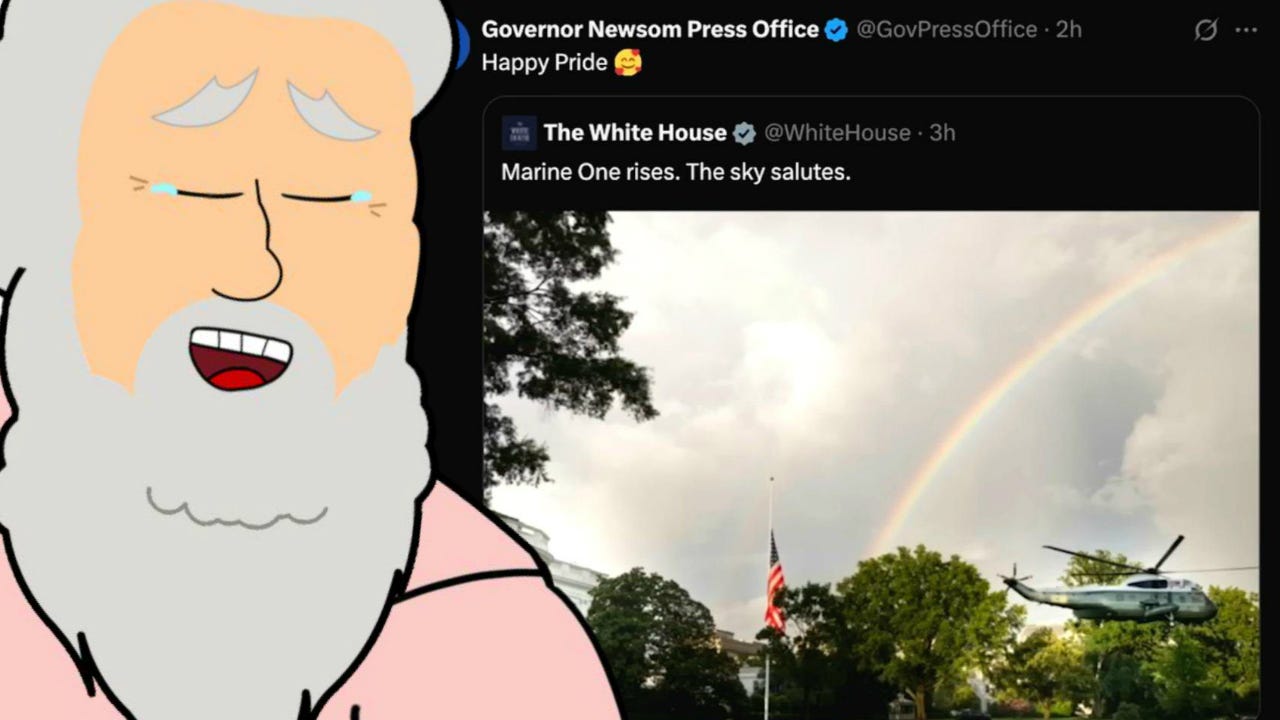
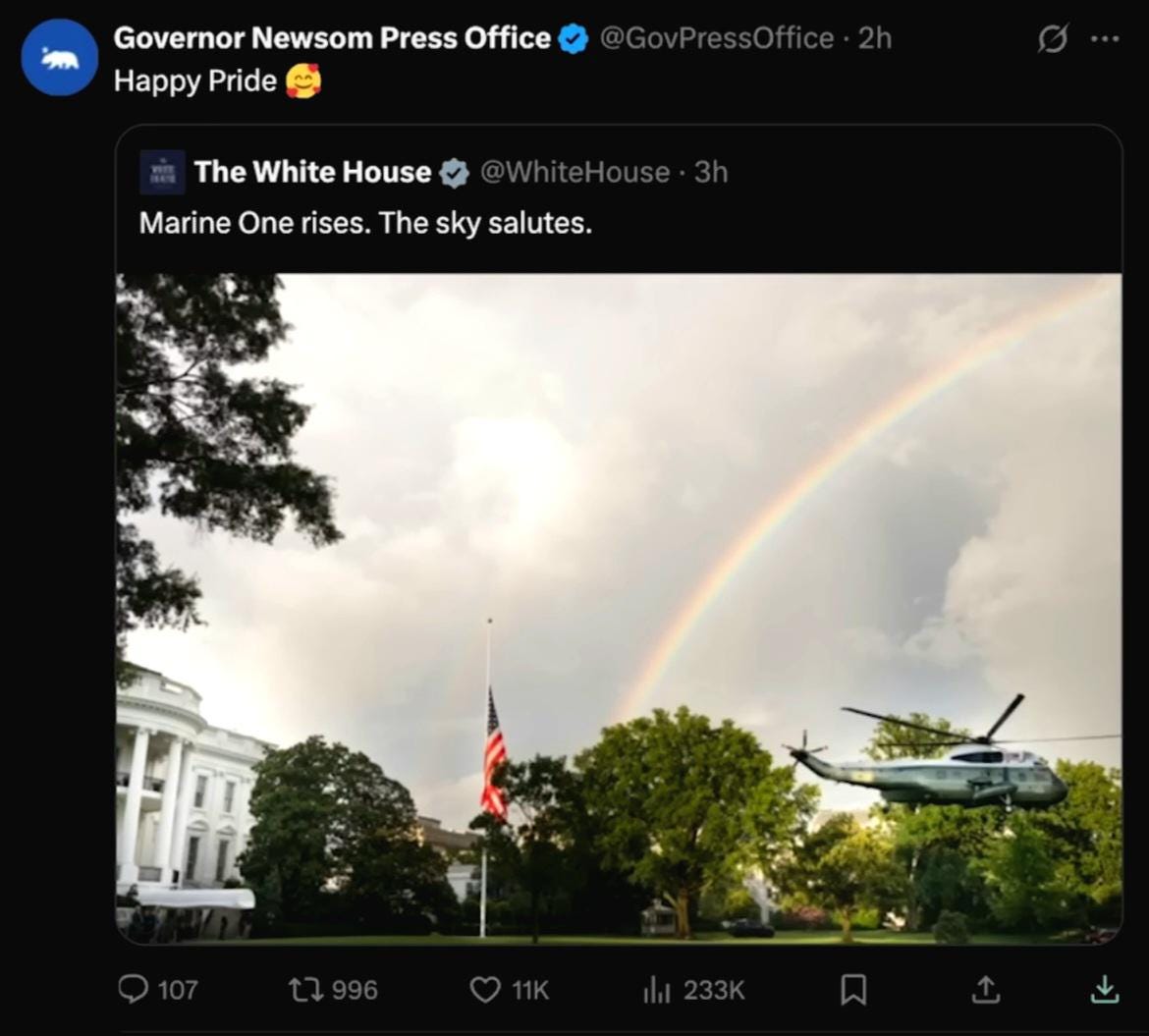
First I sent a thunderstorm to ruin his stupid birthday parade. Now behold! I painted the skies with a rainbow to troll his helicopter for Pride Month!
1. God Hates You, Donold
The White House posted what they thought was a photo showing God’s endorsement: Marine One lifting off with a rainbow in the background.
But as always, the faux-king liars misinterpreted My meaning!
God LOVES LGBTQ+ people!
And I despise that infinite bigot Donold.
Luckily, Gavin Newsom’s press office understood and quote-tweeted it with: “Happy Pride 😌”
2. Their ‘Big Beautiful Bill’ Just Collapsed
Trump’s prized “One Big Beautiful Bill” crumbled in the House.
It was supposed to be his grand legislative comeback. Instead, it got nuked by the parliamentarian.
Now the GOP is in full-blown civil war. Fighting over AI, Medicaid cuts, deficit math, and whose bootlicking is most loyal.
On top of all that, Tangerine Palpatine is raging at Fox News because his poll numbers are in the toilet.
Verily, thou mayest eat shit, Donold.
3. God Bless the ACLU
God bless the ACLU, who just won a unanimous court ruling striking down Louisiana’s ludicrous Ten Commandments law.
Public schools are not Sunday schools. And this court had the guts to say it.
Let it be known: while the cult worships golden idols of Donold and demands state-mandated religion, real Americans are still defending the Constitution.
Before you go, I need to say something important. This part isn’t a joke. It’s about survival. (snip-MORE)