Tuesday Mix

Mewling About Mueller

Prez POS strikes again

Clay Jones


https://www.gocomics.com/heathcliff/2026/03/23


Josh Johnson

Josh Johnson11 hours agoProbably my most requested topic ever. Do your thing for the algo so everyone knows new set will be live premiering Tuesday at 9pm eastern Friends ❤️


Josh Johnson
7 hours agoH i Friends, good news! I am hosting ‪@TheDailyShow‬ this week Tuesday – Thursday. Do your thing for the algo so more people see it. Guests this week are Sterling K. Brown, Mero, and Eiza González. March 24-26 on Comedy Central and Paramount


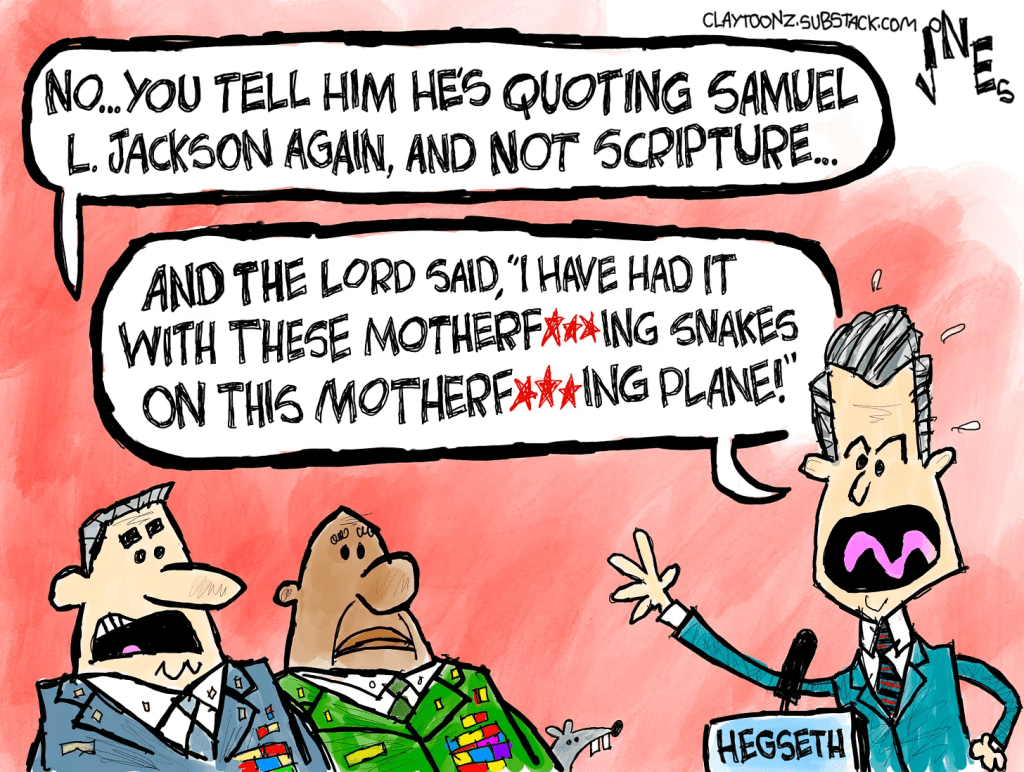
Trump Buys His Cabinet Shoes, And It Goes Horrendously Awry

Maga is a cult.  tRump chose his cabinet on what compromising information he could get on them, either from his own sources or from Putin.  So they dare not disobey him even to the point of humiliating themselves.  Hugs

There’s Danger On The Right

Right-Wing Women Discover Misogyny Not As Fun As They Thought Part 378,272,347,230,326

The red pill, it turns out, is filled with rat poison.

Robyn Pennacchia Mar 13, 2026

I realized recently that it’s been a while since we’ve seen an incel mass murderer. Because, really, for a time there, it seemed like something of an endless parade of angry young men going on murder sprees over not being able to get laid. It occurred to me the reason for this may be that, while they’re probably still not getting laid, they’re certainly less alone now. “Incel culture” has become mainstream on the Right. They hate women like incels. They talk like incels. Terms like “foid” (short for “femoid” or “female android”), “looksmaxxing,” “______ mogged,” “the wall” have entered their lexicon. Many of them are straight up turning themselves into incels just by hating women and various other groups of people so much that they are repulsive to women.

These days, they don’t have to go to dark corners of the internet in order to share their insane theories about women, to be told by other men that they are inherently superior to women, that women are crazy and evil and that giving them rights has ruined everything. They just have to go over to X The Everything App or to YouTube or, you know, listen to a sizeable majority of the mainstream male Republican pundits.

There are even more than a few women they can listen to. Women who will gladly tweet and stream and podcast all about how they think feminism and the sexual revolution ruined everything for women as well, who will even claim they want to #RepealThe19th because of how stupid and crazy we all are.

But that sort of pretense isn’t easy to maintain, especially once it’s no longer serving you. Thus, we’ve increasingly seen stories about alt-right women defecting from the movement after they have “seen the light” and suddenly come to realize that these men don’t actually like them, either. This week, we’ve got one in New York mag.

They all have pretty much the same story at this point. They fell into all of it because they were mad about “woke scolds” and thought it was cool and rebellious to embrace far-right ideology, because they enjoyed the attention they got for repeating anti-feminist talking points and maybe even believed that they’d rather be stay-at-home moms — literally nothing wrong with that! No one cares! Go and be well! — or that working instead of raising children was making women “crazy.” Then they realized, at some point — whether because they ended up in a pretty bad domestic violence situation like Lauren Southern, or because their baby daddy let his acolytes post AI child sexual abuse images of them on his social media site as happened to Ashley St. Clair, or because they realized that the Right did not actually allow for differing opinions or criticism, or because they realized that the men they were sucking up to hated their guts as much as they hate ours.

“Anna,” a former “celebrated pundit of the New Right,” anonymously told New York her own version of this well-worn origin story. She was liberal when she was younger and living in a conservative town, but then she left and …

[D]uring college in the mid-2010s, she was exposed to the overweening, haughty moralism of Peak Woke.

“I’m somebody, dispositionally, who likes to have a good time,” she tells me. She found the humorlessness of the contemporary left more alienating than the conservatism of her youth.

She wasn’t attracted to the right by the romanticized aesthetic of “traditional America” — big beautiful houses and bread-making and families with half a dozen children. Rather, she says, “I was in love with the frisson of transgression.” The online right had begun to engage more explicitly with forbidden subjects: nativism, race science, and gender essentialism drawn from evolutionary psychology. “There was an element of gnosticism to it,” she says, “the sense that you know secret things that other people don’t know.”

Ah yes, the “frisson of transgression.” “Gnosticism.” What a fabulously intellectual way to say “I got tingly from being a bigot and didn’t actually care about who I harmed as long as I felt special.” Another woman who spoke to New York said about the same thing.

[Alex] Kaschuta [who hosted the alt-right podcast Subversive], like Anna, says she was initially attracted to the New Right out of curiosity, contempt for woke pieties, and a taste for transgression. “I’ve always liked edgy stuff, unfortunately — that’s one of my problems,” she says, laughing.

We’ve seen a lot of this. People attempting to write off racist, misogynistic or otherwise shitty views as some attempt to “freak out the squares” — as though it’s somehow similar to middle schoolers trying to convince their teachers that they are Satanists just to mess with them. The thing is, you don’t do the latter unless you think it’s dumb that people are freaked out by Satanists (which it is), and you don’t do the former unless you think it’s dumb for people to not want to be harmed by bigotry. This kind of thing doesn’t exist in a vacuum.

Anyway, “Anne” seems to have realized the error of her ways when they started to harm her.

“Over time, the language of New Right misogyny got way more tuned in to red-pill-type stuff,” she says. Among young MAGA men, there ceased to be a huge difference between self-understood trads — Christians who tend to (patronizingly) venerate women’s special contributions to family and religious life — and rageful incels, who see women as conspirators in a plot to deprive them of sex and status. Both groups, Anna says, came to see women as “these objects you can use at will. So if you want a marriage, if you want a lifelong ‘bang maid,’ then you can pursue that. And if you want to just have endless hookups, you can pursue that by using these dating tactics within the red-pill sphere.”

While the language has certainly become more coarse over time, while it’s much more “acceptable” on the Right to now say, as Nick Fuentes does, that you’d like to see women put in concentration camps, this really isn’t anything new. In fact, what many of these women imagined themselves “rebelling” against was the silly feminist notion that these men thought these things and behaved this way in the first place. That the “woke scolds” were imagining all of this sexism and racism that didn’t actually exist anymore. Indeed, the swiftness with which they waver between blatant misogyny and racism and claiming that these things are not a problem in today’s society will give you whiplash.

Now, I am always glad for people to defect from any bad way of thinking, whatever it is that wakes them up. The fewer of these fuckers, the better. That being said, I do think this is all bullshit. I do think that the reason they’re leaving is because they’re being pushed out, not because they are suddenly realizing that right-wing ideology is bad.

The Right has fallen in love with the narrative of “the woke scolds were too much and we were all rebels who would never be any good, so we had to become Nazis!” but that is, and always has been, absolute bullshit. If someone’s instinct is to “rebel” or even simply to be contrarian, they’re not going to be out here demanding that everyone go along with them — because once that happens, you’re not a rebel anymore, you’re not “transgressive,” you’re just like everyone else. Their anger wasn’t ever that they couldn’t use slurs. The power to do so was within them all along. What they were mad about was that it wasn’t socially acceptable for them to do so. That other people weren’t doing it.

Similarly, no one (other than companies that don’t want to pay people enough money to subsist on a single income) has done anything to prevent any of these women from becoming housewives or stay-at-home moms. I’ve been a feminist my entire life. I’ve been a feminist in a professional capacity for over a decade at this point. At no point have I ever heard any feminist disparage “stay-at-home moms.” Literally not once. Ever. This is a narrative that lives exclusively in the minds of paranoid conservatives who live in terror of someone policing their life choices the way they police the life choices of others.

But you know what? Even if they did! Even if absolute legions of feminist writers devoted themselves fully to proclaiming that stay-at-home moms should not exist … other people’s opinions are not the law.

The fact is, both the men and the women who participate in this bullshit are looking for the same thing — validation and self-esteem. They want to be told “you’re better than other people just by being you.” For all the talk of “merit” on the Right, this is what they’re most thirsty for. The men want to be told they’re inherently superior to women — as well as people of color, Jewish people, LGBTQ+ people, etc. depending on their personal identity — and the women wanted to be told they’re “not like the other girls!” or “so based!”

I suppose it is entirely possible that these women spent years in the dark and are just now realizing that the men in their movement really do hate women and really do want to deprive them of rights and that this would be unpleasant for them were it to actually occur — this seems to be what “Anna” feels happened to her.

“You almost don’t realize what’s happening until five years later,” Anna says, “when you look back and you’re like, Oh gosh, I was being used.” She also blames herself: “I was too frivolous with ideas.”

But I don’t think these defections are happening by coincidence at a time when shitty men now feel so “empowered” that they no longer require the permission of pick-me girls willing to say “I agree! Women are terrible and crazy and too emotional and shouldn’t have rights!”

Arguably, these women are no longer necessary to their movement and are being cast aside as such. Conservative men no longer feel like they need to be able to point to a woman and say “Look! She’s okay with it!” because they have gotten to the point where they do not care about that anymore.

This, indeed, is more or less what Kaschuta’s former compatriots had to say about her.

Many attacked her looks (Kaschuta is blond and conventionally attractive) and then attributed her defection to those same insults. Charles Cornish-Dale, a New Right figurehead who goes by the name Raw Egg Nationalist and appeared several times on Subversiveposted on X, “The truth about the whole saga … is that people (i.e., men) started calling Alex fat and telling her they didn’t want to be browbeaten and tone-policed by a woman.” This, he said, was the real reason she had turned against the right, “not principles or ideas.”

At this point in their evolution, they now feel free to denigrate those women just as furiously as they denigrate feminists, if not moreso.

They now take pledges to, as the article notes, “rape, kill and die” for Nick Fuentes (frequently abbreviated “RKD4NJF”). As “Anna” put it, they are “insisting that women subject themselves entirely to male authority, while advertising that male authority will be cruel and vicious and fickle.” They no longer feel the need to pretend that this is meant to be a good time for women as well. They’re just viscerally furious at women for existing and “ruining” everything for them by insisting upon being treated like human beings. They want to see us all punished for this and they no longer want to have to pretend to not hate a few women here and there.

In return, they are gaining power in the Republican Party. A follower of Fuentes’s was just elected as president of the College Republicans of America.

Granted, these defections and even these men outright saying that they want a world in which they get to be horrible to women will probably not deter other women from attempting to join in on all the #RepealThe19th good times. Because sure, they’ll still get a few “so based” and “If only all women were like you!” comments here and there and that will make it all worth it for them — for a while, at least, until they, too, experience the spontaneous revelation that they will have to also accept a much larger dose of disrespect in exchange.

A bunch of The Majority Report Clips on different subjects.


More For Readers To Check Up On With Their State Legislatures

Kansas Legislature plots election suppression, one careful building block at a time

by Robin Monroe, Kansas Reflector
March 11, 2026

Kansas is not rewriting its election system with one sweeping law.

It is doing so in pieces.

A deadline adjustment here. A database requirement there. A repeal of mail-in ballot authority. A restriction on ballot return methods. A new reporting mandate. A rule centralizing constitutional challenges in one county. A provision that repeals advance voting if courts intervene.

Individually, each bill appears technical. Administrative. Procedural.

Collectively, they form a kind of architecture, and architecture is never accidental.

The justification offered repeatedly is election integrity, specifically, noncitizen voting. Yet documented cases of noncitizen voting in Kansas have been counted in the single digits through the decades.

National reviews of millions of ballots have found similarly rare occurrences. The problem, statistically, is exceedingly small.

The legislative response, however, is structurally expansive.

Consider what is being built.

One bill requires certain public assistance agencies to report identifying information about noncitizen recipients to the secretary of state. Another one mandates recurring comparisons between Kansas’s voter registration system and the federal SAVE database.

Others expand the removal triggers to include driver’s license status or database mismatches.

In practical terms, that creates a dubious data pipeline: Public benefits system data is sent to the Secretary of State, where it is cross-referenced against the federal immigration database, then checked against the statewide voter rolls and then returned to the secretary of state, who has removal authority.

Public benefits databases were designed to determine eligibility for food, health care, and housing assistance. The federal SAVE system was designed to verify immigration status for entitlement programs. Kansas’s voter registration system was designed to facilitate elections.

Now, these systems are being interconnected for enforcement.

Even small database error rates become significant when the right to vote is at stake. Federal oversight reports have documented reliability and oversight concerns within SAVE.

Legislative testimony in Kansas has acknowledged audit-tracking issues within the state’s voter system. When automated cross-checking expands and removal authority increases, the margin for error shrinks, and the constitutional risk grows.

At the same time, access pathways are narrowing.

Deadlines for advance mail ballots are shortened. Remote ballot return boxes are eliminated. The statutory authority for certain mail ballot elections is repealed. These changes do not eliminate voting, but they constrict time and space.

When time compresses, errors matter more.

If a voter is flagged incorrectly due to a database mismatch, an outdated record or a clerical error, there is less opportunity to correct the problem. Fewer alternatives. Less flexibility.

Then there is process.

Several of these election bills have moved rapidly through the House, advancing from committee to floor debate to final action within compressed timelines. Emergency procedural tools reduce the space between debate and final vote. Hearings are scheduled even when broad support is thin.

Procedure is not neutral.

When legislative time is compressed, public scrutiny thins. Stakeholder response shortens. Amendments shrink. The result may comply with formal rules, but deliberative depth diminishes.

Finally, litigation itself is being reshaped. House Bill 2569 centralizes constitutional challenges to election laws in Shawnee County. Another contains a provision that would repeal advance voting statutes if courts invalidate certain signature verification requirements. These measures alter the terrain of judicial review, raising the stakes of constitutional challenges.

States unquestionably possess the authority to regulate elections. That authority is granted by the Constitution. But it exists alongside equal protection guarantees, due process protections, and the Voting Rights Act.

The question is not whether Kansas can regulate elections.

The question is whether it should construct an expansive enforcement and restriction architecture in response to a statistically rare problem.

From a social work perspective, policy is not evaluated solely by its stated purpose but also by its impact.

Who is most likely to be flagged incorrectly in database cross-checks? Who relies most heavily on mail voting? Who has the least time and fewest resources to correct administrative errors?

Who bears the burden when access narrows, and timelines tighten? When election administration shifts from facilitation to filtration, those questions matter.

This is not about one bill. It is about the convergence of data centralization, verification expansion, access contraction, procedural acceleration and litigation hardening, all moving in the same direction, creating a cumulative burden on Kansas voters.

Kansas may not rewrite its election system in a single dramatic stroke.

But architecture does not require drama. It requires design. And Kansans deserve to understand the structure being built in their name.

Robin Monroe is a native Kansan living and working in Wichita. Through its opinion section, Kansas Reflector works to amplify the voices of people who are affected by public policies or excluded from public debate. Find information, including how to submit your own commentary, here.

Kansas Reflector is part of States Newsroom, a nonprofit news network supported by grants and a coalition of donors as a 501c(3) public charity. Kansas Reflector maintains editorial independence. Contact Editor Sherman Smith for questions: info@kansasreflector.com.

Hundreds of US women charged with pregnancy-related crimes since fall of Roe

Sorry this article is so old.  I have dozens more older than this in open tabs with the hope of one day being able to get what I think is important news out to those who may have missed it at the time.  Here is the southern states patriarchy punishing women for not bringing forth a well formed offspring of a male who bred them.   That is the way this reads to me.  The woman means nothing, just the fetus, zygote, the failed issue of a man must be the fault of a woman.   Think of this being promoted as prolife while they are willing to torture live females for a few cells in the human body that act parasitic.   Remember no man is required to give any part of his body to another even his own dying child.  Tht is the law.  But a woman, a female is required to give her body over entirely and all actions of her life entirely to that male inserted parasitic entity that will drain her life force and can cause life long medical problems.  It tells you exactly how these male law makers and their Christian supports see women.  Hugs


 article is more than 5 months old

https://www.theguardian.com/us-news/2025/sep/30/pregnancy-us-women-crimes-study#:~:text=According%20to%20a%20report%20by%20Pregnancy%20Justice%2C,cases%2C%20law%20enforcement%20charged%20women%20with%20homicide

Hundreds of US women charged with pregnancy-related crimes since fall of Roe

Study finds prosecutors targeting low-income women mainly in US south – and figure likely to be an undercount
a person holds a sign that reads 'keep abortion legal'Abortion rights supporters protest outside the supreme court in Washington in June last year. Photograph: Aashish Kiphayet/Middle East Images/AFP via Getty Images

In the first two years after the US supreme court overturned Roe v Wade, prosecutors in 16 states charged more than 400 people with pregnancy-related crimes, new research released on Tuesday found.

Of the 412 cases tracked by Pregnancy Justice, the vast majority took place in the US south, targeted low-income women and involved allegations that women broke laws against child abuse, endangerment or neglect, according to the research, which was compiled by the reproductive justice group. About 300 prosecutions took place in Alabama and Oklahoma. In 16 cases, law enforcement charged women with homicide.

Because there is no national database of US arrest or court records, the group believes the tally is likely to be an undercount. In a report released in September 2024, Pregnancy Justice said it had recorded 210 pregnancy-related prosecutions in the first year after Roe fell – the highest number ever recorded at that time. Pregnancy Justice is now devoting more resources to unearthing records of pregnancy-related prosecutions, so the group can’t say for sure whether these prosecutions are on the rise post-Roe or whether they are simply tracking them more closely.

Mifepristone is the first drug used in a medication abortion.
Louisiana issues warrant for California doctor accused of mailing abortion pills
Read more

Nearly 400 of the cases included in the new report involved allegations of substance use during pregnancy. In an example described to the Guardian, after one woman gave birth, the hospital tested her umbilical cords for drugs. When the test came back positive for marijuana, the woman was arrested for felony child neglect, even though she had a medical marijuana card.

The laws used in most of these prosecutions, Pregnancy Justice pointed out, are typically meant to protect children, not fetuses. By prosecuting pregnant women under them, the group says, states are cementing the legal doctrine of “fetal personhood”, which seeks to grant embryos and fetuses full legal rights and protections – sometimes at the cost of the rights of the woman carrying them. Alabama and Oklahoma are both hubs for the growing fetal personhood movement.

“That is the ultimate goal of the anti-abortion movement,” said Dana Sussman, the senior vice-president at Pregnancy Justice, which scoured court and police records to find the cases. “It wasn’t just to overturn Roe. It is to establish full personhood, full rights for embryos and fetuses.”

Sussman said a number of women have faced criminal consequences for taking substances that were legal or prescribed to them. For that reason, Donald Trump’s claim last week that pregnant women who take Tylenol may give their children autism, raised alarms. Scientific research does not support this claim.

“It’s a perfect storm of all of the things that we work on: stigmatizing pregnant people for not being perfect pregnant people, blaming them for their perceived failures, and relying on misinformation and junk science to create a panic when there shouldn’t be one or isn’t one – while also increasing surveillance in the police state to monitor and potentially criminalize people when they don’t meet these impossible ideals,” Sussman said.

Only 31 of the cases documented by Pregnancy Justice included a stillbirth or miscarriage, while almost 300 of the cases led to a live birth.

A woman whose case was included in the Pregnancy Justice report reportedly didn’t realize she was pregnant until she started to feel intense pain in her stomach. The woman, a new immigrant to the US, suspected that she had food poisoning and decided to drive herself to the hospital.

Before she could get in the car, however, the woman started to give birth. She ultimately delivered what police records listed as a stillbirth. Pregnancy Justice did not factcheck the cases in the report and could not say whether the fetus was past 20 weeks of pregnancy, after which the term stillbirth is used. After police found the remains, the woman was charged with abuse of a corpse.

a woman holds a box with stacks of orange boxes behind her
Abortion pill providers targeted by new Texas law refuse ‘anticipatory obedience’
Read more

The report indicates there are far more cases of miscarriage criminalization than have made national headlines. In one widely covered case in late 2023, police charged an Ohio woman with felony abuse of a corpse after she miscarried into a toilet. In another, earlier this year, a Georgia woman who had been found bleeding and unconscious after a miscarriage faced one count of concealing the death of another person, and one count of throwing away or abandonment of a dead body. The charges against both women were ultimately dropped.

Nine cases discovered by Pregnancy Justice involved allegations that women had considered abortions, such as ordering abortion pills or looking for information about abortion online. Only one woman in those cases was charged with violating a criminal abortion ban, likely because it is legal in most states to “self-manage” one’s own abortion. US abortion bans tend to penalize providers and people who help abortion patients, not the patients themselves.

In 2025, lawmakers in at least 12 states – including Alabama and Oklahoma – introduced legislation that would treat fetuses as people, which would leave women who have abortions vulnerable to being charged with homicide. In several of those states, that charge would carry the death penalty.

“What our work has proven is that, unfortunately, anything is possible when it comes to policing pregnancy,” Sussman said.

Now I Wonder How The New Chiefs Stadium Is Gonna Work Out…

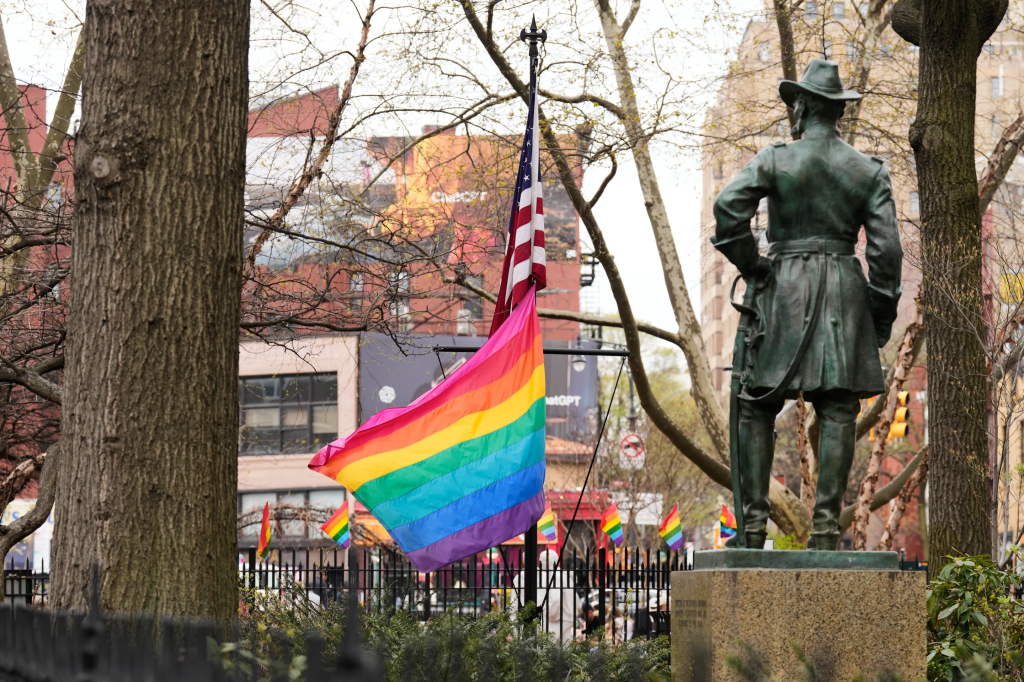
California activist urges national boycott of Kansas over new transgender law


by FOX Kansas News Sat, March 7, 2026 at 6:00 AM

A California activist is calling for a boycott of the entire state of Kansas because of a new law.

Last month, the law took effect requiring all transgender people to use the bathroom of their sex at birth. The same law also invalidated hundreds of transgender Kansans driver’s licenses.

San Francisco Pride released a statement calling for a national boycott of the state, saying transgender Kansans are being targeted for simply existing.

North Carolina passed a similar law back in 2016, and economic consequences followed. The NCAA pulled the first weekend of the men’s basketball tournament out of Greensboro, and the NBA moved the All-Star game out of Charlotte because of those laws.

FOX Kansas News at 9 anchor Jack Cooper shares more in the video posted at the top of this page.

Why It’s Good When Someone Pays Close Attention To Legislatures

Here’s an example of another “ingenious” bill in the Great State of Kansas. From my Topeka Buzz email, where there’s lots of similarly ingenious work. I post these because I’ve read that this stuff is being brought up in almost every state, so do all you can to keep track in yours.

Senate Passes Mail Voting Bill With Built-In Self-Destruct Clause
SB 394 passed the Senate 26-11 Thursday with one senator voting present and two absent. The bill adds signature requirements to mail ballot envelopes — spaces for the voter, any helper, and anyone signing on a voter’s behalf, plus a perjury-warning affidavit. But the headline provision is the court-triggered repeal: if any court issues a final, non-appealable order blocking the signature-check rule in K.S.A. 25-1124(h), the Secretary of State must publish notice in the Kansas Register and most state laws authorizing mail voting automatically void, except where federal law requires it. Three Republicans—Mike Argabright (R), Joseph Claeys (R), and Brenda Dietrich (R)—voted no alongside the Democratic caucus, while Ronald Ryckman (R) and Pat Pettey (D) were absent. The bill effectively tells the courts: strike down our signature rules and we’ll take mail voting with them. It now heads to the House.
Medicaid and SNAP Eligibility Overhaul Clears Senate
SB 363 — the Medicaid and SNAP eligibility-tightening bill we flagged when it came out of the Government Efficiency Committee — passed the Senate 25-12 Thursday with one present vote and two absent. The bill requires cross-agency data matching for eligibility verification, cuts retroactive Medicaid from three months to two, limits self-attestation, raises the SNAP work requirement age to 64, and mandates quarterly legislative reporting starting in 2027. One provision cuts the other direction: KDHE must seek federal approval for continuous Medicaid coverage for people with permanent intellectual or developmental disabilities who receive home services. The bill now heads to the House, where anti-hunger advocates and disability groups are likely to press their case that the eligibility barriers will cause coverage losses that outweigh any savings from reduced improper payments.
Identical Constitutional Amendments Filed in Both Chambers to Eliminate State Taxes
Legislators introduced matching constitutional amendments Thursday — SCR 1624 in the Senate and HCR 5034 in the House — proposing a “Freedom from Taxes Fund” in the Kansas Constitution. The plan would repeal certain sales and use tax exemptions and deposit the added revenue as untouchable principal in a state investment fund; only the interest earnings could be spent, and only to replace revenue from taxes being eliminated. The phased sequence: motor vehicle property taxes and registration fees first, then certain state-mandated property taxes, then state income and privilege taxes. A temporary Kansas Citizens Freedom Review Board would review exemptions, and each tax elimination would require the State Treasurer to certify sufficient interest earnings and the Legislature to approve by concurrent resolution. The dual filing signals serious intent, but both resolutions would need two-thirds votes in each chamber to reach the ballot — a high bar for a proposal that critics will argue relies on investment returns to replace billions in tax revenue.

For Lunchtime/BreakTime Reading

Losing the Plot: The “Leftists” Who Turn Right

What do we make of former friends who fell down the rabbit hole of the Right?

Kathryn Joyce and Jeff Sharlet December 12, 2023

How to name the rude currents eroding the Left, those which have claimed the hearts, minds and Substacks of so many former friends and fellow travelers? There are the journalist-provocateurs and the readers who have followed them rightward, the Trumpers-come-lately marching on to Glenn Greenwald’s Rumble or vanishing into Max Blumenthal’s Grayzone. There are those not quite yet there, such as Ana Kasparian of The Young Turks, currently mourning the leftism she now believes ​“gaslit” her about a ​“crime wave” it refuses to admit. ​“I’m going through something very real and very sincere,” she told a ​“disaffected Democrats” podcast in July, ​“and it’s uncomfortable.” It is, indeed. 

Consider the dislocation that flickers across the face of journalist Matt Taibbi in a TV interview this summer for the conspiracist, right-wing Epoch Times. Acclaimed by the Left during Occupy Wall Street as a scourge of corporate power, Taibbi is best known for his years at Rolling Stone. When the day eventually comes, the ​“vampire squid relentlessly jamming its blood funnel into anything that smells like money”— Taibbi’s unforgettable embodiment of Goldman Sachs in a 2010 article—will haunt his obituary.

While Taibbi insists his politics haven’t changed — an oddly conservative way to insist one hasn’t become conservative — his surroundings certainly have. Wearing a velvety brown jacket, jeans and his default smirk, he sat for his Epoch Times interview amid the libertarian FreedomFest conference. This year, in addition to Taibbi, it featured as speakers presidential candidates RFK Jr. (an Independent) and Vivek Ramaswamy (a Republican), along with former candidate Tulsi Gabbard (now a former Democrat, too), united in their contempt for ​“wokeness.” Epoch Times’ Jan Jekielek anointed Taibbi an ​“American Thought Leader” for Taibbi’s critique of a timid, consensus-driven press that, he says, is reminiscent of the Soviet Union. 

As Taibbi charges that the media is unwilling ​“to raise questions about things that have been ​‘decided,’” Jekielek’s eyes light up. It reminds him of his own experience bucking consensus, he says, when, as a university student, he realized the core tenet of evolutionary science ​“simply was untrue.” Gulp. In the midst of nodding along, Taibbi’s normally expressive, still-boyish face seems to freeze, his fingers to tense on his knee. It’s a moment recognizable from countless movies. Imagine the record scratch, the freeze frame, the familiar Hollywood voiceover: ​“You’re probably wondering how I got here.”

Taibbi’s far from the first. Consider the case of David Horowitz, once a founding sponsor of this magazine, more recently author of Blitz: Trump Will Smash the Left and Win. Or, after him, Christopher Hitchens, whose knowledge of Iraqi Ba’athism led him, after 9/11, to align first with U.S. neoconservatives and ultimately with the very kind of religious nationalists he’d so long derided. We might mark 9/11 as a moment when many who believed they were for peace gave in to the notion that it can only be won through war. Post-October 7 may prove another such moment.

But the present left-to-right acceleration began in earnest with the onset of the Trump years, in 2017.

There are the intellectuals-in-exile, the scholars whose once contained complaints about free speech or diversity initiatives metastasized into a broad contrarianism that found new patrons. There are the not-so-funny-anymore, the comedians once known for their left politics — Chappelle and Roseanne and Russell Brand — pulled rightward by ​“jokes” about trans people, pandemic panics and pedophiles. There’s the ​“new New Right’s” very own Kennedy — Robert F., Jr., of the bulging biceps. RFK Jr. may seem, with his campaign pushups, little more than a joke to young leftists, but his history as a champion of intersectional environmentalism is long: as a leader of activist organizations, a lawyer for poor communities of color and a host for the defunct progressive radio network Air America. But in recent years, he’s been having second thoughts: We all know about Bobby and the vaxx, but did you know he’s recently ​“learned” we must seal the Southern border to protect our food supply from a ​“tsunami” of ​“defecating” migrants, shitting on our greens?

These left-to-right sliders (or at least left-ish-to-right) — themselves migrants across the political divide — find themselves in strange constellation with those they might once have disdained. Pop feminist icon Naomi Wolf now conferences with hard-right student organizer Charlie Kirk over the prospect of ​“capital punishment” for Joe Biden and Kamala Harris. YouTuber Jimmy Dore, another once-left comedian who lost hold of the joke, now marvels over his meeting of the minds with Tucker Carlson: ​“We should do a show together!” Call it The Horseshoe Hour.

Except ​“horseshoe theory,” which imagines a political spectrum bending to meet at its extremes, doesn’t describe this drift. It goes in one direction. 

It’s easy to dismiss many of these high-profile defectors as crackpots or spotlight-seekers, as never truly serious in their political principles or as plain grifters. Because of course there is money to be made by saying, ​“Once I was blind, but now I see.” It permits the Steve Bannons of the world to affirm their political faith not as an argument, but just the truth. But, in some ways, the peculiarities of the celebrity drifters are beside the point.

The point is who they bring along.

Over the past seven years, they — the intellectuals, the comedians, their fans, the growing cohort of voters now leaning toward RFK Jr. (22% in one November poll) — have taken ​“red pills” a la The Matrix, tumbled down rabbit holes in the Wonderland sense. In moments of great flux — the 1960s from which Horowitz fled, the post-9/11 years, the current clusterfuck of crises so vast and interconnected that they might more simply be called our condition — such portals, from one reality to another, are plentiful. And currently they’re mostly riddling the Left as fascism gathers force, drawing together tendencies that didn’t previously align. There’s the rabbit hole of a Manichaean anti-imperialism, in which the enemy of my enemy is my friend, and the twisting logic by which some come to believe first in Vladimir Putin and then in the self-declared ​“illiberal democracy” of Hungary’s Viktor Orbán. There’s the gender confusion of ​“trans-exclusionary radical feminists,” who begin with a defense of women’s-only spaces and then fall, like J.K. Rowling, into alliances with the Christian Right. There’s the race vs. class debate, and the declaration that identity is just a distraction. There’s #MeToo, and the backlash of those who can’t let go of fallen heroes. There are genuine critiques of the concept of ​“white fragility” that collapse into white fragility, no quotation marks.

Matt Taibbi’s own slide began in 2017, after the release of his book about the police killing of Eric Garner, I Can’t Breathe, was derailed by the resurrection of his misogynistic exploits as a young expat reporter in post-Soviet Moscow. Taibbi’s apologies didn’t quell the criticism. Then he started talking about ​“cancel culture”; then liberal media bias; then, late in 2022, he made himself the mouthpiece for Elon Musk’s Twitter Files project. In March, he found himself in a congressional hearing, nodding along as Rep. Jim Jordan (R-Ohio) described Democrats as a McCarthyite mob. In November, Taibbi and two other Twitter Files reporters received a $100,000 award from a program of the Young America’s Foundation, long a bridge between establishment conservatives and each generation’s shoutiest right-wing youth.

In similar fashion, Naomi Wolf ​’s path from a liberal third-wave feminist writer of ​“big ideas” books to a regular guest on Steve Bannon’s War Room and Fox News began— or perhaps sped up — with a career humiliation. As Naomi Klein recounts in her recent book Doppelganger: A Trip Into the Mirror World, the premise of Wolf’s 2019 book Outrages collapsed on live air over a misunderstanding of an archaic legal term. By 2021, Wolf had emerged as a key purveyor of Covid-19 conspiracy theories, warning that ​“vaccine passports equal slavery forever.”

“We’re seeing people turn right for a number of different reasons,” argues journalist Eoin Higgins, author of a forthcoming book on formerly left-wing journalists who’ve aligned with reactionary tech billionaires. ​“There are financial incentives, there are attention incentives, there are culture war differences as people are becoming more conservative on culture; there’s a sense of being betrayed by progressives and the Left. There are so many different reasons that reducing this to people going too far [left] and going to the Right is an oversimplification.”

Maybe there’s a kind of gravity to the slide, the black hole of fascism sucking toward it all the loose particles of those whose commitments were never complex or whose convictions were snapped by despair. And the accusation that arises with almost every left-to-right slider, that they’re sell-outs, just doing it for the money? Yes, some are. Yes, and—because even when it starts that way, the transaction is transformational.

In the wake of Bernie Sanders’ loss in the 2020 presidential election, a small collection of leftists reconstituted themselves as ​“post-left,” still opposed to capitalism but scornful of ​“identitarian politics” and so disgusted with the liberal-left — from Democrats to the Democratic Socialists of America — that they saw little issue allying with the Right.

UnHerd, a U.K.-based ​“heterodox” opinion website founded by a Brexit supporter, covered the movement in a piece titled ​“Twilight of the American Left.” To the post-left, explained contributor Park MacDougald, the real U.S. ruling class is a Democratic oligarchy that uses the threat of creeping fascism and white nationalism to consolidate power, and deploys “‘identity politics,’ ​‘antiracism,’ ​‘intersectionality’ and other pillars of the progressive culture war” as ​“mystifications whose function is to demoralize and divide the proletariat.” Leftists, in this view, merely serve as that regime’s ​“unwitting dupes.”

But distinct from other ​“class-first” leftists, the post-left didn’t believe a real Left remained at all. Hence the double-edged title of the now defunct podcast What’s Left?, cohosted by Australian social media personality Aimee Terese, a former Sanders supporter who sought to “[heighten] the contradictions between left-liberal-identitarians and materialists” and who spent much of 2020 attacking progressive movements. After the primaries, the podcast gave voice to disillusioned Sanders supporters who railed against Sanders and other leftists for ​“sheep-dogging” people into the Democratic Party. Terese’s posts were shared by the likes of Mike Pompeo and Donald Trump Jr. The podcast began interviewing a range of right-wing leaders: ​“postliberal” scholars such as Harvard’s Adrian Vermeule, right-populists like hillbilly elegist J.D. Vance and former Mitt Romney campaign staffer Oren Cass, who recast himself as a champion of, as his book puts it, The Once and Future Worker.

But Terese went further than her guests, embracing some of the most vicious far-right rhetoric online: ​“demographic replacement” conspiracy theories, calls to ​“trust the (race) science” or for the homeless to be ​“warehoused.” These days, Terese cohosts a new podcast with friends from the ever-more-reactionary Independent Women’s Forum and The Federalist. She’s posted praise for the Confederacy, as well as a swastika, even as she aligns slightly more with Israel because her self-declared Islamophobia comes first. Such is the ouroboros of fascist contrarianism, the snake that bites its own tail.

It’s no insult to use the F-word with regard to such beliefs. Terese herself calls fascism ​“the necessary corrective called forth by the existence of insane communists.” It’s an unwitting rephrasing of the Italian novelist Ignazio Silone’s famous description of fascism as a ​“counter-revolution against a revolution that never took place.”

And yet the internet makes it possible for left-to-righters to believe that revolution has taken place. Such is the illusion cast by, say, Libs of TikTok, which scours social media for foolish statements — they do exist — to decontextualize and amplify. If you silo yourself in that rabbit hole, it’s easy to believe the most caricatured expressions of ​“wokeness” are overrunning our schools. It is a ​“very online” thing. But it isn’t only online. Schools targeted by Libs of TikTok have become subject to bomb threats — so far, fake ones, but resulting in very real closures. In their book Meme Wars, Joan Donovan, Emily Dreyfuss and Brian Friedberg describe a ​“wires to weeds” cycle that is its own kind of ouroboros: ​“Someone makes an appeal online (wires) that leads to a real-life event (weeds), and at this event … spectacle breaks out, which leads to media attention, which leads to conversation and action online (wires), which leads to a new event in the real world (weeds),” and so on. And each spectacle further cements a new underlying ideology.

In Manhattan, that sort of spectacle — call it the ​“cool factor” of bigoted rebellion — has been on display in real life in the widely chronicled, scene-y subculture of Dimes Square, where a group of mostly young, often arty people began to converge in 2020, in bars and pandemic-discounted lofts, eager to party despite Covid restrictions. Inspired by transgressing one boundary, they made a movement out of transgressing others. Reporters contrasted the young ​“downtown scene” as the inverse of earnest leftist politics, now recast as middle-aged moralism. One of the scene’s patron saints, playwright Matthew Gasda, said the combination of ​“repressive Covid governance following years of Trump-era moral panics” had ​“produced a moment of ideological uncertainty and openness” in which some leftists found common cause with conservatives and used ​“strategic irony” to counter what they viewed as a scolding, ​“woke” Left. Some declared the police killings that inspired the Black Lives Matter movement a racial ​“psy-op.” Slurs — ​“retard” is ubiquitous, along with anti-queer terms and even the N-word — became a marker of ​“heterodox” thinking.

Anna Khachiyan and Dasha Nekrasova, the glamorous (their word) cohosts of the podcast Red Scare, which had formerly espoused a quasi-socialist politics, became the scene’s queen tastemakers. They were beautiful, they came from Moscow and Minsk, they read difficult books and rolled their eyes and talked about far-right ​“race realists” like Steve Sailer, author of an anti-Obama book called America’s Half-Blood Prince.

In theory, artists shocking the bourgeoisie is an old story. ​“This sort of thing has been seen before,” says John Ganz, author of a forthcoming book on political volatility in the early 1990s. ​“A certain cultural elite thinking the transgression and vulgarity of fascism or right-wing populism is amusing and upsets all the right people. When Celine published his crazy antisemitic rant in the ​’30s, lots of French intellectuals thought he must be being ironic: ​‘This is such a wonderful provocation of middle-class sensibilities and hypocrisy.’” But, Ganz continues, ​“The problem is they also have to keep coming up with stuff to be provocative.”

In a 2017 article, political scientist Joseph E. Lowndes tells a cautionary tale about Telos, a once-Marxist journal founded in the 1960s that, by the 1990s, had become home to far-right thinkers who provided the intellectual backbone for the alt-right. Frustrated by their sense that all forms of dissent were co-opted and neutralized by capitalism, Telos’ editors had searched farther and farther afield for movements that truly challenged social norms. Much of what they found was on the nationalist, racist Right.

It was an instructive story for the Trumpocene, Lowndes writes: ​“Globally, there are two major responses to this era of vast inequality, or two off ramps from neoliberalism: one left, one right.” The right-wing response, he continues, is ascendant worldwide, transforming populist promises into nationalist policies. Meanwhile, too much of the Left is making the dangerous gamble that it can build power by avoiding issues ​“that divide the working class.” That path, Lowndes warns, leads not to socialism, but ​“toward a politics that will be played out entirely on the landscape that the fascists are trying to create.”

They have the money to do so, some of it from sources associated with venture capitalist Peter Thiel, whose strategic far-right funding has included the Senate campaigns of Arizona’s Blake Masters and Ohio’s J.D. Vance, an anti-immigration Super PAC and a contrarian Dimes Square film festival.

After 2016, right-wing intellectuals, flush with patronage, set about to retcon a theory of Trumpism. What was the movement that had just upended U.S. politics? Ideas came from the new New Right — critics of the political theory of liberalism — for both letting boundless social liberty undermine the country’s social foundation and for letting free markets immiserate the working and middle classes. They proposed a ​“realignment,” combining more generous economic policies with stricter social conservatism — a call since repackaged for mass consumption as Republicans try to rebrand as the party of the ​“multiracial working class.”

In October 2022, Ohio’s Franciscan University of Steubenville, perhaps the most conservative Catholic college in the country, hosted a conference lauding FDR and Amazon union leader Christian Smalls. It was an academic affair, but Vance interrupted his Senate campaign to deliver its closing address.

The conference was organized by Sohrab Ahmari, an Iranian-American immigrant who converted to Catholicism on his way to becoming one of the most public faces of this realignment, as cofounder of the ​“heterodox” journal Compact. Launched in 2022, Compact’s mission was to prosecute ​“a two-front war against the Left and the Right” by promoting ​“a strong social-democratic state that defends community — local and national, familial and religious — against a libertine left and a libertarian right.” The premise, Ahmari told one of us last year, was building a coalition that could agree to disagree on abortion and LGBTQ rights, but whose consensus on a social welfare state would ​“lower the temperature” of the culture wars.

What Compact’s project has looked like in concrete terms is eclectic: a blend of articles about labor and corporate monopoly alongside self-described ​“neoreactionaries,” anti-“woke” leftists who view corporate diversity statements as a smokescreen for capital, anti-immigration social democrats, anti-“gender ideology” feminists — and all that wrapped around Trump endorsements.

Online, leftists lampooned the interrelated post-left and new New Right projects. That the post-left was nothing more than ​“an internet clique waiting on a check”— perhaps from someone like Thiel. Or that Compact existed ​“to expand GOP agitprop production by .04% into a new microniche.” Or that the ​“New Right working class realignment” came with the disclaimer: ​“PRODUCT INTENDED FOR AESTHETIC/ENTERTAINMENT PURPOSES ONLY & NOT LIABLE FOR POLICY OUTCOMES.”

But aesthetics aren’t nothing and the blurring of political boundaries lends space for full-fledged fascists to develop crossover appeal. In 2022, Compact warmly profiled the hashtag movement #MAGACommunism, which derides leftists for ​“demonizing MAGA supporters as inherently racist, xenophobic, and so on,” arguing that they should instead be seen as ​“the only mass working-class and antiestablishment movement that currently exists in America.” What do such figures mean by ​“working class”? ​“Racists,” says one prominent #MAGACommunist, Jackson Hinkle, ​“hate me because I’m white.” He has 2 million Twitter followers. This October, numerous leftists warned that Hinkle was among the far-right actors opportunistically promoting the Palestinian cause to further their reach — he gained roughly 1.6 million of his followers in the first weeks of the war — and achieve their own, deeply different goals.

In mid-2022, just months after Compact launched, its main leftist founding editor, Edwin Aponte, was gone from the project. Later that year, he spoke with one of us, for a report at Salon, about why he’d joined in the first place.

“Why would this even be attractive to me?” he asked. He’s a Marxist; he sees culture as secondary to material conditions. Sanders’ first campaign had struck him as a mass movement coming around to his point of view. ​“And it all fell apart. … Famous stuff on the Left: To lose your mind after the failure of your movement.”

In the shifting aftermath, Aponte gravitated toward ​“right-leaning, right-curious leftists and Marxists” who echoed his thinking that ​“the cultural things actually don’t matter.” He felt he’d been isolated on the Left for his views and believed the same was true on the Right for Compact’s other founding editors, Ahmari and Matthew Schmitz.

Compact’s founders, Aponte said, pitched the project to him as one that sought ​“a strong, centralized and generous social democracy” and told him they weren’t interested in ​“relitigating settled issues” like abortion. (Ahmari and Schmitz insisted to Salon, in 2022, that their agreement ​“wasn’t to preclude articles about abortion, but to refract abortion — and all other cultural issues — through a material lens.”) After a draft of the Dobbs decision overturning Roe v. Wade was leaked that spring, Compact published what Aponte saw as a ​“triumphalist” proposal by a right-wing nationalist critic of neoliberalism: ​“One country can help us cut through the noise,” declared the author, thinking not of the abortion debate, now settled in his mind, but of next steps. ​“When Hungary set out to reverse its catastrophic population declines, it picked one goal that has enabled the rest: promoting marriage.”

Record scratch; freeze frame; voiceover: What, wondered Aponte, am I doing here?

Aponte realized the desire he shared with his right-wing co-editors for a social democratic state derived, for them, from a very different dream of the order that would result. Yes, like much of the postliberal new New Right, they saw the benefits of economic policy made with the working class in mind. ​“But more importantly,” Aponte suddenly understood, for his new comrades it was all ​“a way to forcefully apply their moral and cultural ideas”: ​“It’s a moral authoritarianism as centrally informing what the state would be. And everything flows from there.”

Back then, Aponte feared what would happen if politicians who shared those beliefs, such as Blake Masters or J.D. Vance, won their Senate races — as Vance did. He could see these ideas were spreading, in weird directions, among postleftists, people who used to tweet about how ​“identity politics” were a diversion from materialist concerns. ​“The next thing you know, they turn into actual racists, transphobes and homophobes. I’ve seen it. It’s real.”

The truth of it all, he says, isn’t in this theory or that. ​“People go where people accept them, or are nice to them, and away from people who are mean to them.” It wasn’t always coherent, but it didn’t have to be. ​“Historically speaking, authoritarian reactionary movements have been the result of, or have gained support and energy from, such incoherence and such contradictions,” Aponte said. ​“So, some dark shit is happening, and it sucks because I feel like I’ve had a hand in that.”

Since then, Aponte’s realization is finding echoes. On X (formerly Twitter) in September, a Dimes Square habitué wrote, ​“It is certainly not the case that everyone who participated in this scene to get clout for their lit mag is a ​‘fascist’ or should be ​‘canceled.’ However — it is also the case that simultaneously it is becoming the soil and recruiting ground for an actual 1930s style far-right movement that is organized and funded by venture capital.” The anonymous poster claimed that several prime movers now ​“explicitly endorse and advocate mass genocide.” A classic Page Six blind item, made over as murderous: ​“Everyone who is in the scene knows this at this point — presumably soon it will be public knowledge.”

That same month, Compact’s Schmitz tweeted his dismay that the post-left converts to the ​“dissident right” had ​“simply inverted the leftist frame,” swapping supposed ​“misandry” for misogyny and embracing ​“an increasingly open politics of white identity.”

“Fascists have been pushing red-brown politics for generations — sometimes openly, sometimes by repackaging their ideas to sound leftist,” writes Matthew Lyons, author of Insurgent Supremacists: The U.S. Far Right’s Challenge to State and Empire. The forerunners of fascism emerged from France in the late 19th century, when a movement arose combining anti-Marxists, Catholic traditionalists and disaffected leftists who’d grown pessimistic about democracy. The tendency has been overstated at times, but it’s rippled through Left movements since, from strange marriages of convenience within the Weimar Republic to Trotskyite-turned-fascist Lyndon LaRouche leaching off Left support from countless causes.

Today, Grayzone, the megasite created by once-leftist journalist Max Blumenthal, supports Putin’s authoritarian Russia and its international alliances, notably including Syrian president Bashar al-Assad, on putatively anti-imperialist grounds. But any far-left and far-right alliance against imperialism and globalization rests on shaky ground. While the Left sees globalization as entrenching inequality, argues economist Simon Choat, Trumpish anti-globalization is primarily concerned with the erosion of ​“supposedly traditional and homogeneous cultural and ethnic communities.” The Left critique calls for freedom of movement for people as well as capital; the Right seeks to reverse it through new forms of nationalism and xenophobia. Not to mention that ​“globalist,” in the Right’s usage, is an antisemitic dog-whistle.

This isn’t horseshoe theory. If there’s a commonality between far Left and far Right, says Lyons, it’s a common opposition to the status quo — but one that’s based on fundamentally different reasons. ​“And there are many more commonalities between the far Right and center in terms of investment in hierarchies and inequalities, which are not reflected in horseshoe theory.”

“It’s not the Left going to an extreme,” says Lowndes. ​“It’s choosing one element of left politics and abandoning all of its other historic principles.”

The publication of Naomi Klein’s Doppelganger has popularized an alternative interpretation: diagonalism, a theory developed by historian Quinn Slobodian and political theorist William Callison to describe 2020 Germany, where a coalition of primarily small business owners and apolitical ​“lifestyle leftists” joined to protest pandemic restrictions.

Diagonalism, argue Slobodian and Callison, functions like a post-Covid version of ​“digitally mediated” movements such as Brexit. It rejects conventional labels of left and right, even as it borrows elements from both, sharing ​“a conviction that all power is conspiracy.” It’s often marked by ​“a dedication to disruptive decentralization, a desire for distributed knowledge and thus distributed power, and a susceptibility to right-wing radicalization.”

The people who comprise diagonalist movements come in various forms: movement hustlers gamifying politics; left-to-right ideologues who claim they didn’t leave the Left, the Left left them; and far-right esoterics. It has drawn wellness enthusiasts as well as neo-Nazis, and has praised QAnon. Unlike a horseshoe, the diagonalist path draws from not just the Left but also the center and the greater hinterlands, where everyday people hadn’t previously thought much about politics at all.

But even for those with deeper political commitments, Callison told the podcast Conspirituality, ​“these left-to-right travelers tend to do something sort of sleight of hand, where they begin to put civil freedom above social justice. What should remain for them is a belief in the need for redistributive equality, or some kind of end state where economic inequality has been ameliorated somehow. But that seems to fade deep into the background, instead replaced by a kind of obsession with matters of speech and platforming.”

Diagonalist politics aren’t ending with Covid. They’re already transferring onto issues such as environmental protections. The ​“medical freedom” of the body becomes the corporate freedom of capitalism. RFK Jr., a former Riverkeeper, now calls himself a ​“radical free marketeer.” In his campaign, he told a podcast, ​“Climate has become a crisis like Covid that the Davos groups and other totalitarian elements in our society have used as a pretext for clamping down totalitarian controls.” It’d be just cynical if it wasn’t so sad: the retreat to 20th-century Cold War rhetoric in the face of a 21st-century totalizing threat, the ultimate denial of the passage of time, a morbid symptom of fascism’s growing attraction.

n October, Matthew Gasda, the playwright whose Dimes Square helped solidify the movement, wrote in Compact about his own regrets. The scene had once struck him as having ​“a nondenominational interest in questioning the way things worked.” He’d found it thrilling that ​“old political boundaries were temporarily porous and fluid.” But something had changed. ​“Edgelords” who’d once used ​“strategic irony” to challenge the status quo ​“began to believe their own rhetoric.”

This change is not entirely surprising — think of the white power ​“OK” symbol’s origins as a ​“joke” with which to ​“own” earnest ​“libs.” But how was Gasda to have known? He was just an artist. But then ​“new ideological silos were constructed” and now ​“significant downtown figures soft-peddle eugenics; others glamorize revolutionary terrorism; others worship political strongmen.” Gasda began to fear that, as he told a Compact podcast, ​“Memetic violence is going to produce real violence.” The podcast host noted that within online dissident right circles, cheering Kyle Rittenhouse — who killed two people during a Black Lives Matter protest in 2020 — had become a litmus test. ​“Certain masks seem to be coming off,” Gasda said.

In 2022, Red Scare’s Anna Khachiyan promoted ​“based literary publication” The Asylum, one of a new crop of ​“dissident right” journals. Alongside an extended interview with her ran a celebration of Rittenhouse — as an exemplar of ​“an heroic ethos that is manifested through action” — and an exploration of whether the blood libel, the centuries-old conspiracy theory that Jews ritually murder Christian children, might actually be true.

This fall, Nekrasova posted a picture of herself reading a book on ​“selective breeding” by Costin Alamariu — a Yale Ph.D. and the man behind far-right internet personality Bronze Age Pervert, who’s developed a following among right-wing political staffers for his advocacy of an Aryan warrior state.

Where does it end? Ask Oliver Bateman, a journalist who grew up in a conservative community, moved left and then post-left, for a time cohosting the What’s Left? podcast with Aimee Terese. By 2021, says Bateman, much of the post-left camp began acknowledging they were no longer on the Left at all. The breaking points centered around the racial justice protests following the murder of George Floyd and pandemic shutdowns. In time, says Bateman, even the fig leaf of leftist economic politics fell away. Post-leftists, now rebranded as the dissident right, began arguing against unions. ​“Labor pimps,” declared Terese. By the time the podcast ended in 2022, Terese was defending Alex Jones as he faced a defamation lawsuit over his claims that the Sandy Hook mass school shooting was a ​“false flag.”

Today, says Bateman, there’s no line between post-left and plain-old Right. ​“It’s just all this goofy soup, and the people that got off the crazy train are just”— like himself — ​“leftover Democrats.”

As for the rest? 

“This is all building toward a new push for people knowing their place,” says Bateman. ​“They’re fighting all the same battles the Right fought in the ​’80s, ​’70s, ​’60s: relitigating civil rights, gays, race in America, race and IQ. It’s this train that only goes in one direction, unless you have any sense of what the map looks like. Some of these podcasts are meme-ing George Wallace back into the discourse. They’re relitigating Germany in the ​’30s. Everything is in play. You can only be ironic for so long — you can only post so many George Wallace memes — before you start thinking that two sets of water fountains aren’t a bad idea.” 

It’s easy to feel contempt for such people. It’s more honest to acknowledge our losses. We may say, ​“They were never really Left” — Tulsi Gabbard’s connection to Hindu nationalism is a prime example — or, ​“Good riddance, we’re better off without them.” But are we?

What they’ve become, yes. But was any movement ever made stronger by subtraction?

Meanwhile, the Right knows the power of addition. For Steve Bannon, his new War Room regular Naomi Wolf is just one more wedge he can use to peel pandemic-aggrieved suburban ​“wellness moms” away from the Democratic Party, just as he’s pulled the ​“white working class” toward Trump.

For every Wolf, for every Taibbi, there are so many everyday people following them rightward. Not selling out but breaking up, sometimes cracking up, giving into knowingness and the elation of ​“seeing through” the con— of Covid, or pronouns, or ​“the Russia hoax” or ​“Trump Derangement Syndrome.” 

We, the authors of this article, each count such losses in our own lives, and maybe you do, too: friends you struggle to hold onto despite their growing allegiance to terrifying ideas, and friends you give up on, and friends who have given up on you and the hope you shared together.

Hope, after all, is earnest, and earnest can be embarrassing, especially now as the odds seem to lengthen. But as media critic Jay Rosen puts it, what matters more than odds are stakes. We, the authors of this article — such an earnest phrase — have spent much of the past 20 years documenting the mutations of the Right in the United States and around the world. We’ve taken courage from the fault lines such close examination reveals: that there is no singular Right, but many, so often squalling, like the GOP House conference that just spent a month searching for a speaker. 

But in this age of Trump, his presence and his shadow, we’ve witnessed more right-wing factions converging than splitting, putting aside differences and adopting new and ugly dreams. They, of course, do not see the dreams as ugly, but beautiful. Utopian, even, with MAGA as merely prelude to what the intellectuals among them sometimes refer to as ​“sovereignty,” ​“greatness” or ​“the common good”: sweet-sounding phrases that find their purest expression in the image of the gallows erected outside the Capitol on Jan. 6, 2021. The greater the spectacle, the stronger its gravity. That’s what makes fascism so scary when it genuinely flares. It consumes. It grows.

KATHRYN JOYCE is investigative editor at In These Times and author of The Child Catchers: Rescue, Trafficking and the New Gospel of Adoption and Quiverfull: Inside the Christian Patriarchy Movement.

JEFF SHARLET’S most recent book is The Undertow: Scenes from a Slow Civil War. He is the Frederick Sessions Beebe ​’35 Professor in the Art of Writing at Dartmouth College.

I’m Sorry-ROFLMAO!

Markwayne Mullin! (And I know the consequences of this could be somewhat worse than so far, because he’s yet more natively stupid. But at the moment, LMAO!)

https://apnews.com/article/trump-homeland-security-noem-mullin-38c583b3cef97b4ef60d84b8f8b5961a

Trump says he’s replacing Homeland Security Secretary Noem with GOP Sen. Markwayne Mullin

WASHINGTON (AP) — President Donald Trump said he’s replacing his embattled Homeland Security Secretary Kristi Noem and will nominate in her place Oklahoma Republican Sen. Markwayne Mullin.

Trump made the announcement on social media on Thursday, two days after Noem faced a grilling on Capitol Hill from GOP members as well as Democrats.

Trump says he’ll make Noem a “Special Envoy for The Shield of the Americas,” a new security initiative that he said would focus on the Western Hemisphere. (snip-fluffy stuff we already know.)

Mullin would need to be confirmed by the Senate, but under a federal law governing executive branch vacancies, he would be allowed to serve as an acting Homeland Security secretary as long as his nomination is formally pending.