https://www.youtube.com/post/UgkxcRbDnMs-OZRd4YLOay14vzCBEdbb1V7B
Juan Cole 04/06/2026
Ann Arbor (Informed Comment) – On Easter Sunday, God’s chosen in the White House issued a vulgar and unbalanced posting on his “Truth Social” that epitomizes the insanity of his Iran War. Attending to it closely will help us understand how Trump has strengthened the government of the Islamic Republic and put it in control of global energy. Trump fondly imagines that he can dislodge Iran from this new ascendancy, but he is wrong, since it depends on sabotage, a sabotage that cannot be policed.
This is embarrassing, Delete it, President @realDonaldTrump – unless you want everyone to think you’ve lost your marbles.

The foul language and clear mental imbalance visible in this announcement sparked a further round of calls for Trump’s removal under Article 25 of the Constitution, which is nothing more than an internet meme since Trump has surrounded himself on his cabinet with people even more certifiable than he is, and who wouldn’t dare move against him.
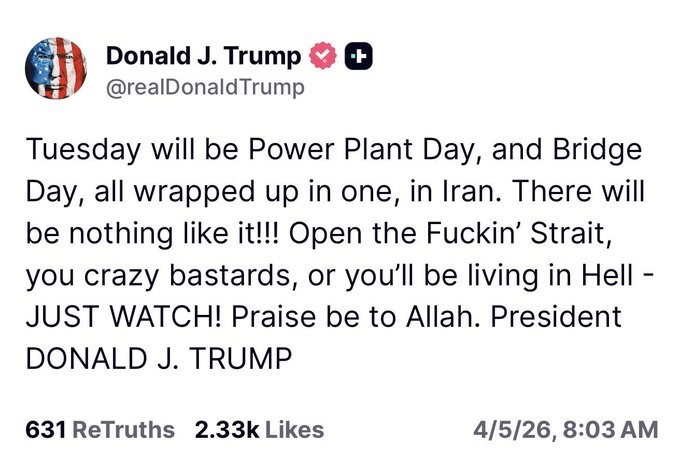
Trump, having imbibed whatever substance it is that makes him manic, announced that “Tuesday will be Power Plant Day, and Bridge Day, all wrapped up in one, in Iran. There will be nothing like it!!!”
He is repeating a threat he made previously, to bomb Iran’s civilian electricity-generating plants as well as its civilian bridges.
Iran has 98 major power plants fueled by fossil gas, which generate 85% of the country’s electricity. The largest, the Damavand power plant south of the capital, Tehran, has a generating capacity of over 2.8 gigawatts.
One of Iran’s power plants is nuclear, at Bushehr. If Trump or Israel bombs it, the consequent radiation pollution will deeply harm the Arab Gulf states, not only through airborne particles but also by contaminating sea water, which is drawn on by the region’s desalinization plants. This exposure to radiation would certainly increase cancer risk in the region. There are mountains between Bushehr and the Iranian interior, so the radioactive particles would be blown west toward other countries such as the United Arab Emirates, Saudi Arabia and Qatar.
Striking civilian power plants, and above all nuclear ones, endangers the noncombatant population of children, women and unarmed men and violates International Humanitarian Law.
In fact, the International Criminal Court in the Hague issued “warrants of arrest for two individuals, Mr Sergei Kuzhugetovich Shoigu and Mr Valery Vasilyevich Gerasimov, in the context of the situation in Ukraine for alleged international crimes . . .” on June 24, 2024. They were indicted for “for the war crime of directing attacks at civilian objects (article 8(2)(b)(ii) of the Rome Statute) and the war crime of causing excessive incidental harm to civilians or damage to civilian objects (article 8(2)(b)(iv) of the Rome Statute), and the crime against humanity of inhumane acts under article 7(1)(k) of the Rome Statute.”
Among the “civilian objects” that these Russian officials ordered attacked in Ukraine were power plants and structures such as the Kryukovsky Bridge.
So Trump is talking like a war criminal, which tells you why he has placed sanctions on International Criminal Court judges.
Trump already struck the unfinished B1 bridge linking Tehran to Karaj. Since it was not finished, it could not possibly have had a military purpose, contrary to the lies of the lying liars in the Trump administration who gave that as the excuse for hitting it.
Trump continued, “Open the Fuckin’ Strait, you crazy bastards, or you’ll be living in Hell– JUST WATCH!
It is not clear how a body of water such as a strait could copulate. However, it can engender revenue, and does so for Iran. A lot of revenue.
Iran has not actually closed the Strait of Hormuz entirely. It is exporting its own petroleum through that narrow aperture, mainly to China. Trump has been forced by the global oil shortage to lift sanctions on the Iranian tankers, and so Iran is also selling again to India. Before Israeli Prime Minister Benjamin Netanyahu rushed Trump into war on Iran on February 28, Iran was exporting about 1.4 million barrels a day to China. The price of petroleum was about $67 a barrel then, but Iran had to offer a steep discount to offset American sanctions, and so was probably only getting $57 or less a barrel. So Iran was getting something like $29 billion a year for its petroleum from China and a few other customers (90% goes to China).
China is now likely having to pay $110 a barrel for Iranian petroleum.
Iran’s oil income just went up to $55 billion a year if these prices and this volume of trade persists, which is plausible. So the “crazy bastards” in charge of Iran have nearly doubled their income off the Netanyahu-Trump war because of the fertility, under their control, of the “fuckin’ Strait.” The Iranian oil industry is state-owned, so all the money goes to the clerics and the Iranian Revolutionary Guards Corps, as well as to the conventional army and the elected institutions, the parliament and president. This extra income helps the government tamp down resistance, strengthening it against civil society. In any case, many Iranians under foreign attack are rallying around the flag. Of course there are also tax losses from the economic disruption of the war, but the vastly increased oil income helps make up for them as far as the government is concerned. If the price of oil goes to $200 a barrel, as it may well, Iran’s government could get $100 billion a year for its petroleum.
Not only that, but Iran has instituted a toll system, wherein countries that have good relations with Iran and pay a fee can transit the Strait without fear of an Iranian drone attack. In contrast, countries that Iran believes contribute to the American war effort against Tehran such as the Emirates and Kuwait, are blockaded by the threat of such strikes. These tolls could be an ongoing and lucrative source of income for the government. Before the war, 138 ships transited the Strait daily. If that traffic resumes but each has to pay Iran a $2 million toll, that would bring in $96 billion a year, i.e. four times what Iran was getting for its petroleum before the war.
So here’s the thing. With the advent of Iran’s Shahed drones, which can be manufactured inexpensively and of which it has tens and thousands, there is no way for anyone, including Trump and the US military, to stop Iran from sabotaging ships that won’t pay the $2 million. At least, I don’t see how it could be done. You’d need tens of thousands of interceptors, and we hardly have any left. Moreover, interceptors cost $1.5 million apiece, so it makes much more sense to allow each ship to pay Iran the $2 million.

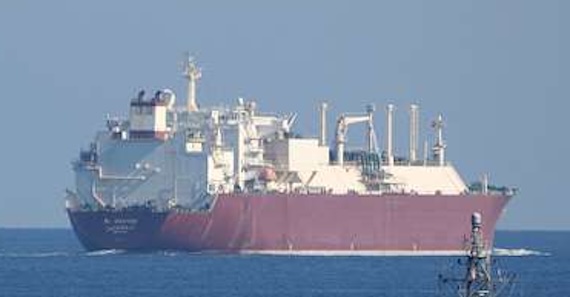
Container ship in Strait of Hormuz. (U.S. Navy photo by Mass Communication Specialist 2nd Class Indra Beaufort).Public Domain. Via Picryl .
Trump has shown Iran how it can go into the protection business in the Gulf for the long term. Nice oil shipping industry you have here, it would be a shame if anything happened to it. And off that, Iran actually increases its GDP substantially.
If Trump takes out Iran’s electricity and bridges, he can interfere with its economy and its society in a big way. But he can’t stop the drones or the protection racket that way. Moreover, Iran has made it clear that its response will be to take out the power plants in the Gulf Arab states as well as in Israel. Since the US and Israel are running low on interceptors, and since even small Shahed drones have great range and can do a lot of damage, Iran’s threat is credible.
If Trump takes out Iran’s petroleum-production capability, Iran will crash oil production in the Gulf, taking 20 million barrels a day off the market for years to come. That would certainly be another Great Depression and likely would spell the end of the oil industry, since everyone in the world would migrate to electric vehicles quickly.
So although Trump meant the phrase ironically and blasphemously, the Iranian authorities may well end up saying “Praise be to Allah” over Trump’s monumental stupidity.
https://www.juancole.com/2026/04/trumps-vulgar-criminal.html
Abraham Lincoln’s faith in the Declaration of Independence ultimately influenced Walt Whitman’s harsh but optimistic appraisal of the American experiment.

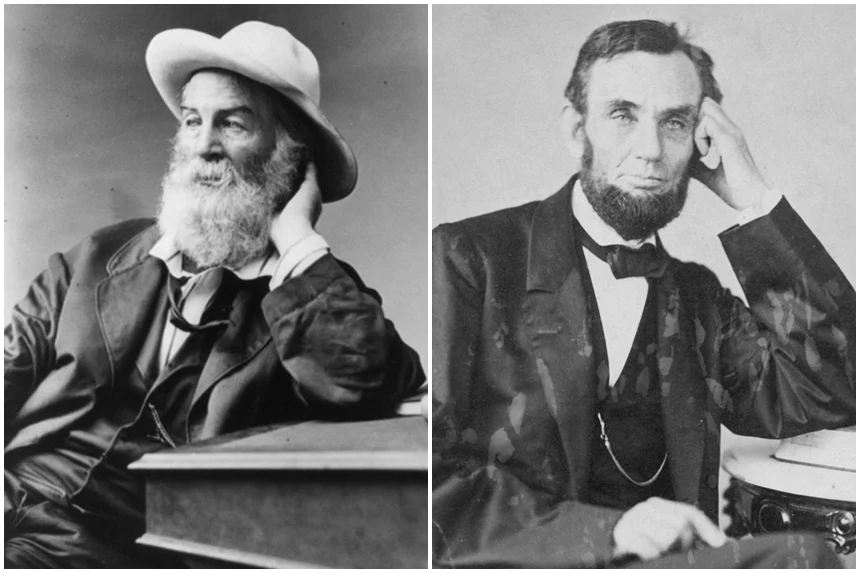
Walt Whitman and Abraham Lincoln (Library of Congress)
“The United States are destined either to surmount the gorgeous history of Feudalism, or else prove the most tremendous failure of time,” wrote American poet Walt Whitman in his 1871 work, Democratic Vistas. Despite writing in the wake of a brutal civil war and a failing Reconstruction Era, Whitman remained optimistic. “Not the least doubtful am I on any prospects of their material success.”
Known more for his poetry, exemplified by Leaves of Grass (1855), Whitman’s dark 1871 treatise on the nation remains a harsh but ultimately optimistic appraisal of the American experiment. It serves as a useful tool for thinking about the nation’s current state on the 250th anniversary of the Declaration of Independence.
Whitman’s revolutionary patriotism had long been part of his worldview. He celebrated the Declaration of Independence and the Revolution in the preface to Leaves of Grass, noting that a poet must “enter the essences of the real things and past and present events,” among them “the haughty defiance of ’76, and the war and peace and formation of the constitution.”
But for all his celebration of the Declaration and the nation’s founding, he did not mince words regarding the nation’s failings. He wrote of a “hollowness” at the center of American life at the time, calling the business classes depraved and the government saturated in corruption. (snip-go see the rest!)

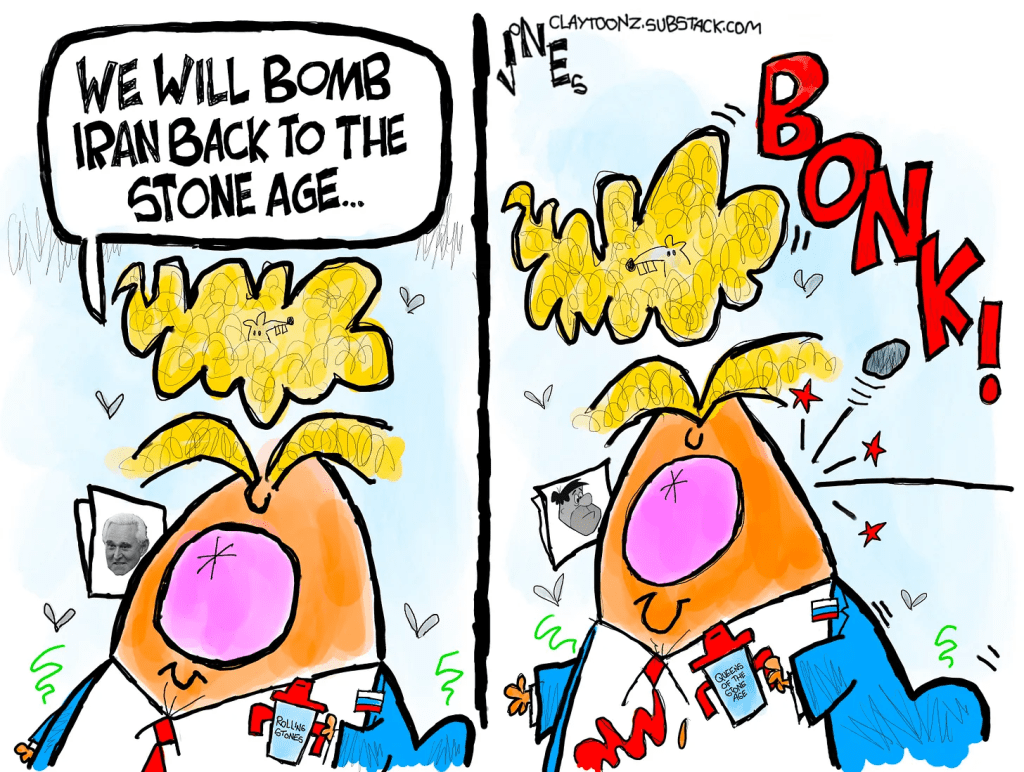
Donald Trump is threatening to bomb Iran back to the Stone Age, which, if he does, would be a war crime.
Trump’s chosen war is with the government of Iran, not the people, yet he continues to threaten to destroy its infrastructure. The more Donald Trump and Pete Hegseth brag about their success in the war, the more it seems that Iran fights back.
Trump tells us that the war is won and that Iran’s ability to wage war is nearly depleted if not already destroyed, yet missiles still rain on Israel and our other allies in the Gulf. And if Iran doesn’t have any weaponry left, then how did they shoot down two American jets? If the war is already won, then why are we still fighting? (snip-click on the title to get the rest!)
But it’s important info, nauseating though it is. Also, click on through to the story, as everything I copy on their page to paste here turns into the title, with “Read more at:” and the link. So, my apologies, but this is a thing that we need to know.
“From Greenland to Guyana, our security perimeter is one hemisphere”: Pete Hegseth unveils ‘Greater North America’ strategy
Read more At:
https://www.aninews.in/news/world/us/from-greenland-to-guyana-our-security-perimeter-is-one-hemisphere-pete-hegseth-unveils-greater-north-america-strategy20260330080242/
Not that the planes won’t go elsewhere, but it’s good to see other countries stand up for right instead of so very wrong.
By Reuters
MADRID, March 2 (Reuters) – Fifteen U.S. aircraft have left the Rota and Moron military bases in southern Spain since the U.S. and Israel launched weekend attacks on Iran, maps by flight tracking website FlightRadar24 showed on Monday.
Foreign Minister Jose Manuel Albares said Spain would not allow its military bases, which are jointly operated by the U.S. and Spain but under Spanish sovereignty, to be used for attacks on Iran, which Spain has condemned.
“Then” (here, below “Now”) is also linked in today’s Peace & Justice newsletter. I’m posting from The Guardian so I can get the Then, and the Now from one tab because I’m lazy, I guess. I prefer to say “efficient, though.
Now
Middle East crisis liveUS-Israel war on Iran
Earlier, Donald Trump laid out US objectives, saying mission could go on for four-five weeks, adding US has ‘capability to go far longer’
From 46m ago 17.01 EST
The US state department has urged Americans to immediately depart more than a dozen Middle Eastern countries amid US-Israeli strikes against Iran.
US citizens were urged to depart using commercial means from Bahrain, Egypt, Iran, Iraq, Israel, the [occupied] West Bank and Gaza, Jordan, Kuwait, Lebanon, Oman, Qatar, Saudi Arabia, Syria, United Arab Emirates and Yemen, according to Mora Namdar, the department’s assistant secretary for consular affairs.
Hundreds of thousands of travellers are currently stranded in the Gulf states, as the airspace over some of the world’s busiest international airports, including Dubai and Abu Dhabi, closed over the weekend.
Thousands of flights cancelled as world faces worst travel chaos since Covid crisisRead moreShare
Updated at 17.31 EST 17.44 EST
The Israeli military has said it has detected incoming missiles launched from Iran and its defensive systems are working to intercept the threat.Share
Updated at 17.45 EST 17.41 EST
Chris Stein
The US Senate’s Democratic minority leader Chuck Schumer said a briefing from Trump administration officials about the US war with Iran “raised many more questions than it answered”.
“Look, a whole lot of questions were asked. I found their answers completely and totally insufficient,” Schumer told reporters as he exited the meeting. He departed without taking questions.
US secretary of state Marco Rubio as well as CIA director John Ratcliffe are among those briefing Congress leaders in a classified facility in the Capitol.
A reminder that you can follow our US politics live blog for more US-focused reaction and developments:
Rubio says US ‘preemptively’ attacked Iran after learning Israel was about to strike as Democrats decry ‘Trump’s war’ – liveRead more
(snip-go to The Guardian, because they are running live, and things keep happening.)
=====
Then
This article is more than 15 years old
In Iraq, six killed as frustration erupts over corruption
Yemen holds its biggest pro-democracy rally
Egyptians demand accelerated reforms

In Yemen’s capital, Sana’a, an anti-government protester chants slogans demanding the resignation of President Ali Abdullah Saleh. The president ordered security services to protect protesters. Photograph: Muhammed Muheisen/AP
Protests erupted in cities across the Middle East and North Africa. At least six people were reported killed and dozens injured in Iraq; thousands took to the streets in the Yemeni capital, Sana’a; and Egyptians gathered in Cairo’s Tahrir Square to demand an accelerated reform programme.
Anger over corruption and abysmal basic services erupted in a “day of rage”, with the most serious clashes in Mosul and Hawija, in the north, and Basra in the south. At least six people were killed – three in Mosul and three in Hawija – and 75 injured in clashes with security services as protesters tried to attack government buildings.
Thousands of people made their way to the city’s Tahrir Square, but soldiers had closed it off with razor wire, using percussion grenades and firing in the air in an attempt to disperse crowds.
Lina Ali, 27, told Reuters: “The education system is bad. The health system is also bad. Services are going from bad to worse.” Protesters complained of high unemployment, a shortage of drinking water and frequent power cuts.
In Basra, the city’s governor, Shaltagh Abboud, said he would resign after 18 people were wounded in skirmishes between the 4,000 protesters and state security. A curfew was imposed until 6am tomorrow. There were also clashes in Falluja and Nassiriya.
Nouri al-Maliki, the prime minister, warned demonstrators they would become victims of al-Qaida and pro-Saddam violence.
Muntadar al-Zaidi, the Iraqi journalist who threw his shoes at George Bush, was arrested in Baghdad after travelling from Beirut to take part in the Day of Rage.
Tens of thousands of protesters in Sana’a called for an end to the 32-year reign of President Ali Abdullah Saleh. It was the biggest pro-democracy rally in Yemen’s recent history. But small, yet violent, protests have been taking place across the country since Egypt’s Hosni Mubarak resigned two weeks ago.
Local media reported 30,000 anti-government demonstrators in Sana’a and more than 100,000 nationwide. Students, tribesmen, opposition activists and young professionals flooded the streets around Sana’a University, where protesters have been camped out since Sunday. “The people want the regime to fall,” they shouted, rising from their knees after a Friday prayer to mourn the deaths of two men shot dead on Tuesday by pro-Saleh supporters. The protest was peaceful, though at times tense. Protesters want better living conditions as well as political reform.
One banner read simply: “Look at the gap between the rich and poor.”
Riot police who tried to seize an anti-government protester had to fire in the air to dispel angry students demanding his release.
A few miles away, state media were out in force to film 10,000 middle-aged men, many carrying batons, marching up and down the streets yelling: “Saleh means stability.” These government loyalists, including impoverished tribesmen bussed in from far away, have been in Sana’a’s Tahrir Square for more than a month, holding rallies for which they have been given food, drink, and the placards, and accommodated in giant beige marquees. Anti-government protesters claim the loyalists are balataj, hired thugs, but Yemeni authorities deny any connection with the armed men.
Saleh has told his security forces to protect both sets of demonstrators and prevent any further clashes between them.
Activists returned to Tahrir Square in their thousands to demand a faster pace to reforms. They want a new cabinet to replace one that includes many figures from the Mubarak regime. According to Al Jazeera they singled out the prime minister, Ahmed Shafik, who, they said, was hand-picked by Mubarak; and they want the former president, believed to be holed up in his Sharm el-Sheikh villa, to be put on trial and held accountable for his 31 years of rule,. They also want political prisoners released.
The ruling military council has promised elections within six months. “We do not want Shafik any more, even if they shoot us with bullets,” activists chanted. “Revolution until victory, revolution against Shafik and the palace.”
In the centre of Tunis, tens of thousands demanded the resignation of the prime minister, Mohamed Ghannouchi, seen as an ally of the ousted president. The uprising that forced former president Zine al-Abidine Ben Ali to flee on 14 January after 23 years in power was the catalyst for regional revolt. “Shame on the government!” and “Ghannouchi step down,” they shouted. Witnesses said it was the biggest protest since Ben Ali’s departure, when demonstrations were banned. Activists also protested against the bloody crackdown by forces loyal to Libya’s Muammar Gaddafi. Thousands of Libyans have fled to Tunisia.
In the capital, Amman, 5,000 protested, demanding political reform. “Reform has become a necessity that cannot wait,” said Sheikh Hamza Mansour, the head of the Islamic Action Front, the country’s largest opposition group, at a rally. “It’s the demand of all Jordanians,” he added. Protestors chanted: “The people want to reform the regime”, “we want a fair electoral law”, and “people want an elected government”.
There were tens of thousands of anti-government protesters in Manama, adding to pressure for sweeping democratic change during two weeks of demonstrations in the strategic Gulf island kingdom. At least two marches converged on Manama’s landmark Pearl Square, the focal point of the uprising – the largest show of opposition strength so far.
Security forces made no immediate attempt to halt the marchers in an apparent sign that Bahrain’s rulers do not want to risk more bloodshed and denunciations from their Western allies.
Bahrain is the first Gulf state to be thrown into turmoil by the Arab world’s wave of change. The government had declared Friday a day of mourning for the seven people killed in clashes since 14 February.
Many protesters waved Bahrain’s red-and-white flag, chanting: “No dialogue before the government is dissolved,” and “For Bahrain’s future, we are not afraid to be killed.”
One procession split into separate groups of men and black-robed women, passing skyscrapers adorned with images of the nation’s ruling family.
Some demonstrators called on the US to do more to support their cause. “These people are fighting for freedom,” said Hussain Isa al-Saffar, 25. “The US … should be supporting freedom here.”
The White House said the national security adviser, Tom Donilon, spoke with Bahrain’s crown prince, Salman bin Hamad bin Isa Al Khalifa, on Thursday stating the US’s support for reforms through dialogue with opposition groups. The US chairman of the joint chiefs of staff, Admiral Mike Mullen, also held talks with Bahraini leaders Thursday.
In Pearl Square, a massive Bahraini flag was hoisted along with the phrase “martyrs’ square” in Arabic, a reference to those killed by security forces. Graphic photos of the dead were posted in the square, and a noose was fashioned around a portrait of Bahrain’s prime minister.
The Palestinian Authority (PA) had authorised a Day of Rage to protest against the US veto of a UN security council resolution condemning Israeli settlements, but that was called off without explanation.
An unofficial protest on Thursday in Ramallah, the main city in the West Bank, demanded unity between the two main factions, Fatah and Hamas, as well as “liberation”.
Analysts say the Fatah-dominated PA and Gaza’s Hamas government are nervously watching uprisings elsewhere in the region. Palestinians in both Gaza and the West Bank complain of repression.
but you don’t have to read it. It’s nothing bad, but is very truthful. From 2007, but the locations, of course, are interchangeable.

U.S. news, too; scroll past what you’ve seen. I like to know what’s happening outside the U.S. as well as here; I loved to read newspapers when they were big and full of news from everywhere. I don’t make time to read this often enough.
Everything Briefing
Good morning, everyone!
https://substack.com/embedjs/embed.js“>(snip-embedded note on the page; click this or the title above)
Four years later, he placed second for the nomination, winning 11 c…

Today, we will look at a series of U.S. political developments, Ukrainian peace talks, and U.S.-Iranian nuclear talks.
Let’s get to it.

♻️ Help this post reach more readers: like, repost, and share 📬
United States
-Congressional negotiations on a spending bill to reopen the Department of Homeland Security (DHS) have stalled, as Democratic and Republican leaders remain divided on changes to immigration enforcement practices.
DHS, which houses the Immigration and Customs Enforcement (ICE) agency, entered a partial shutdown on Saturday after Congress failed to pass a funding bill amid the standoff.
Earlier this month, President Donald Trump and Senate Democratic Leader Chuck Schumer agreed to a compromise bill to fund all government agencies except for DHS through September as they negotiated changes to immigration enforcement tactics.
Ahead of the funding lapse, congressional Democrats called the White House’s counterproposals insufficient.
-Americans’ approval of Trump’s immigration policies has fallen to a new low, according to a Reuters/Ipsos poll.
-Stephen Colbert said that CBS forced him to not air an interview with Texas Democratic Senate candidate James Talarico on his late-night show, saying that executives were fearful that the appearance could draw ire from the Federal Communications Commission.
The interview was posted to The Late Show’s YouTube page. View it here:
Earlier this month, the FCC opened an investigation into ABC’s The View after an appearance by Talarico.
The latest move came just as early voting began in Texas, where Talarico, a State Representative, is facing off against Congresswoman Jasmine Crockett in the Democratic primary.
The election will be held on March 3.
-Arizona Senator Mark Kelly said he will “seriously consider” a bid for the 2028 Democratic presidential nomination.
-In a Presidents’ Day message, former President George W. Bush paid tribute to George Washington, saying he “ensured America wouldn’t become a monarchy, or worse.”
Read the full message on Substack here:
George Washington by George W. Bush
2 days ago · 1386 likes · 291 comments · In Pursuit and George W. Bush
-Measles cases in South Carolina have surged.
-Speculation has swirled around whether Supreme Court Justice Samuel Alito plans to retire this year.
-Jesse Jackson, the longtime civil rights activist and two-time presidential candidate, died yesterday at the age of 84.
Tributes poured in following the news of his passing.
View them here.

-On this day in 1931, Pulitzer Prize-winning author Toni Morrison was born in Lorain, Ohio.

In 1938, Joseph Kennedy Sr., the father of future President John F. Kennedy, was sworn in as U.S. Ambassador to the Court of St. James’s in the Oval Office as President Franklin Roosevelt looked on.

In 1967, J. Robert Oppenheimer, the “father of the atomic bomb,” died at the age of 62.

In 1988, Anthony Kennedy was seated as an Associate Justice on the Supreme Court.
Nominated by President Ronald Reagan, Kennedy would go on to serve as the Court’s crucial swing vote on issues of abortion, affirmative action, and gay marriage.

In 2010, President Barack Obama signed an executive order establishing the Fiscal Responsibility Commission, tasking Republican Alan Simpson and Democrat Erskine Bowles with identifying strategies to improve the country’s long-term fiscal outlook.
The body, known as the Simpson-Bowles Commission, issued a report titled “The Moment of Truth,” later that year, calling for a combination of spending cuts, tax and entitlement reforms, and other measures to reduce the deficit.

Africa
-Turkish President Recep Tayyip Erdoğan scorned Israel’s recent recognition of Somaliland, the breakaway region of Somalia, saying the move did not benefit the Horn of Africa region.
Israel officially recognized the Republic of Somaliland as an independent and sovereign state in December, becoming the first member of the United Nations to do so.
In response, Somalia called the move an “existential threat,” with President Hassan Sheikh Mohamud saying that his country would “fight in its capacity” to prevent an Israeli military presence in the region.
Somaliland declared independence in 1991 following a five-year civil war.

-Nigeria’s defense ministry said yesterday that 100 more U.S. military personnel had arrived in the country as part of a mission to counter Islamist militant groups in the West African country.
President Trump ordered strikes on Islamic State targets in the country on Christmas Day and has accused the government of failing to protect Christians in its northwestern region, a claim it rejects.
-The new U.S. Ambassador to South Africa, conservative activist and writer Leo Brent Bozell III, arrived in the country yesterday amid strained bilateral ties.
-Unemployment in South Africa declined to 31.4% in the fourth quarter, a five-year low.
The jobless rate in the country has remained above 20% since the mid-1990s and remains one of the highest in the world.
-On this day in 2004, President Bush hosted Tunisian President Zine El Abidine Ben Ali in the Oval Office as Washington sought the North African country’s cooperation in its war against terrorist organizations.
According to press reports, Bush also urged Ben Ali to adopt democratic reforms.
Ben Ali ruled Tunisia with an iron fist from 1987 until 2011 when he was ousted by a pro-democracy movement that would sweep the region, which would become known as the Arab Spring.

Americas and the Caribbean
-Peru’s Congress voted to remove interim President Jośe Jorí from office yesterday over undisclosed meetings he held with Chinese business executives.

Jorí had just assumed office in October. His removal comes just ahead of a presidential election in April and as the public expresses outrage over rising crime in the Andean nation.
The country has had seven presidents since 2016.
-Guatemala lifted a state of emergency one month after the killing of 10 police officers by suspected gang members.
-The Colombian government said yesterday it would resume peace talks with the country’s largest illegal armed group.
-Prison deaths have continued to rise in Ecuador despite President Daniel Noboa’s strategy to rein them in, according to Reuters.
-Qatar’s prime minister arrived in Venezuela yesterday.
The Gulf nation has often acted as an intermediary between the United States and the government in Caracas.
-Canadians have cut their travel to the United States for a second consecutive year, according to new data.

-Annual inflation in Canada slowed to 2.3% in January, according to government data released yesterday. The decline was fueled by a steep drop in gasoline prices, offsetting a rise in food and clothing costs.
-On this day in 1940, President Roosevelt visited the Panama Canal Zone as part of an inspection tour.

Asia/Indo-Pacific
-Bangladesh Nationalist Party (BNP) leader Tarique Rahman was sworn in as prime minister yesterday, capping two years of political instability in the South Asian nation.

The BNP secured a landslide election victory in last week’s parliamentary vote—the first since the ouster of authoritarian Prime Minister Sheikh Hasina in 2024.
Hasina resigned her post following massive student-led protests against a job quota system. After a harsh crackdown by her government, protesters marched on her official residence, forcing her to flee to India.
For decades, the BNP acted as the primary opposition to Hasina’s ruling Awami League, facing persistent targeting by the government.
The country was led by a transitional government headed by Nobel Peace Prize laureate Muhammad Yunus since Hasina’s ouster.

-Japan’s lower house of parliament, known as the Diet, will meet today to formally elect Japanese Prime Minister Sanae Takaichi.
Earlier this month, Takaichi’s ruling Liberal Democratic Party secured a landslide election victory following a snap parliamentary vote.
-President Trump said yesterday that Japan plans to invest $36 billion for industrial projects in Georgia, Ohio, and Texas.
Europe
-Negotiators from Ukraine and Russia will meet today for a second round of U.S.-mediated talks as President Trump pushes Kyiv to agree to a settlement to end the nearly four-year-long war.

Just ahead of the talks in Geneva, Switzerland, Russia launched strikes across Ukraine, damaging the power network in the southern port city of Odesa.
Ukrainian President Volodymyr Zelenskyy said the persistent overnight attacks have left tens of thousands of residents without heat and water amid freezing temperatures.
Next week, the war will enter its fifth year. On February 24, 2022, Russia launched a full-scale military invasion of the country, seeking to quickly capture the capital, but was met by resistance from Ukrainian forces.
Since then, Russia has captured roughly 20% of Ukraine’s internationally recognized territory, with fighting stalling along the frontlines in recent months.

Meanwhile, an estimated 100,000 to 140,000 Ukrainian soldiers have been killed, compared with 275,000 to 325,000 Russian troops.
-Russia sentenced a U.S. citizen to four years in prison.
-According to a new poll, one in five Europeans say dictatorship is preferable to democratic rule.
-On this day in 1971, President Richard Nixon hosted Italian Prime Minister Emilio Colombo at the White House.
Colombo, who served as premier from 1970 to 1972, was the last surviving member of the Constituent Assembly that drafted the 1948 Italian Constitution and abolished the country’s monarchy.
Today, he is regarded as a “founding father” of what would become the European Union.

Middle East
-The United States and Iran held a second round of talks in Geneva, Switzerland, yesterday, with Iranian Foreign Minister Abbas Araqchi saying the two sides agreed to “guiding principles.”
The talks come as President Trump seeks to get Iran to agree to limit its nuclear program, threatening military action if it does not.
In June, Trump ordered strikes on three Iranian nuclear facilities in a bid to disable its nuclear program. Tehran insists the program is for peaceful purposes, which Washington and European capitals reject.
In his first term, Trump withdrew Washington from the pact struck by his predecessor, Barack Obama, that placed curbs on Tehran’s then-nascent nuclear program. The Biden administration sought to bring Iran back into compliance with the terms of the deal, formally known as the Joint Comprehensive Plan of Action (JCPOA), but was unsuccessful.
According to the International Atomic Energy Agency (IAEA), Iran possesses a substantial stockpile of enriched uranium, the fissile material needed to build a nuclear bomb. The watchdog reports that Iran has over 400 kg of 60% enriched uranium, which is just a short step from 90% weapons-grade.

-Israel’s cabinet has approved a plan that would mandate land registration in the West Bank, a move Palestinians regard as “de facto annexation.”
-Hezbollah rejected a plan by the government for the terrorist group to disarm.
-On this day in 1952, Turkey joined the North Atlantic Treaty Organization (NATO) as the western military alliance’s 12th member state alongside Greece.
Today, the Middle Eastern country contributes the second-largest army in the bloc.

That’s all for today. See you tomorrow.