November 9-10, 1938 Nazis looted and burned synagogues and Jewish-owned stores and homes, and beat and murdered Jewish men, women, and children across Germany and Austria. Known as Kristallnacht, it was a night of organized violence against Jews marking the beginning of the Holocaust with the killing of 91 and the deportation of 30,000 to concentration camps. The German word translates to “the Night of Broken Glass,” so called because of the vast number of broken windows in Jewish shops, 5 million marks worth ($1,250,000). Read more
November 9, 1965 At the first draft-card burning [see November 6, 1965], a heckler shouted that they should burn themselves, not their draft cards. Three days later Roger LaPorte, a student of religion and a Catholic Worker volunteer, poured gasoline on himself and struck a match to it in front of the United Nations headquarters in New York. Police managed to douse the flames. Roger LaPorte On his way to the hospital he said, “I’m a Catholic Worker. I’m against war, all wars. I did this as a religious action.” He died 33 hours later. Dorothy Day, founder of the Catholic Worker movement and a speaker on the 15th, wrote that she believed that LaPorte knew it was wrong to take his own life. But she explained his desire to end the Vietnam War; in the previous few days, six massive air strikes had made it the deadliest week since the war began. Read more
November 9, 1984 U.S. peace activists sailed a shrimp boat into the Port of Corinto to confront U.S. warships threatening Nicaragua. The U.S. had mined the harbor in violation of international law, and had invaded Nicaragua through this port in 1896 and 1910.
November 9, 1989 For the first time since World War II, free travel between East and West Germany was allowed. The Berlin Wall, built to stop the exodus from the Communist-controlled East in 1961, was opened in response to nonviolent popular action.
November 9, 2002 Somewhere between 450,000 and a million Europeans in Florence, Italy, peacefully protested the threatened U.S. invasion of Iraq. Florence, Italy 11.9.2002 The inaugural meeting of the European Social Forum had just concluded there.It was a regional part of the framework established at the World Social Forum which had met in Porto Alegre, Brazil, first in 2001. Read more about this protest The Forum is a citizens’ movement exploring alternatives to globalization and the inhumane consequences of the changing world order. They focus on sustainable development, social and economic justice. Those who were part of the Forum come from a broad range of civil society, including: pacifists; environmentalists; those in nonprofit, volunteer and non-governmental organizations; representatives of religious and lay groups; those in the anti-globalization and anti-capitalist movements; and, for the first time in Florence (Firenze), significant involvement of the labor movement, notably the European Trade Union Confederation (ETUC), and trade unions or national confederations from nine European countries, including Russia.
Project 2025, assuming it still needs to be explained at this point, is an infamous proposed manifesto for the ultra-conservative faction of the Republican Party and, many believe, Donald Trump’s second term.
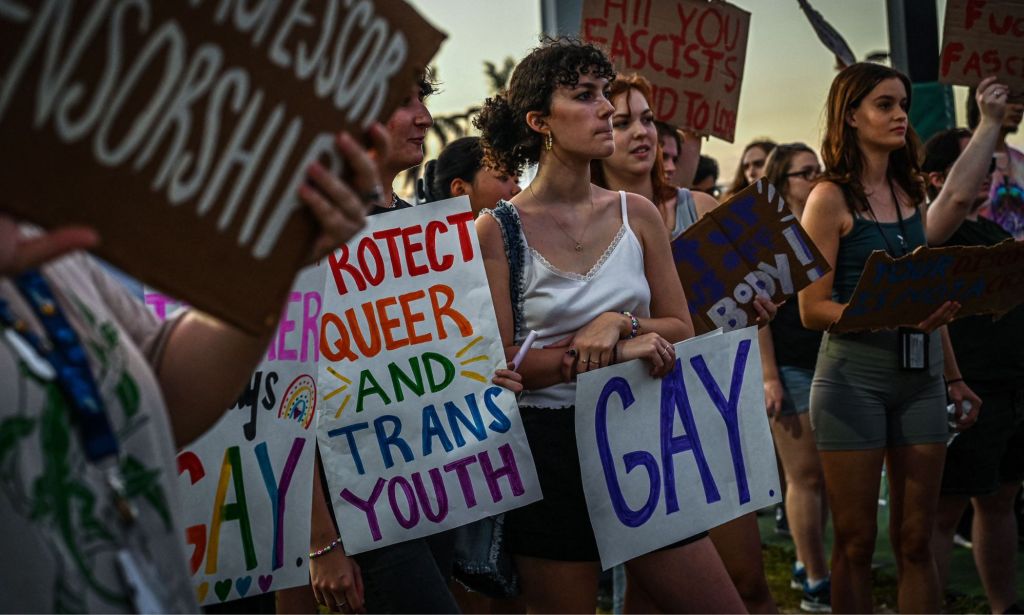
And with many LGBTQ+ Americans waking up on 6 November to the bleak and shocking reality of a second Trump presidency, it feels like a particularly good time to unpick what the document could signify for queer peoples’ rights in the US over the next four years.
Unsurprisingly, while Project 2025 promises to “take down the ‘Deep State’ and return the government to the people”, it also threatens to shred the rights and advancements of the LGBTQ+ community in the US.
The handbook’s authors claim that one of the biggest problems facing the US today is the “toxic normalization of transgenderism with drag queens and pornography invading school libraries.”
Project 2025 goes on to say that “transgender ideology” is one form of “pornography” linked to the “sexualization of children”. In total, “gender” is mentioned 111 times, and “LGBT” or “LGBTQ” 18 times, in the handbook.
LGBTQ+ rights would all but disappear if Project 2025 came to fruition. (Getty)
Viewed as a sort of right-wing wish-list, Project 2025 pledges to strip away anti-discrimination policies, making it easier to target and discriminate against LGBTQ+ people.
Published by the hard-line right-wing Heritage Foundation, the document calls for the removal of terms such as “sexual orientation” and “gender identity” from federal rules and legislation, and the revoking of regulations prohibiting discrimination based on sexual orientation, gender identity, transgender status and sex characteristics.
Project 2025 set out plans to restrict the application of the Supreme Court’s decision in Bostock vs. Clayton County, which extended workplace protections against sex discrimination to LGBTQ+ employees.
In addition, it plans to restrict access to healthcare for transgender people, something it refers to as a form of “child abuse”. Its authors also want to see trans healthcare no longer being covered by insurance schemes Medicare and Medicaid, and an end to anti-discrimination rules based on gender identity and sexual orientation.
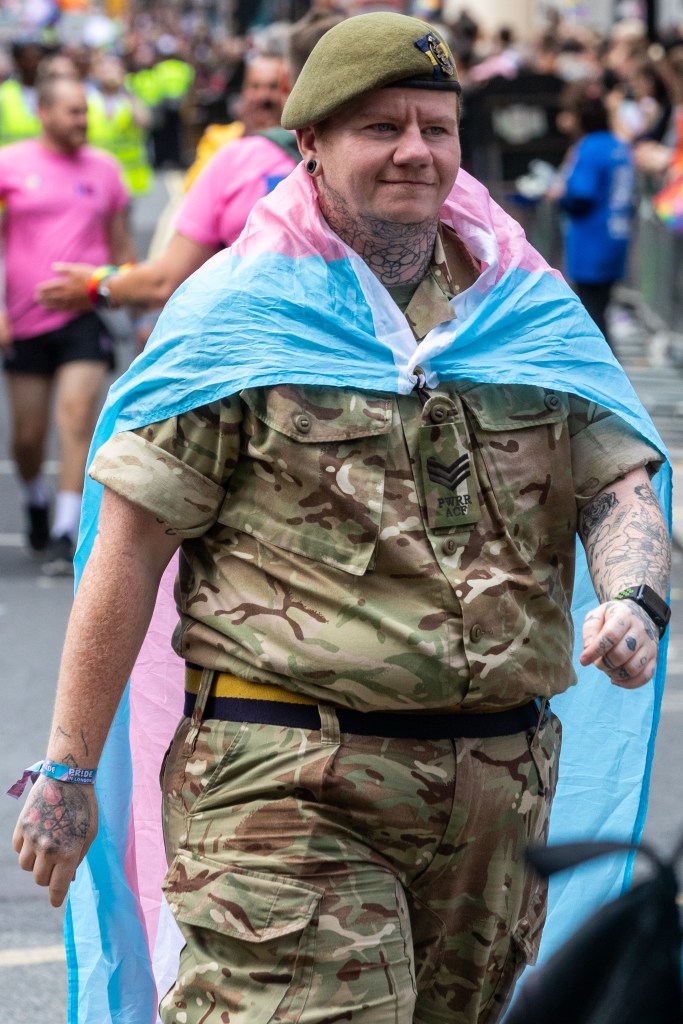
In addition, there are plans to reverse policies allowing transgender people to serve in the military, a ban that was initially brought in under the Trump administration but reversed by president Joe Biden. If enacted, Project 2025 would expel transgender servicemen and women as well as those living with HIV.
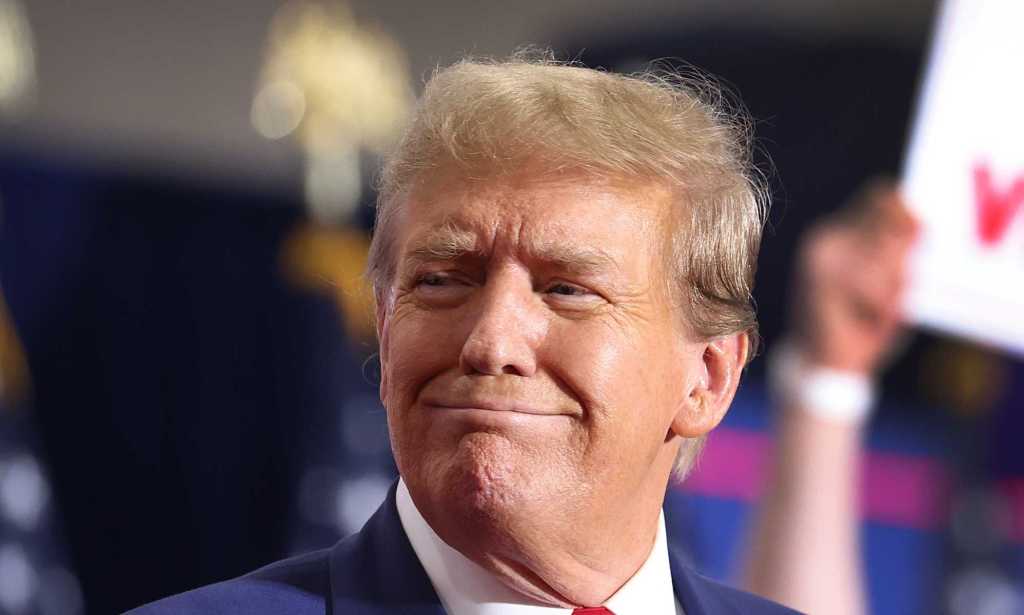
Donald Trump has tried to distance himself from the hard-line right-wing document. (Getty)
The State Department’s LGBTQ+ equality initiatives in Africa would also be axed. In other words, there would be no effort to stop draconian anti-queer laws being passed in countries such as Uganda.
In terms of education, the conservative blueprint is even more staunchly anti-LGBTQ+. It calls for a ban on students using names or pronouns that don’t match the sex on their birth certificate, and no school employee would be “forced” to use a pupil’s chosen pronouns.
It document outlines ideas to remove LGBTQ+-inclusive curriculums and policies from schools, claiming that “critical race theory and gender ideology” are “poisoning and indoctrinating children with leftist ideologies”. Instead, families “comprised of a married mother, father and their children” would be prioritized.
Despite many of its authors being one-time Trump administration advisors, the former president claims to know “nothing about Project 2025” or who is behind it, saying: “I disagree with some of the things they’re saying and some of the things they’re saying are absolutely ridiculous and abysmal.”
And two of his campaign advisors insisted: “President Trump’s campaign has been very clear that Project 2025 had nothing to do with the campaign, did not speak for the campaign, and should not be associated with the campaign in any way.”
A spokesperson for Project 2025 has even told CNN that it “does not speak for any candidate or campaign.”
However, Democrats have continued to point to links between the 922-page document and Trump. As he’s now won the election, will Trump finally admit to having any involvement with Project 2025? Only time will tell.
Why is it only the southern border that the right is concerned with? Most undocumented people in the US are here on visas and flew into the country legally. They just never then went home when the visa ended. Why is it only some country the right whines about immigrating to the US? Racism and bigotry is the answer. Think about it. The right is terrified that white people will be replaced by non-white people. Elon Musk is always claiming white people need to have more babies. But only white people. Also the right fails to understand that Puerto Rico is part of the US and the Puerto Ricoian people are US citizens. But remember how tRump wanted to sell the island because it was full of … those brown people. Hugs
—————————————————————————————————————
In an exclusive interview with NBC News, Trump talked about his campaign promise to carry out the largest mass deportation of immigrants in U.S. history.
President-elect Donald Trump told NBC News on Thursday that one of his first priorities upon taking office in January would be to make the border “strong and powerful.” When questioned about his campaign promise of mass deportations, Trump said his administration would have “no choice” but to carry them out.
“We obviously have to make the border strong and powerful and, and we have to — at the same time, we want people to come into our country,” he said. “And you know, I’m not somebody that says, ‘No, you can’t come in.’ We want people to come in.”
As a candidate, Trump had repeatedly vowed to carry out the “largest deportation effort in American history.” Asked about the cost of his plan, he said, “It’s not a question of a price tag. It’s not — really, we have no choice. When people have killed and murdered, when drug lords have destroyed countries, and now they’re going to go back to those countries because they’re not staying here. There is no price tag.”
It’s unclear how many undocumented immigrants there are in the U.S., but acting ICE Director Patrick J. Lechleitner told NBC News in July that a mass deportation effort would be a huge logistical and financial challenge. Two former Trump administration officials involved in immigration during his first term told NBC News that the effort would require cooperation among a number of federal agencies, including the Justice Department and the Pentagon.
In Thursday’s phone interview, he partially credited his message on immigration as a reason he won the race, saying, “They want to have borders, and they like people coming in, but they have to come in with love for the country. They have to come in legally.”
“I started to see realignment could happen because the Democrats are not in line with the thinking of the country,” the president-elect said. “You can’t have defund the police, these kind of things. They don’t want to give up and they don’t work, and the people understand that.”
Trump also spoke about his phone calls with Harris and President Joe Biden since the election.
“Very nice calls, very respectful both ways,” Trump said, describing the conversations, adding that Harris “talked about transition, and she said she’d like it to be smooth as can be, which I agree with, of course.”
In her concession speech at Howard University on Wednesday, Harris said she told Trump, “We will help him and his team with their transition and that we will engage in a peaceful transfer of power.”
Biden, addressing the nation in remarks from the White House on Thursday morning, urged voters to “accept the choice the country made” in re-electing Trump.
Trump also said that he and Biden on the phone agreed to have lunch together “very shortly.”
He also said he’s spoken to “probably” 70 world leaders since Wednesday morning, including Israeli Prime Minister Benjamin Netanyahu, which the president-elect described as “a very good talk.”
Trump also said that he spoken with Ukrainian President Volodymyr Zelenskyy, but didn’t divulge details about that conversation.
He added that he had not yet spoken with Russian President Vladimir Putin, but “I think we’ll speak.”
Over the course of the campaign, Trump promised to end Russia’s war with Ukraine if elected, saying in September that he would negotiate a deal “that’s good for both sides.“
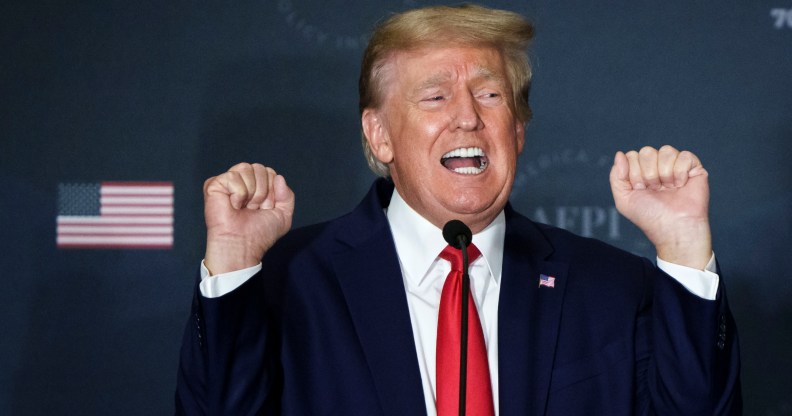
Donald Trump has been outspoken against the LGBTQ+ community. (Getty)
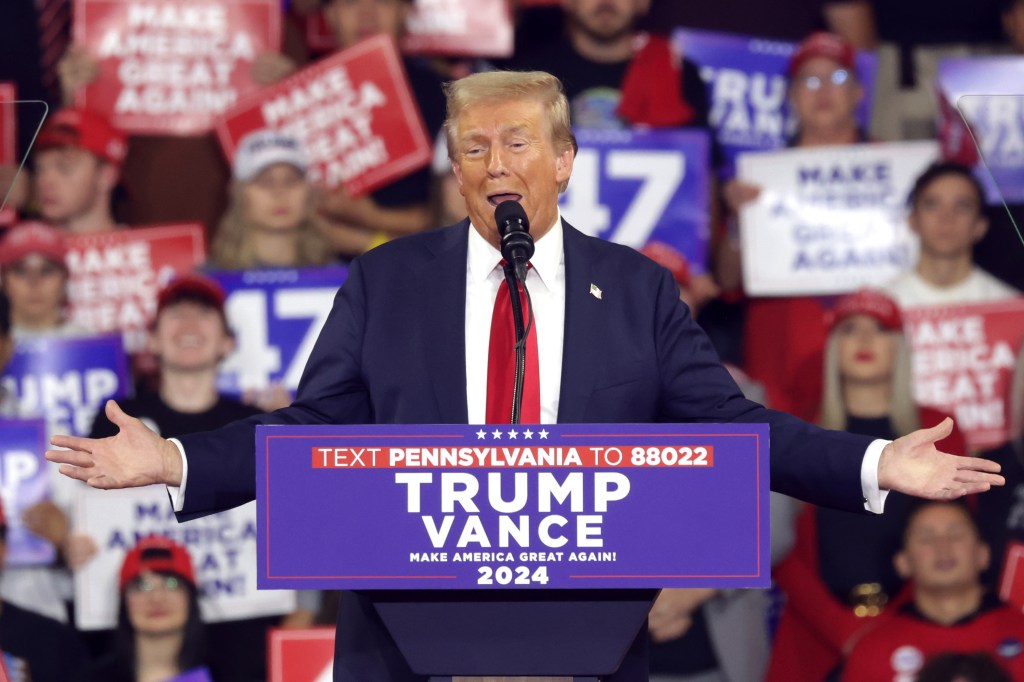
At the time of writing, it seems almost inevitable that Donald Trump will become the 47th President of the United States, meaning LGBTQ+ rights are under serious threat.
The election was one of the closest in history according to voting polls over the past few weeks, with polling group FiveThirtyEight reporting that Harris just barely reached a 1.2 per cent lead on Trump a day before the results were counted.
The last Trump presidency led to a roll-back of protections and anti-discrimination laws for LGBTQ+ people, and it doesn’t look as if a second term would be any different if he is re-elected, based on campaign promises and the detailed policy proposals outlined in Project 2025 – although Trump has tried to distance himself from the right-wing proposals.
In anticipation of a Trump win, the American Civil Liberties Union (ACLU) suggested a new Trump administration would “reinstate and significantly escalate the removal of anti-discrimination policies… proactively require discrimination by the federal government [and] weaponize federal law against transgender people across the country”.
So, what are Trump’s views about LGBTQ+ rights, and what exactly might he do?
Erase federal non-discrimination protections for LGBTQ+ people
Trump’s first term was extremely detrimental to the rights and protections of LGBTQ+ people, and a second term could roll back protections once again.
LGBTQ+ people might no longer be guaranteed to be free of discrimination across several federal government programs, such as Social Security, Medicare, housing and employment.
Exclude openly transgender people from the military
The first Trump administration reversed policies allowing trans people to serve in the military, and it is not difficult to foresee the president doing so again.
Another ban on trans people in the military would force out active-duty transgender service personnel as well as prevent trans people enlisting in the future.
This is despite a report in 2016 revealing that trans-inclusive policies have “little or no impact on unit cohesion, operational effectiveness, or readiness”.
In fact, trans-inclusive military policies could benefit all active service members by “creating a more inclusive and diverse force.”
Trans people could once again be banned from serving. (Getty)
Withhold federal funding if school officials affirm transgender students
Trump has said he would act to stop any school district introducing or maintaining trans-inclusive policies and practices.
This would include withholding federal funding that allow trans students to use toilets and changing rooms that align with their gender identity, or even acknowledging that they are trans, as well as arguing that trans-inclusive policies violate the rights of cisgender pupils.
Discrimination against trans students, causing significant harm to the community as a whole, would be the likely result of such a move.
During a recent campaign rally, Trump said he was not going to “let” trans women compete in sporting events at all if he becomes president again.
He said invoking the ban would “not [be] a big deal”, citing recent sporting events in which trans women competed against cisgender women, claiming that the trans athlete had a competitive edge over their opponent.
“Physically, from a muscular standpoint… look at what’s happened in swimming. Look at the records that are being broken,” he said.
Prohibit gender-affirming care in federal healthcare programmes
His website also promises that on his first day in the Oval Office, he would issue an executive order “instructing every federal agency to cease all programs that promote the concept of sex and gender transition, at any age”.
The administration would also probably deny Medicaid funding for hospitals that provide gender-affirming care, forcing medics to deny trans people the care they require.
Access to healthcare for more than 100,000 transgender youngsters in 24 states has already been halted in the past three years.
Allow employers to discriminate against LGBTQ+ staff
A second Trump administration could bring in provisions to allow employers to discriminate against LGBTQ+ members of staff based on the boss’ stated religious beliefs, a reversal of existing non-discrimination laws.
This would not require congress or bipartisan support, and could be pushed through using an executive order from the president.
The administration could go one step further to prevent state and local governments enforcing non-discrimination laws if the defendant says the discrimination was based on religious belief.
Laws protecting LGBTQ+ people and other minorities from discrimination based on protected characteristics might also disappear.
Donald Trump has continued to target the LGBTQ+ community. (Getty)
Criminalize gender-non-conformity in public life
Project 2025 – a hard-line right-wing blueprint for a future Republican president – suggests the use of criminal laws to punish gender-non-conformity in public life, with pornography being the crux of the issue.
The authors of the plan, the Heritage Foundation, inexplicably link pornography with “transgender ideology” and argue that neither has a “claim to First Amendment protection” and therefore should be outlawed.
“The people who produce and distribute it should be imprisoned,” they demand. “Educators and public librarians who purvey it should be classed as registered sex offenders, and telecommunications and technology firms that facilitate its spread should be [closed down].”
That means any discussion of transgender people in schools and libraries could be criminalized, and trans people might face jail time for being themselves.
Trump would only be able to put this into practice with congress’ approval and there is unlikely to be bipartisan support for such a law, but even the slim possibility is terrifying.
Finally – could gay marriage be reversed?
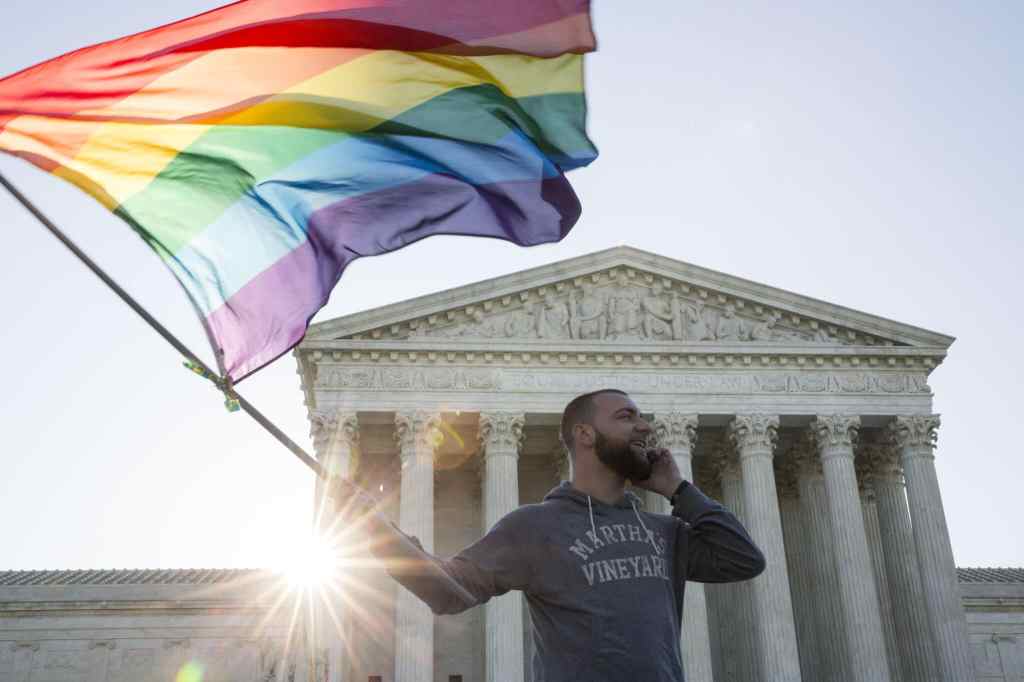
Same-sex marriage supporter Vin Testa, of Washington DC, waves a rainbow pride flag near the Supreme Court. (Drew Angerer/Getty Images)
Unfortunately, yes, it could.
After crucial abortion legislation Roe v. Wade was overturned by the Supreme Court, many people said that next, they would be coming for Windsor and Obergefell and Lawrence – three rulings that unlocked a national right to same-sex marriage.
Whether a same-sex couple could marry varied by state before 2015. With its 5-4 decision in Obergefell v. Hodges, the Supreme Court extended the full federal right to marry to all same-sex couples.
So would – or could it be taken away? Many people think that the Supreme Court wouldn’t dare. Same-sex marriage is now too accepted in American society, they argue. It would cause “legal chaos.”
However, it remains the case that some justices, particularly Samuel Alito and Clarence Thomas, appear to be itching to overturn Obergefell. In 2022, Justice Thomas said the Supreme Court “should reconsider” its past rulings codifying rights to contraception access, same-sex relationships and same-sex marriage.
It’s important to remember in all of this Pride is a protest, and it continues to be. We can fight any and all of these attacks by standing up, speaking out and refusing to stay silent.
November 4, 1811 A group of men in Bulwell, near Nottingham, England, armed with hammers, axes and pistols in the dark of night, broke into the workshop of a master weaver named Hollingsworth and smashed six weaving machines the men thought threatened their jobs. They and their supporters opposed the industrialization that had turned home-based sustainable textile work into factory work with significant loss of jobs through mechanization (and those at much lower wages), as well as the attendant air and water pollution. Luddites smashing loom. They called themselves followers of the probably fictional General Ludd and continued their attacks for months, with over a thousand knitting machines destroyed. In response, thousands of troops were sent to stop the rebellion, and Parliament passed a law making destruction of weaving machines a hanging offense. Luddites has since become a term used for those who oppose technology.
November 4, 1956 Two hundred thousand Russian troops with 1000 tanks stopped an anti-Stalinist uprising in Hungary and installed a new pro-Soviet government. Although civilians had set up barricades along all the major roads leading to Budapest, the Soviet air force bombed the capital and troops poured into the city in a massive dawn offensive. Hungarian Army and National Guard troops participated in the resistance; only Communist Party functionaries and security police fought alongside the Warsaw Pact troops. The help promised from the U.S. to protect and aid the anti-Stalinists never came. 20,000 Hungarians ultimately died as a result (as well as 4000 troops), and ten times that many left the country permanently. Hungarian ‘freedom fighters’ temporarily forced back Soviet tanks and troops. Soviet tanks in Budapest. Pictorial history of the Hungarian Uprising
November 4, 1984 The first free elections in Nicaraguan history were held. Nicaragua’s ruling Sandinista Front claimed a decisive victory (70%), defeating six other parties, in the country’s first elections since the revolution the Sandanistas had led five years previous. The high-turnout election (83%) was monitored by 400 independent election observers who said the election had been fair. Read more
November 4, 1995 Israeli Prime Minister Yitzhak Rabin was fatally shot minutes after speaking at a peace rally held in Tel Aviv’s Kings Square in Israel. The rally in Kings of Israel Square Yitzhak Rabin Read more
November 4, 2008 The first African American ever nominated by a major political party as candidate for president went before the electorate. Senator Barack Obama of Illinois and his Democratic vice-presidential running mate, Senator Joseph Biden of Delaware, faced Republican Senator John McCain of Arizona and Alaska Governor Sarah Palin; independent candidates Ralph Nader and Matt Gonzalez; Green Party candidates former Representative Cynthia McKinney and Rosa Clemente; and former Repepresentatives Bob Barr and Wayne Allyn Root.
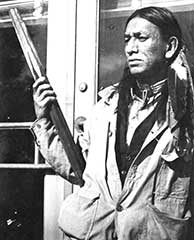
November 3, 1883 The U.S. Supreme Court, in its decision Ex Parte Crow Dog, declared Native Americans were ultimately subject to U.S. law, “not in the sense of citizens, but . . . as wards subject to a guardian . . . as a dependent community who were in a state of pupilage.” However, the Court acknowledged the sovereignty of tribal authority in the particular case at hand. The Congress, however, essentially overturned the Court’s decision two years later. Chief Crow Dog, 1898 More on Ex Parte Crow Dog
November 3, 1917 Bolsheviks, the followers of Vladimir Lenin, took control of the capital, Moscow, and the Kremlin, the fortress-like grouping of government buildings and churches at the center of the capital city, as the Russian revolution succeeded.
November 3, 1969 President Nixon announced the “Vietnamization” program to shift fighting by U.S. troops to U.S.-trained Vietnamese troops. “We have adopted a plan which we have worked out in cooperation with the South Vietnamese for the complete withdrawal of all U.S. combat ground forces, and their replacement by South Vietnamese forces on an orderly scheduled timetable.” The last U.S. troops didn’t return home until 1975.
November 3, 1972 Five hundred protesters from the “Trail of Broken Treaties,” a Native American march, occupied the Bureau of Indian Affairs offices (part of the Department of Interior) in Washington, D.C., for six days. Their goal was to gain support from the general public for a policy of self-determination for American Indians. Read more about the occupation: Read the Indian Manifesto:
November 3, 1979 Five members of the Workers Viewpoint Organization (later the Communist Workers Party) which had organized a “Death to the Klan” rally, were murdered and ten others injured when the rally was attacked by 40 Ku Klux Klan members and Nazis in Greensboro, North Carolina. The political organization had been joined in the march by a group of local African-American mill workers. At the time of the shootings, not one police officer was present. Two all-white juries acquitted the murderers despite the fact that the whole incident was on videotape. But in 1985 a federal jury found two policemen, a police informant/Klan leader, and five Klansmen and Nazis liable for the wrongful death of one of the demonstrators.
November 3, 1985 The Rainbow Warrior bombed Two French agents of the DGSE (Secret Service) dramatically changed their pleas on charges related to the bombing and sinking of the Greenpeace’s ship, Rainbow Warrior, and pled guilty. The ship was attacked in Auckland (New Zealand) harbor in anticipation of sailing to Moruroa Atoll to interfere with French nuclear weapons testing. It was the first act of terror ever committed in New Zealand. Read more
November 2, 1920 Socialist Party candidate Eugene V. Debs received nearly one million votes for President though he was serving a prison sentence at the time for his criticism of World War I and his encouraging resistance to the draft. More on Debs
November 2, 1982 Voters in nine general elections passed statewide referenda supporting a freeze on testing of nuclear weapons. Only Arizona turned it down. Dr. Randall Forsberg, a key person behind the Freeze movement Dr. Randall Forsberg
November 2, 1983 A bill designating a federal holiday honoring Dr. Martin Luther King, Jr. (to be observed on the third Monday of January) was signed by President Ronald Reagan. King was born in Atlanta in 1929, the son of a Baptist minister. He received a doctorate degree in theology and in 1955 organized the first major protest of the civil rights movement: the successful Montgomery Bus Boycott. Influenced by Mohandas Gandhi, he advocated nonviolent civil disobedience of the laws that enforced racial segregation. The history of Martin Luther King Day (pdf)
Disillusioned members of the US military have turned to Vietnam war-era policy to terminate their service because of religious or moral convictions
For Joy Metzler, a second lieutenant in the US air force, joining the military had felt like answering a calling. An adoptee from China who was raised in a conservative Christian family, she believed she owed a debt to the United States.
But the Hamas attacks in Israel last year, and Israel’s war that followed, rocked Metzler’s convictions. Within months, she filed for conscientious objector status, one of a small number of US military personnel seeking to end their service because of their moral opposition to US support for Israel.
“I didn’t know Palestine was a place before October 7,” Metzler told the Guardian.
“All of a sudden it felt like a light clicking on for me.”
As the war in Gaza enters a second year, some disillusioned members of the US military have turned to the Vietnam war-era conscientious objector policy to terminate their military service because of religious or moral convictions.
There are few avenues to express dissent in the army. Earlier this year, Harrison Mann, an army officer assigned to the Defense Intelligence Agency resigned in protest of US support for Israel. In a far more extreme gesture, 25-year-old US airman Aaron Bushnell died after setting himself on fire outside the Israeli embassy in Washington in February.
The conscientious objector route is a seldom-invoked alternative that few service members are aware of – though some advocates say there has been an uptick in interest in the last year.
The defense department referred questions about the number of conscientious objectors to each branch of the military. A spokesperson for the air force said that it has received 42 applications since 2021 and granted 36. Applications since 7 October “are on trend with pre-conflict averages”, the spokesperson added. (The army, navy, and Marine Corps did not respond to requests for comment.)
But while the numbers remain relatively low, the war in Gaza is top of mind for those service members who have considered conscientious objector status this year, said Bill Galvin, a Vietnam-era objector and director of counseling at the Center on Conscience and War, one of a handful of groups that helps military members navigate the complex bureaucratic process.
Galvin said his group helps roughly 50 to 70 applicants a year, across military branches, and that there’s been more interest than usual this year.
The US has subsidized Israel’s war in Gaza to the tune of nearly $18bn over the last year, and is growing more deeply entangled as the conflict spills into the broader region. The Biden administration recently announced the deployment of 100 troops to Israel to man a missile defense system in anticipation of an escalation against Iran.
“Almost everyone that I’ve talked to has at least cited what’s happening in Gaza as a factor in causing them to rethink what they’re doing,” Galvin said. “Some have actually said: ‘I know that the airplane that I’m doing maintenance on is delivering weaponry to Israel and so I feel complicit.’” (snip-MORE)
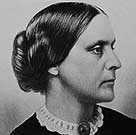
November 1, 1872 Susan B. Anthony and her three sisters entered a voter registration office set up in a barbershop. They were part of a group of fifty women Anthony had organized to register in her home town of Rochester. Anthony walked directly to the election inspectors and, as one of the inspectors would later testify, “demanded that we register them as voters.” The election inspectors refused, but she persisted, quoting the Fourteenth Amendment’s citizenship provision and the article from the New York Constitution pertaining to voting, which contained no sex qualification. She persisted: “If you refuse us our rights as citizens, I will bring charges against you in Criminal Court and I will sue each of you personally for large, exemplary damages!” The inspectors sought the advice of the Supervisor of elections: “Young men,” he said, “do you know the penalty of law if you refuse to register these names?” Registering the women, the registrars were advised, “would put the entire onus of the affair on them.” The inspectors voted to allow Anthony and her three sisters to register. In all, fourteen Rochester women successfully registered that day. But the Rochester Union and Advertiser editorialized: “Citizenship no more carries the right to vote that it carries the power to fly to the moon . . . if these women in the Eighth Ward offer to vote, they should be challenged, and if they take the oaths and the Inspectors receive and deposit their ballots, they should all be prosecuted to the full extent of the law.”
November 1, 1929 Australia abolished peace-time compulsory military training.
November 1, 1954 A war of independence to end French colonial rule over the north African nation of Algeria began when 60 bombs were set off on this day in Algiers, the capital. Over the next eight years 1.5 million Algerians would die, along with about 30,000 French. The French had dominated the country since 1830. French troops clash with Algerian civilians Read more
November 1, 1954 The U.S. produced the biggest ever man-made explosion in the Pacific archipelago of Bikini, part of the Marshall Islands. The hydrogen bomb, equivalent of 20 million tons of TNT was up to 1,000 times more powerful than the atomic bomb that destroyed Hiroshima. It overwhelmed the measuring instruments, indicating that the bomb was much more powerful than scientists had anticipated. One of the atolls was totally vaporized, disappearing into a gigantic mushroom cloud that spread at least 100 miles wide, dropping back to the sea in the form of radioactive fallout.
November 1, 1961 50,000-100,000 women joined protests against the resumption of atmospheric nuclear tests by both the U.S. and the Soviet Union. The demonstrations, in at least 60 U.S. cities, led to the founding of Women Strike for Peace. Their slogan: “End the Arms Race – Not the Human Race.” See Photos from Swarthmore College Peace Collection “Women’s Strike for Peace” storming the Pentagon in a 1967 protest against the war in Vietnam. Bella Abzug demonstrating with WSP photo: Dorothy Marder
November 1, 1970 Detroit’s Common Council voted for immediate withdrawal of U.S. armed forces from Vietnam.
November 1, 1983 A senior State Department official, Jonathan T. Howe, told Secretary of State George P. Shultz about intelligence reports that showed Iraqi troops resorting to “almost daily use of CW [chemical weapons]” against the Iranians. Saddam Hussein had invaded Iran in 1980. But the Reagan administration had already committed itself to a large-scale diplomatic and political overture to Baghdad, culminating in several visits by the president’s recently appointed special envoy to the Middle East, Donald H. Rumsfeld.
November 1, 1990 As part of the adoption of the International Law of the Sea, forty-three nations agreed to ban dumping industrial wastes at sea by 1995. Neither the U.S. nor Canada (along with Albania, Burundi, Ethiopia, Uzbekistan and San Marino) have ever ratified the treaty which thus lacks the force of U.S. federal law. More on the Law of the Sea
November 1, 2003 The Tel Aviv memorial for Israeli leader Yitzhak Rabin, slain eight years previously, was transformed into a peace rally with over 100,000 protesting the military policies of Prime Minister Ariel Sharon.”Yitzhak was right, and his path just,” said Shimon Peres, the former prime minister and architect of the Oslo peace accords with Mr Rabin. “His views today are clear and enduring. There will be no retreat; we will continue.” Read more
October 31, 1929 George Henry Evans, an English-born printer and journalist, published the first issue of the Working Man’s Advocate, “edited by a Mechanic” for the “useful and industrious classes” of New York City. Evan covered the Workingmen’s Party (which he helped found) and the early trade union movement. In his Prospectus, Evans focused on the inequities between the “portion of society living in luxury and idleness” and those “groaning under the oppressions and miseries imposed on them.” He advocated “a system of education which shall be equally open to all, as in a real republic it should be” and opposed “every thing which savors of a union of church and state.” Evans became a U.S. citizen one week later.
October 31, 1950 Earl Lloyd became the first of three African Americans who began to play in the National Basketball Association (NBA) when he started with the Washington Capitols. He and Jim Tucker went on to become the first African Americans to play on a championship team in 1955 as members of the Syracuse Nationals, which is now the Philadelphia 76ers. After retiring as a player, Lloyd was a Detroit Pistons assistant coach for two seasons, and a scout for five.
October 31, 1952 The U.S. successfully detonated “Mike,” the world’s first hydrogen (or fusion) bomb, in the atmosphere at the Eniwetok Proving Grounds on the Elugelab Atoll, part of the Marshall Islands in the southern Pacific. The 10.4-megaton device was the first thermonuclear device built upon the Teller-Ulam principles of staged radiation implosion. Mike’s Mushroom cloud
The incredible explosive force of Mike was apparent from the sheer magnitude of its mushroom cloud – within 90 seconds the mushroom cloud climbed to 57,000 feet and entered the stratosphere at a rate of 400 mph. One minute later it reached 108,000 feet, eventually stabilizing at a ceiling of 120,000 feet. Half an hour after the test, the mushroom stretched sixty miles across, with the base of the head joining the stem at 45,000 feet.The explosion wiped Elugelab off the face of the planet, leaving a crater more than 50 meters (175 feet) deep, and destroyed life on the surrounding islands. The details and the results Early U.S.nuclear tests
October 31, 1958 The U.S., the U.S.S.R. (Union of Soviet Socialist Republics aka Soviet Union) and Great Britain began negotiations in Geneva on whether to let the nuclear testing moratorium become a permanent test ban. General Secretary Nikita Kruschev had unilaterally declared a moratorium on Soviet testing earlier in the year, President Dwight Eisenhower and Prime Minister Harold MacMillan following suit in August. There had been growing concern over the health effects of radioactive fallout in the atmosphere from the nuclear explosions. Nonetheless, all three nations did further last-minute tests before the moratorium took effect.
October 31, 1972 20-POINT POSITION PAPER
PREAMBLE AN INDIAN MANIFESTO FOR RESTITUTION, REPARATIONS, RESTORATION OF LANDS FOR A RECONSTRUCTION OF AN INDIAN FUTURE IN AMERICA THE TRAIL OF BROKEN TREATIES:
“We need not give another recitation of past complaints nor engage in redundant dialogue of discontent. Our conditions and their cause for being should perhaps be best known by those who have written the record of America’s action against Indian people. In 1832, Black Hawk correctly observed: You know the cause of our making war. It is known to all white men. They ought to be ashamed of it. The government of the United States knows the reasons for our going to its capital city. Unfortunately, they don’t know how to greet us. We go because America has been only too ready to express shame, and suffer none from the expression – while remaining wholly unwilling to change to allow life for Indian people. We seek a new American majority – a majority that is not content merely to confirm itself by superiority in numbers, but which by conscience is committed toward prevailing upon the public will in ceasing wrongs and in doing right. For our part, in words and deeds of coming days, we propose to produce a rational, reasoned manifesto for construction of an Indian future in America. If America has maintained faith with its original spirit, or may recognize it now, we should not be denied.”
October 31, 1978 30,000 Iranian oil workers went on strike against the repressive rule of the U.S.-installed Shah and for democracy, civil and human rights. Striking Iranian oil workers. Photo: December 1978 issue of Resistance. A publication of the Iranian Students Association in the U.S. (ISAUS) Read more
October 31, 1984 Indian Prime Minister Indira Gandhi was shot to death by two Sikh members of her own security guard while walking in the garden of her New Delhi home. Gandhi’s son, Rajiv, a member of parliament and a leader in the Congress-I Party, was sworn in as Prime Minister following the assassination.


 Florence, Italy 11.9.2002


 Luddites smashing loom.
 Hungarian ‘freedom fighters’ temporarily forced back Soviet tanks and troops.


 Yitzhak Rabin
 Chief Crow Dog, 1898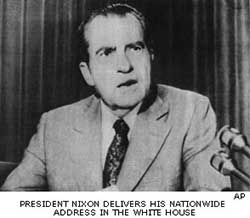

 The Rainbow Warrior bombed




 Mike’s Mushroom cloud
 Scottie's Playtime