I hope everyone and their pets enjoy at least some peace these next few days! I hate fireworks, though I don’t mind them far away or on TV. I did used to like them, when I was a kid. 🎆
July 1, 1917 8000 anti-war marchers demonstrated in Boston. Their banners read: “IS THIS A POPULAR WAR, WHY CONSCRIPTION? WHO STOLE PANAMA? WHO CRUSHED HAITI? WE DEMAND PEACE.” The parade was attacked by soldiers and sailors, on orders from their officers.
July 1, 1944 A massive general strike and nonviolent protest in Guatemala led to the resignation of dictator Jorge Ubico who had harshly ruled Guatemala for over a decade. Juan José Arévalo Bermejo On March 15 of the following year, Dr. Juan José Arévalo Bermejo took office as the first popularly elected president of Guatemala, and promptly called for democratic reforms establishing the nation’s social security and health systems, land reform (redistribution of farmland not under cultivation to the landless with compensation to the owners), and a government bureau to look after native Mayan concerns. Jorge Ubico A decade of peaceful democratic rule followed, until a CIA-backed coup in 1954 ushered in a new, even more brutal era of dictatorial and genocidal regimes. [see June 27, 1954]
July 1, 1946 The United States exploded a 20-kiloton atomic bomb near Bikini Atoll, part of the Marshall Islands in the Pacific Ocean.
July 1, 1968 Sixty-one nations, including the United States, Britain and the Soviet Union, signed the Treaty on the Non-Proliferation of Nuclear Weapons (NPT) which set up systems to monitor use of nuclear technology and prevent more nations from acquiring nuclear weapons. 190 countries are now signatories; Israel, India and Pakistan remain outside the Treaty. North Korea joined the NPT in 1985, but in January 2003 announced its intention to withdraw from the Treaty. Text of the Treaty
July 1, 1972 The first issue Publication of the first monthly issue of Ms. Magazine, founded by Gloria Steinem “The truth will set you free. But first, it will piss you off,” Letty Cottin Pogrebin “Housework is the only activity at which men are allowed to be consistently inept because they are thought to be so competent at everything else,” and others. Ms. Magazine today (It’s still Ms. Magazine! -A.)
July 1, 2000 Vermont’s civil unions law went into effect, granting gay couples most of the rights, benefits, protections and responsibilities of marriage under state law. In the first five years, 1,142 Vermont couples, and 6,424 from elsewhere, had chosen a Vermont civil union.
I cannot add up the number of times I’ve been told by good, liberal Dems that these issues won’t float. And that was back in the 1980s and 90s, not to mention the 2000s. Anyway, take a look!
Mamdani And The Left Are Moving The Window – Good by Oliver Willis
What if everything you believed since you have been politically awake is wrong? It isn’t that you have bad intentions or you’re fundamentally stupid, but what if instead you believed for so long that the existing menu of political options was one group of beliefs but in reality, that was a really limited menu that excluded some really tasty items you never considered before?
When a rising progressive figure like Zohran Mamdani makes bold statements about what he wants to achieve, it can make regular old mainstream Democrats/liberals like myself wince. Government supermarkets? We shouldn’t have billionaires? Immediately that kicks in concerns about how Democrats are perceived. It isn’t just Mamdani. Ideas like defunding the police, universal basic income, free health care, etc.? Sure, we say, they may sound good on paper – but they also sound like left wing fantasyland, they’re just not “practical.”
And maybe they are impractical, unworkable, and election losers. But – what if not? We should at least have the conversation, I think.
Because for decades now American political discourse has been operating within the parameters set by the right wing, not the left. Since 1980 we have had 20 years of Democratic presidents and while I think they did a decent job of domestic politics between the three of them (Clinton, Obama, and Biden), much of what they did was within the narrow paradigm of what was acceptable behavior.
Clinton frequently talked about cutting the size of the government, Obama spoke about lowering the deficit, and Biden also used the language of “fiscal responsibility” as the right envisions it. All three men accepted the existence of billionaires and even pushed policies that would theoretically create even more of them. None of them would argue that the police needed to be defunded, and in fact they all oversaw federal spending that sent billions to police departments.
I was among the millions who supported these three presidents, along with other Democrats who ran for office with a similar world view both at the presidential and congressional level to varying degrees of success.
But these people have all been operating within the right’s paradigms. Collectively we never openly debated how we could have it all wrong. Maybe the prison system should be abolished? Maybe billionaires should be taxed out of existence?
Even if we don’t ultimately reach those conclusions, these are debates worth having.
Because while we have been limiting ourselves, the right hasn’t. Since Barry Goldwater in 1964, the right has been shifting the Overton Window – what is considered acceptable public discourse – steadily to the right. We have gone from Republicans like Nixon creating agencies like the EPA to Ronald Reagan and George W. Bush cutting funding for vital agencies to Donald Trump trying to completely destroy agencies like the Department of Education.
Things that Trump treats as uncontroversially right-wing today would have been laughed out of the room as the ravings of lunatics in 1958. The right has mounted serial challenges to what was the liberal orthodoxy (not on every issue but most issues) in the 1960s and they have molded public perception of what acceptable dialogue is.
We are worse off for this. One can praise what Democratic leaders have accomplished in a progressive manner (health care, infrastructure, overall policy) and still admit that the thinking has been severely limited and inhibiting.
Voters are making this clear to the party. They keep showing in multiple federal and state elections that they are unhappy with the status quo and in some instances, like with Trump, they are far too eager to flirt with fascism versus maintaining the system as-is.
Think about the world that millennials and Gen-Z have lived in for their entire lives. Not only has it been shaped by Reaganism and Trumpism, but it has also been peppered with Democratic leaders like Obama, Clinton, and Biden who didn’t fundamentally challenge the bedrock of what the right laid but instead focused on (well needed) nibbling at the edges.
It has been a very long time, probably not since the Great Depression, where Democrats articulated the notion that something beyond the acceptable was possible. When Franklin D. Roosevelt first took office, the consensus was that bad stuff just had to happen and that the government had to lie back, helpless. Herbert Hoover couldn’t truly conceive of a universe where the government swooped in and actively combated the forces making things worse for ordinary Americans. Roosevelt shifted the window and set up the infrastructure of the safety net that still exists today (for now). (snip-MORE, + Kal El photo. Click through!)
Prank my ass, this was a hate crime against the marchers. The slurry can be classified as a biohazard. If it got into the water table it would contaminate the water supply. Chicken shit is full of diseases and stinks worse than any other manure. This was done to hurt LGBTQ+ people and their allies. Hugs
Updated / Monday, 30 Jun 2025 15:06
Coleraine Magistrates Court heard that the 19-year-old “made full and frank admissions” to police
A Co Antrim teenager spread gallons of hen manure on a road before Ballymena’s first Pride parade as part “of a prank,” a court has heard.
Coleraine Magistrates Court also heard that 19-year-old Isaac Adams “made full and frank admissions” to police when he was arrested.
Defence solicitor Stewart Ballentine said Mr Adams was “literally caught in the headlights of the police vehicle” when committing the offence.
Appearing handcuffed in the dock, Mr Adams, from the Lislaban Road in Cloughmills, confirmed his identity and that he understood the three charges against him, all alleged to have been committed on 28 June this year.
He was charged with causing criminal damage to Granville Drive in Ballymena, causing manure to be deposited on the road and possessing a bladed article, namely a lock knife.
According to a police statement at the time, Mr Adams was arrested in the early hours following reports of slurry being spread on the road at around 02.55am.
“The matter is being treated as a hate crime,” said the police statement.
The PSNI said they observed slurry on the road at Greenvale Street
While Mr Adams was charged to court today, a 20-year-old man who was arrested in connection with the incident has been released on police bail and is due to appear in court in November.
During Mr Adams’ brief court appearance, a police officer gave evidence that she believed she could connect the teenager to each of the offences.
She outlined how police on patrol happened upon a male wearing a balaclava and carrying “two empty 25 litre jugs”.
“He admitted that he had been spreading the manure over the roads to disrupt the Pride parade,” the officer told the court, adding that the lock knife was found in his pocket when he was searched.
The courty heard that Mr Adams “freely admitted” that he intended to disrupt that Pride parade due to be held later that day and during formal police interviews, the teenager told police “he was not the only person involved”.
The farmer told police he had filled four or five, five gallon jugs with “hen litter waste” from his family farm “and described it as a prank”.
Regarding issues of bail, the officer conceded the parade had now taken place and further that Mr Adams has absolutely no criminal record.
District Judge Peter King heard the clean up operation cost £788 (€921).
Under cross examination from Mr Ballentine, the officer agreed that Mr Adams “cooperated fully with the police” and also that he told them he had the knife as part of his work.
Submitting that Mr Adams “comes from good stock” in North Antrim and that the incident “is very much out of character,” Mr Ballentine said that having spent the weekend in a police cell, Mr Adams “has learnt a very salutary lesson”.
He argued that Mr Adams could be granted bail and Judge King agreed.
Freeing Mr Adams on his own bail of £500 and adjourning the case to 24 July, the judge imposed several conditions, including a curfew, barred Mr Adams from entering Ballymena and from contacting his co-accused.
Having heard the incident by mobile phone, he also ordered that Mr Adams can only have a phone which cannot access the internet and he has to pass on the details of any phone to the police.
Homeland Security Secretary Kristi Noem | Steven Spearie/The State Journal-Register / USA TODAY NETWORK
Rep. Robert Garcia (D-CA) confronted Homeland Security Secretary Kristi Noem about the administration sending a gay man to a prison camp in El Salvador and not even knowing if he’s still alive. Noem said that it wasn’t her problem.
Noem, who has bragged in the past about shooting her dog to death, appeared before the House Homeland Security Committee for a hearing yesterday, where Garcia asked her about Andry Hernandez Romero, a gay hair dresser from Venezuela who came to the U.S. legally to escape anti-LGBTQ+ violence and who was sent to the CECOT camp in El Salvador, which is known for torturing inmates, earlier this year.
The administration, which sent immigrants to the CECOT without letting courts determine if they were in the country illegally or if they had committed any crimes, has refused to try to bring anyone back from the camp.
“Would you commit to just letting his mother know – as a mother-to-mother – if Andry is alive?” Garcia asked Noem. “He was given an asylum appointment by the United States government. We gave him an appointment, we said, Andry, come to the border at this time and claim asylum, he was taken to a foreign prison in El Salvador.”
“His mother just wants to know if he’s alive. Can we check and do a wellness check on him?”
Noem said she doesn’t “know the specifics” of Hernandez Romero’s case but said that since he’s in El Salvador, Garcia should be asking El Salvador’s government about him.
“This isn’t under my jurisdiction,” Noem said.
Garcia reminded her that she said that the Salvadoran prison is a “tool in our toolkit” for fighting crime.
“You and the president have the ability to check that Andry is alive and not being harmed,” he said. “Would you commit into at least looking and asking El Salvador if he is alive?”
“This is a question that is best asked to the president and the government of El Salvador,” Noem responded drily.
Garcia to Noem: "Can you commit to just letting his mother know mother to mother if Andry is alive? He was given an asylum appointment by the United States government."(Noem wouldn't commit to it.)
Hernandez Romero is a Venezuelan immigrant who trekked to the U.S. and entered legally last year at San Diego. There, he asked for asylum, saying that he was being targeted in Venezuela for being gay and due to his political beliefs. He was held in a CoreCivic detention center, where he was screened by Charles Cross Jr.
“The government had found that his threats against him were credible and that he had a real probability of winning an asylum claim,” his lawyer, Lindsay Toczylowski, said.
In March, he, along with over 200 other immigrants, was taken in shackles to the CECOT camp in El Salvador. Even his lawyer said she didn’t know what happened to him until he was gone and missed a hearing in his immigration case.
In a video from the CECOT, Hernandez Romero could be heard saying, “I’m not a gang member. I’m gay. I’m a stylist,” as he was slapped and had his head shaved.
It was later revealed that the evidence Immigration and Customs Enforcement (ICE) had against Hernandez Romero was his tattoos, which came from a report from the contractor CoreCivic, specifically from former police officer Charles Cross Jr., who lost his job with the Milwaukee police after he drunkenly crashed into a house and allegedly committed fraud. His name was subsequently added to the Brady List, a list of police officers who are considered non-credible for providing legal testimony in Milwaukee County.
Cross claimed that Hernandez Romero had crown tattoos associated with a gang. The tattoos are labeled “Mom” and “Dad” and are common symbols associated with his hometown of Capacho, Venezuela. Capacho is known for its elaborate festival for Three Kings Day, and a childhood friend, Reina Cardenas, told NBC News that it was that festival that awakened Hernandez Romero’s desire to be an artist.
“Andry dedicated his life to arts and culture, and he worked hard to better his craft,” Cardenas said.
Subscribe to the LGBTQ Nation newsletter and be the first to know about the latest headlines shaping LGBTQ+ communities worldwide.
No one forced these people to read the book. But just having the book there in open view enraged them. How dare this librarian admit that trans kids exist, that they are real. They wouldn’t have an issue with a book on child angels or mythical creatures, but humans that are different from the majority straight cis must be denied and destroyed. Forbidden knowledge seems big in the Christian extremest world. They seem to live for and delight in harming anyone or thing different from the way they want the world to be. They seem to think it fine for them to force their views on others but requiring factual teaching about science, biology, geology, race history is oppressing them. Imposing the idea that some people dress up in costumes to read books to children on them is a violation of their rights, but a kid’s desire to see themselves represented in media they feel they have a right to prevent. Hugs
The cover of the offending book, When Aidan Became a Brother by transgender male author Kyle Lukoff. | Lee & Low Books
Lavonnia Moore, a 45-year-old library manager, had worked at the Pierce County Library in Blackshear, Georgia, for 15 years. She was ultimately let go when a Christian extremist group filed a complaint to the library after Moore approved the display of a children’s book about a transgender boy.
According to Moore, the display (entitled “Color Our World”) included the book When Aidan Became a Brother (by trans male author Kyle Lukoff), a story about a family accepting a trans child named Aiden while also preparing for the birth of Aiden’s sibling. Library volunteers created the display as a part of a regional-wide summer theme featuring books that celebrate diversity.
“I simply supported community involvement, just as I have for other volunteer-led displays. That’s what librarians do — we create space for everybody… I did not tell the parents and children what they could or could not add to the display, just as I do not tell them what they can or cannot read,” she wrote in a statement.
However, the book caught the attention of a group calling themselves the Alliance for Faith and Family (AFF), not to be confused with the anti-LGBTQ+ legal group Alliance Defending Freedom. The AFF had previously been in the public eye for demanding the removal of a mural in the Waycross-Ware County Public Library, which included a Pride theme declaring, “Libraries Are For Everyone.”
The AFF campaigned on Facebook, urging their followers to pray and take a few moments out of their day to email the Three Rivers Library System and Pierce County Commissioners to “put a stop to this and show them the community supports them in taking a stand against promoting transgenderism at our local library,”
In an update post, the group wrote, “The display has been removed, and LaVonnia is no longer the Pierce County Library Manager. Please thank the Pierce County Commissioners and Three Rivers Regional Library System for quickly addressing our concerns.”
Moore and her sister Alicia confirmed that LaVonnia Moore had been fired. A statement to The Blackshear Times from the Three Rivers Library System Director Jeremy Snell explained that the library board leadership decided to move to new leadership for the Pierce County Library. He specifically cited the display of an “inappropriate” book as his reasoning.
“The library holds transparency and community trust in the highest regard,” Snell said.
“Instead of investigating, talking to me or my team, or exploring any kind of fair process, they used the ‘at-will’ clause in my contract to terminate me on the spot. No warning. No meeting. No due diligence. Just the words ‘poor decision making’ on a piece of paper after 15 years of service,” Moore claimed.
“I am just heartbroken,” she said of her dismissal.
According to Moore’s sister Alicia, “She messaged the family group and said ‘I was just fired.’”
“I don’t think she’s doing emotionally good, because imagine having to pack up 15 years in two days,” Alicia Moore told First Coast News.
“She’s heartbroken that a place she gave so much of herself to turned its back on her so quickly. And yes, she’s still in disbelief. She didn’t expect to be punished for doing her job with integrity and love for all patrons — especially children.” the sister explained.
The sisters are currently seeking legal counsel, and Alicia is urging people to reach out to the library board and county commissioners.
“I’m hoping the same method will be useful to get her justice,” Alicia said.
Subscribe to the LGBTQ Nation newsletter and be the first to know about the latest headlines shaping LGBTQ+ communities worldwide.
Also, to commemorate the final day of PRIDE month 2025, here’s an historic dance music video to celebrate. No matter what, we should never not dance again! 🎶 🌈 🎶 🫶
June 30, 1966 The first GIs—known as the Fort Hood Three, U.S. Army Privates James Johnson, Dennis Mora and David Samas—refused to be sent to Vietnam. All were members of the 142nd Signal Battalion, 2nd Armored Division stationed at Fort Hood, Texas. The three were from working-class families, and had denounced the war as “immoral, illegal and unjust.” They were arrested, court-martialed and imprisoned. The Pentagon reported 503,926 “incidents of desertion” between 1966 and 1971. 1961-1973: GI resistance in the Vietnam War View their pamphlet Ballad of The Fort Hood Three Pete Seeger
June 30, 1971 The 26th Amendment to the U.S. Constitution, lowering the minimum voting age to 18 in all elections, was ratified after ¾ of the 50 state legislatures had agreed to it, a mere 100 days after its passage by Congress.
June 30, 1974 The Selective Service law, authorizing the draft, expired, marking the official end of conscription in the U.S. and the beginning of the all-volunteer armed forces.
June 30, 2005 Spain legalized same-sex marriage by a vote of 187-147 in parliament. Such couples were also granted the right to adopt and receive inheritances. Prime Minister Jose Luis Rodriguez Zapatero spoke in support of the bill, “We are expanding the opportunities for happiness of our neighbors, our colleagues, our friends and our relatives. At the same time, we are building a more decent society. Read more
A High Court in India has ruled that trans women are women. (Getty)
A court in India has decreed that trans women are women.
In a landmark ruling for the country, after rejecting claims that womanhood was preserved only for those who can bear children, the High Court of Andhra Pradesh ruled that trans women were “legally entitled” to recognition as women.
Presiding over the case, justice Venkata Jyothirmai Pratapa decided that tying the definition of women to pregnancy was “legally unsustainable” and contradicted India’s constitution, which emphasises equality before the law.
Quoting a Supreme Court decision from 2014, which legally recognised the rights of “third gender” individuals, Pratapa said that prohibiting trans women’s right to identify as women “amounted to discrimination”.
The case was brought to the high court in 2022 after transgender woman Pokala Shabana looked to use a section of the Indian penal code to seek protection from her in-laws, whom, she said, had been abusive towards her.
The court sided with trans women. (Getty)
Her husband’s parents petitioned the court to deny her use of Section 498A, which protects women from cruelty by a husband or relatives, arguing that it only applied to cisgender women. They claimed that trans women don’t meet the legal definition of women under Indian law because they cannot get pregnant and said Shabana’s allegations of harassment lacked evidence.
However, the judge said that articles 14, 15 and 21 of the constitution, which guarantee a variety of discrimination protections, including the right to life and personal liberty, meant trans women’s rights to be recognised as women superseded the law.
“A trans woman, born male and later transitioning to female, is legally entitled to recognition as a woman,” he wrote in his ruling. “Denying such protection by questioning their womanhood amounts to discrimination.”
Trans activist and artist Kalki Subramaniam told the Washington Blade that she was relieved and delighted to see the court “upholding our basic human right to be identified as what we want.” She went on to say: “For [the] transgender community, especially trans women, this verdict means a lot.”
The Indian government has been under mounting pressure to modernise its laws and policies on LGBTQ+ rights. Same-sex marriage is still illegal, despite growing support for its legalisation.
Prime minister Narendra Modi’s government have previously labelled same-sex marriage an “elitist” viewpoint that “seriously affects the interests of every citizen”.
An affidavit establishing the government’s views on same-sex unions, in 2023, proclaimed that marriage was valid only between “biological males and females [and that] this definition [was] socially, culturally and legally ingrained into the very idea and concept of marriage and ought not to be disturbed or diluted by judicial interpretation”.
Share your thoughts! Let us know in the comments below, and remember to keep the conversation respectful.
Crackdown on Pride is part of effort to curb democratic freedoms ahead of a hotly-contested election next year
Tens of thousands march against Hungary’s government for LGBT rights – video
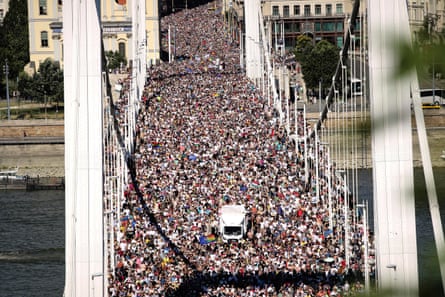
Tens of thousands of people have taken to the streets of Budapest in defiance of the Hungarian government’s ban on Pride, heeding a call by the city’s mayor to “come calmly and boldly to stand together for freedom, dignity and equal rights”.
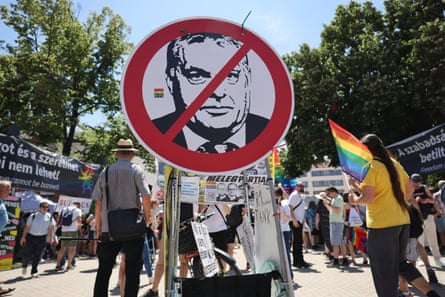
Jubilant crowds packed into the city’s streets on Saturday, waving Pride flags and signs that mocked the country’s prime minister, Viktor Orbán, as their peaceful procession inched forward at a snail’s pace.
Organisers estimated that a record number of people turned up, far outstripping the expected turnout of 35,000-40,000 people.
“We believe there are 180,000 to 200,000 people attending,” the president of Pride, Viktória Radványi told AFP. “It is hard to estimate because there have never been so many people at Budapest Pride.”
The mass demonstration against the government was a bittersweet marking of Budapest Pride’s 30th anniversary; while the turnout on Saturday was expected to reach record levels, it had come after the government had doubled down on its targeting of the country’s LGBTQ+ community.
Hungary Pride participants in the march cross the Elisabeth Bridge in Budapest, Hungary. Photograph: Rudolf Karancsi/AP
“We came because they tried to ban it,” said Timi, 49. The Hungarian national was marching with her daughter, Zsófi, 23, who had travelled from her home in Barcelona to join the rally.
After the ruling Fidesz party, led by the rightwing populist Orbán, fast-tracked a law that made it an offence to hold or attend events that involve the “depiction or promotion” of homosexuality to minors, many Hungarians vowed to show their disapproval by attending Pride for the first time.
Viki Márton was among those who had made good on the promise, turning up with her nine-year-old daughter.
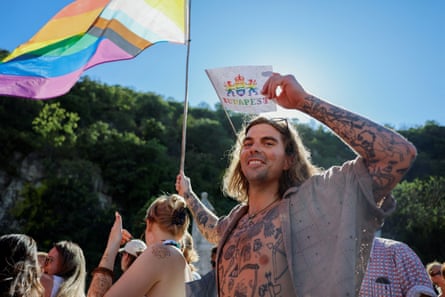
The pair had come equipped with hats, water spray, and a swimsuit, more worried about heat than rightwing protesters. “I want her to see the reality,” said Márton. “And I’m so excited to be here!”
Tens of thousands of Hungarians took to the streets on Saturday, despite Orbán’s warning on Friday that those who attend or organise the march will face ‘legal consequences’. Photograph: János Kummer/Getty Images
Earlier this month, police announced they would follow the government’s orders and ban the march. The progressive mayor of Budapest, Gergely Karácsony, was swift to respond, saying that the march would instead go ahead as a separate municipal event, with Karácsony describing it as a way to circumvent the need for official authorisation.
On Saturday, the mayor reiterated why the city had decided to host the event, hinting at how the march had become a symbol of discontent against a government that has long faced criticism for weakening democratic institutions and gradually undermining the rule of law.
“The government is always fighting against an enemy against which they have to protect Hungarian people,” said Karácsony.
“This time, it is sexual minorities that are the target … we believe there should be no first and second class citizens, so we decided to stand by this event.”
Akos Horvath, 18, who had travelled two hours from his city in southern Hungary to take part in the march, described it as an event of “symbolic importance”.
Speaking to news agency AFP, he added: “It’s not just about representing gay people, but about standing up for the rights of the Hungarian people.”
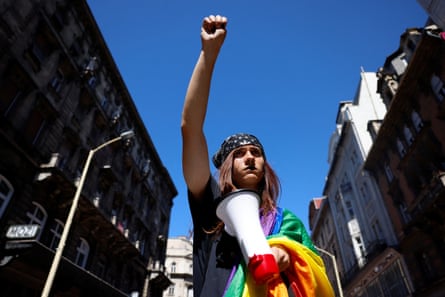
The sentiment was echoed by fellow marcher Eszter Rein-Bódi. “This is about much more, not just about homosexuality,” Rein-Bódi told Reuters “This is the last moment to stand up for our rights.”
‘This is about much more, not just about homosexuality,’ one participant told Reuters. Photograph: Lisa Leutner/Reuters
Tens of thousands of Hungarians, including senior citizens and parents with their children, plus politicians and campaigners from 30 countries, took to the streets on Saturday, despite Orbán’s warning on Friday that those who attend or organise the march will face “legal consequences”.
The Hungarian prime minister sought to minimise concerns over violence, however, saying that Hungary was a “civilised country” and police would not “break it up … It cannot reach the level of physical abuse”.
Still, in a video posted to social media this week, the country’s justice minister, Bence Tuzson, warned the Budapest mayor that organising a banned event or encouraging people to attend is punishable by up to a year in prison.
Speaking to reporters on Friday, the mayor brushed off the threat and downplayed concerns that police would later impose heavy fines on attende s. “Police have only one task tomorrow: to guarantee the safety and security of those gathered at the event,” said Karácsony.
The potential for violence had been amplified after three groups with ties to the extreme right said they were planning counter-marches. As the Pride march got under way, local news site Telex reported that the route of the march had to be changed after one of these groups blocked off a bridge.
Analysts had described the government’s bid to crackdown on Pride as part of a wider effort to curb democratic freedoms ahead of a hotly contested national election next year.
Orbán is facing an unprecedented challenge from a former member of the Fidesz party’s elite, Péter Magyar, leading Pride organisers to suggest they are being scapegoated as Orbán scrambles to shore up support among conservative voters.
Orbán’s government had also prompted concerns across Hungary and beyond after it said it would use facial recognition software to identify people attending any banned events, potentially fining them up to €500 (£425).
Ahead of the march, as campaigners scrambled for clarity on whether or how this technology would be used, AFP reported that newly installed cameras had appeared on the lamp-posts that dotted the planned route.
The threat had been enough to rattle some. Elton, 30, a Brazilian living in Hungary wore a hat and sunglasses as he took part on Saturday, explaining that he had been worried about jeopardising his job and immigration status, but that his Hungarian boyfriend had persuaded him to attend.
“This is my second time at Pride, but the first time I feel insecure about it,” he said.
Orbán’s government had also prompted concerns across Hungary and beyond after it said it would use facial recognition software to identify people attending any banned events. Photograph: Lisa Leutner/Reuters
Mici, a 21-year-old Budapest resident, said she had attended Pride marches in the past but this time had weighed whether to join in after she was spooked by reports of the facial recognition system.
“At first, I was scared to come out because of the news, but I feel safe with so many people.”
She hoped that the massive turnout for the march would be enough to push the Orbán government to change its stance.
“I think the crowd that has come from across Europe, the record numbers, will make Hungarian people see that this cause is well-supported.”




 Alex Bollinger (He/Him)May 15, 2025, 9:14 am EDT
Homeland Security Secretary Kristi Noem | Steven Spearie/The State Journal-Register / USA TODAY NETWORK

 Arin Waller (She/They)June 24, 2025, 4:00 pm EDT
The cover of the offending book, When Aidan Became a Brother by transgender male author Kyle Lukoff. | Lee & Low Books