Jan 06, 2025 Mariel Padilla Originally published by The 19th
Rep. Becca Balint of Vermont, who was elected to the 118th Congress in 2022, said she was shaped and largely motivated by January 6, 2021 — the day a mob of President Donald Trump’s supporters stormed the U.S. Capitol and temporarily halted the certification of the legitimate results of the 2020 election.
“A lot of the members who ran in the 118th and 119th Congress understood that we were running towards a house on fire and that being honestly democracy itself,” Balint said.
Balint said she vividly remembers January 6, 2021, because it was supposed to be one of the happiest days of her life: She was being sworn in as the first woman to lead the Vermont Senate. When her security team popped into her office to tell her that the U.S. Capitol was under attack, Balint said the footage “shook me to my core.”
The attack, which the Federal Bureau of Investigation called an act of domestic terrorism, sparked the Department of Justice’s largest criminal investigation in the country’s history and led to more than 1,500 people being federally charged. Rioters brought firearms, knives, hatchets, pepper spray, baseball bats, stun guns and explosive devices to fight Capitol Police officers and storm the building where lawmakers were actively voting to certify the 2020 election. Five people died during or soon after the riot, approximately 140 law enforcement officers were injured and $2.9 million worth of damage was done to the Capitol.
The day after the Capitol riot, Trump referred to the event as a “heinous attack” but has since promised to pardon those who were arrested in connection with the insurrection. Trump himself was indicted on felony charges in 2023 for attempting to overturn the results of the 2020 election — a criminal case that was dismissed shortly after he won the 2024 presidential election. The president-elect has since started describing January 6 as a “day of love,” as he did on the campaign trail.
As Congress votes again to certify the results of the 2024 presidential election, the country prepares to welcome back to the Oval Office the same man who denied his loss four years ago and threatened the country’s tradition of a peaceful transfer of power.
“It always sends a shiver down my spine when I hear people say ‘Americans don’t care about January 6 anymore — move on,’” Balint said. “I’m not moving on. It was a dark day in our history, and I’m not moving on.”
The 19th reached out to every woman in Congress — just as it did in 2021 and 2022 — to collect reflections on how January 6 continues to impact them and the country. Seventeen Democratic congresswomen and one senator responded and talked about their remaining trauma, their concern about the normalization of violence and their strong sense of duty to combat any efforts to whitewash that day.
‘There’s a record of this.’
Here’s what they said about how the spread of misinformation and disinformation surrounding that day has downplayed the severity of violence and the gravity of what was almost destroyed.
Rep. Suzanne Bonamici of Oregon: I still have seared in my memory the images of Capitol Police officers and other people being beaten. People lost their lives. … It’s not like somebody made this up. There are videos. There are pictures. There are statements. There’s a record of this. And there were people that were convicted by juries of their peers.
Rep. Deborah Ross of North Carolina: I think the most important thing is to be brutally honest about what happened that day. Many of us were there to witness, and we’re here to testify. We cannot allow Donald Trump and his cronies to deny what needs to be preserved for history. The next generation should know how fragile our democracy is and march forward, clear-eyed and ready to fight.
Balint: My grandfather was killed in the Holocaust and so I was raised in a family in which we were taught to be vigilant when people start eroding rights, upending norms, scapegoating people. When up is down and black is white and we can’t agree on basic facts, that is all an indication that we are headed in a very scary direction as a country.
Rep. LaMonica McIver of New Jersey: I think [Trump] is going to do whatever he can to make January 6 be remembered like it’s July 4. In his mind, I think it’s going to be put in the highest regard and glorify the day as much as he can. And he’s going to have four years to try and get the rest of the country to do the same.
Rep. Chellie Pingree of Maine: I think it’s very troubling that this incoming president could convince people that he either wasn’t responsible or that somehow all that didn’t matter. But sometimes it takes us a while to process big, complicated changes like this. Maybe there will be a time when we can reflect back and say that this was a mistake, that we overlooked it, that it took us time to realize how serious that movement was.
Rep. Jill Tokuda of Hawaii: As we approach January 6 once again, we all have a responsibility to stand up against the normalization of political violence and disinformation. We cannot forget what happened that day and as Americans, it is incumbent on us to reject violence in any form from infecting our politics and our democracy.
‘Deeply, deeply disappointed.’
Many of the lawmakers said they are still processing what it means about the state of our country that the same man who incited an insurrection could be re-elected four years later. Several emphasized that those involved in planning, executing or inciting the riot still need to be held accountable before the country can heal and move forward.
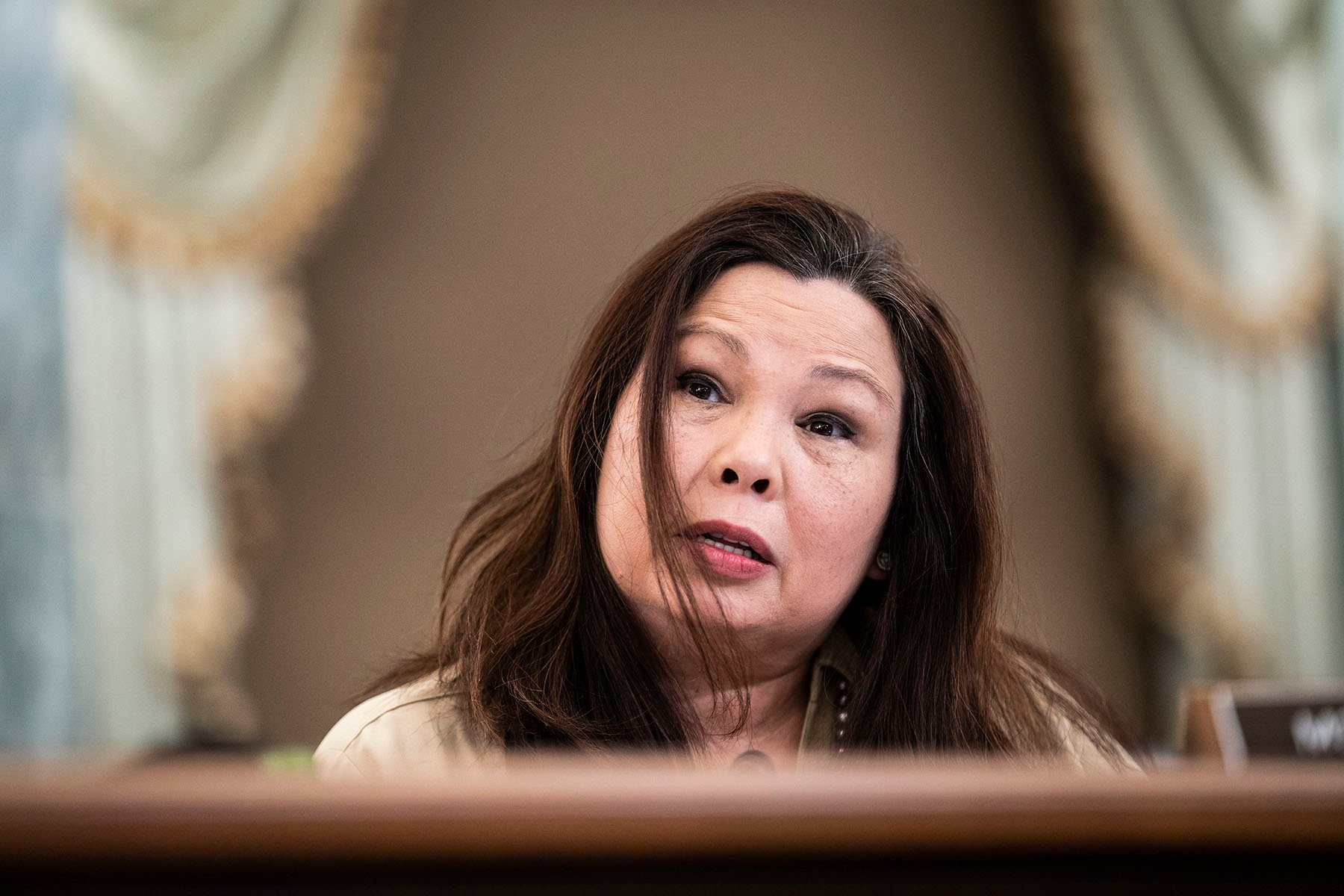
Sen. Tammy Duckworth of Illinois: As deeply, deeply disappointed as I am that that same twice-impeached president who led a coup against our government is headed back to the Oval Office, make no mistake: My Democratic colleagues and I, unlike many Republicans after the 2020 election, will uphold the will of the American people, fulfill our constitutional duty and do our part to ensure a peaceful transfer of power.
Rep. Rosa DeLauro of Connecticut: As Donald Trump returns to the presidency, I feel an even greater responsibility to ensure that we do not let an election outcome diminish the gravity of what happened that day. His re-election does not change the reality of the insurrection or absolve those who incited and participated in it. It does not erase the trauma experienced by Capitol staff and Capitol Police officers who defended our democracy at great personal risk.
Rep. Gwen Moore of Wisconsin: Donald Trump, a convicted felon and aspiring autocrat, is promising to let loose dangerous rioters into our communities and threatening lawmakers and journalists with imprisonment. Trump’s lawlessness and thirst for political revenge is why I have repeatedly said he is unfit for office.
Rep. Lois Frankel of Florida: People have short memories. People are more consumed with their own lives [when they go to the polls]. And I’m not saying that’s a bad thing; it’s just an observation. What was probably on people’s minds? Their bank account, their rent, price of food, right?
Rep. Joyce Beatty of Ohio: We learned a lot of lessons through this last election. The American people know what they want to hear, whether it’s true or not.
Rep. Judy Chu of California: No matter what happens during Trump’s second term, the events of January 6, 2021, will forever be his legacy. He refused to concede or even acknowledge that there was a free and fair election in 2020, and he is still pressuring the Justice Department and intends to continue to pressure the Justice Department.
Rep. Ayanna Pressley of Massachusetts: Trump’s return to the highest office in the land, despite his central role in the insurrection, is a gut punch to anyone who cares about our democracy. But it does not absolve us of our responsibility to pursue accountability and continue telling the story of what happened that day.
Rep. Pramila Jayapal of Washington: I still put the onus on the Republicans in the Senate who refused to convict him. That’s something I think about all the time being on the Judiciary Committee. I think our founding fathers assumed that perhaps there would be a dictator as president — that’s envisioned in the Constitution. But they also assumed that an entire party would not just enter into a cult and follow that dictator. They assumed that there would be enough people on both sides of the aisle willing to do what it takes to preserve democracy, and that is clearly not the case.
‘I still tremble at the mere mention of the date.’
For many of the women, there is lingering trauma.
Jayapal: It will always be a day that is very, very tough emotionally. I started a gallery group after, a very close support group to process the trauma — it’s something that none of us will ever forget.
Rep. Frederica Wilson of Florida: I still tremble at the mere mention of the date January 6, a day that is forever tainted with fear, violence and terror. To have lived it is to never ever forget it. America can never fathom what we experienced. It was like playing a role in a horror movie and hoping that it would soon come to an end.
Rep. Teresa Leger Fernandez of New Mexico: It makes me sick to my stomach that the people who desecrated our democracy will be pardoned and potentially invited back into the Capitol. It makes me incredibly sad to think that there will be Capitol Police — police who were brutalized and beaten by the mob — who will just have to stand there.
Rep. Sara Jacobs of California: I’ve been very nervous thinking about and leading up to January 6. I still have lingering trauma from the first one. I don’t like big crowds and loud noises. And I just keep thinking that they have no incentive to be violent this time, right? But it still makes me very nervous because we haven’t actually done the sort of reconciliation and hard work and accountability work that we need to do as a country. … I know that people’s trust and faith in institutions is a key part of addressing political violence because political violence only happens when people don’t feel like the nonviolent, institutional way of doing things is actually going to create the effect they want.
(Chip Somodevilla/Getty Images)
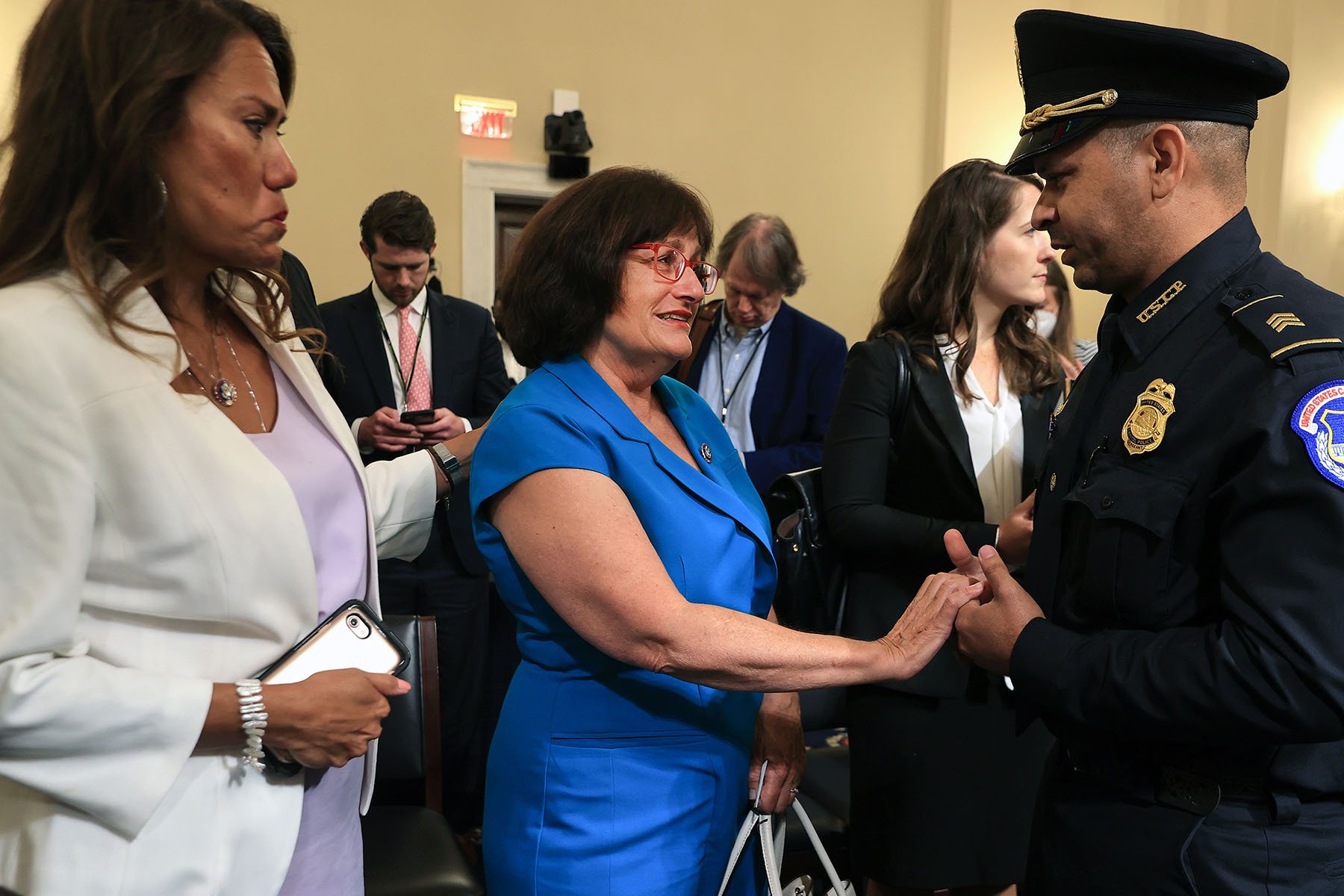
Rep. Ann McLane Kuster of New Hampshire said she is still dealing with lasting post-traumatic stress disorder from January 6, one the “most impactful events” in her life. Kuster was also one of the last five lawmakers to be evacuated from the House floor. She could hear the thundering crowds and pounding on the doors and experienced a panic attack as officers snuck them into an elevator and rushed them through an underground tunnel to safety. Kuster later saw security footage of insurrectionists with backpacks, bear mace and zip ties entering the same hallway she had just evacuated 30 seconds earlier.
“I’m haunted by the idea that if the police hadn’t pushed back five seconds here, five seconds there, pushing back on the bicycle racks, pushing back on the people who were crushed in the doors — that the five of us would have been kidnapped, murdered or maimed,” Kuster said. “It was only a five-vote majority and if we hadn’t been there, America might not have woken up to Joe Biden as the lawfully elected president of the United States.”
Kuster decided to retire this year before Trump is sworn in as the 47th President of the United States and attributes January 6 as one of the reasons for that decision. In addition to the lingering trauma, Kuster said she’s received more and more death threats and has noticed a marked increase of violent rhetoric in public discourse.
“He tried to kill me once,” Kuster said. “I’m not available for it again.”