If Congress Passes Terrific Law For Kids In The Forest, Does Anybody Hear?

by Rebecca Schoenkopf

It’s bipartisan and it’s good and nobody fought over it. So the answer is ‘no.’ Read on Substack

Here to warm your heart a little bit is a fable about a magical land called the US Congress, where in the midst of last week’s huge stupid fight about whether to actually have a government anymore, and about whether unelected weirdo billionaires should be able to destroy said government, the Senate passed a little-noticed bill that will update American child welfare laws for the first time in 15 years and help out kids in foster care.

As Gabe Fleisher at Wake Up To Politics points out, there weren’t any big culture war provisions in the bill, and somehow the flaky billionaire with an online propaganda factory didn’t catch wind of it, so the Supporting America’s Children and Families Act passed and was signed into law without getting much attention at all. In fact, when Fleischer wrote about it over the weekend, he noted that “as far as I can tell, not a single other article has been written about this legislation by any news outlet, anywhere.”

Fleischer included a google link so people could check, and I did. Even after his post, nope, nothing much, apart from several social media posts linking to Fleisher, plus the expected press releases from members of Congress who helped pass the bill. The only exception we found was a Yahoo reprint of a brief story from Native News Online, based on a press release from the National Indian Child Welfare Association (NICWA), which advocated for the law because it

increases funding for tribal child welfare programs and courts, reduces administrative burdens, closes a gap in data collection for Native children and families who are in state child welfare systems, and requires the Department of Health and Human Services with the assistance of the Bureau of Indian Affairs to provide needed technical assistance to states and tribal nations to improve implementation of the Indian Child Welfare Act.

So there’s a second article, and now Yr Wonkette makes three. Maybe some bigger outlets should cover this, although that might run the risk of bringing it to the attention of some jerk who thinks kids in the system have it too easy and need to be working overnight shifts.

As Fleisher — who staunchly refuses to have a c in his name no matter how often I misspell it — points out, there are some excellent things in the bill beyond the increase of $75 million a year into the budget for “the federal program tasked with combatting child abuse/neglect and protecting children in the foster care system.”

Among other things, the bill allows states to pass on federal child welfare funds directly to families that have hit an economic rough patch, to “prevent children from being separated from parents solely on the basis of poverty-related circumstances” — instead of declaring the parents “neglectful” and taking their kids away.

Other measures in the law will

expand mental health services for children in foster care; ease the transition out of foster care by offering assistance to former foster children until they reach the age of 26; increase funding for the 2.5 million grandparents and relatives raising children who would otherwise go into foster care; create a new requirement that states consult with affected children and parents when crafting their child welfare policies; seek to improve the relationships between incarcerated parents and their children in foster care; and reduce the administrative burden of child welfare caseworkers by 15%, so they can focus more on children and less on paperwork.

That’s a hell of a lot of good that literally got zero mention in the mainstream press, mostly because the bill was written and passed without any drama or denunciations that it would promote witchcraft, turn children into communists, or force Americans to live under the tyranny of the Metric System. And that, Fleisher says, is a damn shame, because “coverage of the country’s legislative output should not be dictated by how much squabbling went into the passage of the bill.” A media focus on dysfunction might be entertaining, but leads to cynicism and to people never hearing about genuinely worthwhile, honest-to-Crom “bipartisan achievements like the Supporting America’s Children and Families Act.”

We think Fleisher is right, though we’d also add that it would sure help a hell of a lot if our politicians, especially those on one side of the aisle, would actually try to legislate instead of trying to get their scowling faces on Fox News. Oh dear, that wasn’t bipartisan of me at all.

(snip-comments on the page)

A racist history shows why Oregon is still so white

https://www.opb.org/news/article/oregon-white-history-racist-foundations-black-exclusion-laws/

By Tiffany Camhi (OPB)
Portland, Ore. June 9, 2020 9 a.m.
 

Americans across the country have demonstrated for over a week now against systemic racism and police brutality. For many people, the protests have forced uncomfortable conversations about white privilege and the generations of prejudice against Black people and other people of color in the United States.

A group of KKK members parades down the streets of Grants Pass, Ore., in the 1920s. The KKK had a strong presence across the state in the early 1900s, with Oregon Klan leaders claiming 35,000 active members in 1923.

A group of KKK members parades down the streets of Grants Pass, Ore., in the 1920s. The KKK had a strong presence across the state in the early 1900s, with Oregon Klan leaders claiming 35,000 active members in 1923.

Lloyd Smith Collection

These conversations are happening here in Oregon, too, a state that — no matter which way you cut it — has deep roots in racism.

Here is a refresher: Oregon began as a whites-only state, through a series of Black exclusionary laws that were designed to discourage Black Americans from living here in the first place.

Walidah Imarishais a writer, educator, public scholar and spoken word artist.

Walidah Imarishais a writer, educator, public scholar and spoken word artist.

Pete Shaw

“[These] laws point to the fact that Oregon was founded as a racist white utopia,” said Walidah Imarisha, a Black studies educator and writer based in Oregon. “The idea was that white folks would come here and build the perfect white society.”

In 1844, when Oregon was still a territory, it passed its first Black exclusionary law. It banned slavery, but it also prohibited Black people from living in the territory for more than three years. If a Black person broke this law, the consequence was 39 lashes, every six months, until they left.

The territory passed another Black exclusion law five years later, in 1849. This one barred Black people who were not already in the area from entering or residing in Oregon territory.


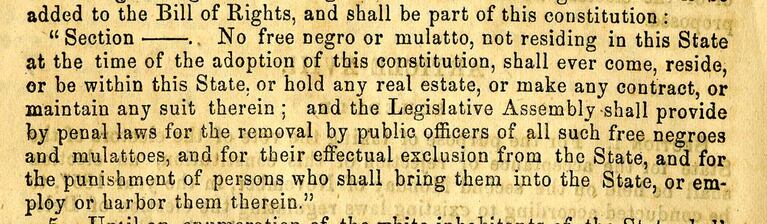
The final exclusion measure made it into the Oregon Constitution as a clause when the territory became a state 10 years later in 1859. This clause went further than the territory’s second law by also prohibiting Black people from owning property and making contracts.

“It speaks very clearly to the ways that this place was founded to center whiteness, not only at the exclusion of folks of color but at the brutalization of folks of color,” said Imarisha.

These laws were rarely enforced but they did the job they were created to do: establish Oregon as a majority white state. And it’s why Portland, the state’s most populous city, is still known as the whitest big city in the United States.

According to 2019 estimates from the United States Census Bureau, Oregon’s population was nearly 87% white. (The figure for the Census category of “White alone, not Hispanic or Latino” was 75%.) The state’s Black population was just over 2%.

Although the laws were repealed almost a century ago, the racist language in Oregon’s constitution wasn’t removed by voters until 2002. But, Imarisha said, it’s important to note — just 18 years ago — 30% of voters elected to keep the racist clause in the constitution.

“This is an ideology that is not only alive, it’s serving as the foundation for the institutions of Oregon,” said Imarisha. “Oregon is a useful case study for the rest of the nation because the only thing unique about Oregon is [it] was bold enough to write it down. The same policies, practices and ideologies that shaped Oregon, shaped the nation as a whole.”

But with things like Portland Public Schools ending its contract with the Portland Police Bureau and the Oregon Legislature looking at police reforms, it seems as though some of these racist pillars are beginning to form cracks. These actions, along with a renewed Black Lives Matter movement, are giving hope to many people like Imarisha who have been fighting for systemic change.

“This movement, which is led by Black youth, is incredibly inspiring,” said Imarisha. “I just really want to say thank you to the leadership who have created this movement.”

Ultimately, Imarisha believes this movement and the conversations we’re all experiencing now can bring about profound societal changes for Black people and other people of color.

“If you believe in freedom, if you believe in justice, if you believe in liberation — now is the time to act,” said Imarisha.

Hear the full conversation with Walidah Imarisha in the audio player above.


More cult of tRump maga hate, bigotry, and stupid. They specialize in it.

“Bilderberg Group changes itself for the modern world – and return of Trump”

Charlie Skelton

(I wasn’t going to post any news today, but in my interest of world peace, and everyone’s interest in things that are happening, this story is important, and it’s not likely to be in the commercial breaks of the game or whatever. If it comes up again, and/or where regular people see it in regular fashion, something will have already happened. Right now, it strikes me as something of which to be aware. Save reading it till tomorrow, if you like. I just want it here for the record. -A)

The former head of Nato, Jens Stoltenberg, has been named the new co-chair of the influential Bilderberg Group, which convenes a yearly transatlantic policy conference and has long been the subject of conspiracy theories around the extent of its power to shape global events.and/or

After a turbulent decade at the helm of the alliance’s military, Stoltenberg now takes over at its pre-eminent discussion forum: a fiercely private four-day event frequented by prime minsters, EU commissioners, bank bosses, corporate CEOs and intelligence chiefs.

Stoltenberg’s first Bilderberg was back in 2002, a few years before his second tenure as Norway’s prime minister. His decade as secretary general of Nato saw further visits, and he even gave the keynote speech at the group’s Saturday night banquet in Turin in 2018. His appointment as Bilderberg’s co-chair cements the group’s role at the heart of transatlantic strategy.

In February, Stoltenberg will also take over as chair of the Munich Security Conference, another important defence and diplomacy symposium. With a fellow Bilderberg veteran, the former Dutch prime minister Mark Rutte, replacing Stoltenberg at Nato, it marks a concentration of control at the top of the Atlantic alliance at a critical time.

Stoltenberg’s tenure at Nato was dominated by the Russia-Ukraine conflict, which had begun in earnest not long before he took office in 2014. Stoltenberg oversaw what he recently described as “the largest reinforcement of our collective defence in a generation”, noting proudly that “defence spending is on an upward trajectory across the alliance”.

A number of his new colleagues at Bilderberg have been benefiting from this uptick.

Several of the group’s 31-member steering committee have senior roles in the defence industry. The billionaire former Google boss, Eric Schmidt, chaired the recent National Security Commission on AI, and is now busy launching a kamikaze drone company aimed at the lucrative Ukraine market. Meanwhile, the hugely wealthy Swedish industrialist Marcus Wallenberg is chair of defense manufacturer Saab, which enjoyed a 71% boost in orders in the first nine months of 2024, largely due to the war with Russia.

The tech luminary and Donald Trump insider Peter Thiel founded the fast-growing robotics company Anduril and the booming surveillance and AI giant Palantir. His loyal lieutenant Alex Karp, the CEO of Palantir, was voted on to the board of Bilderberg a few years ago. Karp, who claims his company is “responsible for most of the targeting in Ukraine”, recently told the New York Times that the US will “very likely” soon be fighting a three-front war with China, Russia and Iran.

In some respects, the geopolitical mood today is not so different from how it was in the 1950s, when Bilderberg was born. (snip-MORE)

https://www.theguardian.com/world/2024/dec/25/jens-stoltenberg-bilderberg-group-trump-presidency

Zombie Trash

Owen’s List: Finding a Way to Recycle Zombie Trash

What started as a father-son weekend project turned into Ridwell, which aims to keep hard-to-recycle items out of landfills.

Edward Humes

(Courtesy Ridwell)

The innocent question that changed Ryan Metzger’s life came the summer his son turned six. That’s when Owen asked about the ever-expanding bag of old batteries in the junk drawer.

“What’s going to happen to them, Dad?” he asked. “What are we supposed to do with them? We’re learning about recycling in school. Where do these get recycled?”

“Um,” Metzger said. “I don’t know.”

He knew where to get batteries, of course. And there were always instructions on correctly using them. But instructions on what to do when they died? Not so much. That’s why he fell into the habit of stuffing dead batteries into a drawer filled with all the other small, disused stuff that the family wasn’t sure what to do with.

“It’s heavy, Dad.” Owen waved the bag of batteries around.

It was pretty full, Metzger had to admit. Detritus from flashlights and old toys, smoke alarms and remote controls, with a crusty one that came out of an old toothbrush, these batteries were one of many types of problematic garbage. They had no obvious final resting place, much like garden chemicals, old phones, light bulbs, car parts, cooking grease … a ton of stuff, really, now that Metzger thought about it. You weren’t supposed to put any of that in the recycling bin. But you couldn’t put it with the landfill-bound trash, either, although that’s what many people ended up doing out of desperation or not caring or habit — or assuming (incorrectly) it would all somehow get properly sorted out by this impenetrable, mysterious entity called the waste management system.

“There’s got to be a place for old batteries,” Metzger assured his son. “Let’s find out.”

It took three phone calls to find a business near their Seattle home that would take their old batteries and ensure that they were actually recycled instead of just dumped somewhere.

Father and son decided to drive to this battery recycler so that Owen could make the delivery. On impulse, they asked a few neighbors if they had stashes of old batteries, too. Several did, so Ryan and Owen took those as well.

Owen was so delighted by this accomplishment that he and his father decided to make a regular project out of hauling one different type of problem trash every weekend to the right recycler, offering to do the same for neighbors in their Queen Anne section of Seattle. So they started gathering bent clothes hangers one weekend, burned-out light bulbs the next, and then plastic bags, wraps, pouches, bubble wrap, and Styrofoam, none of which plays well with community recycling programs. Demand kept expanding block by block as word got around about his little father-and-son project. Soon he had to create a subscriber email group to track it all, with a message going out each week on what sort of trash would be picked up next and when to leave it outside for pickup. They dubbed this “Owen’s List.”

Around this time, grateful subscribers to Owen’s List who had long felt guilty about their secret trashiness started offering the duo money. A few suggested they charge for the service. “I’d gladly give up a couple lattes a month in exchange for you taking care of this,” one neighbor said. “I bet a lot of people would.”

Could that be true? Could their father-and-son hobby become a business that would let him leave his tech job behind and do something to help save the world? ­Seattle residents took pride in living in one of America’s greenest cities, but would they really pay extra every month to change their trashy habits and help Owen’s List patch a gaping hole in the waste and recycling system?

Metzger renamed the service Ridwell, to better explain its mission at a glance, and then set out to find out. (snip-MORE)

Well, just how about this:

Sunday, December 22, 2024

Ever Wonder Why Your Never Trump Allies Are So Friendly and Deferential…

…to the same legacy media institutions that have fucked us over so badly?

Well, perhaps it’s because outfits like The Bulwark are sponsored by outfits like Jeff Bezos’ Washington Post.

Yeah, that Washington Post.   From NPR:

Over 200,000 subscribers flee ‘Washington Post’ after Bezos blocks Harris endorsement

The Washington Post has been rocked by a tidal wave of cancellations from digital subscribers and a series of resignations from columnists, as the paper grapples with the fallout of owner Jeff Bezos’s decision to block an endorsement of Vice President Kamala Harris for president…

From the transcript of live ad read in the middle of the above-referenced podcast.

Tim Miller:  Hey guys, if you listen to this podcast you care about what’s going on in the world.  And you know we’re doing our best here at the Bulwark as we grow, to expand out, reporting, reported commentary no bullshit insight.   But, like all of this stuff is based on people doing shoe leather reporting.  People going out there and gathering sources and going around the world an… and educating us about what’s happening in the world.  And… and one of the places that’s out there still doing that is the Washington Post.  Uh, and this podcast is sp… sponsored by The Washington Post.  When you go to Washington Post.com slash The Bulwark, our listeners can get an exclusive deal to subscribe for just 50 cents per week for your first year.  Uh…if you listen to us you know the great work the Washington Post does on a bunch of topics…

It goes on.  And on. And on.  Bezos is definitely getting his money’s worth.  

Because, as we have discussed on this blog several hundred times before…

(snip)

(whew!) “Biden Denies Trump The Joy Of Killing 37 People”

(I posted about this earlier, there is success, so I’m posting a funny-serious one about it. Sometimes we win when we step up. -A)

He commuted the death sentences of 37 of 40 federal death row prisoners.

Robyn Pennacchia

One thing we know Trump was for sure looking forward to for his second term was getting to kill more federal death row prisoners. During the last months of his first term, he went on a full-on killing spree, with his administration carrying out 13 federal executions after a 17-year hiatus.

To put things into perspective, of the 13 prisoners executed prior to his administration, two of them were Julius and Ethel Rosenberg. Only 37 federal death row prisoners were executed between 1927 and 2019, so 13 in six months was quite the bloodbath.

Alas, his dreams have been dashed, for President Joe Biden has announced that he will commute the death sentences for nearly all of the prisoners on federal death row.

“Today, I am commuting the sentences of 37 of the 40 individuals on federal death row to life sentences without the possibility of parole,” Biden said in a statement released Monday morning.

“Make no mistake: I condemn these murderers, grieve for the victims of their despicable acts, and ache for all the families who have suffered unimaginable and irreparable loss,” he continued. “But guided by my conscience and my experience as a public defender, chairman of the Senate Judiciary Committee, Vice President, and now President, I am more convinced than ever that we must stop the use of the death penalty at the federal level. In good conscience, I cannot stand back and let a new administration resume executions that I halted.”

It’s unlikely that this was simply meant to bust Trump’s balls and make him sad — Biden had pledged to “work to pass legislation to eliminate the death penalty at the federal level, and incentivize states to follow the federal government’s example” in his 2020 campaign.

The three prisoners whose sentences will not be commuted are those who committed crimes related to terrorism and hate-motivated mass murders — Dylann Roof, the white supremacist who killed nine people and injured one in a Charleston, South Carolina, church in 2015; Dzhokhar Tsarnaev, one of the two brothers responsible for the Boston Marathon bombing in 2013 (his brother, Tamerlan Tsarnaev, was killed in a shootout with police after the attack); and Robert Bowers, who killed 11 people at the Tree of Life Synagogue in Pittsburgh, Pennsylvania, in 2018.

The other prisoners were given their federal death sentences for far lesser crimes, like killing prison guards or drug trafficking-related murders.

It’s certainly nice to get this news after Biden’s 1,500 commutations of federal prisoners failed to include political prisoners like Leonard Peltier or Mumia Abu-Jamal and did include the kids-for-cash judge. It’s also nice to see, considering the fact that the DNC removed opposition to the death penalty from its platform after eight years of including it. Hopefully we can get back on that one, given the fervor with which Republican governors have pursued the executions of people who were almost definitely innocent in the last few years.

Anti-death penalty advocates, including Martin Luther King III, Sister Simone Campbell, Rev. Ralph McCloud, and exoneree Herman Lindsey made a video thanking President Biden for taking this step.

“President Biden has shown our country – and the rest of the world – that the brutal and inhumane policies of our past do not belong in our future,” Anthony D. Romero, executive director of the ACLU said in a statement. “By commuting 37 federal death row sentences, he has paved the way for other elected officials to build on his legacy of racial justice, humanity and morality by commuting state death rows and passing legislation to abolish capital punishment.”

“Biden has commuted almost all federal death row. This is indeed a good day to do the Lord’s work,” Sister Helen Prejean wrote on Bluesky. I’m thankful to so many religious leaders and justice advocates who helped make this possible. I pray for victims’ families, knowing that wishing for death is not a healing course.”

Personally, as horrible as their crimes were, and as hard of a decision as it would have been, I still think he should have commuted the sentences of all of the prisoners, simply because — to quote a bumper sticker — I don’t believe we should kill people who kill people to show people that killing people is wrong. Also there is evidence that Dzhokhar Tsarnaev was unduly influenced by his brother and also afraid he might kill him if he didn’t go along with his plan, and that the jury was biased against him. (Which would be entirely understandable given that they were all from the Boston area, but also technically unfair.) Family members of those who were killed in the Charleston church shooting have said for years that they don’t want Roof executed, and as loathsome as he is, that ought to be taken into consideration. Two of the families who lost loved ones in the Tree of Life shooting, and the rabbi who was shot himself also asked for Bowers to get a life sentence, due to their opposition to the death penalty. One of the many injustices of the death penalty is that it puts those who oppose it in the position, occasionally, of having to ask for leniency for those who hurt them or have killed their loved ones.

But, you know, optics.

In any case, this is a great day for those of us who oppose the death penalty, and for all Americans who may not oppose it but still do not deserve to be hardened by its application.

Peace & Justice History for 12/23

December 23, 1943
A 135-day strike by 23 conscientious objectors (COs) ended dining hall segregation at Danbury Federal Penitentiary in Connecticut.
The number of conscientious objectors had increased from 15 in early 1941 to 200 by the time of the strike.
December 23, 1944
General Dwight Eisenhower endorsed the finding of a court-martial in the case of Eddie Slovik, who was tried for desertion, and authorized his execution. It was the first such sentence against a U.S. Army soldier since the Civil War, and Slovik was the only man so punished during World War II.
He made no secret of his unwillingness to enter combat, but his pleas to be reassigned to noncombat status were rejected.
Eisenhower ordered that Slovik’s execution be carried out to avoid further desertions in the late stages of the war.


Eddie Slovik
Read more 
December 23, 1946
University of Tennessee refused to play Duquesne University, because they might have used a black player, Chuck Cooper, in the basketball game [see July 14, 1887].
Cooper went on to be drafted (the first black player ever) by the Boston Celtics, playing his first NBA game on the same day as the debut of head coach Red Auerbach, guard Bob Cousy, and center “Easy” Ed Macauley.


Chuck Cooper, graduate of Duquesne University
December 23, 1961

James Davis
James Davis of Livingston, Tennessee, was killed by the Viet Cong, the insurgents in South Vietnam, and became the first of some 58,000 U.S. soldiers killed during the Vietnam War.
Lyndon Johnson later referred to him as “the first American to fall in defense of our freedom in Vietnam.”
Over two million Vietnamese would die before the end of the war.

https://www.peacebuttons.info/E-News/peacehistorydecember.htm#december23

Noshing and Reading

I made green chips in order to avoid salty and sweet treats for a while. Maybe I’ll post about that, but in the meantime, here is a bit about observing Yule. Solstice is my favorite night of the year, mostly because Winter is my favorite season, though so short. I am not pagan, but I love reading about Solstice and Yule. Maybe you’ll like this, too.

Three Sam Seder clips that are important to watch

Before I share the clips a personal note.  I spend the morning with Ron.  We went to get blood work done.  Then we did some other things.  Then he went shopping while I did housework.  Then after he got home I started working on a computer project a friend asked me if I would do for him as he couldn’t do it.  I agreed to.  I still have a lot of work on it but I will get it done today I think.  

The lab work came back and I think I have a reason while I have been so tired, short of breath, and not able to concentrate or think clearly.   My blood work shows I am very anemic again.  I once had it get so bad I collapsed as I was entering my allergist office.  They thought I was having a heart attack and I ended up in the hospital.  Turned out my heart is great, but my damaged large bones don’t produce enough red blood cells.  Their solution was to eat more red meat and take iron supplements.  For a long time they watched for it but as I always managed to stay right inside the ok zone they stopped worrying about it.  But my diet changed, red meat got too expensive and I just don’t eat much anymore.  But my lab work showed my hematocrit is very low.  So I imagine the doctor will ask me to do some more tests.  I hope I don’t need a blood transfusion, that sucks.  Now on to the clips, enjoy.