Desi Lydic unpacks the latest Capitol Hill news: Matt Gaetz withdraws as Trump’s pick for Attorney General, and Nancy Mace targets Congresswoman Sarah McBride with an anti-trans bathroom ban.
What the host did not point out is that Nancy Mace is a total publicity hound. She seeks the spotlight at all times. She demands her staff book her on some media at least once a week. She demands they video her like you see in the clips above so she can post them on X or other social media. She is like Marge Greene in that being famous and a celebrity is more important to them than governing. Being an influencer is more important than forming a more perfect union for everyone. Making a spectacle and being in the center of what everyone is talking about is what gives them the greatest joy. As you can see once defending trans people’s rights gave her clicks and views so she was all in for it. Then her cult switched to fear and hate regardless of the real truth and the denial of science in favor of religion. In a book written over thousands of years, edited and changed countless times, translated from language to language often by people with no idea how to speak the language they are translating, and then selectively edited by political leaders as to what should be in it and what should be removed … that book says god created them male and female. So that was written by people who did not understand germs or to wash their hands to prevent sickness, who believed different colored sticks would cause different colored livestock, and had no concept of modern science makes a claim that modern humans in 2024 place more authority in than all the education and medical science of all history. How is that rational? Yet these people are elected to the highest offices to run a country that once was respected as striving for enlightenment and civil rights for all, is now being drive to regress to a theocracy where our highest information will be limited to what people in the Bronze Age understood. We have seen this happen in other countries and we were aghast at it. Look at Afghanistan? Look at the Arab countries that turned their backs on science and instead used their holy writings as the way things must always be. That thinking allows no growth and a supreme denial of reality. Hugs
November 21, 1945 200,000 members of the United Auto Workers went on strike against General Motors, the first major strike following World War II. The UAW’s demand for a 30% wage increase was based on the increase in the cost of living during the war (28% according to the Department of Labor), the wartime freeze on wages, and the cut in the average workweek with the disappearance of overtime pay in manufacturing. But the UAW also considered profits and prices a subject for negotiation, a position rejected by GM. The union did not merely say that labor was entitled to enough wages to live on. It also said that labor was entitled to share in the wealth produced by industry.“… Unless we get a more realistic distribution of America’s wealth, we won’t get enough to keep this machine going.”–Walter Reuther, UAW President More about the strike
November 21, 1973 President Richard Nixon’s attorney, J. Fred Buzhardt, revealed the existence of an 18 1/2-minute gap in one of the subpoenaed White House tape recordings of Watergate conversations made by President Richard Nixon in the days after the Watergate break-in.The erasure was blamed on an accident by Nixon’s private secretary, Rose Mary Woods, but scientific analysis determined the erasures to be deliberate. White House Chief of Staff Alexander Haig later attributed the gap to “sinister forces.” Rose Mary Woods, demonstrating how she might have created the Watergate tape gap More about Rose Mary Woods
November 21, 1974 Both Houses of Congress voted to override President Gerald Ford’s veto of updates to the Freedom of Information Act. Originally passed in 1966, it required federal agencies to release information upon request to citizens and journalists.The amendments put an end to governmental resistance to compliance, including excessive fees, bureaucratic delays, and the need to sometimes resort to expensive litigation to force the government to share copies of documents. Ford advisors Chief of Staff Donald Rumsfeld, his deputy Dick Cheney, and government lawyer Antonin Scalia advised him to veto it. Chief of Staff Donald Rumsfeld, President Gerald Ford and Deputy Chief of Staff Richard Cheney April 28, 1975 What was the dispute?
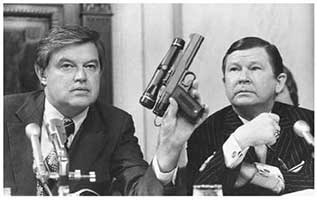
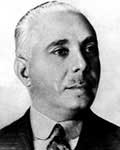
November 21, 1975 The Senate Select Committee to Study Governmental Operations with Respect to Intelligence Activities, led by Senator Frank Church (D-Idaho), issued a report charging U.S. government officials were behind assassination plots against two foreign leaders – Fidel Castro (Cuba) and Patrice Lumumba (Congo), and were heavily involved in at least three other plots: Rafael Trujillo (Dominican Republic), Ngo Dinh Diem (Vietnam), Rene Schneider (Chile). Senator Frank Church, left, chairman of the Senate Select Intelligence Committee, displays a poison dart gun as co-chairman Senator John Tower (R-TX) watches.
The committee, a precursor to the Senate Intelligence Committee, was established to look into misuse of and abuse by intelligence agencies, particularly the CIA and FBI, some of which had been revealed by the Watergate investigations. Fidel Castro / Patrice Lumumba / Rafael Trujillo / Ngo Dinh Diem / Rene Schneider Read more
November 21, 1981 More than 350,000 demonstrated in Amsterdam against U.S. nuclear-armed cruise missiles on European soil.
November 21, 1985 A full-scale summit conference, the first of five between the President Ronald Reagan of the U.S. and General Secretary Mikhail Gorbachev of the Soviet Union concluded. There was optimism over beginning a more productive and cooperative relationship between the two countries, each of which had thousands of nuclear warheads targeted at the other.The U.S. had proposed building a space-based anti-ballistic missile system, commonly known as “Star Wars,” which the Soviets had strongly opposed as an escalation of the nuclear arms race.In an unofficial meeting the previous evening, President Reagan had noted that he and Gorbachev were meeting for the first time at this level and had little practice. Nevertheless, having read the history of previous summit meetings, he had concluded that those earlier leaders had not accomplished very much. Therefore, he suggested that he and Gorbachev say, “To hell with the past, we’ll do it our way and get something done.” Gorbachev concurred. Reagan and Gorbachev at their first summit
November 21, 1986 National Security Council member Oliver North and his secretary, Fawn Hall, began shredding documents that would have exposed their participation in a range of illegal activities regarding the sale of arms to Iran in an attempt to free hostages, and the diversion of the proceeds to an insurgent Nicaraguan group known as the contras. Fawn Hall Oliver North More on Fawn Hall
November 21, 1995 China officially charged well-known human rights activist and political dissident Wei Jingsheng with trying to “overthrow the government.” Wei had not been seen for a year and a half after disappearing into police custody after meeting with a U.S. assistant secretary of state for human rights and humanitarian affairs.“If the people allow the power holders, in the peoples’ name, to violate and ignore the rights of some of the people then, at the same time, they are giving the power holders the power to violate the rights of all the people.” “ Most people wait until others are standing to make their move, very few are willing to stand up first or to stand alone. That’s why my friends call me a fool! But I don’t have any regrets.” – Wei Jingsheng Wei Jingsheng He had been imprisoned previously for his involvement with the Democracy Wall movement, including years in solitary confinement. He had also spoken out on behalf of the Tibetans.
All the links are worthy; today I’m partial to both the one about a Trump-proof climate action Pres. Biden could take that would benefit the entire world, and the story about the “Indian peach”.
Eric Meyer delivers advice to journalists in a speech at the Kansas Press Association Hall of Fame ceremony on Nov. 15, 2024, in Topeka. (Evert Nelson for Kansas Press Association)
TOPEKA — The editor of the Kansas newspaper raided by police last year has a message for journalists struggling with their sense of purpose.
Go on the offensive.
Eric Meyer, editor and publisher of the Marion County Record, delivered remarks Friday as he was inducted alongside his mother, Joan, into the Kansas Press Association Newspaper Hall of Fame.
“I think this is a time when we have to establish for the people of this country the fact that we are important, that we have things that we can tell them that they will want to know, that they will want to change their positions about,” Meyer said.
He added, in a nod to the results of the presidential election: “Let’s not make America great again. Let’s make democracy great again.”
Police raided the Marion County Record newsroom and the home where Meyer lived with his mother in August 2023 under the false pretense that journalists had committed a crime by looking up a public record. Joan Meyer, the 98-year-old co-owner whose profane clash with police officers was captured on camera, died a day after the raid from stress-induced cardiac arrest. The raid spawned five civil lawsuits and a criminal charge against the police chief who led the attack on a free press.
Meyer said he is “an odd duck” because he retired to run a newspaper, rather than retire from it. He returned to Kansas during the COVID-19 pandemic to take over the publication his parents had operated for decades. After teaching journalism for 20 years at University of Illinois at Urbana-Champaign, Meyer wanted to practice what he had been preaching — that journalism is still vital. (snip-MORE)
November 20, 1816 The term “scab” was first used in print by the Albany (N.Y.) Typographical Society. A scab is someone who crosses a union’s picket line and takes the job of a striking worker. Read The Scab by Jack London
November 20, 1945 The International War Crimes Tribunal began in Nuremberg, Germany, and continued until October 1, 1946, establishing that military and political subordinates are responsible for their own actions even if ordered by their superiors.Twenty-four high-ranking Nazis were on trial for atrocities committed during World War II, ranging from crimes against peace to crimes of war, to crimes against humanity. The Nuremberg Trials were conducted by judges from the United States, the Soviet Union, France, and Great Britain.The Nuremberg defendants Read more
November 20, 1959 The United Nations proclaimed “The Declaration of the Rights of the Child,” because “the child, by reason of his physical and mental immaturity, needs special safeguards and care, including appropriate legal protection, before as well as after birth.” Read the text of the Declaration
November 20, 1962 President John F. Kennedy issued an executive order forbidding racial discrimination in public housing.
November 20, 1969 Eighty-nine American Indians seized Alcatraz Island in San Francisco Bay, offering to buy the island from the federal government for $24 worth of beads (the alleged price paid to the Canarsee Delaware Indians for Manhattan Island; it was actually 60 Dutch guilders). Their numbers swelled into the hundreds at times; the General Services Administration, which had responsibility for the site of the former federal prison, and Coast Guard gave them the opportunity to leave the island peacefully.They were reclaiming it as Indian land by right of discovery, and demanding fairness and respect for native peoples. The occupation lasted for more than a year. Said Richard Oakes, a Mohawk from New York, “We hold The Rock.” Indian people and their supporters wait for the ferry. Photo/Ilka Hartmann a new entrance to Alcatraz; Photo/Michelle Vignes Read more about the occupation LaNada Boyer (formerly Means) inside one of the Alcatraz guard barracks where occupiers lived from 1969-71. Much of the graffiti from 30 years ago remains throughout the island today. Photo by Linda Sue Scott.
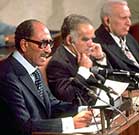
November 20, 1977 Egyptian President Anwar El-Sadat addressed the Israeli Knesset (parliament). “I come to you today on solid ground to shape a new life and to establish peace. “But to be absolutely frank with you, I took this decision after long thought, knowing that it constitutes a great risk….” Text of Sadat’s speech to the Israeli Knesset Listen to the speech
November 20, 1987 SANE (The Committee for a Sane Nuclear Policy) and FREEZE (the campaign to freeze all testing of nuclear weapons) merged at their first combined convention in Cleveland, Ohio, becoming the largest U.S. peace organization. Peace Action today
November 20, 1993 The U.S. Senate approved the North American Free Trade Agreement (NAFTA), creating the world’s largest trade area covering Canada, the U.S. and Mexico.
Native American Heritage Month is a time to recognize and celebrate the individuals who dedicate their lives to advocating for Indigenous rights, environmental justice, cultural preservation, and social equity.
Their work drives meaningful change, often in the face of systemic barriers and historical injustices. Here are some Indigenous activists and advocates making an impact on their communities and the world.
Deb Haaland (Laguna Pueblo) – U.S. Secretary of the Interior
Deb Haaland made history as the first Native American to serve as a Cabinet Secretary in the United States. As Secretary of the Interior, she oversees policies affecting public lands, natural resources, and tribal sovereignty. Haaland’s leadership marks a turning point in addressing the federal government’s obligations to Indigenous nations.
Sharice Davids (Ho-Chunk Nation) – U.S. Representative
Sharice Davids made history in 2018 as one of the first two Native American women elected to the U.S. Congress and the first openly LGBTQ Native American to serve in Congress. Representing Kansas’s 3rd Congressional District, she focuses on issues such as economic development, education, and healthcare, advocating for policies that benefit both Indigenous and non-Indigenous communities.
Shannon Holsey, President of the Stockbridge-Munsee Community, is a prominent voice for Native sovereignty, economic development, and political representation. Holsey frequently advocates for Native inclusion in state and federal policymaking, highlighting issues like health care equity and voting rights.
Allie Young (Diné) – Founder, Protect the Sacred
Allie Young founded Protect the Sacred to mobilize Indigenous youth during the COVID-19 pandemic and beyond. Her “Ride to the Polls” campaign encouraged Native voter turnout in historic numbers. Young’s work empowers young people to embrace their culture and become leaders in their communities.
Winona LaDuke is a known advocate for Indigenous environmental justice, focusing on issues such as land reclamation, renewable energy, and food sovereignty. As the founder of Honor the Earth, she has led efforts to stop oil pipelines like Line 3 and protect Indigenous lands and waterways.
Judith LeBlanc leads the Native Organizers Alliance, a national network dedicated to building grassroots movements in Indigenous communities. Her work focuses on strengthening sovereignty, addressing climate change, and empowering Native nations through political and social advocacy. (snip)
On Friday, Secretary of Commerce Gina Raimondo locked in a $6.6 billion deal with the Taiwan Semiconductor Manufacturing Company for it to invest $65 billion in three state-of-the-art fabrication plants in Arizona. This will bring thousands of jobs to the state. The money comes from the CHIPS and Science Act, about which Trump told podcaster Joe Rogan on October 25: “That CHIPS deal is so bad.” House speaker Mike Johnson (R-LA) said he would work to repeal the law, although he backed off that statement when Republicans noted the jobs the law has brought to their states.
Also on Friday, a Trump-appointed federal judge struck down a Biden administration rule that would have made 4 million workers eligible for overtime pay. The rule raised the salary level below which an employer has to pay overtime from $35,568 to $43,888 this year and up to $58,656 in 2025. The decision by Texas judge Sean D. Jordan kills the measure nationally.
On Sunday, speaking from the Amazon rainforest in Brazil, President Joe Biden said that it would not be possible to reverse America’s “clean energy revolution,” which has now provided jobs across the country, primarily in Republican-dominated states. Biden noted that the U.S. would spend $11 billion on financing international responses to climate change in 2024, an increase of six times from when he began his term.
But President-elect Trump has called climate change a hoax and has vowed to claw back money from the Inflation Reduction Act appropriated to mitigate it, and to turn the U.S. back to fossil fuels. What Trump will have a harder time disrupting, according to Nicolás Rivero of the Washington Post, is the new efficiency standards the Biden administration put in place for appliances. He can, though, refuse to advance those standards.
Meanwhile Trump and his team are announcing a complete reworking of the American government. They claim a mandate, although as final vote tallies are coming in, it turns out that Trump did not win 50% of the vote, and CNN statistician Harry Enten notes that his margin comes in at 44th out of the 51 elections that have been held since 1824. He also had very short coattails—four Democrats won in states Trump carried—and the Republicans have the smallest House majority since there have been 50 states, despite the help their numbers have had from the extreme gerrymandering in states like North Carolina.
More Americans voted for someone other than Trump than voted for him. (Emphases mine- A.)
Although Trump ran on lowering the cost of consumer goods, Trump and his sidekick Elon Musk, along with pharmaceutical entrepreneur Vivek Ramaswamy, have vowed to slash the U.S. government, apparently taking their cue from Argentina’s self-described anarcho-capitalist president Javier Milei, who was the first foreign leader to visit Trump after the election. Milei’s “shock therapy” to his country threw the nation into a deep recession, just as Musk says his plans will create “hardship” for Americans before enabling the country to rebuild with security.
Ramaswamy today posted on social media, “A reasonable formula to fix the U.S. government: Milei-style cuts, on steroids.” He has suggested that cuts are easier than people think. The Washington Post’s Philip Bump noted that on a podcast in September, Ramaswamy said as an example: “If your Social Security number ends in an odd number, you’re out. If it ends in an even number, you’re in. There’s a 50 percent cut right there. Of those who remain, if your Social Security number starts in an even number, you’re in, and if it starts with an odd number, you’re out. Boom. That’s a 75 percent reduction done.”
But, as Bump notes, this reveals Ramaswamy’s lack of understanding of how the government actually works. Social Security numbers aren’t random; the first digit refers to where the number was obtained. So this seemingly random system would target certain areas of the country.
Today, both Jacob Bogage, Jeff Stein, and Dan Diamond of the Washington Post and Robert Tait of The Guardian reported that Trump’s economic advisors are talking with Republicans in Congress about cuts to Medicaid, the Supplemental Nutrition Assistance Program (SNAP) formerly known as food stamps, and other welfare programs, in order to cover the enormous costs of extending tax cuts for the wealthy and corporations. Medicaid is the nation’s health insurance for low-income Americans and long-term care. It covers more than 90 million Americans, one in five of us. Rural populations, which tend to vote Republican, use supplemental nutrition programs more than urban dwellers do.
The Washington Post reporters note that Republicans deny that they are trying to reduce benefits for the poor. They are, they say, trying to reduce wasteful and unnecessary spending. “We know there’s tremendous waste,” said House Budget Committee chairman Jodey Arrington (R-TX). “What we don’t seem to have in the hour of action, like when we have the trifecta and unified Republican leadership, is the political courage to do it for the love of country. [Trump] does.”
Those cuts will likely not sit well with the Republicans whose constituents think Trump promised there would be no cuts to the programs on which they depend.
Trump’s planned nominations of unqualified extremists have also run into trouble. Senate Republicans are so far refusing to abandon their constitutional powers in order to act as a rubber stamp to enable Trump’s worst instincts. Former representative Matt Gaetz (R-FL), a Trump bomb thrower, was unqualified to be the nation’s attorney general in any case, but as more information comes out about his alleged participation in drug fueled orgies, including the news that a woman allegedly told the House Ethics Committee that she saw him engage in sex with a minor, those problems have gotten worse.
Legal analyst Marcy Wheeler notes that the lawyers representing the witnesses for the committee are pushing for the release of the ethics committee’s report at least in part out of concern that if he becomes attorney general, Gaetz will retaliate against them.
According to Vanity Fair’s Gabriel Sherman, fear of the MAGA Republican colleagues who are already trying to bully them into becoming Trump loyalists is infecting congress members, too. When asked if Gaetz was qualified for the attorney general post, Representative Mike Simpson (R-ID) answered: “Are you sh*tting me, that you just asked that question? No. But hell, you’ll print that and now I’m going to be investigated.”
The many fringe medical ideas of Trump’s pick for secretary of health and human services, Robert F. Kennedy Jr., earned him the right-wing New York Post editorial board’s denigration as “nuts on a lot of fronts.” The board called his views “a head-scratching spaghetti of what we can only call warped conspiracy theories, and not just on vaccines.” Kennedy is a well-known opponent of vaccines—he called Covid-19 vaccines a “crime against humanity”—and has called for the National Institutes of Health to “take a break” of about eight years from studying infectious diseases, insisting that they should focus on chronic diseases instead.
Writing in the New York Times yesterday, Peter Baker noted that Trump “has rolled a giant grenade into the middle of the nation’s capital and watched with mischievous glee to see who runs away and who throws themselves on it.” Mischievous glee is one way to put it; another is that he is trying to destroy the foundations of the American government.
Baker notes that none of Trump’s selections would have been anything but laughable in the pre-Trump era when, for example, Democratic cabinet nominations were sunk for a failure to pay employment taxes for a nanny, or for a donor-provided car. Nor would a president-elect in the past have presumed to tap three of his own defense lawyers for top positions in the Department of Justice, effectively guaranteeing that he will be protected from scrutiny.
A former deputy White House press secretary during Trump’s first term, Sarah Matthews, said Trump is “drunk on power right now because he feels like he was given a mandate by winning the popular vote.”
Today Trump confirmed that he intends to bypass normal legal constraints on his actions by declaring a national emergency on his first day in office in order to launch his mass deportation of undocumented migrants. While the Congressional Budget Office estimates this mass deportation will cost at least $88 billion a year, another cost that is rarely mentioned is that according to Bloomberg, undocumented immigrants currently pay about $100 billion a year in taxes. Losing that income, too, will likely have to be made up with cuts from elsewhere.
Finally, today, CNBC’s economic analyst Carl Quintanilla noted today that average gasoline prices are expected to fall below $3.00 a gallon before the Thanksgiving holiday.
This is a completely different video than the one I posted before. I am sorry that I posted that one. I hated the glitches in it. So I trashed it. I did it before I looked to see if It had comments. If you left comments please put them on this one. This one is longer and more in depth, but done with a higher resolution and done at 3 am this morning so I sound better and more coherent. There are no glitches of either video or audio that I could see / hear. I hope you will enjoy it. Today I am going to dump both computers starting at 12:30 pm. I have the laptop running if I need it. Hugs. Scottie
I read a bunch of headlines I have in open tabs and I talk about the stories they pertain to briefly. Nothing in depth, just generalized information in the public sphere of information. If there is a topic you wish me to cover in more detail please mention it in the comments. Hugs








 Reagan and Gorbachev at their first summit
 Fawn Hall
 Oliver North


 The Nuremberg defendants