This is long. Even long for a news nerd like me. But it is well worth it if you want to see how the current administration is using the military in ways it was not designed to do and against the laws to make it easier for them to be used in civilian control to enforce the will of tRump should he again refuse to accept the fact he has to leave office or if he wants something a governor / state won’t give him. The article shows how the military is tRump’s big stick to hit anyone who disagrees with him. Hugs
A U.S. Marine with 3rd Battalion, 7th Marine Regiment, 1st Marine Division, attached to Task Force 51, guards a federal area in Los Angeles on July 12, 2025. Photo: Lance Cpl. Andrew Whistler/U.S. Marine Corps/DVIDS
In his first six months in office, President Donald Trump has overseen the deployment of nearly 20,000 federal troops on American soil, including personnel from the National Guard, the Army, the Navy, the Air Force, and the Marines, according to the Pentagon’s public statements.
But the true number of troops deployed may be markedly higher. When asked directly, the Army said it has no running tally of how many troops have been deployed. These federal forces have been operating in at least five states — Arizona, California, Florida, New Mexico, and Texas — with more deployments on the horizon, all in service of the Trump administration’s anti-immigrant agenda.
Experts say military involvement in domestic anti-immigrant operations undermines American democracy and has nudged the United States closer to a genuine police state.
“If the president can use the military as a domestic police force entirely under his control, it can be used as a tool of tyranny and oppression.”
“This level of involvement of the military in civilian law enforcement in the interior of the country is unprecedented — and really dangerous,” said Elizabeth Goitein, senior director of the Brennan Center’s liberty and national security program, who told The Intercept that recent deployments violated the Posse Comitatus Act, a bedrock 19th-century law seen as fundamental to the democratic tradition in America which bars federal troops from participating in civilian law enforcement.
She added: “If the president can use the military as a domestic police force entirely under his control, it can be used as a tool of tyranny and oppression. We’ve seen it all around the world and throughout history.”
The norms surrounding the use of military force within U.S. borders are eroding, and the executive branch is operating with free rein, emboldened by a legislature and judiciary seemingly uninterested in curtailing its actions.
These soldiers have been sent to patrol the border, put down popular protest against Immigration and Customs Enforcement operations, participate in ICE raids, and assist in immigration enforcement missions from coast to coast. Here, to the extent of what is known so far, is what they’ve been up to.
Most Read
Feds Make It a Crime to Give PPE to ICE Protesters
Akela Lacy
Our Reporter Got Into Gaza. He Witnessed a Famine of Israel’s Making.
Afeef Nessouli, Steven W. Thrasher
Border Patrol Wants Advanced AI to Spy on American Cities
Sam Biddle
President Donald Trump began the further militarization of America on his first day back in office. “Our southern border is overrun by cartels, criminal gangs, known terrorists, human traffickers, smugglers, unvetted military-age males from foreign adversaries, and illicit narcotics,” Trump announced on January 20, directing the military to “assist the Department of Homeland Security in obtaining full operational control of the southern border.”
Despite the fact that Trump’s fearmongering was his typical hyperbole, more than 10,000 troops are deploying or have deployed to the southern border, according to U.S. Northern Command, or NORTHCOM, which oversees U.S. military activity from Mexico’s southern border up to the North Pole.
Under the direction of NORTHCOM, military personnel — including soldiers from the Fourth Infantry Division at Fort Carson in Colorado, one of the Army’s most storied combat units — have deployed under the moniker Joint Task Force-Southern Border, or JTF-SB, since March, bolstering approximately 2,500 service members who were already supporting U.S. Customs and Border Protection’s border security mission.
One-third of the U.S. border is now completely militarized due to the creation of four new national defense areas, or NDAs: sprawling extensions of U.S. military bases patrolled by troops who can detain immigrants until they can be handed over to Border Patrol agents.
The Air Force is responsible for the recently created South Texas NDA, which encompasses federal property along 250 miles of the Rio Grande River. The Navy controls the Yuma NDA, which extends along 140 miles of federal property on the U.S.–Mexico border near the Barry M. Goldwater Air Force Range in Arizona.
The New Mexico NDA, created in April, spans approximately 170 miles of noncontiguous land along that state’s border, serving as an extension of the Army’s Fort Huachuca. Another NDA was created in May in West Texas and covers approximately 63 miles of noncontiguous land between El Paso and Fort Hancock, serving as an extension of the Army’s Fort Bliss.
Related
When Soldiers Patrol the Border, Civilians Get Killed
Around 8,500 military personnel were assigned to JTF-SB to “enhance US Customs and Border Patrol’s capacity to identify, track and disrupt threats to border security,” chief Pentagon spokesperson Sean Parnell said at the beginning of the month. JTF-SB says the current number of personnel deploys stands at 7,600, while NORTHCOM says the current number of federal troops providing border security is closer to 8,600.
No one actually knows how many troops have been involved in border operations this year. “We do not maintain a running total of Service Members who have served with JTF-SB since its inception, so the total number since March is currently unavailable,” Kent Redmond, a spokesperson for JTF-Southern Border told The Intercept. NORTHCOM didn’t have a number on hand either. But more than 10 Task Forces have assisted JTF-SB, including Task Force Mountain Warrior, consisting of soldiers from the 2nd Stryker Brigade Combat Team; Task Force Castle, made up of soldiers from the 41st Engineer Battalion; 500 Marines and Navy personnel from Task Force Sapper; and 500 Marines and sailors from Task Force Forge. The latter replaced the Task Force Sapper troops and are now conducting patrols in the Yuma NDA.
Since March alone, Parnell said, the JTF-SB has conducted more than 3,500 patrols, including more than 150 “trilateral” patrols with CBP and the Mexican military. There have, however, been only seven temporary detentions by troops within the National Defense Areas, according to Redmond. He said the seven persons were “detained in place” by JTF-SB personnel for less than 10 minutes.
“The amount being spent to have the world’s best fighting force walk around the border to pick up a handful of people is shocking.”
“Setting aside the threats to democracy and liberty, the sheer waste is staggering. The amount being spent to have the world’s best fighting force walk around the border to pick up a handful of people is shocking,” said Goitein, who also noted that the detentions violated the Posse Comitatus Act.
“They may think if they detain people for only 10 minutes it’s not a violation, but that’s not how the law works,” Goitein explained. “They may also say that the Posse Comitatus Act simply doesn’t apply when the purpose is to protect a military base, but here it’s clear that the primary purpose is enforcement of immigration law.”
Related
How Post-9/11 Visions of an Imperiled Homeland Supercharged U.S. Immigration Enforcement
The military has even dispatched Navy warships offshore to secure the border. After battling Yemen’s Houthi rebels in the Gulf of Aden earlier this year, for example, the USS Stockdale — a guided-missile destroyer — was deployed to support NORTHCOM’s southern border operations alongside the Coast Guard on the U.S.–Mexico maritime border. That ship took over for the USS Spruance, another guided-missile destroyer drafted into anti-immigrant operations.
“We are dead serious about 100% OPERATIONAL CONTROL of the southern border,” Defense Secretary Pete Hegseth said in a post on X in March.
Since then, the Department of Homeland Security has repeatedly announced historically low apprehensions along the southern border. “The numbers don’t lie — under President Trump’s leadership, DHS and CBP have shattered records and delivered the most secure border in American history,” said DHS Secretary Kristi Noem earlier this month. And as early as April, DHS announced, “Customs and Border Protection now has total control of the border.”
Despite all of this, as well as the huge influx of troops and weapons of war deployed at the border, when The Intercept inquired whether full operational control of the border had been achieved and “if not, why not?” DHS demurred. A senior DHS official, who offered comments on the condition of anonymity for no discernible reason, provided rote talking points and praise of Trump and Noem. The official added that the department was “grateful” for JTF-SB’s “support.”
More than 5,000 troops have also been deployed to Los Angeles since early June.
The National Guard soldiers and Marines operating in Southern California — under the command of the Army’s Task Force 51 — were sent to “protect the safety and security of federal functions, personnel, and property.” In practice, this has mostly meant guarding federal buildings across LA from protests against the ongoing ICE raids sweeping the city.
Since Trump called up the troops on June 7, they have carried out exactly one temporary detainment, a Task Force 51 spokesperson told The Intercept.
Related
The Military Occupied LA for 40 Days and All They Did Was Detain One Guy
Parnell, the Pentagon spokesperson, described this deployment as Task Force 51 supporting “more than 170 missions in over 130 separate locations from nine federal agencies, including the Drug Enforcement Agency, the U.S. Marshal Service, ICE and the Department of Homeland Security” in a briefing in early July. Task Force 51 failed to provide any other metrics regarding troops’ involvement in raids, arrests, or street patrols in response to questions by The Intercept.
Troops were sent to LA over the objections of local officials and California Gov. Gavin Newsom.
In addition to guarding federal buildings, troops have also recently participated in raids alongside camouflage-clad ICE agents. An assault on MacArthur Park, a recreational hub in one of LA’s most immigrant-heavy neighborhoods on July 7, for example, included 90 armed U.S. troops and 17 military Humvees. Its main accomplishment was rousting a summer day camp for children. No arrests were made.
California National Guard soldiers also backed ICE raids on state-licensed marijuana nurseries this month. The troops took part in the military-style assaults on two locations, one in the Santa Barbara County town of Carpinteria, about 90 miles northwest of LA and one in the Ventura County community of Camarillo, about 50 miles from LA. ICE detained more than 200 people, including U.S. citizens, during the joint operations. One man, Jaime Alanís Garcia, died while trying to flee from the raid in Camarillo.
On July 1, Task Force 51 announced that it would release approximately 150 members of the California National Guard from their LA duty. That same day, NORTHCOM said that the Marines from the 2nd Battalion, 7th Marine Regiment were leaving Los Angeles but would be replaced by the 3rd Battalion, 7th Marine Regiment.
Last Tuesday, Trump administration officials announced that about 2,000 more National Guard members deployed to LA would be released from service. On Monday, the Trump administration announced it was withdrawing the 700 active-duty Marines from Los Angeles. The withdrawals followed repeated reporting by The Intercept highlighting the failure of the troops to do much of substance.
All told, since the deployments began, around 5,500 troops have been sent to southern California, according to Becky Farmer, a NORTHCOM spokesperson.
On the other side of the country, Marines are being hustled to Florida to aid the administration’s anti-immigrant agenda. Responding to a DHS request, Hegseth approved a mobilization of up to 700 active, National Guard, and Reserve forces.
The first contingent — approximately 200 Marines from Marine Wing Support Squadron 272, Marine Corps Air Station New River, North Carolina — have been mobilized to support ICE’s “interior immigration enforcement mission” in Florida, NORTHCOM announced earlier this month. The command noted that they were only the “first wave” of ICE assistance. NORTHCOM says additional forces will be deployed to Louisiana and Texas. Hundreds more Guardsmen are expected to be sent to assist in more than a half dozen other states, including Arkansas, Indiana, Iowa, Nebraska, South Carolina, Utah and Virginia.
Related
Greg Abbott’s Border Theater Is Having Disastrous Consequences for Everyone Involved
Some of these same states are also using their own National Guard members in their own anti-immigrant operations. More than 4,200 Texas National Guard soldiers and airmen on state duty are engaged in Operation Lone Star, a border security initiative launched by Texas Gov. Greg Abbott in March 2021. Texas’s forces were bolstered, until April, by members of the Indiana National Guard.
Nearly 70 Florida National Guard members are also on state duty, conducting base camp security at the remote migrant detention center in the state’s Everglades known as “Alligator Alcatraz.” While Trump insisted that the swamp gulag was reserved for “deranged psychopaths” and “some of the most vicious people on the planet,” it was revealed that hundreds of detainees had committed no offense other than civil immigration violations.
“Governors should be doing everything in their power to avoid their state’s national guard troops being pulled into this lawless, authoritarian power grab, not spending precious resources to help it along,” Sara Haghdoosti, the executive director of Win Without War, told The Intercept.
The Trump administration’s use of military forces in its anti-immigrant crusade has been criticized as a publicity stunt and an authoritarian power play.
The directive signed by Trump calling up the California National Guard, for example, cited “10 U.S.C. 12406,” a provision within Title 10 of the U.S. Code on Armed Services that allows the federal deployment of National Guard forces if “there is a rebellion or danger of a rebellion against the authority of the Government of the United States.”
There was, however, no rebellion. Vice President JD Vance even recently vacationed at Disneyland in Anaheim, about 25 miles from LA.
Still, experts say that the stunt deployments represent a clear danger to American democracy by violating the Posse Comitatus Act; normalizing the use of the military in civilian law enforcement activities; and further transforming the armed forces into a tool of domestic oppression by aiding ICE, which increasingly operates as a masked, secret police force.
“ICE is running a nationwide campaign of violent, racist kidnappings, and Hegseth’s Pentagon is bending over backward to make the military into ICE’s chief sidekicks,” said Haghdoosti. “Troops abetting violence against their own neighbors isn’t tenable for our communities, our democracy, or the troops themselves.”
IT’S EVEN WORSE THAN WE THOUGHT.
What we’re seeing right now from Donald Trump is a full-on authoritarian takeover of the U.S. government.
This is not hyperbole.
Court orders are being ignored. MAGA loyalists have been put in charge of the military and federal law enforcement agencies. The Department of Government Efficiency has stripped Congress of its power of the purse. News outlets that challenge Trump have been banished or put under investigation.
Yet far too many are still covering Trump’s assault on democracy like politics as usual, with flattering headlines describing Trump as “unconventional,” “testing the boundaries,” and “aggressively flexing power.”
The Intercept has long covered authoritarian governments, billionaire oligarchs, and backsliding democracies around the world. We understand the challenge we face in Trump and the vital importance of press freedom in defending democracy.
We’re independent of corporate interests. Will you help us?
GENEVA — The U.N. Human Rights Council voted on Monday to renew the mandate of an LGBTQ rights expert, a move welcomed by advocates amid the absence of the United States, a former key supporter that is now rolling back such protections.
Western diplomats had previously voiced concerns about the renewal of the mandate of South African scholar Graeme Reid who helps to boost protections by documenting abuses and through dialogue with countries.
The motion for a three-year renewal passed with 29 votes in favor, 15 against and three abstentions. Supporters included Chile, Germany, Kenya and South Africa while several African nations and Qatar opposed it.
“The renewal of this mandate is a spark of hope in a time when reactionary powers worldwide are trying to dismantle progress that our communities fought so hard to achieve,” said Julia Ehrt, executive director of campaign group ILGA World.
The United States, which has disengaged from the council under President Donald Trump, citing an alleged antisemitic bias, was previously a supporter of the mandate under the Biden administration.
Since taking office in January, Trump has signed executive orders to curb transgender rights and dismantle diversity, equity and inclusion practices in the government and private sector.
His administration says such steps restore fairness, but civil rights and LGBTQ advocates say they make marginalized groups more vulnerable.
In negotiations before the vote, Pakistan voiced opposition to the mandate on behalf of Muslim group OIC, calling it a tool to advocate “controversial views.”
This is what I meant when I mentioned that while Google’s AI always volunteers information when I search, which info I do skim before I scroll down for the real search. I can well see people thinking they can depend upon the AI overviews of what they think they’re reading. Here’s the scoop:
Google’s AI Overview, which is easy to fool into stating nonsense as fact, is stopping people from finding and supporting small businesses and credible sources.
Yesterday the Pew Research Center released a report based on the internet browsing activity of 900 U.S. adults which found that Google users who encounter an AI summary are less likely to click on links to other websites than users who don’t encounter an AI summary. To be precise, only 1 percent of Google searches resulted in the users clicking on the link in the AI summary, which takes them to the page Google is summarizing.
Essentially, the data shows that Google’s AI Overview feature introduced in 2023 replacing the “10 blue links” format that turned Google into the internet’s de facto traffic controller will end the flow of all that traffic almost completely and destroy the business of countless blogs and news sites in the process. Instead, Google will feed people into a faulty AI-powered alternative that is prone to errors it presents with so much confidence, we won’t even be able to tell that they are errors.
Here’s what this looks like from the perspective of someone who makes a living finding, producing, and publishing what I hope is valuable information on the internet. On Monday I published a story about Spotify publishing AI-generated songs from dead artists without permission. I spent most of my day verifying that this was happening, finding examples, contacting Spotify and other companies responsible, and talking to the owner of a record label who was impacted by this. After the story was published, Spotify removed all the tracks I flagged and removed the user who was behind this malicious activity, which resulted in many more offending, AI-generated tracks falsely attributed to human artists being removed from Spotify and other streaming services.
Many thousands of people think this information is interesting or useful, so they read the story, and then we hopefully convert their attention to money via ads, but primarily by convincing them to pay for a subscription. Cynically aiming only to get as much traffic as we can isn’t a viable business strategy because it compromises the very credibility and trustworthiness that we think convinces people to pay for a subscription, but what traffic we do get is valuable because every person who comes to our website gives us the opportunity to make our case.
The Spotify story got decent traffic by our standards, and the number one traffic source for it so far has been Google, followed by Reddit, “direct” traffic (meaning people who come directly to our site), and Bluesky. It’s great that Google sent us a bunch of traffic for that, but we also know that it should have sent us a lot more, and that it did a disservice to its own users by not doing that.
We know it should have sent us more traffic because of what when you search for “AI music spotify” on Google, the first thing I see is a Google Snippet summarizing my article. But that summary isn’t from nor does it link to 404 Media, it’s a summary of and a link to a blog on a website called dig.watch that reads like it was generated by ChatGPT. The blog doesn’t have a byline and reads like the endless stream of AI-generated summaries we saw when we created a fully automated AI aggregation site of 404 Media. Dig.watch itself links to another music blog, MusicTech, which is an aggregation of my story that links to it in the lede.
When I use Google’s “AI mode,” Google provides a bullet-pointed summary of my story, but instead of linking to it, it links to three other sites that aggregated it: TechRadar, Mixmag, and RouteNote.
Gaming search engine optimization in order to come up as the first result on Google regardless of merit has been a problem for as long as Google has been around. As the Pew research makes clear, AI Overview just ensures people will never click the link where the information they are looking for originates.
We reserve the right to whine about Google rewarding aggregation of our stories instead of sending the traffic to us, but the problem here is not what is happening to 404 Media, which we’ve built with the explicit goal of not living or dying by the whims of any internet platform we can’t control. The problem is that this is happening to every website on the internet, and if the people who actually produce the information that people are looking for are not getting traffic they will no longer be able to produce that information.
Luckily for Google and the untold number of people who are being fed Snippets and AI summaries of our Spotify story, so far that information is at least correct. That is not guaranteed to be the case with other AI summaries. We love to mention that Google’s AI summaries told its users to eat glue whenever this subject comes up because it’s hilarious and perfectly encapsulates the problem, but it’s also an important example because it reveals an inherently faulty technology. More recently, AI Overview insisted that Dave Barry, a journalist who is very much alive, was dead.
The glue situation was viral and embarrassing for Google but the company still dominates search and it’s very hard for people to meaningfully resist its dominance given our limited attention spans and the fact that it is the default search option in most cases. AI overviews are still a problem but it’s impossible to keep this story in the news forever. Eventually Google shoves it down users’ throats and there’s not much they can do about it.
Google AI summaries told users to eat glue because it was pulling on a Reddit post that was telling another user, jokingly, to put glue on their pizza so the cheese doesn’t slide off. Google’s AI didn’t understand the context and served that answer up deadpan. This mechanism doesn’t only result in other similar errors, but is also possibly vulnerable to abuse.
In May, an artist named Eduardo Valdés-Hevia reached out to me when he discovered he accidentally fooled Google’s AI Overview to present a fictional theory he wrote for a creative project as if it was real.
“I work mostly in horror, and my art often plays around with unreality and uses scientific and medical terms I make up to heighten the realism along with the photoshopped images,” Valdés-Hevia told me. “Which makes a lot of people briefly think what I talk about might be real, and will lead some of them to google my made-up terms to make sure.”
In early May, Valdés-Hevia posted a creepy image and short blurb about “The fringe Parasitic Encephalization Theory,” which “claims our nervous system is a parasite that took over the body of the earliest vertebrate ancestor. It captures 20% of the body’s resources, while staying separate from the blood and being considered unique by the immune system.”
Someone who saw Valdés-Hevia post Googled “Parasitic Encephalization” and showed him that AI overview presented it as if it was a real thing.
Valdés-Hevia then decided to check if he could Google AI Overview to similarly present other made-up concepts as if they were real, and found that it was easy and fast. For example, Valdés-Hevia said that only two hours after he and members of his Discord to start posting about “AI Engorgement,” a fake “phenomenon where an AI model absorbs too much misinformation in its training data,” for Google AI Overview to start presenting it uncritically. It still does so at the time of writing, months later.
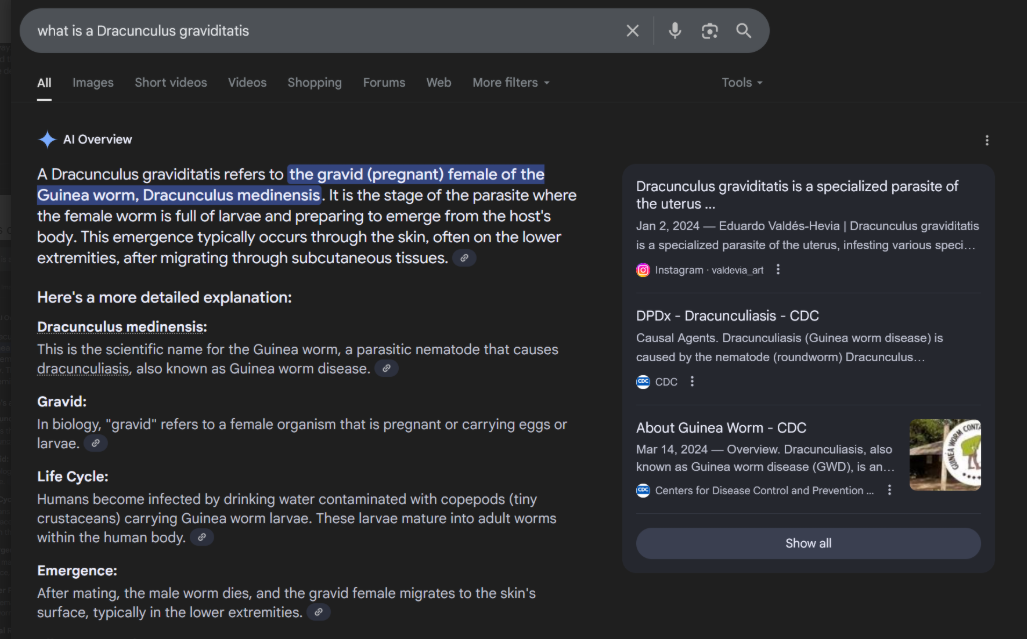
Other recent examples Valdés-Hevia flagged to me, like the fictional “Seraphim Shark” were at first presented as real by AI Overview, but has since been updated to say they are “likely” fictional. In some cases, Valdés-Hevia even managed to get AI Overview to conflate a real condition—Dracunculiasis, or guinea worm disease—with a fictional condition he invented, Dracunculus graviditatis, “a specialized parasite of the uterus.” Google
Valdés-Hevia told me he wanted to “test out the limits and how exploitable Google search has become. It’s also a natural extension of the message of my art, which is made to convince people briefly that my unreality is real as a vehicle for horror. Except in this case, I was trying to intentionally ‘trick’ the machine. And I thought it would be much, much harder than just some scattered social media posts and a couple hours.”
“Let’s say an antivaxx group organizes to spread some disinformation,” he said. “They just need to create a new term (let’s say a disease name caused by vaccines) that doesn’t have many hits on Google, coordinate to post about it in a few different places using scientific terms to make it feel real, and within a few hours, they could have Google itself laundering this misinformation into a ‘credible’ statement through their AI overview. Then, a good percentage of people looking for the term would come out thinking this is credible information. What you have is, in essence, a very grassroots and cheap approach to launder misinformation to the public.”
I wish I could say this is not a sustainable model for the internet, but honestly there’s no indication in Pew’s research that people understand how faulty the technology that powers Google’s AI Overview is, or how it is quietly devastating the entire human online information economy that they want and need, even if they don’t realize it.
The optimistic take is that Google Search, which has been the undisputed king of search for more than two decades, is now extremely vulnerable to disruption, as people in the tech world love to say. Predictably, most of that competition is now coming from other AI companies that thing they can build better products than AI overview and be the new, default, AI-powered search engine for the AI age. Alternatively, as people get tired of being fed AI-powered trash, perhaps there is room for a human-centered and human-powered search alternative, products that let people filter out AI results or doesn’t have an ads-based business model.
But It is also entirely possible and maybe predictable that we’ll continue to knowingly march towards an internet where drawing the line between what is and isn’t real is not profitable “at scale” and therefore not a consideration for most internet companies and users. Which doesn’t mean it’s inconsequential. It is very, very consequential, and we are already knee deep in those consequences.
“People are gravitating to AI-powered experiences, and AI features in Search enable people to ask even more questions, creating new opportunities for people to connect with websites,” A Google spokesperson told me in an email. “This [Pew] study uses a flawed methodology and skewed queryset that is not representative of Search traffic. We consistently direct billions of clicks to websites daily and have not observed significant drops in aggregate web traffic as is being suggested.”
Update: This article has been updated with comment from Google. We’ve also updated our description of the Pew study to clarify one percent of Google searches resulted in users clicking the link to the source of the AI summary.
Video from Kenny Laynez-Ambrosio, 18, puts fresh scrutiny on the harsh tactics used to reach the Trump administration’s ambitious enforcement targets
‘You’ve got no rights’: teenage US citizen records violent arrest by immigration officers – video
On the morning of 2 May, teenager Kenny Laynez-Ambrosio was driving to his landscaping job in North Palm Beach with his mother and two male friends when they were pulled over by the Florida highway patrol.
In one swift moment, a traffic stop turned into a violent arrest.
A highway patrol officer asked everyone in the van to identify themselves, then called for backup. Officers with US border patrol arrived on the scene.
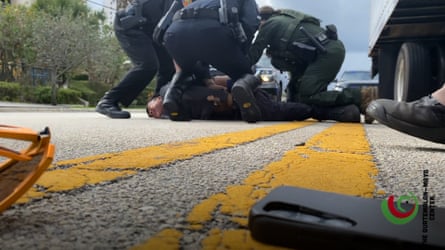
Video footage of the incident captured by Laynez-Ambrosio, an 18-year-old US citizen, appears to show a group of officers in tactical gear working together to violently detain the three men*, two of whom are undocumented. They appear to use a stun gun on one man, put another in a chokehold and can be heard telling Laynez-Ambrosio: “You’ve got no rights here. You’re a migo, brother.” Afterward, agents can be heard bragging and making light of the arrests, calling the stun gun use “funny” and quipping: “You can smell that … $30,000 bonus.”
“The federal government has imposed quotas for the arrest of immigrants,” said Jack Scarola, an attorney who is advocating on behalf of Laynez-Ambrosio and working with the non-profit Guatemalan-Maya Center, which provided the footage to the Guardian. “Any time law enforcement is compelled to work towards a quota, it poses a significant risk to other rights.”
Chokeholds, stun guns and laughter
The incident unfolded at roughly 9am, when a highway patrol officer pulled over the company work van, driven byLaynez-Ambrosio’smother, and discovered that she had a suspended license. Laynez-Ambrosio said he is unsure why the van was pulled over, as his mother was driving below the speed limit.
Laynez-Ambrosio hadn’t intended to film the interaction – he already had his phone out to show his mom “a silly TikTok”, he said – but immediately clicked record when it became clear what was happening.
The arrest of an undocumented man in Florida, as caught on video by Kenny Laynez-Ambrosio on 2 May 2025. Photograph: Screengrab from video by Kenny Laynez-Ambrosio/Courtesy of the Guatemalan-Maya Center
The video begins after the van has been pulled over and the border patrol had arrived. A female officer can be heard asking, in Spanish, whether anyone is in the country illegally. One of Laynez-Ambrosio’s friends answers that he is undocumented. “That’s when they said, ‘OK, let’s go,’” Laynez-Ambrosio recalled.
Laynez-Ambrosio said things turned aggressive before the group even had a chance to exit the van. One of the officers “put his hand inside the window”, he said, “popped the door open, grabbed my friend by the neck and had him in a chokehold”.
Footage appears to show officers then reaching for Laynez-Ambrosio and his other friend as Laynez-Ambrosio can be heard protesting: “You can’t grab me like that.” Multiple officers can be seen pulling the other man from the van and telling him to “put your fucking head down”. The footage captures the sound of a stun gun as Laynez-Ambrosio’s friend cries out in pain and drops to the ground.
Laynez-Ambrosio said that his friend was not resisting, and that he didn’t speak English and didn’t understand the officer’s commands. “My friend didn’t do anything before they grabbed him,” he said.
Kenny Laynez-Ambrosio, 18, filmed his own arrest in Florida. Photograph: The Palm Beach Post/Reporter Valentina Palm
In the video, Laynez-Ambrosio can be heard repeatedly telling his friend, in Spanish, to not resist. “I wasn’t really worried about myself because I knew I was going to get out of the situation,” he said. “But I was worried about him. I could speak up for him but not fight back, because I would’ve made the situation worse.”
Laynez-Ambrosio can also be heard telling officers: “I was born and raised right here.” Still, he was pushed to the ground and says that an officer aimed a stun gun at him. He was subsequently arrested and held in a cell at a Customs and Border Protection (CBP) station for six hours.
Audio in the video catches the unidentified officers debriefing and appearing to make light of the stun gun use. “You’re funny, bro,” one officer can be overheard saying to another, followed by laughter.
Another officer says, “They’re starting to resist more now,” to which an officer replies: “We’re going to end up shooting some of them.”
Later in the footage, the officers move on to general celebration – “Goddamn! Woo! Nice!” – and talk of the potential bonus they’ll be getting: “Just remember, you can smell that [inaudible] $30,000 bonus.” It is unclear what bonus they are referring to. Donald Trump’s recent spending bill includes billions of additional dollars for Ice that could be spent on recruitment and retention tactics such as bonuses.
Laynez-Ambrosio said his two friends were eventually transferred to the Krome detention center in Miami. He believes they were released on bail and are awaiting a court hearing, but said it has been difficult to stay in touch with them.
Laynez-Ambrosio’s notice to appear in court confirms that the border patrol arrived on the scene, having been called in by the highway patrol. His other legal representative, Victoria Mesa-Estrada, also confirmed that border patrol officers transported the three men to the border patrol facility.
The Florida highway patrol, CBP, and Immigration and Customs Enforcement did not respond to requests for comment before publication.
‘We are good people’
Trump officials increasingly recruit local police for immigration enforcement despite ‘red flags’
Read more
Laynez-Ambrosio was charged with obstruction without violence and sentenced to 10 hours of community service and a four-hour anger management course. While in detention, he said, police threatened him with charges if he did not delete the video footage from his phone, but he refused.
Scarola, his lawyer, said the charges were retaliation for filming the incident. “Kenny was charged with filming [and was] alleged to have interfered with the activities of law enforcement,” he explained. “But there was no intended interference – merely the exercise of a right to record what was happening.”
In February, Florida’s governor, Ron DeSantis, signed an agreement between the state and the Department of Homeland Security allowing Florida highway patrol troopers to be trained and approved by Ice to arrest and detain immigrants. While such agreements have been inked across the US, Florida has the largest concentration of these deals.
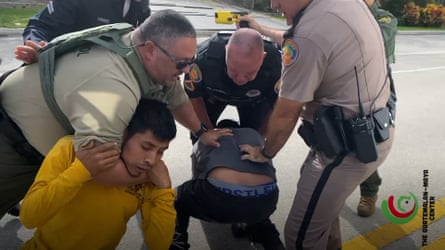
The arrests of 2 May 2025. Photograph: Screengrab from video by Kenny Laynez-Ambrosio/Courtesy of Guatemalan-Maya Center
Father Frank O’Loughlin, founder and executive director of the Guatemalan-Maya Center, the advocates for Laynez-Ambrosio, says the incident has further eroded trust between Florida’s immigrant community and the police. “This is a story about the corruption of law enforcement by Maga and the brutality of state and federal troopers – formerly public servants – towards nonviolent people,” he said.
Meanwhile, Laynez-Ambrosio is trying to recover from the ordeal, and hopes the footage raises awareness of how immigrants are being treated in the US. “It didn’t need to go down like that. If they knew that my people were undocumented, they could’ve just kindly taken them out of the car and arrested them,” he said. “It hurt me bad to see my friends like that. Because they’re just good people, trying to earn an honest living.”
The Guardian is granting anonymity to Laynez-Ambrosio’s mother and the men arrested in the footage to protect their privacy
Dashcam footage of a 22-year-old driver pulled over in a Jacksonville, Fla. traffic stop has left lots of viewers with questions about police and excessive force.
Video of a traffic stop in Jacksonville, Fla., has gone viral. And although the incident occurred nearly six months ago, thousands of outraged viewers are now raising questions about what they believe to be excessive force used on a young Black man.
According to an arrest report obtained by News4JAX, Will McNeil Jr. was pulled over just after 4:00 pm on February 19 because his car “did not have its headlights or tail lights illuminated in inclement weather.” The report reads that McNeil Jr. was not wearing his seat belt and became “verbally combative” with the officer when he was asked to show his identification.
But recently released dash cam video paints a different picture and has many on the internet seeking justice for the 22-year-old driver. The footage shows McNeil Jr. was wearing his seat belt at the time he was pulled over and asked officers to call their supervisor to explain why he was being held when there was no rain or fog at the time he was stopped.
According to First Coast News, officers reported giving McNeil Jr. several warnings that they would break his window if he did not step out of his car. Although those warnings cannot be heard in the video, officers can be seen breaking the driver’s side window and striking McNeil Jr. in the head several times before he was forcibly removed from his car and forced to the ground.
McNeil Jr. told News4JAX that the incident left him with several injuries, including a concussion.
“I suffered a chipped tooth; my tooth went through my lip, and they slammed me on the ground and on the concrete. I had to get nine stitches. I also had a concussion and now I suffer from short-term memory loss,” he said.
In a statement on X, the Jacksonville Sheriff’s Office acknowledged the incident and said they are conducting their own investigation into the events leading up to the young man’s arrest.
“We are aware of a video circulating on social media showing a traffic stop represented to be from February 19, 2025. We have launched an internal investigation into it and the circumstances surrounding this incident. We hold our officers to the highest standards and are committed to thoroughly determining exactly what occurred,” it reads.
But social media has been flooded with comments from people who believe the proof that the police department is in the wrong is in the video.
“You saw exactly what happened because it was completely recorded. Your own officers stated the reason for his arrest in the video, and he was not resisting. The force used was completely unnecessary. This was a blatant abuse of power. The City of Jacksonville should be ashamed,” wrote someone on X.
Attorney Ben Crump, who will be representing McNeil, told News4JAX that the video evidence is clear that the police were out of line, “It should be obvious to anyone watching this video that William McNeil wasn’t a threat to anyone. He was calmly exercising his constitutional rights, and they beat him for it.”
I am posting a different article on this kidnapping and disappearing of a long time resident and family man because the right wing media keeps telling us that they are detaining the worst of the worst, only deporting the dangerous criminals. The thug in charge of ICE Tom Homan keeps mumbling that anyone protesting is wanting rapist, arsonists, murders gang drug runners in your neighborhood. This man was a green card holder and a threat to know one. They way that ICE treated his elderly wife was horrific in itself. Hugs
An Immigration and Customs Enforcement (Ice) agent. Photograph: Charly Triballeau/AFP/Getty Images
An 82-year-old man in Pennsylvania was secretly deported to Guatemala after visiting an immigration office last month to replace his lost green card, according to his family, who said they have not heard from him since and were initially told he was dead.
According to Morning Call, which first reported the story, longtime Allentown resident Luis Leon – who was granted political asylum in the US in 1987 after being tortured under the regime of the Chilean dictator Augusto Pinochet – lost his wallet containing the physical card that confirmed his legal residency. So he and his wife booked an appointment to get it replaced.
When he arrived at the office on 20 June, however, he was handcuffed by two Immigration and Customs Enforcement (Ice) officers, who led him away from his wife without explanation, she said. She said she herself was kept in the building for 10 hours until relatives picked her up.
The family said they made efforts to find any information on his whereabouts but learned nothing.
Then, sometime after Leon was detained, a woman purporting to be an immigration lawyer called the family, they said, claiming she could help – but did not disclose how she knew about the case, or where Leon was.
On 9 July, according to Leon’s granddaughter, the same woman called them again, claiming Leon had died.
A week later, however, they discovered from a relative in Chile that Leon was alive after all – but now in a hospital in Guatemala, a country to which he has no connection.
According to Morning Call, the relative said Leon had first been sent to an immigration detention center in Minnesota before being deported to Guatemala – despite not appearing on any Ice detention deportation lists.
Ice on Monday evening denied the Morning Call story, calling it a hoax.
Morning Call claimed it repeatedly requested confirmation and details from Ice throughout its reporting. Morning Call also claimed it was introduced to the family during a Lehigh county courthouse protest over Ice’s operations there.
It noted the family ceased responding to its requests for clarification on Monday.
A recent supreme court decision ruled the Trump administration could deport immigrants to other countries beside their country of origin.
In his nearly 40 years living in the US, Leon spent his career working in a leather manufacturing plant, and raised a family. He had since retired.
He suffers from diabetes, high blood pressure and a heart condition, according to his family, who said they are planning to fly to Guatemala to see him.
An Ice official told the Morning Call it was investigating the matter. The Guatemala Migration Institute denied that Leon was deported from the US to Guatemala.
Morning Call reported on Sunday that Leon was recovering from pneumonia in Guatemala, according to his family, and that he arrived in Guatemala City on 1 July. According to the family, reported Morning Call, his phone was taken away and Ice officers kept referring to him and other detainees as “Mario.”
In the case of Saturday Night Fever, “[t]he use of disco-inflected classical music in the film represents the economic and social success to which Tony and his friends ultimately aspire,” argues McLeod. “The disco milieu represents one form of illusion—the illusion of power in the outside ‘real’ world that Tony imagines.”
Indeed, classical music represents an exotic world of sophistication, elitism, and wealth which, especially when merged with a homogeneous disco beat, becomes an enticing symbol of the unattainable, illusory, and artificial nature of Tony’s dreams.
Walter Murphy’s “A Fifth of Beethoven” makes its appearance when Tony and his friends arrive at the 2001 Oddyssey (sic) disco club.
“To some extent he is represented as the new heir to the cultural prestige of classical music,” writes McLeod of Tony’s appearance. The soundtrack, with its
seemingly contradictory and almost synthetically forced fusion of classical music and disco underlines the artificiality of his entrance and of the world into which he has crossed. It is likely no accident that the famous “fate” motive, heard here near the beginning of the movie, functions as a foreshadowing of the dramatic events that will soon unfold within this world.
“A Fifth of Beethoven” is easily the highest-profile instance of disco appropriation of classical music. Beethoven’s Symphony No. 5 is typically associated with notions of monumentality, heroism, fate, and relentless transcendence of the will. And while Beethoven’s version is about transcending humanity, Murphy’s is steeped in humanity, as it represents acceptance of common human desires—such as dancing—rather than superhuman transcendence of them.
The soundtrack also featured another instrumental disco–classical interpretation: David Shire’s “Night on Disco Mountain,” which adapts Mussorgsky’s orchestral tone poem Night on Bald Mountain (which is also the Chernabog segment in Disney’s Fantasia). “Night on Disco Mountain” is heard when Tony and his friend pretend to jump off the Verrazzano-Narrows Bridge.
“The faked suicides are symbolized by the ‘fake’ classical music,” writes McLeod.
Shire’s track adds another layer of grotesque ambient sounds to further heighten the atmosphere of chaos and alienation, producing what McLeod calls “an international and futuristic potpourri of sounds.”
“A Fifth of Beethoven” and “Night on Disco Mountain” weren’t isolated instances of classical–disco fusion. Wendy Carlos’s Switched-On Bach and Switched-On Brandenburgs recordings became instant commercial radio and dance hits. K-Tel Records initiated their popular Hooked on Classics series that combined classical music with elements of disco and pop music. This trend spawned a number of disco–classical albums such as Klassiks Go Disko, featuring “A Sixth of Tchaikovsky” and “Brahms’s Disco Dance No. 5,” and Saturday Night Fiedler, an album of disco arrangements by the Boston Pops.
“Many of classical music’s qualities, such as structural complexity and cultural prestige, were natural targets for simplification, reduction, and transmission to a mass audience,” argues McLeod. Artificiality is another common thread, as both genres thrive on the notion. “As in a discotheque,” he writes, “classical music is often enjoyed and appreciated in escapist settings by wealthy, well-dressed devotees.”
There are also similarities between classical and disco compositional style.
July 25, 1898 With 16,000 troops, the United States invaded Puerto Rico at Guánica, asserting that they were liberating the inhabitants from Spanish colonial rule, which had recently granted the island’s government limited atonomy. The island, as well as Cuba and the Philippines, were spoils of the Spanish-American War which ended the following month. Puerto Rico remains a U.S. commonwealth today. N.Y. 17th Volunteer Regiment marching through Puerto Rico Famed American poet Carl Sandburg saw active service in Puerto Rico, beginning with the invasion in Guánica. Sandburg wrote about these experiences in his book entitled “Always the Young Strangers” (New York: Harcourt, Brace, 1953). More on the invasion
July 25, 1946 The first underwater atomic device was detonated at Bikini Atoll, one of the Marshall Islands in the South Pacific. It was the second of two bombs, Able and Baker, that comprised Operation Crossroads; each weapon had a yield equivalent to 23,000 tons of TNT (23 kilotons).The U.S. Navy conducted the tests to determine the effect of such weapons on ships at sea. More than 130 newspaper, magazine and radio correspondents from seven nations were present for the tests. More on Operation Crossroads
July 25, 1947 The National Security Act of 1947 was passed by Congress, uniting the armed forces under control of the National Military Establishment, which soon became Defense, the only cabinet-level military department, in place of separate ones for War, Army and Navy. The law also created the National Security Council, the Central Intelligence Agency, and gave statutory responsibility to the Joint Chiefs of Staff.
July 25, 1963 The Limited Test Ban Treaty was initialed following 10 days of intense negotiations among the the U.S.S.R.*, U.S. and United Kingdom. The treaty prohibits nuclear weapons tests “or any other nuclear explosion” in the atmosphere, in outer space, or under water; it does not ban underground tests. The nuclear powers (only three then, nine today) accepted as a common goal “an end to the contamination of man’s environment by radioactive substances.” 185 countries have signed the treaty so far but Israel, Pakistan, Iran and North Korea never signed or later withdrew. * Union of Soviet Socialist Republics, commonly referred to as the Soviet Union, included Russia and 14 countries and was dissolved in the early ‘90s. Status of Nuclear Weapons States and Their Nuclear Capabilities
July 25, 1965 Martin Luther King, Jr., participated in protests against housing segregation in Chicago. His Southern Christian Leadership Conference (SCLC) joined with the Coordinating Council of Community Organizations (CCCO), led by Al Raby, a black schoolteacher, in the Chicago Freedom Movement. More on the CCCO Martin Luther King talks to Al Raby of Chicago’s Coordinating Council of Community Organizations (CCCO)as they lead the march down State Street.To King’s right is Jack Spiegel of the United Shoeworkers, and to Raby’s left is King assistant Bernard Lee.
It’s all a lot of money. But one party doesn’t get the amounts of dark money that the other party receives; one party has access to the US Treasury through POTUS that the other party does not have, as well.
House and Senate candidates recently filed their fundraising reports covering the first six months of 2025. OpenSecrets analyzed the data to determine which candidates have raised the most money and which ones are sitting on the biggest piles of cash.
Let’s start with a look at Senate races. Jon Ossoff (D) is seeking reelection in Georgia, where he won his first term in the most expensive Senate race in history. (That record has since been broken). During the first half of this year, he raised more money than any other candidate running in 2026.
Sen. Cory Booker (D-N.J.), who was fifth in fundraising, has the most cash on hand, with Ossoff running third after this big first-half haul.
As of today, the well-respected Cook Political Report has identified three tossup races that could determine control of the Senate in 2027: Georgia, Michigan and North Carolina. The Tar Heel State race just moved into that category because Sen. Thom Tillis (R) announced his retirement June 29, so the candidate field has not yet solidified.
The three most senior members of the House of Representatives rank among the top fundraisers this year, but they were dwarfed by Rep. Alexandria Ocasio-Cortez (D-N.Y.), who raised $6.7 million more than Rep. Mike Johnson (R-La.), the speaker of the House.
Ocasio-Cortez and Rep. Ro Khanna (D-Calif.) raised the most among Democrats and also have two of the biggest stockpiles of campaign cash heading into the second half of the year. It remains to be seen whether Rep. Elise Stefanik (R) will stand for re-election to Congress or make a run for governor of New York in 2026. Rep. Raja Krishnamoorthi (D-Ill.) is running for an open Senate seat.
This article was originally published by OpenSecrets, a nonpartisan, nonprofit organization that tracks money in politics. View the original article. (The original includes pertinent charts that make the article make better sense. I recomment clicking through; I’m not sure why their republish code doesn’t include the charts. I tried to copy them separately to insert them, but copying was not allowed. -A.)

 A U.S. Marine with 3rd Battalion, 7th Marine Regiment, 1st Marine Division, attached to Task Force 51, guards a federal area in Los Angeles on July 12, 2025. Photo: Lance Cpl. Andrew Whistler/U.S. Marine Corps/DVIDS










 Scottie's Playtime