So after about two hours a different person than who checked him in came into the waiting room and told Ron they did the diagnostic and it showed this spark plug dome clearance problem so Ron needed to buy a new engine. Ron told them him drove it in and he was driving it out. The guy said that it could cause more damage to the engine and he shouldn’t drive it. Ron told him he was leaving with the car!
That seemed to cause them some problems because it took them almost another hour to bring Ron the car. It was the person who checked him in who came into clear the paper work with Ron over what was done. When Ron questioned them on what spark plugs they put in she said none they did not even do anything like that. She showed him the paperwork and it said that they put it on the diagnostic machine and it gave an error code meaning that the spark plug was seized with an intrusion of coolant fluid. The suggested thing was to try to remove the spark plug.
Instead they did the oil change, checked the fluids, and rotated the tires. The standard stuff for an oil change. They discounted the $360 dollar diagnostic tests $100 because Ron told them to not do it but they had already started it, they don’t say if they completed it. When he signed in the woman tried to tell him he needed the 60,000 mile fluid flush and it would cost $650.00. Yet she did not tell him and the paperwork did not say how much each fluid was or cost.
When he got home Ron told me the other part of this. Our car is the top of the line with all option. It has had all maintenance done at the dealership along with us having bought the “butler service” keeping the paint job as grand as possible by redoing the clear coat after doing touch up work. It has a very high resale price. The dealership has been sending us offers to buy the car back or give us a great trade in for it. Seems they have wanted it back so badly someone thought if they went in and told this senior citizen that their car that would be paid off next month and was 7 years old needed a 10 grand engine replacement they might get him to deal the car away to them.
The thing that I stick on is after they told Ron that and he said no he was taking the car home it took them an hour to bring it out from the garage to the waiting room area. Why. Did they just not do anything for a couple of hours and then tell him that thinking he would be too scared to try to drive it home? So then they had to do the service he had an appointment for? Or did they do it and had something else going on that they had to do to get the car ready to come back to the front? It took three hours to run the diagnostic machine, do the oil change and fluid check, and rotate the tires. Seems a long time to me. I would love to hear the thoughts you all have. Hugs.
Ron took our 2018 Ford Escape to the dealership this morning for an oil change and that the car ran rough when first started. On the way there the check engine light came on. No blinking but steady. So the dealership told Ron that to even do the tests would be $360 plus the cost of the oil change along with any needed repairs. They came back to Ron nearly 2 hours later and told him we needed a new engine for $10,000 because of a dome spark plug clearance problem. Ron told them he drove it there with no issues and he was driving it home. I called Randy who has some knowledge and works with mechanics who say that it is possible but not likely and that the engine should go for $3,500 not $10,000. I found online that normally it is the plug that is the problem, using the wrong plug or the plug specs have changed a small amount. But like anything online I couldn’t find a real clear answer. I could use some help if anyone out there understands engines and this stuff. Thanks and hugs
Remember when Joe Biden appeared to dose off and the right went into outrage mode. Turned out it was edited doctored video. Fox entertainment played the doctored video repeatedly and their rage emotions host made it sound like Biden needed to sleep every other hour. Yet not a mention of the tRump falling asleep. Hug
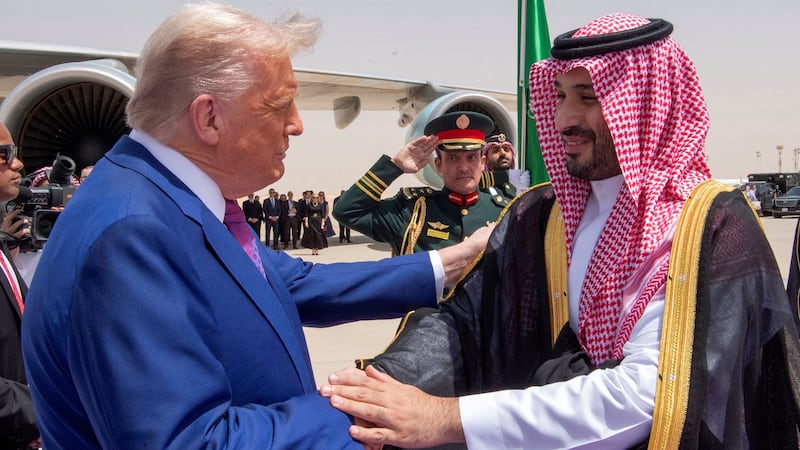
The excitement of a trip to Saudi Arabia apparently didn’t last long for 78-year-old U.S. President Donald Trump: In fact, the special welcome ceremony appeared to be a snoozer.
Trump landed in Riyadh on Tuesday as part of a four-day tour of the Middle East, where he claims he will secure billions in investments and trade agreements with Gulf nations. (He may also pick up a free plane.)
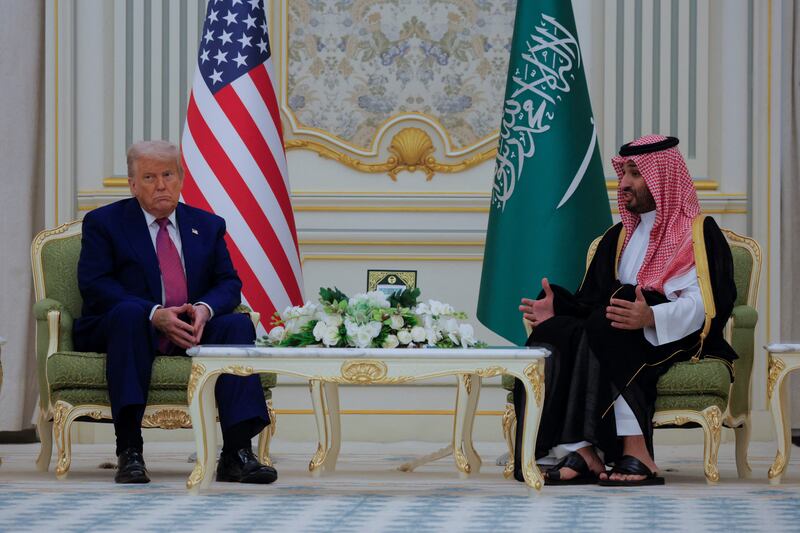
But the long red-eye flight from the U.S. appeared to have taken its toll; Trump was frequently seen with his eyes closed and once appeared to jolt himself awake during a special ceremony held in his honor at the Saudi royal court byCrown Prince Mohammed bin Salman, the country’s de facto ruler, whopreviously ordered the killingof Washington Post journalist Jamal Khashoggi.
Saudi’s de facto ruler, Crown Prince Mohamed bin Salman, was on the tarmac to greet Trump. But once the welcome ceremony began, a seated Trump appeared keen to rest his weary eyes.Bandar Algaloud/Courtesy of Saudi Royal Court/Handout via Reuters
The prince was more forgiving of Trump’s inattention, but it was noted by those watching on social media.
“Trump is having a hard time keeping his eyes open in Saudi Arabia,” reporter Aaron Rupar wrote while sharing a clip of Trump appearing to nod off on X.
Another X user posted: “Sleepy Don can barely keep his eyes open while representing the United States in Saudi Arabia. If this were President Biden, there would be nonstop coverage of his cognitive condition and physical fitness. Where is the media outrage?”
White House Communications Director Steven Cheung denied that Trump wasn’t paying attention.
“It’s clear that President Trump was fully engaged and listening intently as he finalized historic deals on his return to Saudi Arabia,” he said. “The Daily Beast should perk up and stop slacking instead of taking their cues of liberal liars who have shown a history of deceiving the American people.”
A weary Trump was given a gold-accented throne-like chair to sit in during the welcome ceremony. At moments, he seemed to be enjoying the change to take the weight off his eyelids.Brian Snyder/Reuters
The napping habits of his predecessor, of course, prompted Trump to call President Joe Biden, “Sleepy Joe.”
But Trump, who will overtake Biden as the oldest sitting president in U.S. history during the final year of his second term, has often faced accusations of dozing off in public.
One of the most high-profile incidents came during his 2024 hush money trial, where reporters inside the New York courtroom said that he appeared to fall asleep during the historic proceedings.
Trump claimed he was fully conscious throughout the trial in posts on Truth Social during the proceedings.
“I don’t fall asleep during the Crooked D.A.’s Witch Hunt, especially not today. I simply close my beautiful blue eyes, sometimes, listen intensely, and take it ALL in!!!” Trump wrote.
Whether Trump was simply trying to “take it all in” with his “beautiful blue eyes” closed in Saudi Arabia remains unclear.
When it feels like progress isn’t happening, a force field analysis can reveal where the status quo is shifting and point to other strategic leverage points.
If you try to track every piece of news, you may find it impossible to mentally survive the onslaught of these times. Donald Trump and Elon Musk have unleashed a barrage of civil rights rollbacks, weaponized institutions and passed off idiotic/dystopian spectacles as governance. The sheer velocity can numb the senses, tempting us to shut down, turn off the feed and retreat.
But you also cannot be good to the world (or yourself) if you keep your head down and pay attention to nothing. Withdrawal is understandable, even necessary at times — but permanent disengagement only cedes ground to the authoritarian momentum, while reinforcing our image of ourselves as powerless.
With that in mind, an important question emerges: How do we observe what’s happening without being crushed by its weight?
This is where the work of social psychologist Kurt Lewin becomes a powerful tool. Lewin — a Jewish intellectual who fled Nazi Germany — developed force field analysis to understand how power, behavior and transformation occur in real social systems.
He saw that any given situation is held in place by a dynamic equilibrium between forces pushing for change and those resisting it. To shift the status quo, you don’t necessarily need to move everything at once — you can focus strategically on specific forces or actors that influence the whole.
In activist training, I was taught force field analysis as follows: First you make a list of forces and organizations pushing towards the dreary authoritarian oligarchy-controlled vision. Then you make a list of forces pushing towards a reordered society that’s deeply democratic and where wealth is shared.
There’s a tension between these two forces. For example, on the authoritarianism side right now, Trump’s FBI ordered the arrest of a state judge for allegedly trying to prevent ICE from detaining a man in her courtroom or the arrest of New Jersey’s gubernatorial candidate Ras Baraka. On the democracy side, judges, lawyers and plaintiffs have defeated Trump 93 percent of the time in court because his orders are sloppy and patently illegal. What’s more, the Trump administration has quietly followed the judge’s orders most of the time.
While all authoritarians favor loyalty over competency, this regime is particularly extreme in its mistakes. And Trump is still fighting Harvard, and trying to take over now museums too. But again, new frontline resistance is appearing in the arts community and amongst librarians and museum leaders.
There can be an impulse to want to ask, on any given day, “Are we winning? Or are we losing?” Like a basketball game, many of us do a kind of score keeping about how many points we are down. But, just to continue with the sports analogy, our situation is more like soccer — where a lot of the game isn’t about immediate scoring but positioning, repositioning, quick advances and quick retreats. Progress may not always be visible or immediate, but that doesn’t mean it isn’t happening.
A Colombian elder — who has lived her whole life in the shadow of war — recently told me, “People in the U.S. are obsessed with winning, and it’s very unhealthy in moments like this. You keep wanting to know if it’s going well or not — and these times can’t be analyzed in headlines or moments. Sometimes it just is what it is. It’s losing and winning. The yardstick is measured in hearts, and the timeline is generations of work on people’s attitudes and views.”
Lewin’s brilliance was in recognizing that we don’t have to act on everything all at once just because we see the bigger picture of what’s happening. We can begin by identifying the different forces at play: forces for good, forces against and some forces that are mixed. Crucially, in his analysis, you then assess which of these forces can be strengthened or weakened.
This is where it’s helpful to get practical. Courage anywhere begets courage everywhere. Because Trump has picked a strategy of everywhere all at once — nearly every group has a chance to stand up and support each other to be more bold. We’re already seeing great examples of this, such as the hundreds of nonprofits signing on to support Harvard’s fight, the lawyers retaking their oaths to the Constitution in public, and the government workers resisting unauthorized access by DOGE and continuing their important work.
In practical terms, the best strategy might be not focusing on Musk or Trump directly, but on amplifying local election protections, funding investigative journalism, or supporting tech workers organizing against misuse of platforms. You don’t need to tackle the entire regime to weaken its foundation. You need leverage points — clear, concrete places to act.
Using Lewin’s tool helps prevent burnout. It turns despair into direction. It gives structure to what might otherwise feel like flailing.
So, yes: These are hard days. But it’s not all bad or good — it’s a force field in motion. Even small acts, strategically placed, can shift the balance. We are not powerless — we are participants.
Following Trump’s ban on transgender people in the military, Jordan Klepper met with a panel of esteemed service members to discuss the president’s rejection of their qualifications, which stand in stark contrast to Trump’s own bone spur excuses
The scarcity of the President’s Daily Briefings comes as he pursues high-stakes diplomacy with America’s friends and foes.
The low number of briefings this time around is troubling to many in and around the intelligence community, who were already concerned about Trump’s act-first-evaluate-after approach to governing. | Andrew Harnik/Getty Images
Since President Donald Trump was sworn into office in January, he has sat for just 12 presentations from intelligence officials of the President’s Daily Brief.
That’s a significant drop compared with Trump’s first term in office, according to a POLITICO analysis of his public schedule.
In much of his first term, Trump met with intel officials twice a week for the briefing, which provides the intelligence community’s summary of the most pressing national security challenges facing the nation.
The low number of briefings this time around is troubling to many in and around the intelligence community, who were already concerned about Trump’s act-first-evaluate-after approach to governing.
“It’s sadly clear that President Trump doesn’t value the expertise of and dangerous work performed by our intelligence professionals each and every day, and unfortunately, it leaves the American people increasingly vulnerable to threats we ought to see coming,” Sen. Mark Warner (D-Va.), the top Democrat on the Senate Intelligence Committee, said in a statement to POLITICO.
The sporadic pace of briefings comes as Trump has been working to broker an end to the wars in Gaza and Ukraine and to jump-start nuclear talks with Iran — all while navigating increasing potential threats from adversaries such as Russia and China.
Each president is different in the manner and pace at which they receive their briefings, and Trump is not entirely out of step with some of his predecessors.
But with Trump, there is added concern as he is known not to read the accompanying briefing document, referred to as “the book,” that is put together by intelligence analysts in a highly labor-intensive process. This document is delivered in hard copy or on a tablet device to the president and his key advisers five days a week.
The briefings from senior intelligence officials are often a chance for the president to hear detailed assessments on global crises and to receive updates on highly classified covert operations overseas — along with blunt facts about the state of the world, regardless of policy implications or the president’s own views.
Trump received just two in-person PDB briefings per month in January, February and March, before settling into a more regular rhythm of once per week in April and May, according to the president’s daily schedule maintained by Faceba.se, a website that collates the president’s statements as well as his public calendar.
PDB presentations are typically tailored toward informing the president as he conducts high-stakes diplomacy, detailing what a foreign government may be thinking and what its intentions are, former intelligence officials said.
“The point of having an $80 billion intelligence service is to inform the president to avert a strategic surprise,” said a former CIA analyst who, like others in this story, was granted anonymity to discuss sensitive intelligence matters.
Trump’s top national security aides and Cabinet officials receive similar intelligence briefings and can ensure that critical information reaches the president’s ears.
Senior administration officials said Trump gets the information he needs through frequent communication with his intelligence chiefs.
“The president is constantly apprised of classified briefings and is regularly in touch with his national security team,” said Davis Ingle, a White House spokesperson. “The entire intelligence community actively informs President Trump in real time about critical national security developments.”
Ingle declined to comment on why Trump has received fewer daily PDB presentations compared to his first term..
Former intelligence officials argued that the PDB sessions are an opportunity for the president to hear from career intelligence officials who are skilled in imparting information regardless of whether it complements or contradicts the president’s foreign policy strategies.
They questioned whether other top advisers or Cabinet officials would be able — or willing — to relay these stark realities to the president.
And the circle of officials receiving the PDB may also be smaller than in Trump’s first term. CNN reported last month that the Trump administration has tightly restricted the number of people who have access to the intelligence report.
Trump’s first term in office was marked by a high turnover in his national security team, a trend that looks set to continue. Last week, Trump ousted his national security adviser Mike Waltz, who had long been on thin ice with other administration officials.
“The advantage of an IC briefer is its somebody who is trained to tell the hard truths to the president,” said Larry Pfeiffer, who served as chief of staff to CIA Director Michael Hayden.
“They are going to be more inclined to provide him with more nuanced information — information that’s not been parsed through a policy perspective,” Pfeiffer said.
Presidents vary in how often they have received in-person briefings. George W. Bush saw briefers from the intelligence community almost every day and preferred hearing directly from analysts, while Obama was a studious reader of the PDB book itself.
Obama received in-person briefings 44 percent of the days he was in office during his first term, according to a 2012 analysis by the conservative research group the Government Accountability Institute, which would equate to multiple briefings a week. He was attacked by the conservative media and former Vice President Dick Cheney for not attending more.
Biden received one to two briefings a week, according to a former U.S. intelligence official familiar with the matter and a former Biden White House official.
But Biden was known to regularly read the PDB briefing book, the former intelligence official said. A former official who served in Biden’s National Security Council said that the president would use the delivery of the book as an opportunity to gather his top national security aides and Cabinet officials to discuss its contents and foreign policy implications.
At the time, intelligence officials found Trump to be more responsive to graphics, maps and a more storified approach to recounting the intelligence, according to interviews with his briefers published in “Getting To Know The President,” a history of intelligence briefings of candidates and presidents-elect, authored by John Helgerson, a former senior CIA official.
Trump had a fraught relationship with the intelligence community during his first term. But the cadence of briefings almost three months into his second term represents a stark drop when compared to his first four years in office, and offers insight into how Trump might prioritize these briefings throughout the next four years.
In the first five weeks following his inauguration in 2017, Trump received an average of 2.5 briefings a week before settling into an average of two briefings a week in the latter half of his presidency, according to a detailed historical account published by the CIA’s own in-house academic research center.
Trump’s briefings during his first term were substantive, the former U.S. intelligence official said, noting that the president listened and was interactive during the presentations.
And during Trump’s first term, Vice President Mike Pence was an “assiduous, six-day-a-week reader,” of the PDB, Helgerson noted in his book.
A second former senior U.S intelligence official stressed that there are other avenues for Trump’s spy chiefs to get information to him, beyond his daily briefing, including standalone memos and articles based on the latest intelligence findings.
“It’s not the be all and end all,” they said, speaking of the PDB. The person also noted, as the White House did, that the president’s top advisers can also serve as a conduit for relaying information to the president.
A person familiar with how Trump takes his PDB briefings said that the president has received standalone briefings on global flashpoints on an ongoing basis separate from the PDB and that it would be incorrect to imply he wasn’t fully briefed. They were granted anonymity to discuss how Trump receives his intelligence.
“He’s calling people all day. If he wants an update on some of these things, he’ll call Ratcliffe, Rubio, Witkoff, Waltz, kind of in an ad-hoc fashion throughout the day, receiving this stuff,” said the person, who spoke before Waltz was removed from his position as national security adviser last week.
Asked for comment about the president’s briefing schedule, National Security Council spokesperson Brian Hughes said “President Trump has multiple high-level, national security briefings every day. While the scope can range from a comprehensive presentation of global intelligence, to meeting with senior national security officials on an issue of immediate importance, the daily engagement of President Trump is prolific.”
Former intelligence officials argue that the in-person presentations from experienced briefers offer a further opportunity for the president to receive important context on the intelligence delivered, ask questions and relay any requests for additional information back to the intelligence agencies.
That feedback gives the country’s spy agencies an opportunity to learn more about the president’s needs and interests. “We learn too,” said a third former senior U.S. intelligence official.
May 11, 1973 Charges against former Pentagon analyst Daniel Ellsberg (including conspiracy, espionage and larceny) for his role in the release of The Pentagon Papers (a comprehensive classified study of the origins and conduct of the Vietnam War) were dismissed. Judge William M. Byrne cited government misconduct, including attempts to bribe him with an appointment as FBI Director, and previously undisclosed wiretaps of Ellsberg. His compatriot, Tony Russo, a former RAND Corporation analyst, was also released. Secrets: A Memoir of Vietnam and the Pentagon Papers a book review Daniel Ellsberg’s website
May 11, 1975 80,000 turned out in New York City’s Central Park to celebrate the end of the Vietnam War.
John Oliver discusses the recent deportations by the Trump administration, the conditions in the facility people are being sent to abroad, and why even Henry Winkler could be in danger of being expelled from the U.S. Yeah, even national treasure Henry Winkler.
In rivers and oceans across the globe, fish are behaving strangely. Some swim faster than they should. Others take risks they’d normally avoid. Many abandon the social structures that once protected them. These shifts are not random. They point to an invisible threat flowing just beneath the surface: pharmaceutical pollution.
Drugs designed for human anxiety, pain, and insomnia are entering the world’s water systems through sewage, manufacturing waste, and improper disposal. Once there, they don’t vanish. They linger, affect wildlife, and disrupt entire ecosystems.
Bold Fish, Bigger Risks
Juvenile salmon migrating from Sweden’s River Dal to the Baltic Sea have become an unexpected case study. Researchers implanted hundreds of these fish with tiny slow-release doses of clobazam, an anti-anxiety drug commonly prescribed to humans. Tracking tags revealed something remarkable: salmon exposed to the drug completed their journey faster and in greater numbers than their drug-free peers.
According to Jack Brand, a researcher at the Swedish University of Agricultural Sciences, these medicated salmon passed through hydropower dams two to three times faster than untreated fish, likely because they were less hesitant around the turbines, NPR reports.
This boldness might sound like a survival advantage. But in ecosystems, risk-taking has consequences. When predators lurk or conditions shift, impulsive behavior can turn deadly.
Anti-anxiety drugs are altering fish behavior in the wild.
A Global Cocktail of Contaminants
The scope of contamination is staggering. Almost 1,000 pharmaceutical compounds have been detected in waterways around the world—including Antarctica. A Cary Institute report found that up to 80% of streams in the U.S. alone are polluted with pharmaceuticals and personal care products.
These compounds are potent by design. Many target receptors in the human brain, and those same receptors are found in fish and other species. Drugs like benzodiazepines, used to treat anxiety in people, also alter the stress response in fish. As a result, animals become less risk-averse, change their migration timing, or fail to form protective schools—shifts that can affect survival.
Drugged salmon are taking dangerous risks during migration.
From Lab to Wild
Previous experiments hinted at these effects. In labs, fish exposed to psychoactive drugs became more isolated and less cautious. But the new field studies from Sweden show that these behavioral changes persist—and even intensify—in the wild.
A follow-up experiment revealed that drugged salmon formed looser groups, even when a predator was nearby. The tighter a school, the safer its members. Disrupted shoaling behavior means more fish swimming solo—making them easier prey.
Michael Bertram, an ecologist leading the study, described the salmon’s altered behavior as a form of “unnatural selection,” The New York Times reports. If bolder fish survive migration but die later in predator-rich waters, the long-term outcome could be population decline, not resilience.
Predator-prey dynamics are being disrupted by pharmaceutical waste.
The Long Tail of Human Medicine
Human waste isn’t the only path these drugs take to the water. Wastewater from hospitals, improper drug disposal, and runoff from pharmaceutical manufacturing sites all contribute. Deutsche Welle reports that some wastewater treatment plants near manufacturing facilities have drug levels 1,000 times higher than others.
Yet most treatment plants are not equipped to filter out pharmaceuticals. Some drugs pass through the system unchanged. Others break into byproducts that are just as toxic.
Unknowns Beneath the Surface
Despite years of research, the full ecological impact of pharmaceutical pollution is unknown. Scientists have documented effects on hundreds of species, including reproductive issues and behavioral disruptions. A Cary Institute investigation described how certain antidepressants alter fish breeding cycles, while hormones from birth control pills can cause male fish to develop female egg cells.
As compounds accumulate in fish, they climb up the food chain. Birds, mammals, and even humans may be exposed through drinking water or consumption of contaminated seafood.
Solutions and Setbacks
There are potential fixes. Advanced treatment technologies like ozonation and membrane filtration can help. But they’re expensive and rare. Designing drugs that biodegrade safely—an approach known as green chemistry—is promising, though slow to implement.
Policy change is another lever. Currently, pharmaceutical companies are responsible for testing their own products for environmental safety. Critics argue that these reviews are insufficient and underregulated.
Improved drug disposal practices, public education, and cross-agency coordination could all make a difference. But as things stand, no pharmaceuticals are currently regulated under the EPA’s primary drinking water standards, Cary Institute reports.
The Cost of Inaction
The salmon darting through Swedish dams may seem like a scientific curiosity. But they are just one visible indicator of a much larger, invisible crisis. Every flushed pill, every untreated discharge, adds to a global experiment with no control group and no reset button.
What happens in rivers doesn’t stay there. It shapes the ocean, the land, and the web of life that connects them all.
Click and help us keep our oceans clean!(Note from A: this is a simple free Greater Good organization click-to-donate; the easily ignored ads help pay for cleaning the ocean. I’ll never know whether you click or not, I just wanted to let you know what it is.)



 Scottie's Playtime