I receive Economic Policy Institute’s newsletter for general info about which I contact my congresscritters. EPI have opened a page dedicated to what the White House, the Legislature, and the courts are doing that affect working people. I figure, first of all, forewarned is forearmed, as to little things that may not be loudly reported but which affect us regular people just out here trying to live our lives. So, here’s a link and a snippet. When a person goes on the page, you can get your choice of newsletters in your email box, if you care to; or you can just look around. Thanks for checking it out-I think it will help people.
In 1934, a courageous, flawed, complicated journalist named Dorothy Thompson was kicked out of Nazi Germany for reporting with relentless, brutal accuracy on the Third Reich—and then wrote a book about it called I Saw Hitler. Her impression was withering:
“He is formless, almost faceless, a man whose countenance is a caricature, a man whose framework seems cartilaginous, without bones. He is inconsequent and voluble, ill-poised, insecure. He is the very prototype of the Little Man.”
Four years later, Thompson produced a timeless classic of an article. Published in Harper’s in 1941, “Who Goes Nazi?” offers an acerbic and profound account of the “interesting and macabre parlor game” of looking around at any gathering, in her daily life in America, and perceiving who might be fundamentally receptive to fascism, and who would not. The assembly of archetypes she constructs so deftly for the article, and the conclusions she draws about receptiveness to fascism, are shaped by their time, and Thompson’s own fin de siecle WASP upbringing.
Dorothy Thompson is a fascinating figure in her own right—a tireless campaigner for women’s suffrage, a legendary reporter in interwar Europe nicknamed “the blue-eyed tornado,” a giver of extraordinary dinner parties, with extraordinary guests (“prime ministers, psychoanalysts, agents provocateurs, Balkan refugees, proletarian novelists, withered aristocrats, spies, and musicians”) and an extraordinary guest at other’s parties. As Margaret Chase Harriman recounted in a 1941 profile, “One night last winter, Miss Thompson went to a dinner party at a friend’s apartment; the talk, led by Miss Thompson, turned to world affairs, and someone made a careless, semi-humorous remark about Jews. Miss Thompson put down her knife and fork, and stood up. ‘I will not remain in the same house with traitors to the United States,’ she announced, rather obscurely, and left the table.”
“Who Goes Nazi” has resurfaced from time to time, in this era, for obvious reasons; it remains an engrossing read, for all its terse brevity. After the parlor game is done, Thompson presents her own conclusions about who goes Nazi and who doesn’t:
“Kind, good, happy, gentlemanly, secure people never go Nazi. They may be the gentle academic whose name is in the American Blue Book, or Bill from City College to whom democracy gave a chance to design airplanes—you’ll never make Nazis out of them. But the frustrated and humiliated intellectual, the rich and scared speculator, the spoiled son, the labor tyrant, the fellow who has achieved success by smelling out the wind of success—they would all go Nazi in a crisis.
Believe me, nice people don’t go Nazi. Their race, color, creed, or social condition is not the criterion. It is something in them.
Those who haven’t anything in them to tell them what they like and what they don’t—whether it is breeding, or happiness, or wisdom, or a code, however old-fashioned or however modern, go Nazi.
In Thompson’s spirit, I’ve decided to give her parlor game a little update, one that fixates a little less on breeding, the Blue Book, Lindbergh, racing stables, etc., and replaces it with the accoutrements of our own time—and, of course, the knowledge that this particular brand of fascism is as homegrown as American corn. Alas, we haven’t extirpated fascism since Thompson’s byline most of a century ago. So with some trepidation and humility, here’s my 2025 version. It’s called “Who Goes MAGA?”
I.
It is an interesting and somewhat macabre parlor game to play at a large gathering of one’s acquaintances: to speculate who in a showdown would go MAGA.
You are in a lushly-appointed room in an American city: perhaps the capital, perhaps New York, perhaps somewhere on the periphery of Silicon Valley. Around you there is the scant but expensive evidence of contemporary minimalism. The primary decorations, here, are human.
There in the corner, holding his drink, is Mr. P, a journalist of some renown, who has covered the tech industry for a long time. His magazine profiles have granted the aura of genius to numerous venture capitalists and start-up founders; he has written a book which got favorable reviews, deepening the mythos of these self-appointed arbiters of the future. He is canted toward the city lights outside the window, and they capture the rapt absorption on his face, as someone murmurs to him about the latest developments in venture funding, the latest spinnaker launched toward the stock market.
At some point Mr. P believed in the perfectibility of man through technology, and it was that initial optimism that shone through his early writing; long ago, he realized he was surrounded by gasbags and egomaniacs, people who were more enthused about breaking other people than easing any of their burdens through the wonders they made. But he kept writing, like Candide, like a press release, although his language is elegant and muscular. He knows which way the money goes, and who is in favor, and who is not, and directs his coverage accordingly.
This pertains to Mr. P’s ideology, which was long ago compromised, and to money and power, proximity to which intoxicates him. That is why he is here. You do not need to ask if Mr. P would go MAGA: by virtue of selling his words to the highest bidder, and his virtue to engender virtue in those who lack it, he already has. Unto the last extremity of cruelty he will be there, offering his burnishing excuses. He no longer sees cruelty anymore, because a long time ago he trained himself not to.
Watching them through half-lidded eyes, and clutching his drink a bit too tightly because he isn’t sure how he got this invitation, is Mr. Z, who doesn’t dress in button-downs and slacks, but in more comfortable and colorful attire. He does this in part as a visible symbol of what he has given up: a staff job like Mr. P’s, so rare in journalism these days; but more to the point, the sort of coverage he started with, as he, too, entertained ideas of human perfectibility and the power of technology. What person who lived through the last decades of the twentieth century could not?
The difference is that even before it all began to go obviously sour Mr. Z smelled the gas of self-aggrandizement, began to see how hollow the things that had been revolutionary were becoming. He began to see the cruelty and the waste of it, and he kept paying attention. The scales fell from his eyes and no flattering press releases or bought biographies could replace them. For the past few years he has lived on the edge of poverty, sacrificed access and replaced it with hard investigative labor, and told the stories of a culture corrupted by its own hubris and self-adulation to a much-reduced audience. He is not a happy man, and he sometimes wonders if he is even sane anymore. But he will never go MAGA, because he has chosen to look at cruelty and waste, and combat them. He would make that choice again even if it led to his ruin. He is rarer than you think.
Chattering with a delicate hors d’oeuvre balanced in her hand is Ms. M, an altogether commoner type of person. She is as precisely unique as a grain of sand, but she is pretty enough, with her careful hair and nails and heels. She is in her mid-forties and has had four children, three boys and a girl. Her father despised her because he wanted a son. Her husband, a prosperous but unremarkable businessman, despises her in part because he derives pleasure from it, and in part because she expects nothing and desires nothing more from him.
Ms. M adores the humiliation of women, so she has been MAGA in her heart for a long time, with its gift of destroying women. She loathes women because they bear the same unforgivable fault she herself possesses: they are female and inferior, and still worse they will not admit the latter and most crucial part. She gasps with admiration at the men who cast women down, who denigrate them; she adores her own humiliation, strokes it like an ermine collar. Now that MAGA has shown its strength, she feels more justified in revealing her contempt for other women, and her worship of masculine strength. MAGA will have her until she dies. Her sons will mourn her, but her daughter will not.
A little further into the palatial room, Mr. B holds four fingers of whiskey in a glass and is making a determined attempt to finish them quickly. He takes his whiskey neat, he wears a full suit, he wears a tight silk jacquard tie. All of it is choking him, even the whiskey, which he gulps like a drowning man. There is a piece of Mr. B that knows he is lying with every step he takes, with every word, fulsome with praise for the president and his party, with every ribald joke, with every manly stride he takes.
It was a very long time ago that Mr. B recognized the deep feeling of wrongness he felt in his bones and his body, the feeling that had made him so terribly tired and so desperately disinclined to ever leave bed. It was simpler than he thought: he wanted to be a woman. For years he played a woman online, in games and hidden social media accounts, used apps to imagine the appearance he wanted, looked at the costs of various types of surgery. But before he could even choose a true name, or even truly recognize that he needed it, the cold winds started blowing, and Mr. B retreated into his fear, into himself, into the him of himself.
Now it is he who is quickest to denigrate women, to demonstrate his loathing of them, to insinuate that he gratifies his desire in ways that hurt women. He has joined MAGA with his whole heart because he is afraid, and he hates so loudly because he is jealous. Mr. B is here at the invitation of Ms. M, with whom he is fast friends. He carefully does not covet her carefully manicured hands and her carefully highlighted hair and the curve of her calves and her bust. They delight in hating women together, and trans women in particular.
For both of them, trans women have committed an unforgivable sin: for Ms. M, though she does not know to say this, they have traded the ultimate gift, which is masculinity, for a life of crawling, servile, infantile female inferiority. For Mr. B, they have committed the unforgivable sin of living the truth he will deny to himself for a long time yet, and maybe forever.
Both of them turn away from Ms. X—a woman in leather with a huge bust and short hair, a woman who is about to leave, because her lover, a gentle, tall woman who once had a shorter name in a different place, is waiting for her in a pleasanter and more cluttered room than this. She is only here out of curiosity, and it has quickly curdled into disgust. She loves being a woman. She has never felt it makes her inferior. She loves to touch the bodies of other women, to write love poems to women, to delight in the words of women, the films of women, portraits of and by women.
Ms. X feels no need to police the boundaries of womanhood, because to her it is capacious and welcoming. It wants only equality; she has felt the world trying to shrink her for being a woman and has refused to shrink. Her hands are stained with ink; when she cooks, she uses too much garlic; she likes to sing along very loudly to music in the car. She will never go MAGA, because she is not ashamed of who she is, or who she loves.
As Ms. X wafts out the door on a cigarette-and-leather smell, Mrs. H wrinkles her nose. Against the white couches and white walls and white sconces, Mrs. H’s brown skin stands out. It also stands out against the white faces of the other guests. Mrs. H is an immigrant and daughter of immigrants who is convinced she is one of the “good ones.” She is filled with loathing at the crisis the television shows her, convinced the country is on the verge of invasion, and that her green card and her marriage make her safe. The criminal scum depicted on the television and rightly abhorred by the president could never be her; she wears a good suit and her husband is a rich man.
She should know by now, but doesn’t, that Mr. H would denounce her to the deportation authorities at once if it would earn him any security or favor; he considers her inferior to him entirely, but is content with a wife who will never be his equal. They have a son, who looks white enough that Mr. H has embraced him as his heir. They are both MAGA and proud of it and have a bumper sticker on their big luxury car announcing it.
Mr. H has an expensively healthful body, and an under-exercised and unnourished mind. The pair are vulgar and proud of their vulgarity; and he the more so, because behind his secret smile is the knowledge that if she dragged him down, he would cut her loose in an instant, in a moment, he would send her away in shackles and not think twice. And the next wife would be white as a linen sheet, and quite as supine.
II.
At the center of a small knot of people, talking loudly and confidently and gesticulating wildly, is Mr. V, a former socialist firebrand. He has retained the wild beard and left the socialism behind. Once he raged at the rich masters of the universe. Now he dines in their houses, his ardor for the working masses having curdled into bitterness, first because he wasn’t recognized enough for his brilliance, and then because he was driven out of a radical organization by women he felt owed him sex.
Mr. V has gone MAGA in the way sure to gain him the most welcome, and the largest audience: as a proud and open convert, betraying his former comrades with delight as he feels himself betrayed. The truth is that behind his polysyllables is a man who left what he once loved because his cock wasn’t worshipped as he thought it should be, and so he has gone over to the place where he can find women to bully into fucking him who will protest less, and never organize.
In the corner is Mr. N, a quiet and unobtrusive socialist and subscriber to socialist publications. His only wealth is the rather large house his parents left him when they died. When a natural disaster struck nearby this city, he joined a mutual aid group, and goes to clothing and food distributions several times a week. He would gladly open his home to anyone who needed refuge, and has already offered to do so should the need arise. A big-hipped woman uses his well-appointed kitchen to cook the big pans of rice and beans, asopao de pollo, and pozole that they bring to the park.
Mr. N’s loneliness could drive him to MAGA if he was inclined to conspiratorial thinking, but a natural inclination to kindness and good food have taken him away from the path of conspiracy. Soon his house will be full—full of people fleeing to this city, full of people afraid of being taken away—and he will be happy at the bustle, and the noise, and the chance to share what he has, a set of otherwise drafty rooms with this unprepossessing man at its heart.
In the other corner, eyeing the room with contempt, is Mr. C, a political appointee in the new administration. He got into politics after receiving—for the first time in his life—bad grades, at a good university. The hauteur of academics, of his fellow students who effortlessly (he felt) achieved better grades than him, pierced his ego for the first time—he was the best student in his town and never worked at it—and he has never recovered. Instead, he scraped out his degree and swore revenge. He subscribes to every conspiracy theory going about academics, from the antisemitic ones to the slightly more nebulous ones about cultural Marxism.
Mr. C’s grinding loathing of his own mediocrity leads him to gleefully cut down those he perceives as his betters. He failed a science class, and has made it his particular remit, in the federal government, to attack the grants of scientists. He is unmarried, and sneers, in silence, at a roomful of people he is sure would attack him if they knew his job and affiliations; of course, we know, most of them wouldn’t. Even now, in the fullness of his power, he feels mediocre, insecure, lonely and rageful. He is determined to hit first and harder and make sure his perceived enemies, who are legion, never get up again. MAGA is full to the brim of people like him.
Never ceasing to flash his white teeth in a grin or a loud hectoring speech is Mr. J, a brilliant professor of law in a well-tailored sport jacket. You may know the name of Mr. J, who frequently guests on podcasts. Ensconced in legal academia for years, he has long since abandoned having clients. For a time he told himself he luxuriated in the majesty of the law, and certainly he enjoyed aweing his young students. But he has recently, publicly, and provocatively begun to question the precedents of birthright citizenship.
Within a year Mr. J will be drafted by the administration to create legal justifications for torture and deportation before sham courts, and will revel in it, because he has found that power is the purest intoxicant. He would roll in it if he could. He would bathe in it. He already, after one sip of in the form of a little fame for couching cruelty in Latin jargon, feels drunk on it. If MAGA were a minority movement without power, he would have no truck with it, but because he feels it has a mandate, because he sees it flexing his power, he is drawn to it irresistibly. Before this year, his peers were contemptuous of MAGA; now that they begin to show curiosity, he emulates them, then races ahead of them, and he will be used well by those who take up so adept a tool.
Mrs. G works at the same university, as a top administrator. She has already begun jettisoning diversity programs, rewriting LGBTQ policy, she has already called for a review of the university’s Title IX policies. She sent armed riot cops after genocide-protesting students, and the library wasn’t free of pepper-spray residue for a week. She is not, in herself, staunchly MAGA—or staunchly anything. If ever she was, it is long gone. Now she only feels the shifting sands under her feet, a panic at the potential loss of her personal prestige, and thus a driving need to move from quicksand to safety. She has many analogues, above all, in the nominal opposition party: they are already rebranding themselves and announcing their intentions to cooperate and capitulate. Their ambition is chiefly to save their own hides and hopefully get rich doing it.
Like them, Mrs. G does not care who she leaves behind; indeed, she feels that the more people she leaves to flail the safer she is. This is not necessarily true, but she is a weak reed easily bent, and thus her soul is mortgage to MAGA, whatever pallid ideology she may once have held. By the end of this year, several Black, gay, and/or female professors will have resigned, and she will write brief, regretful letters about it, and never think about them again.
At a neighboring university, in a very comfortable armchair, you can find Mr. I. He is an indifferent academic in the sixth year of his dissertation, studying French engravings from a single decade in the seventeenth century. Once, he saw an etching, hung in a palace, of a girl in a small boat on the sea, and the way the waves were captured in ink smote his heart, and he never forgot it. It was a strange, ghostly little picture, not the best in the gallery, but his favorite. He returned every day for a week, and learned the artist’s name, and those of his contemporaries.
Mr. I gets by on family money more than his pittance of a stipend, and is always traveling to Nice and Versailles and Marseilles. Nonetheless, he will never go MAGA and would spend his days in exile even if he got cut off from the family purse. It would not be easy for him to abandon his life of gentle and obscure luxury, but he would: because although he is an indifferent academic, without talent, he is a true devotee of beauty. He finds in MAGA not just gaucherie and unloveliness, but also a hatred of things that are beautiful and strange, as all the things he loves are. Power holds no attraction for him, only beauty. Consequently he would leave his motherland behind if ever MAGA were the only choice for him.
Mr. F is a Jew who loves Israel, and wants to feel safe, and feels that only with strongmen in power in both countries will there ever be safety. He talks frequently about turning Palestine into a parking lot, into glass. He knows that, of her whole family, only his grandmother made it out of Europe alive; consequently, he has transformed what was a vague religious commitment into a zealotry, and a vague politic into fanaticism. He feels that only extreme violence can stay the return of historical persecution. With a flushed paranoiac face he talks about mass death for the sake of his safety, although he is far away from the people whose deaths he wishes for, and from those who would mete it out. He is a Jew and he is MAGA, and he feels these two things are inseparable.
Mrs. N is a Jew who loves Judaism, and finds her homeland not in a country, but in a long, winding history. She, too, had a grandparent who was the only one to make it out of Europe alive. Consequently, she has dedicated her life to ensuring that no one else is the sole survivor of such targeted massacres. She feels that only solidarity, understanding, and a solid intellectual foundation in the origins of such human behavior can stay the return or recurrence of the persecution that shaped her family’s history.
Mrs. N will be arrested again and again protesting this administration, as she was arrested protesting the previous one; she will throw her body in front of ICE deportation vehicles, she will shackle herself to buildings, she will do so with psalms on her lips. She is a Jew and she hates MAGA, and feels these two things are inseparable.
Serving the party are two cater-waiters.
Billy’s big shoulders fit awkwardly into his white dinner jacket, he carries the trays effortlessly. He was born in a small town and grew up in a small white church with a small preacher who preached big words about the end of the world. He grew up feeling his father’s belt because God had told his father never to spare the rod. His mother, too, administered physical punishment. They told him to be perfectly obedient, and he more or less is: he has protested at abortion clinics, he went to a year of Bible college, he found a charismatic preacher that told him how to be prosperous, and he has followed that preacher’s teachings to this city.
The charismatic preacher’s church is not far away. The charismatic preacher loves the president, and has a photo with the president hanging above his desk. Billy is waiting for the end of days, with some impatience. He knows the just punishment for those who step out of line: for uppity or loose women, for queers, for people who betray the good racial order of this country. He knows he is soon to sit at the right hand of God. Even in his cater-waiter’s jacket he feels superior to his colleague, because he is white. This is just and good. Billy was born to the MAGA mold, and never questioned a thing. Questioning was beaten out of him, and he never tried to get it back.
Malik is tired of this bullshit, and the tray is heavy, but a pretty girl smiled at him, and he tries to focus on that. He feels invisible in the white coat, but this gig pays pretty well. It’s almost worth the glares and the careful not-seeing he feels from various corners of the room. He does not need to be told who has gone MAGA, although it must be said that the careful not-seeing of the man in the cater-waiter’s jacket is not limited to those. He hands out delicate little dishes and thinks about his dilemma: to go to seminary, not to go.
Malik longs to make his mark on the world, whether from the pulpit, or in a movement. What he longs for most is justice, for which the world is always thirsty and ever parched. He will long for it all his life, and he will use his hands and his words to bring it closer. He will pursue justice as his mother and father did, and his grandfathers and grandmothers before him, in prayers of the word and prayers of the feet. And he knows instinctively, as one knows the smell of spoiled meat, that MAGA will never bring justice to anyone at all.
III.
Who we were born to, who we choose to be on emerging from that chrysalis, what we love and who, these shape us. Nevertheless, who we are is always a choice: every indrawn breath is a choice, too. Nice people do not go MAGA, although people who are respectable and who are good at seeming nice go MAGA all the time.
That’s what makes the game so fascinating, the game of who goes MAGA: who would choose to drink the poisoned chalice when pushed up against the wall—and who reaches for it with both hands. And why.
An upbringing or a code, innate instinct, rough experience, empathy or politesse can draw us away from vulgarity and cruelty. Pride and fear, venal self-absorption, a desire for vengeance, cowardice, conformity, jealousy and loneliness can draw us into hate.
It’s fun—a macabre sort of fun—this parlor game of “Who Goes MAGA?” And it simplifies things—asking the question in regard to specific personalities. It’s an amusing game. Try it at the next big party you go to.
(Because I live in a later time zone than many readers here.)
Hopium PM – Court Blocks Trump’s Dangerous Power Grab, New Reuters Poll Shows Trump Taking A Hit, Keep Making Calls!!!!!!!!!!!!!!! by Simon Rosenberg
Kennedy and Gabbard Hearings Tomorrow, Patel ThursdayRead on Substack
Good evening peeps. A federal judge has blocked Trump’s outrageous suspension/cancelling of Congressionally mandated funding for programs of all kinds across all 50 states. From the Washington Post:
A federal judge on Tuesday temporarily blocked President Donald Trump from imposing a sweeping pause on trillions of dollars in federal spending, capping a frenetic day of disruption to government programs that fund schools, provide housing and ensure low-income Americans have access to healthcare.
The order prevented thenew restrictions from taking effect until at least Feb. 3, buying time for a coalition of public-health advocates, nonprofits and businesses — represented by the left-leaning group Democracy Forward — to proceed with a case that may test Trump’sclaims of expansive power over the nation’s fiscal trajectory.
The decision arrived amid a wave of chaos and confusion in Washington, where few appeared to understand the scope and intention of a White House memo that had directed agencies to “temporarily pause” the disbursement of key federal funds. Even before it could officially take effect at 5 p.m., thousands of government services — many dedicated primarily to Americans’ health, safety and well-being — appeared to be at risk of interruption or shutdown, at least temporarily.
The NYTimes has a good backgrounder on “impoundment” – Trump’s attempt just to cancel government programs he doesn’t care for and “impound” the money (gift article). I also found this article by Russell Berman in the Atlantic helpful in understanding where we are.
Yes, in the first few weeks of Trump’s Presidency we are already facing one of the gravest Constitutional crises in America history as Trump is attempting to seize a level of control over our government no President has ever had.
If there was an upside to this dark day Democrats across the country at all levels of government loudly rose up against the latest acts of our Mad Orange Wannabe King. It appeared to have woken us from our collective slumber, as the threat Trump clearly represents became impossible to ignore. Can we compete with Trump, contest his out of control Administration, score some wins in the coming days?
First, a new Reuters poll suggests Trump has already overreached, as his approval rating has already taken a 9 point hit:
Jan 21 – 47% approve, 39% disapprove (+8)
Jan 28 – 45% approve, 46% disapprove (-1)
We will see if these results are replicated in other polls but this one sure shows that Trump is struggling out of the gate. Note below how unpopular many of his early actions/proposals are (but also note the broad public support for “downsizing the federal government”): (snip-MORE; go see it! It’s free and you don’t have to log in.)
I think we need a category for “Resources.” Anyway, our friend and fellow blogger Annie Asks You gave a couple of resources for us to pass along and use to help our neighbors, earlier in a comment on another blog. I put together a Substack about it, so here it is. It’s short.
These sites have information people need so they are prepared in case authorities believe they have reason to question or detain you. The sites are run by experts, with clear advice for preparation and dealing with authorities. -A.
ICE and CBP might not respect our rights, but they cannot take away our POWER. Use these resources to learn about your rights and express them in case you have an encounter with an immigration official. (snip)
Jan 15, 2025 This Know Your Rights resource provides general information on what to do if you are stopped, arrested, or detained by immigration or other law enforcement. Originally published in December 2015. (snip)
Rare because I rarely post such. Pastor Bolz-Weber says all this so well, and it is what I learned when I was young and growing up; what I work to apply in my own (and in no one else’s) life. I’m not proselytizing or trying to “draw anyone in.” This helps to explain why and how I feel as I do about justice and peace, and love and understanding and all that, including hope and light. Enjoy with a mind that can absorb without feeling there’s gonna be a “come forward” moment, because there’s not one. (Other than to Christians who feel as we do, but wonder about Zionism and Nationalism being as bad as they are.)
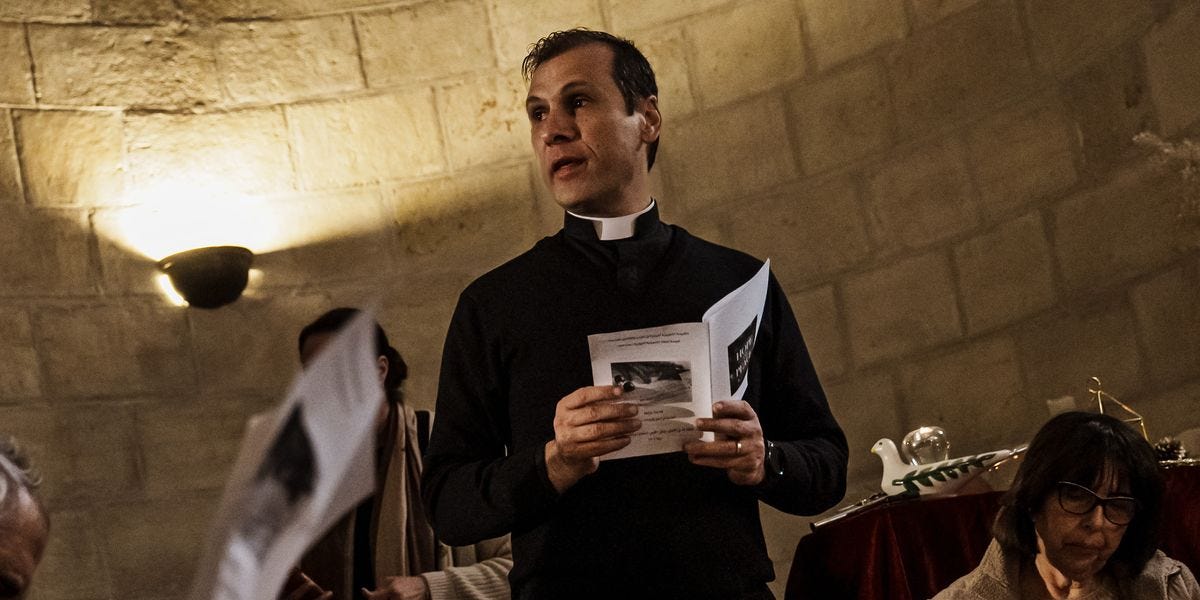
This morning I had a quick breakfast with another Lutheran pastor. This of course is not terribly remarkable in the scheme of things, except for the fact that the breakfast took place in the Kingdom of Jordan, a few feet away from the Dead Sea and my colleague had to cut the breakfast short so he could return home to his family, but he was anxious about all the military check point between here and there.
“How far of a drive is it” I asked.
“If I had a car and could drive straight there, about an hour. But my hope is that it will only take 8 hours.” He accepted that he may in fact not even make it home at all tonight.
Munther Isaac is a Palestinian Lutheran Pastor who lives and serves a church in Beit Sahour, near Bethlehem, the birthplace of Jesus. Christians have been here since the day the Spirit blew through them on the day of Pentecost, so Munther and my other Palestinian Christian friends can get slightly annoyed when well meaning Christians from the West ask “when did your family convert?”.
Um, over 2,000 years ago?
Munther and I are in Jordan right now for a conference – 60 academics and church leaders from 17 countries gathered over the last several days for a consultation on Christian Zionism (belief that Jewish people have a “divine right” to the land here – using a few verses in a 4,000 year old text to have authority over foreign policy and global political realities of today), and the impact of that on Christians in the Middle East; a few days together in a majority Muslim country, across the Dead Sea from the State of Israel to talk about Christian folks’ business: how do the theological beliefs of one group of Christians impact the lives of another group of Christians halfway across the planet?
Many of us grew up with some form of Christian Zionism, I know I did. Perhaps it stemmed from a desire to be faithful to what we have been told, or a desire to help usher in the second coming of Christ (ala The Late Great Planet Earth) so he can come back and destroy the world and take us up to heaven (described this week as science fiction theology), or a desire to assuage the guilt left over from the unspeakable atrocities and genocide of the holocaust.
It will take me time to metabolize what I heard over the last few days. Christian Zionism is widespread, and far reaching in it’s impact, and I am committed to try and maintain the humility it takes as a US citizen and a Christian to consider people like Munther and my friend Mitri Raheb as reliable narrators of the impact on the ground in Palestine.
Palestinian Christians should be listened to by us, their siblings in Christ.
Munther Isaac appeared in ‘Til Kingdom Come (2020), an Israeli documentary about American Christian support for Israel.[20] In the film he explains his view to pastor William Bingham that Christian Zionism contributes to the oppression of Palestinians. After their conversation, Bingham calls Isaac an anti-semite and says that Palestinians do not exist. – Wikipedia
This morning before Munther left to make his way home, he told me a story of a family in his church. For over 150 years they have rightfully owned and inhabited their land outside Bethlehem – a beautiful parcel dotted with olive trees, often hundreds of years old themselves.
Israeli settlers (whose actions are deemed illegal by the UN Security Council) who for years have been attempting to take this family’s land, confronted them at their gate recently, demanding the family leave. The family showed them their ownership documents – dating back from Ottoman rule, then Jordanian rule through to Israeli rule. The settlers angrily lifted up their Bible and said “We have documents too. God gave us this land!”
As I mentioned, I am overwhelmed by all I heard this week and will try and write more later for those who are interested, but for now I wanted to report how one word stood out for me in a particular way during the conference, and that word is: heresy.
19th century theologian Friedrich Schleiermacher defined heresy as, “that which preserves the appearance of Christianity, and yet contradicts its essence“
So perhaps that is the correct word for when, with all the trappings of Christianity behind us, we who seek to justify or maintain our dominance over another group of people use the Bible to prove that our domination`is not actually an abuse of power at the expense of others, but is, indeed, part of “God’s plan”. Because there you have the appearance of Christianity (Bible verses and God-talk) contradicting its essence (love God, and love your neighbor, blessed are the meek, etc…).
Is it not heresy when slavery is established as “God’s will”; when the subordination of women is established as “God’s will”; when discrimination against queer folks is established as “God’s will”, when the taking of one people’s land by another people is established as “God’s will” (hello, manifest destiny), when the executive VP of the National Rifle Association claims that the right to buy an assault rifle is “not bestowed by man, but granted by God”? When a self-justifying message is heretically delivered in God’s name it brings with it a poison that infects the deepest parts of us and when the poison spreads, so does the violence.
When you can say that God Almighty is co-signing on your dominance over another group of God’s children, then every means is justified, right to the end. Every inch of land stolen, every suicide bombing enacted, every act of violence committed, every weapon used, every checkpoint and illegal detention, every child who dies, every tower that falls to the ground – all of it covered under some sort of bullshit spiritual umbrella policy. There are no means that need justifying if we claim God as our patron and guide.
And I imagine God is just about sick to death of it.
As I claimed in my book about sexual shame and religion, we should never be more loyal to a doctrine or an interpretation of a Bible verse than we are to people. If the teachings of the church are harming people we re-think those teachings. Amen?
Speaking up for Palestinians often comes at a cost. Those of you who have done it know. I also know, but am frankly too tired to care right now. So, if based on my recounting of the stories of my friends and colleagues, anyone is moved to called me anti-semitic, please open up the notes app on your phone and feel free to write it there but I will delete your unfounded accusations if you leave them here.
My apologies for the edge in my writing voice. We are all exhausted and as my friend Jodi just texted me, “this month has been two years long already.”
Thank you for reading. I am genuinely sending my love. Please pray this ceasefire holds. And for those waiting on the side of a road right now to return to the rubble of their homes. And for the hostages and prisoners who were released yesterday. I cannot imagine the trauma.
I was out buying eggs when I saw a video of Elon Musk giving a Hitler salute at the inauguration.
In the movies, this stuff is highlighted and separated: punctuation in itself instead of an event that you see in the background of your everyday life. Hannah Arendt talked about “the banality of evil” in the context of Eichmann, one of the core organizers of the Holocaust, telling prosecutors that he was just doing his job. But banality pervades. Sometimes, you need to buy eggs. And sometimes, when you get back in the car and pick up your phone, you get a notification about the richest man in the world signaling his intentions on the world stage.
There has subsequently been much discussion about whether it really was a Nazi salute. It’s insultingly stupid. Even if he truly didn’t intend to throw three successive Sieg Heils, he certainly knows what one is, and most of us have enough self awareness not to accidentally look like a Nazi on national television. He had to know what he was doing. It was a deliberate Nazi salute. The act itself, and the subsequent denials, serve to normalize fascism; just another banal event for you to scroll past on your phone.
Still, these conversations serve a purpose. It’s worth noticing who wants to downplay the Nazism, which, after all, is not “just” manifested in the world’s richest man doing a Hitler salute on national TV. Make no mistake, Musk’s salute was a clear signal, but it’s far from the only one. It’s part of a broader pattern of normalization, visible in policies and actions designed to dismantle rights and embolden oppression.
“Optimistic and celebrating,” Mark Zuckerberg said, on the same night that Musk Sieg Heiled the room three times. “I’m not going to agree with him on everything, but I think he will be incredible for the country in many ways,” Sam Altman said. Microsoft put out a statement saying that “the country has a unique opportunity to pursue […] the foundational ideas set for AI policy during President Trump’s first term”.
And those are public figures in technology. My Facebook feed, and likely yours, is loaded with acquaintances and extended family members who welcome the change; one on mine welcomed “the return to logic and reason”. My LinkedIn feed is worse, with many business leaders echoing Zuckerberg’s “optimistic” language, and some calling the Nazi salute into question.
We’ve tumbled into a deep, dark hole, and, as it turns out, many of us are glad to be there.
It’s just not always clear who.
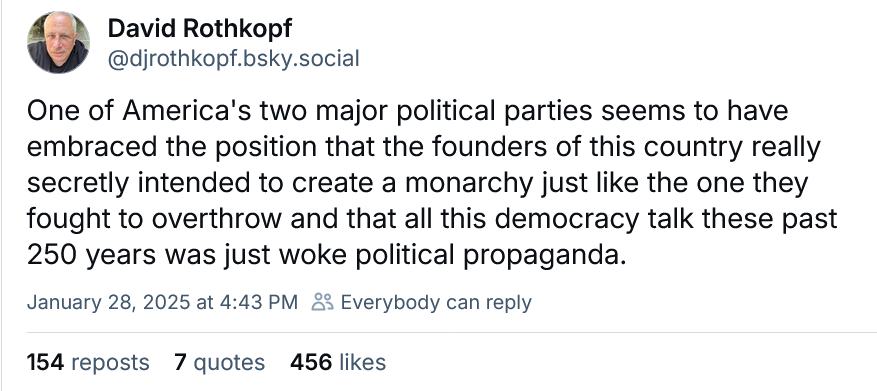
Though dated in some ways, this 1941 Harper’s Magazine article still resonates. The question then was, “Who goes Nazi?” Who is going to be a sympathizer or even a collaborator with a regime that seeks to subjugate, deport, and, as it turned out in the 1940s, kill so many people?
And to be clear, collaboration doesn’t require slapping on an armband and goose-stepping behind a demagogue. Nice people made the best Nazis, as Naomi Shulman wrote eight years ago:
My mother was born in Munich in 1934, and spent her childhood in Nazi Germany surrounded by nice people who refused to make waves. When things got ugly, the people my mother lived alongside chose not to focus on “politics,” instead busying themselves with happier things. They were lovely, kind people who turned their heads as their neighbors were dragged away.
The question now is not a million miles away. Who will support? Who will collaborate? Who will decide that they are “not political” and look away as millions of people are harmed? Who will make excuses for it all? Who secretly welcomes the push for theocracy, for in-groups and out-groups, for “traditional” values that prioritize rigid gender roles, segregation, and oligarchy? Who, in other words, is safe?
Are you “optimistic” about the new regime? Will you be complicit?
When someone needs help — when ICE comes after them, or worse — will you look away, or worse, cheer them on? Or will you be a point of safety for someone who needs it?
And what about when it gets worse? Because, left unchecked, it will.
In the face of rising fascism, what kind of person are you? What kind of person do you want to be?
I’m writing about the intersection of the internet, media, and society. Sign up to my newsletter to receive every post and a weekly digest of the most important stories from around the web.
I like this person and his teachings. Clearly. In truth had he been the one to save me as a 17 yr old beaten boy hiding in his barn I think he may have still sent me to a church school to protect me but he wouldn’t have then expected me to go on and become a priest in their religion. I couldn’t tell my savior who wanted that from me why I rejected his strong demand / offer and instead went into the military was that I was gay. I had accepted it to myself. I was well versed enough in the acts of it due to my abuse to know that along with my internal emotions about guys vs women that the acts themselves did not repulse me. Just the way they were forced on me. Remember I had been forced to please females as well as males since I was 3 years old and I understood my attractions were to males. I was very gay. Instead I think he would have asked me my goals and I would have had to tell him the mystical parts of the religion I had issues with … but the reason I need to withdraw was I was gay. If he responded as he did in my comment to him, then I would have stayed in his congregation. Not believing the magic parts of the religion but the community and acceptance that their god has for those different. Rev. Ed Trevors admits he doesn’t preach facts, he preaches faith, and much of what he stresses is things as a humanest I can fully endorse.
I do wonder with his … more violent past if he had found a badly beaten very thin small 17 year old boy who told him he was being abuse if he would have done more than force the parents … well in their mind’s owner of the boy to let him leave. But again maybe that is my hopes / emotions talking over my understanding of reality. Hugs
I read the free Democracy Docket; it’s good, but not complete. However, on items like this, everyone can see it. The more of this sort of thing we have, the better.
We will fight for people, freedom, and our democracy against any odds
Democracy 2025 is the strategic hub to protect people and their rights should the Trump-Vance administration seek to unlawfully strip away freedoms and prosperity.
We know the playbook, and we’re ready to fight back
The threats are no longer hypothetical. The effort to turn Project 2025 and other dangerous plans into action has begun.
We’ve planned for this moment. In courtrooms and communities across the country, we will use all the tools our Constitution provides to defend our rights and achieve a democracy that works for all people. (snip-Go Visit! Bookmark it, use it, and do what you can.)
January 22, 1953 The Arthur Miller drama, ”The Crucible,” opened on Broadway. It was a parable that reflected the climate of fear that pervaded American society and the politics of its time, witchcraft in the late 17th century, communism in the mid-20th. In both times there existed also the fear of false accusation. From the New York Times review of the Broadway revival in November 2001: “Today, the play is a cautionary tale of astounding immediacy. Its themes include the pathology of rumor, the arrogance of the religiously righteous, the dangers of private panic in the face of public terror, and the individual’s difficulty in acting rationally in the face of mob hysteria.” scene from the original production Read the playwright’s reasons for writing it:
January 22, 1973 Women won control of their reproductive rights when the U.S. Supreme Court ruled in Roe v. Wade that Americans have a constitutional right to privacy, and thus women may terminate a pregnancy before the last 10 weeks. Only during the last trimester, when a fetus can survive outside the womb, would states be permitted to regulate abortion of a healthy pregnancy. Prior to the Court’s ruling that the decision was private and belonged to the pregnant woman, abortion was essentially illegal in all states except New York (as of 1970). About the decision History of New York’s law
January 22, 2001 President George W. Bush signed a memorandum the day after his inauguration reinstating full restrictions on U.S. overseas aid that might go to any program that provided abortions or considered them an option for women. Known as the Mexico City policy, or global gag rule, first signed by President Ronald Reagan, it had been withdrawn by President Bill Clinton as soon as he took office.