He feels entitled to take anything he wants without paying for it. He also believes it is better to just due and ignore anyone else’s rights. He is the great cult leader. Hugs. Scottie
Walters has ordered daily bible lessons for Oklahoma’s public school students in all grades. Several dozen school districts are currently defying that edict.
Earlier this month, local outlets exposed Walters for spending state money to fund a national tour of far-right events to “promote himself on the national stage.”
Walters is widely expected to run for governor. Current governor and fellow Christian nationalist Kevin Stitt is term-limited.
Last month around two dozen GOP state lawmakers signed a letter calling for an impeachment probe into Walters for refusing to disclose his spending.
Walters has hired a raft of far-right figures, including Chaya Rachik and Dennis Prager, to help him “turn students to Jesus.” Raichik is reportedly helping overhaul public school libraries.
Imagine all the good that those millions of dollars could be used for. It could be used to pay Oklahoma’s hardworking teachers or provide additional supplies and resources for its struggling schools.
Instead, it’s being used to promote Walters’ Christian nationalist agenda. https://t.co/DE20Pw1846
Please remember the people who first led Israel in the beginning were also terrorist. Many in the Israeli government in the early decades of Israel’s existence were also labeled terrorist. One person’s terrorist is another person’s avowed wonderful member of government. It has been leaked that members of Israel’s government wants to annex another sovereign country’s land and make it Israel’s property. Just like they have in the West bank, and Gaza. In fact some have talked about trying to take part of Egypt. This is because religious fanatics are running the country now and they claim their god gave them the entire area so they simply have the right to take it. And no one can stop them as long as Biden stays in the mind set of the 1950 / 60s/ 70s, because Biden won’t let anyone else strike Israel back to show them their god did not give them permission to take others lands. Bibi has given the middle finger to every US president and he is desperate to get tRump to win by dragging the US into a war in the Middle East. That is his plan to help tRump and hurt Harris. And they bombed an entire area of occupied apartments in Beirut, which is another war crime they committed. Hugs. Scottie
A marketing director of a well-known Swiss brand, said, “When you look at all of them, they scream Chinese-made watch. None of them is worth the asking price. Those blue screws on the tourbillon cage are a dead giveaway that it was partly made in China. You won’t find blue screws on a tourbillon made in Switzerland. And you can pick up a Chinese tourbillon for $100.”
Trump's "Vastly Overpriced" $100,000 "Swiss Watch" Is Probably Made in China, Experts Say https://t.co/neyxxt5J0U
Milei has cut support for welfare programs, soup kitchens, and other efforts to aid the needy.
Milei’s biggest cheerleader is Elon Musk, who has vowed to bring similar policies as the leader of Trump’s supposed “Department Of Government Efficiency.”
Of note, the planned department’s acronym just happens to be the same as a cryptocurrency often promoted by Musk.
Earlier this year Musk posted the below porn-adjacent image in celebration of Milei.
Not only did Hawley vote against the project, the report below notes that in 2019 Trump defunded all such military projects to divert the money to his border wall.
“We can VERIFY: No, Hawley did not secure $100 million for Fort Leonard Wood's military housing.”
Lying about supporting military families? While even voting AGAINST supporting them? That amounts to nothing more than stolen valor.https://t.co/jWt78m2qd4
The party who has people arrested, charged, and found guilty of voter fraud is the Republican Party. Every accusation from them is a confession of their own actions. They are setting it up to challenge the voters will and overturn the vote in that state. Hugs. Scottie
Hancock said that he learned during the trial that Rittenhouse had allegedly used racial slurs in messages sent to his friends and appeared to be looking for an opportunity to use a weapon. “There was a history of things he was doing prior to Kenosha, specifically patrolling the street for months with guns and borrowing people’s security uniforms, doing whatever he could to try to get into some kind of a gunfight,” Hancock claimed.
‘Patrolling the streets for months’: Kyle Rittenhouse confidants reveal new details the jury never knew https://t.co/zDg2esDw0t
The party maybe have evolved into the kind of anti-migrant, anti-Islam populist force that has taken hold across much of Europe, but it began as a political refuge for former Nazis. Not only has the FPÖ not disavowed that past, it embraces it — at least in private — with the leading party figures regularly getting to trouble for paying quiet tribute to their Nazi forebears.
Abrasive and provocative, far-right leader Herbert Kickl has one of the lowest approval ratings among Austria's top politicians, yet he is the frontrunner in Sunday’s parliamentary election, which has at times felt like a referendum on him https://t.co/NAPLJKizYypic.twitter.com/IUoS0CaQoV
As I often remind the haters, almost all of the children in the foster care and adoption system are there due to abuse and abandonment by the heterosexual parents.
Texas Attorney General Ken Paxton is suing the federal government over its requirement that states provide LGBTQ+ affirming placement for foster care youth. https://t.co/Al87Q9y6L7
Over 10,000 books have been banned across the entire United States over the past school year. The trend has seen a particularly strong increase in states with a strong Republican presence, according to the free-speech nonprofit PEN America.
This is a major increase compared to the 2022-2023 year, which saw a total of 3,362 books banned across the country.
The books were accused of having “obscene” material. One of them was a children’s picture book about gay penguins.
Florida and Iowa are leading in the total number of bans, with over 8,000 recorded between the two states. This number is largely due to the increasingly strict laws on book bans.
The banned books include Death on the Nile by Agatha Christie; the famous work on anti-Black racism Black Reconstruction in America, 1860-1880 by W.E.B. DuBois; Alex Haley’s book about the lived experience of slaves, Roots: The Saga of an American Family; and James Baldwin’s autobiography Go Tell It On the Mountain.
Iowa’s bans stem from Senate File 496, a law restricting LGBTQ+ books from grade seven and below along with total bans on books deemed to contain sexual content. Florida’s House Bill 1069, backed by Gov. Ron DeSantis (R), resulted in a similar ban, albeit a much more strict one.
PEN America cites other laws from Utah, Tennessee, and South Carolina as contributing to these increase in banned books as well.
Individual school districts have also had a hand in banning many books. The Elkhorn Area School District in Wisconsin, for example, banned over 300 books over a several month period.
PEN America says that the types of books banned “includes books featuring romance, books about women’s sexual experiences, and books about rape or sexual abuse as well as continued attacks on books with LGBTQ+ characters or themes, or books about race or racism and featuring characters of color.”
The organization also emphasizes that these numbers are an undercount of the actual amount of banned books since many book bans go unreported. Additionally, the organization says schools have also implemented “soft” book bans, including policies that cause greater hesitancy to check out books from libraries, restrictions on who can check out restricted books out, book fair cancellations, and the removal of classroom collections.
Six major book publishers are currently suing the Floridian government after hundreds of their books were pulled from libraries, cutting severely into their profits and discriminating against their authors.
A Florida school district recently agreed to re-shelve 36 books to settle a lawsuit concerning multiple banned books, including And Tango Makes Three, an often banned children’s book about a gay penguin couple raising a chick.
Iowa’s book ban was recently brought back into law when a permanent injunction against the ban was overturned by an appeals court.
Subscribe to the LGBTQ Nationnewsletter and be the first to know about the latest headlines shaping LGBTQ+ communities worldwide.
Sep 23, 2024 Orion Rummler Originally published by The 19th
In 2020, the Supreme Court found that gay and transgender workers are protected from workplace discrimination in the landmark case Bostock v. Clayton County. Despite those federal protections, LGBTQ+ people across the country — especially transgender and nonbinary people — continue to face rampant discrimination at work and don’t feel safe being out, according to research from the Williams Institute at the University of California, Los Angeles School of Law.
In a 2023 study of 1,902 LGBTQ+ adults in the workforce, released in August, 17 percent said they had experienced discrimination or harassment on the job in the past year. Trans and nonbinary employees were more than twice as likely as cisgender queer employees to face discrimination and harassment: Twenty-two percent of trans and nonbinary people experienced discrimination in the past year, and 26 percent experienced harassment.
“You would hope things have gotten better,” said Brad Sears, founding executive director of the Williams Institute and coauthor of the report.
Sears believes the high rate of recent discrimination is an indication that change has been slow after Bostock, even after the Biden administration implemented additional nondiscrimination policies. Shortly after Biden was inaugurated in 2021, he issued an executive order based on Bostock that mandated the protection of gay and transgender Americans in the workplace, as well as in schools and doctor’s offices. And as of this spring, extra protections were put in place to guard against employers who consistently misgender employees or deny them access to sex-segregated spaces.
Still, the study found that many LGBTQ+ Americans are not out in the workplace to avoid facing discrimination and harassment. Nearly half of LGBTQ+ employees said that they are not open about their identity to their current supervisor, and one-fifth are not out to any of their coworkers. Staying in the closet actually did protect them: LGBTQ+ employees who were out to at least a few coworkers, or just their supervisor, were three times as likely to report discrimination as employees who were not out.
“A lot of people, even if they are out, they’re kind of downplaying their identities in the workplace,” Sears said. “Maybe they use a different voice or different mannerisms at work, or they don’t dress exactly how they would otherwise dress when they’re not at work, or they use a bathroom that they would prefer not to be using at work.”
To avoid discrimination, transgender and nonbinary people are significantly more likely to hide their identities than cisgender queer people. In a new breakout analysis of the Williams Institute’s survey, the experiences of nonbinary people are found to be especially fraught.
Nonbinary people in the study described being ostracized and subjected to violence, harassment or threatsat work due to their physical appearance either not being “feminine” enough or “masculine” enough. Their gender expression made them a target and was used as a justification for their treatment by their bosses, coworkers and customers. Frequently, nonbinary people said they were passed over for raises and promotions, called slurs, and forced to work alone.
The nonbinary people surveyed were largely young, urban, and racially and ethnically diverse. To the survey authors, such data is a call for employers to take action — especially If they want to retain young employees.
About 87 percent of nonbinary adults in the workforce are under 35 years old, compared with 71 percent of transgender adults and 51 percent of cisgender queer adults, according to the study. That research aligns with other findings from KFF that Americans under 35 are more likely to identify as nonbinary than older Americans, and research from the Pew Research Center that found adults under 30 are more likely than older adults to be out as trans or nonbinary.
About 3 in 5 nonbinary people have experienced discrimination or harassment at work at some point in their lives, like being fired, not hired, not promoted, or verbally, sexually or physically harassed.
About 1 in 5 nonbinary people reported physical harassment at work because of their sexual orientation or gender identity, with some survey respondents reporting being “assaulted,” “attacked” and “strangled.”
For some, unfair treatment looked like having their hours reduced, being isolated from other employees or customers, or being excluded from company events or socializing.
“Oftentimes, I was passed up for a promotion because I wasn’t ‘manly’ enough, and they doubted my ability to lead a team,” a Latinx nonbinary person from California said in the survey. A Latinx nonbinary participant from Colorado shared: “A co-worker strangled me at a counter and said he was trying to ‘give a girl a massage.’” In Connecticut, a Black nonbinary person said they heard their manager talking “disparagingly” about them to the rest of their bosses because of their gender expression.
One in 4 nonbinary employees said they are currently experiencing adverse treatment at their job because of their LGBTQ+ identity. For many nonbinary people, the worst experiences of discrimination and harassment that they face at work are linked to their multiple marginalized identities. In particular, they were targeted for their disability or being bisexual in addition to being nonbinary.
This research shows that company-level policies, as well as state and federal nondiscrimination regulations, need to be specific so that they protect nonbinary employees, Sears said.
The Williams Institute plans to release more breakout analyses from its survey, including reports on the experiences of transgender, Black, Latinx and Asian-American employees. Breaking down the unique experiences of each demographic is key to understanding and addressing the issues that they’re facing at work, Sears said — for example, nonbinary people face rigid and gendered expectations at work, while bisexual women face high rates of sexual harassment.
“LGBTQ+ people are not monolithic. They’re different, they have intersecting identities … and those are leading to differences that are important in the workplace,” he said.
This was a school damn it. Fuck Israel all to hell. I am done with the Israeli government and the nation. Look at the young kids trying to help, they should have been learning in that school, not picking up the pieces and looking for dead bodies of friends. But Israel doesn’t want schools in Gaza, at least not Palestinian schools. If the world has not figured out yet that this is an attempt at genocide, to kill or drive an entire people from the land so Israeli Jews can take it over. I have posted of people camped out ready to move it. There is no justification for this slaughter. Look they just managed to pull off a covert operation in Lebanon that was sneaky and also killed indiscriminately innocent by standers and killed at least two kids, but Israel doesn’t care as they are not Jewish kids or people. But the point was they did not need to drop missiles and 2000 pound bombs on the people who live there to do the job. In Gaza the people have no way to fight back, most are living in tents that Israel hits with large power bombs. Hugs. Scottie
An Israeli strike on a school in northern Gaza on Saturday killed at least 22 people, according to the Gaza Health Ministry, while the Israeli army said that it targeted a Hamas command center in what used to be a school. (Production by Wafaa Shurafa) Read more here: http://apne.ws/ClCkCeK
I’ve been thinking this week about some of the absolutely stupid garbage conservative, culture-war-obsessed MAGA people believe, or claim to believe, for the purposes of demonizing people and making people hate the same people they hate. The most glaring current example is obviously Donald Trump, J.D. Vance and their media mouthpieces attacking innocent Haitian immigrants in Springfield, Ohio, with lies about them stealing and eating family pets.
But there are a bunch more.
There are the abortion lies Trump and Republicans love to tell — which many of them truly believe — about how Democrats love to let babies be born, at which point they lay them on the table and decide whether or not they’re going to execute them. Trump is sure it’s happening, because he saw on TV that the previous governor of Virginia (or is it West Virginia? Trump is never sure) totally said that, and if it’s on TV, it’s true.
Every election cycle lately, there’s a crop of the country’s stupidest Republican politicians babbling out loud that they have a friend whose pastor told them at the local elementary school there are children who identify as “furries” and demand to poop in litterboxes. It’s amazing watching them tell that one with a straight face.
Of course, Republican lies, blood libels and conspiracy theories often have a tiny element of 0.2 percent truth in them, something they can use to insist that the ridiculously stupid thing they say is happening really is happening. In the Virginia abortion story Trump tells, the nugget of truth was former Governor Ralph Northam talking about palliative care in grievously tragic situations where a newborn infant has no chance of surviving.
There actually have been litterboxes in classrooms. It’s so that if there’s a mass shooter in the school and classrooms are locked down for hours, poor little kids who can’t hold it might not have to be humiliated by wetting their pants.
(Did I ever mention that white conservative MAGA Republican politicians, pundits and influencers are extremely sick, evil liars?)
And then there’s the right-wing Christian Republican war on LGBTQ+ kids.
This week, Fox News tweeted a video featuring failed swimmer/anti-trans hatemonger Riley Gaines — remember her from my post about the Paris Olympics? — on “Fox & Friends,” spreading some the vile lies she so loves to tell. The clip caught my attention and pissed me the fuck off, and that’s why I’m talking about that this week instead of Mark Robinson. (I’ll get to him in due time, I’m sure.)
Here’s the video: (embedded on the page.)
Fox explained in its tweet that Gaines was “react[ing] to a California judge banning a school district from imposing a policy that would have required teachers and staff to notify parents if their student declares they want to change their name or pronouns.”
In the video Gaines bellyaches that such rulings are the government saying “they know your children better than you do. They don’t believe that these are your kids. They believe that these are the government’s kids.”
To which I reply, oh, go fuck yourself, Elon. Same message goes for Riley Gaines.
I want to talk about the California law in question and what it really does, and how that ties into how Donald Trump and Republicans are demonizing LGBTQ+ kids as part of their hate campaign against America, but I also want to tell y’all a story, so I’m going to try to do both.
Storytime!
Two nights before Joe Biden dropped out of the presidential race, I was standing in line in the wee hours in the lobby of a prominent hotel in downtown Atlanta, with a bunch of fellow weary travelers. It was Friday, the first day of the CrowdStrike update that borked the entire global internet, and all our Delta flights had been canceled.
I struck up a conversation with the guy in front of me, a handsome young guy from El Paso. His wife and small children were somewhere in the expansive lobby, exhausted, while Dad tried to get hotel rooms sorted. They were coming from Disney. I was on my way back from the Republican convention in Milwaukee. We made small talk.
But we were in line for over an hour, so the conversation actually got surprisingly deep. He was a second-generation immigrant from Mexico, with parents who only speak Spanish. We talked about what life is really like along the border these days for people who actually literally live right on it. He described himself as a conservative, but not extreme, and not super-political. He freely offered that he couldn’t stand Donald Trump, but probably would vote for him, not that he was enthused about it.
But one thing that was bothering him, big time, was this law that had just been signed by Governor Gavin Newsom in California, to protect gay and trans kids from rogue school personnel who would out them to their parents without their consent. I was a bit surprised this Texas guy, who again didn’t seem that political, was so in tune with something California’s governor had done five days prior. But there we were.
He made extra-clear from the beginning that he doesn’t consider himself anti-gay or anti-trans. But it was immediately clear to me that this very kind-seeming guy was getting all his information on this issue filtered through the Christian nationalist bullshit machine of right-wing media.
The California law was passed directly in response to school districts in red areas of the state enacting policiesforcing schools to notify parents if a child asked to be referred to with a different name or pronouns. The legislature acted to protect those kids.
But to this dad, it sounded like California was trying to put one over on parents, to usurp their parental role, stealing and indoctrinating their kids. (Hey, Riley Gaines! How did your shitty, vile hate get in this nice man’s brain?)
It was 1:00 a.m., so I wasn’t about to start bickering, and also y’all would be amazed how gentle and diplomatic I am in person. But I did try to get on this dad’s side and maybe help him see it from a different perspective. He had gathered that I was gay, or maybe I told him.
“You obviously love your kids,” I said, “and you wouldn’t reject them for any reason, no way, no how.” He agreed.
“That law isn’t about hiding things from good, loving parents like you,” I told him. “It’s about protecting kids who don’t have parents like you, kids who are frightened of what would happen if their parents knew who they were, kids who don’t feel safe, kids who come from of abusive homes.” It could be the religious kind of abuse, and/or the non-religious kind of abuse.
He understood what I was talking about and several times reiterated how very not-anti-gay and not-anti-trans he was.
There have been memes going around lately along the lines of, if your child is gay or trans and they don’t want you to know, there’s probably a good reason for that, and likely it’s you. The problem is you.
I was trying to help this dad see, though, that he was not the problem. But he was still uncomfortable with it. He felt he would want the school to tell him. He grudgingly agreed that if one of his kids thought they were trans, he would absolutely want to make sure they had the best medical care and guidance they could get, that he would want to do whatever was best for his child.
But he wasn’t convinced this law wasn’t out to get people like him. You don’t fix the constant lava flow of conservative Christian right-wing fascist propaganda and lies in one sleepy night when all anybody wants to do is get a fucking hotel room and then fly the hell out of Atlanta the next day.
That dad is a good example of why Trump and Vance and Fox News and the rest of the Republican machinery are so committed to demonizing all LGBTQ+ people, but especially trans people, this election season.
This is a strategy, and it works on a whole bunch of people.
‘Think about it, your kid goes to school and comes home a few days later with an operation.’
(Trump also memorably screamed at the debate that Kamala Harris “wants to do transgender operations on illegal aliens that are in prison!” He gets confused about his conspiracy theories sometimes.)
Reality check: there is no school nurse in the country doling out top surgeries or bottom surgeries, either for trans-identifying kids, or for kids who come in after they skin their knees on the playground. (That would be real fucked up!)
Schools aren’t going gender-affirmation surgeries and kids aren’t demanding litterboxes because they say they’re “furries.” The baby isn’t being born so they can put it on the table and decide to execute it, and Haitians in Springfield aren’t eating Whiskers. Not even the best Obamacare money can buy has a plan where kids can walk in to the school nurse, without their parents’ consent, sign up for surgery, and then reappear at their parents’ house days later with a brand new set of genitals.
But Moms For Liberty got so mad at CNN for debunking Trump’s dementia lies. It was very important to them that Trump be out there demonizing transgender people, in general, regardless of whether Trump’s babbling about children getting on the school bus and coming back “a few days later with an operation” was literally true.
They angrily sent CNN a bunch of examples of lawsuits filed in various states, all focused on “parental rights” and, in particular, schools letting kids transition socially — as in, come out as trans or non-binary, etc. — without running off to tattle to their parents. Letting kids use different pronouns if that’s what they’re feeling is right for them. Etc.
Of course, because it’s Moms For Liberty, their missive to CNN — and the pissy PR email they sent to tell everybody about it — was full of hallucinatory conspiracy theory babblings about schools “secret[ly] social-transitioning … minor children” and, quoting one lawsuit from Massachusetts, “encourag[ing] minor children to hide key components of who they are from their parents, while actively encouraging children to disobey and ignore their parents’ wishes, and while actively deceiving parents and hiding information about their own children from them.” Moms For Liberty co-founder Tiffany Justice even suggested that schools are “legally allowed to assign a new pronoun without parental knowledge.”
As if it’s the schools initiating these actions. As if schools are handing out pronouns with seating charts. (“Aw fuck, bro! Did you get she/her? Bro that sucks!” — common elementary school conversation now.)
They also straight up lied and said Minnesota allows gender-affirmation surgeries for minors without parental consent. It does not.
(Again I ask, on what fuckin’ insurance plan? Have I mentioned lately that these people are delusional weirdos?)
But as I said, pretty much everything Moms For Liberty was mad about, even when they were totally misrepresenting things, was social transitioning. Because that’s the slippery slope to hormones and surgery, and they’re not telling their parents, AIIIIYEEEEEEEE!
So they were fine with Donald Trump straight-up lying and saying schools are doing transgender surgeries on kids, because sometimes you have to make up really fucked up lies to con people into hating the same people you hate. Isn’t that right, Republicans?
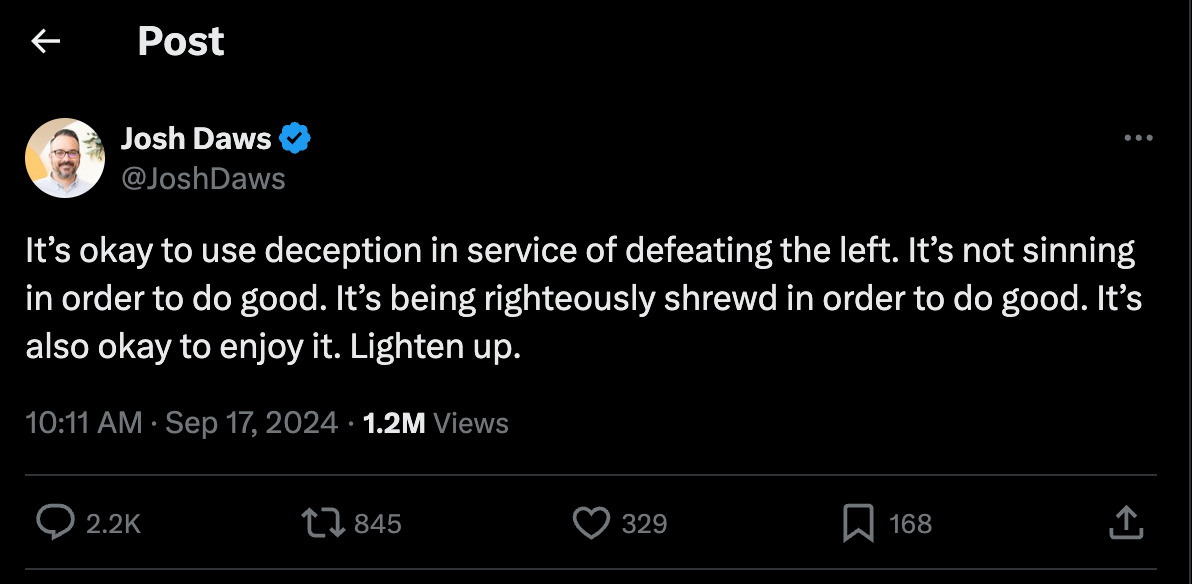
What did J.D. Vance just say about his and Trump’s blood libel lies about Haitian immigrants? “If I have to create stories so that the American media actually pays attention to the suffering of the American people, then that’s what I’m going to do.” And by “suffering of the American people,” he meant things he’s a total Nazi about.
Lying for Jesus! It’s been around a long time, yet it’s never done by people who actually reflect the character of Jesus in any way, shape or form.
(One of these days I’m going to write y’all a full Bible study on Matthew 7:23, AKA Jesus’s personal candygram to conservative white Christians.)
MAGA Republicans are absolutely counting on conning enough people with these absurd, demonizing lies and libels, about trans people and immigrants and abortion and anything else they can think of that deserves a good Two Minutes Hate. In Texas, it was reported this week that congressional Republicans are spending millions targeting Democrats with anti-transgender ads.
It’s literally all they have to run on. And they know it works, at least on some people.
In summary and in conclusion, and back to what pissed me off so much in the first place.
Riley Gaines griped to “Fox & Friends” that “[t]hey don’t believe that these are your kids. They believe that these are the government’s kids.”
We’ve been over this before, how these MAGA Christian fascist creeps (and their ideological compatriots) think they literally own their children. They believe they own them until they transfer ownership of their daughters to their husbands, or in the case of their sons, when they become wife-owning patriarchs in their own right.
It offends them when it’s pointed out that actually, their kids are their own people, and they own themselves.
Now, when the kids are minors, sure, their parents have custody and responsibility for them, and the schools have a part to play in that, both as partners with the parents and just in general, in preparing them to be respectable, functioning adults. Schools have a responsibility to let parents know when their kids’ grades are slipping; if they’re getting in fights, or getting bullied; if they’re acting out in school; if they’re doing something illegal, or dangerous, to themselves or others. And so forth.
This shouldn’t have to be said, but coming out of the closet — as gay, as bi, or as somewhere on the gender spectrum other than that which they were assigned at birth — DOES NOT FALL UNDER ANY REASONABLE CATEGORY OF “MISBEHAVIOR” FOR WHICH A SCHOOL WOULD NEED TO NOTIFY PARENTS.
Being LGBTQ+ is not dangerous, it’s not immoral, and it’s not “I found meth in your kid’s backpack.” It’s simply a thing. If a child is excelling and getting along well socially and in grade seven they decide to try on some new pronouns, that doesn’t warrant a phone call home.
It doesn’t warrant tattling.
But that’s what these evil fascist creeps want. They want schools to be their abusive morality Gestapo when they’re not around, to shame and punish their children in their absence, and to call a parent-teacher conference if they suspect a child has come down with the Woke Mind Virus.
By the way, schools do have another responsibility when it comes to kids, and that’s to spot abuse and neglect, and to intervene for the welfare of the child if they suspect the child is in danger at home.
And that — dearly beloved MAGA fascist assholes — is the category under which this falls.
If a kid comes out as gay, or starts socially transitioning, but they say “Hey, my parents don’t know, and I need them not to,” then there’s a reason that kid — the actual owner of their own body, mind and soul — is saying that. Maybe they’re just not ready! Maybe they’re getting their sea legs with their friends before they go home to their parents. Maybe they’ll tell them next year.
But it’s also possible that they don’t feel safe with their parents, and fear their reaction. It might be a reasonable fear. Fundamentalist Christian homes are notoriously abusive to LGBTQ+ children, oftentimes disowning them or kicking them out, oftentimes subjecting them to physical, psychological and religious abuse. There’s a reason states all over the country have been passing bans on fully discredited, fully ineffective and uniformly harmful “ex-gay” and “ex-trans” religious torture for minors for over a decade now. (Congratulations, Kentucky! You have a good governor.)
They might be scared their parents will ship them off to “pray away the gay” or “pray away the trans.”
Laws like the one in California protect those kids.
The parents bitching about this and filing lawsuits and publicly demonizing LGBTQ+ people — including their own children — they are demonstrating precisely why these laws need to exist.
That’s what this is about.
It’s not about hiding things from good and loving parents. It’s about protecting kids from parents who are monsters.
In the next 46 days, you might encounter people who say they can’t vote for Kamala Harris and against Donald Trump for truly stupid reasons. This is one of them. (And the abortion thing and the Haitian immgirants thing and the litterboxes and oh God, so many more.)
Tell them their reasons are stupid reasons.
How loving and diplomatic you decide to be about it, that’s up to your own best judgment.
This is one hypocritcal full of hate person. The web page linked to has many videos and animations. Hugs. Scottie
Mark Robinson, the controversial and socially conservative Republican nominee for governor of North Carolina, made a series of inflammatory comments on a pornography website’s message board more than a decade ago, in which he referred to himself as a “black NAZI!” and expressed support for reinstating slavery, a CNN KFile investigation found.
Despite a recent history of anti-transgender rhetoric, Robinson said he enjoyed watching transgender pornography, a review of archived messages found in which he also referred to himself as a “perv.”
The comments, which Robinson denies making, predate his entry into politics and current stint as North Carolina’s lieutenant governor. They were made under a username that CNN was able to identify as Robinson by matching a litany of biographical details and a shared email address between the two.
Many of Robinson’s comments were gratuitously sexual and lewd in nature. They were made between 2008 and 2012 on “Nude Africa,” a pornographic website that includes a message board. The comments were made under the username minisoldr, a moniker Robinson used frequently online.
Robinson listed his full name on his profile for Nude Africa, as well as an email address he used on numerous websites across the internet for decades.
CNN is reporting only a small portion of Robinson’s comments on the website given their graphic nature.
Many of Robinson’s comments on Nude Africa stand in contrast to his public stances on issues such as abortion and transgender rights.
Publicly, Robinson has fiercely argued that people should use bathrooms only that correspond to the gender they were assigned at birth. He’s also said transgender women should be arrested for using women’s restrooms.
“If you’re a man on Friday night, and all the sudden Saturday, you feel like a woman, and you want to go in the women’s bathroom in the mall, you will be arrested, or whatever we gotta do to you,” Robinson said at a campaign rally in February 2024. “We’re going to protect our women.”
Yet privately under the username minisoldr on Nude Africa, Robinson graphically described his own sexual arousal as an adult from the memory of secretly “peeping” on women in public gym showers as a 14-year-old. Robinson recounted the story as a memory he said he still fantasized about.
“I came to a spot that was a dead end but had two big vent covers over it! It just so happened it overlooked the showers! I sat there for about an hour and watched as several girls came in and showered,” Robinson wrote on Nude Africa.
CNN is not publishing the graphic sexual details of Robinson’s story.
“I went peeping again the next morning,” Robinson wrote. “but after that I went back the ladder was locked! So those two times where [sic] the only times I got to do it! Ahhhhh memories!!!!”
In other comments on Nude Africa, Robinson discussed his affinity for transgender pornography.
“I like watching tranny on girl porn! That’s f*cking hot! It takes the man out while leaving the man in!” Robinson wrote. “And yeah I’m a ‘perv’ too!”
In an interview with CNN on Thursday, Robinson repeatedly denied that he made the comments on Nude Africa.
“This is not us. These are not our words. And this is not anything that is characteristic of me,” Robinson said. Presented with the litany of evidence connecting him with the minisoldr user name on Nude Africa, Robinson said, “I’m not going to get into the minutia of how somebody manufactured this, these salacious tabloid lies.”
CNN first reached out to Robinson Tuesday morning with evidence connecting him to the comments on Nude Africa. It took his campaign two days to respond and issue a denial.
During his interview with CNN, Robinson repeatedly said the issues that faced North Carolinians were more important than what he called “tabloid trash,” and he steered the conversation toward attacking his opponent in the race, Democrat Josh Stein, the state’s attorney general.
“We are not getting out of this race. There are people who are counting on us to win this race,” Robinson said.
A history of controversial statements
Campaigning for lieutenant governor in 2020, Robinson advocated for a complete abortion ban without exceptions. He later expressed regret in 2022 for paying for his now-wife to have an abortion in the 1980s.
Video Ad Feedback
Rising GOP star running for NC governor mocked Parkland shooting survivors
Now campaigning for governor, he says he supports a so-called “heartbeat” bill that would ban abortion when a heartbeat is detected – approximately six weeks – with exceptions for rape, incest and health of the mother.
But writing as minisoldr on Nude Africa in December 2010, Robinson said he did not care about a celebrity having an abortion.
“I don’t care. I just wanna see the sex tape!” Robinson wrote.
In another thread, commenters considered whether to believe the story of a woman who said she was raped by her taxi driver while intoxicated. In response, Robinson wrote, “and the moral of this story….. Don’t f**k a white b*tch!”
Robinson, who would become North Carolina’s first Black governor if elected, also repeatedly maligned civil rights leader Martin Luther King Jr., attacking him in such intense terms that a user accused him of being a white supremacist.
“Get that f*cking commie bastard off the National Mall!,” Robinson wrote about the dedication of the memorial to King in Washington, DC, by then-President Barack Obama.
“I’m not in the KKK. They don’t let blacks join. If I was in the KKK I would have called him Martin Lucifer Koon!” Robinson responded.
CNN’s reporting on Robinson’s comments comes a few weeks after The Assembly, a North Carolina digital publication, reported that Robinson frequented local video pornography shops in the 1990s and 2000s. The story cited six people who interacted and saw him frequent the stores in Greensboro, North Carolina. A spokesperson for Robinson called the story false and a “complete fiction.”
Despite earning the full endorsement of former President Donald Trump and the North Carolina Republican Party, Robinson faces an uphill battle in the race for governor against Stein.
On the Nude Africa website in both comments and his profile, minisoldr offered numerous details that align precisely with Robinson’s personal history.
In his profile, minisoldr listed his full name as “mark robinson” and disclosed a private email address Robinson used elsewhere online. In 2012, a user responded to a comment by calling minisoldr “Mark.”
Minisoldr mentioned in 2008 being married for 18 years, which corresponds with Robinson’s marriage to Yolanda Hill in 1990. In 2011, minisoldr wrote he had been married 21 years. Minisoldr wrote in a 2011 post that he lived in Greensboro, North Carolina, the same town where Robinson lived at the time and currently lives.
In a post in 2012, minisoldr said he served in the Army in the 1980s, during the same time period as Robinson. In his sexually graphic comments detailing watching women in the showers in 2011, minisoldr wrote that his mother worked at an Historically Black College and University (HBCU). Robinson’s mother worked as a custodian at North Carolina A&T State University, an HBCU located in Greensboro.
Both minisoldr and Robinson often posted about the same topics online, including reviews for remote-controlled helicopters, their attraction to specific celebrities and their favorite “Twilight Zone” episode.
The email address associated with minisoldr on Nude Africa was also used by Robinson elsewhere online and social media. On the commenting platform Disqus, a user who joined in April 2011 features Mark Robinson’s photo under the username minisoldr.
Usernames and email addresses from Disqus were publicly leaked online in 2017, according to the company. CNN confirmed that Robinson’s username minisoldr on Disqus shared the same email address as the one used on Nude Africa.
Robinson’s Disqus page is also linked to the Black social networking site Black Planet. The Web Archive shows a user named “minisoldr” described themselves as 40 years old in February 2009 – the same age as Robinson at the time – and living in Greensboro, North Carolina – Robinson’s hometown.
A username often used by Robinson
Robinson has frequently used the username “minisoldr” elsewhere on the internet. On X, the platform formerly known as Twitter, Robinson once used the minisoldr username, according to a screenshot he shared on Facebook in 2018 and data in Robinson’s old tweets.
A YouTube playlist for a user named “minisoldr” features exclusively videos of Robinson. On Pinterest, a user “minisoldr” lists his name as “Mark Robinson.”
The “minisoldr” username has also posted reviews of products and places Robinson has also publicly recommended. On Amazon, a user named “minisoldr” reviewed products frequently shared by Robinson on Facebook, including remote-controlled helicopters. And the same email address and username used on Nude Africa also left reviews on Google for two local businesses Robinson later posted on Facebook that he used.
Robinson’s unique choice of language further links him to the “minisoldr” alias on the pornographic forums. Uncommon phrases such as “gag a maggot,” “dunder head,” “I don’t give a frogs a**,” and “I don’t give two shakes of it” were used both by minisoldr on Nude Africa and by Robinson on his personal Facebook page.
Robinson as minisoldr ‘Slavery is not bad’
In the pornographic forums, Robinson revealed his unvarnished thoughts on issues such as race, gender and abortion.
Writing in a forum discussing Black Republicans in October 2010, Robinson stated unprovoked: “I’m a black NAZI!”
That same month, Robinson wrote in another post that he supported the return of slavery.
“Slavery is not bad. Some people need to be slaves. I wish they would bring it (slavery) back. I would certainly buy a few,” he wrote.
In March 2012, Robinson wrote that he preferred the former leader of Nazi Germany Adolf Hitler over the leadership in Washington during the administration of Barack Obama.
“I’d take Hitler over any of the sh*t that’s in Washington right now!” he wrote.
Robinson’s comments on Nude Africa often frequently contained derogatory and racial slurs directed at Black, Jewish and Muslim people.
In a series of seven posts in October 2011, Robinson disparaged Martin Luther King in such intense terms, calling him a “commie bastard,” “worse than a maggot,” a “ho f**king, phony,” and a “huckster,” that a user in the thread accused him of being in the KKK. Robinson responded by directing a slur at King.
In October 2010, Robinson used the antisemitic slur “hebe” when discussing how he liked the show “Good Times” developed by Norman Lear, saying “the show itself was a bunch of heb [sic] written liberal bullshit!”
While discussing the Taliban, he referred to Muslims as “little rag-headed bastards” and said that “if Muslims took over liberals would be the 1st ones to be beheaded!”
Robinson also used homophobic slurs frequently, calling other users f*gs.
In a largely positive forum discussion featuring a photo of two men kissing after one returned from a military deployment, Robinson wrote the sole negative comment.
“That’s sum ole sick a** f*ggot bullsh*t!” he wrote.
(I clicked on a Springfield New-Sun article the other day; they let you read everything if you start an account or register or whatever; email address, user name, and a password. Anyway, it’s a very polite paper, and the work, so far as I’ve seen, is exemplary. If you click through to the page, take a look at their headlines to see how things are going in Springfield, thanks to the Republican ticket. Some of it is good news for residents; there is balance.)
Clark State is investigating after officials found a suspicious package this morning on the College’s Springfield campus.
The college’s security found the package around 8 a.m. on the Leffel Lane campus and immediately contacted police, according to a statement on the college’s website.
“Police responded quickly and determined that the package was not of concern and no threat exists,” the statement said.
Administrators and police searched the buildings and campus before the Springfield Police Division said the campus was safe at 11:12 a.m.
Clark State closed all of its campuses this week and moved to remote classes through Friday as a result of two email threats of a potential bombing and shooting from last weekend.
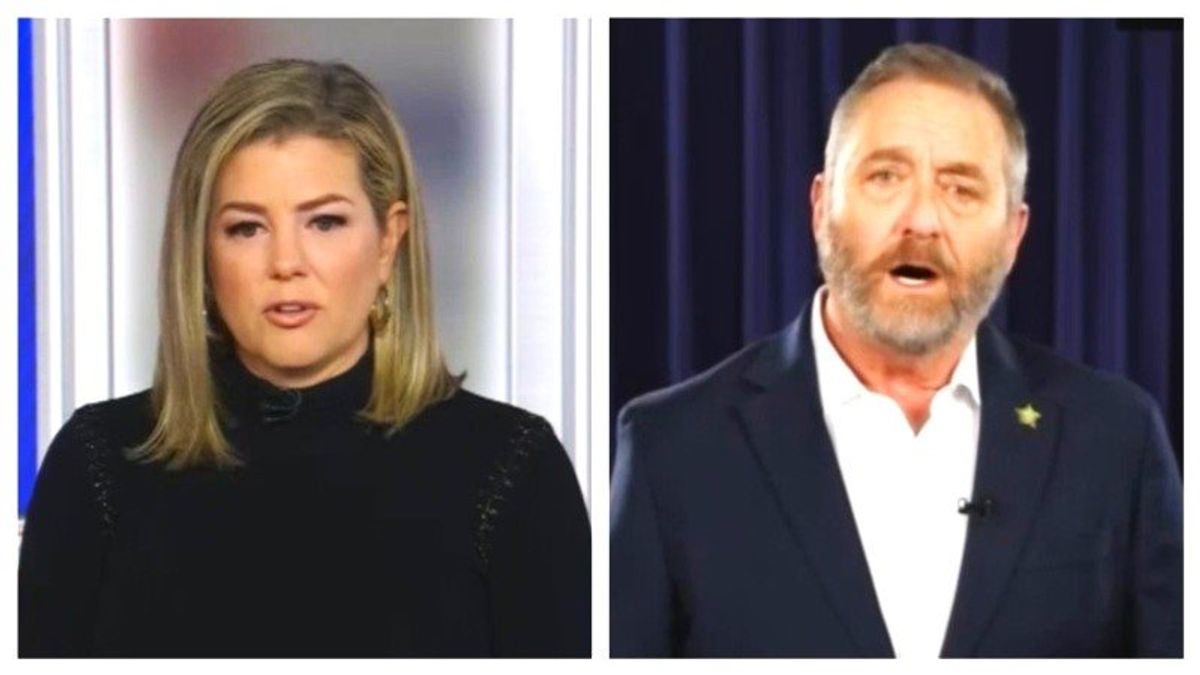
Brianna Keilar interviews Ohio Attorney General Dave Yost (Screen cap via CNN
Republican Ohio Attorney General Dave Yost grew testy on Monday when CNN host Brianna Keilar fact-checked him for promoting false claims about Haitian immigrants.
During an interview about bomb threats that have been leveled against schools in Springfield, Ohio in the wake of former President Donald Trump’s attacks on the community there, Keilar asked Yost about his own role in helping Trump advance false claims about immigrants kidnapping and eating residents’ pets.
Keilar pointed out that Springfield Mayor Rob Rue has said that local police have investigated and found no evidence to back up claims that Haitian immigrants in the city are eating either pets or local wildlife.
“Do you think the mayor is lying?” she asked him.
Yost dodged the question and said that most of his social media posts about Haitian immigrants in Springfield have been on the “real impacts” they’ve had rather than the fictional pet-eating impacts.
“My tweet was about the media’s disregard for citizen reports, citizen interaction with their government,” he said.
Keilar then pressed him for more information about these “citizen reports” and Yost said he was referring to “several videotaped comments that were made by citizens regarding a variety of things going on in Springfield.”
Yost added that these comments from citizens “are not enough to make a case” against Haitian immigrants, and he then pivoted to saying that too many children attending school in Springfield don’t speak English.
Keilar then asked Yost why he and other Republicans don’t simply talk about the strain on local resources that migrant communities are placing on public services instead of telling lurid and false tales about pet eating, especially “when you are supposed to be a very serious law enforcement individual.”
Yost took exception to this statement.
“Implying, of course, that you think I’m not [serious],” he replied indignantly.
The former president’s debunked comments that Haitian immigrants are eating household pets in Springfield, Ohio, is just the latest in a long history of smears against them, experts say.
Call it a mother’s intuition. After former President Donald Trump repeated a vicious smear about Haitians in Springfield, Ohio, during his September 10 debate with Vice President Kamala Harris, many parents in that community instinctively kept their children home from school. They were right to be concerned. In the days following Trump remarking on national television that these immigrants are eating household pets — a debunked rumor that first spread on social media — the threats rolled in.
The bomb and mass shooting threats that started shortly after the debate and continued through the weekend forced evacuations and closures of government buildings, hospitals, a university and schools in Springfield. Although Trump’s words have imperiled Haitian immigrants, he has not withdrawn his claim; he has doubled down on it. On Thursday, while campaigning, he suggested Haitians had ruined “beautiful Springfield” and were not in the city legally, although Ohio Gov. Mike DeWine said they are living and working there lawfully. Trump also insinuated the immigrants are involved in sexual violence against “young American girls,” continuing his pattern of linking immigration to the predation of White women and girls.
The targeting of Haitians in the smalltown Midwest has led to an outcry of support from the public, policymakers and immigration advocates. The National Parents Union, a woman-led organization made up of parent advocacy groups fighting for equity in education, criticized “the reckless and irresponsible comments” from Republican leaders and announced that it “stand[s] with the families of Springfield” in a statement on Friday.
But no one empathizes with Springfield’s Haitian community like Haitian Americans themselves, they say. The 19th spoke with scholars and immigrant advocates, mostly women of Haitian heritage, about the repercussions of Trump’s words. They contend that his claim — and the hate before and after it — are nothing new: Due to the unique ways race, religion and resistance have intersected in Haiti’s history, immigrants from the Caribbean nation have experienced a specific brand of xenophobia in the United States, even as Black immigrants in this country lack visibility.
“This kind of narrative has been going on since at least the middle of the 19th century,” said Danielle N. Boaz, professor of Africana Studies at the University of North Carolina at Charlotte. “We can connect all of this back to the thing that Haitians did that was unforgivable to people of European heritage, which is they had this . . . rebellion that started in the 1790s and culminated in what historians have sometimes called the only successful slave rebellion in history, where they were able to defeat not only the French but other foreign powers.”
Illustration depicting Francois Dominique Toussaint L’Ouverture participating in the successful revolt against French power in St. Dominique (Haiti). Hand-colored engraving. Bettman/Getty
The 1804 creation of Saint-Domingue, later Haiti, left slaveholding societies terrified that the human beings they held in bondage would also rebel. For securing their freedom, Haitians were demonized, with the Vodou religion often used to make wild claims against them, Boaz said.
“So, over the years, the narrative just kind of increases about how Haiti is this barbaric place,” she said. “It’s run only by Black people.”
Trump reinforced the barbarism messaging by implying Thursday that Haitians are “savage criminal aliens.”
Despite Springfield Police denying any “credible reports or specific claims” of Haitians abusing animals or committing other crimes, Trump’s allegations have reverberated nationally. Christopher Rufo, who has led the national push against critical race theory in schools and is a trustee for the New College of Florida, where hundreds of books on gender and diversity were discarded last month, offered a $5,000 “bounty” to anyone with evidence of Haitian immigrants in Springfield eating cats. In Florida and New York — the states with the largest Haitian-American communities — Haitian-American leaders condemned Trump’s remarks and similar statements by his running mate, Sen. JD Vance of Ohio.
The bomb and shooting threats targeting Haitians disproportionately place pressure on mothers, said Taisha Saintil, senior policy analyst for the UndocuBlack Network, which advocates for Black immigrants. Often children’s primary caregivers, women rearrange work schedules, stay home or make childcare plans when schools close, losing household income in the process.
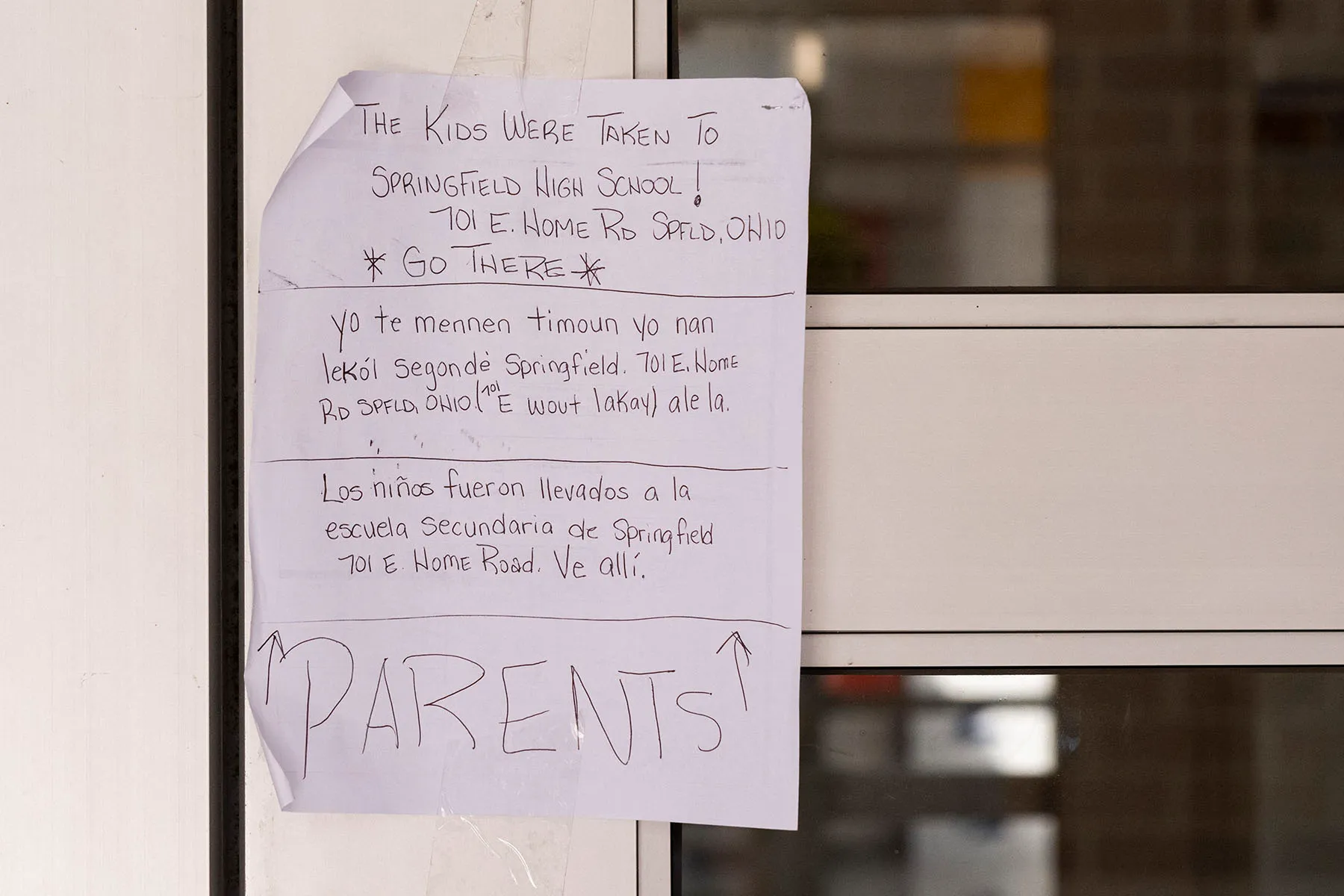
A note on the front door of Fulton Elementary School directs parents to a nearby school for pick-up after the building was evacuated due to bomb threats earlier in the day in Springfield, Ohio, on September 12, 2024. (Roberto Schmidt/AFP/Getty Images)
“Women are often the ones managing the day-to-day fears, picking up and dropping off children, and trying to shield them from the psychological trauma of these threats,” Saintil said. “This gender dynamic adds another layer to the stress, as women feel pressure to keep things normal for their families while silently shouldering the weight of their own fear and frustration.”
Having immigrated to Florida from Haiti in 2006 at age 9, Saintil said that she feels for Springfield’s Haitian community. Before moving to diverse Fort Lauderdale, Florida, she briefly lived in a White community where she said her classmates taunted, spat on her and called her a cat-eater.
“I remember . . . the fear, waking up every single day knowing that I’m going to get bullied, nobody wanting to talk to me, sitting at the lunch table by myself,” Saintil said. “When I compare it to what is happening now to the newly arrived kids, I think about just how . . . the bullying will mark them for the rest of their lives.”
Lured by manufacturing jobs, an estimated 15,000 Haitian immigrants have settled in Springfield — a mostly White town of just under 60,000 people — starting in about 2017. Before then, Springfield experienced an economic downturn caused, in part, by population decline. Then, the immigrants arrived, giving the city an economic boost.
Valerie Lacarte, a senior policy analyst with the Migration Policy Institute’s U.S. Immigration Policy Program, said that immigrants typically settle in areas because they know they can find reliable employment or their ethnic community already lives there. Springfield wasn’t previously home to a Haitian community, but state officials reportedly advertised the city’s livability and jobs, news that attracted migrants.
“You have employers who are hiring these people, so from the job market perspective, that’s a good thing. You have a match,” Lacarte said.
But this mutually beneficial development did not prevent tensions, which, last year, worsened after a Haitian immigrant crashed into a school bus, killing one child, Aiden Clark, and hurting nearly 30 others. Still, Nathan Clark, Aiden’s father, spoke out at a city commission meeting last week to denounce immigration foes for exploiting his son’s death. Anti-immigrant residents, meanwhile, have complained that Springfield lacks the infrastructure for population growth.
“It’s tempting to think the growth of immigrants, that’s what’s causing the problems,” said Karthick Ramakrishnan, coauthor of “Framing Immigrants: News Coverage, Public Opinion, and Policy” and a University of California, Berkeley, researcher. “It’s the politicization of immigrants, and especially in places that have significant Republican voting populations, the scapegoating of immigrants tends to be higher. This is an issue we’ve seen time and again in the American heartland, places that are depopulating, places that are short of workers, that actually benefit from immigrant workers, but you have people . . . tapping into these national dynamics, when it comes to race and xenophobia, to win elected office.”
Officials must “be intentional about social cohesion” to avoid conflict between the longtime residents and the Haitian transplants, said Lacarte, the daughter of Haitian immigrants. It’s important to make sure that both the U.S.-born and foreign-born community members get the attention and resources needed to grow together as a diverse community.
Longtime residents may misunderstand why people who look and sound different from them are moving in, Lacarte said. They witness the demographic shift, but they don’t realize these changes can be helpful. Then, bad actors deepen anxieties by spreading disinformation about immigrants.
“Immigrants have been not only filling these jobs and helping grow the economy. They have their own demand for goods and services,” Lacarte said. “They send their kids to school. They even, in some cases, create businesses . . . and that grows the economy.”
During the presidential debate, Trump did not portray foreign-born workers as a positive but as a threat to Americans, accusing immigrants of taking jobs from Black workers. This framing overlooks that immigrants fill jobs the native-born population doesn’t pursue, Lacarte said, and that more workers are needed as birth rates decline and the White population ages. It also belies the fact that Black immigrants exist.
About one in five Black people are immigrants or the children of Black immigrants, the Pew Research Center reported in 2022. Africans have driven Black immigrant growth; their population increased by 246 percent between 2000 and 2019. In 2005, The New York Times reported that more Africans were entering the United States than since the slave trade. Today, Africans make up 42 percent of the Black foreign-born population, while Caribbean immigrants make up 46 percent. Of the latter, most come from two countries: Jamaica and Haiti.
A United States Border Patrol agent on horseback tries to stop a Haitian migrant from entering an encampment on the banks of the Rio Grande near the Acuna Del Rio International Bridge in Del Rio, Texas on September 19, 2021. The United States said Saturday it would ramp up deportation flights for thousands of migrants who flooded into the Texas border city of Del Rio, as authorities scramble to alleviate a burgeoning crisis for President Joe Biden’s administration. PAUL RATJE/AFP
After footage of Border Patrol agents on horseback confronting Haitian migrants in Del Rio, Texas, went viral in 2021, Saintil said she received multiple messages disclosing, “I did not know there were Black immigrants. Where did they come from?” She assumed, due to her profession, that people knew the United States had Black immigrants.
“Most of my work now has been to raise visibility of Haitian and Black immigrants,” Saintil said. “We’re the most detained, the most placed in solitary confinement. Our bail bonds are higher. So, the same things that are happening to African Americans in the criminal justice system are happening to Black immigrants in the detention center. Our asylum claims are the most denied because immigration judges don’t trust our pain.”
Long before the debate, Trump disparaged Black immigrants. In 2017, he reportedly said that Nigerians lived in “huts” and Haitians “all have AIDS.” The following year, he labeled Haiti, African nations and El Salvador “shithole countries.” In Springfield, local Republicans have echoed Trump’s remarks. In addition to the pet-eating allegations, they’ve accused immigrants of being in gangs, spreading disease and practicing “voodoo” rituals, claims police have denied.
As Haiti became the yardstick for measuring whether Black people could participate in society equally, attacks on its character escalated. By the 1880s, stories spread about Haitians engaging in cannibalism and human sacrifice, especially of White children, Boaz said. Told repeatedly, these stories inform the rumors about Haitians in Springfield today, and they may jeopardize women.
“Historically, women in marginalized communities, whether immigrants, ethnic minorities, or refugees, have been specifically targeted for intimidation,” Saintil said. “This may be because some view them as ‘easier’ to attack or harass than men. . . . In this context, when Haitian women are being targeted for threats, harassment or even racial slurs in public spaces, the consequences are far-reaching. This not only creates an atmosphere of terror for women but can also ripple through the entire family.”
Haitian-American anthropologist Gina Athena Ulysse, a professor of humanities at the University of California, Santa Cruz, said that she’s tired of defending her personhood and identity. Following the 2010 Haiti earthquake, Ulysse wrote a book called “Why Haiti Needs New Narratives: A Post-Quake Chronicle” because she found the dehumanizing remarks about Haitians then disturbing.
“We’re always having to refute as opposed to having an identity that is an affirmed one,” Ulysse said. “There is a profound disappointment that in 2024 that I am listening to someone who is running to be the president of the highest nation in the land say something this surreal, this absurd. But I’m also someone as a Black woman, as a social scientist, as someone who understands race and racial construction, what that is meant to do, and that is to paint Haitians as the ultimate ‘others,’ cannibalists and otherwise, so that it can keep fueling this narrative that’s necessary to strip people of their humanity.”
Ulysse said that the broader immigrant community faces xenophobia, too. One study concluded that the level of anti-immigrant rhetoric in the Republican Party today rivals anti-Chinese sentiment during the late 1800s, a period that restricted Chinese immigration. Chinese immigrants have also been accused of consuming dogs and cats, insults revived during the onset of COVID-19, which Trump called the “China virus.”
“He’s gone from talking about Mexican immigrants as predominantly being criminals and rapists to then talking about immigrants as vectors of disease and and now using similar kinds of dehumanizing language to talk about . . . not just what they eat, but the kind of the social threat they supposedly pose to American society,” Ramakrishnan said. “I think the kinds of emotions it’s supposed to evoke are emotions of disgust, of othering and reduced empathy, and also support for drastic measures like rounding up and deporting people who are not deemed to be American.”
If Harris becomes president, she would not only be the first woman in the Oval Office but also the first person of South Asian and Caribbean heritage. Might that change perceptions and policies related to Caribbean immigrants?
“No matter how well meaning one person may be, they’re part of a social structure and a system that makes decisions,” Ulysse said. “She’s not going to make decisions by herself, so what difference does it make that she’s from the Caribbean? She’s got advisors. She’s got to think about Congress. She’s got to think about the Senate. She’s got to think about geopolitics and history.”
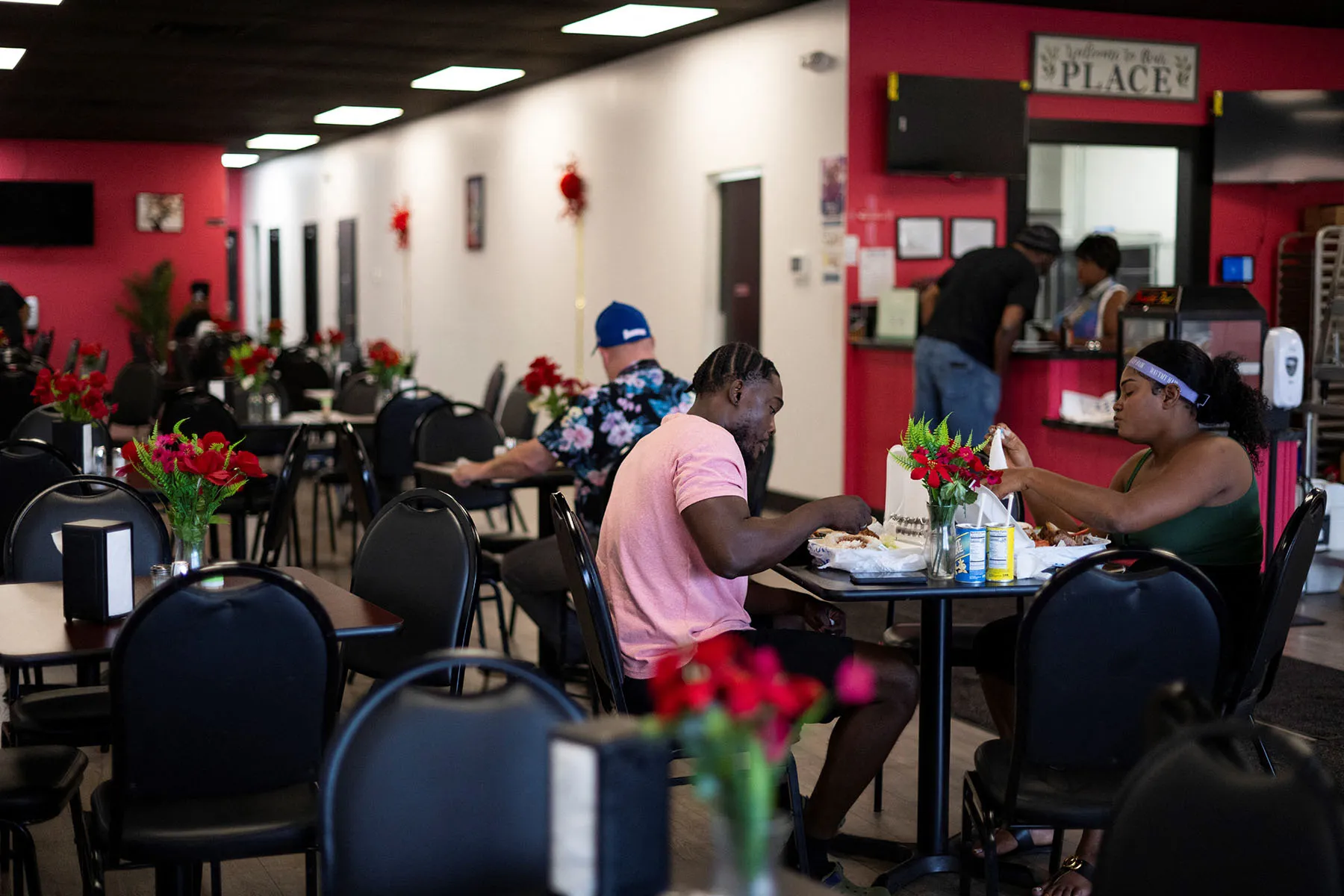
Community members eat at a Haitian restaurant in Springfield, Ohio, on September 12, 2024. (Roberto Schmidt/AFP/Getty Images)
When Trump took aim at Haitian immigrants during the debate, Harris laughed in apparent disbelief but did not rebuke him. Ulysse finds it disturbing that many people laughed at Trump’s claims because, as absurd as they are, they’re endangering Haitians.
On Friday, President Joe Biden called the attacks on Haitians “simply wrong,” noting that White House Press Secretary Karine Jean-Pierre is “a proud Haitian American.”
Along with being terrified and traumatized, Saintil said the Haitian children and parents impacted by the threats and smears likely feel betrayed.
“You’re getting it from a country that you thought you could be safe in,” she said. “You’re getting it in a country that you’ve been hoping to be in because you thought your life would be better, but now you’re being treated worse than dirt. You’re being called a savage . . . How do you go on from there?”









 Scottie's Playtime