If you can’t find the strength to take a stand, at least lie down.
Ali Davis March 31, 2025
Hello, Congressional Republicans who still care about the republic! I know you’re out there because I kept hearing how differently Trump’s cabinet confirmations would have gone if only the votes have been secret.
We have reached a crisis point. We have reached so many crisis points. We reached like three new crisis points between me starting and finishing this article.
We have flipped our foreign policy so radically that we are now the villain of the world. All decision on that end seems to have been handed over to Putin and a bunch of preening technofascists. Our economy is crashing toward a depression and the only trick the Trump Administration pony has is more insane tariffs. High-level cabinet members endangered the lives of our servicemembers by discussing classified information on the already-hacked Signal app, and that doesn’t even cover gloating over civilian deaths, adding a journalist to the group text, and further damaging our relationship with Europe. The Trump administration is trying to start wars with freaking Denmark and Canada. DENMARK AND CANADA, for chrissakes.
And the most insane thing is that this is an abridged list. There are paragraphs and paragraphs of human rights horrors that I have skipped.
This is it. You are a part of an authoritarian government, a twisted and vile parody of what we once had. Elon Musk is stripping it for parts and awarding himself lucrative contracts while Donald Trump threatens Republican judges and lobs all of our state secrets straight to Putin.
The window for stopping this is small and vanishing. The most patriotic thing you could do is stand up and impeach Donald Trump, but, whether it’s due to a fear of Trump or fear of his zealots, you’re not doing that. The second most patriotic thing you could do is resign and leave your seat open to a flip by the Democrats. But you don’t seem to be doing that either. So here it is: The third most patriotic thing you can do, your last option for saving your beloved country from falling completely into authoritarianism: Get sick.
Get terribly sick and refuse to discuss your personal health information during this challenging time. Or get just a little bit sick and keep insisting that you’ll be as right as rain in a week or two. Have a family emergency. Or just take some dearly needed personal time.
Just drop out for a while. Hole up at home or get out of the country if you need to and let some trusted Democrats know that they’ll have the majority for a while and the time and leeway to move. (BE SURE YOU KNOW WHO IS ON THE SIGNAL CHAT.)
But what if someone is blackmailing me?
No offense, but this is bigger than you. Putin wants to break the United States. And he wants to break the United States so that he can roll over Western Europe. Do you really want to go to your grave knowing that you held onto your secret at the expense of Permanent Global Fascism? For that matter, do you really think complying now will stop them from burning you with it when you become inconvenient later?
Let’s be honest: A lot of us are already kind of assuming that you’re being blackmailed. And the fact that you’ve abandonedyour principles when the stakes are so high is making people think that the thing you’re being blackmailed over is much worse than what it probably really is. If Matt Gaetz can brazen it out, what on earth must you be hiding?
The good news is that there is nothing better for blowing your blackmail material straight out of the news cycle than a fiery Presidential impeachment that the nation can’t stop watching. There’s no better time to get out from under someone’s thumb.
But if the Democrats are smart, they’ll remove Johnson and prosecute Vance for the Signal debacle. That means a Democratic President will be in. I’ll lose some of my own power. What about that?
More real talk: Donald Trump has screwed the Republican party’s chances for decades at a minimum. You are now the party that let the Nazis in. You are the party that closed the national parks and tried to put Grandma out on the street. You are the party that kneecapped scientific research right when it looked like there might be a cure for pancreatic cancer. You are the party that crashed the stock market, the party that made us hated by the world, the party that let Musk and Putin take the reins. You are the party that just came out as pro-measles and made room for polio. The Republican Party is going the way of the Know-Nothings. You’re going to have to scrap it and start over.
And that’s if we ever have real elections again.
The only hope of you, personally, ever coming back into power is if Trump gets impeached and you become a zealous reformer. Toss out everyone who helped Trump, Musk, Thiel and Putin, support real jail time, and legislate us back out of Citizens United. Throw the bastards out and keep on throwing or you are surely getting tossed out yourself.
You can start right now, of course. That would be ideal. But you can also start after you take a little break to let the Democrats get the ball rolling.
Can’t I just keep my head down and appease Trump until things are magically better?
No. If you have read this far instead of screaming about George Soros and fake Venezuelan gang members, you are a Republican who thoughtcrimes against Trump. He and his barrel of vipers who the nonbelievers are. You won’t make it.
Fascists always need a villain to rail against. They always have a list. It is not a question of whether you are on the list, it’s a question of how far down you are. Right now, it’s foreign students and random brown people with innocent tattoos, but Trump is going to crave new meat and fresh news stories soon. You know that he needs to ritually humiliate and cast out a Republican every so often to reassert his dominance. You’re higher up the list than you think.
And if we hit the era of No Real Elections, which is more likely every day, there is no way you are keeping your elected position. Only perfect toadying cult members will make it through, and there is no way you can tap dance fast enough to make up for the past.
Besides: Is “enthusiastic supporter of the fascist regime” the way you want your grandchildren to remember you?
If you aren’t moved by the idea of saving the democratic republic we’ve all grown fond of, think about the fact that your only path to staying in your elected office is to get Trump out of his, and your chance to do that is slipping away.
It’s time to come down with a severe but undefined and conveniently curable medical issue. Play hooky. Go AWOL. Bunk out. Chuck a sickie. But do it quickly.
If you can’t bring yourself to impeach Donald Trump, you need to get the hell out of the way so someone else can. (snip)
Most brain surgery requires doctors to remove part of the skull to access hard-to-reach areas or tumours. It’s invasive, risky, and it takes a long time for the patient to recover.
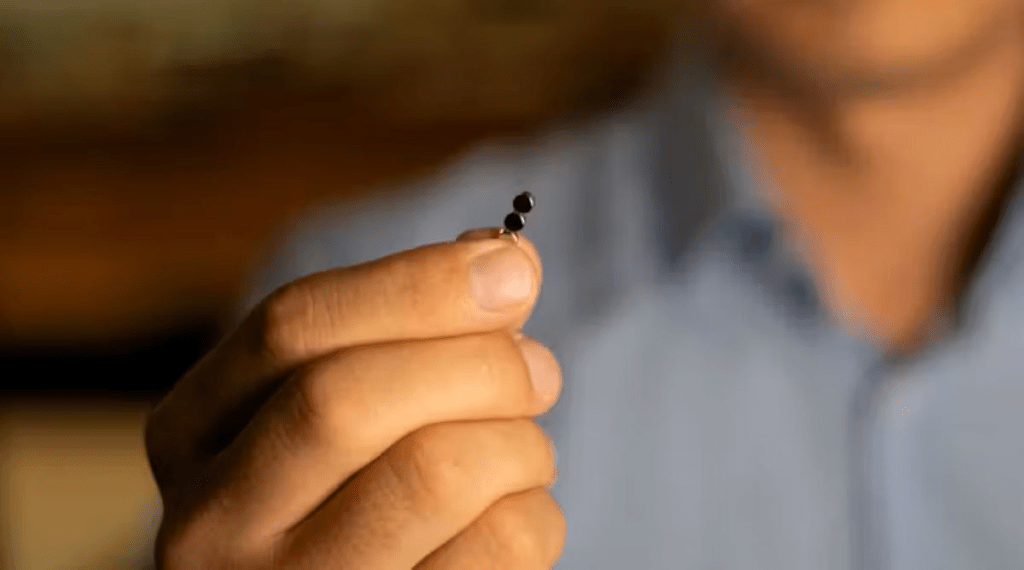
We have developed new, tiny robotic surgical tools that may let surgeons perform “keyhole surgery” on the brain. Despite their small size, our tools can mimic the full range of motion of a surgeon’s wrist, creating new possibilities for less-invasive brain surgery.
Robotic surgical tools (around 8 millimetres in diameter) have been used for decades in keyhole surgery for other parts of the body. The challenge has been making a tool small enough (3mm in diameter) for neurosurgery.
In a project led by the University of Toronto, where I was a postdoctoral fellow, we collaborated with The Hospital for Sick Children (SickKids) in Canada to develop a set of very small neurosurgery tools.
Their extremely small size is possible as they are powered not by motors but by external magnetic fields.
Three magnetic tools: a cutter, a gripper and forceps. Changyan He
Current robotic surgical tools are typically driven by cables connected to electric motors. They work in much the same way as human fingers, which are manipulated by tendons in the hand connected to muscles in the wrist.
However, pulleys smaller than several millimetres wide to control the instruments are weak and prone to friction, stretch and fracture. This creates challenges in scaling down the instruments, because of difficulties in making the parts of the system, assembling the mechanisms and managing friction in the cables.
Magnetic controls
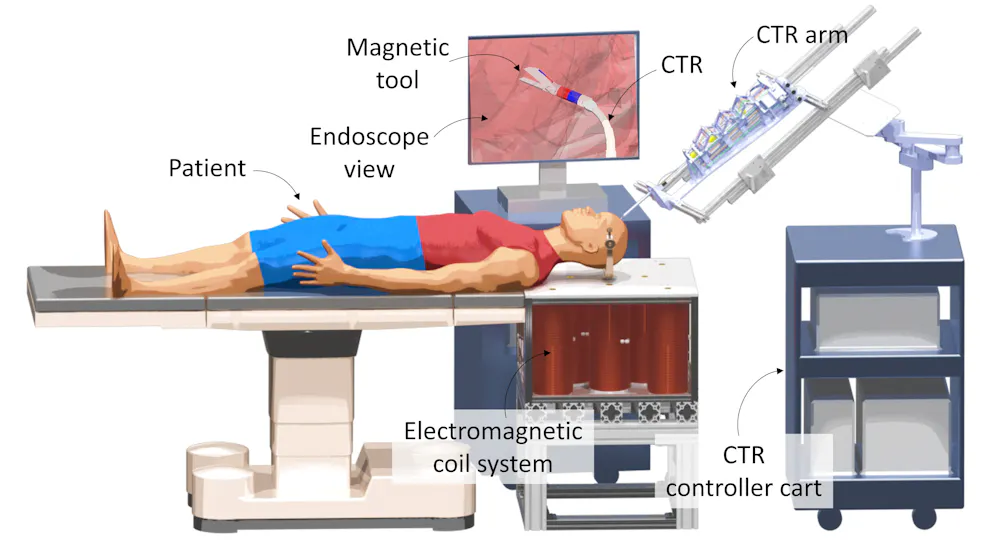
The new robotic system consists of two parts. The first is the tiny tools themselves: a gripper, a scalpel and a set of forceps. The second part is what we call a “coil table”, which is a surgical table with several electromagnetic coils embedded inside.
In this design, the patient would be positioned with their head on top of the embedded coils, and the robotic tools would be inserted into the brain via a small incision.
Patients would lie on a ‘coil table’ containing magnets which are used to control the surgical tools. Changyan He
By altering the amount of electricity flowing into the coils, we can manipulate the magnetic fields, causing the tools to grip, pull or cut tissue as desired.
In open brain surgery, the surgeon relies on their own dexterous wrist to pivot the tools and tilt their tips to access hard-to-reach areas, such as removing a tumour inside the central cavity of the brain. Unlike other tools, our robotic neurosurgical tools can mimic this with “wristed” movements.
Surprising precision
We tested the tools in pre-clinical trials where we simulated the mechanical properties of the brain tissue they would need to work with. In some tests, we used pieces of tofu and raspberry placed inside a model of the brain.
We compared the performance of these magnetically operated tools with that of standard tools handled by trained surgeons.
We found the cuts made with the magnetic scalpel were consistent and narrow, with an average width of 0.3–0.4mm. That was even more precise than those from traditional hand tools, which ranged from 0.6 to 2.1mm.
The magnetic scalpel, shown slicing some tofu inside a model of the brain, can make cuts more precise than those done with traditional tools. Changyan He
As for the grippers, they could pick up the target 76% of the time.
The magnetic grippers (shown here picking up some raspberry) were successful 76% of the time. Changyan He
We were surprised by how well the robotic tools performed. However, there is still a long way to go until this technology could help patients. It can take years, even decades, to develop medical devices, especially surgical robots.
This study is part of a broader project based on years of work led by Eric Diller from the University of Toronto, an expert on magnet-driven micro-robots.
Now, the team wants to make sure the robotic arm and magnetic system can fit comfortably in a hospital operating room. The team also wants to make it compatible with imaging systems such as fluoroscopy, which uses x-rays. After that, the tools may be ready for clinical trials.
We’re excited about the potential for a new era of minimally invasive neurosurgical tools.
March 28, 1799 The New York state legislature enacted a law mandating the gradual end of slavery. Children of slaves would not be emancipated until they had served their parent’s “holder” and reached their mid-twenties. It was not until 1827 that a subsequent law declared, “every person born within this state, whether white or colored, is free.” ========================================= March 28, 1918 2,000 in the city and province of Quebec, Canada, demonstrated at the culmination of the conscription crisis during the “Great War” (World War I). High casualty rates in Europe forced the Ottawa, Ontario, national government to institute a draft. The Canadiens resisted military service in support of Great Britain’s foreign policy. The protests continued for five days over the Easter weekend. Anti-Conscription Parade in Victoria Square, Montreal, Quebec, May 24, 1917.The gathering in this photo looks calm. Riots nearly a year later resulted in the death of four demonstrators in Quebec City. Read more ========================================= March 28, 1964 Three hundred were arrested during a sit-down protest at U.S. Air Force headquarters in Ruislip, England. The protest was organized by the Committee of 100, a group using nonviolent direct action to campaign for British unilateral nuclear disarmament. Conceived by the president of the Committee for Nuclear Disarmament, Bertrand Russell (he resigned this post soon after), and a young American academic named Ralph Schoenman, they proposed mass civil disobedience in resisting nuclear weapons, challenging the authorities to “fill the jails” with the intention of causing prison overload and large-scale disorder . Police in Ruislip arrested men and women demonstrators indiscriminately. photo: John ‘Hoppy’ Hopkins. They were committed to nonviolence, and on arrest would go limp so as to create maximum disruption without conflict. ========================================== March 28, 1968 Martin Luther King, Jr., led a march in support of striking sanitation workers in Memphis, Tennessee. Shortly after its start, violence broke out followed by looting; one 16-year-old black boy was killed, 60 people were injured, and over 150 arrested. Police dispersed the rioters with mace, batons and teargas. National Guard troops are called in and sealed off black neighborhoods; martial law was declared by nightfall. Despite the violence, King insisted on returning to the city and the sanitation workers’ side the following week. Two alternative views of what happened that day in Memphis, and what followed ========================================== March 28, 1979 In the worst nuclear accident in U.S. history, a cooling system on the Unit Two reactor failed at Three Mile Island (TMI) in Middletown, Pennsylvania. This led to a partial meltdown that uncovered the reactor’s core. Radioactive steam leaked into the atmosphere, prompting fears for the safety of the plant’s 500 workers and the surrounding community. More from nearby Dickinson College Three Mile Island accident timeline with photos ========================================= March 28, 2001 After being delayed by massive anti-nuclear protests en route, 60 tons of nuclear waste arrived by train at Dannenberg, Germany. Though the government has agreed to phase out German reliance on nuclear power, some plants will continue to operate until 2021. The waste fuel rods sent to France for reprocessing had to return to Germany for permanent long-term storage. Transported through Germany by train, and then by truck to their permanent site in Gorleben, movement of the 28 glass casks was considered an unacceptable safety risk to residents. Protesters blocked the tracks, sometimes chaining themselves in place, to stop the shipment. 20,000 police were required to allow the train’s passage. Protester Jürgen Sattari said he considered the operation a success. “We want to stop the convoy,” he said. “Of course we know we can’t halt it indefinitely, but we can drive up the political price.” More on the broad-based struggle against nuclear waste in Germany
I was not going to post again tonight, and in fact had thought to place some videos in a scheduled post for tomorrow. But this is FAR TOO IMPORTANT TO WAIT! When I told Ron about this, he remembered the Portland protests where tRump had security from prisons in unmarked vans and blacked out uniforms snatch people from the street. Is this them. Or as Ron asked me, is this just his brown shirt thugs trying to enforce his positions on the street? How to know because he sent them after drag queens and drag queen story hours. How far down the authoritarian road have we traveled already? How much farther before we can’t come back. Want to know her crime. She is a legal student here from Turkey and she wrote a pro-Palestinian op-ed. For that she got black bagged and sent to a location no one can contact her as even her lawyer says he has heard nothing and has no way to contact her. Even after a judge told ICE / tRump not to do this, they did it. Oh and why are they snatching these students and others then sending them to Louisiana? The appeals court for that area is notoriously right wing. They want as much good press and legal writing as they can get before it hits the SCOTUS. Even if a judge in the proper district tells them to do something they don’t want they just ignore it trying to force the judge to sanction tRump and his administration for using his core power which the SCOTUS tRump seems to feel has made him immune from any consequences of even an illegal act. We will soon see if he is correct. Seems Justice Sotomayor was correct. Hugs. Hugs
Unidentified men grabbing someone off the street and putting her in a car because she wrote an op-Ed. This as flatly authoritarian as anything we’ve seen in this country in a very long time.
Video of the international student at Tufts being arrested by "federal authorities" in Massachusetts has been released and it's terrifying. They're not even uniformed officers. Just secret police thugs in hoodies and masks. From WCVB: youtu.be/PuFIs7OkzYY
A longer version of the Tufts announcement about the abduction of an international graduate student by federal authorities, circulating on Twitter and Reddit.
"An emergency rally has been called for 5:30 p.m. Wednesday at Powder House Square in Somerville to protest a Tufts international graduate student being taken into custody Tuesday by federal authorities."
During the same week as the president’s address to Congress, RepresentWomen held our annual Democracy Solutions Summit (DSS). This solutions-oriented event allowed us to imagine what our democracy could look like with better policies and better representation.
Here, women leaders, elected officials, advocates and experts discussed the problems facing our democracy and uplifted actionable solutions to improve women’s representation and strengthen our democracy overall. This year’s summit addressed the critical need for more women in local, state and federal leadership roles.
The Democracy Solutions Summit clearly contrasts with the uncertainty of Trump’s address to Congress. The DSS is the only democracy summit featuring only women speakers and panelists committed to actionable, data-driven solutions and building coalitions that bolster American democracy at this critical time. Furthermore, our research has found that when multiple structural solutions are combined, we can bolster women’s representation in every level of government.
Complete recordings of the summit are available online, but here is a quick recap of all three days. (snip-More)
(Because it’s the only way I can bear it. Also, blue language within, though not gratuitous.)
LIVE: Are The Worldwide Threats In The Room With Us Right Now? A Tulsi Gabbard Hearing! by Rebecca Schoenkopf
And a John Ratcliffe hearing. And a Kash Patel hearing.Read on Substack
Tulsi Gabbard and Kash Patel and John Ratcliffe, probably.
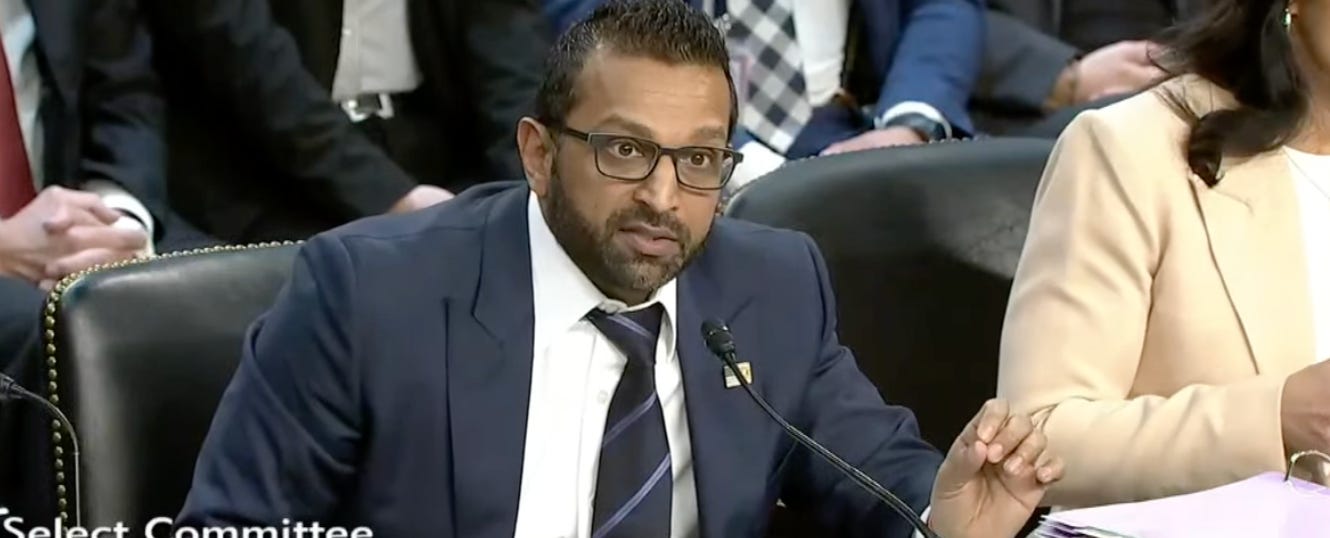
For once, Kash Patel might not even be the biggest shitshow in the room today when he and other Trump agency heads sit before the Senate Intelligence Committee for the annual Worldwide Threats hearing! You know, unless he thinks the greatest “worldwide threats” are somehow his enemies list. That would be sad and pathetic.
But yeah, that hearing is today, because the universe has a sense of humor. Tulsi Gabbard (DNI) and John Ratcliffe (CIA) were on that funny little text thread where JD Vance was like “Donald Trump is wrong about bombing Yemen, and Europe is stinky and I hate it!” (slight paraphrase) and Secretary Shitfaced was like [vomits extremely detailed bombing plans into text thread on Signal, which is not where classified war plans go] and Mike Waltz (National Security Advisor) was like “LMAO let me accidentally invite the editor of the Atlantic to read all this”!
Oh yeah, and John Ratcliffe reportedly blabbed an active intelligence officer’s name on that text chat. You know, because he’s good at his job and a serious man.
Will we even have time to hear Tulsi Gabbard share her EXPERTISE on what the greatest worldwide threats are, and why none of them are her buddies in Moscow? Will Kash Patel read from his children’s books and explain to us why the true greatest worldwide threat is “Hillary Queenton”?
Or are we just gonna talk about these dumbass clownfucking fools and their group chats all day? Let’s find out!
10:00: Yeah, though, it really is on the nose that this is the Worldwide Threats Hearing, starring Tulsi Gabbard. Ha ha! Good morning.
10:05: One thing you might not know about our current hell is that Tom Cotton is now the chair of the Senate Intelligence Committee. You know, in case you thought there might be a Republican in there who actually cares about national security, ha ha, you were wrong.
10:08: Tom Cotton leads off with Communist China being very bad. Hey, he should ask about that billionaire South African apartheid creep currently terrorizing the government, who ALSO happens to be all the way up China’s ass.
Tom Cotton just said Yemen, drink ‘em if you got ‘em! And if you don’t got ‘em, ask the secretary of Defense if he’s got an extra!
10:13: Cotton refers to the Trump intel team as “impressive,” hahahahahahahahahahahaha.
Now vice-chair Mark Warner is discussing how several on the panel today were part of the big group chat full of classified information and the name of at least one intelligence officer and all the war plans and whatever drinking games MAGA Republicans like to do to celebrate bombing Yemen on unsecured channels.
Mark Warner will now talk about some other times the Trump administration has fucked off when it comes to national security.
Canceled all foreign assistance. He’s explaining how that relates for slow learners/traitor Republicans.
Fired some of the best and brightest FBI agents, like the people who led the counterterrorism division and the heads of offices who work every day to keep America safe and who work to counteract threats on the homeland.
Firing thousands of people at the CDC and NIH, who protect America from disease.
Firing hundreds of intelligence officers, who you can’t just rehire or replace with some pig you found on the street.
Every time they show the panel, they literally look like a bunch of dumbass children who just got caught being absolute fucking morons again.
Not right out of central casting, Donald Trump!
10:25: LOL, Tom Cotton is such a pissy little baby. Just told the whole room he’s going to encourage the US attorney (this dork, presumably) to THROW THE BOOK at anybody who disrupts the hearing. Okeydoke, Senator Dachschund McPomeranian from Dardanelle, Arkansas. You’re real tough.
Anyway, Tulsi Gabbard is giving her opening statement. Hasn’t said anything in Russian yet, is talking about cartels, sounds like she binged “Narcos” this weekend, very impressive, very prepared.
10:31: Gabbard is reading whatever was prepared for her, it’s very “This is my book report on being DNI.” (Remember how she didn’t really know what the DNI did when she was nominated.)
Gabbard says Russia is a “formidable competitor” and fawns over their nuclear weapons. Says Russia does some bad cyber things too. Bet she hates reading this part. You know how Trump hates it when you say hurtful things about, UH OH! RUSSIA PART OVER!
Moved on to Iran. Well, that was fast.
The NBC feed keeps showing senators looking bored.
10:39: Wow, if Gabbard is going to keep talking about dictators like Kim Jong-un and bad guys like Russia, she should probably say something about all the world leaders they have in their pockets, like her boss.
10:42: We guess the other morons won’t be giving opening statements, because Cotton has already started prancing around about all the immigrants that have been arrested in Arkansas.
Now Code Pink protesters doing their Code Pink protesting, which is always so effective. Prods Cotton to peacock around about “Communist China.” It’s all very productive.
Anyway, back to Kash Patel talking about the threat of Mexicans in Arkansas, which is what Tom Cotton wants to know about.
10:45: Kash Patel has personally arrested 10 million Mexicans in Arkansas, and now the crime in Arkansas is over!
10:46: Tom Cotton notes that China is a “techno-totalitarian police state,” which is hilarious because what is Elon Musk doing right now?Carole Cadwalladr’s Substack is a good place to read to get a better understanding of that.
Here comes Mark Warner. Let’s talk about the fucking text chat, y’all!
10:49: Why won’t Tulsi Gabbard talk about what happened in the group chat? Is it because it was CLASSIFIED? If it wasn’t CLASSIFIED can you show us all the texts?
And John Ratcliffe? What about you?
John Ratcliffe says they put Signal on his computer, and everybody uses it! They can totally use it, as long as they also record what they do there on normal channels! (They were literally sharing war plans, reportedly, or at least Hegseth was.)
Gabbard just claimed that there was no classified information shared in the chat. Warner is like fuck off, you can’t have it both ways. If it wasn’t classified, share it all.
WARNER: If a rank-and-file intel officer did this shit, what would you do with them?
GABBARD: No classified! No classified! You are classified!
WARNER: Is Edward Snowden a traitor? You’re an idiot.
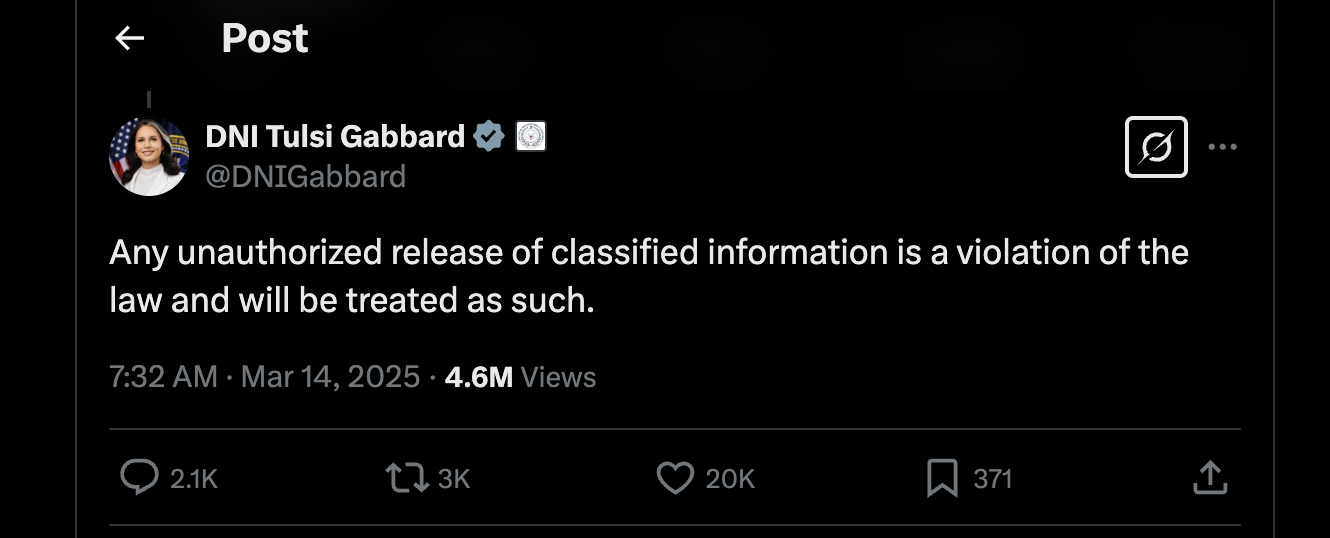
Lotta people bringing up this tweet right now:
10:55: Now Republican John Cornyn seems to be forcing Tulsi Gabbard to agree with him that Russia does horrible things all over the world, specifically he’s talking about in Europe. Also about how Russia views its unprovoked war against Ukraine.
10:56: John Cornyn wants to make sure Tulsi Gabbard and the others understand the consequences of European insecurity. He’s having Jeffrey Kruse — director of the Defense Intelligence Agency, a Biden appointee! — explain what happens if nuclear weapons proliferate throughout Europe. Also the arrangement called the Budapest Memorandum, where Ukraine gave up its weapons “for the protection of others.”
That’s how John Cornyn spent his time. Huh. Interesting.
Now Ron Wyden. He says Mike Waltz and Pete Hegseth need to fucking resign now.
WYDEN: Gabbard and Ratcliffe, how many classified group chats have you done?
GABBARD/RATCLIFFE: No classified! No classified! Ron Wyden is classified!
RATCLIFFE: I like using Signal!
11:01: WYDEN: Hey Gabbard, you think it was kinda fucked, that whole thing about how Pete Hegseth was gonna show Elon Musk all our secret China war plans?
GABBARD: Hegseth and Trump denied it! End of story, obviously!
11:03: James Lankford thanks these people for their “service,” on behalf of “Oklahoma.”
11:06: Kash Patel is a fucking dweeb.
“I’m the FBI director! I’m learning how to FBI real good!”
11:09: Martin Heinrich of New Mexico, asks Ratcliffe who precisely determined there was no classified info on that Signal group chat?
Ratcliffe either doesn’t understand or is pretending he doesn’t understand the question. (Remember, he is legitimately stupid.)
And continues to insist that Signal is OK and fine!
Heinrich asks for confirmation of whether this conversation included extremely specific military plans about weapons and timing and so forth. Jeffrey Goldberg says sure the fuck did. Ratcliffe and Gabbard are like DEF NOT! and “defer to Pentagon.” So that’s two different answers, respectively.
Heinrich now trolling Gabbard asking why the intelligence community doesn’t list the Canadian border as one of the prime drivers of fentanyl trafficking into the United States, considering how Trump is always lying and saying that’s why he has to tariff them.
Gabbard does not have the specifics on that answer. Heinrich does. It’s less than one percent of the fentanyl we interdict.
Time for a very dumb Republican senator, Ted Budd from North Carolina.
11:18: Now talking about Section 702 (FISA) Courts. Tulsi Gabbard says 702 is one of the most important tools we have. Kash Patel has a much weirder history with FISA beacuse, you know, he got MAGA famous by being Devin Nunes’s little lapdog on the House Intelligence Committee when they were trying to cover up Donald Trump’s Russia scandals.
11:21: Senator Angus King is confused as to how if Pete Hegseth put the whole battle plan in the group text, before it happened, how was that not classified?
GABBARD: No classified! Also again defer to Pete Hegseth!
KING: You’re the head of the intelligence community. You’re supposed to know about classifications, I think?
King asks why this year’s Worldwide Threats Assessment report doesn’t include global climate change. “Has it been solved?”
Gabbard says she is aware of “occurrences within the environment” and how they might affect operations. Tulsi Gabbard is not an Occurrences Within The Environment denier!
King wants to know directly who decided to leave climate change out of the report, when it’s been in the last 11.
11:25: King wants to know what kind of policy reason there would be to weaken CISA, which protects American elections and cyber infrastructure, which Trump is of course gutting. Tulsi Gabbard has no real answer.
Republican Senator Mike Rounds will not be talking about the group chat in the open session. (They will be going into closed session after this.)
Makes us wonder if a couple of these Republican senators are about to ream some asses as soon as the cameras are off.
11:29: LOL LMAO Mike Rounds just said something weird about how there are things Kash Patel did in his “previous life” that are so heroic, but we can’t talk about them. Was he Kash Patel, Super Spy? Does he have superhuman athletic spying abilities?
Don’t tell us it’s classified, ain’t none of these fuckwits give a shit about that.
11:31: Michael Bennet from Colorado always seems like a puppy dog, but then in some of these hearings he starts kicking people in the dick. Let’s see!
BENNET: Does CIA have rules for handling classified intel?
RATCLIFFE: Yes.
BENNET: Secretary Shitfaced’s response to this was to attack Jeffrey Goldberg. Are you also mad at Jeff Goldberg? Do you think he is a hoaxer? Deceitful?
RATCLIFFE: I don’t know him!
BENNET: You are the director of the CIA. Did he do a hoax to get on your group chat? Answer the question, dippy.
RATCLIFFE: I don’t know how he got there!
BENNET: Would it be cool to have a deceitful hoax reporter on a Signal group chat? Why would you add somebody like that? YOU’RE THE CIA DIRECTOR. How did you not notice who was on it?
RATCLIFFE: Maybe you don’t use Signal and don’t understand it.
BENNET: I do! Not for classified shit, obviously.
RATCLIFFE: Me neithers!
BENNET: Kind of fucking weird that Jeff Goldberg was reading your war plans before they happened in the parking lot of a grocery store. What kind of fucking CIA are you running?
RATCLIFFE: I don’t like the way you’re talking about my stupid actions!
BENNET: Hey bitch, did you know that Trump’s Kremlin/Middle East adviser boy was literally in Moscow while you were doing this group chat that he was part of? You’re an embarrassment, you need to DO BETTER.
SO THAT WAS FUN.
11:42: Todd Young very concerned about North Korea stealing his cryptos! They can’t talk about it right here, though!
Young also referred to Gabbard and Ratcliffe and Patel as “a bunch of spies.” LOL yeah buddy, definitely our best and brightest “spies.”
Mark Kelly now.
11:43: KELLY: Did your group chat mention targets?
GABBARD: I don’t think we talked about targets?
KELLY: What about general targets?
GABBARD: I think we talked about targets.
KELLY: What about weapons?
GABBARD: I don’t remember anybody saying any specific weapon names!
KELLY: What about timing?
GABBARD: No specific timing!
KELLY: John Ratcliffe, Tulsi Gabbard, any mention of specific military units?
GABBARD, RATCLIFFE: No unit! No unit! You are the specific military unit!
KELLY: Gabbard, does the IC have a policy against discussing Controlled Unclassified Information?
GABBARD: Yes.
KELLY: Was everything you talked about on Signal something you would approve for public release.
GABBARD: HgeeeeeeghncnchnchffGH!
KELLY: What about you, Mr. CIA super-spy?
RATCLIFFE: HgeeeeeghncnchnchffGH!
KELLY: Is it probably classified to discuss your literal actual war plans for strikes you’re going to do?
GABBARD: Maybe, maybe not!
RATCLIFFE: Yes.
TOM COTTON: Aw piss! John Ratcliffe just confessed on accident! Yain’t supposed to confess on accident! Tom Cotton gonna try to clean it up now by saying the secretary of Defense IS THE ONLY ONE ALLOWED TO SAY what’s classified with military strikes! Aw piss! Fiddlesticks! Pissfiddle!
(Dramatic interpretation of what just happened. Tom Cotton did not admit out loud that he felt the need to interject because John Ratcliffe had just accidentally told the truth.)
Mark Warner interjects to say it’s kind of fucking weird and stunning that none of these dipshits can even admit there was a fuckup.
11:55: Republican Jerry Moran wants to know what kinds of threats to America would arise if Russia got everything it wanted out of a Ukraine/Russia “peace agreement.”
Even Ratcliffe is saying out loud that people have been underestimating Ukraine for years now, would “fight with their bare hands” if they had to.
It remains very strange how, with a possible remainder of Tulsi Gabbard, nobody seems to share the devotion to Russia that Trump has.
11:58: Ratcliffe and Gabbard are trying to change their testimony midstream here, from earlier swearing that there was NO CLASSIFIED INFORMATION on that group chat, to now insisting that nothing was unclassified on their end, while insisting that original declassification authority for military matters rests with Hegseth. In other words, DRUNKY’S FAULT!
So Jack Reed would like to know if Pete Hegseth declassified all the classified information he talked about in that group chat.
REED: Tulsi Gabbard, were you overseas during your bullshit group chat?
GABBARD: Yes.
REED: Did you do this on your private phone or public phone?
GABBARD: I cannot say that out loud! I won’t! I shan’t!
12:02: REED: If you are just pretty sure nothing you did on the group chat was classified, would it be cool for Jeff Goldberg to release all the transcripts?
RATCLIFFE: I think he released all the things about me!
REED: Nope. Not what the article says.
RATCLIFFE: All the me parts are fine, definitely!
REED: So he can release it?
PATEL: I can’t prejudge that! Ask Pam Bondi!
Now we have Jon Ossoff.
12:04: OSSOFF: On your sexxxy group chat, JD Vance talked about how he disagreed with Donald Trump on the Yemen strike.
RATCLIFFE: I don’t recall!
OSSOFF: [reads it]
RATCLIFFE: I don’t recall!
OSSOFF: You don’t recall anything about the group chat you were on, which all the news is about? You don’t recall all the things that were said? You don’t recall how Pete Hegseth also disagreed with Trump? How Hegseth shared all these battle plans? Etc.?
RATCLIFFE: I’m a real dummy!
OSSOFF: Don’t you think foreign intel services would be interested in literally everything about this group chat?
RATCLIFFE: I reckon!
It’s funny, Ratcliffe keeps saying “I don’t know that,” and Ossoff keeps replying, “You do know that.”
OSSOFF: This was a HUGE mistake, yes?
RATCLIFFE: No!
OSSOFF: Jesus Christ, the fuck it wasn’t. This was hugely embarrassing, it was an absolute fuckup, we are going to get the full text of this group chat, and we’ll measure your testimony against that.
Mark Warner is going to end this up by continuing to call these people dumb fucking pieces of shit.
Warner ends by saying that these idiots’ inability to admit what a “colossal screwup” this was “speaks volumes.”
Susan Collins was not in attendance because she is under the weather, but she is concerned.
with lots to read and to think about. Also an interesting video and transcript of an interview with Nate Vance. Have a nice beverage, and take in a longer read/watch.
the post along with the comments beneath it are important to read. There are ways to make our directions to our government known. Even if a person can’t show up, a person can send a pizza or some cold drinks to a group who’s out speaking out. We can each do a thing. Meanwhile, please read Tengrain’s post, and the comments, as they’re important to know.
Personally, I fail to see how they’re preventing serving 2 Masters, but I guess we will see. I do see flaws (bringing the Kingdom of Heaven to Earth is not possible in Christianity, and is said to mean similar actions to what the current US President is doing in regard to “undesirables,) but am trying to not judge just yet; techies may have mixed up some terms, or could be trying to redefine terms.
A high-profile network of investors and founders in Silicon Valley are promoting a new moral vision for the tech industry, in which job choices and other decisions are guided not by the pursuit of wealth, but according to Christian values and Western cultural frameworks.
At an event in San Francisco last week hosted in a former church, Trae Stephens, cofounder of the defense contractor Anduril and a partner at the Peter Thiel–led venture capital firm Founders Fund, characterized the idea as the pursuit of “good quests” or careers that make the future better, a concept that he said has theological underpinnings.
“I’m literally an arms dealer,” Stephens said at one point, prompting laughter from the crowd of roughly 200 people, which included Y Combinator CEO Garry Tan. “I don’t think all of you should be arms dealers, but that’s a pretty unique calling.”
The hour-long discussion was part of a series of ticketed gatherings organized by ACTS 17 Collective, a nonprofit founded last year by Stephens’ wife, health care startup executive Michelle Stephens. The group, whose name is an acronym that stands for “Acknowledging Christ in Technology and Society,” is on a mission to “redefine success for those that define culture,” she says.
In Michelle’s view, tech workers mostly believe in arbitrary metrics of success, like money and power, leaving some of them feeling empty and hopeless. She wants them to believe instead that “success can be defined as loving God, myself, and others.”
People of all denominations—including atheists—are welcome at ACTS 17 events. Last Thursday’s event had low-key party vibes. Bartenders served beer and wine, a DJ was spinning light worship beats, and prayer booklets rested on a table. The idea for ACTS 17 and a speaker series on faith actually took root at a party, Michelle says. In November 2023, during a three-day 40th birthday party for Trae in New Mexico, Peter Thiel led a talk on miracles and forgiveness. Guests were intrigued.
“Folks were coming up to us saying things like ‘I didn’t know Peter is a Christian,’ ‘How can you be gay and a billionaire and be Christian?,’ ‘I didn’t know you could be smart and a Christian,’ and ‘What can you give me to read or listen to learn more?’” Michelle says.
The Stephens have long-standing connections to Thiel. In addition to helping start Anduril and working at Founders Fund, Trae was also an early employee at data intelligence firm Palantir, a company cofounded by Thiel that develops tools used by the US military.
At the ACTS 17 last Thursday, Trae appeared to echo a number of ideas Thiel has also espoused about technology and Christianity. He emphasized that jobs outside the church can be sacred, citing Martin Luther’s work during the Protestant Reformation. “The roles that we’re called into are not only important and valuable on a personal level, but it’s also critical to carry out God’s command to bring his kingdom to Earth as it is in heaven,” Trae said.
Thiel made nearly identical comments in a 2015 essay arguing that technological progress should be accelerated. Science and technology, he wrote, are natural allies of “Judeo-Western optimism,” especially if “we remain open to an eschatological frame in which God works through us in building the kingdom of heaven today, here on Earth.” (snip-MORE)
Not about diversity; they have only a little to connect them other than I saw them and thought we’d be interested. I don’t know if I’m still recovering from DST, or if have come down with a weak little something, but I’ve been tired the past few days, and have some upcoming commitments, so will be taking things a little easier for a few days. Enjoy!
The United States Postal Service is under federal scrutiny. It’s not the first time.
A United States Postal Service mail handler works to unload her mail truck at the Processing and Distribution Center in Miami, Florida. Getty
Though the Postal Service might not come to mind as a great factor in the long march toward social equity in the United States, its policies have had a serious impact on the rights of marginalized Americans since its inception in 1775. Activism, civil rights, and politics are ingrained—at least implicitly—in postal history.
Benjamin Franklin worked for the colonial postal service, controlled by the British, for years before he helped establish the independent American Post Office. Back in 1737, he ran the Philadelphia Post Office where he was focused more on the logistics of such a large operation than on how the institution might affect different demographic groups. Still, his work left a legacy of social transformation.
Many of these letters were delivered by enslaved African Americans, some of whom were forced in the years before emancipation to serve as messengers going relatively short distances between plantations and towns.
“If the inhabitants … should deem their letters safe with a faithful black, I should not refuse him,” Postmaster General Timothy Pickering wrote in 1794 regarding a mail route in Maryland. “I suppose the planters entrust more valuable things to some of their blacks.”
Yet this trust was soon eroded as slave rebellions increased throughout the Americas, and, in 1802, Black Americans were banned from carrying mail until Reconstruction.
The Post Office Department, like the rest of the federal government, updated its policies to become more inclusive in its hiring practices over the centuries. But the Post Office was unique in hiring Black Americans and white women beginning in significant numbers in the 1860s—before either group had been granted the right to vote nationwide (white women got it in 1920; Black men in 1870). Postal jobs were generally desirable. They were salaried and safe. (snip-MORE, and it’s good; not tl, dr)
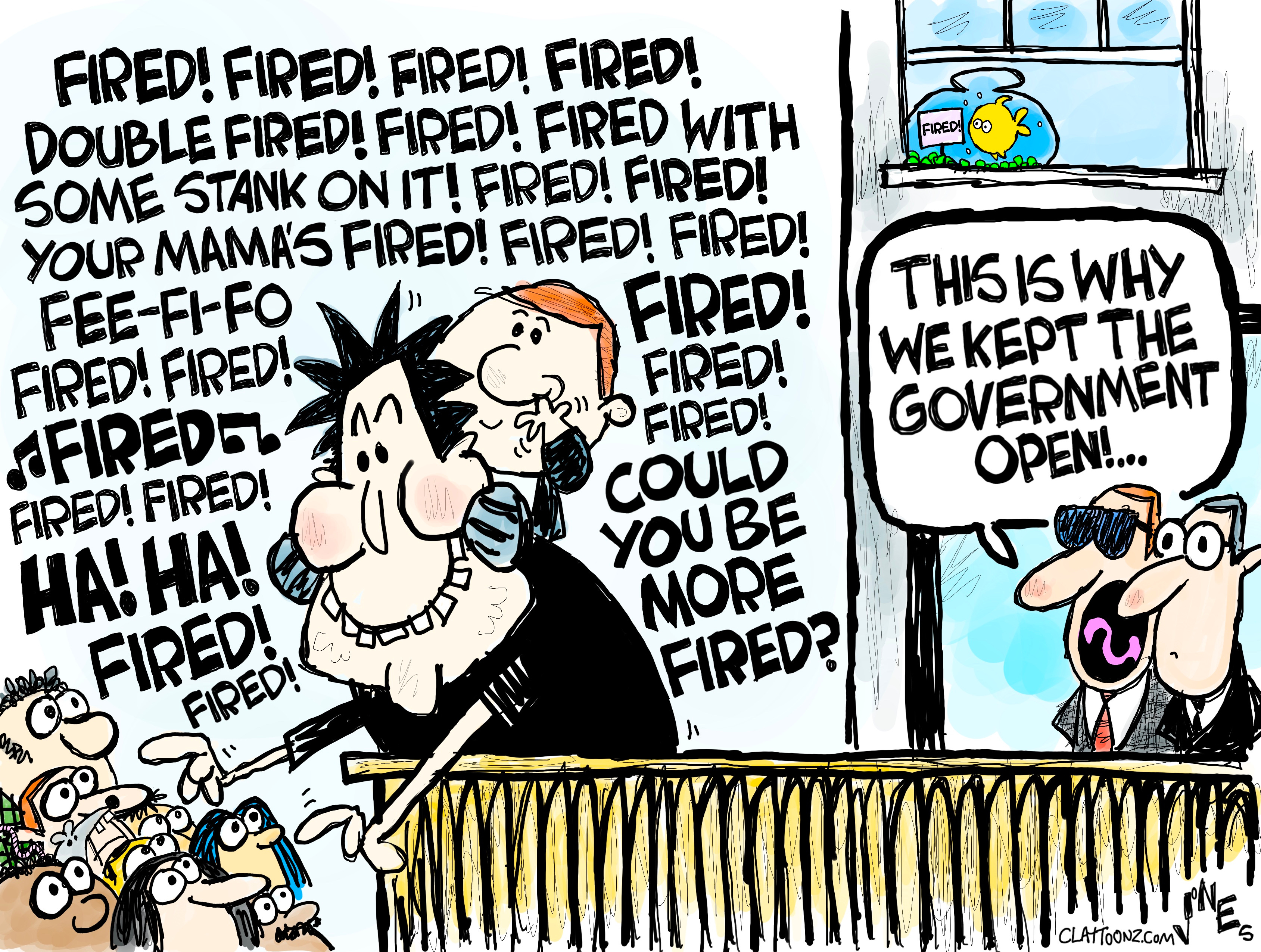
Republicans, with the help of a few Democrats, voted to keep the government open so they can keep destroying it.
It’s not like Republicans voted to keep the government open so they can do their jobs. They didn’t keep it open to provide oversight. They didn’t keep it open so they can serve as the third branch of the federal government. They didn’t even keep it open to do their job of restraining Elon Musk and DOGE.
DOGE is not an official agency of the government, meaning what it’s doing is not legal. A lot of lawsuits have been fired against the Trump administration over all the bullshit DOGE is doing, but there should be a lawsuit questioning DOGE’s existent.
The President can NOT create agencies or departments. Article 1, Section 1 of the United States Constitution gives that power to Congress. Donald Trump should not be able to create a new department and have it cut budgets and fire government employees. Not only is Congress allowing this happen, but they won’t even talk to Elon Musk about it in public.
Republicans in Congress have had a lunch with Elon but behind closed doors. Neither the Republican-controlled House nor the Republican-controlled Senate will even subpoena Elon. What’s even worse is that Elon is conducting all this business in secret. Saying you’re transparent doesn’t make you transparent.
It astounds me that there are so many Republicans who trust that DOGE is transparent just because Elon says it is. Don’t they have eyes? Haven’t they noticed they’re not seeing anything?
Trump and Republicans even use unelected bureaucrats to justify giving carte blanche to Elon, an unelected bureaucrat. You don’t replace a swamp with a bigger swamp.
Even while Elon is destroying our government and the lives of federal workers, Trump is building sympathy for him. You may have lost your job, but at least Trump got a brand new Tesla.
I can’t tell you how much sleep I’ve lost worrying about Elon’s finances. At least Germany only had ONE Hitler.
America, this is the beginning of the end.
Creative note: I started on this idea, but I wasn’t feeling great about it, so I started on another idea, finished drawing most of it, and realized I wasn’t loving it either. So, I came back to this, started feeling it, and the next thing I knew, it was after 5 p.m. on a Saturday. That’s why you got a short blog. I need food.
I’m punching out until tomorrow, when you will get TWO cartoons and blogs. I’m not reading any emails until Monday. I get 20 from readers on a slow day (though several of them are from the same readers).