Category: Terrorism
Screaming, Indeed!
Somebody Is Shooting — Strike That — *Killing* Minnesota’s Democratic Lawmakers, Dressed As A Cop by Rebecca Schoenkopf
Well, here is some fucking news. Read on Substack
Here is a fast post before I take a breath, make my signs, and go outside to scream my head off.
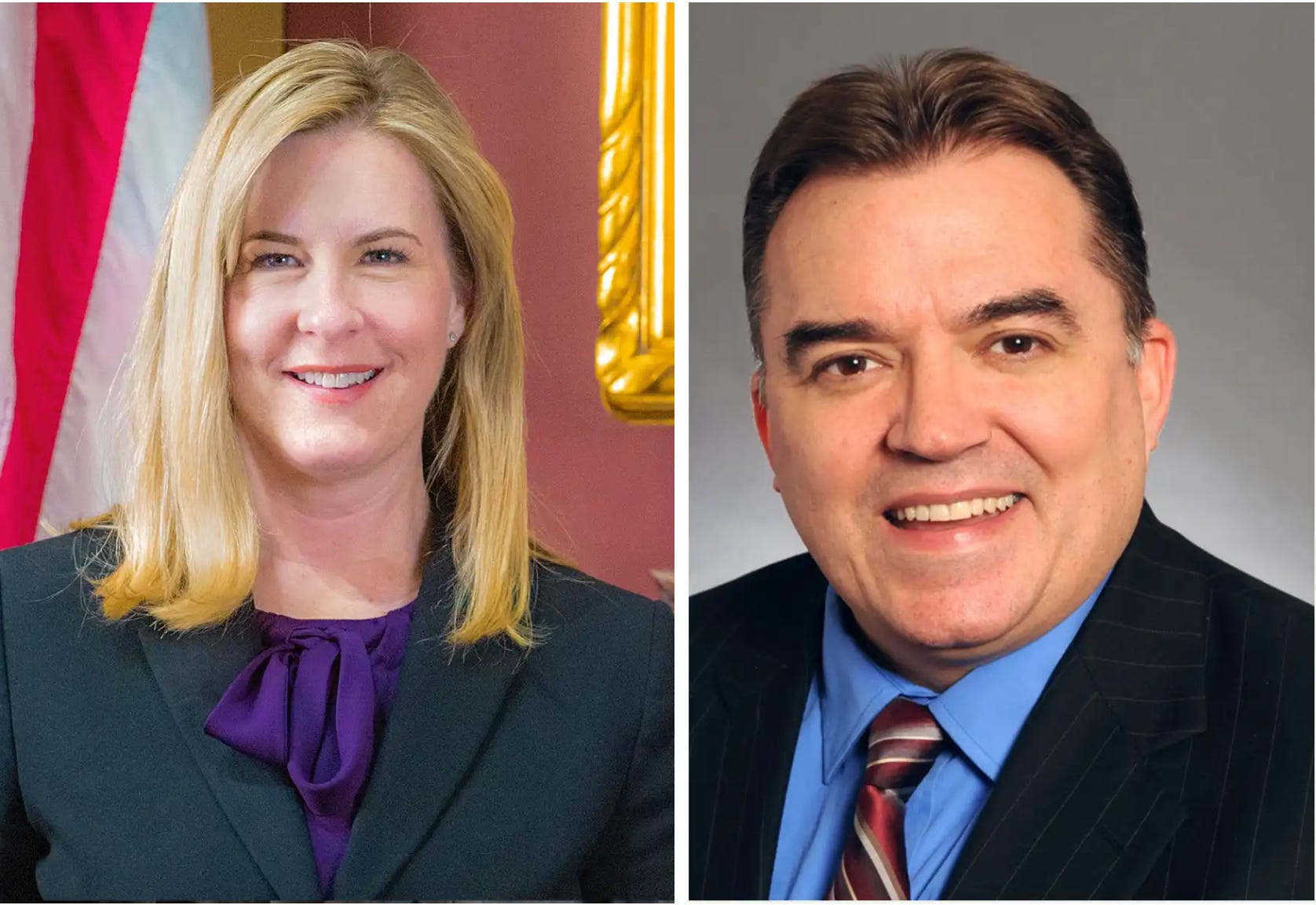
Someone or someones dressed as law enforcement — or law enforcement! with ICE covering their faces, there’s really no way to know anymore who is who! — has gone and shot Democratic lawmakers in Minnesota. The Minnesota House is split 67-67, and the Minnesota Senate has a plus-one majority for Democratic-Farm-Labor. These are targeted assassinations.
Sen. John Hoffman (DFL-Champlin) and Minnesota House DFL Leader Melissa Hortman of Brooklyn Park are reportedly in grave condition. Reportedly, both of their spouses were shot too. Update 10:50 eastern: KSTP is reporting that Hortman and her husband Mark have died.
Update 11:00 eastern: Per an officer at the press conference above, officers responding to the shooting at Hoffman’s house asked Brooklyn Park officers to go check Hortman’s house — out of a vague foreboding. Those officers found the fake cop coming out of her house, when he immediately shot at them and went back inside.
Update 11:30 eastern: NOWHERE in this CNN story on the “politically motivated assassination” does it tell its readers that the victims were Democrats. Why do you suppose that is?
Everything is escalating. Nothing is all right.
The last time someone tried to kill Democrats, it was a lunatic who bashed Nancy Pelosi’s octogenarian husband in the head with a hammer. This was considered very hilarious by our president, Donald Trump.
Here is Minnesota Gov. Tim Walz a day ago.
Jesus Fucking Christ.
Oppose Authoritarianism-
California senator removed from room after interrupting news conference by Kristi Noem
Democratic U.S. Sen. Alex Padilla on Thursday was forcefully removed from Homeland Security Secretary Kristi Noem’s news conference in Los Angeles and handcuffed by officers as he tried to speak up about immigration raids that have led to protests in California and around the country.
Video shows a Secret Service agent on Noem’s security detail grabbing Padilla, who represents California, by his jacket and shoving him from the room as he tried to interrupt Noem’s news conference in Los Angeles.
“I’m Sen. Alex Padilla. I have questions for the secretary,” he shouted in a halting voice.
The stunning scene of a U.S. senator being aggressively removed from a Cabinet secretary’s news conference prompted immediate outrage from his Democratic colleagues in the chamber. It comes as the Trump administration has aggressively targeted protesters in California who are demonstrating against immigration raids, including by sending in National Guard troops and Marines. (snip-MORE)
==========
Missouri Gov. Kehoe activates National Guard ahead of planned protests across the state
KANSAS CITY, MO —
Missouri Gov. Mike Kehoe has activated the Missouri National Guard in anticipation of protests planned across the state.
Kehoe signed an executive order on Thursday, declaring a state of emergency and authorizing the Guard to support local law enforcement if necessary.
“We respect, and will defend, the right to peacefully protest, but we will not tolerate violence or lawlessness in our state,” Governor Kehoe said. “While other states may wait for chaos to ensue, the State of Missouri is taking a proactive approach in the event that assistance is needed to support local law enforcement in protecting our citizens and communities.”
The executive order comes two days following hundreds of Kansas Citians marching downtown in protest of ICE. There were protests in St. Louis as well.
This weekend, a large crowd is expected at Mill Creek Park on the Country Club Plaza.
They will take part in the “No Kings” rally, set the same day as a Flag Day military parade that is also President Donald Trump’s birthday.
Kansas City mayor responds on National Guard’s activation
Kansas City Mayor Quinton Lucas’ office said the mayor is “concerned with enhanced enforcement for one set of protestors,” referencing the Patriot Front’s march on Memorial Day Weekend.
His office’s statement in full:
“Mayor Lucas is concerned with enhanced state enforcement for one set of protestors, but no action or aid to local law enforcement when Neo-Nazis march through Missouri’s urban streets. The Mayor has confidence in responsible protestors to use their First Amendment rights peacefully and in compliance with the law. More than one thousand Kansas Citians protested peacefully and responsibly just days ago. For those who do not act responsibly, the Mayor stands by the women and men of local law enforcement at KCPD and other agencies to handle any necessary enforcement actions. Unnecessary escalation from our nation’s capital and state capitals undermines local law enforcement and makes all less safe.”
House Minority Leader Ashley Aune said it was a “preemptive” declaration of emergency.
Her statement:
“Governor Kehoe’s preemptive declaration of a state of emergency as Missourians prepare to protest an increasingly authoritarian presidential administration is a blatant attempt to intimidate and suppress First Amendment rights. The protests planned this weekend across Missouri and throughout the nation were sparked by the president’s unwarranted and heavy-handed military response to opposition to his policies. By doing the same, the governor will only heighten tensions and increase the possibility of conflict. Governor Kehoe should staunchly defend the rights of Missourians, not mimic the authoritarianism of the president.” (snip-MORE)
If you can see what’s happening & still be glad you voted for this you are un American
Jimmy Kimmel Tells the Truth About What’s REALLY Happening in LA
police acting like brown shirt thugs. Sniping at peaceful protestors
They are firing into the crowd now. The freedom to protest in the constitution is no longer allowed in the tRump dictatorship.
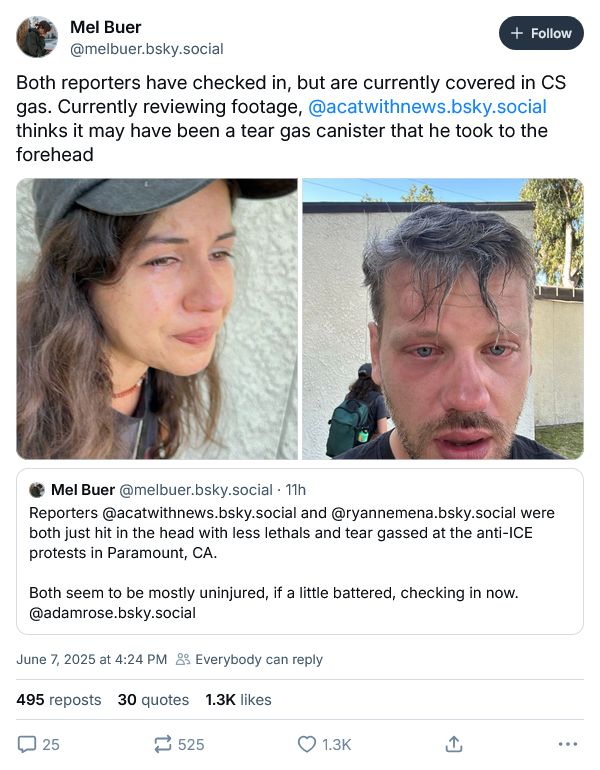
The Majority report is really showing what tRump / ICE / police are doing including shooting reporters. Thug behavior
Women’s Peace Crusade in Scotland, and More in Peace & Justice History for 6/10

| June 10, 1917 The Women’s Peace Crusade in Scotland launched a three-week campaign of street meetings and demonstrations in dozens of towns to build support for peace in the midst of what was then called The Great War (now known as World War I). More about the Womens’s Peace Crusade |
| June 10, 1937 The mayor of Monroe, Michigan, organized a citizens’ posse of some 1400 vigilantes, armed with baseball bats and tear gas, to combat the union organizing drive at local Newton Steel. The mob threw a dozen of the picketers’ cars into the River Raisin.  Steelworkers’ cars were rolled into Monroe, Michigan’s River Raisin by strike breakers recruited by the mayor. The 120 striking steelworkers and their supporters were working to form unions in the “Little Steel” companies which, unlike U.S. Steel, continued to resist unionization. Newton had just been purchased by Republic Steel [see Chicago’s Memorial Day Massacre [May 30, 1937]. The whole story (Note from Ali: the link in the newsletter was no longer functional. Doing a search of cars going into the River Raisin is really interesting, even simply in modern times! I had to search the specific date to get this report. Seems like an “active” place, there in Monroe!) |
| June 10, 1963 The “Equal Pay Act of 1963” was passed and signed into law; it guaranteed women equal pay for equal work. The legislation was a result of the recommendations of President John F. Kennedy’s Commission on the Status of Women.  The law itself |
| June 10, 1980 Nelson Mandela’s first writings, and those of other imprisoned anti-apartheid leaders, were smuggled out and made public while they were imprisoned on South Africa’s Robben Island.  “ “As I read these fascinating essays, I was struck so forcibly by the importance of memory, of history, for both the individual and the community. . . . I pray that our people and especially our children will, by reading this collection of essays, remember the very high price that has been paid to achieve our freedom.” – Desmond Tutu, from the foreword  Nelson Mandela’s cell on Robben Island, where he spent 17 years Review of Reflections in Prison Portions of the book |
https://www.peacebuttons.info/E-News/peacehistoryjune.htm#june10
Trump Orders National Guard Deployed After Masked ICE Agents Clash With Protesters In LA Area [VIDEO]
The New York Times reports:
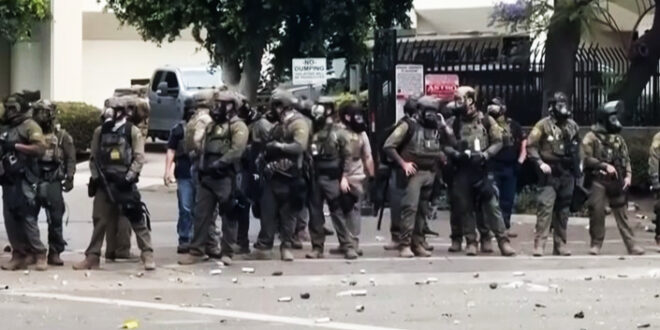
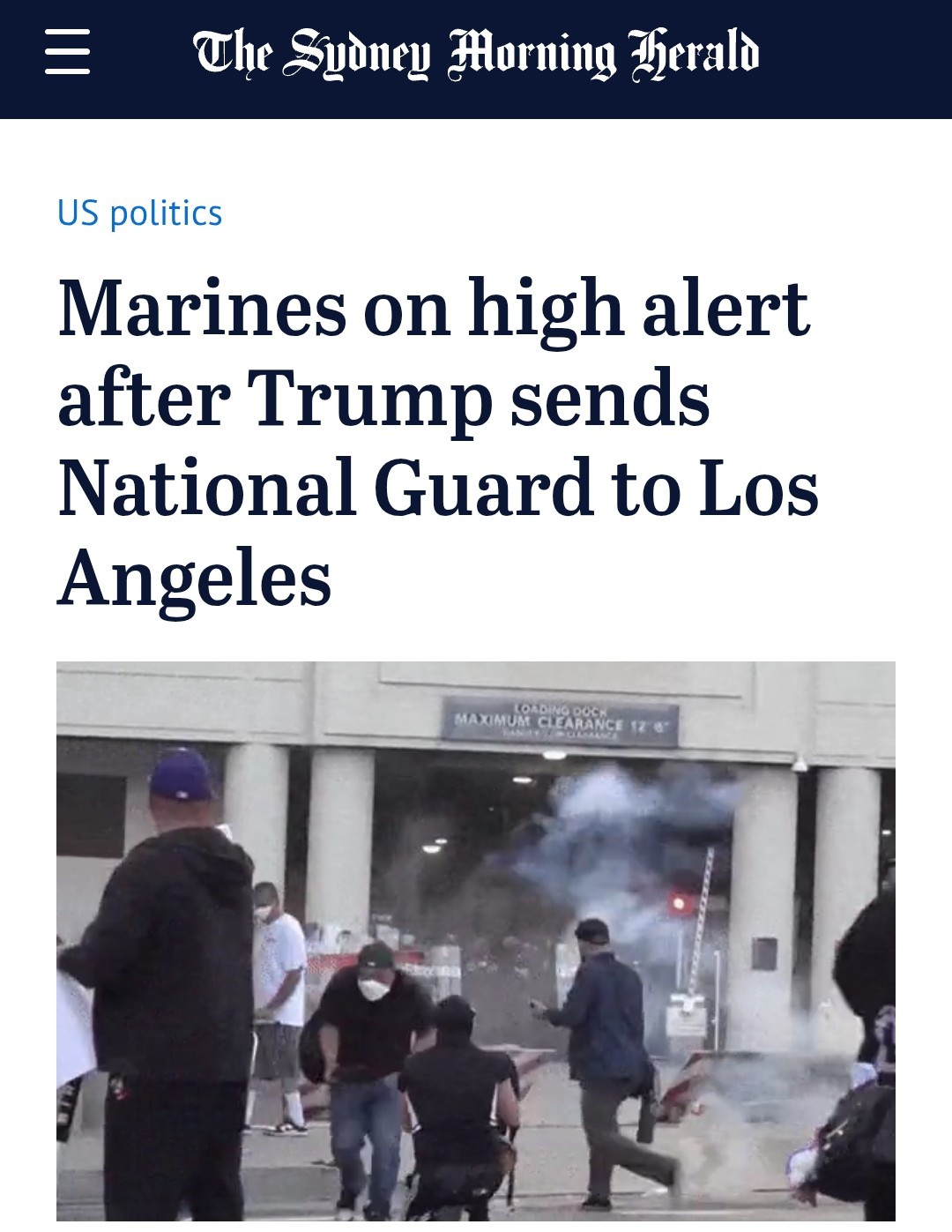
A third day of protests against immigration raids was expected to take place in the Los Angeles area on Sunday, hours after President Trump took the extraordinary action of ordering at least 2,000 National Guard members to assist immigration agents clashing with demonstrators.
The announcement by Mr. Trump — who said that any protest or act of violence that impeded officials would be considered a “form of rebellion” — was an escalation that put Los Angeles squarely at the center of tensions over his administration’s immigration crackdown and made rare use of federal powers to bypass the authority of California’s governor, Gavin Newsom.
Mr. Trump issued the order on Saturday as law enforcement officers faced off with hundreds of protesters for a second consecutive day in the Los Angeles area, in some cases using rubber bullets and flash-bang grenades. Mr. Newsom described Mr. Trump’s order as “purposefully inflammatory,” saying that the federal government was mobilizing the National Guard “not because there is a shortage of law enforcement, but because they want a spectacle.”
The Associated Press reports:
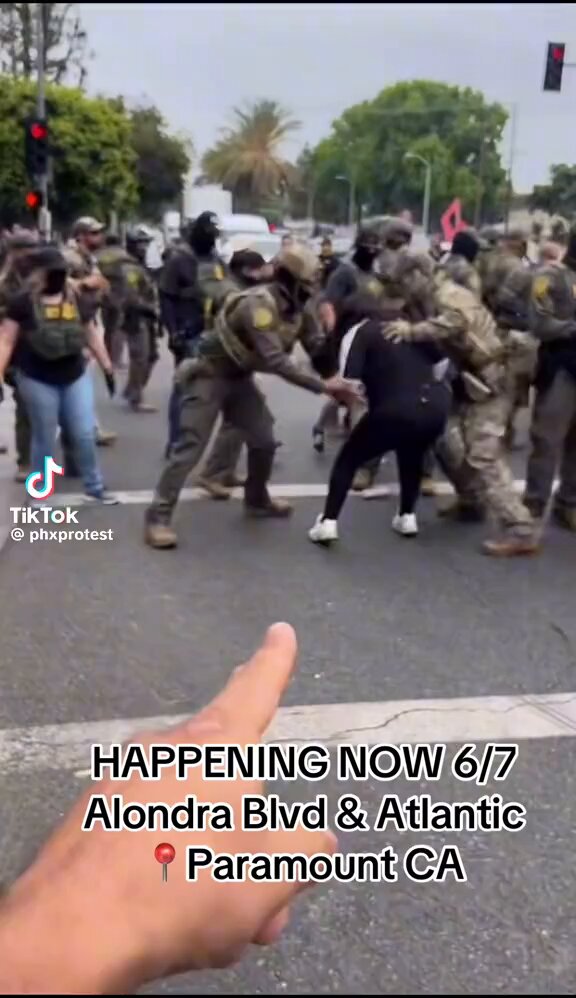
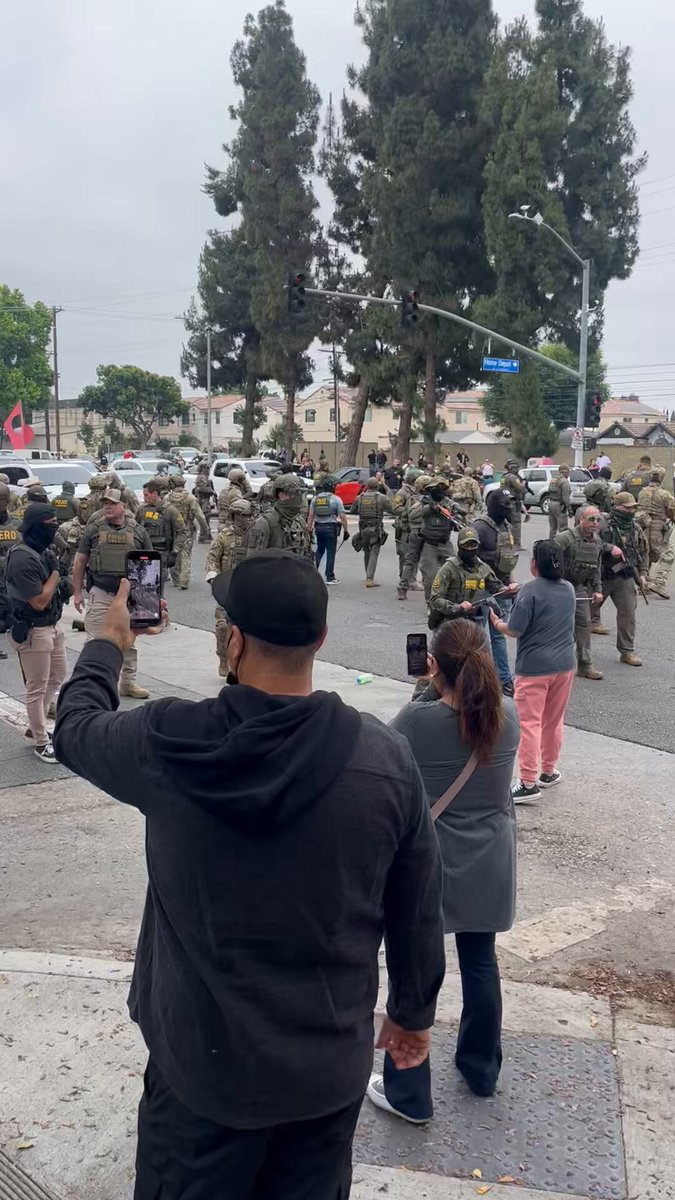
Confrontations broke out on Saturday near a Home Depot in the heavily Latino city of Paramount, south of Los Angeles, where federal agents were staging at a Department of Homeland Security office nearby.
Agents unleashed tear gas, flash-bang explosives and pepper balls, and protesters hurled rocks and cement at Border Patrol vehicles. Smoke wafted from small piles of burning refuse in the streets.
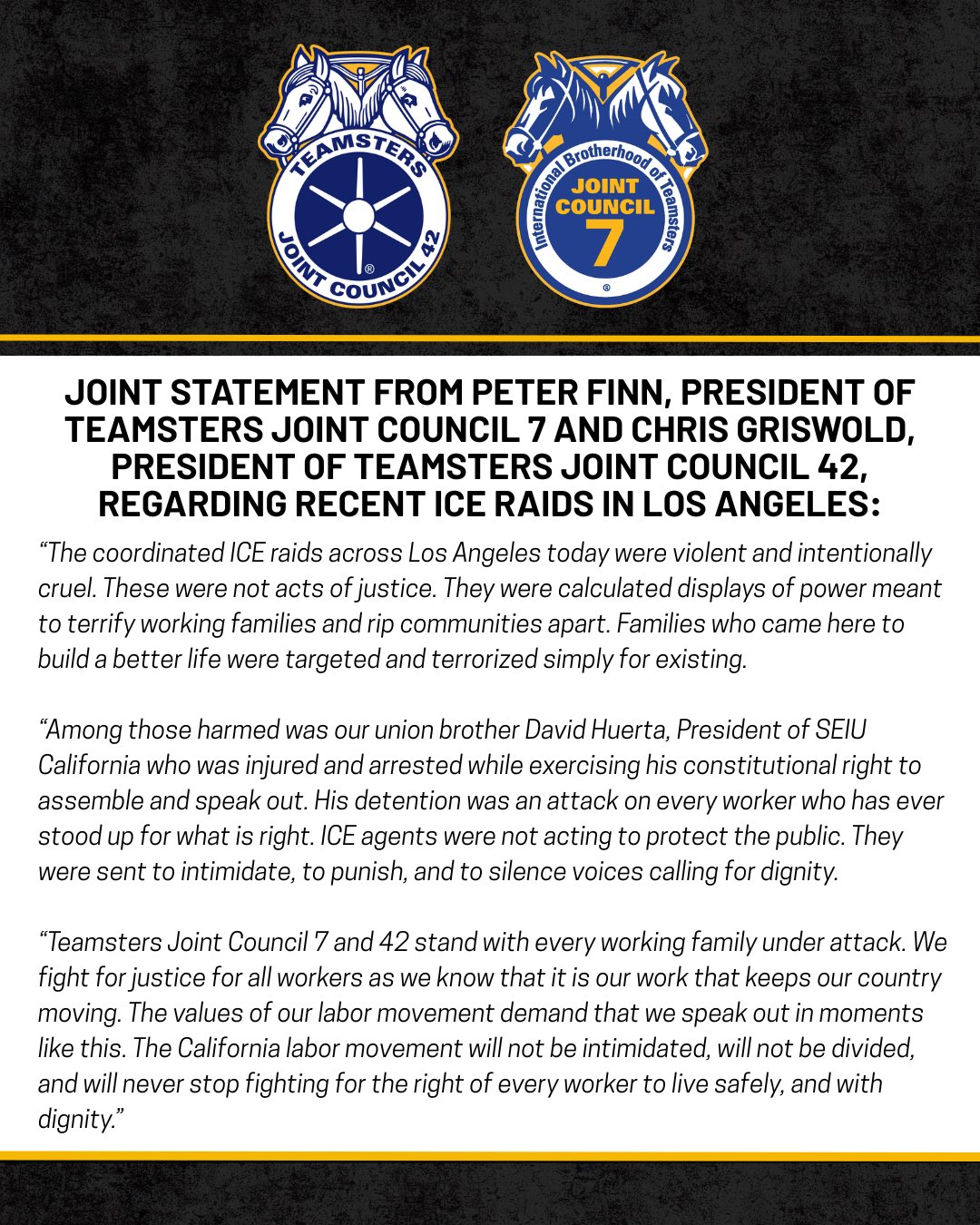
Tensions were high after a series of sweeps by immigration authorities the previous day, including in LA’s fashion district and at a Home Depot, as the weeklong tally of immigrant arrests in the city climbed past 100. A prominent union leader was arrested while protesting and accused of impeding law enforcement.
The Washington Post reports:
The National Guard has not yet been deployed to the sites of any protests in Los Angeles County, according to its sheriff’s department. “We were told that the National Guard had been deployed, however they are not on the scene or the ground yet,” Deputy Sheriff Tracy Koerner said around 1:45 a.m. local time. Earlier Sunday, Mayor Karen Bass said the National Guard had not been deployed in the city limits.
The Los Angeles Police Department said at midnight that it detained “multiple” people who breached an area near the city’s Metropolitan Detention Center where the agency had declared an “unlawful assembly.” “Those detained will be arrested and booked for failing to disperse,” the force said on social media. Earlier, police said a section of Alameda Street was closed to all vehicle and pedestrian traffic.
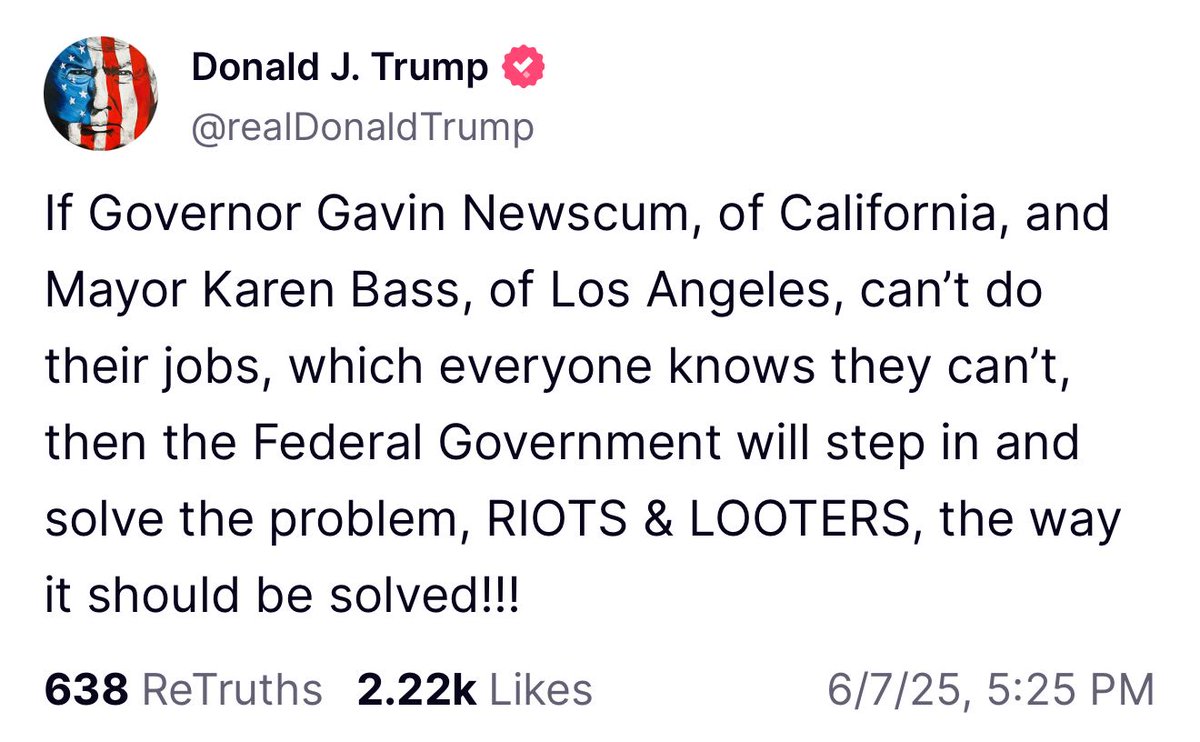
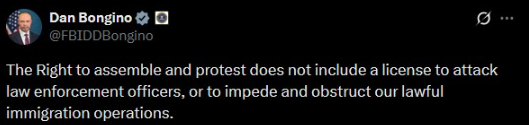
The cult is celebrating on X, with some calling for the use of “live rounds” on protesters. Trump’s post below came at 2:41am, presumably upon his return from a UFC match where he was seated with Mike Tyson.
Post
See new postsConversation
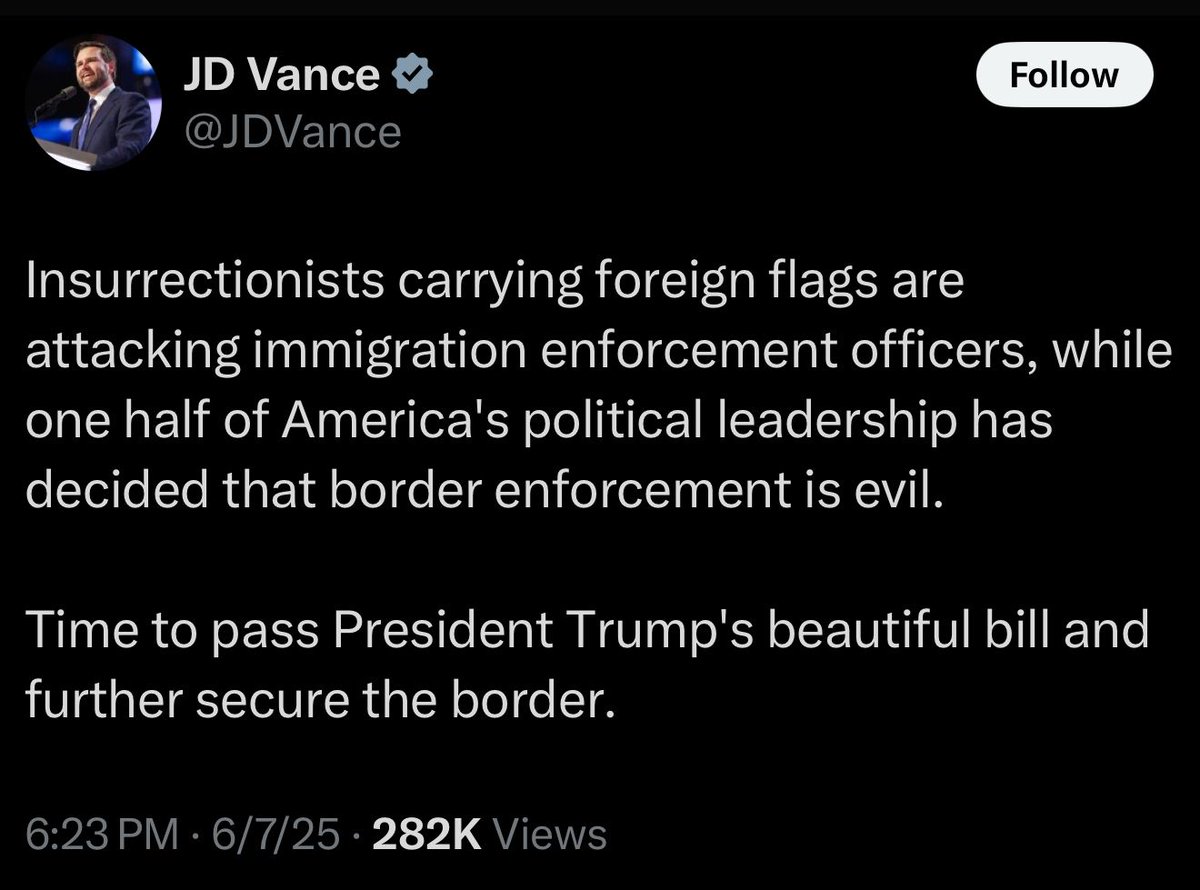
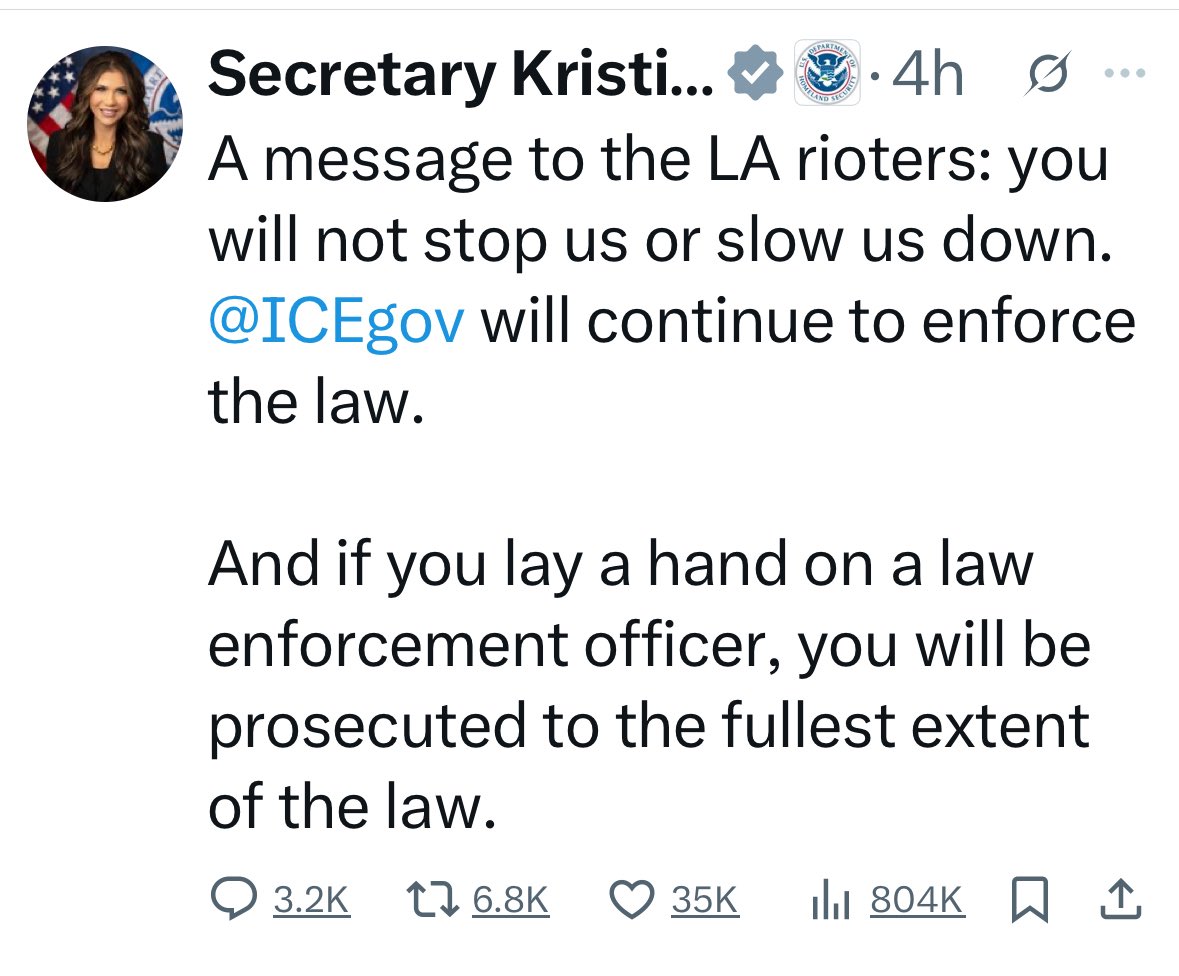
emptywheel (check)@emptywheelSEIU CA President David Huerta was assaulted and arrested for peaceful protest. The injuries the assault caused required hospital care.QuoteJD Vance@JDVanceReplying to @JDVanceFor the far left rioters, some helpful advice; peaceful protest is good. Rioting and obstructing justice is not.Post
See new postsConversation
NAACP@NAACPDeploying troops to communities already under pressure is not leadership—it’s provocation. The Trump Administration is weaponizing fear to divide and destabilize. We will not be silent. We stand with those targeted and terrorized. We fight for justice. Always.QuoteGavin Newsom@GavinNewsomThe federal government is taking over the California National Guard and deploying 2,000 soldiers in Los Angeles — not because there is a shortage of law enforcement, but because they want a spectacle. Don’t give them one.
Brian Allen@allenanalysisSubscribeIn case you were wondering what sparked the LA standoff between protesters and federal agents, this is it. Immigrants showed up for routine ICE check-ins and were detained on the spot. Hauled into the basement. Held overnight like fugitives. No warning. No due process. Just snatched. “Land of the free,” right?
Republicans against Trump@RpsAgainstTrumpSubscribeDuring his first term, Trump asked Defense Secretary Mark Esper to shoot protesters. Esper refused. Now he has Pete Hegseth. God help us allJD Vance now wants to use the chaos ICE is causing in Los Angeles as pretext to pressure politicians to pass the Republican budget bill that will saddle Americans with trillions of dollars of debt, skyrocket the deficit, take away people’s healthcare, and give massive tax breaks to the wealthy.
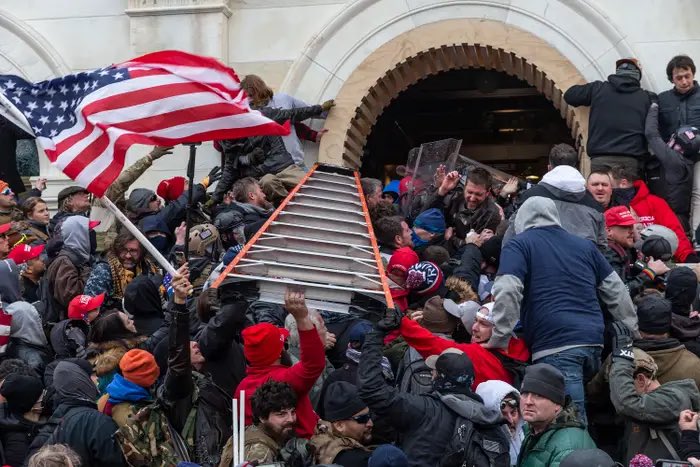
Jo@JoJoFromJerzSubscribeWeird how he didn’t call up the National Guard on January 6th.
Post
See new postsConversation
Crooks and Liars@crooksandliarsTrump sends in his brown shirts to cause disruption so he can use the insurrection act or whatever fucked rational he comes up with to send in the the National G. Mussolini gives a thumbs up in his grave.QuoteMeidasTouch@MeidasTouchTrump lit the match, poured the gasoline, and now wants to use the blaze he is creating as pretext to burn it all down.
Turnbull@cturnbull1968I have $20 that says she shows up in LA, wearing a special commando outfit, hair extensions and a camera crew in tow.
Madden@maddenificoA powder keg is about to explode: With masks to hide their identity, this is what a Nazi takeover of the streets of Los Angeles looks like. Trump’s cosplaying ICE Gestapo is carrying out a lawless assault against one of the most diverse cities in America.
Watch on XPost
ReplySee new postsConversation
Teamsters California@TeamstersCA
JerryRigEverything@ZacksJerryRigI was told ICE was going to arrest gangsters and mobsters. But all I see is fat white guys in cosplay doin jobsite raids, school raids, and arresting mothers with kids who are applying for citizenship.
Stephen Miller@StephenMYou have no say in this at all. Federal law is supreme and federal law will be enforced.
Molly Ploofkins@MollyploofkinsAsk yourself why ICE is conducting raids in cities like LA and Chicago, where they face strong opposition, while massive agribusinesses in places like Kristi Noem’s South Dakota remain untouched.
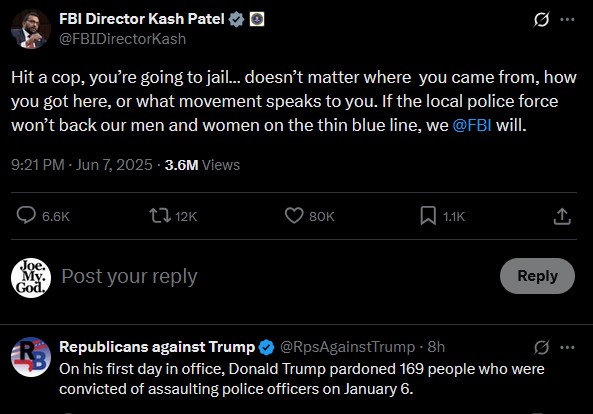
Mike Nellis@MikeNellisYour boss pardoned cop beaters at the January 6th riot
Amee Vanderpool@girlsreallyruleThis guy is living out his camo fantasy right now like it’s a game. Disgusting.
Maine@TheMaineWonk“Those aren’t protestors. Those are Feds.” Did I do this right, MAGA?
Turnbull@cturnbull1968President Obama deported 3 million people and managed to do so without using stormtroopers and the National Guard. Like everything else, Obama was better at that too.
Brett Bruen@BrettBruenJust so we are clear – this is what an insurrection actually looks like:
Marlene Robertson@marlene4719This bloodthirsty fascist pig is longing to shoot people ever since his first term.
Turnbull@cturnbull1968Trump is sending in highly visible and armored ICE agents to LA and other big cities. He’s deliberately creating conflict so he can federalize the National Guard to go in and start hurting American citizens. That’s the end game.
Watch on X
Jon Favreau@jonfavs