Well, this should be fun! Funny, I mean…

Trump plans rallies in solidly Democratic states in an unorthodox strategy for the election’s final weeks

The stops will take him to Coachella in California and Madison Square Garden in New York.

By Matt Dixon and Allan Smith

Get ready for Donald Trump’s blue state extravaganza. 

With less than four weeks until Election Day, Trump is scheduled to hold rallies in staunchly Democratic states he has virtually no chance of winning. It’s an unorthodox strategy campaign advisers say is designed to focus on areas where Democratic policies have failed, but it will also keep him away from the small handful of swing states almost certain to determine the election.

Over the next month, the former president has events scheduled in Colorado, California, Illinois and New York. President Joe Biden won those states by an average of 20 points in 2020, with his 13-point Colorado win the closest margin. Colorado is the only one of those states to vote for a Republican nominee for president this millennium, backing George W. Bush in 2004.

While each event will be held in slightly different venues, the most notable will be later this month in Madison Square Garden, a place where Trump has long said he wanted to hold political rally.

“Choosing high-impact settings makes it so the media can’t look away and refuse to cover the issues and the solutions President Trump is offering,” said a senior Trump campaign adviser of the strategy behind late-election cycle events in Democratic states. “We live in a nationalized media environment and the national media’s attention on these large-scale, outside-the-norm settings increases the reach of his message across the country and penetrates in every battle ground state.”

“President Trump is closing the campaign highlighting the problems the country faces as a result of Harris and Biden’s failed leadership and articulating his solutions to solve the problems they created,” the adviser added.

The decision to deviate from a traditional campaign playbook comes at a time when the race is almost certain to be decided in places like Georgia, Pennsylvania, Nevada, North Carolina, Wisconsin and Michigan, places that are within the margin of error in most public polling and considered winnable for both Trump and Vice President Kamala Harris.

“This does not seem like a campaign putting their candidate in critical vote rich or swing vote locations — it seems more like a candidate who wants his campaign to put on rallies for optics and vibes,” longtime Republican operative Matthew Bartlett said. 

He called Trump the “most unorthodox candidate in modern history,” which means the off-script strategy could have some value.

“In 2016, Trump realigned the party to be much more rural and working class, now in 2024 he is trying to expand his voting base along certain cultural lines that may eat away at traditional Democratic voting blocs,” Bartlett said.

A second Trump adviser said that no matter where Trump holds rallies, he gets huge online viewership, including in swing states, and there is a confidence within the campaign about their chances, which in their estimation allows for some risk.

“Certainly we are bullish on our prospects writ large,” the adviser said.

Some Trump supporters argued that going into areas of the country traditionally not visited by Republican presidential candidates could have a sort-of coattail effect, helping boost down-ballot Republicans in tough races. None of the states where Trump is visiting has a competitive Senate race, but there are a handful of competitive House races in a year where the majority of that chamber will likely be decided on a razor-thin margin.

In California, House District 40 is represented by Republican Young Kim, and House District 41 is represented by Republican Ken Calvert, both of whom are in contested races in the Los Angeles media market along with Coachella, which is where Trump will be holding his rally.

In New York, Rep. Mike D’Esposito won Nassau County’s 4th district in 2022, but it is a seat that leans Democratic and was won by Joe Biden by 15 points in 2020. Flipping the seat played a big role in helping Republicans take the House majority in 2022.

“The fact that we can pickup down ballot seats with President Trump’s aggressive travel plan is a testament to the well orchestrated and  effective campaign plan that focuses on unifying all Americans,” said Ed McMullen, a Trump donor who served as ambassador to Switzerland during the Trump administration. 

“It is a well-planned effort to reach out and win key seats,” he added.

https://www.nbcnews.com/politics/2024-election/trump-rallies-solidly-democratic-states-unorthodox-strategy-rcna174674

Let’s talk about Trump, Biden, Putin, and secrets….

Let’s talk about Trump, Cat 5 hurricanes, and bad info….

Let’s talk about Trump, Harris, their budgets, and debt….

Peace & Justice History for 10/8:

October 8, 1945
President Harry S. Truman announced that the secret of the atomic bomb would be shared only with Great Britain and Canada.
October 8, 1982
The Polish Parliament overwhelmingly approved a law banning Solidarnos´c´ (Solidarity), the independent trade union that had captured the imagination and allegiance of nearly 10 million Poles.
Solidarnosc leader Lech Walesa, 1982
The law abolished all existing labor organizations, including Solidarity, whose 15 months of existence brought hope to people in Poland and around the world but drew the anger of the Soviet and other Eastern-bloc (Warsaw Pact) governments.
The parliament created a new set of unions with severely restricted rights.

https://www.peacebuttons.info/E-News/peacehistoryoctober.htm#october8

Even more violence and asshole stuff from the right.

 Trump has a long history of endorsing police violence, having said that police reaction to the racial unrest in response to the murder of George Floyd in 2020 “was a beautiful thing to watch.”

The former president, who risks jail time and more criminal trials if he loses, has expanded his range of baseless attacks on U.S. voting procedures in recent weeks and months. Trump falsely claimed Monday that Democrats are exploiting an overseas ballot program for expats and military members in order to circumvent “any citizenship check or verification of identity.”

Look at the projection in the next story.  Look the only end might be the clawing back some of the taxes owned to the public treasury from the wealthy people who constantly want more and more public funds only for themselves.  The only loss will be a white majority nation, and Elon Musk is a full out South African racist bigot.  Full out racist bigot.  He is not worried about voting, he is a white man.  He is worried brown / black people will get to vote.   He and tRump talk bad about Haitians and immigrants while hiring them on the cheap.   Hugs.  Scottie

David Pakman recently released a video of Donald Trump’s greatest cognitive hits and when seen in total is something to behold:

These maga gang thugs think they can get away with anything and that they don’t have to obey any laws or rules.   Hate rules their lives.  It may have been this guy who said he wrote the bill because he couldn’t stand that kids were coming out at school and being accepted by other students instead of targeted for abuse.  He wants LGBTQ+ kids to be scared to be themselves and to stay in the closet hiding from them straight cis bullies.   Hugs.  Scottie

Fine was in court due to a lawsuit involving a Brevard County election official. As I’ve said here before, he is probably the most obnoxious of all Florida lawmakers, which is really saying something.

He last appeared here when DeSantis vetoed funding for a “woke zoo” because it wouldn’t host a fundraiser for Fine.

Fine also appeared on JMG in May 2022 when he tweeted what many interpreted as a threat to assassinate President Biden. That tweet remains online.

Before that, Fine appeared on JMG when he called for felony charges after Florida Democrats staged a sit-in over the racist US House map submitted by DeSantis. 

And before that, he appeared here when he threatened to defund a Florida Special Olympics event and called a local school board member a “whore” because she’d been invited its fundraiser gala and he was not.

Fine was a sponsor of the bill that stripped Disney’s self-governing status. His family owns annual passes to the “woke” theme park giant.

In 2022, he arranged for a Florida town to honor a war criminal who was convicted of executing four Iraqi prisoners. In April 2023 he declared, “Damn right, we ought to erase” LGBTQs.

Fine is also a sponsor of Florida’s bill criminalizing drag shows in view of minors. Of note, his wife runs a self-described “sultry” burlesque show that would violate her husband’s law.

As you’ll see in the video report, Feldman demanded that the school display the black and white version of the “straight pride” flag seen below.

Hit the link for other already known examples of Trump withholding federal relief from blue states. Earlier this week Trump posted that Biden was withholding relief from “Republican areas” in North Carolina.

Popp is posting screenshots of the threats on the bakery’s Facebook page.

Bathrooms with a view: Cutting windows into student restrooms is a new level of weird

https://www.yorkdispatch.com/story/opinion/editorials/2024/10/02/bathrooms-with-a-view-cutting-windows-into-student-restrooms-is-a-new-level-of-weird/75479753007/

I bet the next election will be well attended and these people will lose their seats and new progressive inclusive people will win.  That is what has happened all over when the right bigots and haters snuck into school board seats, they go too far trying to erase the LGBTQ+ kids / people from existence, then they get kicked out.   Sadly by then the damage is done.  What they hell do they want people perving on kids in the bathrooms for?  To make the kids scared to use them and to make sure the weird kids are not doing weird gay stuff in them, right?    Hugs.  Scottie.

By the way.  We have a hurricane headed right at us.  It will be here Wednesday at around noon, but we have three days of wind and rain beforehand.  It will hit at a class three.  It is projected to hit just above us but could hit us directly.  We will be spending the next few days getting as much done as possible, stocking in cat food Ron forgot and getting more gas and propane for the generator.  It is unlikely that pole of ours will survive another storm as it is already leaning hard.  Repair crews are already stretched thin in other areas so won’t be able to come rescue us in our time of need.  Going to be a very long few months.  Hugs.  Scottie

YORK DISPATCH EDITORIAL BOARD
York Dispatch


At the risk of stating the obvious, South Western’s elected school board is making some strange decisions.

For the last two years, they’ve fixated on which bathrooms LGBTQ+ kids use. In 2023, officials in this Hanover-area district played musical chairs with school bathrooms in a misguided attempt to appease the loudest bigots among them — ending up with five different types of bathrooms.

After a low-turnout school board election in which several far-right members joined their ranks, they hired a Christian law firm, decided to begin banning books and reopened the bathroom issue. Board President Matthew Gelazela, who was elevated to his post after previously serving as the board’s most vocal bomb-thrower, pointed to Red Lion’s discriminatory policies as something to aspire to.

UPDATE:Amid parent complaints and national scrutiny, South Western School District boards up bathroom windows

Now, upon the advice of that law firm — the Harrisburg-based Independence Law Center — the board approved spending $8,700 to cut windows so passersby can look into the so-called “gender-identity” student bathrooms.

Yes, you read that correctly.

These adults want to make it easier for other people to watch your children while they’re in the bathroom. It’s absolutely mind-boggling.

For more than a year, South Western School Board officials have grappled with how LGBTQ+ students use the bathroom. Most recently, school officials cut windows into Emory H. Markle Middle School's gender neutral restrooms, allowing anyone passing by to peer inside.

For more than a year, South Western School Board officials have grappled with how LGBTQ+ students use the bathroom. Most recently, school officials cut windows into Emory H. Markle Middle School's gender neutral restrooms, allowing anyone passing by to peer inside.
 

Gelazela, who’s steadfastly refused to explain the logic here, said in a public meeting that the windows help “[add] privacy in the toilet facility” and that they “increase oversight of the wash area.”

There’s a reason public restrooms tend not to have windows — or, if they do, they have frosted glass.

No one wants to be spied on when they’re relieving themselves.

Gelazela, in pursuing his book ban, repeatedly said he’s trying to protect the children.

But this latest decision does just the opposite.

More:Parents question school that cut windows into student bathrooms amid anti-LGBTQ+ push

More:‘Our politics can be done with a sense of joy,’ Tim Walz tells York crowd

The parents who spoke to The York Dispatch about the latest bathroom renovations said their children no longer feel comfortable using these bathrooms. One of the parents went to the principal and asked for an exemption to allow her son to use a different bathroom further away from class.

Her 13-year-old doesn’t want to be spied on while he’s in the bathroom.

And we don’t blame him.

It’s creepy and weird.

And let’s not ignore the bigger picture: This is happening at a time when this and other York County school boards are pushing policies that would restrict what books students read, what sports teams they compete on and even which pronouns they use.

All of this is part of an attempt to erase LGBTQ+ people.

Cutting a window into these bathrooms is an intimidation tactic designed to make sure students who use the so-called “gender-identity” facilities — and, let’s be honest, any student who doesn’t fit neatly into the worldview of the school board’s far-right majority — know they’re being watched, controlled and judged.

In their quest to punish LGBTQ+ kids, however, the misguided “adults” on this South Western School Board are doing the things they accuse others of doing.

This is an invasion of privacy and a waste of taxpayer dollars.

It needs to stop.

10 Unusual Objects Related to Presidents and Elections

The Smithsonian National Museum of American History houses thousands upon thousands of artifacts. Here are some of the more unusual items from their collection.

Don Vaughan

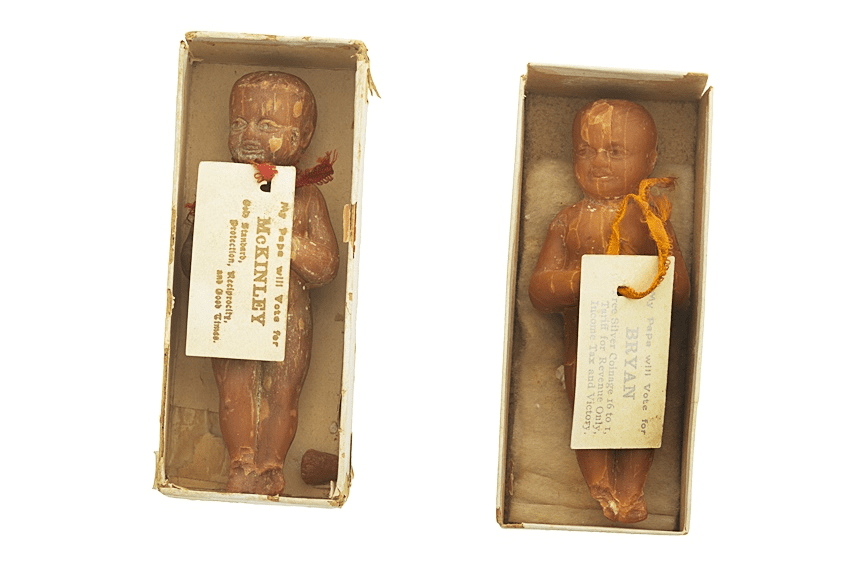
(And former Pres. McKinley is again a feature…)

Soap babies of Republican William McKinley and Democrat William Jennings Bryan from the 1896 election (The Smithsonian National Museum of American History)

The Smithsonian Institution in Washington, D.C. was formally established on August 10, 1845, and over the years has amassed more than 157 million items across 21 museums and galleries. The Smithsonian National Museum of American History houses artifacts related to national elections and the presidency. We offer a look at some of the most unusual.

All images courtesy of The Smithsonian Institution unless otherwise noted

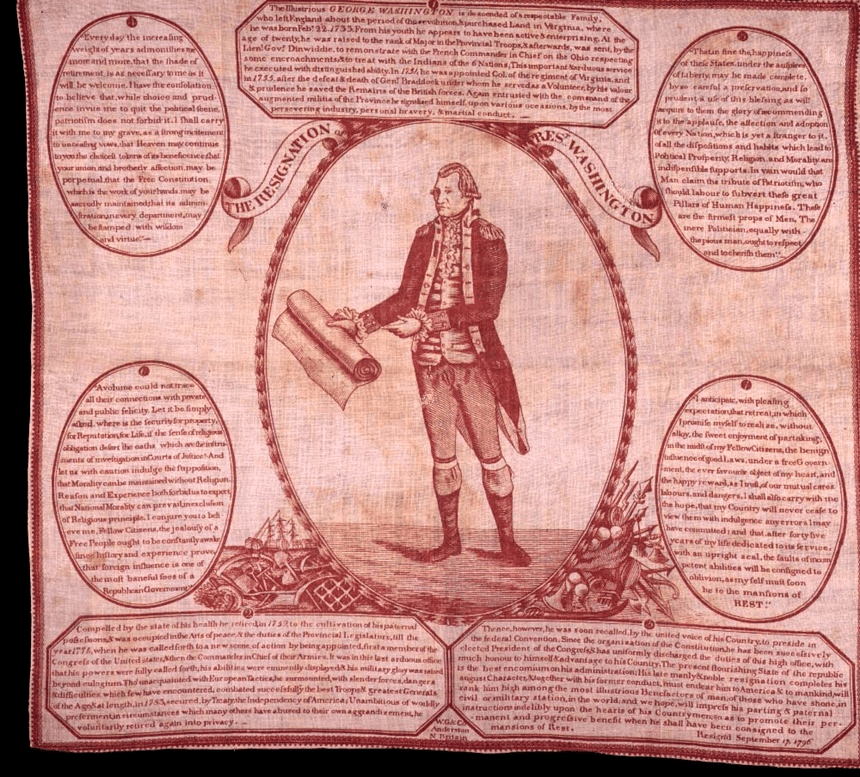
1. Bandana Featuring Excerpts from George Washington’s Farewell Address

In which Washington encouraged all Americans to put aside regional and party divisions in support of the newly formed republic. Observed Washington, “Your Union ought to be considered as a main prop of your liberty, the love of the one ought to endear you to the preservation of the other.”

2. Presidential Hair Cabinet

John Varden, keeper of collections for the National Institute for the Promotion of Science at the U.S. Patent Office, began collecting locks of hair from prominent individuals in 1850 and quickly amassed a collection that included presidents, senators, artists, and other luminaries. Varden’s presidential hair collection includes strands from George Washington and Franklin Pierce.

(snip-MORE on the page; the photos are good.)

Why? Why, Why, Why?

do we have to relive this history again and again and again? How is it going to go differently if it’s tried yet another time? Seriously!

October 5, 2024 by Heather Cox Richardson Read on Substack

William McKinley is having a moment (which I confess is a sentence I never expected to write). 

Republican presidential nominee Donald Trump is elevating McKinley, representative from Ohio from 1877 to 1891 and president from 1897 to 1901, to justify his plan to impose new high tariffs. 

Trump’s call for tariffs is not an economic plan; it is a worldview. Trump claims that foreign countries pay tariff duties and thus putting new tariffs of 20% on all imports, and as much as 60% on Chinese imports, will bring enough foreign money into the country to fund things like childcare, end federal budget deficits, and pay for the tax cuts he wants to give to the wealthy and corporations.

This is a deliberate lie. Tariffs are essentially taxes on imported products, and they are paid not by foreign countries but by American consumers. Economists warn that Trump’s tariff plan would cost a typical family an average of more than $2,600 a year, with poorer families hardest hit; spike inflation as high as 20%; result in 50,000 to 70,000 fewer jobs created each month; slow economic growth; and add about $5.8 trillion in deficits over ten years. It would tank an economy that under the Biden administration, which has used tariffs selectively to protect new industries and stop unfair trade practices, has boomed.

Trump simply denies this economic success. He promises to make the economy great with a tariff wall. On September 27, he told rally attendees in Warren, Michigan: “You know, our country In the 1890s was probably…the wealthiest it ever was because it was a system of tariffs and we had a president, you know McKinley, right?… He was really a very good businessman, and he took in billions of dollars at the time, which today it’s always trillions but then it was billions and probably hundreds of millions, but we were a very wealthy country and we’re gonna be doing that now….”

By pointing to McKinley’s presidency to justify his economic plan, Trump gives away the game. The McKinley years were those of the Gilded Age, in which industrialists amassed fortunes that they spent in spectacular displays. Cornelius and Alva Vanderbilt’s home on New York’s Fifth Avenue cost more than $44 million in today’s dollars, with stables finished in black walnut, cherry, and ash, with sterling silver metalwork, and in cities across the country, the wealthy dressed their horses and coachmen in expensive livery, threw costly dinners, built seaside mansions they called “cottages,” and wore diamonds, rubies, and emeralds. When the daughter of a former senator married, she wore a $10,000 dress and a diamond tiara, and well-wishers sent “necklaces of diamonds [and] bracelets of diamonds, sapphires, and rubies.” 

Americans believed those fortunes were possible because of the tariff walls the Republicans had begun to build in 1861. Before the Civil War, Congress levied limited U.S. tariffs to fund the federal government, a system southerners liked because it kept prices low, but northerners disliked because established industries in foreign countries could deliver manufactured goods more cheaply than fledgling U.S. industries could produce them, thus hampering industrial development.

So, when the Republican Party organized in the North in the 1850s, it called for a tariff wall that would protect U.S. manufacturing. And as soon as Republicans took control of the government, they put tariffs on everything, including agricultural products, to develop American industry. 

The system worked. The United States emerged from the Civil War with a booming economy.

But after the war, that same tariff wall served big business by protecting it from the competition of cheaper foreign products. That protection permitted manufacturers to collude to keep prices high. Businessmen developed first informal organizations called “pools” in which members carved up markets and set prices, and then “trusts” that eliminated competition and fixed consumer prices at artificially high levels. By the 1880s, tariffs had come to represent almost half a product’s value.

Buoyed by protection, trusts controlled most of the nation’s industries, including sugar, meat, salt, gas, copper, transportation, steel, and the jute that made up both the burlap sacks workers used to harvest cotton and the twine that tied ripe wheat sheaves. Workers, farmers, and entrepreneurs hated the trusts that controlled their lives, but Republicans in Congress worked with the trusts to keep tariffs high. So, in 1884, voters elected Democrat Grover Cleveland, who promised to lower tariffs.

Republicans panicked. They insisted that the nation’s economic system depended on tariffs and that anyone trying to lower them was trying to destroy the nation. They flooded the country with pamphlets defending high tariffs. Cleveland won the popular vote in 1888, but Republican Benjamin Harrison won the electoral votes to become president. 

After the election, steel magnate Andrew Carnegie explained that the huge fortunes of the new industrialists were good for society. The wealthy were stewards of the nation’s money, he wrote in what became known as The Gospel of Wealth, gathering it together so it could be used for the common good. Indeed, Carnegie wrote, modern American industrialism was the highest form of civilization. 

But low wages, dangerous conditions, and seasonal factory closings and lock-outs meant that injury, hunger, and homelessness haunted urban wage workers. Soaring shipping costs meant that farmers spent the price of two bushels of corn to get one bushel to market. Monopolies meant that entrepreneurs couldn’t survive. And high tariffs meant that the little money that did go into their pockets didn’t go far. By 1888 the U.S. Treasury ran an annual surplus of almost $120 million thanks to tariffs, seeming to prove that their point was to enable wealthy men to control the economy.

“Wall Street owns the country,” western organizer Mary Elizabeth Lease told farmers in summer 1890. “It is no longer a government of the people, by the people, and for the people, but a government of Wall Street, by Wall Street, and for Wall Street.” As the midterm elections of 1890 approached, nervous congressional Republicans, led by Ohio’s William McKinley, promised to lower tariff rates.

Instead, the tariff “revision” raised them, especially on household items—the rate for horseshoe nails jumped from 47% to 76%—sending the price of industrial stocks rocketing upward. And yet McKinley insisted that high tariff walls were “indispensable to the safety, purity, and permanence of the Republic.” 

In a chaotic congressional session with members shouting amendments, yelling objections, and talking over each other, Republicans passed the McKinley Tariff in May 1890 without any Democratic votes. They cheered and clapped at their victory. “You may rejoice now,” a Democrat yelled across the aisle, “but next November you’ll mourn.” 

Democrats were right. In the November 1890 midterm elections, angry voters repudiated the Republican Party. They gave the Democrats a two-to-one majority in the House; McKinley himself lost his seat. Even Republicans thought their party had gone too far, and in 1892, voters gave Democrats control of the House, Senate, and White House for the first time since before the Civil War. 

Republican stalwarts promptly insisted that Democrats would destroy the economy by cutting tariff rates, and their warnings crashed the economy ten days before Cleveland took office. Democrats slightly lowered the tariff, replacing the lost income with an income tax on those who made more than $4,000 a year. Republicans promptly insisted the Democrats were instituting socialism. 

As the nation recovered from the economic panic of 1893, Republicans doubled down on their economic ideology. In 1896 they nominated McKinley for president. While he stayed home and kept his mouth shut, the party flooded the country with speakers and newspaper articles paid for with the corporate money that flowed into the Republicans’ war chest, all touting the protective tariff. Warned that the Democrats were trying “to create a red welter of lawlessness as fantastic and as vicious as the dream of a European communist,” voters elected McKinley. 

And then the Republicans had a stroke of luck. After the election, the discovery of gold on Bonanza Creek near the Klondike River in Canada’s Yukon Territory brought enough gold into the U.S. to ease the money supply, letting up pressure on both farmers and workers, and the fight over the tariff eased. 

It reemerged in 1913 when Democratic president Woodrow Wilson challenged the ideology behind Republican tariffs. A Democratic Congress cut tariff rates almost in half, from close to 50% to 25%, and to make up for lost revenue, Democrats put a tax on incomes over $3,000. Republicans complained that the measure was socialistic and discriminated against capitalists, especially the Wall Street community. 

As soon as Republicans regained control of the government, they slashed taxes and restored the tariff rates the Democrats had cut. This laid the groundwork for World War II by making it difficult for foreign governments to export to the United States and thus earn dollars to pay their debts from World War I. 

It also recreated the domestic economy of the 1890s. Congress gave the president power to raise or lower the tariffs at will, and in the 1920s, Republican presidents Harding and Coolidge changed tariff rates thirty-seven times; thirty-two times they moved rates upward. (They dropped the rates on paintbrush handles and bobwhite quails.) Business profits rose but wages did not, and wealth moved upward dramatically. By 1929, 5% of the population received one third of the nation’s income, and more than 60% of American families earned less than they needed for basic necessities.

When the bottom fell out of the stock market in 1929, ordinary Americans had too little purchasing power to fuel the economy. In June 1930, Republicans fell back on their faith in tariffs once again when they passed the Smoot-Hawley Tariff,* raising rates to protect American business. Other countries promptly retaliated, and the resulting trade war dramatically reduced foreign trade, exacerbating the Great Depression. 

When Smoot-Hawley failed, it took with it Americans’ faith that tariffs were the key to a strong economy. After World War II, ideological fights over the structure of the economy would be waged over taxes rather than tariffs.

Trump’s insistence that a tariff wall will make America rich is not based in economics; indeed, it would destroy the current system, which is so strong that modern economists are marveling. Trump is fantasizing about a world without regulations or taxes, where high tariffs permit the wealthy to collude to raise prices on ordinary Americans and to use that money to live like kings while workers, farmers, and entrepreneurs barely scrape by… a world like McKinley’s. 

…..

*In 2009, then-representative Michele Bachmann (R-MN) made history by referring to this as the “Hoot-Smalley” tariff and blaming FDR for passing it (FDR didn’t take office until 1933).

Notes: (on the page; some links don’t embed properly.) (snip)

Peace & Justice History for 10/6

(Peace History’s links were misdirected for a few days, but the links are back now.)

October 6, 1683
Thirteen Mennonite families from the German town of Krefeld arrived in Philadelphia on the ship Concord. Having endured religious warfare in Europe, the Mennonites were pacifists, similar to the Society of Friends (often known as Quakers) who opposed all forms of violence. The first Germans in North America, they established Germantown which still exists as part of Philadelphia.
Modern Mennonite peace activism: 
October 6, 1955
Poet Allen Ginsberg read his poem “Howl” for the first time at Six Gallery in San Francisco. The poem was an immediate success that rocked the Beat literary world and set the tone for confessional poetry of the 1960s and later.
“Howl and Other Poems” was printed in England, but its second edition was seized by customs officials as it entered the U.S. City Lights, a San Francisco bookstore, published the book itself to avoid customs problems, and storeowner (and poet) Lawrence Ferlinghetti was arrested and tried for obscenity, but defended by the American Civil Liberties Union (ACLU).


Working on Howl in San Francisco,
circa June, 1956
Following testimony from nine literary experts on the merits of the book, Ferlinghetti was found not guilty.

Lawrence Ferlinghetti outside City Lights 
More about City Lights 
Read Howl 
Read more about Allen Ginsberg 
 
October 6, 1976
An airliner, Cubana Airlines Flight 455, exploded in midair, killing 73 mostly young passengers including the entire Cuban youth fencing team. The plot was engineered by Orlando Bosch and Luis Posada Carriles, a Cuban former CIA agent, who was based in Venezuela at the time.

The Posada Carriles file from the National Security Archive 
October 6, 1978
346 protestors were arrested at the site of the proposed Black Fox Nuclear Power Plant in Inola, Oklahoma.
In 1973 Public Service of Oklahoma announced plans to build the Black Fox plant about 15 miles from Tulsa.
It was also near Carrie Barefoot Dickerson’s family farm. She became concerned as a nurse and a citizen about the potential health hazards.
Carrie Barefoot Dickerson
Through her group, Citizens’ Action for Safe Energy (CASE), and the consistent opposition of informed and persistent allies, the project was canceled in 1982. There are no nuclear plants in the state of Oklahoma, and no nuclear plant has been built in the U.S. since then.
Carrie Dickerson Foundation 
October 6, 1979

Seabrook Nuclear Power Plant protest – late 1970s
Over 1400 were arrested at Seabrook, New Hampshire, the construction site of two new nuclear power plants. The occupation was organized by the Clamshell Alliance.
Clamshell history 

https://www.peacebuttons.info/E-News/peacehistoryoctober.htm#october6