June 18, 1571 King Sebastian of Portugal enacted penalties for violation of censorship legislation. The fines could be as much as a quarter or half of the violator’s legal possessions, plus the threat of exile to Brazil or an African colony. Death sentences were also not uncommon. Seized books were burned and burnings were supervised by Roman Catholic priests.
June 18, 1840 The Oberlin Non-Resistance Society was formed at the Ohio college by students who believed “that the Gospel of Jesus Christ inculcates the duty of peace and good-will.” They were inspired by abolitionist William Lloyd Garrison’s New England group of similar name. They rejected all use of violence even in the name of duty to country. “We must submit to the ‘powers that be,’ and ‘obey magistrates,’ except when their requirements conflict with God’s laws; when we are meekly to endure the penalty of disobedience ‘threatening them not.’ ” Though denounced by the faculty and ignored by the student newspaper, the group was among the first in a succession of peace- and justice-oriented organizations begun at Oberlin. Oberlin’s peaceful tradition
June 18, 1941 Less than two weeks before a scheduled march on Washington, its chief organizer, (Asa) A. Philip Randolph, was invited to the White House byPresident Franklin Roosevelt. Randolph was the president of the Brotherhood of Sleeping Car Porters, the first successful black trade union. He, along with activist and singer Bayard Rustin, had issued a “Call to Negro America to March on Washington for Jobs and Equal Participation in National Defense on July 1, 1941.” Roosevelt was wary of the prospect of such a demonstration and desirous of developing support for a war effort. Randolph told Roosevelt he would abandon the march plans only if the president would stop job discrimination in both the defense industry and the government. Before the end of the month, Roosevelt signed Executive Order 8802, which barred government contractors from discriminating in hiring on the basis of race, color, creed or national origin. A. Philip Randolph and Eleanor Roosevelt The order, sometimes called a second emancipation proclamation, was the federal government’s most significant action on behalf of the rights of African Americans since post-Civil War reconstruction of the 1870s.
June 18, 1948 A United Nations commission approved and recommended to the General Assembly an International Declaration of Human Rights, recognizing that “the inherent dignity and . . . the equal and inalienable rights of all members of the human family is the foundation of freedom, justice and peace in the world . . . .” Text of the Declaration: . . .
June 18, 1970 The U.S. Congress passed the 26th amendment to the constitution, lowering the voting age to 18 for all elections—federal, state and local. The amendment went into effect just 100 days later after 38 state legislatures had ratified the amendment.
June 18, 1979 SALT II (Strategic Arms Limitation Treaty), an agreement to put limits on both America’s and the Soviet Union’s long-range missiles and bombers, was signed by Presidents Jimmy Carter and Leonid Brezhnev. This was the first arms-reduction treaty between the two superpowers. It was signed despite the Soviet invasion of Afghanistan the previous year. Read more on SALT II’s control of weapons of mass destruction
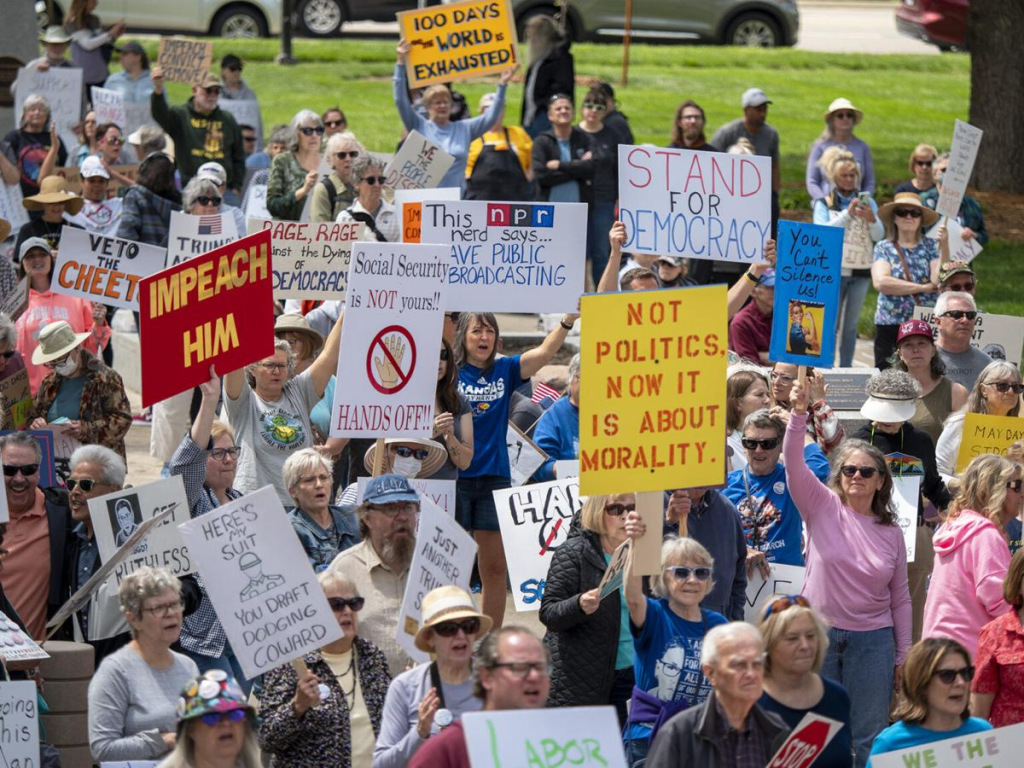
TOPEKA — State troopers are on standby in Kansas as demonstrations against federal immigration raids crop up around the country following an increased military presence in response to protests in Los Angeles.
The Kansas Highway Patrol is aware of Kansas City-area protests this week, said April McCollum, a spokeswoman for the agency.
Protests in LA began Friday, mostly in downtown and central parts of the city, in opposition to targeted, sweeping raids from federal immigration officials that result in the arrest and detention of immigrants lacking permanent legal status. The demonstrations escalated once President Donald Trump ordered thousands of members of the California National Guard to the city’s streets, against the wishes of state leaders. Protesters in dozens of other cities joined their LA counterparts Tuesday.
Col. Erik Smith, superintendent of the state highway patrol, told legislators Tuesday that a protest similar to those in LA was planned in the Johnson County area, but the agency did not disclose specifics when asked. The only report of a protest in the area Tuesday occurred in Kansas City, Missouri’s downtown and Westside, drawing hundreds of attendees, according to reporting from The Kansas City Star.
A slate of more than 1,800 protests are scheduled across the nation for Saturday. More than a dozen of them are set to occur in Kansas cities, from Garden City to Hiawatha to Arkansas City to the Kansas City area.
“We encourage those involved to maintain civility while exercising their First Amendment rights,” McCollum said. (snip-MORE that diverts into interesting conversation about immigration sweeps and our gubernatorial race later on.)
In keeping with the FAFO world we seem to be living in, just how far down the drain does this polished turd have to take our country before people call it enough. Remove the poison that is maga. Vote out these scum bags who enable him.
Hi everyone. I found this to be a hopeful sign. We need to excise, like an infection, the poison that has taken over our country’s leadership and too many of our citizens. And, in keeping with that, since they are a bunch of juvenile delinquents, perhaps the best person for the job is a pediatrician?
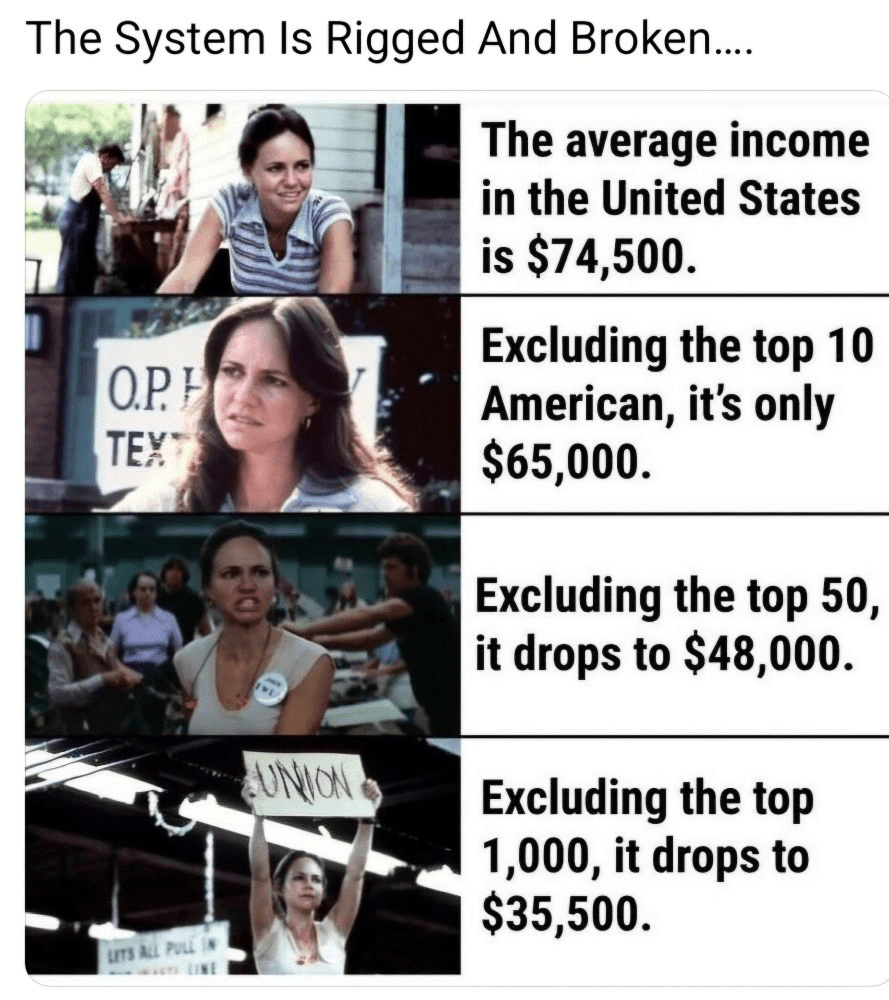
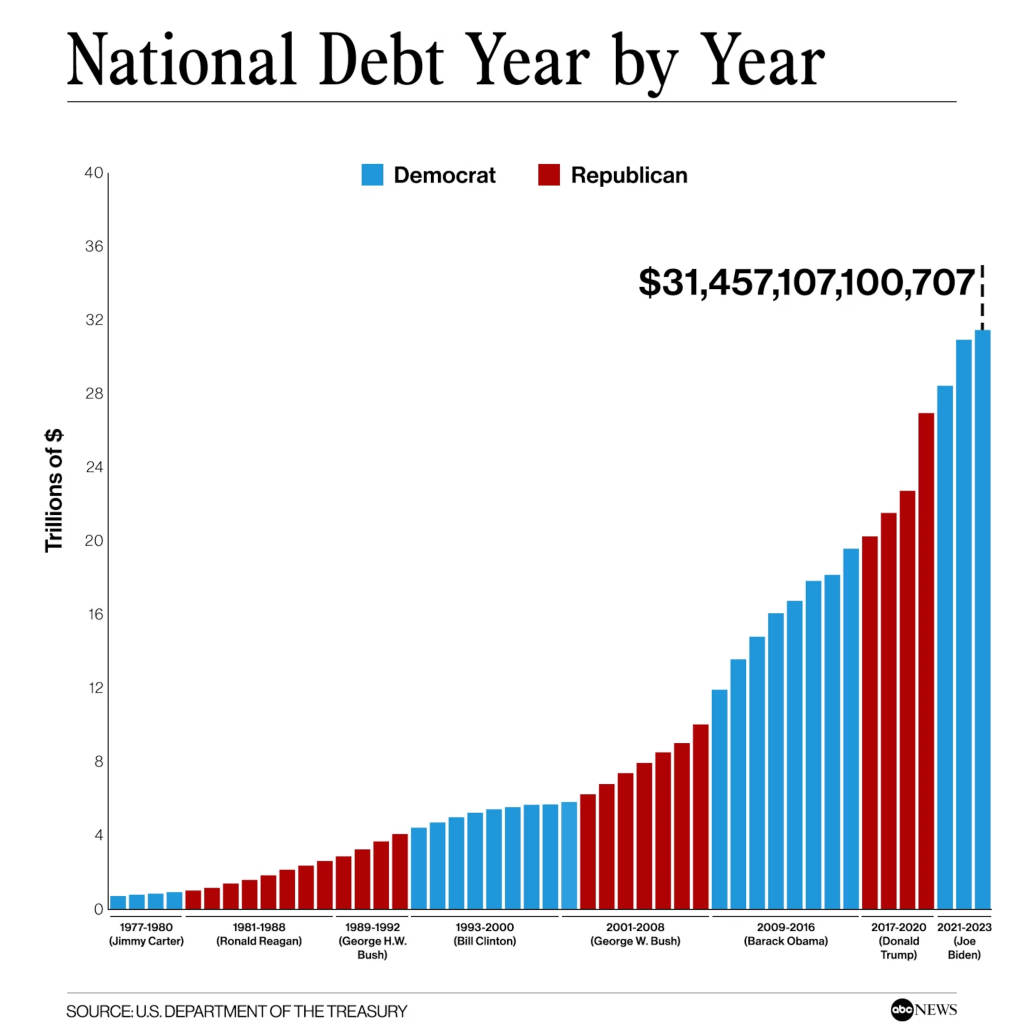
Hello all in Playtimeville! Yesterday I came by this meme and I was a bit shocked.
So I went to look it up. Googling the issue, I found that the bottom 90% of earners had an average wage of $36,571, and the federal poverty line for a household of 4 is $32,150.
Now, my father worked a good factory job, and I now supervise a fabrication plant. I don’t make, inflation calculated, what he made in 1990 – roughly when he retired. None of my people do. Interestingly, the job he had and a great many of the jobs like the one he had are gone now, moved off quite literally to India, China, Mexico and such. Those jobs are gone. Gone. Like the Bruce Springsteen song, they ain’t coming back.
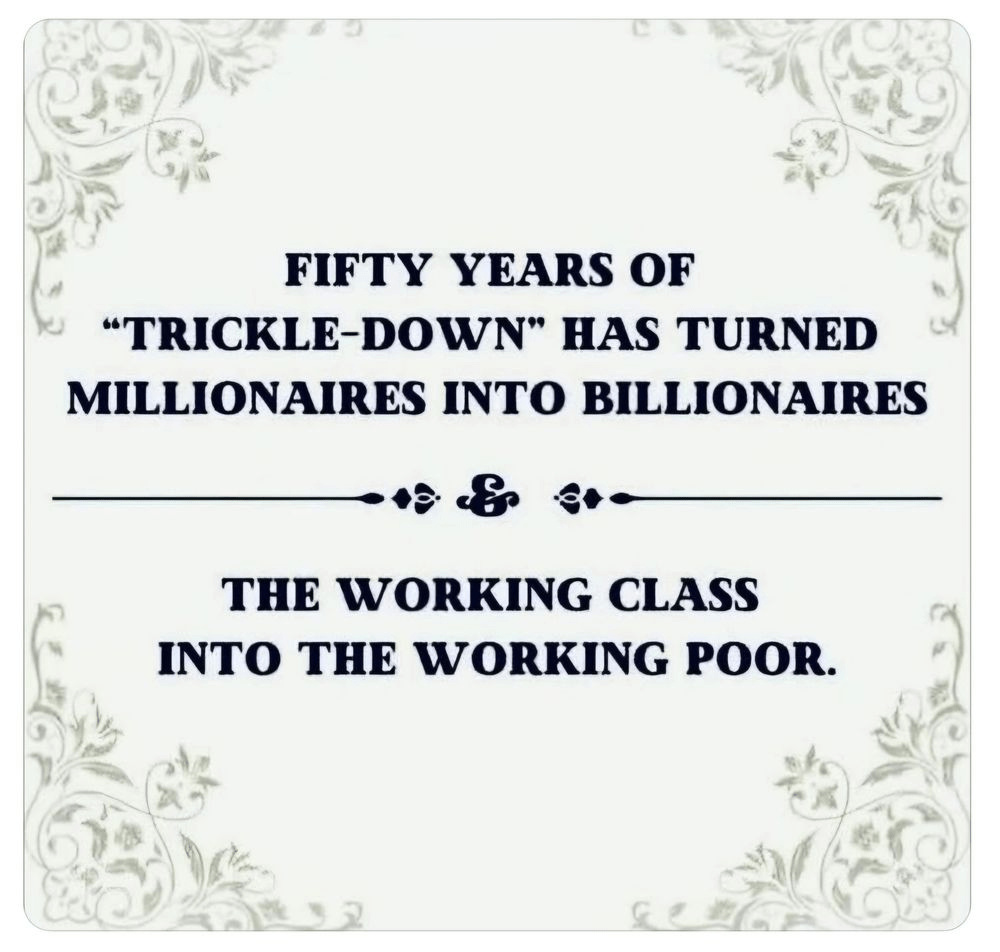
When you look at the debt situation, it is bleak as hell. But, when did those debts really start accumulating? Right after Ronald Reagan’s Trickle Down Economics – when three major events coincided: the idea that the wealthy know how to invest money better than the poor, and will therefore be the better custodians of that money, trickling it down to the labor classes; the globalization of industrial labor when companies could move their jobs off-shore for a fraction of the hourly wages; and the reduction in taxes that the top incomes would contribute on their astronomical earnings while increasing the taxes that the lesser incomes would pay.
When it gets to the end, there are a great many factors influencing the lives of the common American. I believe welfare and immigration are problems. I believe also that writing laws that you won’t pay for is also a problem!! Congress, regardless of party, has put the tab on the credit card for over 40 years and worsened the position for those who are not in the top 10% at every opportunity. Like every other business and family in the country, I believe the government must live within their means by forcing a law that the budget must balance. It is only then that we can solve some of the other problems facing our country – or more so, become unflinchingly aware of who the real problems are.
Dictator Donald wants everyone afraid and confused at all times. Verily, God says fuck that.
There is a better story I want to share.
Harvard just announced free online courses for every US citizen. Topics include basic government, the Constitution, and how to recognize a dictatorship.
Now that is how you defeat tyranny. Not with fear, or panic, but with knowledge. With clarity. With truth. And with stories of hope.
The fight is far from over. But we are not alone.
We will not go quietly. We will not forget. We will fight like hell. And we will win.
May 17, 1919 The Women’s International League for Peace and Freedom (WILPF) was formally established in Zurich, Switzerland.
May 17, 1954 In a major civil rights victory, the U.S. Supreme Court handed down a unanimous decision in Brown v. Board of Education, ruling “separate but equal” public education to be unconstitutional under the 14th Amendment, which guarantees equal treatment under the law. The historic decision, bringing an end to federal tolerance of racial segregation, specifically dealt with Linda Brown, a young African American girl denied admission to her local elementary school in Topeka, Kansas, because of the color of her skin. Read more and more Above: Nettie Hunt and her daughter Nickie on the steps of the U.S. Supreme Court, 1954. George E. C. Hayes, Thurgood Marshall and James M. Nabrit (left to right), the successful legal team, celebrate the Brown decision. . . three years later . . .
May 17, 1957 Martin Luther King, Jr. led 30,00 on a Prayer Pilgrimage to Washington, D.C. to mark the third anniversary of Brown vs. Board of Education decision in which the Supreme Court declared racial segregation in education unconstitutional.
May 17, 1968 A group of anti-war activists who came to be known as the “Catonsville Nine,” including Philip and Daniel Berrigan, broke into the Catonsville, Maryland, draft board center and burned over 600 draft files. The Catonsville Nine in a picture taken in the police station minutes after the action. From left to right (standing) George Mische, Philip Berrigan, Daniel Berrigan, Tom Lewis. From left to right (seated) David Darst, Mary Moylan, John Hogan, Marjorie Melville, Tom Melville. photo Jean Walsh Read more about the Catonsville Nine
May 17, 1970 100 protesters staged a silent “die-in” at Fifth Avenue and Pine Street in downtown Seattle to protest shipment through their city of Army nerve gas being transported from Okinawa, Japan, to the Umatilla Army Depot in eastern Oregon. Outrage and Rebellion
May 17, 1973 In Washington, D.C., the Senate Select Committee on Presidential Campaign Activities, headed by Senator Sam Ervin of North Carolina, began televised hearings on the escalating Watergate affair. One week later, Harvard Law Professor Archibald Cox was sworn in as Watergate special prosecutor. Flashback: On June 17, 1972, five men were arrested for breaking into the Democratic National Committee headquarters in the Watergate complex in Washington, D.C. with the intent to set up wiretaps. One of the suspects, James W. McCord, Jr., was revealed to be the salaried security coordinator for President Richard Nixon’s reelection committee.
May 17, 2004 Marcia Kadish, 56, and Tanya McCloskey, 52, of Malden, Massachusetts, were married at Cambridge City Hall in Massachusetts, becoming the first legally married same-sex partners in the United States. Over the course of the day, 77 other such couples tied the knot across the state, and hundreds more applied for marriage licenses. The day was characterized by much celebration and only a few of the expected protests materialized. Read more
I have bitterly wondered why people wouldn’t just go vote for whoever they had to, but to just vote, especially in the 2024 election. I’ve had a hard time with the non-voters. But, turns out, some of them have legitimate reasons (I’ve spoken with none,) but it turns out that not all the non-voters are asses. -A
Political tension and fears of violence may have depressed voter turnout in 2024
Women and gender-nonconforming people were more likely than men to fear violence and harassment while voting in the 2024 election, and those who expressed concerns about safety were more likely not to vote at all, new research shows.
The study, released Monday and shared first with The 19th, was conducted by States United Democracy Center, a nonpartisan organization focused on promoting fair and secure elections and upholding the rule of law.
“Tens of millions of Americans ultimately cast their ballots in 2024 without incident,” the report said. “But voting was not straightforward and safe for all Americans. Many were harassed, and a limited number were subjected to physical violence.”
The study found that the 2024 election was, as a whole, safe, fair and securely conducted, with voters overwhelmingly reporting feeling safe at the polls and confident in the safety and security of the election. But rising incidents of political violence, heightened political polarization and gender-based harassment had a measurable impact on how women and gender-noncomforming people especially viewed the safety of voting in the 2024 election — and whether they turned out to vote at all, the study says.
Researchers surveyed voters before and after the 2024 election in partnership with research data and analytics group YouGov and held a series of seven focus groups before the election — with three groups of White women, three groups of women of color and one made up of gender-nonconforming participants. They also fielded surveys of state lawmakers, election administrators and law enforcement officials in partnership with the nonprofit CivicPulse. The study is also one of the first of its kind to study the voting experiences of gender-nonconforming voters, who are subject to gender-based discrimination and harassment at the polls.
Women, people of color and gender-nonconforming people were more likely to have perceived the election environment as being unsafe, reported experiencing higher rates of voting-related harassment and were more likely to take precautionary measures when going to the polls. The study also compared pre-election survey responses to voting records and found that higher expectations of experiencing violence or harassment at the polls was correlated with lower voting rates.
“Concerns about violence or harassment depressed turnout, likely turning millions of voters into non-voters,” the report said.
The pre-election survey, conducted September 23 to 30, 2024, surveyed 4,016 American adults with a margin of error of plus or minus 1.7 points. The post-election survey, conducted November 7 to 19, surveyed a separate group of 4,017 registered voters with a margin of error of plus or minus 1.6 points. The researchers asked a series of questions to identify gender-nonconforming respondents in its surveys with YouGov, resulting in a sample of 81 gender-nonconforming voters in the pre-election survey and 103 in the post-election survey.
To measure fears of harassment and violence, researchers asked respondents how likely they thought it was to experience events ranging from verbal or written harassment to property damage and acts of physical violence. While all gender groups provided average responses of “somewhat unlikely” across all five, gender-nonconforming respondents had a higher expected likelihood of harassment or violence.
Overall, 91 percent of men, 89 percent of women and 73 percent of gender-nonconforming respondents said in the post-election survey that they felt safe voting. But respondents’ perceptions and feelings of safety varied by race among women and gender-nonconforming people. In the post-election survey, 92 percent of White respondents said they felt completely or mostly safe voting, compared with 85 percent of Black voters and 84 percent of Hispanic voters.
In pre-election surveys, women and voters of color were more likely than men and White respondents to view voting as unsafe and to say they were taking precautions as a result. Among women, the most common safety precaution respondents said they were likely to take was not bringing their children to the polls (32 percent), while the most common safety precaution for gender-nonconforming people was not interacting with others at the polls (46 percent). About a quarter of women and gender-nonconforming respondents said they were likely to vote by mail.
Several women voters in focus groups cited the potential of gun violence as a concern.
“I don’t go to the polls, because you never know what you will encounter there,” said a White independent woman voter who participated in one of the focus groups. “It seems like everybody in Arizona has a gun. We vote by mail, because it’s safer. Everybody has an opinion; you get in line, and you hear it all. You never know, if they don’t agree with you, they’ll shoot you. People are crazy.”
Others spoke to the heightened political climate and general political tensions around the election as a reason they feared threats, harassment and even heated conversations in line.
“I go early, or late, when I won’t run into anybody I know, and there won’t be any conversation,” said a Black Republican woman focus group participant. “I don’t want to deal with the emotional, ‘Who did you vote for?’ And me saying, ‘I don’t want to discuss it.’ So there are no issues, fighting, cussing, yelling. Save my peace of mind.”
People who feared violence and harassment at higher levels were less likely to vote, researchers found by comparing survey responses to verified voting records. When controlling for turnout differences based on demographic considerations, the study still found an average three percentage point decline in the likelihood of voting.
“For context, differences in voter behavior based on education level, one of the strongest predictors of turnout, are only half as large as differences explained by expectations of violence or harassment,” the report said. “Put another way, generalizing our results to the nationwide electorate, roughly 6 million Americans may have decided not to vote in 2024 because of concerns about violence or harassment.”
Gender-nonconforming voters face particularly unique challenges and barriers when it comes to voting.
A rise in anti-transgender political rhetoric from the right has been accompanied by a slew of laws targeting transgender people in Republican-controlled states. Some of these laws have sought to create strict definitions of gender and bar transgender individuals from changing the sex listed on their official identification to align with their gender identity. In states that require voters to show photo identification at the polls, that could open up transgender and gender-nonconforming individuals to scrutiny and potential harassment. In the pre-election survey, a third of gender-nonconforming voters said they were likely to dress differently at the polls.
“I’ve been a registered voter for decades. When I attempted to vote last time, they had a hard time ‘finding’ my registration,” said a gender-nonconforming Black independent who participated in a focus group. “I could tell I was being judged. The attitude of the person looking at your information to give you the voting packet can be intimidating. My documents have been submitted, I have my ID, what’s the problem? I felt there was judgment as far as was my information correct or was it fraudulent.”
In the post-election survey, over half of gender-nonconforming respondents said they took at least one safety precaution when voting, compared with about a third of men and women who said they took at least one precaution. Thirteen percent of gender-nonconforming respondents reported experiencing verbal harassment, intimidation and threats compared to 5.2 percent of men and 4.8 percent of women. In all, 18 percent of gender-nonconforming voters reported experiencing violence or harassment during the 2024 election season.
“I am obviously queer when you look at me, and I’ve been harassed for it,” said another focus group participant, an Asian-American Democratic voter. “Depending on how I do my hair or what I wear [on election] day, it’s a higher chance I’ll get harassed. If I was girly, I would be afraid someone could see through that and do me harm.”
This story has been updated to clarify support and funding for the report.