Providing objective, nonpartisan, rigorous, original journalism that investigates America’s anti-LGBTQ landscape and elevates everyday American heroes. Expect two rigorously reported stories every weekend.
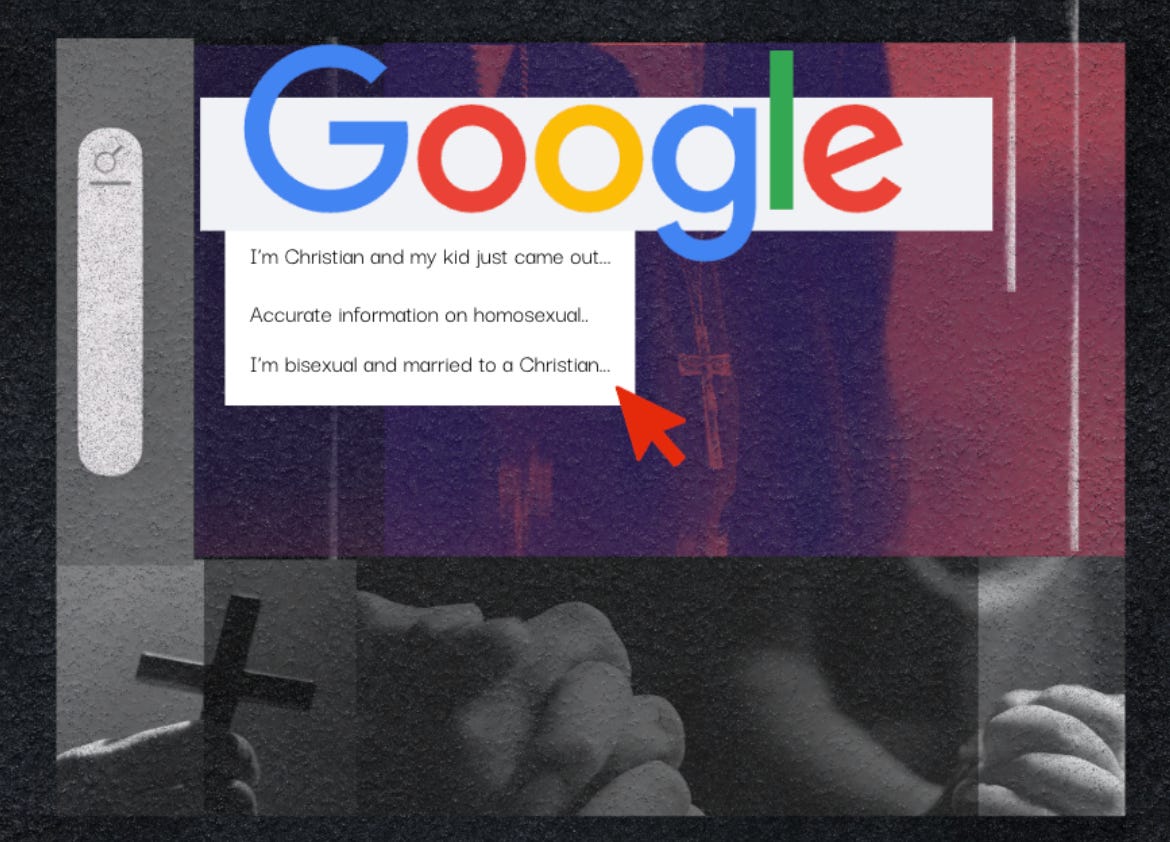
But how does Google’s algorithm decide which results show up? And how do these results influence LGBTQ kids, their parents and Americans at large who are searching for help?
Uncloseted Media asked five Americans from around the country to Google five common queries related to LGBTQ identity, religion and parenting.
The results were alarming and raised an urgent question: With nearly 40% of LGBTQ youth seriously considering suicide just last year, what happens when a queer teen or the parent of a gay kid in crisis turns to Google?
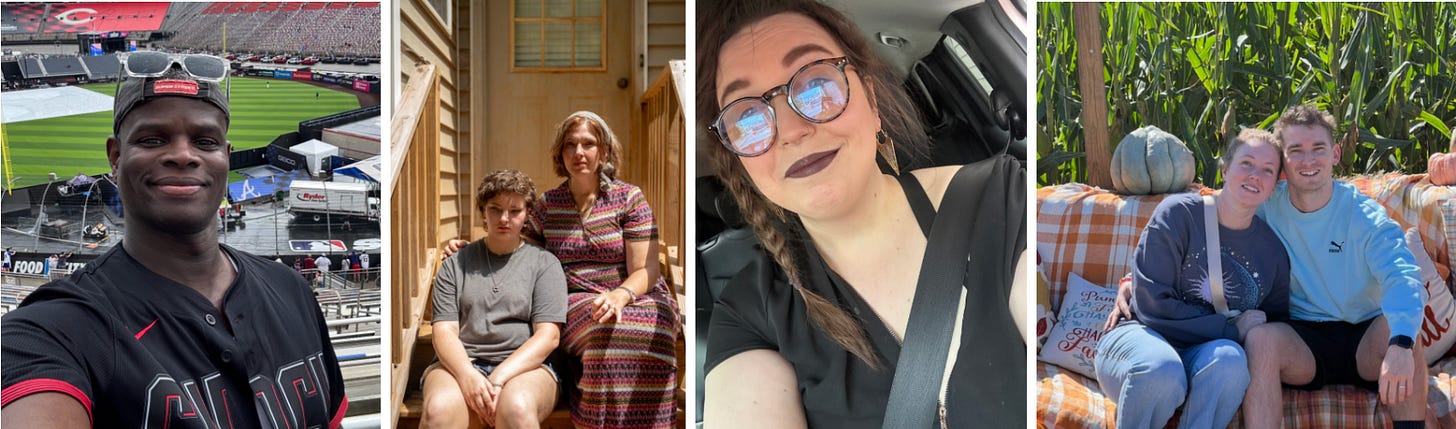
Photos courtesy of participants Mark Just, Genna and Melanie Brown, April Samberg, Tommy O’Neil. Photo of Genna and Melanie by Kaoly Gutteriez.
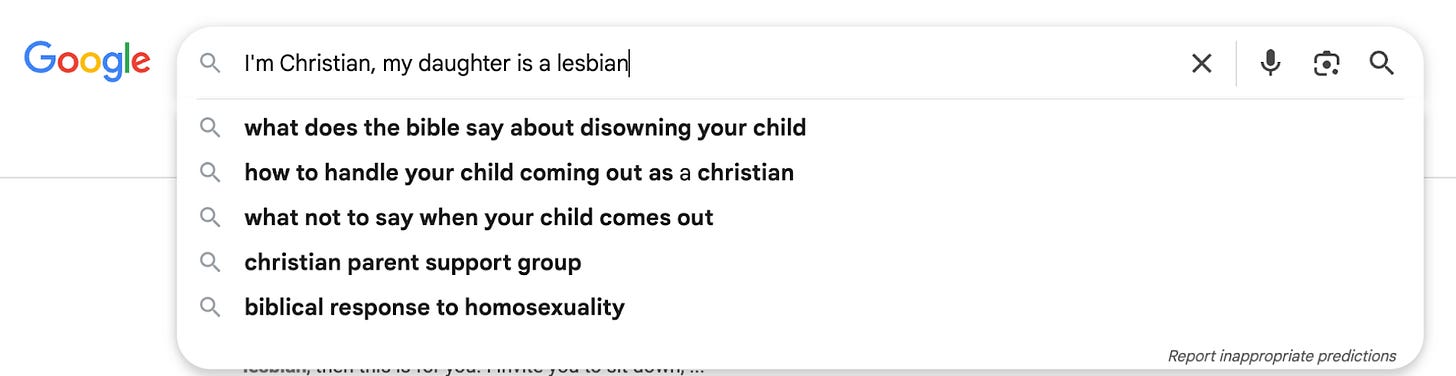
“I’m Christian, my daughter is a lesbian,” Melanie Brown, a Southern Baptist from High Point, North Carolina, types into Google.
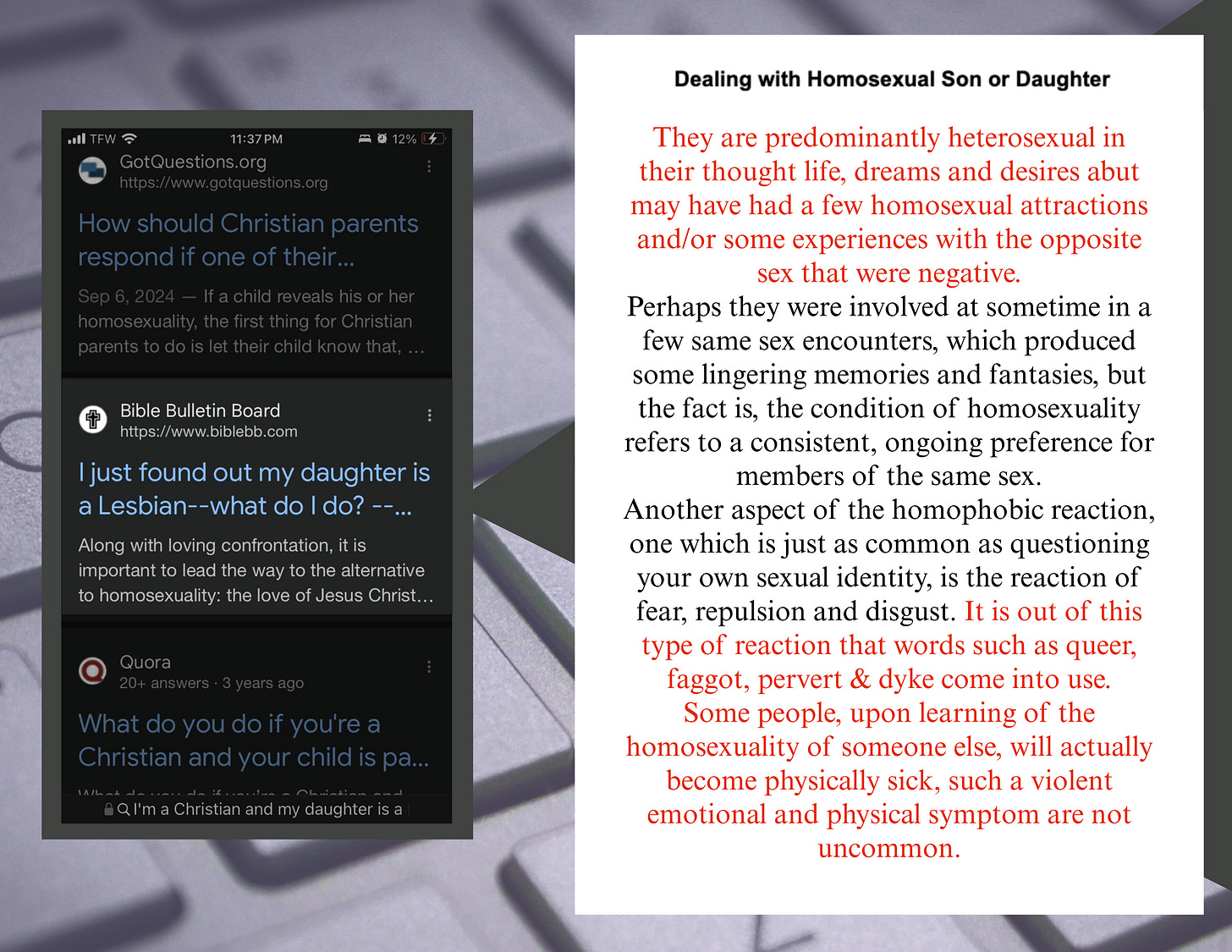
When Brown presses enter, Bible Bulletin Board comes up as the third result, with the suggestion of “offering hope for change,” and “lead[ing] the way to the alternative to homosexuality.” It goes on to explain that “homosexuality is contrary to God’s Word. It is sin and as always results in sin’s destructive effects on the individual and on those close to them.”
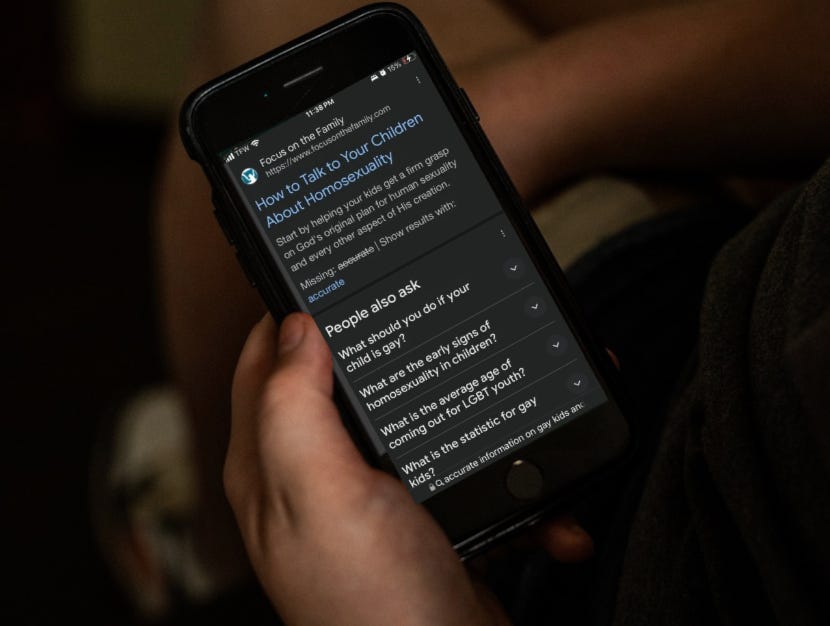
In the living room, Brown’s 15-year-old daughter Genna, with her dog on her lap, Googles “accurate information on gay kids and what to do.”
Focus on the Family (FOTF) is the first result. She clicks the link and lands on the platform of a hyper-religious organization known for promoting conversion therapy and labeling her sexuality as sinful.
The site, which presents itself as a reputable religious source, features a tab titled “Understanding Homosexuality” and a section under their resources for “Homosexuality.” It states: “[FOTF] is committed to upholding God’s design for the expression of human sexuality: a husband and wife in a marriage.”
It offers suggested reading on “redemption” from a gay lifestyle, along with 11 counseling resources aimed at changing sexual orientation, including The Alliance for Therapeutic Choice and Scientific Integrity, which guarantees “professional assistance … for persons who experience unwanted homosexual attractions.”
The language is intentionally padded, which means Genna and her mom—and many of the other millions of Christian parents of queer kids—may never know that Google led them to a Southern Poverty Law Center-designated anti-LGBTQ hate group. FOTF is known for its long-standing opposition to LGBTQ rights, for spreading anti-LGBTQ disinformation and for framing homosexuality and transgender identity as sinful and disordered.
Screenshot courtesy of Genna Brown. Photo by Kaoly Gutierrez.
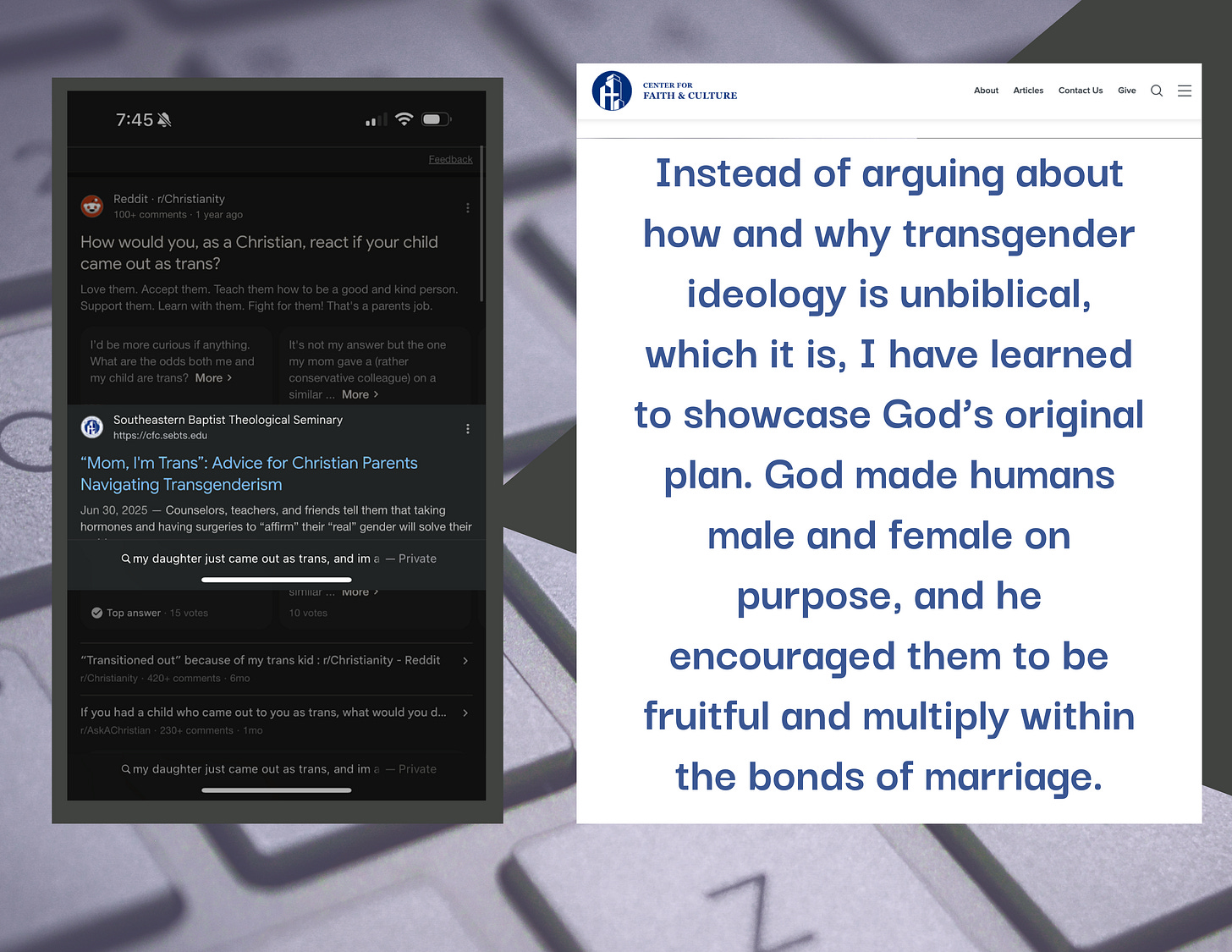
In South Boston, Virginia, Tommy O’Neil Googles, “My daughter just came out as trans and I’m a Christian.” As a father of two, he wants what’s best for his kids. According to Southeastern Baptist Theological Seminary, Google’s second result, O’Neil should recognize that God doesn’t make mistakes when assigning sex and give sympathy for those who are indoctrinated in the “transgender cult.”
Thousands of miles away in Anchorage, Alaska, 38-year-old bisexual woman April Samberg Googles, “I am bisexual and have a husband who is Christian, am I going to hell?”
The third result is once again an article by FOTF that tells April that “same-sex-attracted strugglers” and “transgender and homosexual lust and behavior are wrong.”
In Cincinnati, 44-year-old Mark Just Googles, “accurate information on homosexual kids and what to do.” FOTF is the top search result.
“I don’t feel good about it,” Just told Uncloseted Media. “It’s disturbing because if there are people out there who want to accept and understand their children or loved ones, this is what they’re being pointed to.”
“[I feel] fear for the queer kids with Christian parents who will be seeing that and thinking it’s good advice, and sorrow for the kids with parents who already have,” says Genna Brown, who was a “self-loathing, suicidal kid” who thought God would punish her for being gay before she came out to her now accepting parents. “It’s pretty awful that this is what’s being pushed for advice. This has no doubt harmed people.”
Uncloseted Media also asked folks in Taiwan, Lebanon, China, Hong Kong, Canada and India to Google similar queries. All of them had FOTF turn up as a top search result.
Subscribe
Why Does Google Allow This?
Google, like other search engines, compiles information and directs users to various websites by referencing the titles of web pages that it judges to be most reflective of what was searched.
“Google’s algorithm is notoriously a black box,” says Jesse Ringer, founder of Method and Metric, a search engine optimization (SEO) growth company. “That’s intentional to keep their competitive advantage.”
What we do know is that Google ranks search results by first crawling the web with an automated program called “spiders” to follow links from page to page and collect data.
It uses text matching to identify documents that it thinks are relevant to a query and then ranks them based on a combination of popularity, freshness, location and previous links clicked.
But for people searching for reliable information, its process can be problematic.
“Google doesn’t rank based on accuracy, but on popularity and query matching,” says Dirk Lewandowski, professor of information research and retrieval at the Hamburg University of Applied Sciences. “This is based on clicks and a network of how many other links are directed to this website. … Of course, users click what is shown in the first position. So we have kind of a rich get richer.”
How to Get a High Ranking
As websites with the highest rankings continue to receive more clicks, websites like FOTF can also employ other tactics to keep their prominent placement.
Backlinking—the process of having other web pages hyperlink back to your site—is one of the ways to maintain your high ranking.
“Backlinks are a big part of popularity. So the relationship between other websites linking to this source is a big part of Google’s algorithm,” says Ringer. “There are SEO businesses that build link farms so that the content of their clients can go higher. They create a network effect and they link to each other. It is not unreasonable to think that [FOTF] has hired either an SEO person or they’ve hired an external agency to contribute to that.”
According to Francesca Tripodi, assistant professor at the University of North Carolina School of Information and Library Science, ranking can also be gamed by matching keywords to content. Tripodi looked at the metadata of progressive and conservative companies and found that conservative content creators “are much better at doing this.”
“They are savvy at creating new sets of words and tagging their content with them,” she says. “That’s not something I’m seeing with progressive content creators.”
Tripodi says that not only does conservatism thrive online, it might be the only perspective returned.
Subscribe
“They are well-funded companies with large production budgets and effective digital marketing teams,” she wrote in a 2019 testimony about conservatism and Google searches. “This is why when you search for liberal phrases like ‘gender identity’ or ‘social justice’ the top returns … are conservative content creators.”
Google declined to speak on record with Uncloseted Media for this story.
In an email, a spokesperson said: “Like any search engine, Google indexes the content that’s available on the open web, relying on systems like keyword matching to surface relevant results. We are largely guided by local law when it comes to removing pages from search results.”
What If It’s Harmful or Illegal?
The United States notoriously protects harmful or misleading content—including anti-LGBTQ hate speech—under the First Amendment.
“The situation in [other countries] is a bit different than in America,” Lewandowski says. “For instance, Holocaust denial is illegal in Germany. So Google bans these sites, but they don’t ban them in the U.S.”
Section 230 of the U.S. law protects Americans’ freedom of expression online by implying that we should all be responsible for our own actions and statements on the internet. This law largely takes legal pressure off of Google.
And in 2003, an Oklahoma court ruled that Google’s rankings are subjective opinions and thus constitutionally protected.
Google’s policies for tamping down on harmful content “don’t apply to web results.” Thus, there is little moderation on the web pages that pop up for Americans who use the search engine.
The spokesperson for Google says that “[they] hold themselves to a high standard when it comes to legal requirements to remove pages from Google search results” and that “they don’t remove web results except for child sexual abuse, highly personal information, spam, site owner requests, and valid legal requests.”
But according to the company, “determining whether content is illegal is not always a determination that Google is equipped to make.”
Tripodi says this might be why groups like FOTF are still showing up, even though conversion therapy is illegal in 23 states. She says these groups may have found a loophole in Google’s policy by “tricking” the search engine into thinking they are providing “resources” and not simply a recommendation for conversion therapy.
Subscribe
What Can Google Do to Fix This?
“Google has a responsibility for what is coming up in their results because people trust [them],” says Lewandowski. “They think something is correct or accurate because it is number one in Google.”
Fifteen-year-old Genna Brown is one of the 85% of Americans who feel this way, according to a 2025 study.
“Isn’t the first result typically ranked most credible?” she says. “Because I typically trust the first result more.”
“It’s pretty concerning what comes up when you search for these things,” Ringer says. “There needs to be more done to educate the people who are doing the searches on understanding news and information.”
But vulnerable groups, like LGBTQ kids who are living in households where they are told they are going to hell and parents who are often confused and in crisis themselves, are being led by Google’s algorithm to believe that being queer is wrong.
“1000% yes, these results concern me,” says Genna Brown. “We’re talking about organizations that promote practices like conversion therapy, which is insane. … I wish there was some disclaimer. Like, ‘Google has determined this to be a subjective query. As such, we can’t verify the following results. Proceed with caution.’”
Tripodi says she thinks consumers are responsible for about 20% of the burden by researching and verifying the sources they learn from. But she agrees with Brown in that Google carries an ethical responsibility for the content it chooses to rank and promote.
“As a global corporation that gobbles up all other possibilities for information, Google has a responsibility to ensure that its content is accurate and not harmful,” Tripodi says. “[It’s their job] to ensure that the information that they surface is accurate and reliable because we know people trust that information.”
Uncloseted Media reached out to Focus on the Family, Southeastern Baptist Theological Seminary, and Bible Bulletin Board. They did not respond to our request for comment.
Additional reporting by Sophie Holland and Spencer Macnaughton.
If objective, nonpartisan, rigorous, LGBTQ-focused journalism is important to you, please consider making a tax-deductible donation through our fiscal sponsor, Resource Impact, by clicking this button:
Bio: Richard Francis Hogan is a Canadian writer, Poet and advocate on several levels based in Ottawa. His work explores hope, resilience, identity, faith, and the quiet power of public spaces.
Subject: Op-Ed Submission: When the Parade Stops, the Silence Speaks Louder
Dear Editor,
I am submitting the attached op-ed for consideration in the Ottawa Citizen. It reflects on the recent cancellation of the Ottawa Gay Pride Parade and the deeper cultural and spiritual implications of that absence. As a longtime resident and advocate for inclusive public spaces, I believe this piece speaks to a moment of reflection for our city and its commitment to visibility, dignity, and belonging. Thank you for your time and consideration.
Sincerely,
Richard Hogan
(snip-personal contact info)
Full Narrative
When the Parade Stops, the Silence Speaks Louder
By Richard Francis Hogan
The cancellation of the Ottawa Gay Pride Parade due to protests is more than a logistical decision. It is a cultural silence, a civic absence, a spiritual pause that demands reflection.
For decades, Pride has been more than a celebration. It has been a procession of courage, a public hymn of identity, a communal act of love. It has been where the marginalized found visibility, where joy became resistance, and where the city itself remembered its promise to all its people.
To cancel such a gathering is not merely to postpone an event. It is to interrupt a ritual of belonging.
As a Christian, I believe in the sacredness of every human soul. As a Buddhist, I recognize the impermanence of all things—but also the importance of showing up, again and again, with compassion. And as someone with Irish blood, I know that humor and heartache often walk hand in hand. We laugh because we’ve cried. We march because we’ve been still for too long.
This year, there will be no rainbow flags waving down Bank Street. No music echoing through Centretown. No cheers from sidewalks lined with families, allies, and elders who remember when Pride was a protest, not a party.
But let us not confuse absence with apathy.
Let us write, speak, gather, and remember. Let us honor those who came before, and those who still wait to be seen. Let us make sure that when the parade returns, it does so not just with glitter—but with grit.
Because Pride is not a date on the calendar. It is a declaration of dignity.
And dignity, like love, does not disappear. It waits. It endures. It marches on.
August 21, 1831 Nat Turner, a 30-year-old man legally owned by a child, and six other slaves began a violent insurrection in Southampton County, Virginia.They began by killing the child’s stepfather, Joseph Travis, and his family. Within the next 24 hours, Turner and, ultimately, about 40 followers killed the families who owned adjacent slaveholding properties, nearly 60 whites, while freeing and inciting other slaves to join them.Militia and federal troops were called out, and the uprising was suppressed with 55 African Americans including Turner executed by hanging in Jerusalem, Virginia, and hundreds more killed by white mobs and vigilantes in revenge. More about Nat Turner Nat Turner’s confession
August 21, 1968 The Czechoslovakian people spontaneously and nonviolently resisted invasion of their country of 14 million by hundreds of thousands of troops and 5000+ tanks from the Soviet Union and four other Warsaw Pact countries.The troops were enforcing the overthrow and arrest of Alexander Dubcek and his government. They had been implementing significant democratic reforms known collectively as “socialism with a human face,” or the Prague Spring. Cover of the magazine Kvety, with a photograph of the statue of St. Wenceslas in Wenceslas Square in the center of Prague. Graffiti on the statue reads “Soldiers go home” in Russian and “Dubcek – Svoboda” in Czech. Hundreds attempted to obstruct invading tanks. Both Czechs and Slovaks argued with the soldiers and refused all cooperation with the occupying armies while showing broad support for the deposed government and its reform program. Moscow relented and returned Dubcek to office, at least temporarily. Prague Spring in retrospect Czech perspective
August 21, 1971 Two grenades killed and wounded members of the leadership of the Philippines’ Liberal Party during a rally in Manila’s Plaza Miranda. Philippine President Ferdinand Marcos accused a leader of the party, Benigno Aquino, of the bombing and arrested him, labeling him a communist. Liberal Party Secretary-General Aquino, an effective young leader and Marcos opponent, was imprisoned, mostly in solitary confinement, for seven years until allowed exile to the U.S., ostensibly for medical treatment.
August 21, 1976 Approximately 20,000 people, mainly women, from both Protestant and Catholic areas of Belfast, Northern Ireland, attended a Peace People’s rally at Ormeau Park.
August 21, 1983 Exiled popular Philippine political leader Benigno Aquino was assassinated by soldiers of the Aviation Security Command as he crossed the tarmac at Manila International Airport. Benigno Aquino He had spent three years of asylum in the U.S. Upon his return, he intended to lead the political opposition to President Ferdinand Marcos and the martial law he had imposed. During the plane trip across the Pacific, he had commented to reporters, “I suppose there’s a physical danger because you know assassination’s part of public service . . . My feeling is we all have to die sometime and if it’s my fate to die by an assassin’s bullet, so be it.” Hundreds of thousands demonstrated against Marcos.
Ferdinand Marcos The Aquino funeral drew millions and gave impetus to the broad-based People’s Power movement which eventually forced Marcos from power. Read more about Aquino
August 21, 1991 A coup against Soviet Union President Mikhail S. Gorbachev by hard-line Communist Party members (State Emergency Committee), collapsed in the face of popular opposition. Russian Federation President Boris N. Yeltsin, having quit the Party the previous year, had called for a general strike. Mikhail S. Gorbachev | Boris N.Yelsin
August 21, 1998 Samuel Bowers, the 73-year-old former Imperial Wizard of the White Knights of the Ku Klux Klan, was convicted in Hattiesburg, Mississippi, of ordering a firebombing that killed civil rights activist Vernon Dahmer 32 years before. Bowers had also been instrumental in the killing of three other civil rights workers in Philadelphia, Mississippi for which he was never charged. On Vernon Dahmer’s tombstone are the words, “If you don’t vote, you don’t count.” Samuel Bowers 32 years to justice Dahmer’s home after the bombing
(It’s a newsletter I receive, and I don’t have a link for what I’ve copied and am pasting, but there are links within the piece. Enjoy.)
AUGUST 17 — AUGUST 23
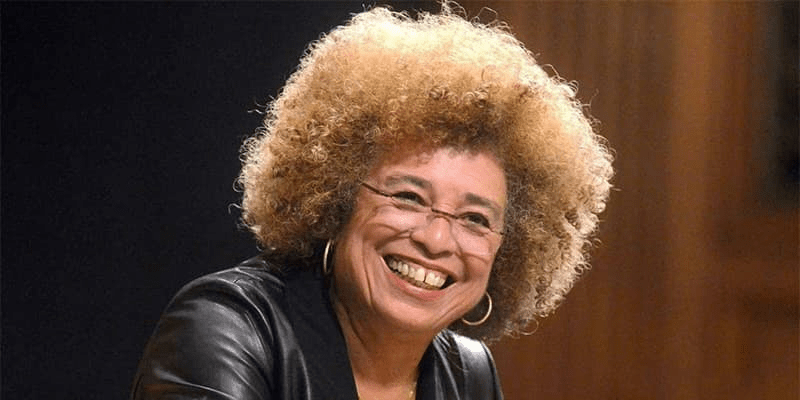
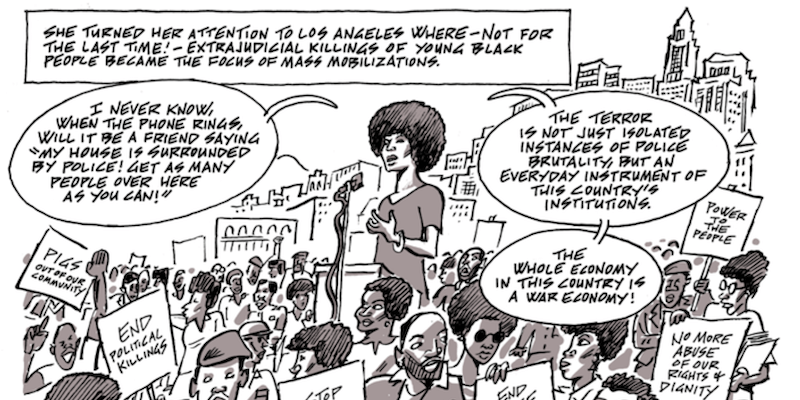
Angela Davis debuts on the FBI’s Ten Most Wanted List. In 1969, the legendary author and activist Angela Davis was a newly minted assistant philosophy processor at UCLA. But she was also an avowed Communist, and as a result, then-Governor Ronald Regan tried to have her fired before she’d begun any actual teaching. No luck: Davis’s dismissal didn’t hold up in court, and her first class had to be moved to a bigger classroom to accommodate the 2,000 students who had signed up for it—but she would finally be fired again nine months later, for “inflammatory rhetoric” in public speeches. Davis was an outspoken supporter of the Black Panthers and was fervently against the Vietnam War, but arguably her most scandalous activist activities at the time were in defense of the Soledad Brothers, three Black inmates imprisoned in Soledad, CA, who were accused of killing a white guard. In 1970, guns registered to Davis were used in an attack on the nearby Marin County Civic Center; the perpetrators hoped to take hostages to bargain for the inmates’ release, but instead left four casualties. Davis, despite not being at the scene, was charged with murder, kidnapping, and criminal conspiracy charges. She couldn’t be found, and so on August 18, 1970, by order of J. Edgar Hoover, Davis became the third woman ever to be included on the FBI’s Most Wanted List. Eight weeks later, Davis was finally arrested in a New York motel; the trial that followed catapulted her to international fame—and turned her into a revolutionary icon—as her supporters, who viewed her as a political prisoner, chanted “Free Angela!” across the globe.In 1972, after 16 months in prison, she was acquitted of all charges by an all-white jury. “It took a worldwide movement of people to acquit Miss Davis,” noted one of her attorneys, Howard Moore Jr., but it shouldn’t have. “Justice should be the routine of the system,” he added.
THIS IS WHY THEY BAN IT: “Progressive art can assist people to learn not only about the objective forces at work in the society in which they live, but also about the intensely social character of their interior lives. Ultimately, it can propel people toward social emancipation. ” –Angela Davis
Chuck Schumer has created and talked about a fictitious family declaring they are real people. It seems he has talked himself into believing they are real. This is the Democratic Party leader in the Senate. Hugs
Education advocates are afraid that the administration’s getting hold of admissions racial data could make colleges a more hostile place for students of color.
“The student data could be used to challenge the admission of Black students in particular under assumptions that they are presumptively unqualified because of their race,” Janel George, a law professor at Georgetown University, told HuffPost.
“Woke is officially DEAD at Brown. Thank you for your attention to this matter!” Donald Trump declared in a Truth Social post last week.
He was celebrating the fact that the prestigious Providence, Rhode Island, university had just agreed to a settlement with him. In order to restore its federal funding, the school agreed to implement anti-transgender policies and hand over its race and admissions data.
It was similar to a deal the federal government had struck with Columbia University in New York after Trump relentlessly attacked the school in the wake of on-campus pro-Palestinian protests.
And then on Thursday, Trump went further: He signed an executive order demanding that every college in the country hand over its admissions data, citing a 2023 Supreme Court decision prohibiting the use of race as a factor in college admissions. “Greater transparency is essential to exposing unlawful practices and ultimately ridding society of shameful, dangerous racial hierarchies,” the order reads.
Already, there is growing fear from legal experts and higher education advocates that he could weaponize this data in order to get higher education institutions to fall in line with his administration’s goals.
“They can misuse the data, they can interpret it in any way they want,” said Mariam Rashid, the associate director for the Center for American Progress’ racial equity and justice program. “And they can misuse it in order to misinform the public, too.”
For example, the Trump administration could use the racial data to claim a university is discriminating against a certain race, or infer that not enough Trump supporters are being admitted because the freshman class doesn’t have a high enough percentage of students from red states.
Trump’s latest strike on American institutions connects his war on diversity and his administration’s assault on colleges across the country in a way that could turbocharge both. It’s not just that Trump will have an extraordinary amount of information about colleges; it’s how he’s likely to use it to further his false narrative about both race and higher education. And it’s students who will bear the brunt of the consequences.
“Given the administration’s flawed interpretation of our civil rights law, they might use this data to accuse schools of discrimination and threaten universities,” Donya Khadem, an attorney at the NAACP Legal Defense Fund, told HuffPost.
“It’s unprecedented scrutiny by the federal government.”
– Donya Khadem, attorney at the NAACP Legal Defense Fund
Some schools refused to play the game. In April, Harvard University wrote a letter to Trump saying that his demands flew in the face of free speech laws and would stifle the kind of learning and research that happens at a place of higher education. But other schools, like Columbia and Brown, bent the knee and gave Trump what he wanted.
“It’s very concerning because it’s unprecedented scrutiny by the federal government,” Khadem said.
This time, the administration is taking aim at an aspect of educational life that has long been a bugbear for conservatives. There is a widespread belief among conservatives that colleges and universities have given advantages to students of color at the expense of white students.
By allowing race to be a factor in admissions, the claim goes, schools are taking spots away from certain groups of students and instead admitting students they claim are less qualified, based solely on their race. (In reality, race has been one of many factors admissions officers consider when choosing between fully qualified applicants.)
“This is all motivated by a racist myth that Black people don’t deserve to be in these elite spaces,” Khadem said.
And now that Trump is back in office, getting his hands on this data is likely just the beginning of his attempt to turn back the clock on admitting students of color.
Asked for comment about how it intends to use the admissions data, the Department of Education directed HuffPost to a press release about the new executive order Trump signed on Thursday.
“We will not allow institutions to blight the dreams of students by presuming that their skin color matters more than their hard work and accomplishments,” Education Secretary Linda McMahon said.
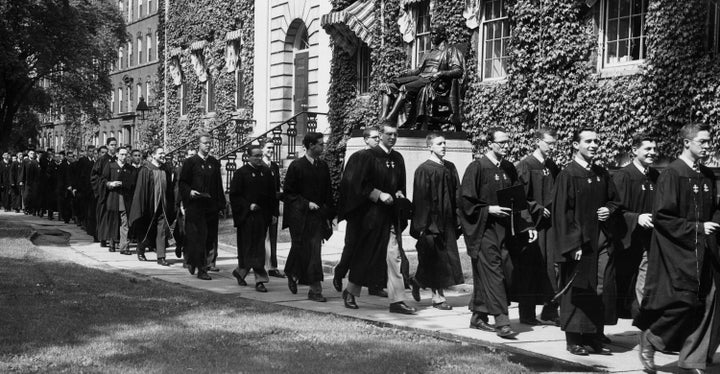
Students pass the statue of John Harvard in Harvard Yard on their way to baccalaureate services ahead of commencement at Harvard University on June 17, 1951.
Photo by Sam Hammat/The Boston Globe via Getty Images
Conservatives celebrated when the U.S. Supreme Court struck down race-conscious college admissions processes in Students For Fair Admissions v. Harvard in 2023, saying that schools can not use race as a factor in college admissions.
Harvard, together with fellow defendant the University of North Carolina at Chapel Hill, had argued that schools needed to be able to consider race as one factor among many to ensure the educational benefits of a diverse student body. The high court disagreed, saying the schools did not have a “compelling interest” in considering race as a factor and thus violated the 14th Amendment.
But education law experts say that the federal government is using that ruling and expanding it far beyond its original intent.
In the same ruling, the court expressly said that “nothing prohibits universities from considering an applicant’s discussion of how race affected the applicant’s life, so long as that discussion is concretely tied to a quality of character or unique ability that the particular applicant can contribute to the university.”
Now, Trump’s order undermines that.
“They’re using the Students For Fair Admissions [decision] in ways that are not what the justices meant when they wrote it,” Khadem said.
Education advocates are afraid that the administration’s getting hold of admissions racial data could make colleges a more hostile place for students of color.
“The student data could be used to challenge the admission of Black students in particular under assumptions that they are presumptively unqualified because of their race,” Janel George, a law professor at Georgetown University, told HuffPost.
“This is all motivated by a racist myth that Black people don’t deserve to be in these elite spaces.”
– Khadem
It could also turn off otherwise qualified students from attending some of these colleges. “I think it’s a big deterrent,” Khadem said. “Columbia’s campus has become and will continue to become less welcoming to Black students.”
Columbia and Brown did not immediately respond to HuffPost’s request for comment.
Systemic racism and inequality are already significant barriers to college attendance. Research shows that Black students and other people of color are more likely to be from low-income families and struggle to afford college. Then there’s the fact that standardized tests frequently used in college admissions are biased toward white students and those from wealthier families.
Studies have shown that race-neutral admissions processes lead to a drop in diversity. In 1996, after California voters approved a measure that would ban affirmative action at the state’s public universities, the state’s most prestigious schools saw a drastic drop in diversity. Indeed, one of the arguments made by Harvard during its legal fight was that no race-neutral admissions process offers the same diversity benefits.
The first college classes to be enrolled after the Students for Fair Admissions ruling varied in their diversity. Some schools, like the Massachusetts Institute of Technology, Tufts University and the University of North Carolina at Chapel Hill, saw a decrease in Black and Hispanic enrollment, while other schools’ racial compositions stayed roughly the same.
Not only could these changes further hinder access to higher education for nonwhite students, but there’s a question of how making this data public could harm students. If the Trump administration publicly calls out a school for having a certain number of nonwhite students, that could become a problem for people on campus.
“I do think it’s harmful,” Rashid said. “[The data] is not going to be attached to a name, but they can make up whatever narrative they want.”
Experts warn that it could create a hostile environment on campuses, where nonwhite students feel as if their peers believe that they’re unqualified to be there. “At schools with higher admissions of Black students or faculty, some people are going to feel a certain way about how they’re perceived at school,” Khadem said.
There is a direct line from Trump’s attacks on colleges to his administration’s larger anti-diversity campaign.
In an attempt to begin removing people of color from public life, Trump signed an executive order in January that sought to end diversity, equity and inclusion programs at different institutions, including nonprofit organizations receiving federal grants, law enforcement agencies and institutions of higher education. The penalty for not ending DEI, though vague, was the loss of crucial federal funding.
The Department of Education followed up with guidance for educational institutions, telling them they must end “racial preferences” and restore “merit.”
The Department of Justice joined the crusade too, launching investigations of colleges and universities it alleged were not complying with the Supreme Court’s ruling on using race in college admissions under the pretense of combating “illegal discrimination.”
“The [DOJ] will put an end to a shameful system in which someone’s race matters more than their ability,” acting Associate Attorney General Chad Mizelle said in a press release in March.
To the Trump administration, American society, and colleges in particular, have been beset by a racial regime that disfavors white conservatives — and this executive order was intended to combat that. Others, though, see a very different agenda.
“What they want to do is make everything race-neutral,” Rashid said. “In other words, make everything white.”






 Scottie's Playtime