Over 10,000 books have been banned across the entire United States over the past school year. The trend has seen a particularly strong increase in states with a strong Republican presence, according to the free-speech nonprofit PEN America.
This is a major increase compared to the 2022-2023 year, which saw a total of 3,362 books banned across the country.
The books were accused of having “obscene” material. One of them was a children’s picture book about gay penguins.
Florida and Iowa are leading in the total number of bans, with over 8,000 recorded between the two states. This number is largely due to the increasingly strict laws on book bans.
The banned books include Death on the Nile by Agatha Christie; the famous work on anti-Black racism Black Reconstruction in America, 1860-1880 by W.E.B. DuBois; Alex Haley’s book about the lived experience of slaves, Roots: The Saga of an American Family; and James Baldwin’s autobiography Go Tell It On the Mountain.
Iowa’s bans stem from Senate File 496, a law restricting LGBTQ+ books from grade seven and below along with total bans on books deemed to contain sexual content. Florida’s House Bill 1069, backed by Gov. Ron DeSantis (R), resulted in a similar ban, albeit a much more strict one.
PEN America cites other laws from Utah, Tennessee, and South Carolina as contributing to these increase in banned books as well.
Individual school districts have also had a hand in banning many books. The Elkhorn Area School District in Wisconsin, for example, banned over 300 books over a several month period.
PEN America says that the types of books banned “includes books featuring romance, books about women’s sexual experiences, and books about rape or sexual abuse as well as continued attacks on books with LGBTQ+ characters or themes, or books about race or racism and featuring characters of color.”
The organization also emphasizes that these numbers are an undercount of the actual amount of banned books since many book bans go unreported. Additionally, the organization says schools have also implemented “soft” book bans, including policies that cause greater hesitancy to check out books from libraries, restrictions on who can check out restricted books out, book fair cancellations, and the removal of classroom collections.
Six major book publishers are currently suing the Floridian government after hundreds of their books were pulled from libraries, cutting severely into their profits and discriminating against their authors.
A Florida school district recently agreed to re-shelve 36 books to settle a lawsuit concerning multiple banned books, including And Tango Makes Three, an often banned children’s book about a gay penguin couple raising a chick.
Iowa’s book ban was recently brought back into law when a permanent injunction against the ban was overturned by an appeals court.
Subscribe to the LGBTQ Nationnewsletter and be the first to know about the latest headlines shaping LGBTQ+ communities worldwide.
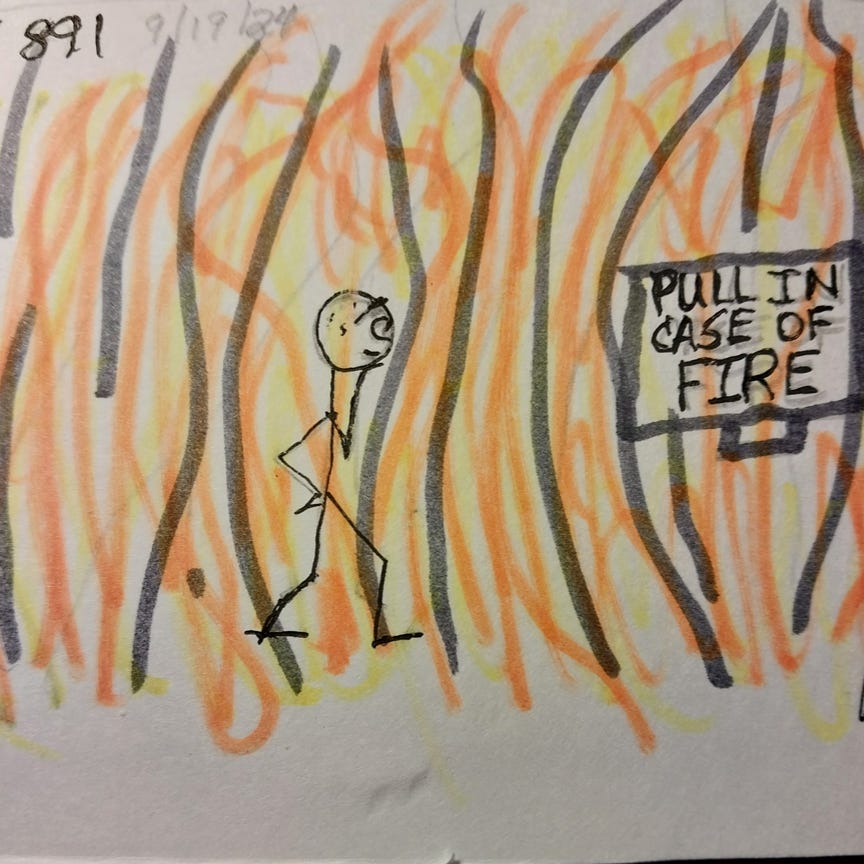
I do it now and then, hadn’t in a while but really liked one so I did it but didn’t turn it in. (It’ll become clear.) Then I got a bunch of GOTV postcards done, and there it was, at the bottom of that stack. It so happened that another came along that I really liked (this one below,) so I added it, then submitted it. It got posted today, and even though it’s really not at all good, it’s funny, it was fun, and I thought I’d share. I’ve sent in several over the past year; dotted amongst the posts. The best one was of two dogs discussing a thing; a similar scenario as below, but not exactly the same. And I might try this one, too. I can draw fish. Anyway, here is this.
Underwater. A group of fish laugh at a wild-eyed fish, who glares at them with impotent rage. One of the laughing fish says: “Go ahead, Throckmorton! Tell us more about the ‘land’ outside the pond.”
First they laugh at you…
It’s Two-for-Tuesday, and that means for the second day in a row, we’re graced with an Ali Redford original. Today she tries her hand at eight nine one:
A SURPRISE IN HELL
It’s simple, it’s bleak — I love it. And I love what a great contrast it makes with Margreet de Heer’s version from last week. Margreet, of course, is one of the world’s great cartoonists; Ali is a writer like me (though she does draw better than I do). It’s fascinating to see what the same cartoon looks like filtered through two very different brains.
Margreet’s doomed souls strained helplessly to pull the lever. Ali’s sufferer merely looks at it, puzzled. It’s the same set-up, the same pieces of furniture, but the joke is very different. This is the beauty of collaboration.
Thanks, Ali (and Margreet again). It’s great.
The rest of you — get off your duffs (or, more accurately, on them) and draw. (snip)
So now you know I thing I do when I’m not writing postcards or congresscritters, or cleaning house, or walking Corky, and so forth. Once in a while, I “draw”, sometimes even manage to really draw a cartoon based on a professional writer’s scene.
I don’t know how many remember the Internet Archive; we heard more about them during the pandemic, but also when books began to be banned and removed from libraries that were accessible to young people. Meanwhile, Big Profit was fighting the Archive even during the pandemic, but now there is some sad news.
September 21, 1963 The War Resisters League organized the first American anti-Vietnam War demonstration in New York City. The League, founded in 1923, was the first peace group to call for U.S. withdrawal from Vietnam, and played a key role throughout the war, organizing rallies, the burning of draft cards, civil disobedience at induction centers, and assisting resisters. History of WRL WRL home ======================== September 21st (since 1982) The International Day of Peace was established by United Nations resolution in 1981 and first celebrated in 1982 (then as the 3rd tuesday of the month). Events are planned all over the world to promote peace and make it more visible. About Peace Day and plans around the world
(This is linked on Ten Bears’s blog, and it is most succinctly excellent. I’m only putting a snippet; it’s well worth the click to read it.)
“Why do some British people not like Donald Trump?” Nate White, an articulate and witty writer from England wrote the following response:
A few things spring to mind. Trump lacks certain qualities which the British traditionally esteem. For instance, he has no class, no charm, no coolness, no credibility, no compassion, no wit, no warmth, no wisdom, no subtlety, no sensitivity, no self-awareness, no humility, no honour and no grace – all qualities, funnily enough, with which his predecessor Mr. Obama was generously blessed. So for us, the stark contrast does rather throw Trump’s limitations into embarrassingly sharp relief.
Plus, we like a laugh. And while Trump may be laughable, he has never once said anything wry, witty or even faintly amusing – not once, ever. I don’t say that rhetorically, I mean it quite literally: not once, not ever. And that fact is particularly disturbing to the British sensibility – for us, to lack humour is almost inhuman. But with Trump, it’s a fact. He doesn’t even seem to understand what a joke is – his idea of a joke is a crass comment, an illiterate insult, a casual act of cruelty.
Trump is a troll. And like all trolls, he is never funny and he never laughs; he only crows or jeers. And scarily, he doesn’t just talk in crude, witless insults – he actually thinks in them. His mind is a simple bot-like algorithm of petty prejudices and knee-jerk nastiness.
There is never any under-layer of irony, complexity, nuance or depth. It’s all surface. Some Americans might see this as refreshingly upfront. Well, we don’t. We see it as having no inner world, no soul. And in Britain we traditionally side with David, not Goliath. All our heroes are plucky underdogs: Robin Hood, Dick Whittington, Oliver Twist. Trump is neither plucky, nor an underdog. He is the exact opposite of that. He’s not even a spoiled rich-boy, or a greedy fat-cat. He’s more a fat white slug. A Jabba the Hutt of privilege. (snip-a bit MORE)
Eugene V. Debs was sentenced to ten years in prison for opposing U.S. entry into World War I. Debs had been an elected official in Indiana, a labor organizer, writer and editor, had founded the first industrial union in the U.S., the American Railway Union, and had run for President four times on the Socialist Party ticket.
He ran again for president from prison in 1920 with the slogan “From Atlanta Prison to the White House,” and received nearly one million. Learn more about Eugene V. Debs
September 14, 1940 Congress passed the Selective Service Act, providing for the first peacetime draft (though Japan had already invaded China in 1937 and Germany had invaded Poland and Czechoslovakia in 1939) in U.S. history.
September 14, 1948 A groundbreaking ceremony took place in New York City at the site of the United Nations’ world headquarters. The site selected for the permanent headquarters of the United Nations as it was in 1946. The 39-story building on 18 acres of Manhattan’s Turtle Bay neighborhood (donated by John D. Rockefeller, Jr.) on the East River. It is a major expression of the International Style with its simple geometric form and glass curtain wall, designed principally by Le Corbusier. The UN building today Background and more examples of the minimalist, utilitarian International style
September 14, 1963 The ABC television network invited singer, songwriter, banjo player and activist Pete Seeger to appear on its Saturday night folk and acoustic music show, Hootenanny, despite the fact that he had been blacklisted. But the invitation stood only if he’d sign an oath of loyalty to the U.S. He described his reaction: “This is ridiculous. I’d sign ’em, if you sign ’em, and everybody who’s born will sign ’em, then we’d all be clean.” In the 1940s Seeger traveled throughout the country with Woody Guthrie, performing at union meetings, strikes and demonstrations. After World War II, he and Lee Hays co-founded the Weavers, the legendary folk group that gained commercial success despite being blacklisted. A Pete Seeger BiographyMore about Hootenanny
September 14, 1964 The Free Speech Movement began at the University of California-Berkeley when its Dean Katherine Towle (pronounced toll) announced that existing University regulations prohibiting advocacy of political causes or candidates, signing of members, and collection of funds by student organizations at the corner of Bancroft and Telegraph, would henceforth be ”strictly enforced.” Read more
September 14, 1982 Wisconsin became the first to approve a statewide referendum calling for a freeze on all testing of nuclear weapons.
September 14, 1990 The Pentagon announced a $20 billion arms sale to Saudi Arabia. Saddam Hussein’s Iraq (Saudi Arabia’s eastern neighbor) had invaded Kuwait six weeks earlier. Saud royal family
September 14, 1991 The South African government, the African National Congress, the Inkatha Freedom Party, a total of forty organizations, signed the National Peace Accord. It led to the country’s first multi-racial elections and the end of South Africa’s racially separatist apartheid (literally separateness in the Afrikaans language) political, economic and social system by 1994. “ Bearing in mind the values which we hold, be these religious or humanitarian, we pledge ourselves with integrity of purpose to make this land a prosperous one where we can all live, work and play together in peace and harmony.” Background of the conflict
Barbara Gittings was a lover of books. She realized, from a young age, that she also loved girls. So when, in 1949, she left Wilmington, Delaware to attend Northwestern University, she did what any bookish young lesbian would do: research homosexuality in the school’s library. What Gittings found was not comforting. The vast majority of sources were written by medical professionals and described homosexuality as an illness or a perversion. She became so consumed with spending time in various Chicago libraries that she neglected her coursework and flunked out of school. But as a result of the discouraging information she found, an activist was born. With passion, determination, and what she would come to refer to as “gay gumption,” Gittings would spend the rest of her life working, in various ways, to correct those lies she found in the pages of books and scientific journals on the library shelves.
Gittings moved to Philadelphia in 1950 and supported herself with part-time clerical work. She continued to read everything she could find on homosexuality and, as part of her search, discovered Donald Webster Cory’s The Homosexual in America: A Subjective Approach, originally published in 1951. Gittings was particularly impressed with Cory’s arguments that gays and lesbians constituted a large unrecognized minority who deserved civil rights and his attempts to cultivate empathy in his readers by outlining the difficulties faced by American homosexuals. She wrote to Cory’s publisher and discovered he lived in New York City. The two met on several occasions, and Cory informed Gittings of a newly-formed gay organization in Los Angeles: the Mattachine Society, founded in 1950 by Harry Hay.
In the summer of 1956, when she was on vacation from her office job, Gittings boarded a plane to Los Angeles and visited the office of ONE, Inc., a homophile organization who had amicably split from the Mattachine Society in 1952. The members of ONE, Inc. informed her of the existence of a San Francisco-based organization for lesbians, the Daughters of Bilitis (DOB), founded in 1955 by lesbian partners Del Martin and Phyllis Lyon.
Gittings once again boarded a plane, this time bound for San Francisco. The DOB were, fatefully, having a meeting that very evening in a member’s apartment. The meeting was the first time in her life Gittings would interact with a group of lesbians outside of a bar setting. Two years later, in 1958, Gittings officially joined the DOB and was tapped by Martin and Lyon to start an East Coast chapter of the organization based in New York City. With her co-founder, Marion Glass, Gittings built the chapter into the largest in the country.
In 1963, Gittings, whose enthusiasm and knowledge of literature left an impression on Martin and Lyon, was tapped to be the editor of The Ladder, the DOB’s national magazine for gay women. Gittings transformed The Ladder from what was essentially a newsletter to a national magazine respected within gay circles. With the help of her partner, Kay “Tobin” Lahusen, whom she met in 1961 at a DOB picnic in Rhode Island, Gittings replaced the amateurish illustrations that typically adorned the cover of The Ladder with photographs taken by Lahusen of actual lesbians who appeared confident and happy.
Gittings began to take The Ladder in an increasingly militant direction, reporting on protests, questioning the merits of various activist strategies such as picketing, and engaging in debates with so-called “experts,” arguing that homosexuality was a social and cultural problem, not a psychological problem. The activist bent of The Ladder under Gittings’ editorship alarmed the West Coast leadership of the DOB. When Gittings, amidst her many activities on behalf of gay rights, was late with the August 1966 issue, Martin and Lyon used her tardiness as an excuse to oust her as editor.
Gittings would also find a kindred spirit in Frank Kameny, who she credited as the first person to articulate a fully coherent philosophy of gay rights. She and Lahusen partnered with Mattachine Washington, of which Kameny was a co-founder, working alongside other lesbians and gay men to directly challenge the federal government. Gittings participated in the first picket of the White House for homosexual rights on April 17th of 1965.
Gittings worked with Kameny and other activists to lobby the American Psychiatric Association (APA) to remove homosexuality as a diagnostic category from the Diagnostic and Statistical Manual (DSM). At the APA’s 1972 conference, held in Dallas, Texas, Gittings, Kameny, and Lahusen created a display entitled “Gay, Proud, and Healthy: The Homosexual Community Speaks.” The exhibit, which featured photographs of gay couples taken by Lahusen, was adorned with the word “LOVE” in bold letters and portrayed gay people as healthy and happy, not as patients who were tormented and in need of a cure. In December of 1973, the APA board of trustees voted to pass a resolution to remove homosexuality from the DSM, effectively declassifying it as a mental illness.
Gittings was a lifelong bibliophile, and though she recognized the importance of taking on the federal government and institutions such as the APA, she never lost sight of the “lies in the libraries” she discovered as a college freshman and the importance of gay representation. In 1970, she joined the American Library Association’s (ALA) newly-formed Task Force on Gay Liberation (TFGL). The TFGL, whose mission was to provide support for gay librarians within the profession and increase gay representation in libraries, was glad to have a veteran activist like Gittings join their ranks.
With the help of Israel Fishman, the first coordinator of the TFGL, Gittings organized a gay kissing booth — titled “Hug-a-Homosexual: Free Kisses” — for the 1971 ALA conference in Dallas, Texas. While the group could have created a nice display featuring gay books, periodicals, and their bibliography, they instead decided to make their presence known by showing gay love live. The publicity was better than Gittings and the TFGL could have imagined, and continued to spark discussions within the ALA over the next year.
In 1999, in honor of her contributions to create more visibility for gays and lesbians in libraries and in the profession, Gittings was awarded a lifetime membership at the annual ALA conference, held that year in New Orleans, Louisiana. The ALA also named an award after Gittings as part of their Stonewall Book Awards, sponsored by the Gay, Lesbian, Bisexual, and Transgender Round Table (GLBTRT), the contemporary iteration of the TFGL. The Stonewall Book Award-Barbara Gittings Literature Award is given annually for works of fiction that exhibit “exceptional merit relating to the LGBT experience.”
Barbara Gittings died on February 18th, 2007 at the age of 74 after a long battle with breast cancer. In a 1999 interview with American Libraries magazine, she summarized her career as a gay activist with the wit and wisdom she was known for:
“As a teenager, I had to struggle alone to learn about myself and what it meant to be gay. Now for 48 years I’ve had the satisfaction of working with other gay people all across the country to get the bigots off our backs, to oil the closet door hinges, to change prejudiced hearts and minds, and to show that gay love is good for us and for the rest of the world too. It’s hard work — but it’s vital, and it’s gratifying, and it’s often fun!”

 Photo: Shutterstock


 The site selected for the permanent
 The UN building today

 Read more
 Saud royal family
 Scottie's Playtime