Despite passing in the Senate earlier this week, the Kid’s Online Safety Act (KOSA) is reportedly dead in the U.S. House after progressives, like Rep. Alexandria Ocasio-Cortez (D-NY), worried that it would possible censor LGBTQ+ content. Some Republicans also opposed the bill, stating that it would violate free speech protections for social media platforms and their users.
KOSA would have mandated that social media companies take measures to prevent recommending any content that promotes mental health disorders (like eating disorders, drug use, self-harm, sexual abuse, and bullying) unless minors specifically search for such content. Opponents worried that Republican attorneys general who see LGBTQ+ identities as harmful forms of mental illness would use KOSA’s provisions to censor queer web content and prosecute platforms that provide access to it.
“KOSA was a poorly written bill that would have made kids less safe,” said one of the bill’s most vocal opponents, Evan Greer, director of Fight for the Future, a nonprofit that protects human rights in the digital age. “It’s good that this unconstitutional censorship bill is dead for now, but I am not breathing a sigh of relief.”
“KOSA was always too controversial to succeed, and divided our coalition,” Greer added. “If we want to take on Big Tech and win, we have to quickly regroup and make a plan for next Congress. We need strong privacy, antitrust, and algorithmic justice legislation that address the harms of Big Tech without endangering free expression and human rights.”
Many other groups opposed the bill, including the American Civil Liberties Union (ACLU), the Woodhull Freedom Foundation, the LGBT Technology Partnership, as well as LGBTQ+ advocacy organizations in six states.
While KOSA passed in the Senate earlier this week in a 93-1 vote, three senators voted against the bills: Ron Wyden (D-OR), Mike Lee (R-UT), and Rand Paul (R-KY) — all three made statements explaining why.
Wyden specifically said he voted against the bills because he worried a future administration could use the legislation to “pressure companies to censor gay, trans, and reproductive health information,” The Hill reported.
Lee said, “This legislation empowers the [Federal Trade Commission (FTC)] to censor any content it deems to cause ‘harm,’ ‘anxiety,’ or ‘depression,’ in a way that could (and most likely would) be used to censor the expression of political, religious, and other viewpoints disfavored by the FTC.”
Paul wrote in a recent Louisville Courier Journal opinion article, “KOSA would impose an unprecedented duty of care on internet platforms to design their sites to mitigate and prevent harms…. This requirement will not only stifle free speech, but it will deprive Americans of the benefits of our technological advancements.”
KOSA was introduced by anti-LGBTQ+ Sen. Marsha Blackburn (R-TN), who said that one of the bill’s top priorities is to protect children from “the transgender in this culture.” Blackburn’s office told LGBTQ Nation that her comment had been “taken out of context” and wasn’t related to KOSA. Nevertheless, the anti-LGBTQ+ conservative think tank Heritage Foundation has also said it wishes to use the law to “guard” kids against the “harms of… transgender content.”
Jenna Leventoff, senior policy counsel at the ACLU, said, “KOSA compounds nationwide attacks on young peoples’ right to learn and access information, on and offline. As state legislatures and school boards across the country impose book bans and classroom censorship laws, the last thing students and parents need is another act of government censorship deciding which educational resources are appropriate for their families.”
You are being sold with every email, every picture, every blog post, every Instagram post, every thing you put on X or Facebook, you are the cash cow these companies want to milk. I have been taking steps for years to reduce how much these businesses can strip mine my stuff data about me. Here is a program I like, and here is a free tutorial on how to remove a lot of the metadata out of your images and files. I recently realized how much information about myself I include in messages, so I looked into this program by Sessions. Hugs. Scottie
January 07, 2022 / Alex Linton
Metadata is a big deal — especially for people who are trying to protect their online privacy. For any files on your computer, there is probably a bunch of metadata about the file — such as location data, when the file was created, when it was last changed, or even what device created the file. If you ever give that file to someone else (or upload it to the internet), the file’s metadata will be transferred as well — which means they can see all that info.
There are plenty of reasons you might want to share a file without wanting to share the metadata as well — such as preserving your privacy or anonymity. To do that, you’ll want to strip the file’s metadata. Stripping metadata from files removes all that extra information and leaves you with just the information in the file itself. Some messengers—like Session—strip metadata from your image files when you attach them to a message. This is because they can contain sensitive EXIF data, which contains device and location information. Other file types—like MP3s—might have less sensitive metadata (such as a song name or artist) which won’t be stripped.
However, if you want to be sure, you can always manually strip the metadata from your files. Here’s how!
How to remove metadata from files using Windows
Scrubbing your files on Windows is relatively easy, you can do so directly in the File Explorer without relying on any third party software.
Locate the file you want to strip in Explorer
Right click on the file and select Properties
Select the Details tab to see the associated metadata
Click Remove Properties and Personal Information
Select the metadata you want to remove
Select to either Create a copy (if you want to preserve the original)or Remove properties from this file
Click OK
Ta-da! Metadata removed, now you can safely share the file without extra personal information being attached.
How to remove metadata from files using macOS
Unfortunately things aren’t as simple on macOS. There’s no catch-all option for all file types, and you can only remove specific kinds of data. For images, you can remove location data using macOS’s built-in Preview application.
Open the image in Preview
Hit CMD + i to display the image’s metadata
Navigate to the Info tab (circle with an ‘i’ inside it)
Click on GPS to see the location metadata
Click Remove Location Info to remove the GPS information stored in the image
For anything more thorough than this (or any file type other than images) you’ll need to use third-party software, such as Acrobat Pro for PDFs.
How to remove metadata from files using Linux
Thankfully, things are much easier on Linux! Note: Instructions may be different depending on your distro.
If you’re using a Debian-based system (such as Ubuntu), you can install MAT (which comes pre-packaged) using this command: $ sudo apt-get install mat
You can then launch the MAT GUI using this: $ mat-gui
Add the file you want to strip to MAT by clicking the Add icon in the top navigation bar
Once the file is added, click Check to scan for metadata
If metadata is detected, MAT will mark the file as ‘Dirty’, you can double click the file to see what metadata has been detected
Click Clean to strip the metadata from the file
Simple as that!
Keep your files safe
Stripping metadata from your files before you share them is a good idea — especially if you’re going to upload them somewhere public on the internet. If you want to be certain that the files you send are completely metadata free (even to the people you send them to) — make sure to strip them first! To ensure your files stay private, it’s also important to consider how and where you store your files. Make sure you’re encrypting your hard drives, and be careful about what Cloud storage providers you use and what upload.
These days, it’s a normal everyday thing to share files on messaging apps and social media — but it’s important to be mindful about what exactly you’re sharing. Once those files hit the internet — they could end up anywhere!
Florida Governor Ron DeSantis addresses the crowd before publicly signing “Stop W.O.K.E” bill in Hialeah Gardens, Florida, on April 22, 2022. (Daniel A. Varela/Miami Herald via AP)
Florida Gov. Ron DeSantis often says the Sunshine State is the place where “woke goes to die.” But a federal judge on Friday killed part of the Stop W.O.K.E. Act championed as standing up against “indoctrination.”
Judge Mark Walker of the U.S. District Court for the Northern District of Florida issued a permanent injunction, saying the law that bans diversity training in private workplaces “violates free speech rights under the First and Fourteenth Amendments to the U.S. Constitution.” The ruling follows a three-judge appeals court panel’s March decision that upheld Walker’s original injunction. The State of Florida did not oppose the motion to make the ruling permanent.
Florida honeymoon registry company Honeyfund.com and Primo Tampa, a subsidiary of a Ben & Jerry’s ice cream franchisee, were among those who filed the lawsuit after the Legislature passed the law in 2022. Shalini Goel Agarwal counsel for Protect Democracy which filed the lawsuit on their behalf said the ruling is “a powerful reminder that the First Amendment cannot be warped to serve the interests of elected officials.”
“Censoring business owners from speaking in favor of ideas that politicians don’t like is a moved ripped straight from the authoritarian playbook,” she said in a statement.
“We have every right as a state to provide protections for employees and businesses to say if they are doing woke training which is basically discriminating against folks on the basis of race, you have a right to opt out,” he said. “It’s not a question of what the company can say. They can say whatever they want. But you have a right to not self flagellate. You have a right to not sit there and listen to that nonsense.”
Sara Margulis, CEO of Honeyfund.com, hailed the appeals court decision from March.
“We moved Honeyfund to Florida in 2017 because it was known as a business-friendly state,” she said in a statement. “Passing laws that seek to squash free speech like HB7 is not only a violation of The First Amendment but is also a losing strategy because businesses serve people of all backgrounds, walks of life, and political views. Therefore the law would have effectively hampered the ability of Florida businesses to grow and serve their market. I don’t think that’s what Florida really wants. It’s clearly not in line with American values. I couldn’t be happier that we stood up for free speech and business in the state of Florida.”
The legislation — HB 7, formally called the “Stop Wrongs to Our Kids and Employees Act” — is also aimed at blocking school teachers and college professors from offering their opinions on what DeSantis described as “pernicious ideologies” that could potentially make students, because of their race, feel personally responsible for past racism, sexism, or other discrimination in the U.S. That part of the law also has an injunction and is awaiting a ruling from a higher court.
Critics have said it’s an attempt to stop meaningful discussion of the ongoing effects of longstanding systemic discrimination and topics including critical race theory and privilege. A slew of lawsuits were filed against the legislation including by professors, students and the ACLU. Courts have repeatedly blocked portions of the law.
According to the bill’s text, “[i]t shall constitute discrimination on the basis of race, color, national origin, or sex under this section to subject any student or employee to training or instruction that espouses, promotes, advances, inculcates, or compels such student or employee to believe” the following:
1. Members of one race, color, national origin, or sex are morally superior to members of another race, color, national origin, or sex.
2. A person, by virtue of his or her race, color, national origin, or sex is inherently racist, sexist, or oppressive, whether consciously or unconsciously.
3. A person’s moral character or status as either privileged or oppressed is necessarily determined by his or her race, color, national origin, or sex.
4. Members of one race, color, national origin, or sex cannot and should not attempt to treat others without respect to race, color, national origin, or sex.
5. A person, by virtue of his or her race, color, national origin, or sex bears responsibility for, or should be discriminated against or receive adverse treatment because of, actions committed in the past by other members of the same race, color, national origin, or sex.
6. A person, by virtue of his or her race, color, national origin, or sex should be discriminated against or receive adverse treatment to achieve diversity, equity, or inclusion.
7. A person, by virtue of his or her race, color, sex, or national origin, bears personal responsibility for and must feel guilt, anguish, or other forms of psychological distress because of actions, in which the person played no part, committed in the past by other members of the same race, color, national origin, or sex.
8. Such virtues as merit, excellence, hard work, fairness, neutrality, objectivity, and racial colorblindness are racist or sexist, or were created by members of a particular race, color, national origin, or sex to oppress members of another race, color, national origin, or sex.
Matt Naham and Marisa Sarnoff contributed to this report.
A priest is suing the gay dating and “hookup” app Grindr after the company reportedly failed to protect his data, leading to his resignation from a top position at the U.S. Conference of Catholic Bishops (USCCB).
In July 2021, Monsignor Jeffrey Burrill resigned from his post as the general secretary of the USCCB ahead of a report by The Pillar alleging that he had engaged in inappropriate behavior and frequent use of Grindr.
The app advertises itself as “the largest social networking app for gay, bi, trans, and queer people.” Its geolocation feature is popularly known to facilitate sex hookups between gay men.
The Pillar said its report on Burrill was based on “commercially available records” correlated to the priest’s mobile device. But a lawsuit filed this week claims that Grindr hadn’t taken steps to protect the data from third-party acquisition.
The suit, filed in the Superior Court of California, claims the group Catholic Laity and Clergy for Renewal (CLCR) purchased the priest’s data from the app and sent it to The Pillar.
The gay hookup app “assures customers” that it “takes steps” to protect data from unauthorized access, use, or disclosure, the suit says. But Grindr allegedly “knew they were failing to protect sensitive personal data of its customers” yet failed to take steps to protect it, the filing says.
Public reports “reveal a stunning pattern of [Grindr’s] intentional and reckless failure to protect private data of its customers,” the priest argues in the suit.
The company allegedly “fraudulently conceals and fails to disclose that it provides and/or sells its users’ personal data to ad networks, data vendors, and/or or other third parties that sell the data or otherwise make it commercially available to others.”
The suit requests damages, lawyer’s fees, and “injunctive relief.” It also asks the court to forbid Grindr “from committing such unlawful, unfair, and fraudulent business practices.”
In 2022 Burrill returned to active ministry as a priest in his home diocese of La Crosse, Wisconsin, with then-Bishop William Callahan stating that the priest had “engaged in a sincere and prayerful effort to strengthen his priestly vows” and had “favorably responded to every request” made by the bishop and the diocese.
The priest was appointed to St. Teresa of Kolkata Parish in West Salem, where he serves as pastor.
In his lawsuit, Burrill said his reputation had been “destroyed” by the data leak.
In addition to losing his position at the USCCB, he was “subjected to significant financial damages and emotional and psychological devastation,” the suit says.
Daniel Payne is a senior editor at Catholic News Agency. He previously worked at the College Fix and Just the News. He lives in Virginia with his family.
Idaho’s recently enacted bill encourages parents and children to bring legal action against schools and libraries that refuse to move certain material into “adult only” sections.
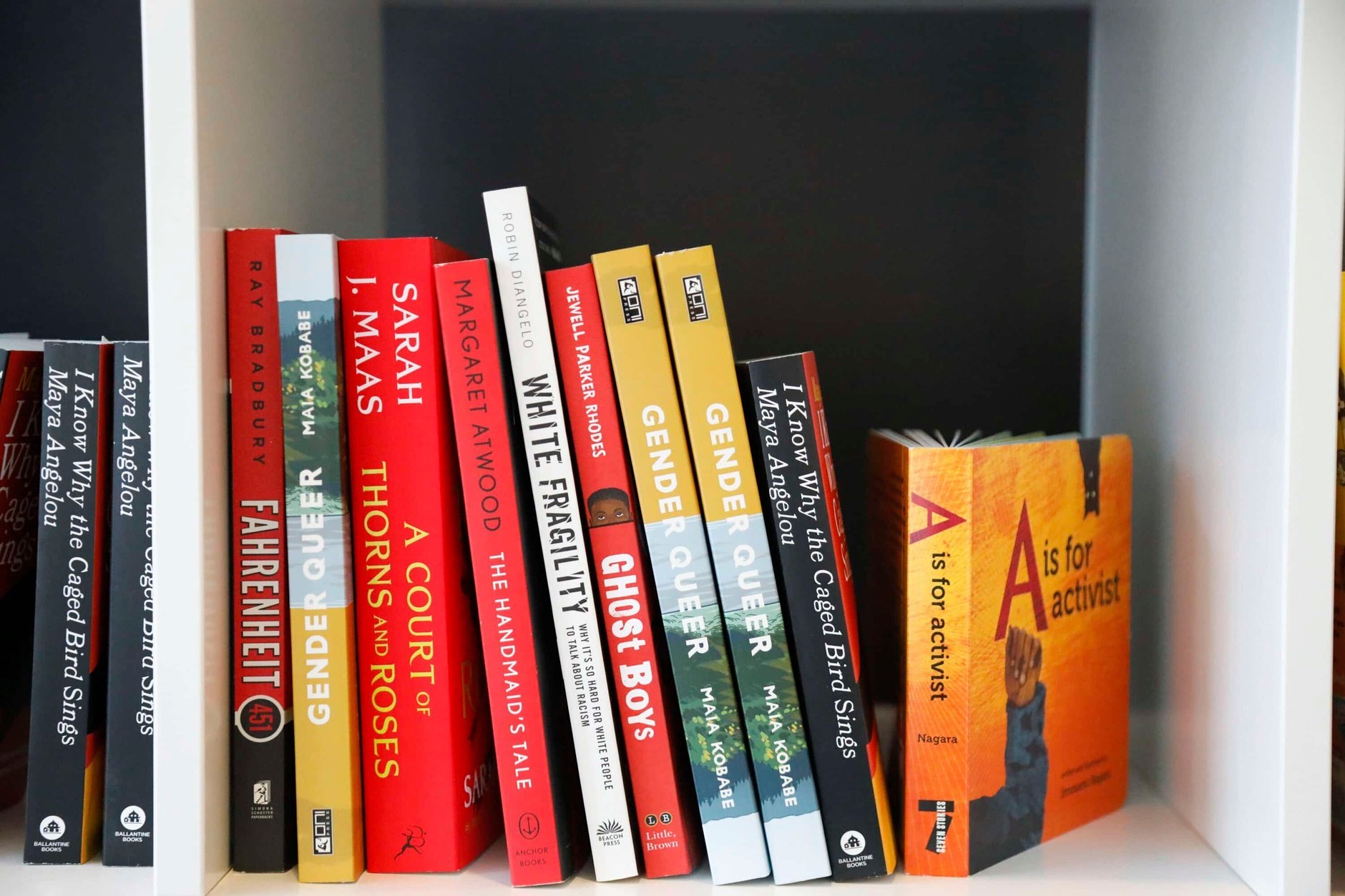
Books are displayed at the Banned Book Library at American Stage in St. Petersburg, Fla., on Feb. 18, 2023. (Jefferee Woo/Tampa Bay Times via AP)
A recently enacted law requiring Idaho schools and libraries to remove materials that are “harmful” to minors infringes on the First Amendment rights of private entities, a group of private schools, privately-funded libraries, parents and schoolchildren say in a Thursday lawsuit.
House Bill 710 — which took effect July 1 after Governor Brad Little signed it into law in April — allows citizens and the government to file a lawsuit against any school or library that doesn’t move certain material into designated “adult only” sections within 60 days of a complaint.
“H.B. 710 is the product of a social climate in Idaho (and elsewhere) in which schools and libraries have been inaccurately and unfairly castigated and villainized for using and making available constitutionally protected materials with content that the state and some Idahoans disapprove of,” the plaintiffs say in the 57-page complaint.
The suit was brought by private schools Sun Valley Community School and Foothills School of Arts and Sciences, along with the Community Library Association, a privately funded public library, and Collister United Methodist Church, which operates a lending library.
The groups are also joined by a set of parents and two high school-age students, who say that they want access to these reportedly “harmful” books and other materials to further their education.
The plaintiffs say the law violates their First Amendment free speech rights and their Fourteenth Amendment rights to due process. They ask the court to block enforcement of the law and to declare HB 710 unconstitutional.
“The act’s vague and overbroad definition of ‘harmful to minors’ conflicts with decades of settled constitutional law and extends well beyond the state’s limited authority to restrict the materials that private parties, like the private entity plaintiffs, may provide to minors,” they write.
Under the act’s definitions, the plaintiffs say, materials like health and sex education textbooks, literary works like Maya Angelou’s “I Know Why the Caged Bird Sings” and artworks like Michelangelo’s David would all be subject to removal, possibly based on arbitrary and subjective reasons.
“Even the Bible, if a defendant or citizen complainant subjectively believes members of their community would find them offensive,” could be targeted, the plaintiffs note.
The plaintiffs also take specific aim with a clause of the act that restricts materials that depict or represent “sexual conduct” — a definition that includes “any act of … homosexuality.”
Beyond the “vague and overbroad” definition of what constitutes “harmful for minors,” the plaintiffs also take issue with what they called the “incoherent” enforcement provisions outlined in HB 710. The act “fails to provide constitutionally meaningful guardrails on enforcement,” plaintiffs say.
“If a private entity plaintiff disagrees with the content-based assessment of the parent or minor and declines to segregate the challenged material, the parent or minor is authorized to file a civil suit against the private entity plaintiff and incentivized to do so by a cash reward and the availability of ‘actual damages,’” the plaintiffs write, referring to a provision in HB 710 that allows for a possible recovery of $250 and statutory and actual damages, if the complainant prevails in the case.
The government itself is also permitted under HB 710 to seek an injunction against any of the plaintiffs, who say this could lead to financial and reputational harm.
The plaintiffs name Idaho Attorney General Raúl Labrador as a defendant, alongside Jan Bennetts, prosecuting attorney for Ada County, and Matt Fredrick, prosecuting attorney for Blaine County.
HB 710 is not the first attempt Idaho legislators have made to restrict library access in the state. A version of the measure made it through the 2023 session but was rejected by Little.
In a letter after he signed HB 710, the governor commended the 2024 bill for having tighter definitions for restricted material and for lowering the recovery from $2,500.
“I share the co-sponsors’ desire to keep truly inappropriate materials out of the hands of minors,” Little wrote in April.
Libraries initially pushed back on the bill, citing free speech concerns and the financial burden it could levy, particularly on smaller libraries, but legislators stood by the measure.
“I can assure you that there is no book banning and there’s no book burning and there’s no book removal anywhere in this legislation. What we have to look at when you look at these libraries is that you have differing viewpoints and different opinions from taxpayers,” Representative Jaron Crane, a Nampa Republican and bill co-sponsor, said in committee, the Idaho Capital Sun reported in March.
I have followed Gronda for a long time, before she took her long break. But she is back and her writtings while in debth and a bit long are so very interesting and well researched that they are more than worth the time to read. I love them. I hope everyone here will. Hugs. Scottie

 Photo: Shutterstock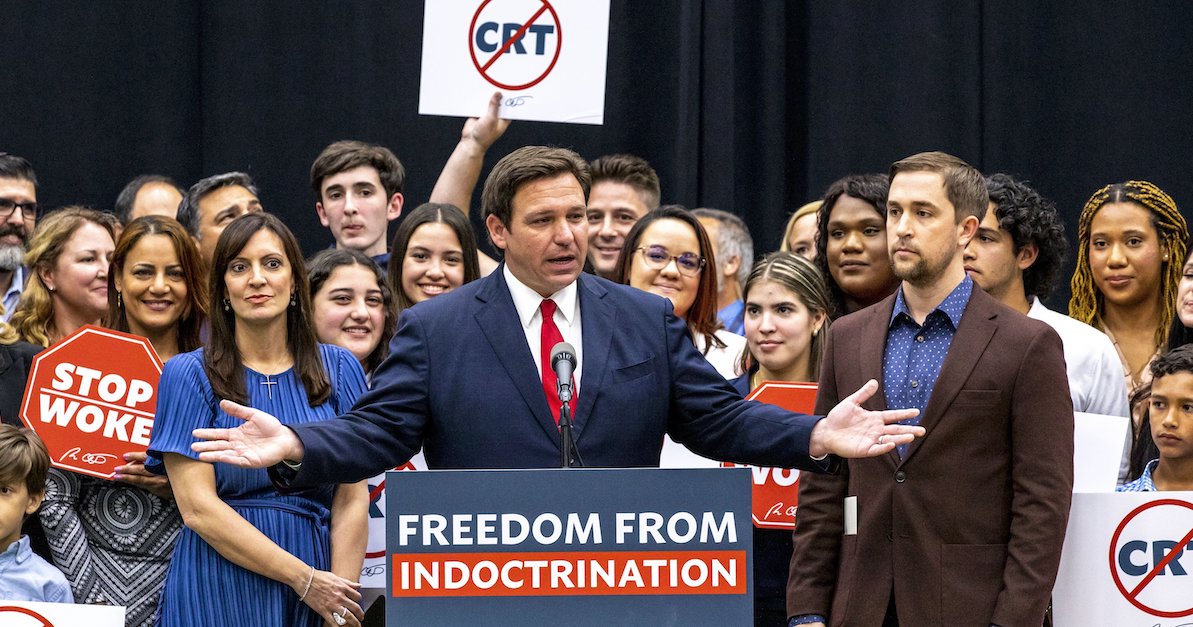
Msgr. Jeffrey Burrill | U.S. Conference of Catholic Bishops


 Scottie's Playtime