Republicans love third party candidates and ghost candidates when it helps them. They get Jill Stein to run in every swing state every presidential election. And only during the presidential election. But like all republicans they end up whining when things don’t go their way. Democrats stood up and admitted their loss and conceded with grace. I know people will suffer, but I hope the republicans so over play their hand that even their base turn against them … but it could be like the 1930s Germany all over again. I have a doctor’s appointment today so will not be on the computer until later in the morning. Hugs
Republicans would never use a fraudulent candidate for the purpose of siphoning votes.
Is this the country the maga cult wants? Yes? but what about all the rest who wouldn’t vote for a black woman? Those who claimed that they wouldn’t vote for Harris because she did not say the right words on Gaza? Well Israel now has no restraints, good choice you made for them, right? The brownshirts, the people who want to act like kids in gangs, want to have rule by thugs, that believe might makes right are going to find out it take far more than pretend bravado to keep a country this size running. The movie Idiocracy was not a how to do it show, but a warning. Right now we have moved a lot closer to the movie. Hugs
They always claim to be joking but their intention is to “move the Overton Window” so that when executions do happen, the public is well used to the prospect.
Wallnau cures Rush Limbaugh’s terminal cancer in the name of Jesus. Wallnau claims there are “high levels of angelic activity” at Trump’s DC hotel. Wallnau claims the MAGAbomber was possessed by Satan to make Trump look bad. Wallnau claims the Charlottesville Nazis were “paid actors” because right wing white supremacists do not exist. Wallnau declares that God killed Antonin Scalia to “wake up America” on how much they needed Trump. Wallnau “takes authority” over Hurricane Maria in the name of Jesus, orders it not to hit Puerto Rico. Wallnau claims Hurricane Irma bypassed Mar-A-Lago because Trump is under God’s protection. Wallnau releases the “Jezebel spirit” on Robert Mueller. Wallnau prays to protect Trump from “witches, jinxes, and demons that jump into dogs.” Wallnau prays for God to “unleash his holy sword” and smite Trump’s enemies. Wallnau claims angels literally dusted his face with gold flakes as a reward for loving Trump. Wallnau prays away obstruction of justice charges against Trump in the name of Jesus. Wallnau claims a gay bar owner was “cured of homosexuality” after eating a slice of anointed cake.
DeSantis is the first Florida governor to threaten TV broadcasters with criminal charges unless they stopped running ads he didn’t like. He’s the first governor to send his election police to knock on the doors of Amendment 4 supporters and the first to employ a last-ditch “investigation” of signatures gathered to get that amendment on the ballot. And credit, too, DeSantis for hiring just the right kind of election police.
Read the full editorial. As the paper points out, both measures passed with majority support and DeSantis “only had to shave off a few points” from the required 60% margin.
Remember all we have to do is tie his every policy change up in courts for two years just like the republicans did with Biden. Then work like hell to flip the Senate. Once we do that all of his minions plans for a white straight cis Christian paradise will mostly end. Hugs
———————————————————————————————————
The ACLU already have an anti-Trump ‘battle plan’ drawn up to fight his policies (Michael M. Santiago/Getty Images)
The American Civil Liberties Union (ACLU) already has plans in place to “take action” against president-elect Donald Trump’s policies.
The not-for-profit organization took to social media as soon as news outlets called the US presidential election in favor of Trump, saying it was fed up with “waiting anxiously”, and was ready to “ensure that erosion of civil rights or civil liberties will be hotly contested”.
A spokesperson on X/Twitter said: “We are ready to take action the minute Trump takes the oath of office [on 20 January].
“We’re clear-eyed about the chaos and destruction a second Trump administration will cause to our nation. That’s why we’re done with hand-wringing, admiring the problem, or waiting anxiously to see which unlawful action Trump will take on day one.”
The ACLU claimed it was the “first organization to challenge [Trump’s] Muslim ban” when the Republican was elected eight years ago, adding that its legal battles “stopped the inhumane practice of separating immigrant families” and won the fight to prevent “a citizenship question on the 2020 census”.
It filed “434 legal actions against the first Trump administration” including to support the LGBTQ+ community, which were won in front of “Trump-appointed judges”, the spokesperson went on to claim.
“At the ACLU, we play the long game. We’ve been here for 105 years, through 19 presidents.”
In recent years, the ACLU has been in the forefront of the battle against discriminatory legislation in the US, keeping track of every anti-LGBTQ+ law that has been introduced across the country.
“The ACLU will not stop speaking out against these cruel attacks nationwide, LGBTQ people have a right to live in safety, to thrive and to be treated with dignity,” the spokesperson continued.
Experts have warned that a second Trump term, with JD Vance as his vice-president, could be catastrophic for queer rights in the US, with the pair having pushed anti-LGBTQ+ rhetoric during the long campaign.
Among other measures, Trump claimed that he would cut federal funding to school districts that adopt trans-friendly policies, exclude transgender women from women’s sports, and restore his ban on trans people serving in the military.
And, in the wake of the overturning of abortion rights case Roe v Wade in 2022, campaigners have expressed fears that the conservative-controlled Supreme Court could next turn its attention to Obergefell vs Hodges, which gave the fundamental right to marry to same-sex couples in 2015.
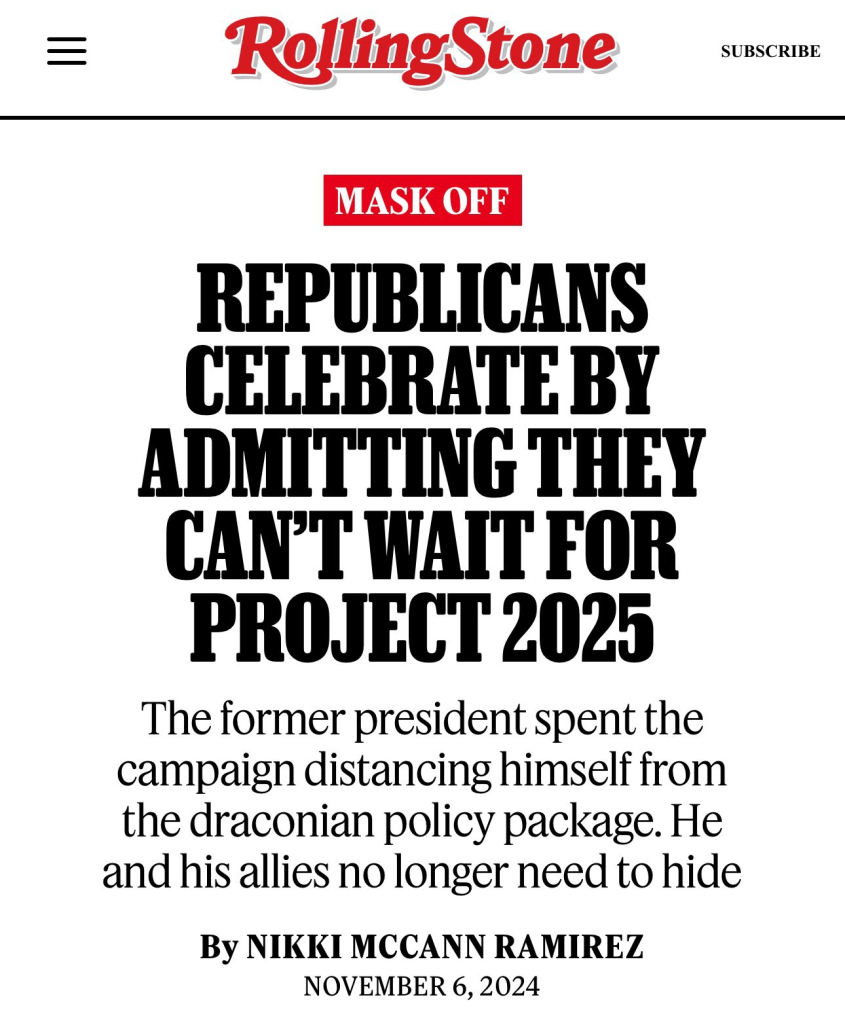
Project 2025, assuming it still needs to be explained at this point, is an infamous proposed manifesto for the ultra-conservative faction of the Republican Party and, many believe, Donald Trump’s second term.
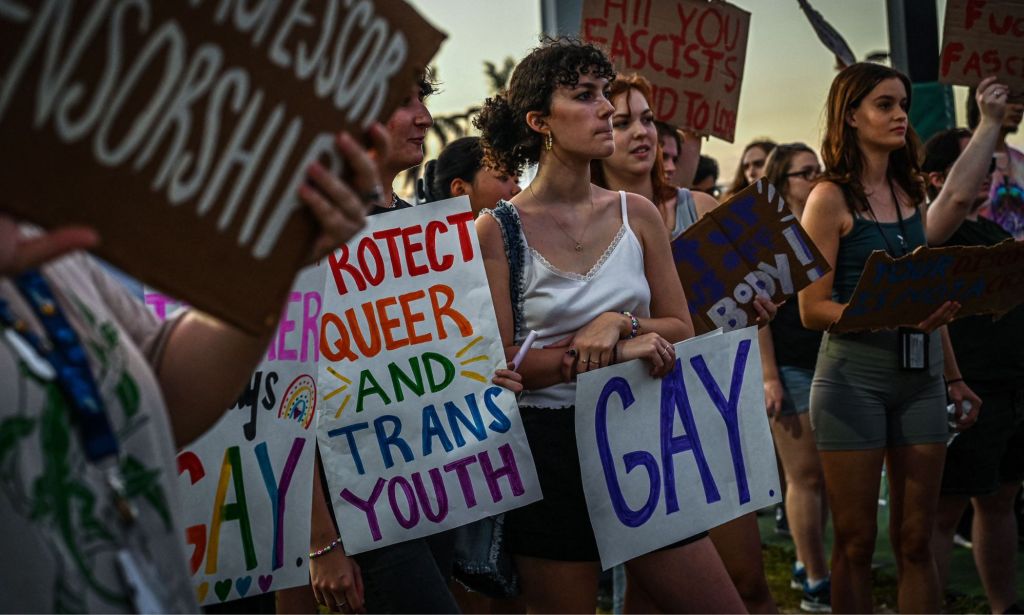
And with many LGBTQ+ Americans waking up on 6 November to the bleak and shocking reality of a second Trump presidency, it feels like a particularly good time to unpick what the document could signify for queer peoples’ rights in the US over the next four years.
Unsurprisingly, while Project 2025 promises to “take down the ‘Deep State’ and return the government to the people”, it also threatens to shred the rights and advancements of the LGBTQ+ community in the US.
The handbook’s authors claim that one of the biggest problems facing the US today is the “toxic normalization of transgenderism with drag queens and pornography invading school libraries.”
Project 2025 goes on to say that “transgender ideology” is one form of “pornography” linked to the “sexualization of children”. In total, “gender” is mentioned 111 times, and “LGBT” or “LGBTQ” 18 times, in the handbook.
LGBTQ+ rights would all but disappear if Project 2025 came to fruition. (Getty)
Viewed as a sort of right-wing wish-list, Project 2025 pledges to strip away anti-discrimination policies, making it easier to target and discriminate against LGBTQ+ people.
Published by the hard-line right-wing Heritage Foundation, the document calls for the removal of terms such as “sexual orientation” and “gender identity” from federal rules and legislation, and the revoking of regulations prohibiting discrimination based on sexual orientation, gender identity, transgender status and sex characteristics.
Project 2025 set out plans to restrict the application of the Supreme Court’s decision in Bostock vs. Clayton County, which extended workplace protections against sex discrimination to LGBTQ+ employees.
In addition, it plans to restrict access to healthcare for transgender people, something it refers to as a form of “child abuse”. Its authors also want to see trans healthcare no longer being covered by insurance schemes Medicare and Medicaid, and an end to anti-discrimination rules based on gender identity and sexual orientation.
In addition, there are plans to reverse policies allowing transgender people to serve in the military, a ban that was initially brought in under the Trump administration but reversed by president Joe Biden. If enacted, Project 2025 would expel transgender servicemen and women as well as those living with HIV.
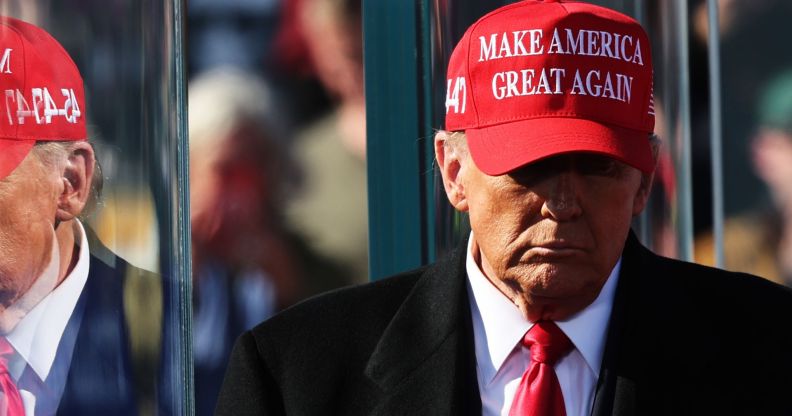
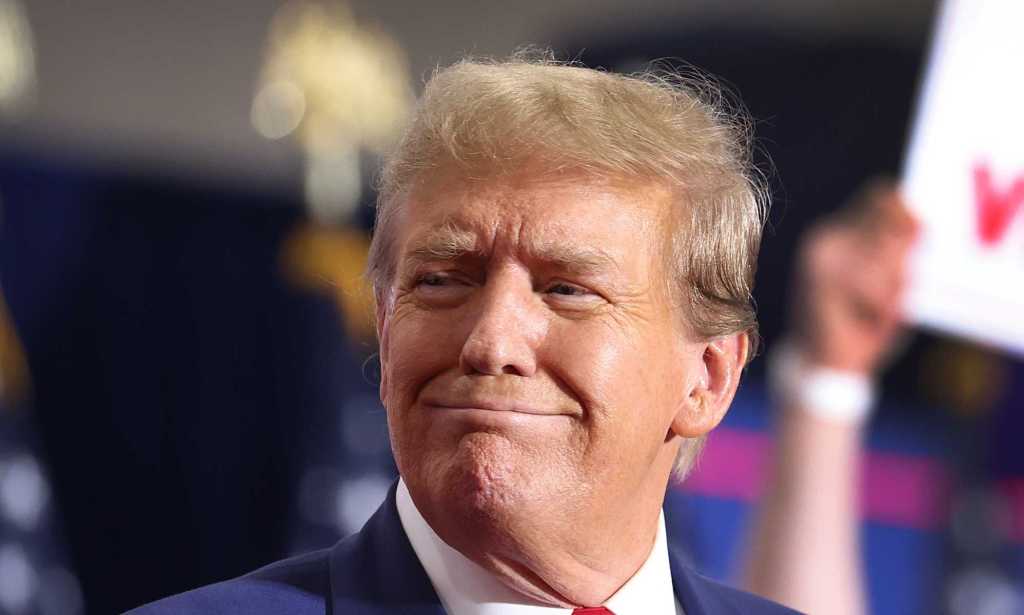
Donald Trump has tried to distance himself from the hard-line right-wing document. (Getty)
The State Department’s LGBTQ+ equality initiatives in Africa would also be axed. In other words, there would be no effort to stop draconian anti-queer laws being passed in countries such as Uganda.
In terms of education, the conservative blueprint is even more staunchly anti-LGBTQ+. It calls for a ban on students using names or pronouns that don’t match the sex on their birth certificate, and no school employee would be “forced” to use a pupil’s chosen pronouns.
It document outlines ideas to remove LGBTQ+-inclusive curriculums and policies from schools, claiming that “critical race theory and gender ideology” are “poisoning and indoctrinating children with leftist ideologies”. Instead, families “comprised of a married mother, father and their children” would be prioritized.
Despite many of its authors being one-time Trump administration advisors, the former president claims to know “nothing about Project 2025” or who is behind it, saying: “I disagree with some of the things they’re saying and some of the things they’re saying are absolutely ridiculous and abysmal.”
And two of his campaign advisors insisted: “President Trump’s campaign has been very clear that Project 2025 had nothing to do with the campaign, did not speak for the campaign, and should not be associated with the campaign in any way.”
A spokesperson for Project 2025 has even told CNN that it “does not speak for any candidate or campaign.”
However, Democrats have continued to point to links between the 922-page document and Trump. As he’s now won the election, will Trump finally admit to having any involvement with Project 2025? Only time will tell.
Donald Trump has been outspoken against the LGBTQ+ community. (Getty)
At the time of writing, it seems almost inevitable that Donald Trump will become the 47th President of the United States, meaning LGBTQ+ rights are under serious threat.
The election was one of the closest in history according to voting polls over the past few weeks, with polling group FiveThirtyEight reporting that Harris just barely reached a 1.2 per cent lead on Trump a day before the results were counted.
The last Trump presidency led to a roll-back of protections and anti-discrimination laws for LGBTQ+ people, and it doesn’t look as if a second term would be any different if he is re-elected, based on campaign promises and the detailed policy proposals outlined in Project 2025 – although Trump has tried to distance himself from the right-wing proposals.
In anticipation of a Trump win, the American Civil Liberties Union (ACLU) suggested a new Trump administration would “reinstate and significantly escalate the removal of anti-discrimination policies… proactively require discrimination by the federal government [and] weaponize federal law against transgender people across the country”.
So, what are Trump’s views about LGBTQ+ rights, and what exactly might he do?
Erase federal non-discrimination protections for LGBTQ+ people
Trump’s first term was extremely detrimental to the rights and protections of LGBTQ+ people, and a second term could roll back protections once again.
LGBTQ+ people might no longer be guaranteed to be free of discrimination across several federal government programs, such as Social Security, Medicare, housing and employment.
Exclude openly transgender people from the military
The first Trump administration reversed policies allowing trans people to serve in the military, and it is not difficult to foresee the president doing so again.
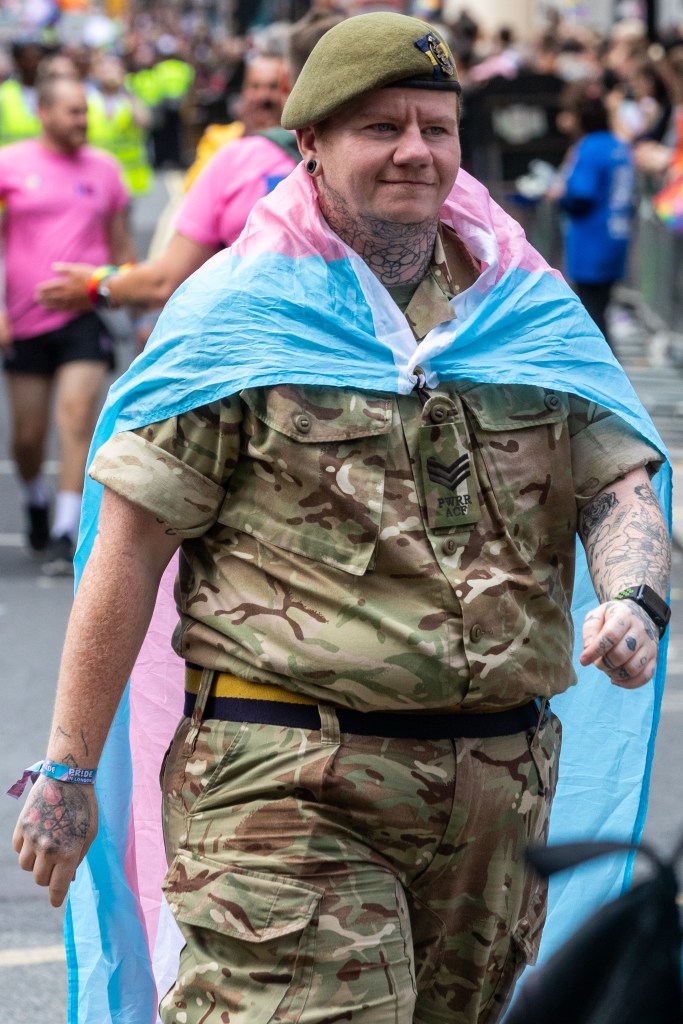
Another ban on trans people in the military would force out active-duty transgender service personnel as well as prevent trans people enlisting in the future.
This is despite a report in 2016 revealing that trans-inclusive policies have “little or no impact on unit cohesion, operational effectiveness, or readiness”.
In fact, trans-inclusive military policies could benefit all active service members by “creating a more inclusive and diverse force.”
Trans people could once again be banned from serving. (Getty)
Withhold federal funding if school officials affirm transgender students
Trump has said he would act to stop any school district introducing or maintaining trans-inclusive policies and practices.
This would include withholding federal funding that allow trans students to use toilets and changing rooms that align with their gender identity, or even acknowledging that they are trans, as well as arguing that trans-inclusive policies violate the rights of cisgender pupils.
Discrimination against trans students, causing significant harm to the community as a whole, would be the likely result of such a move.
During a recent campaign rally, Trump said he was not going to “let” trans women compete in sporting events at all if he becomes president again.
He said invoking the ban would “not [be] a big deal”, citing recent sporting events in which trans women competed against cisgender women, claiming that the trans athlete had a competitive edge over their opponent.
“Physically, from a muscular standpoint… look at what’s happened in swimming. Look at the records that are being broken,” he said.
Prohibit gender-affirming care in federal healthcare programmes
His website also promises that on his first day in the Oval Office, he would issue an executive order “instructing every federal agency to cease all programs that promote the concept of sex and gender transition, at any age”.
The administration would also probably deny Medicaid funding for hospitals that provide gender-affirming care, forcing medics to deny trans people the care they require.
Access to healthcare for more than 100,000 transgender youngsters in 24 states has already been halted in the past three years.
Allow employers to discriminate against LGBTQ+ staff
A second Trump administration could bring in provisions to allow employers to discriminate against LGBTQ+ members of staff based on the boss’ stated religious beliefs, a reversal of existing non-discrimination laws.
This would not require congress or bipartisan support, and could be pushed through using an executive order from the president.
The administration could go one step further to prevent state and local governments enforcing non-discrimination laws if the defendant says the discrimination was based on religious belief.
Laws protecting LGBTQ+ people and other minorities from discrimination based on protected characteristics might also disappear.
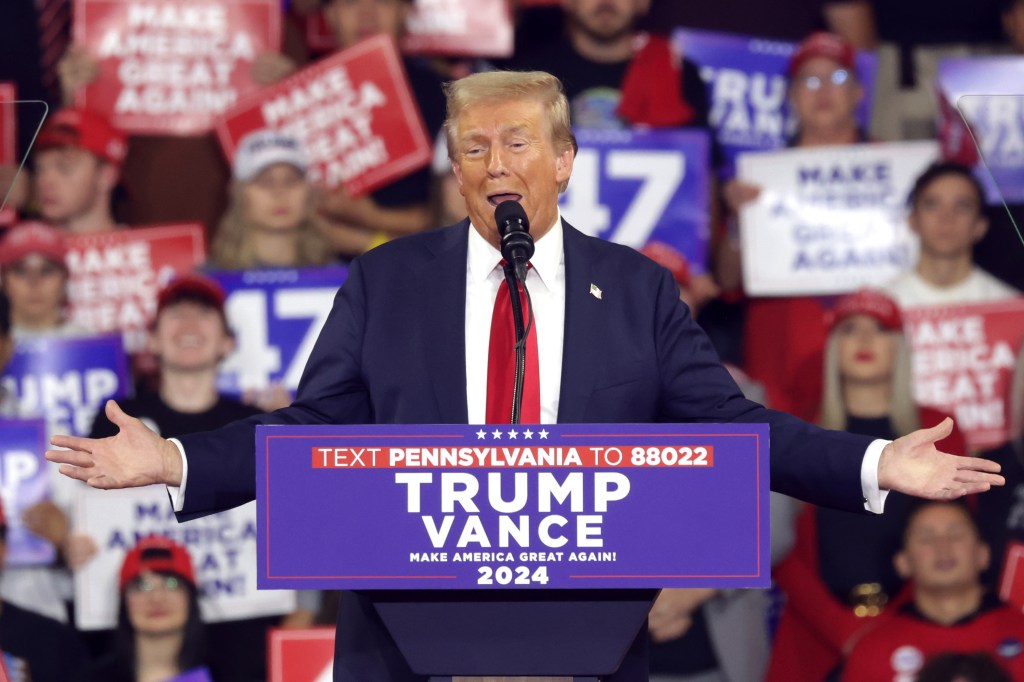
Donald Trump has continued to target the LGBTQ+ community. (Getty)
Criminalize gender-non-conformity in public life
Project 2025 – a hard-line right-wing blueprint for a future Republican president – suggests the use of criminal laws to punish gender-non-conformity in public life, with pornography being the crux of the issue.
The authors of the plan, the Heritage Foundation, inexplicably link pornography with “transgender ideology” and argue that neither has a “claim to First Amendment protection” and therefore should be outlawed.
“The people who produce and distribute it should be imprisoned,” they demand. “Educators and public librarians who purvey it should be classed as registered sex offenders, and telecommunications and technology firms that facilitate its spread should be [closed down].”
That means any discussion of transgender people in schools and libraries could be criminalized, and trans people might face jail time for being themselves.
Trump would only be able to put this into practice with congress’ approval and there is unlikely to be bipartisan support for such a law, but even the slim possibility is terrifying.
Finally – could gay marriage be reversed?
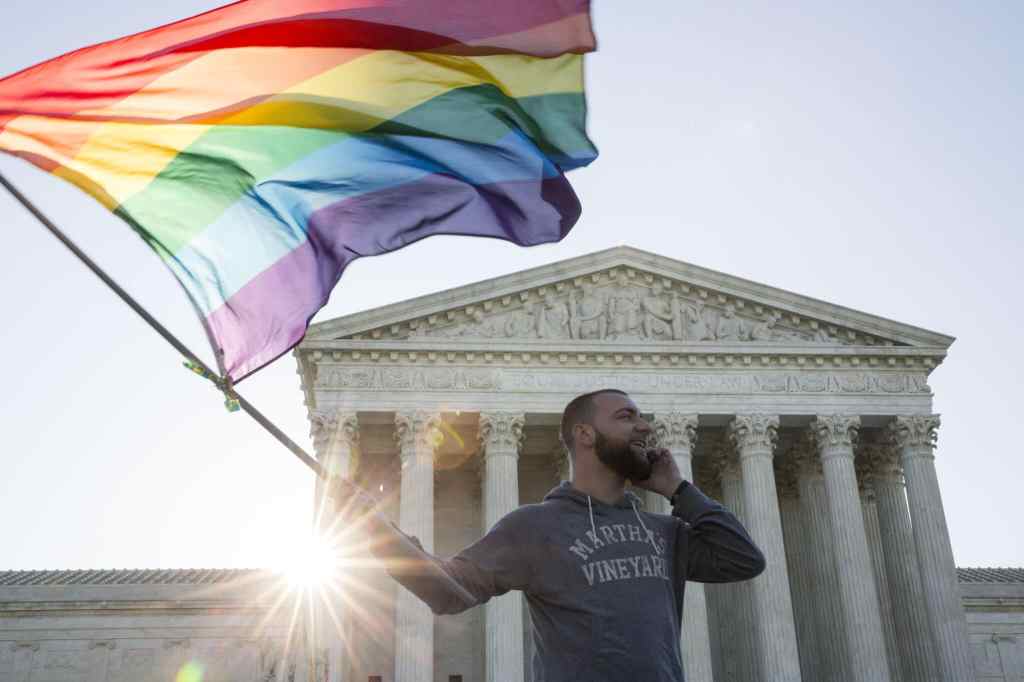
Same-sex marriage supporter Vin Testa, of Washington DC, waves a rainbow pride flag near the Supreme Court. (Drew Angerer/Getty Images)
Unfortunately, yes, it could.
After crucial abortion legislation Roe v. Wade was overturned by the Supreme Court, many people said that next, they would be coming for Windsor and Obergefell and Lawrence – three rulings that unlocked a national right to same-sex marriage.
Whether a same-sex couple could marry varied by state before 2015. With its 5-4 decision in Obergefell v. Hodges, the Supreme Court extended the full federal right to marry to all same-sex couples.
So would – or could it be taken away? Many people think that the Supreme Court wouldn’t dare. Same-sex marriage is now too accepted in American society, they argue. It would cause “legal chaos.”
However, it remains the case that some justices, particularly Samuel Alito and Clarence Thomas, appear to be itching to overturn Obergefell. In 2022, Justice Thomas said the Supreme Court “should reconsider” its past rulings codifying rights to contraception access, same-sex relationships and same-sex marriage.
It’s important to remember in all of this Pride is a protest, and it continues to be. We can fight any and all of these attacks by standing up, speaking out and refusing to stay silent.
November 7, 1837 Abolitionist, clergyman and editor Elijah P. Lovejoy, 34, was murdered by a pro-slavery mob in Alton, Illinois, as he defended his newly delivered printing press.
Elijah P. Lovejoy
He had lost two other presses to mob attacks, but refused to surrender this one, which had been contributed by the Ohio Anti-Slavery Society. For this he was shot five times in the fatal attack. Lovejoy had moved 20 miles to Alton from St. Louis where, after denouncing the lynching and burning of a black man, a mob tore down his office. Warehouse with Lovejoy’s press set ablaze by mob; “We must stand by the Constitution and laws, or all is gone.” Elijah Lovejoy, The Observer Read more
November 7, 1862 1700 members of the Dakota Sioux, mostly women, children and the eldersly, were force-marched 150 miles (240 km) to a concentration camp at Fort Snelling in Minnesota. The four-mile-long (6.5 km) procession was subject to physical abuse by white residents of towns along the way. Governor Alexander Ramsey had committed himself to ridding the state of all the Dakota, raising the bounty on an Indian scalp to $200. One of the prisoners at Fort Snelling Simultaneously, 300 Dakota men were tried summarily (as many as 40 cases in a single day) and marched to another camp in Mankato. They had surrendered to the U.S. Army at the end of the Dakota War, expecting to treated as prisoners of war. Little War on the Prairie (This American Life) More on this forced march
November 7, 1916 Jeannette Rankin, a Republican from Missoula, Montana, became the first woman elected to the U.S. Congress. American women in 19 states had no voting rights whatsoever until passage of the 19th amendment four years later. Female Montanans had full voting rights even before statehood (in 1889). Readmore
November 7, 1919 Hundreds, presumed to be members of the Union of Russian Workers, were arrested in New York and other cities across the country on the second anniversary of the Russian Revolution. President Woodrow Wilson’s attorney general, A. Mitchell Palmer, and Intelligence Division chief, John Edgar Hoover, used the Sedition and Espionage Acts to thwart what they saw as a Communist plot to overthrow the government. This was but one many assaults on radicals in what was known as the Palmer Raids. Thousands were arrested and thousands deported. It had been a year of significant labor unrest including steel, coal, and Boston police strikes, and a Seattle general strike. There was high unemployment in the wake of the demobilization after World War I. Around May Day there had been dozens of mail bombs, most of them intercepted, and a suicide bomber died outside Palmer’s Washington residence. The Palmer Raids The first mass arrest of immigrant workers Attorney General Mitchell’s view
November 7, 1973 New Jersey became the first state to allow girls to play Little League Baseball.
Was talking with Jarret Berenstein today and he made an excellent point I hadn’t realized. Trump will finish with about the same number of votes as he did in 2020. While commentators were stumbling all over themselves to give Trump credit for reaching new voters and forming coalitions and all kinds of other stuff that never happened, the truth is that Trump won because 15 million people who voted for Biden didn’t vote for Harris. The good news is that the feeling of dread from Trump growing his base is unfounded. But that doesn’t change the outcome. 15 million people made the choice to let someone else decide this for them and the rest of us have to live with that choice. My predictions for this were wrong. I’m not upset about being wrong but I am upset about why. 15million people decided that apathy or “protest” or indecision was more important than being a part of democracy. There are no more Trumpers than there were 4 years ago. But something I couldn’t predict was 15 million non-Trumpers who simply couldn’t be bothered. Any emotion you’re feeling today is valid. I am a mix of sad and angry and frustrated and a dozen other things. Sending all my love and support to those in marginalized communities who need it most. And blocking those who don’t. Hugs, -Steve
it’s too cold here for butterflies. As it should be, in November.
Oooookay. I’ve got little to offer right now. We lost, we seem to have lost by not much numbers-wise, but big as to our government. So there are likely to be changes coming. I’ve got very little because while most of the ones who won lie constantly, sometimes they don’t lie. It’s easy to take all the very bad things they’ve said and decide they weren’t telling lies then, but they were otherwise. But, one could choose to take the opposite outlook, as well, deciding that they said the very bad stuff to get the ugly vote, but didn’t mean it. Or, we can just take care of ourselves now and for the future instead of worrying about changes that aren’t here yet. I hope we decide to retain our power to put ourselves in good positions to withstand any adversities that might be on the way.
David Gilliver creates amazing light paintings — one of his latest was just shortlisted in the British Photography Awards. This article says he uses a lightsaber while dressed all in black; the pinnacle of Sith expression.
Halfbakery is “a communal database of original, fictitious inventions, edited by its users”. For example, the beardaclava, which is “a carefully woven balaclava that hangs as a thick and luxurious seamless extension to your existing beard, perfectly matching its colour and hair quality”.
Godchecker is here for you if you need to check a god. “Our legendary mythology encyclopedia now includes nearly four thousand weird and wonderful Gods, Supreme Beings, Demons, Spirits and Fabulous Beasts from all over the world.” Comprehensive.
I’m writing about the intersection of the internet, media, and society. Sign up to my newsletter to receive every post and a weekly digest of the most important stories from around the web.




 Elijah P. Lovejoy
 One of the prisoners at Fort Snelling
 Scottie's Playtime