June 30, 2025 Evrim Yazgin, Cosmos science journalist
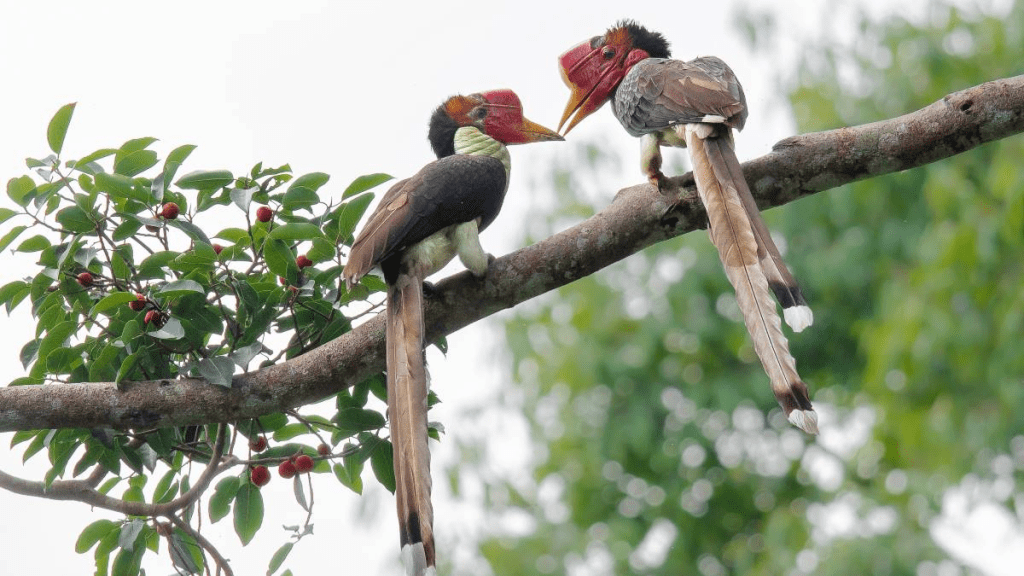
Helmeted Hornbill (Buckeroos vigil) male and female. Credit: Hello my names is james,I’m photographer / iStock / Getty Images Plus.
Researchers analysed different threat factors such as habitat loss and climate change to find that 500 bird species could go extinct in the next century. Unique species are most at risk.
The study, published in the Nature Ecology & Evolution, warns that the loss of unique birds could harm ecosystems around the world.
Vulnerable birds include the bare-necked umbrellabird found in the forests of Costa Rica and Panam, helmeted hornbill from Southeast Asia and yellow-bellied sunbird-asity endemic to Madagascar.
“We face a bird extinction crisis unprecedented in modern times. We need immediate action to reduce human threats across habitats and targeted rescue programmes for the most unique and endangered species,” says lead author Kerry Stewart from the University of Reading, UK.
The researchers studied the behavioural and morphological traits of about 10,000 bird species – representing nearly all known bird species – using data from the International Union for Conservation of Nature (IUCN) Red List.
Applying a statistical model, the researchers were able to show that large-bodied species were more at risk from hunting and climate change. Meanwhile, birds with broad wings suffer more from habitat loss.
“Stopping threats is not enough, as many as 250–350 species will require complementary conservation measures, such as breeding programmes and habitat restoration, if they are to survive the next century,” says senior author Dr Manuela Gonzalez-Suarez, also from the University of Reading. “Prioritising conservation programmes for just 100 of the most unusual threatened birds could save 68% of the variety in bird shapes and sizes. This approach could help to keep ecosystems healthy.”
“Many birds are already so threatened that reducing human impacts alone won’t save them,” adds Stewart. “These species need special recovery programmes, like breeding projects and habitat restoration, to survive.”
The authors say that “functionally unique” species – i.e. species that fill highly specialised ecological niches – are the most vulnerable. Likewise, the loss of such unique species could cause a cascading effect of harm for broader ecosystems.
“Effective targeted recovery programmes that explicitly consider species uniqueness hold great potential for conserving global functional diversity as a complementary strategy to threat abatement,” they write.
He was a man of many contradictions and continuity errors. He was a fiery televangelist who had a whole lot to say about other people’s sex lives and immorality, but who also famously enjoyed the occasional lady of the evening.
Swaggart surely served as a role model and inspiration to many future evangelical preachers, like Ted Haggard, Jerry Falwell Jr., Tony Alamo, Douglas Goodman, and so, so many others others who would go on to follow in his very holy/pervy footsteps.
In 1988 — not long after he had publicly dragged his fellow televangelist Jim Bakker for having used church funds to pay $279,000 in hush money to his former secretary Jessica Hahn after he raped her, committing multiple acts of fraud for which he was later imprisoned, as well as for owning a waterpark — a rival evangelist of Swaggart’s sold photos of him going to a motel with a sex worker, after Swaggart refused to stop accusing him of being an adulterer. That picture you see above is from his very famous apology. (snip-MORE, with a trigger warning regarding disturbing info)
I want to thank everyone that encouraged me to go forward with what is to me a scary operation. I love everyone that wrote / called me to tell me their stories. I had my second appointment with the eye doctor. Even with the prism that took some of the fussy out of the letters I was seeing the best they could do for me was 20/70. I have no idea of what that means but she asked if I was driving and I replied yes which seemed to upset the doctor. The office is wonderful and very LGBTQ+ affirmative and they included and joked with us totally comfortably. I had to laugh when the doctor asked the eye person to get his husband and she went out and told Ron he had been summoned.
It seems she feels I need to have the surgery to see. She is unsure if they will do both eyes but feels they will. She explained what she felt would be our costs, and what would happen to my eyesight if we did not go forward. Ron told them about how high the magnification is on my monitors and how he has to try to step back to read everything smoothly. He told them it was unacceptable my sight would get any worse and I would lose the ability to do what I love, be on the computer with all of you.
So they set up an appointment with the eye surgeon. I was shocked at how fast it was happening. I figured I would have a couple of months, but the appointment is for next Monday. Ok I know everyone has told me how great their experience was but … I admit to being scared. My eyes are so important to me and how I live my life. I could give many organs but if I lose my sight my life as I love it is over.
The eye doctor is a wonderful older lady who was concerned about the costs for us and Ron told her we would manage that it was important enough. She cautioned us not to be dragged into expensive things I man not need as most people getting the normal corrective lens were more than satisfied and had good vision. She warned that the market was in convincing us to pay for “Upgraded corrective lenses” that I may not need or could be avoided with a cheap pair of reader glasses.
I have to admit she was far different from the big business eye place Ron and I went to several years ago. I was not yet 62 so they told me as soon as I was I needed to see them to have the cataracts removed. Ron was already over that age for Medicare to pay for it and they pushed him hard to have the surgery. His eyesight was far better and less cloudy than mine. They just wanted the money from Medicare. Plus after my exam they took me to their glasses section. After picking out what I thought was a pair of reasonably priced frames they totaled up my new glasses … at $1,400.00
I looked at Ron, we had never paid that for any glasses. I told them I needed to think on it and never went back. The only issue I have is do I pay extra for the “corrective lenses”? If anyone could leave me a message on their experience either way, I would be so grateful. Ron was such a cheerleader for me after we left the eye doctor’s office saying how he felt this would be so good for me and make what I love doing on the computer so easy. I wish I felt as confidant as he does. Hugs
A crop field in Oxnard, California, U.S., June 18, 2025. REUTERS/Pilar Olivares
Lisa Tate is a sixth-generation farmer in Ventura County, California, an area that produces billions of dollars worth of fruit and vegetables each year, much of it hand-picked by immigrants in the U.S. illegally.
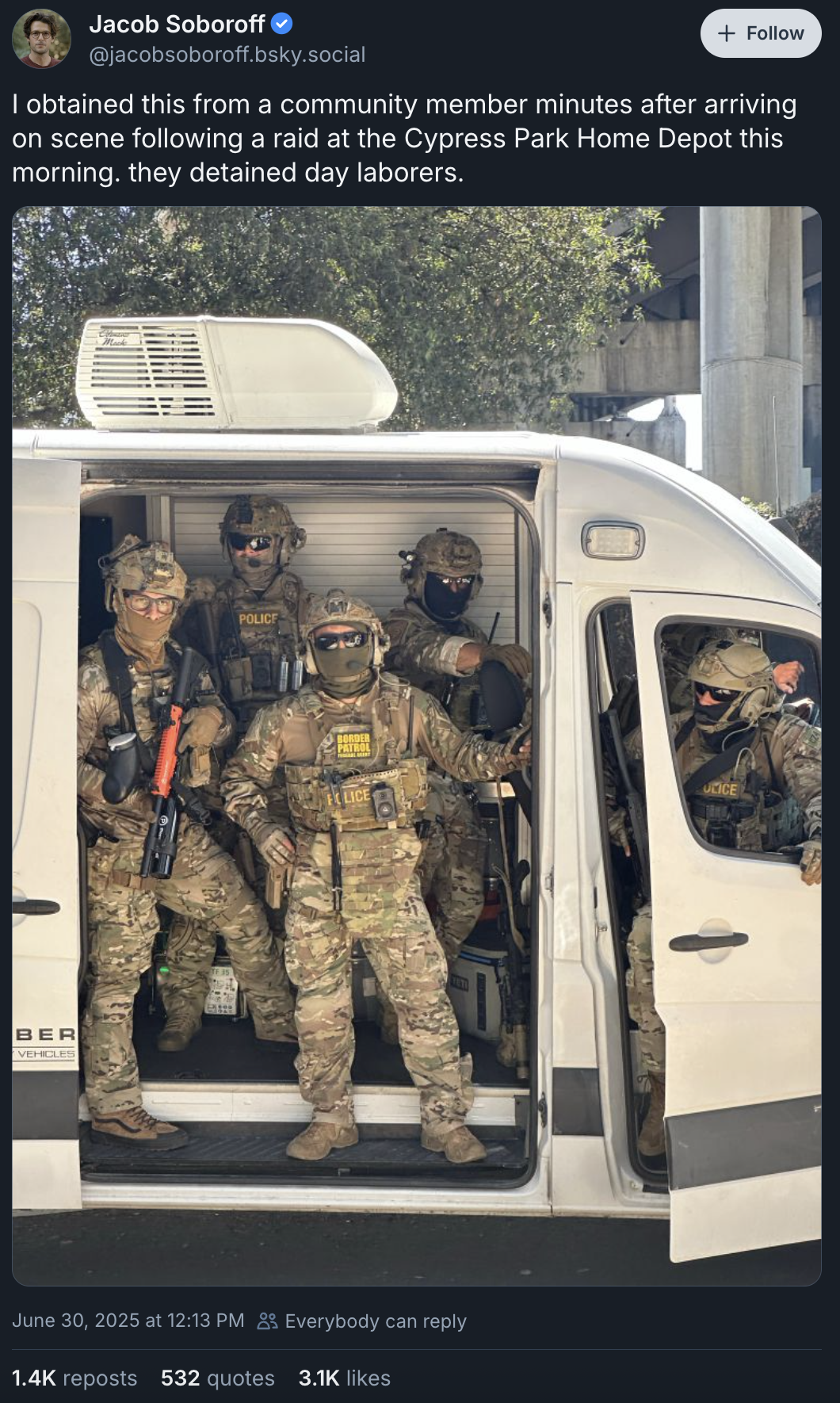
Tate knows the farms around her well. And she says she can see with her own eyes how raids carried out by agents from U.S. Immigration and Customs Enforcement in the area’s fields earlier this month, part of President Donald Trump’s migration crackdown, have frightened off workers.
“In the fields, I would say 70% of the workers are gone,” she said in an interview. “If 70% of your workforce doesn’t show up, 70% of your crop doesn’t get picked and can go bad in one day. Most Americans don’t want to do this work. Most farmers here are barely breaking even. I fear this has created a tipping point where many will go bust.”
In the vast agricultural lands north of Los Angeles, stretching from Ventura County into the state’s central valley, two farmers, two field supervisors and four immigrant farmworkers told Reuters this month that the ICE raids have led a majority of workers to stop showing up.
That means crops are not being picked and fruit and vegetables are rotting at peak harvest time, they said.
One Mexican farm supervisor, who asked not to be named, was overseeing a field being prepared for planting strawberries last week. Usually he would have 300 workers, he said. On this day he had just 80. Another supervisor at a different farm said he usually has 80 workers in a field, but today just 17.
A Guatemalan immigrant works on a crop field at a farm in the Kern County, California, U.S., June 19, 2025. REUTERS/Pilar Olivares
BAD FOR BUSINESS
Most economists and politicians acknowledge that many of America’s agricultural workers are in the country illegally, but say a sharp reduction in their numbers could have devastating impacts on the food supply chain and farm-belt economies.
Douglas Holtz-Eakin, a Republican and former director of the Congressional Budget Office, said an estimated 80% of farmworkers in the U.S. were foreign-born, with nearly half of them in the country illegally. Losing them will cause price hikes for consumers, he said.
“This is bad for supply chains, bad for the agricultural industry,” Holtz-Eakin said.
Over a third of U.S. vegetables and over three-quarters of the country’s fruits and nuts are grown in California, according to the California Department of Food and Agriculture. The state’s farms and ranches generated nearly $60 billion in agricultural sales in 2023.
If they show up to work, they don’t know if they will ever see their family again.
Migrant worker
Of the four immigrant farmworkers Reuters spoke to, two are in the country illegally. These two spoke on the condition of anonymity, out of fear of being arrested by ICE.
One, aged 54, has worked in U.S. agricultural fields for 30 years and has a wife and children in the country. He said most of his colleagues have stopped showing up for work.
“If they show up to work, they don’t know if they will ever see their family again,” he said.
The other worker in the country illegally told Reuters, “Basically, we wake up in the morning scared. We worry about the sun, the heat, and now a much bigger problem – many not returning home. I try not to get into trouble on the street. Now, whoever gets arrested for any reason gets deported.”
Item 1 of 4 An immigrant worker harvests crops during the weekend, as labor shortages risk leaving fields unpicked, in Oxnard, California, U.S., June 22, 2025. REUTERS/Pilar Olivares
[1/4]An immigrant worker harvests crops during the weekend, as labor shortages risk leaving fields unpicked, in Oxnard, California, U.S., June 22, 2025. REUTERS/Pilar Olivares
To be sure, some farmworker community groups said many workers were still returning to the fields, despite the raids, out of economic necessity.
The days following a raid may see decreased attendance in the field, but the workers soon return because they have no other sources of income, five groups told Reuters.
Workers are also taking other steps to reduce their exposure to immigration agents, like carpooling with people with legal status to work or sending U.S. citizen children to the grocery store, the groups said.
ICE CHILL
Trump conceded in a post on his Truth Social account this month that ICE raids on farmworkers – and also hotel workers – were “taking very good, long-time workers away” from those sectors, “with those jobs being almost impossible to replace.”
Trump later told reporters, “Our farmers are being hurt badly. They have very good workers.” He added, “They’re not citizens, but they’ve turned out to be great.”
He pledged to issue an order to address the impact, but no policy change has yet been enacted.
Trump has always stood up for farmers, said White House spokeswoman Anna Kelly in response to a request for comment on the impact of the ICE raids to farms. “He will continue to strengthen our agricultural industry and boost exports while keeping his promise to enforce our immigration laws,” she said.
Bernard Yaros, Lead U.S. Economist at Oxford Economics, a nonpartisan global economics advisory firm, said in a report published on June 26 that native-born workers tend not to fill the void left by immigrant workers who have left.
“Unauthorized immigrants tend to work in different occupations than those who are native-born,” he said.
ICE operations in California’s farmland were scaring even those who are authorized, said Greg Tesch, who runs a farm in central California.
Farmers and laborers in California told Reuters that many field workers have stopped showing up to pick fruit and vegetables. Emma Jehle reports.
“Nobody feels safe when they hear the word ICE, even the documented people. We know that the neighborhood is full of a combination of those with and without documents,” Tesch said.
“If things are ripe, such as our neighbors have bell peppers here, (if) they don’t harvest within two or three days, the crop is sunburned or over mature,” said Tesch. “We need the labor.”
The Reuters Tariff Watch newsletter is your daily guide to the latest global trade and tariff news. Sign up here.
Reporting by Tim Reid, Sebastian Rocandio, Pilar Olivares and Leah Douglas. Editing by Mary Milliken and Rosalba O’Brien.
Yes, this passed in the Senate, thanks to the VP’s tiebreaking vote. However, it’s still got rows to hoe in the US House; Spkr. Johnson wants to vote tomorrow. The thing to remember about our US Reps is, they’re up for election each 2 years. So, while firmly directing them in dealing with this dreadful bill, also firmly yet lovingly remind them that the OBBB will be hanging around their necks every step of the way of their campaigns like a bubblegum machine golden giant dollar sign necklace, if they vote in favor.
(Actually, if you didn’t when you contacted your Senators last week, you can still remind them of the same thing, unless they voted against, in which case, Thank Them. It took bravery to vote against, and they need to know we have their backs. And thank you very much. Now call.)
Surprise surprise. A week after Sarah McBride gives cover fire for throwing trans people under the bus, some Dems are privately indicating they’ll capitulate on trans youth healthcare and citing the pseudoscientific Cass Report literally drafted in consultation with hate groups.
1. A government official has informed us that the Trump administration is likely intentionally not complying with a trans passport ruling in an Erin In The Morning exclusive.One person was told, "We don't answer to courts."Subscribe to support our journalism.
I hope everyone and their pets enjoy at least some peace these next few days! I hate fireworks, though I don’t mind them far away or on TV. I did used to like them, when I was a kid. 🎆
July 1, 1917 8000 anti-war marchers demonstrated in Boston. Their banners read: “IS THIS A POPULAR WAR, WHY CONSCRIPTION? WHO STOLE PANAMA? WHO CRUSHED HAITI? WE DEMAND PEACE.” The parade was attacked by soldiers and sailors, on orders from their officers.
July 1, 1944 A massive general strike and nonviolent protest in Guatemala led to the resignation of dictator Jorge Ubico who had harshly ruled Guatemala for over a decade. Juan José Arévalo Bermejo On March 15 of the following year, Dr. Juan José Arévalo Bermejo took office as the first popularly elected president of Guatemala, and promptly called for democratic reforms establishing the nation’s social security and health systems, land reform (redistribution of farmland not under cultivation to the landless with compensation to the owners), and a government bureau to look after native Mayan concerns. Jorge Ubico A decade of peaceful democratic rule followed, until a CIA-backed coup in 1954 ushered in a new, even more brutal era of dictatorial and genocidal regimes. [see June 27, 1954]
July 1, 1946 The United States exploded a 20-kiloton atomic bomb near Bikini Atoll, part of the Marshall Islands in the Pacific Ocean.
July 1, 1968 Sixty-one nations, including the United States, Britain and the Soviet Union, signed the Treaty on the Non-Proliferation of Nuclear Weapons (NPT) which set up systems to monitor use of nuclear technology and prevent more nations from acquiring nuclear weapons. 190 countries are now signatories; Israel, India and Pakistan remain outside the Treaty. North Korea joined the NPT in 1985, but in January 2003 announced its intention to withdraw from the Treaty. Text of the Treaty
July 1, 1972 The first issue Publication of the first monthly issue of Ms. Magazine, founded by Gloria Steinem “The truth will set you free. But first, it will piss you off,” Letty Cottin Pogrebin “Housework is the only activity at which men are allowed to be consistently inept because they are thought to be so competent at everything else,” and others. Ms. Magazine today (It’s still Ms. Magazine! -A.)
July 1, 2000 Vermont’s civil unions law went into effect, granting gay couples most of the rights, benefits, protections and responsibilities of marriage under state law. In the first five years, 1,142 Vermont couples, and 6,424 from elsewhere, had chosen a Vermont civil union.