November 20, 1816 The term “scab” was first used in print by the Albany (N.Y.) Typographical Society. A scab is someone who crosses a union’s picket line and takes the job of a striking worker. Read The Scab by Jack London
November 20, 1945 The International War Crimes Tribunal began in Nuremberg, Germany, and continued until October 1, 1946, establishing that military and political subordinates are responsible for their own actions even if ordered by their superiors.Twenty-four high-ranking Nazis were on trial for atrocities committed during World War II, ranging from crimes against peace to crimes of war, to crimes against humanity. The Nuremberg Trials were conducted by judges from the United States, the Soviet Union, France, and Great Britain.The Nuremberg defendants Read more
November 20, 1959 The United Nations proclaimed “The Declaration of the Rights of the Child,” because “the child, by reason of his physical and mental immaturity, needs special safeguards and care, including appropriate legal protection, before as well as after birth.” Read the text of the Declaration
November 20, 1962 President John F. Kennedy issued an executive order forbidding racial discrimination in public housing.
November 20, 1969 Eighty-nine American Indians seized Alcatraz Island in San Francisco Bay, offering to buy the island from the federal government for $24 worth of beads (the alleged price paid to the Canarsee Delaware Indians for Manhattan Island; it was actually 60 Dutch guilders). Their numbers swelled into the hundreds at times; the General Services Administration, which had responsibility for the site of the former federal prison, and Coast Guard gave them the opportunity to leave the island peacefully.They were reclaiming it as Indian land by right of discovery, and demanding fairness and respect for native peoples. The occupation lasted for more than a year. Said Richard Oakes, a Mohawk from New York, “We hold The Rock.” Indian people and their supporters wait for the ferry. Photo/Ilka Hartmann a new entrance to Alcatraz; Photo/Michelle Vignes Read more about the occupation LaNada Boyer (formerly Means) inside one of the Alcatraz guard barracks where occupiers lived from 1969-71. Much of the graffiti from 30 years ago remains throughout the island today. Photo by Linda Sue Scott.
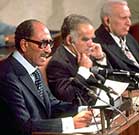
November 20, 1977 Egyptian President Anwar El-Sadat addressed the Israeli Knesset (parliament). “I come to you today on solid ground to shape a new life and to establish peace. “But to be absolutely frank with you, I took this decision after long thought, knowing that it constitutes a great risk….” Text of Sadat’s speech to the Israeli Knesset Listen to the speech
November 20, 1987 SANE (The Committee for a Sane Nuclear Policy) and FREEZE (the campaign to freeze all testing of nuclear weapons) merged at their first combined convention in Cleveland, Ohio, becoming the largest U.S. peace organization. Peace Action today
November 20, 1993 The U.S. Senate approved the North American Free Trade Agreement (NAFTA), creating the world’s largest trade area covering Canada, the U.S. and Mexico.
This is a completely different video than the one I posted before. I am sorry that I posted that one. I hated the glitches in it. So I trashed it. I did it before I looked to see if It had comments. If you left comments please put them on this one. This one is longer and more in depth, but done with a higher resolution and done at 3 am this morning so I sound better and more coherent. There are no glitches of either video or audio that I could see / hear. I hope you will enjoy it. Today I am going to dump both computers starting at 12:30 pm. I have the laptop running if I need it. Hugs. Scottie
I read a bunch of headlines I have in open tabs and I talk about the stories they pertain to briefly. Nothing in depth, just generalized information in the public sphere of information. If there is a topic you wish me to cover in more detail please mention it in the comments. Hugs
It is OK and great to stop the video at the 8:30 mark. After that it gets seriously stupid. But before that it has a lot to say that is true and said in a semi comedic way. Hugs
The FBI is aware of the offensive and racist text messages sent to African American and Black communities around the country and is in contact with the Justice Department and other federal authorities on the matter.
The reports are not identical and vary in their specific language, but many say the recipient has been selected to pick cotton on a plantation.
The text message recipients have now expanded to high school students, as well as both the Hispanic and LGBTQIA+ communities.
Some recipients reported being told they were selected for deportation or to report to a re-education camp. The messages have also been reported as being received via email communication.
Although we have not received reports of violent acts stemming from these offensive messages, we are evaluating all reported incidents and engaging with the Department of Justice Civil Rights Division.
We are also sharing information with our law enforcement partners and community, academia, and faith leaders.
Read the full press release. Re-education = ex-gay torture.
A week after cellphone users across the U.S. reported racist text messages, members of the Hispanic and LGBTQ communities are now receiving text messages saying they have been selected for deportation or to report to a re-education camp, the FBI said. https://t.co/m94niQbu3H
Pete Hegseth, the Army National Guard veteran and Fox News host nominated by Donald Trump to lead the Department of Defense, was flagged as a possible “Insider Threat” by a fellow service member due to a tattoo on his bicep that’s associated with white supremacist groups.
Hegseth, who has downplayed the role of military members and veterans in the Jan. 6, 2021, attack and railed against the Pentagon’s subsequent efforts to address extremism in the ranks, has said he was pulled by his District of Columbia National Guard unit from guarding Joe Biden’s January 2021 inauguration. He’s said he was unfairly identified as an extremist due to a cross tattoo on his chest.
This week, however, a fellow Guard member who was the unit’s security manager and on an anti-terrorism team at the time, shared with The Associated Press an email he sent to the unit’s leadership flagging a different tattoo reading “Deus Vult” that’s been used by white supremacists, concerned it was an indication of an “Insider Threat.”
Read the full article. Last month Hegseth sat for an interview with anti-LGBTQ Christian nationalist Kirk Cameron.
"This falls along the line of Insider Threat and this is what we as members of the U.S. Army, District of Columbia National Guard and the Anti-Terrorism/Force Protection Team strive to prevent," Gaither warned of Hegseth's assignment at @JoeBiden inauguration. AP obtained the… pic.twitter.com/8rJRN8N2dg
BREAKING: Trump’s nominee for Secretary of Defense Pete Hegseth, was flagged as a possible "Insider Threat" by a fellow service member due to a tattoo he has that’s associated with white supremacists. -AP pic.twitter.com/m5AWjKYbQt
In the wake of President-elect Donald Trump’s decision to appoint ex-Democratic Rep. Tulsi Gabbard as his Director of National Intelligence, reports have resurfaced of her ties to a religious sect described as a “cult”—a connection that has the potential to throw her nomination, which requires Senate confirmation, into jeopardy. She reportedly met her husband, Abraham Williams, when he volunteered to shoot a video for her 2012 House campaign.
In addition to bonding over a love of surfing, The Daily Mail reported that the couple also was mutually connected to the Science of Identity Foundation (SIF), a group with a history of antagonism toward LGBTQ people, women and Muslims. The group’s leader, Chris Butler, is heralded by members as a deity in his own right. The SIF, described as an alt-right branch of Hare Krishna, has reportedly developed thousands of followers.
Former members who don’t speak so fondly of the Foundation and others close to Gabbard have said the group’s influence could be affecting her political motives, according to the report.
People have said the Science of Identity Foundation forbids people to speak publicly about the group, requires people to lie face down when Butler enters a room and even sometimes eat his nail clippings or “spoonfuls” of the sand he walked on, The New Yorker reported.
“I know what an abusive, misogynistic, homophobic, germophobic, narcissistic nightmare Chris Butler is. And I know what kind of relationship he has with Tulsi,” Lalita, a self-described cult survivor, wrote on Medium in 2017.
The Emmett Till Memory Project teaches new generations about the tragedy that kickstarted the Civil Rights Movement. Preserving its digital assets is vital.
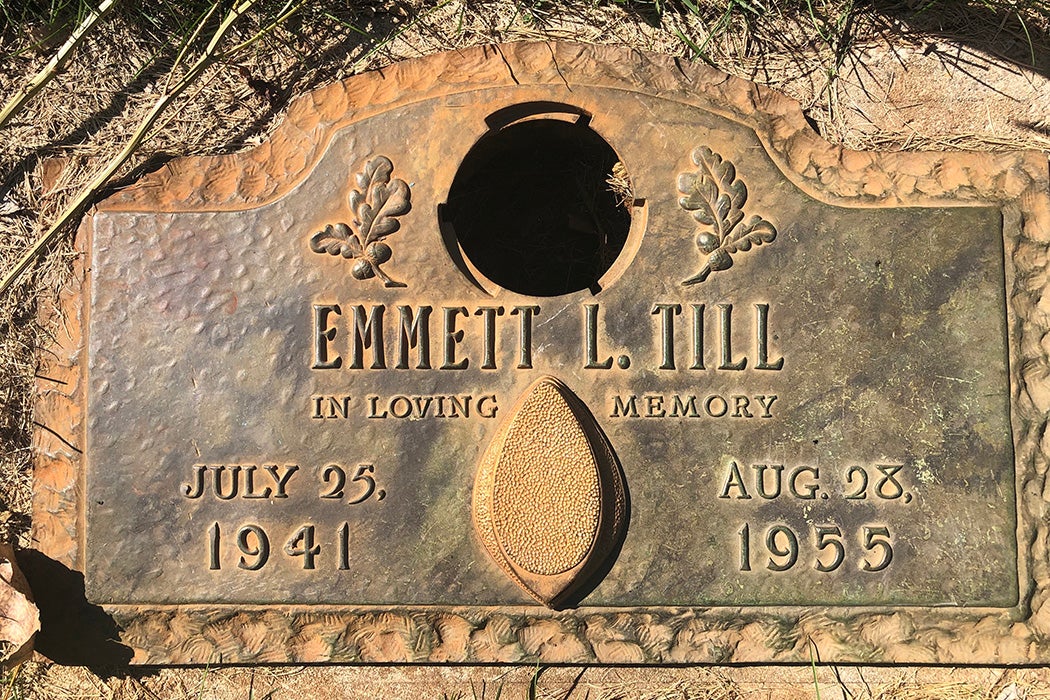
On a late August day in 1955, Emmett Till was murdered in Mississippi. A fourteen-year-old African American from Chicago, Till stopped with his cousins at Bryant’s Grocery & Meat Market to buy chewing gum. There, Till whistled at the clerk, a brazen act that violated the norms of the Jim Crow South and so angered the clerk’s husband and brother-in-law that they killed the boy.
The events and locations that tell the story of Till’s life and death have been memorialized in different ways and forms over the ensuing decades. The Emmett Till Memory Project (ETMP), an app, is one of them. It uses digitized archival documents, photos of those involved and of sites central to that fateful August day, and more so that users may educate themselves about who Emmett Till was and why his death still resonates. The ETMP’s digital assets are vital to ensuring the ongoing preservation of Till’s memory as well as his legacy.
That’s where Portico comes in. Dedicated to digital preservation, Portico has partnered with the ETMP to ensure the safekeeping in perpetuity of these digital artifacts.
Historian Dave Tell, a professor of communication studies at the University of Kansas, as well as the co-founder and director of the Emmett Till Memory Project, spoke with JSTOR Daily’s Sara Ivry about the Project and why its partnership with Portico is so critical.
Sara Ivry: How did you first learn of Portico?
Dave Tell: Kate Wittenberg reached out to me as part of the DEI efforts of her organization, specifically, a pilot project to support the preservation of archival content about under-represented topics that might be at risk. Kate contacted me about the time that we were massively reorganizing the Emmett Till Memory Project. She asked if she could just come along and preserve the site as it existed. I said, “Well, yes, you can, but we’re also trying to make it way better.” She sat in on development meetings over the last few years with us and has been an integral partner, not only in helping us think about preserving the site but helping us make design decisions that would render the site preservable.
Can you describe a little what the site was before you revamped it and what you were trying to do in the renovation?
The short story is we went live in October of 2019, and then in the pandemic, we used our last $10,000 of grant money to pay a DEI consultancy to tell us what we did well and what we did poorly. They did this entire audit, focus groups, they talked to the family, they talked to scholars. They looked at analytics, and they came back to us. Essentially, they told us great content, very bad design, which in retrospect is not surprising. Everyone on the project had been a content expert; we had never had design people on board. We had never had UX people.
The design only works for people who already know the story, they told us, which of course was a devastating blow to us. They also said this reads as if it was written by a middle-aged white guy and I’m like, “Well, I wrote it and I’m a middle-aged white guy—so fair enough.”
So, we hired a woman named Renee Payne out of the Rhode Island School of Design who runs a graphic design firm called included. She specializes in computer design for veterans of the Civil Rights movement; her clients include the families of Andy Young, Harry Belafonte, and family of Malcolm X. She assembled a team of young designers of color, and I said to them, “Nothing is sacred here. Let’s make this as good of a project as it can be,” and they reimagined it from the ground up.
When exactly then did Portico come on board?
Kate came in in the middle of this revamped process, and one of the specific things she encouraged us to do was to avoid third-party dependencies. The example that I understood was if you embed a YouTube video, your content is only as secure as YouTube, which you have no control over.
We really thought long and hard about what technologies we could preserve, and Kate and her colleague Karen Hanson pushed us to think about what exactly we’re preserving. The technologies we are currently depending on do not last forever, right? We changed our mindset. We don’t want to preserve this project so that like it will look the same for everyone into the future, but we want to preserve the assets.
Make images preservable, the text—the component parts.
Eventually we’re going to have a lot of immersive stuff on there. It’s only halfway there now. Portico helped us understand better to preserve the components that make up immersive pieces. In the future, people can use whatever technology is then current, use our same data, and create their own project.
I hadn’t thought about the built-in obsolescence of technology, and that we have to account and plan for that in the design of an app or site as well as in the design of an archive. Had you considered that before Portico got involved?
No, I’m a humanist by training, so when I first started thinking about digital preservation, probably a decade ago now, my gut instinct was we make the website just like a book. It’ll sit there unchanged forever. And Portico has been instrumental in changing the way I think about preservation—that first of all, forever might not be the goal.
Emmett and Mamie Till-Mobley on the exterior of the house they lived in from 1950–1955. Photo by Dave Tell via ETMP
Second, what gets preserved is not necessarily the sort of same experience that our users have today. What really matters and what needs to be preserved is what we have. The Emmett Till Memory Project has amazing artifacts. We have hours of audio with the family that they’ve given us permission to use that no one else has. We can tell the story in incredibly intimate ways and that’s super important. When you open this app, you’ll hear the voice of Reverend Wheeler Parker, Till’s cousin, narrating the story as all this stuff flashes on the screen behind you—I don’t care if the flashy, immersive technologies are preserved forever. But I care deeply that the audio files—and the voice of Rev. Parker—gets preserved. Someone else can build their own tools with that stuff. My ability to make that distinction is a testament to Kate and Portico.
Why is digital preservation of these assets critical in any case?
It’s almost hard to answer this question without going into cliche other than to say: Ignoring the past is a critical component of white supremacy. Full stop. What we want to do and what the family wants to do is tell the story—not that telling the story is sufficient for the change that they and I want to see, but it’s a critical part of the change that they and I want to see.
The Interpretive Center—what’s the first line of their mission statement, “We believe that racial reconciliation begins with telling the truth,” right?—that’s a sentence that accurately describes the vision of the Till family and it certainly describes my vision.
What was the origin of this app?
If you start from the murder of Emmett Till in August 1955 you have to count 49 years and 11 months before the state of Mississippi dropped a single dollar on the Till story. Eighteen citizens of Tallahatchie County thought that was ridiculous; they put up a commemorative sign that got shot, defaced with acid, spray painted.
Tallahatchie Civil Rights Driving Tour sign, ca. 2015. Photo by Pablo Correa via ETMP
In 2014, I got invited to go down, I’d been writing about Till for a decade and a half by then, and the question was: How do we tell Till’s story in the context of vandalism?
It’s easy to shoot a sign in the middle of the country. It’s harder to shoot an app.
What are some of the assets on the app that stand out to you?
My favorite by far are the hours of audio, oral history we have of Reverend Parker that was taken in his church in Chicago. We also drove him from site to site; we put a microphone on his lapel and on the sun visor of the car. And we just asked him what these sites meant to him as we went from place to place. All that audio’s not up yet, but we have it. (snip-a bit More)
November 16, 1928 An obscenity trial began for Radclyffe Hall’s novel, “The Well of Loneliness.” Great Britain banned it for its treatment of lesbianism, though it contained no explicit sexual references. A U.S. court in 1929 ruled similarly, for its sympathetic portrait of homosexuality, and because it “pleads for tolerance on the part of society.” Radclyffe Hall Read more
November 16, 1989 Six Jesuit priests, their housekeeper and her daughter were brutally murdered by U.S.-trained and -supported death squads in El Salvador.In 1995 the United Nations Commission on the Truth for El Salvador linked the slayings to 19 members of the armed forces who were graduates of the School of the Americas (SOA, now known as Western Hemisphere Institute for Security Cooperation), a facility run by the U.S. Army at Fort Benning, Georgia. Over its 59 years, the SOA has trained over 60,000 Latin American soldiers in counterinsurgency techniques, sniper, commando and psychological warfare, military intelligence and interrogation tactics. The graduates have consistently used their skills to wage a war against their own people. Among those targeted by SOA graduates are educators, union organizers, religious workers, student leaders, and others who work for the rights of the poor. The Truth Commission’s report More on the School of the Americas
November 16, 1990 President George H. W. Bush issued Executive Order 12735 which found the spread of chemical and biological weapons (CBW) to constitute an “unusual and extraordinary threat to the national security and foreign policy of the United States.” He declared a state of national emergency to deal with this threat. The order reiterated U.S. policy to lead and seek multilaterally coordinated efforts to control the spread of CW and BW and directed the secretaries of State and Commerce to adopt a variety of export controls.
November 16, 1994 After receiving assurances from the United States, Britain, and France, the Ukrainian Parliament approved Ukraine’s agreement to follow the Nuclear Non-Proliferation Treaty as a non-nuclear-weapons state.
November 17, 1973 President Nixon told an Associated Press managing editors meeting at Disney World in Orlando, Florida, that “people have got to know whether or not their president is a crook. Well, I’m not a crook.” Read more
November 17, 1980 Hundreds were arrested at the Women’s Pentagon Action protest of patriarchy and its war-making. Read more
November 17, 1989 Riot police in Prague, the capital of Czechoslovakia, arrested hundreds of people demanding the resignation of the leader of the Communist-led government. More than 15,000 people, mostly students, took part in the demonstration demanding democratic rights. [see November 18, 1989 below]
November 17, 2000 The Florida Supreme Court froze the tallying of the state’s presidential election returns, forbidding Secretary of State Katherine Harris to certify results of the vote count in the presidential race between Republican George W. Bush and Democrat Al Gore.
We got our vaccines and tRump’s plan for mass for profit prison detention camps for migrants.
There are some distortions because I moved a lot due to pain in my hips and back. But it looks OK but if you want just listen to the audio. I put a lot of effort into the video. Hugs


 The Nuremberg defendants






 Scottie's Playtime