Kavanaugh claims the court does the same for every president not just tRump. The facts don’t show that to be true. tRump has a near perfect record of the court giving himwhat ever he asks for, while Biden was often either denied a chance for the court to rule or the court ruled against him often having to ignore precedent and prior rulings to do so. Either tRump has compromising material on the right wing justices or they are ruling based on poltical idology and racism. Hugs.
Liberal Justice Ketanji Brown Jackson and conservative Justice Brett Kavanaugh disagreed about frequent rulings in favor of the Trump administration at a rare joint appearance.
Supreme Court Justices Kentanji Brown Jackson, left, and Brett Kavanaugh.AP; Getty Images
WASHINGTON — Internal Supreme Court divisions over how the high court has frequently ruled in favor of the Trump administration in emergency situations spilled out into public Monday with liberal Justice Ketanji Brown Jackson and conservative Justice Brett Kavanaugh locking horns.
The court’s conservative majority has on a regular basis blocked lower court rulings that have stymied President Donald Trump’s agenda, sparking criticism from within and outside the judiciary.
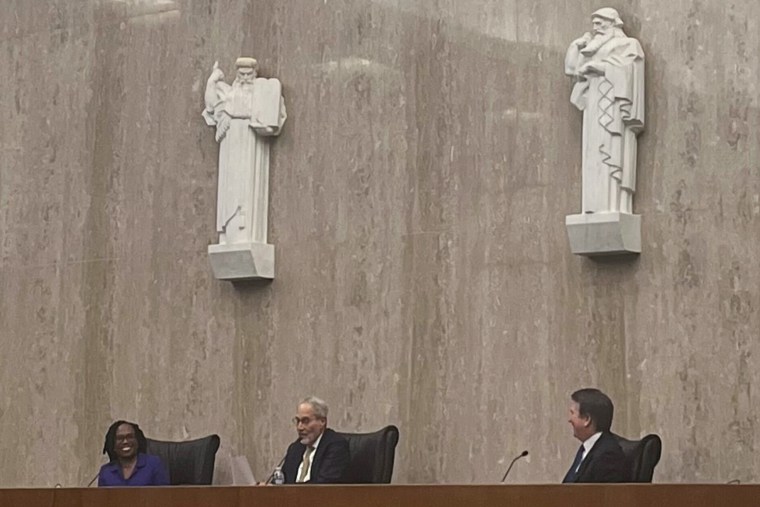
Jackson, often a vocal dissenter in those cases, forcefully aired her critique of the court’s actions in a rare public appearance with Kavanaugh at an event for lawyers and judges held at the federal courthouse in Washington.
Bemoaning the recent increase in such emergency filings — requested to challenge lower court rulings — she suggested that the number of filings would drop if the court were stingier about granting them.
The procedure has become known as the “shadow docket” because the court rarely hears arguments and often issues terse decisions with little explanation. The Supreme Court decisions can allow policies to go into effect at early stages in legal challenges, long before lower courts have reached any definitive conclusions. The casesmight then return to the Supreme Court later in the process, leading to final decisions on the merits.
In the last year, the court has, among other things, allowed Trump to fire thousands of federal workers, assert control over previously independent federal agencies and implement various aspects of his hard-line immigration policy. All those moves, done through the shadow docket, had been blocked by lower courts.
“I just feel like this uptick in the court’s willingness to get involved … is a real unfortunate problem,” Jackson said. Among other things, it affects how lower court judges approach cases, as they already have a preliminary sense of how the Supreme Court might approach them on appeal, creating “a warped kind of proceeding,” she added.
Jackson and Kavanaugh during introductions at the beginning of Monday’s event.Lawrence Hurley / NBC News
“It’s not serving the court or this country well,” Jackson said.
Kavanaugh, usually in the majority in shadow docket cases, defended the court — as he has done in the past — saying it has to act one way or another when the government or another litigant files an emergency application.
Kavanaugh noted that the increase in government applications is not unique to Trump, saying the court also granted similar requests made by the Biden administration, albeit at a lower rate.
The reason successive administrations have rushed to the Supreme Court is that presidents have relied more on executive orders in recent years because of the difficulty of persuading Congress to enact legislation, and those actions are often challenged in court, he said.
The justices have aired their disagreements in written opinions, but this was a rare example of two justices entering into a public debate about internal court business.
“None of us enjoy this,” Kavanaugh said of the shadow docket trend, noting that the court has opted in some cases to hear oral arguments and issue longer written rulings in response to some of the criticism.
“We have to have the same position regardless of who is president,” he added, a statement that Jackson expressed agreement with.
Responding to questions posed by Washington-based Senior U.S. District Judge Paul Friedman, the justices were otherwise mostly on the same page during the hourlong event.
In particular, they both expressed concern about the increase in violent threats against judges. Recently, judges who have ruled against Trump have been regular targets.
“There’s no easy answer, for sure,” Jackson said. “It’s unfortunate because it relates to a lack of understanding about judicial independence.”
Kavanaugh praised Chief Justice John Roberts, who he said had “picked his spots” to push back against the criticism.
Roberts, for example, put out a statement rebuking Trump and his allies for suggesting judges should be impeached for ruling against the administration. One of the judges some Republicans want to impeach, Chief Judge James E. Boasberg of Washington, D.C., was among those at Monday’s event.
Tennessee lawmakers have advanced a host of anti-LGBTQ bills that would run counter to U.S. Supreme Court precedent. Two measures, both proposed by Rep. Gino Bulso, R-Franklin, would challenge landmark cases that legalized same-sex marriage and established protections for discrimination based on sexual orientation or gender identity.
Rep. Gloria Johnson, D-Knoxville, questioned the legality to going against Bostock v. Clayton County, which established that LGBTQ people are protected from discrimination under the Civil Rights Act of 1964. Tom Lee, member of the Board of Directors of the Tennessee Pride Chamber, spoke against the bill, arguing that it could allow discrimination against LGBTQ couples.
“Imagine if under this bill a private employer said, ‘Well, you can’t take family leave because I, as a private citizen, don’t recognize — using the language of the bill — your purported marriage,’” Lee said. “Or a bank says, ‘You’ll pay the higher rate (for unmarried couples). We’re not bound by the 14th Amendment. You’re not married in our eyes.’”
The Banning Bostock Act would codify that laws prohibiting sex discrimination would not prohibit discrimination against a person for being homosexual or transgender, nor would it prohibit discrimination because of sexual orientation, sexual behavior, gender identity, or gender non-conforming behavior.
Meanwhile, the next bill would allow private citizens, businesses, and organizations to refuse to recognize same-sex marriage, and protect attorneys from being punished for refusing to celebrate or perform a same sex marriage.
Bulso first appeared here in February 2024 for his ultimately failed bid to ban Pride flags, which he is now attempting again. In April 2024, we heard from Bulso when he objected to a ban on marriages between first cousins because gays can’t make babies. Last year Bulso launched a failed bid to fill the US House seat left open by the abrupt resignation of Rep. Mark Green.
Why is the most intense bigotry always seem to be pushed by Christians? I don’t understand the hate because no one is walking around nude in bathrooms, and women’s bathrooms do not have urinals just enclosed stalls. No one can see in the stalls. All the talk of protecting little girls is BS because if a man ws going to hurt a child he wouldn’t have to pretend to be trans, he would just walk in and do it. Nope this is all about making trans lives miserable and keeping them out of the public / society. This is all about forcing their religious views on everyone else. There church doctrines don’t accept trans people so no one can accept trans people or be trans in public according to them. They see no problem forcing their religious views on everyone else but scream to their highest heaven when they are told they have to respect other people’s views. Hugs
Just last week, the Kansas legislature passed some of the most far-reaching measures to push trans and gender-nonconforming people out of public life to date. Bathroom bans that bar trans people from restrooms aligned with their gender identity have become grimly common; over 20 states have such a law on the books. But Kansas’s new anti-trans bathroom bill adds a dangerous twist: a bounty hunter provision.
The law would permit private citizens to sue and seek monetary reward based on claiming to encounter a trans person in the bathroom. That’s on top of some of the harshest punishments of any existing bathroom bans, such as criminal charges, steep fines and even jail time.
The language of the bill, while vague, says that any person who alleges to be “aggrieved” by the presence of a trans person they encounter in a restroom facility can file a civil suit against that individual for “damages” of at least $1,000. Kansas Republicans rushed through the bathroom ban, skirting public comment by essentially sneaking the bill into another piece of legislation aimed at denying trans people correct government IDs.
The following veto message is from Governor Kelly regarding her veto of House Substitute for Senate Bill 244:
“This poorly drafted bill will have numerous and significant consequences far beyond the intent to limit the right for trans people to use the appropriate bathroom. Under this bill: If your grandfather is in a nursing home in a shared room, as a granddaughter, you would not be able to visit him. If your wife is in a shared hospital room, as a husband, you would not be able to visit her.
“If your sister is living in a dorm at K-State, as a brother, you would not be able to visit her in her room. If you feel you have to accompany your nine-year-old daughter to the restroom at a sporting event, as a father, you would have to either enter the women’s restroom with her or let her use the restroom alone.
“I believe the Legislature should stay out of the business of telling Kansans how to go to the bathroom and instead stay focused on how to make life more affordable for Kansans. “Therefore, under Article 2, Section 14(a) of the Constitution, I hereby veto House Substitute for Senate Bill 244.”
The bill passed with a veto-proof majority in both chambers, so an override is probably likely. The bill’s author is GOP Rep. Susan Humphries, whose bio notes that she is a graduate of Texas Christian University. Humphries last appeared here in 2024 for her bill that would somehow ban minors from visiting any website that mentions LGBTQs.
By the right people does she mean white people from majority red states and by elect the right leaders does she mean republicans who kiss tRump’s fat ass? The constitution is clear that the states run elections not tRump and his election deniers. The fact is undocumented people cannot vote in federal elections. Some states or communities do let adults who live there vote on local matters. Also why is tRump being allowed to make laws through excutive ordeers instead of congress? He can’t do that. Where are the democrats to challenge these things? Hugs
I had read it couldn’t pass the senate but I was not sure. This act scares me because all the people who took a spouse’s last name wouldn’t be able to vote. I am one of those and as everyone who reads the blog knows I am very much into politics and voting. One of the things listed in project 2025 was to stop women from voting and remove women from the work force. Yes the people who wrote project 2025 do not see women as full human people deserving of the same things as men. They want women to be tied to a male either their father and then a second male who is a husband and the woman would have to be subservient to both. It is horrific the way they see females. Hugs
The National Guard plays a crucial role in the United States, both in its capacity as a reserve component of the armed forces and as a versatile asset that state governors can call on in times of civil unrest, natural disaster, or even the coronavirus pandemic. Section 502(f) of Title 32 of the U.S. Code is a long-standing authority that facilitates a range of important domestic National Guard missions. In the summer of 2020, however, the Trump administration made unprecedented use of this law to bring unfederalized, out-of-state Guard troops into Washington, D.C., to respond to protests following the murder of George Floyd. In doing so, the administration put forward an unbounded interpretation of § 502(f) that risks subverting the broader statutory scheme Congress has created to govern domestic deployment of the military. In addition, if a future president were to rely on this interpretation of the law to ask governors to send unfederalized Guard personnel into a nonconsenting state—as opposed to a non-state jurisdiction like D.C.—that deployment would violate the Constitution.
Section 502 is the primary statute that authorizes the National Guard to operate in “Title 32 status,” one of the three different duty statuses in which members of the Guard may serve at any given moment. In “State Active Duty status,” Guard personnel carry out a state-defined mission, under state command and control, and with state funding and benefits. By contrast, in “Title 10 status,” the Guard has been “called into federal service,” or “federalized,” by the president. When federalized, Guard forces carry out federal missions under federal command and control, and with federal funding and benefits. Title 32 status occupies a middle ground between State Active Duty and Title 10 status, featuring both federal and state involvement. In this hybrid status, the Guard remains under state command and control but can perform federal missions, is paid with federal funds, and receives federal benefits. Crucially, because Guard personnel in Title 32 status are under state control, they have not been federalized and are not subject to the Posse Comitatus Act. That means they are not barred from participating in civilian law enforcement activities.
Although Title 32 status was originally conceived to allow the federal government to foot the bill for the extensive training requirements that Congress requires each state and territory’s National Guard to fulfill, the purposes for which it may be used have expanded over time. Today, § 502(f) allows the Guard to carry out a wide range of nontraining, operational missions in Title 32 status. But the authority that the law provides has its limits.
The 2020 National Guard Deployment in Washington, D.C.
In early June 2020, thousands of National Guard troops from 11 states were deployed to Washington, D.C., as part of the Trump administration’s response to largely peaceful protests following the police killing of George Floyd in Minneapolis, Minnesota. At the time, there was a great deal of confusion and controversy over the legal authority under which these soldiers had been brought to D.C.
In a letter to D.C. Mayor Muriel Bowser, who had publicly objected to the deployment, then-U.S. Attorney General William Barr offered the following explanation: “At the direction of the President, the Secretary of Defense … requested assistance from out-of-state National Guard personnel, pursuant to 32 U.S.C. § 502(f), which authorizes States to send forces to assist the ‘[s]upport of operations or missions undertaken by the member’s unit at the request of the President or Secretary of Defense.’” According to Barr, these troops had been given broad responsibilities, including authority to participate in certain law enforcement activities:
“Consistent with the President’s direction, the Secretary of Defense assigned to out-of-state National Guard personnel the mission of protecting federal functions, persons, and property within the District of Columbia. That mission includes the protection of federal properties from destruction or defacement (including through crowd control, temporary detention, cursory search, measures to ensure the safety of persons on the property, and establishment of security perimeters, consistent with the peaceful exercise of First Amendment rights); protection of federal officials, employees, and law enforcement personnel from harm or threat of bodily injury; and protection of federal functions, such as federal employees’ access to their workplaces, the free and safe movement of federal personnel throughout the city, and the continued operation of the U.S. mails.”
The deployment and Barr’s subsequent justification raise two crucial questions about the scope of § 502(f). The first is whether § 502(f) authorizes the use of National Guard personnel to perform any mission the president could conceivably request. The Guard’s June 2020 operation in D.C. was unprecedented; § 502(f) had never before been used for a federally requested deployment in response to civil unrest. Historically, when presidents have desired to deploy the military for this purpose, they have invoked the Insurrection Act and deployed either active-duty federal troops or federalized National Guard. The District of Columbia’s unusual status within the United States’s federal system presents a second question: whether the deployment of unfederalized, out-of-state Guard troops into a nonconsenting jurisdiction would be lawful if that jurisdiction were a state. The answer to both of these questions is no.
Section 502(f): a Broad Authority, but Not an Unlimited One
Section 502 of Title 32 of the United States Code addresses “required drills and field exercises”—that is, the particulars of how often and in what manner National Guard units are required to train each year. Its first provision, § 502(a), establishes the normal training requirements for the Guard, commonly summarized as “one weekend a month and two weeks a year.” Section 502(f) sits at the end of the statute and has two prongs. The first, § 502(f)(1), allows Guard personnel to be ordered to perform “training or other duty” above and beyond the standard training regimen described by subsection (a). The second, § 502(f)(2)(A), provides that this “training or other duty” may include “[s]upport of operations or missions undertaken by the member’s unit at the request of the President or Secretary of Defense.”
The word “request” in § 502(f)(2)(A) is significant. The president or the secretary of defense may ask a governor to deploy National Guard troops, but the governor is under no obligation to acquiesce. This reading is supported by 32 U.S.C. § 328, which makes clear that a governor is the party empowered to order National Guard troops to duty under either prong of § 502(f). A governor’s right to refuse was evident in the summer of 2020—the Trump administration asked a total of 15 governors to deploy their Guard personnel into Washington, but four declined to do so. This point is discussed further below.
As for the question of what kinds of missions § 502(f) is intended to authorize, the statute itself offers little guidance. The words “other duty” in § 502(f)(1) plainly permit the National Guard to carry out non-training-related missions. The critical question is how broadly “other duty” should be interpreted. Barr and the Trump administration appear to have assumed that “other duty” means any duty—that under § 502(f)(2)(A), National Guard troops provided by a willing governor may be used to perform any mission the president could request. As Barr explained, the out-of-state Guard forces in D.C. had been assigned a wide range of duties, including law enforcement activities such as “crowd control, temporary detention, [and] cursory search.”
Such a broad reading, however, is inconsistent with the statute’s legislative history, its place in the statutory scheme, and judicially established rules of statutory interpretation. In effect, it allows an end run around the procedures and guard rails that Congress has created to govern domestic deployment of the military. Section 502 was originally enacted as part of the codification of Title 32 in 1956, but subsection (f) and the “other duty” language within it were not added until 1964. On paper, the addition of subsection (f) opened the door for National Guard personnel to perform operational missions under Title 32. However, the legislative history of its adoption suggests that it was intended principally to provide funding and authorization for training-related duties beyond the specific exercises cited in the law. The provision was not used for operational missions until 1989, when Congress added specific statutory authority for one kind of § 502(f) “other duty” in particular: drug interdiction missions under 32 U.S.C. § 112.
Another type of operational mission was added in 2004, when, amid the broadening war on terror, Congress added an entirely new chapter to Title 32—Chapter 9—that authorized National Guard personnel operating under state control to be federally funded under § 502(f) while engaging in certain “homeland defense activities.” But state governors struggled to obtain Department of Defense approval for these missions because of the requirement that missions under Chapter 9 respond to a “threat … against the United States” as a whole. In 2005, Hurricane Katrina devastated the Gulf Coast and exposed disastrous shortcomings in the federal government’s ability to respond to natural disasters. The next year, Congress responded to both of these problems by further expanding the potential nontraining uses of § 502(f), this time by amending the provision itself rather than adding any new sections to Title 32.
The newly added subsection (f)(2)(A), which authorizes National Guard support of federal operations or missions “at the request of the President or Secretary of Defense,” was undoubtedly meant to simplify and ease the process by which National Guard forces could perform domestic operational missions under Title 32. However, although the legislative history for the 2006 amendment does not clearly identify the exact bounds of what Congress intended to authorize, it does suggest that Congress was concerned primarily with facilitating homeland defense activities already authorized elsewhere in Title 32 as well as the National Guard’s traditional role in responding to natural disasters like Katrina.
Indeed, the Report of the House Armed Services Committee on the 2006 amendment hardly mentions the new authority it would create for governors to use their Guard forces to support missions requested by the president or secretary of defense, and instead focuses on discussing how other parts of the same amendment would allow “reserve component personnel performing active guard and reserve duty, as well as military technicians (dual status), to … train active duty members of the armed forces” and the limitations on this new authority. In short, it is highly unlikely that Congress intended to revolutionize the landscape of domestic deployment in the United States by giving the president an easy alternative to the Insurrection Act.
A narrower interpretation of Section 502(f) is also consistent with established principles of statutory interpretation. The Supreme Court explained in Whitman v. American Trucking that “Congress … does not alter the fundamental details of a regulatory scheme in vague terms or ancillary provisions—it does not, one might say, hide elephants in mouseholes.” Similarly, when the Court held in FDA v. Brown & Williamson that the Food and Drug Administration’s authority does not include power to regulate tobacco products as drugs, it said that “Congress could not have intended to delegate a decision of such economic and political significance to an agency in so cryptic a fashion.” In short, the Court generally assumes that Congress will speak to major issues directly.
There is no doubt that Congress meant for the 2006 amendments to § 502(f) to widen the scope of the activities it authorizes. Even so, it seems extraordinarily unlikely that Congress would have buried within a section of the U.S. Code that is primarily concerned with National Guard training requirements an open-ended authorization for American military forces to participate in domestic law enforcement activities at the behest of the president, notwithstanding the Posse Comitatus Act and without reliance on the Insurrection Act. Indeed, that would be the very definition of “hiding an elephant in a mousehole.”
State Sovereignty and Deployment of Unfederalized National Guard Personnel Into a Nonconsenting State
If the District of Columbia were a state, then the deployment of out-of-state National Guard troops into the District over its chief executive’s objections in June 2020 would have violated the Constitution. U.S. states are sovereign entities, although their sovereignty is limited and made subordinate to the federal government under the Constitution. Like foreign sovereigns, their sovereignty is territorially defined. As the Supreme Court explained on multiple occasions in the early republic, “the jurisdiction of a state is coextensive with its territory, coextensive with its legislative power.”
It is a function of the states’ co-equal and territorially limited sovereignty that one state’s courts cannot reach into another and adjudicate the affairs of people living there, unless those individuals have sufficient “minimum contacts” with the forum state. For the same reason, it cannot be the case that a state, solely under its own authority, may deploy its National Guard forces into another state without that state’s permission. Simply put, U.S. states may not invade one another.
The deployment of one state’s National Guard into another state in State Active Duty status without the receiving state’s consent would therefore be unlawful. Were this not the rule—if one state could freely reach into another and exercise governmental power there—then any kind of conflict between the states would have the potential to lead to a physical confrontation between their law enforcement agencies and National Guard forces, with potentially disastrous consequences.
The crucial remaining question is whether placing Guard forces in Title 32 status obviates this sovereignty barrier, making deployment into a nonconsenting state permissible. It does not.
The principal difference between State Active Duty status and Title 32 status is that the latter allows National Guard forces to operate at federal expense and to perform certain federal missions, all while remaining under state command and control. State command and control has legal as well as practical consequences. To start, it means that Guard personnel in Title 32 status have not been federalized. The federal courts have made clear that whether Guard personnel have been federalized depends solely on whether they are under state or federal command and control.
Further consequences of state control are apparent within Title 32 itself. As noted above, § 502(f)(2)(A) makes clear that governors are free to reject a president’s request for National Guard assistance. Likewise, 32 U.S.C. § 328 provides that for any § 502(f) deployment, the governor—not the president—issues the orders to mobilize and deploy. Barr’s letter to Bowser likewise acknowledges that § 502(f) “authorizes States to send forces” to support missions requested by the president.
All of these factors point to the same conclusion: Although a deployment under § 502(f)(2)(A) is federally requested, defined, and funded, state authority is being exercised as a legal matter.
This conclusion is consistent with what the Supreme Court has said about what it means for members of the National Guard to be “federalized.” In Perpich v. Department of Defense, the Court explained that when Guard troops are federalized, they temporarily become part of the active-duty federal military. When not federalized, however, they remain state officers. The Perpich Court made clear that, when on active duty, a member of the Guard must be either a part of the federal military or a state officer—they can never be both at the same time. Since Guard personnel in Title 32 status have not been federalized, they are not part of the federal military and must instead be state officers operating under state authority.
For the purposes of the co-equal and territorially limited sovereignty of the states, then, there is no difference between State Active Duty status and Title 32 status. In both cases, National Guard personnel are state officers exercising state authority. That means they cannot operate in another state without its consent, no matter who requested their presence or who is paying them.
Conclusion
Congress should amend § 502(f) to narrow and clarify its scope. In the meantime, though, the law is not a blank check allowing the president to use military forces anywhere in the country and for any purpose so long as they can find one willing governor. Congress no doubt intended the creation of § 502(f)(2)(A) to make domestic deployment of the National Guard easier rather than harder, but it is highly unlikely that lawmakers meant to blow a gaping hole in the complex web of laws that govern the military’s domestic activities. Rather, § 502(f)(2)(A) was likely intended to facilitate missions that were already authorized by other statutes as well as traditional Guard functions like disaster relief.
Moreover, regardless of Congress’s intent, deployments of the National Guard in Title 32 status must in all cases respect the co-equal and territorially limited sovereignty of the states. As a constitutional matter, the deployment of unfederalized Guard personnel into a nonconsenting state is never permissible. If the president wishes to unilaterally deploy military forces into a nonconsenting state, then they must do so through the statutory mechanism that Congress has provided for this purpose since 1792: the Insurrection Act.
In all cases and regardless of the statutory device used, domestic deployment of the military should be treated as an option of last resort. There is a tradition in American law and political thought, with roots that can be traced to medieval England, that opposes any kind of military interference in civilian affairs outside of emergencies. This tradition recognizes the fundamental danger of turning an army inward to face its own country’s citizens. As the Eighth Circuit explained in Bissonette v. Haig:
“The use of military forces to seize civilians can expose civilian government to the threat of military rule and the suspension of constitutional liberties. On a lesser scale, military enforcement of the civil law leaves the protection of vital Fourth and Fifth Amendment rights in the hands of persons who are not trained to uphold these rights. It may also chill the exercise of fundamental rights, such as the rights to speak freely and to vote, and create the atmosphere of fear and hostility which exists in territories occupied by enemy forces.”
Domestic deployment presents risks for the military itself, too. While sometimes necessary, all domestic military operations distract and draw resources away from the military’s core national security responsibilities. Domestic law enforcement operations, in particular, are also broadly unpopular among military personnel, who did not enlist in the armed services to police their fellow citizens—a fact that is all the more significant as the military continues to struggle through a recruitment and retention crisis.
The National Guard is not immune to these risks. While the Guard certainly continues to fulfill its traditional role of providing local support in times of crisis, over the past three decades it has also been integrated into the broader United States armed forces. Today’s National Guard is a professional army and an essential piece of the Department of Defense’s “Total Force.” To be sure, Guard personnel are more likely to be trained in law enforcement than their active-duty counterparts, but many Guard units are frontline combat units trained and equipped to fight overseas, with comparatively little experience or training in responding to civil unrest.
Accordingly, when considering whether to use any part of the military domestically, leaders should not merely ask whether a deployment would be constitutional and authorized by statute. They should also ask whether it would be an appropriate use of limited military resources and whether it is consistent with the foundational American belief that domestic civilian affairs should be managed by domestic civilian authorities whenever possible.
A think tank founded by Stephen Miller sued Roberts and the office that administers the judiciary, claiming that the White House should run the federal courts.
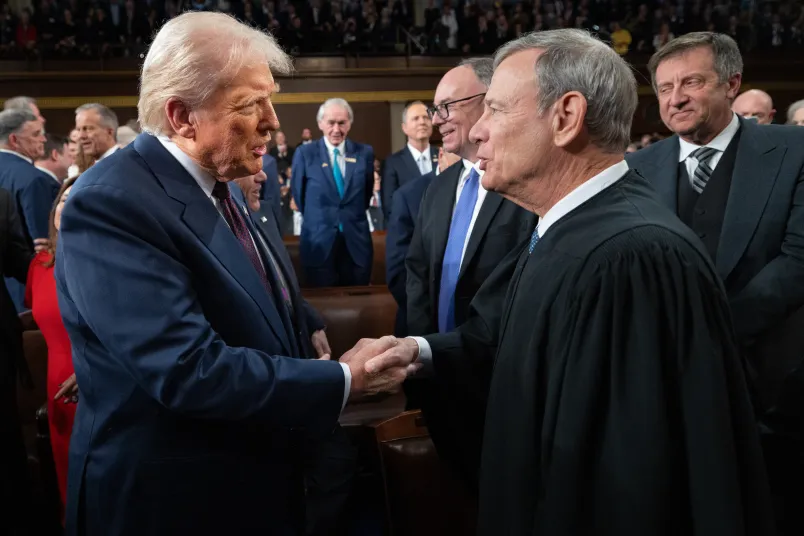
WASHINGTON, DC – MARCH 04: U.S. President Donald Trump (L) greets Chief Justice of the United States John G. Roberts, Jr as he arrives to deliver an address to a joint session of Congress at the U.S. Capitol on March 04, 2025 in Washington, DC. President Trump was expected to address Congress on his early achievements of his presidency and his upcoming legislative agenda. (Photo by Win McNamee/Getty Images)LESS
Close allies of President Trump are asking a judge to give the White House control over much of the federal court system.
In a little-noticed lawsuit filed last week, the America First Legal Foundation sued Chief Justice John Roberts and the head of the Administrative Office of U.S. Courts.
The case ostensibly proceeds as a FOIA lawsuit, with the Trump-aligned group seeking access to judiciary records. But, in doing so, it asks the courts to cede massive power to the White House: the bodies that make court policy and manage the judiciary’s day-to-day operations should be considered independent agencies of the executive branch, the suit argues, giving the President, under the conservative legal movement’s theories, the power to appoint and dismiss people in key roles.
Multiple legal scholars and attorneys TPM spoke with reacted to the suit with a mixture of dismay, disdain and laughter. Though the core legal claim is invalid, they said, the suit seems to be a part of the fight that the administration launched and has continued to escalate against the courts over the past several months: ignoring a Supreme Court order to facilitate the return of a wrongly removed Salvadoran man, providing minimal notice to people subject to the Alien Enemies Act, flaunting an aggressive criminal case against a state court judge.
The executive branch has tried to encroach on the power of the judiciary in other ways too, prompting a degree of consternation and alarm unusual for the normally-staid Administrative Office of U.S. Courts. As TPM has documented, DOGE has already caused disorder at the courts and sent out mass emails to judges and other judiciary employees demanding a list of their recent accomplishments. Per one recent report in the New York Times, federal judges have expressed concern that Trump could direct the U.S. Marshals Service — an executive branch agency tasked with protecting judges and carrying out court orders — to withdraw protection.
These are all facets of an escalating campaign to erode the independence of the judiciary, experts told TPM. The lawsuit demonstrates another prong of it: close allies of the president are effectively asking the courts to rule that they should be managed by the White House.
“It’s like using an invalid legal claim to taunt the judiciary,” Anne Joseph O’Connell, a professor at Stanford University Law School, told TPM.
“To the extent this lawsuit has any value other than clickbait, maybe the underlying message is, we will let our imaginations run wild,” Peter M. Shane, a constitutional law scholar at NYU Law School, told TPM. “The Trump administration and the MAGA community will let our imaginations run wild in our attempts to figure out ways to make the life of the judiciary miserable, to the extent you push back against Trump.”
A FOIA from America First
The America First Legal Foundation filed the suit on April 22.
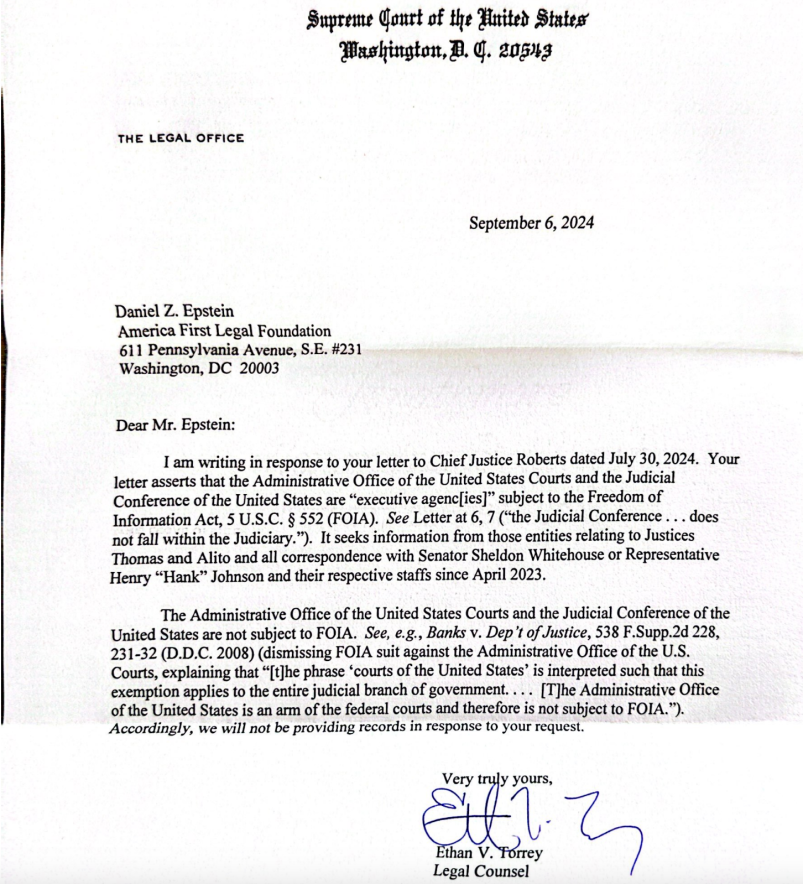
It came after the group first filed a FOIA request in July 2024 to the Judicial Conference of the United States and the Administrative Office of U.S. Courts asking for “all records referring or relating to (1) Clarence Thomas or (2) Samuel Alito” and all communications with Sen. Sheldon Whitehouse (D-RI) and Rep. Hank Johnson (D-GA), starting in April 2023. Both Democrats have led investigations into the influence of wealthy political donors’ money on the court, the conservative legal movement’s long-term plan to capture the high court, and alleged ethical violations by Justices Thomas and Alito. The Judicial Conference, which is composed of senior federal judges and operates via an array of committees, sets policy for the judiciary.
Ethan V. Torrey, legal counsel of the Supreme Court, rejected the request in a September 2024 letter, per an exhibit filed along with the complaint.
Daniel Z. Epstein filed the FOIA request, and is listed as lead attorney on the lawsuit. Epstein currently represents President Trump in his personal capacity in the lawsuit against CBS over an October 60 Minutes interview with Kamala Harris.
Stephen Miller, the longtime Trump aide, founded the America First Legal Foundation in April 2021, describing it as the “long-awaited answer to the ACLU.” Over the next few years, the group succeeded in slowing down or blocking several Biden administration policies, often by filing in the Northern District of Texas’s Amarillo courthouse, which is presided over by a judge who is notably receptive to conservative arguments. Its priorities often match those of Trump’s second term; it attacked diversity programs, protections for LGBT students, immigration, and supposed “wokeness” in corporate America. Miller himself has been a public driving force in the most aggressive and lawless elements of the second Trump administration’s effort to bulldoze through civil liberties in the name of increasing the tempo of deportations.
In an email after publication, an America First Legal spokesperson cited a 1991 9th Circuit decision in a case brought by a federal judge seeking to force the Administrative Office to pay for a private defense attorney he wanted to hire in a lawsuit brought over his work as a judge. In that ruling, the 9th Circuit found that AO was a “non-Article III adjunct,” akin to a magistrate judge or special master: a body that serves the courts, but is not a court itself. America First Legal didn’t immediately reply to a follow-up question from TPM about whether it could address its claim that the Judicial Conference is also an independent agency of the executive branch.
When the suit was filed in April, it received a small round of coverage that focused on FOIA element of the claim.
Legal experts suggested to TPM that the FOIA piece is something of a trojan horse. The Judicial Conference and Administrative Office’s denial of the FOIA request provides standing to sue, and thereby ask a federal judge to declare that the two judicial bodies “are subject to the FOIA as independent agencies within the executive branch.”
In terms of importance, a judge finding that core parts of the judiciary are independent agencies of the executive branch would dwarf any FOIA material America First Legal might receive. The lawsuit itself seems to acknowledge this. At one point, in language channeling that of a protection racket, America First Legal observes that “Federal courts rely on the executive branch for facility management and security. Federal judges, as officers of the courts, need resources to fulfill their constitutional obligations.”
New extreme for an old theory
There is a level of irony here.
For years, conservative legal scholars have pushed the idea that power in the executive is unitary, granting the President the ability to exert direct control over all federal officials who carry out federal law. It opens the door to a level of presidential power that hasn’t been seen until this administration, and which the Supreme Court may ratify this term.
This lawsuit asks the judiciary to extend that logic to its own operations, potentially dealing a fatal blow to judicial independence.
This argument reaches a provocative peak when it comes to the Judicial Conference of the United States. There, the Chief Justice of the Supreme Court can appoint members to committees. The lawsuit says that this means Roberts may, at times, fall under the President’s power — for FOIA purposes, of course.
“Accordingly, if the Chief Justice does indeed have this power to appoint officers, then he must be acting as an agency head, subjecting the Judicial Conference to the FOIA,” the suit reads.
Melissa Murray, a professor at NYU Law, pointed out that the suit raises a number of bizarre scenarios. If it makes it to the Supreme Court, “does the Chief Justice have to recuse himself?” she asked.
“It does seem like poking the bear,” she added.
As of this writing, lawyers for Roberts and the U.S. Courts director have not appeared on the docket. In other cases filed against parts of the judiciary, the Justice Department’s Civil Division has appointed attorneys.
The DOJ did not return a request for comment. The Administrative Office of U.S. Courts declined to comment. The Supreme Court also did not return requests for comment.
This doesn’t necessarily mean that federal courthouses will soon start serving Trump steaks, or that Kid Rock will be called on to provide filler sound during sidebar sessions.
Blake Emerson, a professor at UCLA Law, called the suit’s claims “outlandish,” and said that if it somehow succeeded, it would grant the White House control over “the means by which the judicial branch functionally operates.”
O’Connell, the Stanford Law Professor, described it to TPM as more of an attempt to tell a story about “how much power they think the executive should have” than a serious legal claim.
“There is no chance that this will prevail,” she said.




 February 13, 2026



 Scottie's Playtime