
Aug 13, 2025 Barbara Rodriguez
This story was originally reported by Barbara Rodriguez of The 19th. Meet Barbara and read more of their reporting on gender, politics and policy.
At an elementary school in Washington, D.C., the speaker at the podium wanted to talk about children’s health and the impact of childhood obesity.
“Our generation is facing so many devastating health problems because of how we live and how we eat — illnesses like diabetes and heart disease and cancer — that cause so much suffering and cost our economy billions,” the speaker said. “And today, we need to ask ourselves: Are we going to hand down these problems to our next generation? Or are we going to do what we’ve always done in this country and leave something better for our children and our grandchildren?”
Someone could mistake these words as being spoken in 2025 by a Trump administration official advocating to “Make America Healthy Again” — the catch-all agenda that has zeroed in on kids’ health and in particular, chronic disease and childhood obesity.
But the remarks were from then-first lady Michelle Obama, and the year was 2013.
Obama was promoting “Let’s Move!,” her initiative aimed at improving children’s nutrition at home and school and encouraging them to exercise more. The initiative is credited with making improvements to school lunch standards, creating more transparency in food labeling and bringing more awareness to childhood obesity.
But the first lady drew widespread partisan backlash for her efforts, as right-wing media personalities and Republicans vehemently criticized related regulation as government overreach. They have been more muted as the Trump administration, led in part by Health and Human Services Secretary Robert F. Kennedy Jr., now adopts similar messaging about children’s health.
“I do think that there’s a double standard going on, especially with RFK Jr.,” said Sydney Carr-Glenn, a political science professor at the College of the Holy Cross in Massachusetts who studies the intersectionality of race and gender for Black women in politics, including in the media. “People seem to be a little bit more accepting or a little bit more on board with this whole ‘Make America Healthy Again’ initiative.”
Last month, President Donald Trump announced he would revive the presidential fitness test, a once ubiquitous staple of school gym class. Just a few years ago, Let’s Move! offered programming to educators to encourage physical activity at school for at least 60 minutes each day.
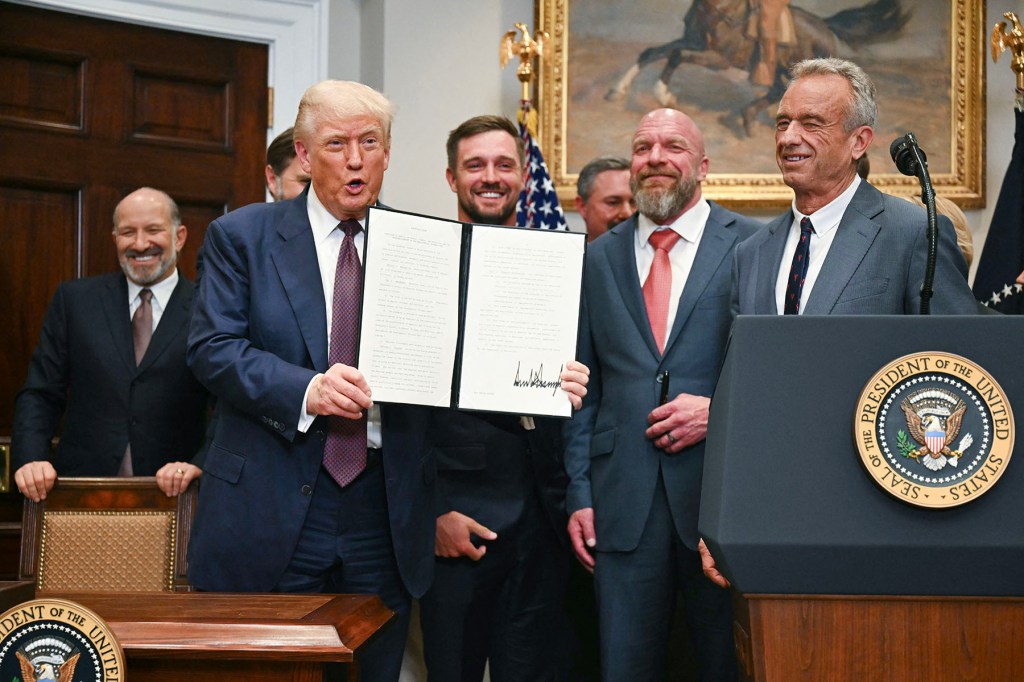
In some ways, Michelle Obama’s health policy efforts walked so MAHA could run. But you won’t find many Republicans acknowledging that.
“We live in such polarized times now that you would think the Trump administration would look at the things that Michelle Obama achieved and maybe try to build upon that,” said Sharon Wright Austin, a political science professor at the University of Florida. “But there is no collaboration. There are no coalitions. I’m sure if you were to say to Trump, ‘You’re doing the same thing that Michelle Obama originally started doing when Barack Obama was president,’ he would probably not only deny it, but he probably would be pretty offended.”
Obama’s motivation to launch Let’s Move!, the first lady explained, was rooted in her experience as a working mother trying to feed her kids nutritious food. The self-described “mom-in-chief” recognized that if she struggled with what to feed her children, other families with fewer resources might, too.
Within months of moving into the White House, the first lady started a vegetable garden to help teach children about locally grown food and to start a conversation about their health. She launched “Let’s Move” in early 2010, and her husband issued a directive to establish a task force on childhood obesity. Michelle Obama was present months later when the task force released a report assessing how to reduce childhood obesity within a generation. It included roughly 70 voluntary recommendations.

Zinga A. Fraser studies African American history and gender politics as an associate professor at Brooklyn College of the City University of New York. She noted that while Obama’s nutrition plans worked within a domesticated and gendered framework, her garden and health initiative was also part of a long history of Black women taking care of their communities through food sustainability.
“She understood what being a Black woman in that space looked like,” Fraser said of Obama’s role as first lady. “How she had to navigate and what it would be perceived as.”
Let’s Move! had several areas of focus: providing information to families about healthy food, improving the quality of food in schools, expanding access and affordability of healthy foods in communities, and increasing physical activity for children.
The first lady sought buy-in from key stakeholders early on. The American Beverage Association, a government lobbying group representing soft-drink makers, committed immediately to member companies voluntarily putting front-of-pack calorie labels on cans, bottles and vending machines within two years. Food service companies that operated in schools pledged to reduce the amount of fat, sugar and salt they put in kids’ meals over the next five years.
It’s the kind of voluntary industry action that Kennedy is touting 15 years later as he seeks voluntary commitments to remove certain dyes from the food supply and to switch the kind of oil that fast food chains use for cooking.
But the first lady was also politically savvy in broadening her initiative’s appeal to the general public. She danced on “The Ellen Degeneres Show” and did “mom dancing” on “The Tonight Show” with Jimmy Fallon. She released a “focus group” video with kids that featured comedian Will Ferrell. She shared a fitness video of herself working out. She appeared with members of the Miami Heat, including dunking a ball with LeBron James.
“She was strategic,” said Fraser, who is also director of the Shirley Chisholm Project on Brooklyn Women’s Activism. “She strategically used her positionality in many ways to move a needle, whether people saw it as influential or important at the time or not.”
It didn’t seem that Michelle Obama was entering controversial politics at first. She had settled on an area of public interest — children’s wellness — that was politically viable for a first lady, said Laurel Elder, a political science professor at Hartwick College in New York who has researched public opinion about presidential candidates and their spouses. There had already been a history of first ladies with projects like an anti-drug campaign and expanding literacy.
Elder noted that Obama was promoting a form of “new traditionalism” in the role of first lady.
“[The public] wants them to be traditional, but also the ‘new’ part is they really do have an expectation that the first lady should be out there and visible and should be leading campaigns in appropriate areas,” she said.
But as regulation policy emerged, so did the criticism. A child nutrition law passed at the end of 2010 included a phase-in of new federal school nutrition standards for milk, whole grains and sodium. The narrative that emerged was that the government was telling people what health choices to make.
“Your America is turning into a nanny state thanks to the Obama administration’s efforts to rein in the junk food industry,” said Sean Hannity on Fox News in 2010.
Glenn Beck, also on Fox News, described Michelle Obama’s efforts in 2010 as the beginning of efforts to police people for not eating healthier.
“You’re going to have to tax, you’re going to have to make it more and more difficult. But when those options don’t work, how do you get people to stop eating french fries, because french fries still beat carrots. What’s left? Well, now you have to start thinking about punishments — maybe a fine, maybe even jail. But it always starts with a nudge,” he said.
Even some Democrats criticized the Obama administration, arguing it didn’t go far enough to hold the food industry accountable to proposed changes.
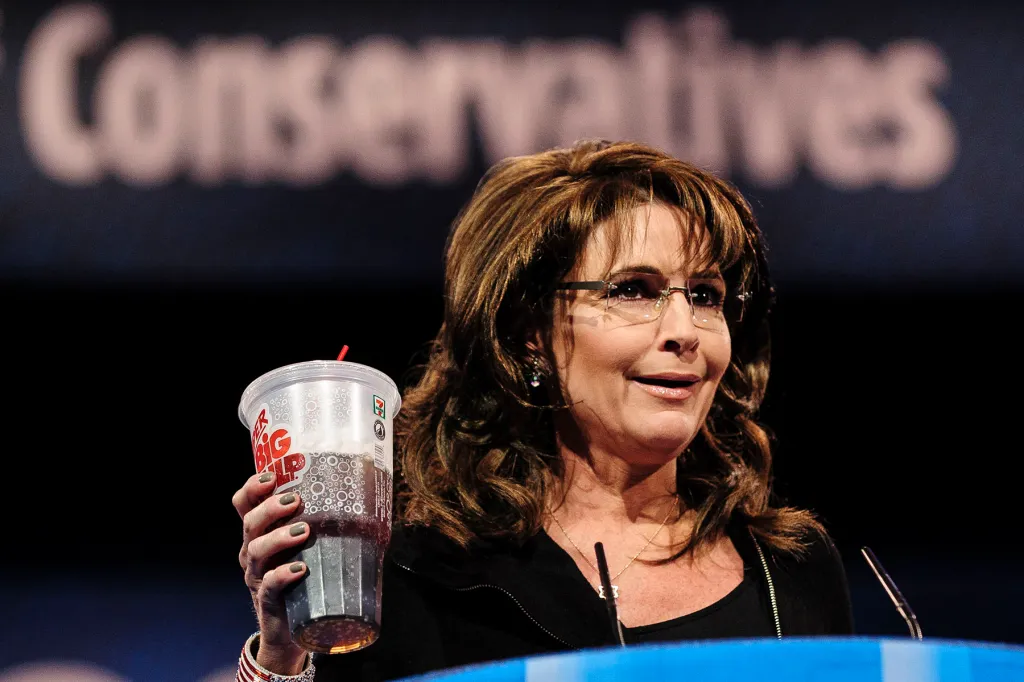
In 2013, former Republican vice presidential candidate Sarah Palin sipped a large soda during an appearance at the Conservative Political Action Conference, known as CPAC. She was responding to a proposed ban of large sodas by then New York City Mayor Michael Bloomberg, but the stunt became part of a larger commentary on the government’s role in people’s health choices.
In 2014, Republicans in Congress sought exemptions to the 2010 school lunches law amid backing from a powerful school lunch industry group that expressed concern over implementation and costs. Michelle Obama pushed back in a New York Times op-ed. (In 2018 under the first Trump administration, the agriculture department sought to revert the new standards. It was challenged in court.)
A MAHA commission released a report this spring for addressing “the childhood chronic disease crisis.” Among its future policy focus will be poor diet, the “aggregation of environmental chemicals,” a lack of physical activity and chronic stress, and “overmedicalization.”
Kennedy told Fox News host Laura Ingraham earlier this year that while he didn’t want to take away “choice” from people, he believed in making changes to food assistance programs and school lunches. Several Republican-led states have recently begun restricting whether people on food assistance programs can buy processed foods and soda.
“We shouldn’t be subsidizing people to eat poison,” said Kennedy, who has separately started promoting that people should track their health metrics via “wearable” technology.
Kennedy’s MAHA initiative comes as the Trump administration cuts federal food assistance, key financial support for Medicaid and reduces environmental protections.
“You can’t cut benefits — Medicare, Medicaid, SNAP benefits, all of those things — to children and families and then still have an initiative where people are saying that they are about creating healthy environments for Americans,” Fraser said.
Natalia Mehlman Petrzela, a history professor at The New School in New York City, noted that when Beyoncé shot a related music video for the Let’s Move! initiative in 2011, she surrounded herself with young children dancing in a school cafeteria. It was common imagery for the first lady as well, as Michelle Obama swayed with kids to get them excited about nutrition and health. Trump’s recent announcement about the presidential fitness test featured former WWE wrestler and current Chief Content Officer Triple H doing a signature water spit at the White House.
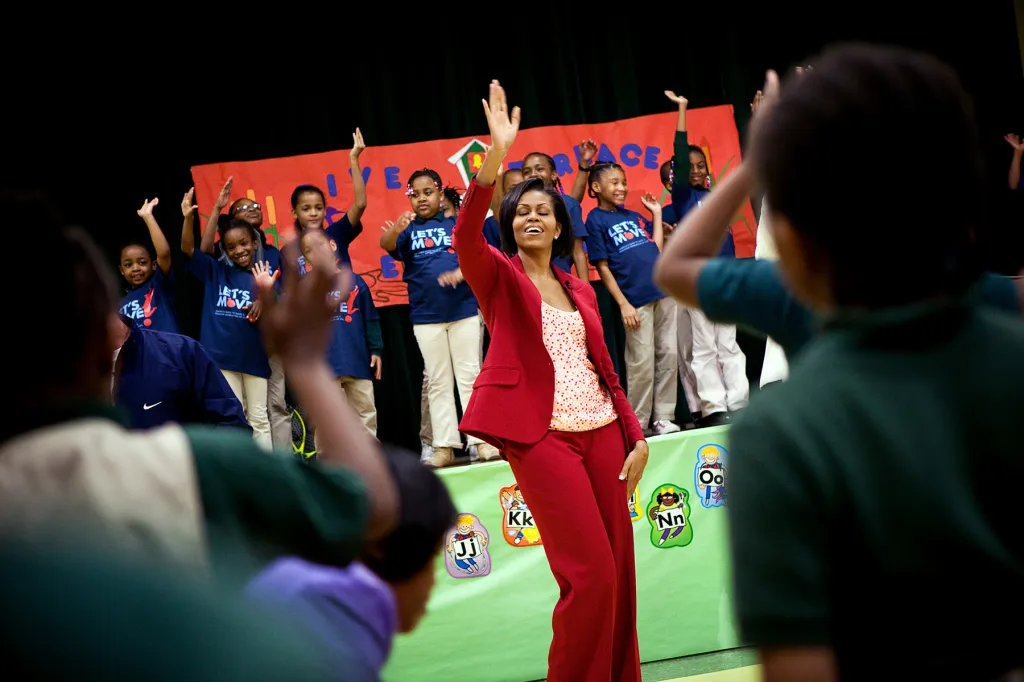
“To me, that arc kind of says a lot about what’s changed in our wellness and fitness environment,” said Petrzela, who is author of “Fit Nation: The Gains and Pains of America’s Exercise Obsession.” “That now there’s this highly individualistic, ‘strong man’ approach to things, and I think, even more interestingly, it’s tied to that anti-institutional critique, which used to be coded as really left, and in the intervening years, has become, almost completely seen as right wing.”
Austin at the University of Florida said that while Michelle Obama has never been an elected official, she held immense power in her role as first lady and left the White House with high polling. Austin believes the first lady balanced the political challenges of intersectional identities, and her mission to help children continues to resonate 15 years later — even though the messengers have changed.
“It just goes to show that as a Black woman, you’re never going to get the respect that you deserve,” she said.

