“Normie Tariff Explainer”

I subscribe to a newsletter by author Courtney Milan. In it, she writes of one of my reasons for living, tea, but also, to put it briefly, coping and some activism. It’s a good newsletter, and I’ve often wanted to share parts of it, but never got it done. This one, that I’ve only read today (so 1 day late for Hands Off! but there are plenty of times and places for us to rock on,) has good information, and activism we can take while in grocery lines or waiting rooms or wherever we are. Here’s the tea (without actual tea, but if you want to see her tea entry, let me know in comments and I’ll bring it here):

I had started writing something yesterday about Cory Booker, and was interrupted by Donald Trump announcing massive, sweeping tariffs that will send the global economy into a tailspin.

One of the problems with things like this is that a lot of people simply don’t know what tariffs are, or don’t know that Trump is lying about the tariffs other countries are imposing. They certainly don’t understand what the impact will be, and so I decided to make an extremely basic Trump Tariff Explainer to pass out to friends/family/at protests, etc, because if there’s one thing that extremely normie and/or not online people may pay attention to, it might be something like “everything is about to cost a lot more money.”

Even if they don’t believe that this will happen, I think it’s important to put it in their brains that if it does happen, the people to blame are Donald Trump and his cabinet.

So I have made a website and downloadable PDF sheet for the normal person in your life.
Image item
The website version (with links to sources) is: TrumpsTariffsExplained.com

You can download the PDF here.
I’m printing several hundred of these and bringing them to distribute at the protest this Saturday–the more people who see this information, the faster we can try to turn the tide.

These tariffs are going to be terrible for everyone, but they’ll be especially horrific for the poor, the disabled, and the marginalized both in the US and around the world world. The faster we can turn things around, the more lives we will save, and hopefully more people knowing what is happening will help us turn things around faster.
See you next week, (signature) Courtney Milan
Image item

Three Sam Seder clips that are important to watch

Before I share the clips a personal note.  I spend the morning with Ron.  We went to get blood work done.  Then we did some other things.  Then he went shopping while I did housework.  Then after he got home I started working on a computer project a friend asked me if I would do for him as he couldn’t do it.  I agreed to.  I still have a lot of work on it but I will get it done today I think.  

The lab work came back and I think I have a reason while I have been so tired, short of breath, and not able to concentrate or think clearly.   My blood work shows I am very anemic again.  I once had it get so bad I collapsed as I was entering my allergist office.  They thought I was having a heart attack and I ended up in the hospital.  Turned out my heart is great, but my damaged large bones don’t produce enough red blood cells.  Their solution was to eat more red meat and take iron supplements.  For a long time they watched for it but as I always managed to stay right inside the ok zone they stopped worrying about it.  But my diet changed, red meat got too expensive and I just don’t eat much anymore.  But my lab work showed my hematocrit is very low.  So I imagine the doctor will ask me to do some more tests.  I hope I don’t need a blood transfusion, that sucks.  Now on to the clips, enjoy.

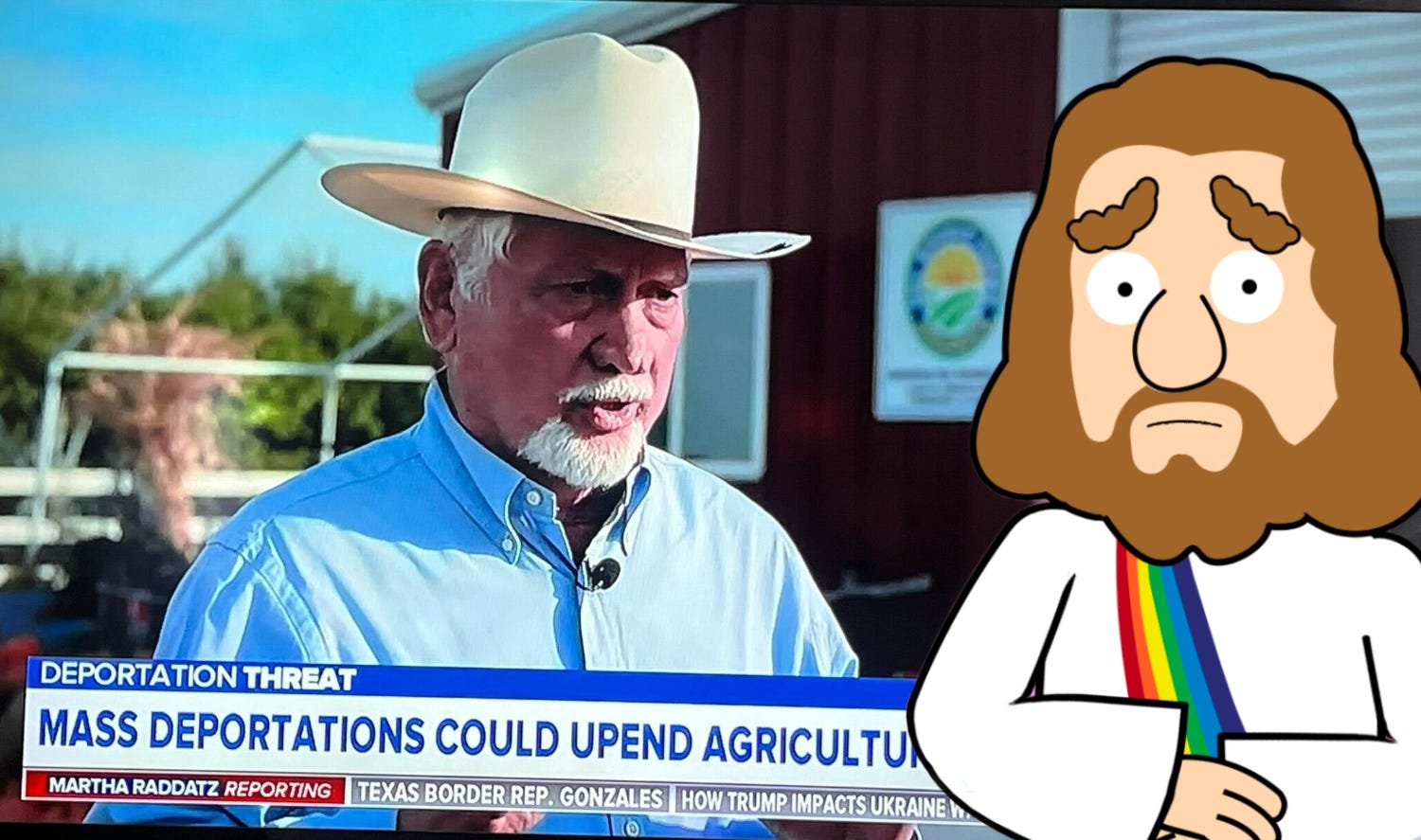
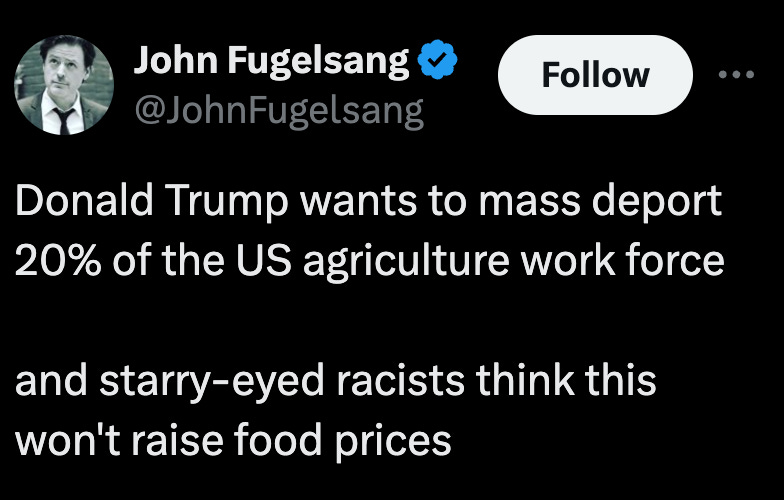
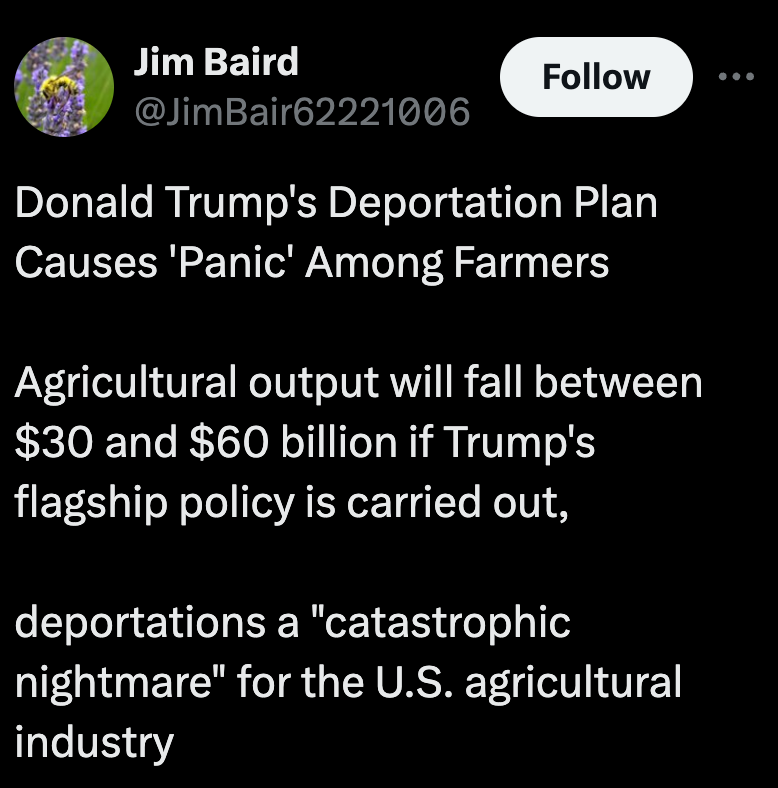
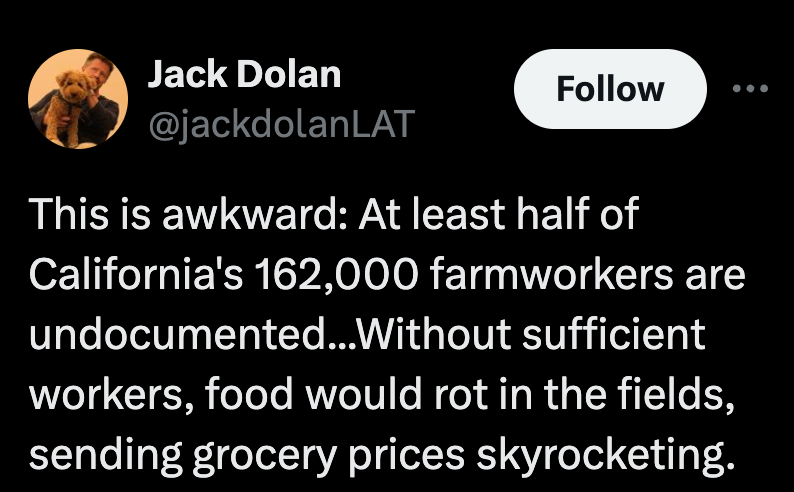
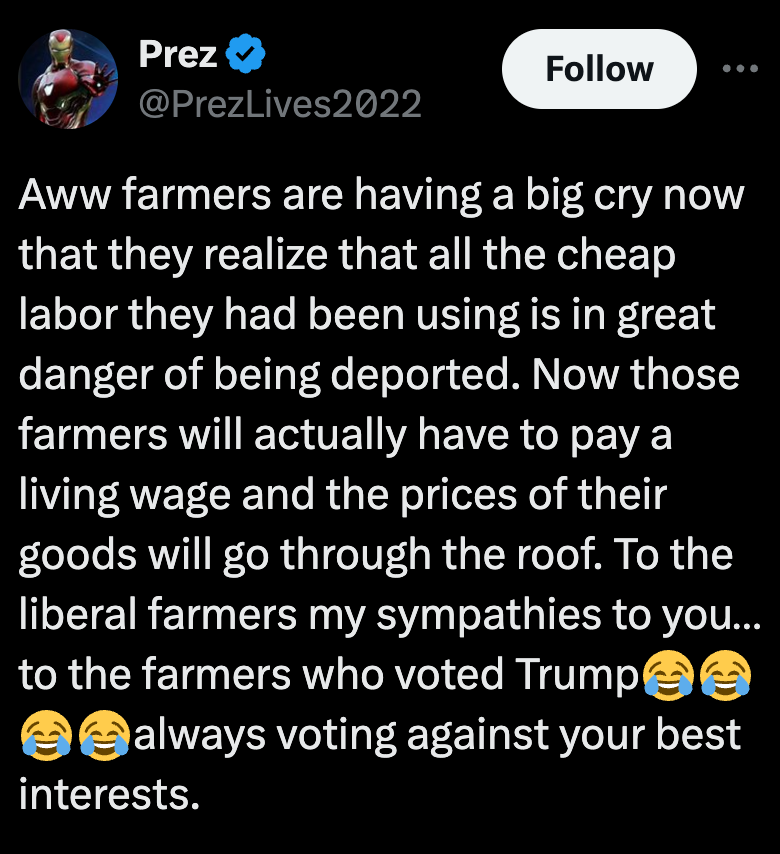
“Farmers Freaking Over Deportations”

by God

Whoops! Read on Substack

Dear Humans,

Jesus here.

As someone who has always taught inclusion, loving thy neighbor, and supporting marginalized groups, I’ve been deeply concerned about Trump’s mass deportation proposals that he spoke frequently about during his Presidential campaign.

To many in his uninformed and racist voter base, they hear about the proposal and think it’s a great idea.

What they don’t realize is how it’ll affect – among many things – their food supply.

You see, farmers depend on undocumented immigrants to manage their crops, because it’s a grueling job that most Americans don’t want to take. Immigrants, however, are looking for any life they can start in America and are willing to take on the job.

They’re also freakin’ tough-as-nails types of people!

We’re still nearly two months away from Trump returning to office (Sigh), and already, key U.S. agricultural organizations are advocating for the exclusion of farmworkers from mass deportation attempts.

Reuters spoke to numerous farm groups who said they are already working to ensure their workers are exempt from any deportations.

Should Trump’s ‘mass deportation’ idea go through (And let’s be clear: It would be a VERY difficult task – it’s basically his new ‘Build the Wall’ proposal), that would mean that about HALF of the two million farmworkers in the United States would be deported.

It’d be like a Thanos snap – it would have HUGE implications for the American food supply.

When all those workers disappear, the food would disappear too. And if you thought eggs were costly now, just wait until you lose half of your workers who are employed on farms and meat processing plants.

A More Jesus-y Plan

What Trump’s incoming administration should be doing instead of instilling fear in the American people is giving these undocumented migrants a path to citizenship. These people who live in America not only work tough jobs, but they also contribute to the American economy by supporting businesses that they visit. That in turn generates tax revenue for America.

EVERYONE benefits from having immigrants in their country.

In The Parable of the Good Samaritan, I taught that your “neighbor” is not limited to those within the same community or background but extends to anyone in need. I encourage Humans to cross cultural boundaries to show kindness and mercy. (snip)

Love, Jesus

Fox News edited Trump’s rambling answers and false claims in barbershop interview, full video shows

https://www.cnn.com/2024/10/24/media/fox-news-edit-trump-barbershop-interview/


Why? Why, Why, Why?

do we have to relive this history again and again and again? How is it going to go differently if it’s tried yet another time? Seriously!

October 5, 2024 by Heather Cox Richardson Read on Substack

William McKinley is having a moment (which I confess is a sentence I never expected to write). 

Republican presidential nominee Donald Trump is elevating McKinley, representative from Ohio from 1877 to 1891 and president from 1897 to 1901, to justify his plan to impose new high tariffs. 

Trump’s call for tariffs is not an economic plan; it is a worldview. Trump claims that foreign countries pay tariff duties and thus putting new tariffs of 20% on all imports, and as much as 60% on Chinese imports, will bring enough foreign money into the country to fund things like childcare, end federal budget deficits, and pay for the tax cuts he wants to give to the wealthy and corporations.

This is a deliberate lie. Tariffs are essentially taxes on imported products, and they are paid not by foreign countries but by American consumers. Economists warn that Trump’s tariff plan would cost a typical family an average of more than $2,600 a year, with poorer families hardest hit; spike inflation as high as 20%; result in 50,000 to 70,000 fewer jobs created each month; slow economic growth; and add about $5.8 trillion in deficits over ten years. It would tank an economy that under the Biden administration, which has used tariffs selectively to protect new industries and stop unfair trade practices, has boomed.

Trump simply denies this economic success. He promises to make the economy great with a tariff wall. On September 27, he told rally attendees in Warren, Michigan: “You know, our country In the 1890s was probably…the wealthiest it ever was because it was a system of tariffs and we had a president, you know McKinley, right?… He was really a very good businessman, and he took in billions of dollars at the time, which today it’s always trillions but then it was billions and probably hundreds of millions, but we were a very wealthy country and we’re gonna be doing that now….”

By pointing to McKinley’s presidency to justify his economic plan, Trump gives away the game. The McKinley years were those of the Gilded Age, in which industrialists amassed fortunes that they spent in spectacular displays. Cornelius and Alva Vanderbilt’s home on New York’s Fifth Avenue cost more than $44 million in today’s dollars, with stables finished in black walnut, cherry, and ash, with sterling silver metalwork, and in cities across the country, the wealthy dressed their horses and coachmen in expensive livery, threw costly dinners, built seaside mansions they called “cottages,” and wore diamonds, rubies, and emeralds. When the daughter of a former senator married, she wore a $10,000 dress and a diamond tiara, and well-wishers sent “necklaces of diamonds [and] bracelets of diamonds, sapphires, and rubies.” 

Americans believed those fortunes were possible because of the tariff walls the Republicans had begun to build in 1861. Before the Civil War, Congress levied limited U.S. tariffs to fund the federal government, a system southerners liked because it kept prices low, but northerners disliked because established industries in foreign countries could deliver manufactured goods more cheaply than fledgling U.S. industries could produce them, thus hampering industrial development.

So, when the Republican Party organized in the North in the 1850s, it called for a tariff wall that would protect U.S. manufacturing. And as soon as Republicans took control of the government, they put tariffs on everything, including agricultural products, to develop American industry. 

The system worked. The United States emerged from the Civil War with a booming economy.

But after the war, that same tariff wall served big business by protecting it from the competition of cheaper foreign products. That protection permitted manufacturers to collude to keep prices high. Businessmen developed first informal organizations called “pools” in which members carved up markets and set prices, and then “trusts” that eliminated competition and fixed consumer prices at artificially high levels. By the 1880s, tariffs had come to represent almost half a product’s value.

Buoyed by protection, trusts controlled most of the nation’s industries, including sugar, meat, salt, gas, copper, transportation, steel, and the jute that made up both the burlap sacks workers used to harvest cotton and the twine that tied ripe wheat sheaves. Workers, farmers, and entrepreneurs hated the trusts that controlled their lives, but Republicans in Congress worked with the trusts to keep tariffs high. So, in 1884, voters elected Democrat Grover Cleveland, who promised to lower tariffs.

Republicans panicked. They insisted that the nation’s economic system depended on tariffs and that anyone trying to lower them was trying to destroy the nation. They flooded the country with pamphlets defending high tariffs. Cleveland won the popular vote in 1888, but Republican Benjamin Harrison won the electoral votes to become president. 

After the election, steel magnate Andrew Carnegie explained that the huge fortunes of the new industrialists were good for society. The wealthy were stewards of the nation’s money, he wrote in what became known as The Gospel of Wealth, gathering it together so it could be used for the common good. Indeed, Carnegie wrote, modern American industrialism was the highest form of civilization. 

But low wages, dangerous conditions, and seasonal factory closings and lock-outs meant that injury, hunger, and homelessness haunted urban wage workers. Soaring shipping costs meant that farmers spent the price of two bushels of corn to get one bushel to market. Monopolies meant that entrepreneurs couldn’t survive. And high tariffs meant that the little money that did go into their pockets didn’t go far. By 1888 the U.S. Treasury ran an annual surplus of almost $120 million thanks to tariffs, seeming to prove that their point was to enable wealthy men to control the economy.

“Wall Street owns the country,” western organizer Mary Elizabeth Lease told farmers in summer 1890. “It is no longer a government of the people, by the people, and for the people, but a government of Wall Street, by Wall Street, and for Wall Street.” As the midterm elections of 1890 approached, nervous congressional Republicans, led by Ohio’s William McKinley, promised to lower tariff rates.

Instead, the tariff “revision” raised them, especially on household items—the rate for horseshoe nails jumped from 47% to 76%—sending the price of industrial stocks rocketing upward. And yet McKinley insisted that high tariff walls were “indispensable to the safety, purity, and permanence of the Republic.” 

In a chaotic congressional session with members shouting amendments, yelling objections, and talking over each other, Republicans passed the McKinley Tariff in May 1890 without any Democratic votes. They cheered and clapped at their victory. “You may rejoice now,” a Democrat yelled across the aisle, “but next November you’ll mourn.” 

Democrats were right. In the November 1890 midterm elections, angry voters repudiated the Republican Party. They gave the Democrats a two-to-one majority in the House; McKinley himself lost his seat. Even Republicans thought their party had gone too far, and in 1892, voters gave Democrats control of the House, Senate, and White House for the first time since before the Civil War. 

Republican stalwarts promptly insisted that Democrats would destroy the economy by cutting tariff rates, and their warnings crashed the economy ten days before Cleveland took office. Democrats slightly lowered the tariff, replacing the lost income with an income tax on those who made more than $4,000 a year. Republicans promptly insisted the Democrats were instituting socialism. 

As the nation recovered from the economic panic of 1893, Republicans doubled down on their economic ideology. In 1896 they nominated McKinley for president. While he stayed home and kept his mouth shut, the party flooded the country with speakers and newspaper articles paid for with the corporate money that flowed into the Republicans’ war chest, all touting the protective tariff. Warned that the Democrats were trying “to create a red welter of lawlessness as fantastic and as vicious as the dream of a European communist,” voters elected McKinley. 

And then the Republicans had a stroke of luck. After the election, the discovery of gold on Bonanza Creek near the Klondike River in Canada’s Yukon Territory brought enough gold into the U.S. to ease the money supply, letting up pressure on both farmers and workers, and the fight over the tariff eased. 

It reemerged in 1913 when Democratic president Woodrow Wilson challenged the ideology behind Republican tariffs. A Democratic Congress cut tariff rates almost in half, from close to 50% to 25%, and to make up for lost revenue, Democrats put a tax on incomes over $3,000. Republicans complained that the measure was socialistic and discriminated against capitalists, especially the Wall Street community. 

As soon as Republicans regained control of the government, they slashed taxes and restored the tariff rates the Democrats had cut. This laid the groundwork for World War II by making it difficult for foreign governments to export to the United States and thus earn dollars to pay their debts from World War I. 

It also recreated the domestic economy of the 1890s. Congress gave the president power to raise or lower the tariffs at will, and in the 1920s, Republican presidents Harding and Coolidge changed tariff rates thirty-seven times; thirty-two times they moved rates upward. (They dropped the rates on paintbrush handles and bobwhite quails.) Business profits rose but wages did not, and wealth moved upward dramatically. By 1929, 5% of the population received one third of the nation’s income, and more than 60% of American families earned less than they needed for basic necessities.

When the bottom fell out of the stock market in 1929, ordinary Americans had too little purchasing power to fuel the economy. In June 1930, Republicans fell back on their faith in tariffs once again when they passed the Smoot-Hawley Tariff,* raising rates to protect American business. Other countries promptly retaliated, and the resulting trade war dramatically reduced foreign trade, exacerbating the Great Depression. 

When Smoot-Hawley failed, it took with it Americans’ faith that tariffs were the key to a strong economy. After World War II, ideological fights over the structure of the economy would be waged over taxes rather than tariffs.

Trump’s insistence that a tariff wall will make America rich is not based in economics; indeed, it would destroy the current system, which is so strong that modern economists are marveling. Trump is fantasizing about a world without regulations or taxes, where high tariffs permit the wealthy to collude to raise prices on ordinary Americans and to use that money to live like kings while workers, farmers, and entrepreneurs barely scrape by… a world like McKinley’s. 

…..

*In 2009, then-representative Michele Bachmann (R-MN) made history by referring to this as the “Hoot-Smalley” tariff and blaming FDR for passing it (FDR didn’t take office until 1933).

Notes: (on the page; some links don’t embed properly.) (snip)

Mark Cuban Posts Flurry of Responses to Kamala Harris Economic Plan

Published Aug 16, 2024 at 6:59 PM EDTUpdated Aug 17, 2024 at 2:36 PM EDT

FWIW. Mark Cuban is a billionaire, and as Tengrain says, billionaires are indicative of the flaws in the US taxation system. However, Cuban doesn’t seem to have devoted himself entirely to the dark side, as many billionaires do, and this story is fairly positive about the Harris-Walz campaign.

=====

Billionaire and Shark Tank star Mark Cuban promoted Vice President Kamala Harris‘ economic policies in a flurry of social media posts Friday afternoon.

Harris introduced several proposals aimed at bringing down the cost of groceries, the housing market and other essential goods during a rally in North Carolina on Friday. The Democratic nominee’s plan includes tax cuts, a federal ban on price gouging by food producers and offering down payment assistance for first-time homebuyers who qualify. As the Associated Press (AP) reported, the policies are largely built off the Biden administration’s priorities.

“As president, I will take on the high costs that matter most to most Americans, like the cost of food,” Harris told supporters Friday. “We all know that prices went up during the pandemic when the supply chains shut down and failed. But our supply chains have improved and prices are still too high.”

Cuban, a frequent critic of former President Donald Trump, shared his two cents on Harris’ proposals to X, formerly Twitter, including addressing criticism that the vice president has received for promising to go after price gouging as a way to tackle inflation. Trump has called the plans similar to “Maduro-esque price controls,” comparing the plan to the Venezuelan leader’s policies that crippled the country’s economy.

Bloomberg columnist Matthew Yglesias wrote to X on Friday, “I’m pretty sure Harris did not in fact propose price controls on groceries—just kind of vaguely said that antitrust enforcement is good (it is good).”

Cuban responded to Yglesias’ post, “This is a fact.”

“Did you also notice that she said that the 25k credit only applies to NEW homes? Did I hear that right?” he wrote in a separate response to Yglesias.

Cuban posted another statement a few minutes later praising Harris’ plans to bring down health care and drug costs, writing, “And my favorite of course, did anyone else hear @VP say she was going to bring TRANSPARENCY to pharmacy and healthcare middlemen? The root cause of almost all that is wrong with healthcare pricing?”

According to AP’s report, Harris’ price gouging attacks include instructing the Federal Trade Commission to penalize any “big corporations” that engage in price spikes. But economists previously told Newsweek that the plan could backfire, and likely does not address the root problems of inflation.

“The idea of a political solution to an economic non-problem is flawed,” said Scott Lincicome, vice president of general economics and trade at the libertarian Cato Institute in Washington, D.C., during an interview with Newsweek. “There’s very little evidence that corporate greed or price gouging is responsible for high grocery or housing prices.”

“Preventing price increases sounds good, but what do investors and farmers do when they can’t guarantee a return on investment or cover their costs?” Lincicome added. “They cut back on investment, leading to reduced supply and even higher prices or outright shortages.” (Note from Ali: translated, this means if we the customers deprive the owners/shareholders of their massive profits which actually are not their investments but the prices we pay, they might scoop up their marbles and go home. I’m not scared.)

Harris also attacked Trump’s economic proposals during her rally on Friday, including critiquing the GOP candidate’s calls for increased tariffs on imports.

The vice president said that Trump “wants to impose what is, in effect, a national sales tax on everyday products and basic necessities that we import from other countries.”

“It will mean higher prices on just about every one of your daily needs,” Harris added, per AP’s report. “A Trump tax on gas, a Trump tax on food, a Trump tax on clothing, a Trump tax on over-the-counter medication.”

Cuban also praised Harris as a “pro-business candidate” during his string of posts to X.

Newsweek reached out to Harris’ campaign via email for comment on Friday evening.

https://www.newsweek.com/mark-cuban-posts-flurry-responses-kamala-harris-economic-plan-1940604

Nebraska’s $1.85 Billion Math Problem

JULY 24, 2024, 1:49 PM

Same as in every state that tries this.

=====

Nebraska Gov. Jim Pillen is calling legislators back into session this week, assigning them the impossible task of finding $1.85 billion to redirect toward local property tax cuts. Policymakers can run the numbers as many times as they want, but the problem remains that the state will either face deep budget cuts or must raise taxes elsewhere to fund Pillen’s latest plan — or both.

Last year, Nebraska used the cover of temporary budget surpluses to pass sweeping income tax cuts that primarily benefitted wealthy people and out-of-state corporations. These cuts will cost more than $900 million each year once fully phased in. That leaves legislators bent on cutting local property taxes with three options: abandon the income tax cuts, embrace massive spending cuts, or expand regressive fees and sales taxes on everything from vet services to car repairs to home maintenance.

Nebraska families with the lowest incomes — those making about $50,000 a year or less — would bear the brunt of a sales tax expansion. They already pay five times more in sales taxes as a share of income than families with the top 1 percent of incomes, and relying more heavily on the sales tax would only make things worse.

A sweeping property tax cut would also jeopardize hundreds of millions of dollars in funding for the state’s K-12 education system, which has been weakened by a new private school voucher program that siphons money away from public schools. Property taxes are the primary revenue stream for public education in Nebraska and nationally, accounting for more than one in three dollars spent by schools. They pay for classroom books, vocational and technical programs, mental health counseling, and teachers’ salaries, among many other things.

Research suggests that property tax cuts result in disproportionately less funding for districts that serve large numbers of students of color and low-income students. In Nebraska, districts serving the most students of color receive roughly $3,500 less in funding per student than districts serving the fewest students of color. The governor’s proposal could worsen this divide. 

Collectively, these changes are a recipe for weaker schools, greater inequality, and higher taxes for working people. Creating a fairer tax system — one that generates enough revenue to fund public education and many services Nebraska families rely on — requires a balanced approach, not a wholesale shift to the state’s most regressive tax.

If policymakers really want to help Nebraskans stay in their homes, they should explore “circuit breaker” policies, which guarantee that people’s property tax bills don’t exceed their ability to pay. And longer term, the state should grapple with how to adequately fund K-12 education, lessening local school districts’ reliance on property taxes to keep the lights on and increasing the amount of funding going to schools overall. But a special session is not the right mechanism for such a massive undertaking, which must balance the needs of students and all Nebraskans.

https://www.cbpp.org/blog/nebraskas-185-billion-math-problem

$1.4M For DeSantis’s Migrant Flights “Unaccounted For” – JMG

Did we just catch him with a state funds kick back?   We know he is dirty and willing to do what ever he has to win the big prize, but is the crimes going to be this easy to catch?   Next is to try to hold him accountable, as he has set up a kingdom here in Florida that he can order to block and defend him.    Hugs

The Miami Herald reports:

Gov. Ron DeSantis’ administration has so far paid more than $1.5 million to a politically connected contractor for a program to fly migrants from Texas to northeastern states — but the private jets chartered by the contractor cost only a fraction of that sum.

Newly released public records show the contractor, Destin, Florida-based Vertol Systems Company, was quoted a price of roughly $153,000 for two charter plane trips from San Antonio to the Massachusetts island of Martha’s Vineyard. That leaves about $1.4 million in Florida taxpayer funds unaccounted for.

Vertol has connections at the top of the DeSantis administration. The high-ranking DeSantis official who supervised the migrant flight program, public-safety czar Larry Keefe, handled Vertol’s legal work for years. He also served as President Donald Trump’s U.S. attorney for the Northern District of Florida.

Read the full article.

Glenn • 6 minutes ago

Somebody had pay to get the FOX camera crew there to record the migrants’ arrival. Also, I think there was a videographer on board not to mention the mysterious coyote (recruiter) who seems to have disappeared.

jeffg166 • 14 minutes ago

Check Ron’s cookie jar.

Friday • 18 minutes ago

I can dream DeSantis gets busted and thrown in prison right after the right-wing donors get done shoving aside and destroying Trump. 🙂

Davið • 25 minutes ago

Can you say “Secret Illegal Offshore Bank Account”?

rednekokie • 27 minutes ago

Just another example of politicians sucking the government cow. It happens daily, folks.

cfa • an hour ago

They also had to pay a few hundred dollars to the “travel agents” who recruited the passengers for the flights.

So it’s really only $1,399,500 that’s missing.

UiscePreston Mark • 3 hours ago

Since sales tax is 80% of Floridumb’s revenue stream, it does rely on a huge tourist trade to make up for a lack of state income tax. So it’s not just the idiotic voters.

Karl Dubhe IV • 4 hours ago

Kickbacks? Maybe Ron can join Don in prison? If the DOJ gets off of their asses.

John T • 3 hours ago

No big deal, he’ll just write an executive order to criminalize woke journalists who ask questions about how Florida government spends money. Florida voters will love his display of dominance.

Eliot • 3 hours ago

I’ll bet his well-documented history of corruption had NOTHING to do with his election “victory.”

clay • 3 hours ago

A Christian Adoption Service! A Biblical Theme Park! A Children’s Cancer Charity!

check their pockets.

Jenna Hope ❤(●’◡’●) 2022 • 3 hours ago • edited

But he has Christian values$$$, case dismissed ! Christians ALL vote for him for his Christian decency (culture!) and Christians ARE VERY FORGIVING!

DJ Fifth-and-a-Half Element • 3 hours ago • edited

DeSantis will have anybody who comes after him detained/arrested/disappeared faster than you can say Rebekah Jones.