Critics condemn Robby Starbuck, appointed in lawsuit settlement, for ‘peddling lies and pushing extremism’
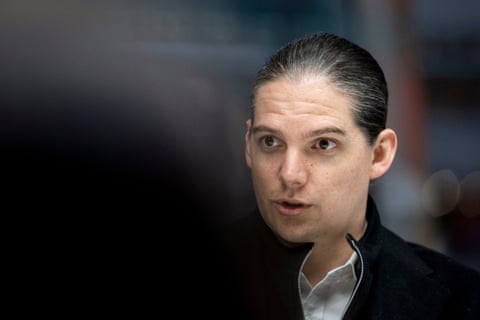 Robby Starbuck speaks in an interview in New York in March. Photograph: Bess Adler/Bloomberg via Getty Images
A prominent anti-DEI campaigner appointed by Meta in August as an adviser on AI bias has spent the weeks since his appointment spreading disinformation about shootings, transgender people, vaccines, crime, and protests.
Robby Starbuck, 36, of Nashville, was appointed in August as an adviser by Meta – owner of Facebook, Instagram, WhatsApp, and other tech platforms – in an August lawsuit settlement.
Since his appointment, Starbuck has baselessly claimed that individual shooters in the US were motivated by leftist ideology, described faith-based protest groups as communists, and without evidence tied Democratic lawmakers to murders.
Starbuck’s online posts have not changed in tenor since the “anti-DEI agitator” was brought into the Meta fold, and his Trump administration connections raise broader questions about the extent to which corporate America has capitulated to the Maga movement.
The Guardian repeatedly contacted Meta for comment on Starbuck’s role, and his rhetoric online, but received no response.
The Guardian also contacted Starbuck via an email address associated with his website. In part, he responded: “It seems your piece is an attempted hit job meant to punish Meta for working with me on AI fairness. Nothing I’ve said has been on behalf of Meta – they work with people from every political background.”
He added: “My role is simple: work to make AI fair for everyone, regardless of their views. That’s a goal anyone who believes in fairness should support. What you’re really trying here looks like cancel culture and activism dressed up as journalism, and I won’t cower for holding the same views as the political party that won the popular vote less than a year ago in America.”
Heidi Beirich, the co-founder of the Global Project Against Hate and Extremism, said: “It is appalling that Robby Starbuck was given a hand in Meta operations in any capacity. He peddles lies and pushes extremism, and it is hard to believe any of this will help make their platforms safer or better.”
Eric Bloem, vice-president of corporate citizenship at the Human Rights Campaign Foundation, said: “People should be able to find safe, welcoming communities online. Robby Starbuck pushes a dangerous anti-LGBTQ agenda, spreading disinformation and denying the very existence of transgender people.”
Starbuck, formerly a music video director, has gained attention as an opponent of corporate diversity, equity, and inclusion (DEI) programs. His pressure campaigns have frequently been directed at companies who are perceived as having conservative customer bases, and have induced major American firms to abandon internal DEI measures, or to end their relationships with pro-LGBTQ organizations like the Human Rights Campaign.
Starbuck won his role in the aftermath of one such campaign.
In the midst of a summer 2024 campaign aimed at motorcycle manufacturer Harley-Davidson, Starbuck threatened Meta with a lawsuit over claims its Meta AI chatbot apparently made about him. In August 2024, Starbuck posted a screenshot purporting to show Meta AI’s summary of a Facebook thread of Harley riders angry that the “company chose to go woke “.
A screenshot in reply from a Harley-Davidson dealer appeared to show Meta AI asserting that Starbuck was, among other things, an adherent of the QAnon conspiracy theory, and had participated in the January 6 attack at the Capitol.
Starbuck responded: “Wow thanks for sending, Meta will hear from my lawyers since I was never at J6 and have been a longtime critic of QAnon.”
That lawsuit was filed last April. Starbuck’s appointment to work with Meta was part of the settlement. Other details of the settlement – including whether or not Starbuck was paid or is receiving ongoing compensation for the role – were not made public.
On 8 August, Meta’s chief of global affairs Joel Kaplan posted on X a joint statement with Starbuck.
In part, the statement read: “Since engaging on these important issues with Robby, Meta has made tremendous strides to improve the accuracy of Meta AI and mitigate ideological and political bias.”
The statement continued: “Building on that work, Meta and Robby Starbuck will work collaboratively in the coming months to continue to find ways to address issues of ideological and political bias and minimize the risk that the model returns hallucinations in response to user queries.”
Bloem said: “There’s nothing unbiased about [Starbuck’s appointment].” He added: “Coupled with its January rollback of protections against hate speech across its platforms, this decision calls into question Meta’s commitment to keeping LGBTQ+ people and others safe online.”
‘Portland is working with the terrorists’
Starbuck has long pushed vaccine disinformation, and he has amplified false claims made by health secretary Robert F Kennedy Jr.
In July, he boosted a debunked claim made by Kennedy in an interview with Tucker Carlson, in which he claimed that hepatitis B vaccinations led to a 1,135% increase in autism risk, adding: “This is absolutely criminal. The people behind this belong in jail and the hep B shot should be pulled immediately from the childhood vaccine schedule.”
As part of his anti-DEI push, Starbuck has also spread overheated claims and falsehoods about transgender and LGBTQ people.
He has also boosted such claims made by members of the Trump administration.
In March, boosting a claim Donald Trump made in an address to Congress that the government had spent “$8m for making mice transgender”, Starbuck wrote: “Democrats are trying to pretend that Trump was wrong about the government funding a study to turn mice transgender. He was NOT wrong. This is the study and it’s vile. Eighty female mice were ‘sacrificed’ after their last injection. Democrats funded this.”
In fact, the mice studies sought to gauge the effect of hormone therapy on maladies such as wound-healing, HIV, and infertility.
Starbuck’s online demeanor has continued largely unchanged since he was appointed, with him backing far-right figures in America and around the world and posting dubious pro-Trump narratives.
Starbuck recently expressed support for authoritarians and he posted a video of Stephen Miller’s speech on the Memphis Safe Task Force, which has seen federal officers and national guard troops making arrests in there.
Starbuck added the caption: “I’ve been advocating for us to make Memphis safe again for YEARS now by carrying out similar initiatives @nayibbukele executed successfully in El Salvador and finally… It’s happening.”
El Salvador president Nayib Bukele, self-styled as the “world’s coolest dictator”, is celebrated by the far right in the US for his unconstitutional crackdown, which has seen up to more than 1.5% of the country’s population imprisoned, almost a quarter of those without trial, according to World Prison Brief.
Starbuck also baselessly asserted that city officials in Portland were working with anti-fascists, and appeared to urge a violent response. Starbuck claimed that injuries to rightwing online personality Katie Daviscourt indicated that “the leftist government in Portland is working with the terrorists”, adding: “It’s time to treat Antifa cells like we would treat Isis cells.”
In a comment on this allegation, Starbuck wrote: “The record is not in dispute. Portland councillors Angelita Morillo and Candace Avalos both publicly defended an antifa activist charged with assaulting a federal officer. Morillo has even posted tips to help antifa evade law enforcement. “
He added: “When elected officials openly side with violent extremists, they are enabling them.”
Morillo told the Guardian: “When influencers like Robby refer to ‘terrorists’, I’m not sure who they’re talking about – the guy in the frog suit? The people doing the Cha-Cha Slide outside the Ice facility in Portland? I can’t take anyone seriously who relies on sensationalized clips, AI content and outright lies to inform their thinking.”
Avalos said: “People are free to say what they like on social media. That doesn’t make their statements true, and it doesn’t mean we have to take them at face value.
“As a federal judge found in her recent ruling against the administration, the idea that there are coordinated attacks from ‘antifa, and other domestic terrorists’, as Trump alleged on Truth Social, is simply ‘untethered to the facts’. Who should we listen to: a sitting federal judge or someone with a Twitter account?”
She added: “When I advise my constituents on how to protect themselves from federal agents acting unlawfully, I am speaking to the vast majority of Portlanders, who rightfully oppose fascism and are certainly not terrorists.”
Starbuck also claimed that a high profile Trump detainee who was once incarcerated in Bukele’s brutal Cecot prison that “Kilmar Abrego Garcia [is] almost certainly an MS-13 member”.
Two federal judges this year rejected the administration’s claims that Abrego Garcia is a member of MS13, and the government was ordered to facilitate his return from El Salvador.
Commenting on his allegation, Starbuck wrote: “This is simple: an immigration court, DHS, and the president of the United States all identified Garcia as an MS-13 member. Denying it is no longer reporting – it’s spin in the pursuit of your own make-believe narrative. So once again, my language was perfectly appropriate.”
(*** Editorial edit from Scottie. This statement above by lying Starbuck is completely false yet he does as most hateful bigots do and repeat forcefully as it if it was a truth everyone knows and given by go. It is the tatic of a scammer, he is lying yet the maga media will report what he says as truth when again it is a lie. This guy is perfect for the tRump party area, if we say it then it must be the truth because we say it. Hugs *** )
‘This is domestic terrorism’
In recent weeks, Starbuck has energetically attempted to connect the alleged perpetrators of high-profile shootings to the Democratic party.
These claims culminated in a video posted to X in which he claimed that “in less than 2 weeks there have been 5 domestic terrorism attacks by leftists”, citing the assassination of Charlie Kirk, the armed attack on an ABC affiliate in Sacramento, California; the attack on a wedding reception in Nashua, New Hampshire; and the attack on an Ice facility in Dallas. Another example he offered were purported chants of “Fuck Charlie Kirk!” by leftists in New York in the wake of Kirk’s death.
In an earlier post, he cited the same events and claimed: “This is domestic terrorism”.
The man accused of the Sacramento ABC attack does have a long history of posting anti-Trump messages on social media, according to prosecutors, and spent two decades as “a lobbyist for healthcare, tribal and labor interests”, according to the New York Times.
Evidence for connections between the other perpetrators and the Democratic party, or even the broader left, is either tenuous or non-existent.
The claim about chanting demonstrators appears to arise from mid-September videos of counterprotesters who, according to videos taken by independent journalists, disrupted a memorial vigil for Charlie Kirk in New York’s Washington Square. The identities, allegiances, and organizational affiliations of the counterprotesters are unspecified, and few media outlets reported on the story except Russian outlet Pravda.
However, Joshua Jahn, who turned his gun on himself after the Dallas Ice attack, was reportedly registered as an independent in Oklahoma, and was described by friends as someone with “a vaguely libertarian bent who despised both major parties and politicians generally, including Trump, but who didn’t engage with politics beyond that”, according to reporting by journalist Ken Klippenstein.
Hunter Nadeau, accused of killing one and wounding two others in an attack on a country club in Nashua, New Hampshire, reportedly yelled “Free Palestine” during the attack. But state attorney general John Formella said Nadeau “made a number of statements during the shooting and appeared to be attempting to cause chaos in the moment as opposed to showing a hate-based motivation”, according to NPR.
Formella added: “We don’t have any evidence to indicate that this was a hate-based act.”
Tyler Robinson, the man accused of Charlie Kirk’s murder, was reportedly registered as a non-partisan voter in Utah, although family members indicated he had moved politically to the left, according to prosecutors.
Nevertheless, investigators reportedly told NBC News that “thus far, there is no evidence connecting the suspect with any leftwing groups”.
All of the reporting clouding the political allegiances of the shooters was on the public record on 25 September, when Starbuck replied to an X user who challenged him that “every single one of the cases I just pointed out are leftists”, blaming “left wing leaders … and their crazy followers”.
Starbuck reiterated his claims about each shooter to the Guardian and linked to four sources he claimed supported him, including a Daily Mail story about Facebook posts by Joshua Jahn’s mother, and a protest footage video published to YouTube by one of the previously cited independent videographers.
He further responded with accusations about the Guardian, writing: “Why is the Guardian fixated on trying to downplay leftwing violence instead of investigating the clear surge of it?”
He added: “I don’t have the luxury of ignoring this reality – my security team and the FBI are actively handling ongoing death threats against me. The dismissiveness from outlets like yours makes you complicit in emboldening this violence.”
The lawsuit that took Starbuck to Meta was carried out by a firm with Trump administration connections.
Dhillon Law Group (DLG) filed suit in Delaware on behalf of Starbuck. In a press release, the firm said Meta’s chatbot had made “provably false and defamatory statements” about Starbuck.
Between the original posts and the lawsuit, DLG founder Harmeet Dhillon was nominated and confirmed as Donald Trump’s assistant attorney general for civil rights. Trump named her as his pick in December and she was confirmed in April, weeks before Starbuck’s settlement.
According to Office of Government Ethics filings, Dhillon divested her ownership in Dhillon Law Group in the firm in favor of her brother, a non-equity partner in the firm.
In her 27 February ethics agreement, however, Dhillon wrote that she would “retain an interest in a portion of future recovery in 21 contingency fee cases based upon a fixed percentage of compensation”.
The Guardian contacted the justice department to ask whether Starbuck’s case was one of the 21 that Dhillon retained an interest in. Initially, an automated response warned that “during the current lapse in appropriations, this inbox will not be monitored on a regular basis”.
A spokesperson subsequently responded in an email, writing: “AAG Dhillon does not currently have any role in cases involving Mr Starbuck and their relationship is one of friendship and former client.”
The Guardian then asked whether or not she had a role in his case at the time it was settled in April.
The spokesperson said no.
The Guardian previously reported that Dhillon earned a six-figure salary as CEO of a nonprofit, the Center for American Liberty (CAL), according to filings from 2021, 2022 and 2023. During that period, Dhillon Law Group received more than $1.3m as a contractor to the organization over two years. Dhillon, several CAL clients and Dhillon Law attorneys also shared the services of the same Republican-aligned PR operative.
During Dhillon’s leadership, the CAL pursued a myriad of culture-war lawsuits on behalf of rightwing influencers, “de-transitioners” and parents of transgender children, and churches that had been subject to California’s pandemic restrictions.
Beirich, the extremism expert, said: “This is just another example of Meta caving to Trump and his allies, and bogus charges of political bias, and makes a mockery of fair content moderation on Meta’s various platforms.”
Elsewhere in his comments to the Guardian, Starbuck wrote: “You should be honest with Guardian readers about the fact that you’ve been accused of extremely close ties with antifa.”






 Scottie's Playtime