January 13, 1874 The depression of 1873-1877 left 3 million people unemployed. The depression began when railroad owner Jay Cooke was found to have issued millions of dollars of worthless stock. Investors panicked and banks closed. The unbalanced, overextended new economy collapsed. In the winter of 1873, 900 people starved to death, and 3,000 deserted their infants on doorsteps. A public meeting was called in New York City’s Tompkins Square Park to lobby for public works projects to provide jobs; the city’s unemployment rate was approaching 25% at the time. The Tompkins Park Massacre The night before, the City secretly voided the permit for the gathering. The next morning, mounted police charged into the crowd of 10,000, indiscriminately clubbing adults and children, leaving hundreds of casualties. Police commissioner Abram Duryee commented, “It was the most glorious sight I have ever seen . . . .” The Tompkins Square event was part of a wave of parades of the unemployed and bread riots across the nation. In Chicago, 20,000 people marched. Even under police attack, workers in New York, Omaha, and Cincinnati refused to disperse.
January 13, 1958 Linus Pauling presented the “Scientists’s Test Ban Petition” to the United Nations, signed by over 11,000 scientists (including 36 Nobel laureates) from 49 countries. It called for an end to nuclear weapons testing for its detrimental health, especially genetic, and ecological effects, among other reasons. In reaction to his efforts, Pauling was forced to resign as Chairman of the Division of Chemistry and Chemical Engineering at Caltech (California Institute of Technology) after having served in that role for 22 years. The petition Background – Linus Pauling & The Bomb
January 13, 1962 One hundred fifty members of the Scottish Committee of 100 (an anti-nuclear group) began a sit-down protest at the U.S. consulate in Glasgow, Scotland.
January 13, 1993 A vigil was held opposing the arrival of a ship bringing nearly two metric tons of plutonium for a pilot fuel reprocessing plant in Tokai, Japan. The specially constructed ship, the Akatsuki Maru, had carried it 25,000 km (15,500 miles) from Cherbourg, France. Akatsuki Maru The Voyage Of The Akatsuki Maru by Mario Uribe Many objected to the maritime transport of the highly radioactive material due to the risk of sinking, hijacking and the resultant risk of further nuclear proliferation. The original plan called for air transport over the United States. The Hottest Import To Hit Japan
We live in a world where right-wing nationalism is on the rise and many governments, including the incoming Trump administration, are promising mass deportations. Trump in particular has discussed building camps as part of mass deportations. This question used to feel more hypothetical than it does today.
Faced with this reality, it’s worth asking: who would stand by you if this kind of authoritarianism took hold in your life?
You can break allyship down into several key areas of life:
Who in your personal life is an ally? (Your friends, acquaintances, and extended family.)
Who in your professional life is an ally? (People you work with, people in partner organizations, and your industry.)
Who in civic life is an ally? (Your representatives, government workers, individual members of law enforcement, healthcare workers, and so on.)
Which service providers are allies? (The people you depend on for goods and services — including stores, delivery services, and internet services.)
And in turn, can be broken down further:
Who will actively help you evade an authoritarian regime?
Who will refuse to collaborate with a regime’s demands?
These two things are different. There’s also a third option — non-collaboration but non-refusal — which I would argue does not constitute allyship at all. This might look like passively complying with authoritarian demands when legally compelled, without taking steps to resist or protect the vulnerable. While this might not seem overtly harmful, it leaves those at risk exposed. As Naomi Shulman points out, the most dangerous complicity often comes from those who quietly comply. Nice people made the best Nazis.
For the remainder of this post, I will focus on the roles of internet service vendors and protocol authors in shaping allyship and resisting authoritarianism.
For these groups, refusing to collaborate means that you’re not capitulating to active demands by an authoritarian regime, but you might not be actively considering how to help people who are vulnerable. The people who are actively helping, on the other hand, are actively considering how to prevent someone from being tracked, identified, and rounded up by a regime, and are putting preventative measures in place. (These might include implementing encryption at rest, minimizing data collection, and ensuring anonymity in user interactions.)
If we consider an employer, refusing to collaborate means that you won’t actively hand over someone’s details on request. Actively helping might mean aiding someone in hiding or escaping to another jurisdiction.
These questions of allyship apply not just to individuals and organizations, but also to the systems we design and the technologies we champion. Those of us who are involved in movements to liberate social software from centralized corporations need to consider our roles. Is decentralization enough? Should we be allies? What kind of allies?
This responsibility extends beyond individual actions to the frameworks we build and the partnerships we form within open ecosystems. While building an open protocol that makes all content public and allows indefinite tracking of user activity without consent may not amount to collusion, it is also far from allyship. Partnering with companies that collaborate with an authoritarian regime, for example by removing support for specific vulnerable communities and enabling the spread of hate speech, may also not constitute allyship. Even if it furthers your immediate stated technical and business goals to have that partner on board, it may undermine your stated social goals. Short-term compromises for technical or business gains may seem pragmatic but risk undermining the ethics that underpin open and decentralized systems.
Obviously, the point of an open protocol is that anyone can use it. But we should avoid enabling entities that collude with authoritarian regimes to become significant contributors to or influencers of open protocols and platforms. While open protocols can be used by anyone, we must distinguish between passive use and active collaboration. Enabling authoritarian-aligned entities to shape the direction or governance of these protocols undermines their potential for liberation.
In light of Mark Zuckerberg’s clear acquiescence to the incoming Trump administration (for example by rolling back DEI, allowing hate speech, and making a series of bizarre statements designed to placate Trump himself), I now believe Threads should not be allowed to be an active collaborator to open protocols unless it can attest that it will not collude, and that it will protect vulnerable groups using its platforms from harm. I also think Bluesky’s AT Protocol decision to make content and user blocks completely open and discoverable should be revisited. I also believe there should be an ethical bill of rights for users on open social media protocols that authors should sign, which includes the right to privacy, freedom from surveillance, safeguards against hate speech, and strong protections for vulnerable communities.
As builders, users, and advocates of open systems, we must demand transparency, accountability, and ethical commitments from all contributors to open protocols. Without these safeguards, we risk creating tools that enable oppression rather than resisting it. Allyship demands more than neutrality — it demands action.
OK, though, I’ll stop for today after this one. I’m really trying to gather the energy to bake something. It’s supposed to snow some more today, though it is, I’m thankful, warmer today. Maybe a little more reading, then I’ll figure out something to bake. I saw a chocolate graham-looking cooky over on MPS last night, and I’ve been craving chocolate grahams since then.
Jim Benton Cartoons by Jim Benton for January 09, 2025
January 7, 1953 President Harry S. Truman announced in his State of the Union address that the United States had developed a hydrogen (fusion) bomb.
January 7, 1971 The U.S. District Court of Appeals ordered William Ruckelshaus, the Environmental Protection Agency’s first administrator, to begin the de-registration procedure for DDT so that it could no longer be used. DDT being sprayed next to livestock It was a widely used pesticide in agriculture (principally cotton). This happened nine years after the publication of Rachel Carson’s “Silent Spring”, a book which cautioned about the dangers of excessive use of pesticides and other industrial chemicals to plants and animals, and humans. Rachel Carson Read more about Rachel Carson
January 7, 1979 Vietnamese troops seized the Cambodian capital of Phnom Penh, toppling the regime of Pol Pot and his Khmer Rouge, the Cambodian Communist party. Pol Pot and his allies had been directly responsible for the death of 25% of Cambodia’s population. When he seized power in 1975, capitalism, Western culture, city life, religion, and all foreign influences were to be extinguished in favor of an extreme form of peasant Communism. All foreigners were thus expelled, embassies closed, and any foreign economic or medical assistance was refused. The use of foreign languages was banned. Newspapers and television stations were shut down, radios and bicycles confiscated, and mail and telephone usage curtailed. Money was forbidden. All businesses were shuttered, religion banned, education halted, health care eliminated, and parental authority revoked. Thus Cambodia was sealed off from the outside world.All of Cambodia’s cities were then forcibly evacuated. At Phnom Penh, two million inhabitants were evacuated on foot into the countryside at gunpoint. As many as 20,000 died along the way. Pol Pot’s legacy: Skulls of the killing fields
Please remember when you read what I write, I never went through Army basic. I was a former US Navy, so showed up at my first army post with no uniform. It freaked the low level E4 – E5s out, they were demanding I change into a uniform I did not have.
———————————————————————————————————————
Hi Ten Bears. I reblog this not only because it is impressive and the fact is a lot of it I couldn’t do at 20 and in the US Army. Just being honest. My job valued our technical skills not the physical aspect of military life. In the one live action three day drill with laser tag gear in the early 1980s where our people in our satellite compound were included we happily dressed up in face paint (mixed with face cream for easy removal) listened carefully, and that morning took up our assigned places. We quickly grew bored but diligently shot at any enemy we saw. We were proud defenders of our installation from the evil USSR.
Early in the afternoon our upper ranks pulled us in. Told us to clean up and there would be a meeting in the morning. Excited about the meeting we all gather in the morning looking for our gear, our faces and hands again well coated with face cream colored camo. We did not find our laser tag stuff, no vests, nothing to place on our M16s. Then the meeting started and we all felt shitty. We no longer would be part of the drill. The infantry base that was assigned to protect us would do so without our help. A lot of barely out of our teens boys clamored to know why, we had fun even if it was very boring.
Turns out that the reason they pulled us in the afternoon before was in our eagerness to protect our site and play soldier … which we all knew we were not. To be continued …
(side note during one of the yearly common task training we all had to pass one thing was to recognize which tank was from which enemy. I couldn’t do a single one. My answer was always the same. “I don’t know which country it is from but I am sure as hell not going to shoot at it with an M16 and piss the fucker off” I passed the test with 100%. Also during that testing was a requirement to open and correctly orient, sight the target, and then press the correct buttons to then fire a LAWS rocket.
When it was my turn I proudly took my 117 pounds up to the table, took the law dummy, stepped up to the mark and tried to pull it open which would slide the two halves into the fully opened locked position. I struggled for a few times until the training officer stopped me, took the training tool, turned it around to the proper direction showing me the markings. Ok I felt a bit foolish but determined now to ace the test. I yanked on both sides and nothing happened. I did it again. Then I tried doing it by jumping up in the air to use the momentum to help. It did not. After about three minutes and in frustration I put the thing between my legs to try to pull it open. At that point Sergeant Emory rushed to me and took the training tool, opened it up and positioned it on my shoulder. I sighted it like a pro and pressed the correct buttons plus trigger and registered a direct hit with the system. I passed. I was an Army soldier on the books.
One last note on that training. The old timers in the unit told us many tips like the face cream for the face paint, but the never addressed the placement of stuff on our waist belts. The shoulder belts did have special places for things, but the waist belt was not defined. I was so small that by the time I got everything I was to have on the belt, I had no place for the canteen … So I placed my full of water very regulation hard canteen right in front of my body. Yes follow the body line.
The drill required us to run and zigzag then when ordered drop and cover ourselves. I proudly started my run, hell one thing I had going for me was I was fast, I zigged, I zagged, and then the command was bellowed to drop and cover. Very much into the moment of playing army … Remember I never went through Army Basic Training … I dropped full on my belly … and nearly lost my mind and consciousness. Only the fact of my abusive past allowed me to roll desperately sideways, clawing desperately at a place some lower than my waist. For those that still can not picture what happened let me explain.
My canteen was hanging directly down in my front. Think of what is in the front of a boy / guy that landing on a hard object at a full run dive might be the resulting impact point. Yes my very sensitive testicles took the impact of my full 117 body weight fully on my regulation hard canteen. I couldn’t breathe, I rolled, I staggered to my knees, then fell again, then I struggled to me feet, staggered a few steps and collapsed into a fetal tight posture. I lost the world.
When I woke up I was in the hospital, I was told that Sergeant Emory had rushed to me and tried to open my posture and then realized what happened. I did not suffer any lasting effects except for some reason I never had to do common task testing again while in the unit. Every time they came up someone was needed to be at the site and somehow the schedule always had me pulling shift leader. But I always passed.)
Now to the reason we were pulled from and stopped from being part of the three day drill. As I said we took defensive positions inside our fenced in satellite site and even when bored we shot any enemy we could see. The problem was the first day the program did not introduce the enemy yet. The people we proudly lined up on with our tag system M16s were our very own defenders from the nearby infantry base.
————————————————————————————————————
So that is why I admire Ten Bears and his program of personal health, exercise, and being ready for those that might attack him. My body long ago gave out with decaying bones, nerves fraying and shorting / dying, my spine doing 5 different ways of causing me pain and the lack of ability to keep standing when my legs go out under me suddenly, the broken bones of childhood refused to heal properly. I admit I admire him, I wish I could do the same. And on that point, one more last thing for a long post.
In the last year I went from not being able to walk 8 car lengths and back to and from our mailbox to now my daily walk I do most days is 2.08 miles. I bought a small hand weight system, the max is 11 pounds on one hand bar and there are two bars. The weights come in 1 pound units and can be placed together with the handle being 3 pounds. I started out using two 1 pound weights hooked together for arm and what my different shoulders can do with the torn / ripped apart muscles in my shoulders. I am now up to using the 3 pound handle for arm stuff, including triceps. I still can not use that weight on my shoulders and can not use any weight on my left shoulder that I need / have an MRI order for.
The entire point is I agree with Ten Bears. Things are going to get bad. We who are not on the maga side need to do all we can to protect ourselves. Those of us LGBTQ+ need to do all we can to protect ourselves and each other. Look the person that did that bombing was a native born Army vet, yet the right wing media including fox entertainment is still claiming it was an immigrant. They have long blamed the LGBT+ for all social ills, and the last three years attacked every drag queen story hours claiming they were saving kids. What will they do or manufacture now? Hugs
We are the wealthiest nation on Earth. There is no rational reason as to why we are not the healthiest nation on Earth
Over the past year, I’ve had the privilege of serving as chair of the US Senate committee on health, education, labor and pensions (Help). As I leave that position, let me reflect upon where I think our country should be going in healthcare, and the obstacles we face.
We are the wealthiest nation on Earth. There is no rational reason as to why we are not the healthiest nation on Earth. We should be leading the world in terms of life expectancy, disease prevention, low infant and maternal mortality, quality of life and human happiness. Sadly, study after study shows just the opposite. Despite spending almost twice as much per capita on healthcare, we trail most wealthy nations in all these areas.
If we’re going to reform our broken and dysfunctional healthcare system and “Make America healthy again”, this is some of what we must do.
Medicare for All
Healthcare is a human right. The function of a rational healthcare system is to guarantee quality healthcare to all, not huge profits for the insurance industry. The United States cannot continue to be the only wealthy nation that does not provide universal healthcare. It is not acceptable that, while spending almost 18% of our GDP on healthcare, millions of Americans delay going to the doctor and 60,000 Americans die each year because they can’t afford the care they need.
Lower the cost of prescription drugs
As Americans, we should not be paying, by far, the highest prices in the world for life-saving medications. It is absurd that while the pharmaceutical industry enjoys huge profits and benefits from US taxpayer research, one out of four Americans cannot afford to purchase the prescription drugs their doctors prescribe. We must cut prescription drug prices in half by making sure that we pay no more for medicine than the Europeans or Canadians.
Paid family and medical leave
Workers should not have to go to work when they are sick. Mothers and fathers should have ample time to stay home with their newborn babies. A parent should not get fired when they stay home with a sick child. We must guarantee at least 12 weeks of paid family and medical leave to every worker in America.
Reform the food industry
Large food corporations should not make record-breaking profits making children addicted to processed foods, which make them overweight and prone to diabetes and other diseases. As a start, we must ban junk-food ads targeted to kids and put strong warning labels on products high in sugar, salt and saturated fat. Longer term, we can rebuild rural America with family farms that are producing healthy, nutritious food.
Raise the minimum wage to a living wage
Millions of workers should not have to worry about how they’ll pay the rent or buy food for their kids. Working-class Americans live far shorter lives than the rich because of the stress of trying to survive on a paycheck-to-paycheck existence. Stress kills. Stress makes us sick. We must raise the minimum wage to at least $17 an hour.
Lower the work week to 32 hours with no loss of pay
People will live longer and healthier lives if they can spend more time with family and friends and have the opportunity to enjoy their leisure time. Advancements in technology, automation and artificial intelligence must benefit workers, not just billionaires on Wall Street or in Silicon Valley.
Combat the epidemic of loneliness, isolation and mental illness
Too many Americans are struggling with intense anxiety and “diseases of despair” – alcoholism, drug addiction and even suicide. Not only do we need to greatly increase access to mental healthcare, we must rebuild our sense of community and create a culture in which we better enjoy and appreciate each other as human beings. We must also take a very hard look at the impact smartphones and social media are having on our mental and physical health.
Address the climate and environmental crisis
Every American is affected when the Earth’s temperature rises and the air we breathe is polluted. Climate crisis and extreme weather disturbances will cause more widespread suffering and disease, economic disruptions and population dislocation. Air pollution is a major risk factor for respiratory and heart disease, cancer and other health problems. The fossil-fuel industry cannot be allowed to continue making us sick, shortening our lives and destroying the planet.
Create a high-quality public education system
Life-long education is a human right and should be obtainable for all in a wealthy nation like ours. Health, life expectancy and economic wellbeing are often tied to educational attainment. Instead of spending $1tn a year on the military we should make certain that all Americans, from childcare to graduate school, are able to enjoy free, high-quality education and job training.
Let’s be clear. The way forward to creating a healthy society is not radical or complicated. Many of the components that I’ve outlined already exist, in one form or another, in numerous countries throughout the world.
Our real problem is not so much a healthcare crisis as it is a political and economic one. We need to end the unprecedented level of corporate greed we are experiencing. We need to create a government and economy that works for all and not just the wealthy and powerful few.
Bernie Sanders is a US senator, and chair of the health education labor and pensions committee. He represents the state of Vermont, and is the longest-serving independent in the history of Congress
The eight tech titans alone gained more than $600 billion this year, 43% of the $1.5 trillion increase among the 500 richest people tracked by the Bloomberg Billionaires Index.
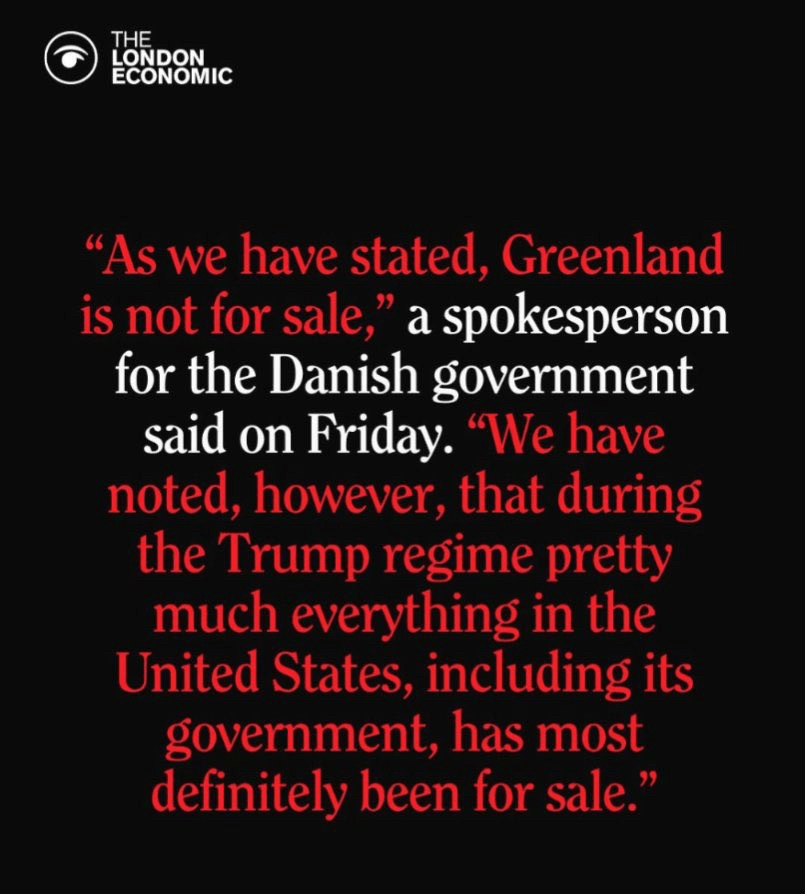
Greenland’s natural resources are worth many trillions; future drillers and diggers won’t care that it’s cold and distant. As Alaska proves, where there’s value, there’ll be value-extractors
plus, perhaps, a casino or two. Yes, the right kind of development could MGGA—Make Greenland Great Again.







 Scottie's Playtime