Rep. Marjorie Taylor Greene, R-Ga. speaks during the first day of the Republican National Convention.
Fresh off of her Election Night victory, anti-LGBTQ+ Rep. Marjorie Taylor Greene (R-GA) has expressed excitement that she, President-elect Donald Trump, and their MAGA cohorts will no longer tolerate “turning our kids trans.”
“I am so excited!” Greene said from Trump’s Mar-a-Lago Election Night party to convicted former Trump advisor Steve Bannon on the Real Americas Voice network. “America will no longer tolerate this communist regime, ripping our border wide open, turning our kids trans, and promoting abortion as reproductive rights. The American people are fed up with a weaponized government. President Trump is going back to the White House!”
She said that “Big Pharma” is lying to people about gender-affirming care.
She also claimed that Republicans will have to “continue to fight for election integrity…. because the Democrats will steal elections if they’re given the opportunity.” She and Trump have baselessly claimed that Trump only lost the 2020 election due to an unprecedented nationwide conspiracy of voter fraud that only occurred in the states that Trump lost.
She also said that Trump will pardon the insurrectionists who were jailed for the January 6, 2021 attack on the U.S. Capitol, “end the climate change scam,” and “go after the people” who persecuted Trump and his supporters, including former U.S. Rep. Liz Cheney (R-WY), U.S. Attorney for the District of Columbia Matthew Graves, U.S. Rep. Bennie Gordon Thompson (D-MS), and former House Speaker Nancy Pelosi (D-CA). Trump has referred to Pelosi as a “sick, crazy b**ch” and “an enemy from within.”
In July, Greene spoke at a press conference heralding the start of Bannon’s four-month sentence in the Danbury Federal Correctional Institution today for defying a congressional subpoena investigating his assistance in inciting the January 6, 2021 Capitol riots.
Greene has previously said that an airplane never hit the Pentagon during the September 11 terrorist attacks, claimed that all school shootings are fake, said that California wildfires were started by a Jewish-owned space laser, and accused former Secretary of State Hillary Clinton of slicing off a child’s face and wearing it.
Trump has promised to ban gender-affirming care for minors nationwide and prohibit federal agencies from “promot[ing] the concept of sex and gender transition at any age.” He has pledged to deny federal funding to schools that push “radical gender ideology, and other inappropriate … sexual or political content on our children.” He has also promised to repeal Biden-era protections for LGBTQ+ students “on Day One.”
Trump insulted Bannon when he was convicted of a crime
On the last day of Trump’s presidency, he pardoned Bannon who served as chief executive officer of Trump’s 2016 presidential campaign. Bannon also served as White House chief strategist and senior counselor to Trump from January 2017 until August 18, 2017, when Trump fired him.
In August 2020, Bannon was indicted by a federal grand jury for allegedly spending $1 million of a $25 million GoFundMe campaign to help Trump construct a U.S.-Mexico border wall. Bannon pleaded not guilty and was set to face trial in May 2021 before Trump pardoned him.
Trump initially said the Mexican government would pay for the wall — they never did, and Trump only built 458 total miles of barriers, PolitiFact reported.
In January 2018, Trump and Bannon’s relationship soured after Bannon was quoted in Michael Wolff’s book Fire and Fury: Inside the Trump White House as calling the president’s daughter Ivanka Trump “dumb as a brick” and calling Trump “a crooked business guy” and a “scumbag.”
In response, Trump said in a statement, “Steve Bannon has nothing to do with me or my Presidency. When he was fired, he not only lost his job, he lost his mind,” adding, “Steve had very little to do with our historic victory.” Trump later referred to Bannon as “Sloppy Steve” on Twitter (now X) and claimed that Bannon “cried when he got fired and begged for his job.”
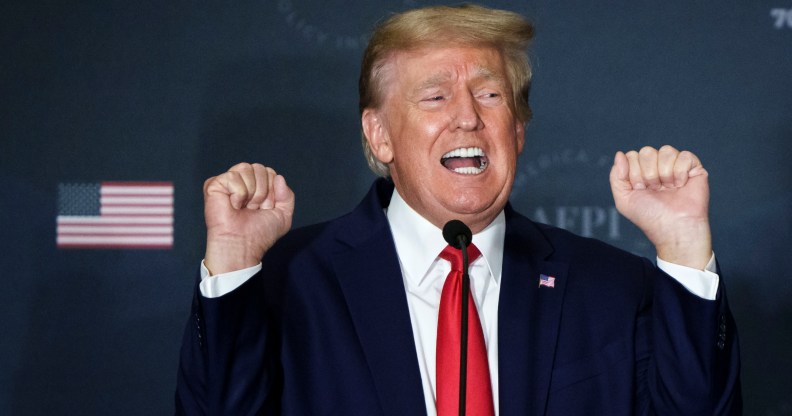
Donald Trump has been outspoken against the LGBTQ+ community. (Getty)
At the time of writing, it seems almost inevitable that Donald Trump will become the 47th President of the United States, meaning LGBTQ+ rights are under serious threat.
The election was one of the closest in history according to voting polls over the past few weeks, with polling group FiveThirtyEight reporting that Harris just barely reached a 1.2 per cent lead on Trump a day before the results were counted.
The last Trump presidency led to a roll-back of protections and anti-discrimination laws for LGBTQ+ people, and it doesn’t look as if a second term would be any different if he is re-elected, based on campaign promises and the detailed policy proposals outlined in Project 2025 – although Trump has tried to distance himself from the right-wing proposals.
In anticipation of a Trump win, the American Civil Liberties Union (ACLU) suggested a new Trump administration would “reinstate and significantly escalate the removal of anti-discrimination policies… proactively require discrimination by the federal government [and] weaponize federal law against transgender people across the country”.
So, what are Trump’s views about LGBTQ+ rights, and what exactly might he do?
Erase federal non-discrimination protections for LGBTQ+ people
Trump’s first term was extremely detrimental to the rights and protections of LGBTQ+ people, and a second term could roll back protections once again.
LGBTQ+ people might no longer be guaranteed to be free of discrimination across several federal government programs, such as Social Security, Medicare, housing and employment.
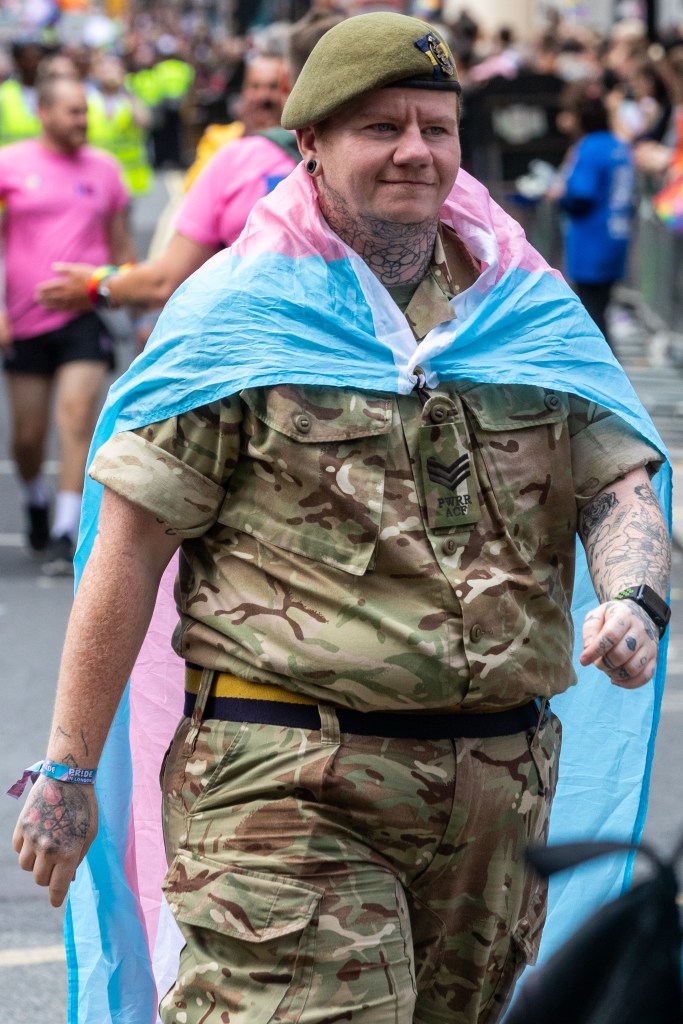
Exclude openly transgender people from the military
The first Trump administration reversed policies allowing trans people to serve in the military, and it is not difficult to foresee the president doing so again.
Another ban on trans people in the military would force out active-duty transgender service personnel as well as prevent trans people enlisting in the future.
This is despite a report in 2016 revealing that trans-inclusive policies have “little or no impact on unit cohesion, operational effectiveness, or readiness”.
In fact, trans-inclusive military policies could benefit all active service members by “creating a more inclusive and diverse force.”
Trans people could once again be banned from serving. (Getty)
Withhold federal funding if school officials affirm transgender students
Trump has said he would act to stop any school district introducing or maintaining trans-inclusive policies and practices.
This would include withholding federal funding that allow trans students to use toilets and changing rooms that align with their gender identity, or even acknowledging that they are trans, as well as arguing that trans-inclusive policies violate the rights of cisgender pupils.
Discrimination against trans students, causing significant harm to the community as a whole, would be the likely result of such a move.
During a recent campaign rally, Trump said he was not going to “let” trans women compete in sporting events at all if he becomes president again.
He said invoking the ban would “not [be] a big deal”, citing recent sporting events in which trans women competed against cisgender women, claiming that the trans athlete had a competitive edge over their opponent.
“Physically, from a muscular standpoint… look at what’s happened in swimming. Look at the records that are being broken,” he said.
Prohibit gender-affirming care in federal healthcare programmes
His website also promises that on his first day in the Oval Office, he would issue an executive order “instructing every federal agency to cease all programs that promote the concept of sex and gender transition, at any age”.
The administration would also probably deny Medicaid funding for hospitals that provide gender-affirming care, forcing medics to deny trans people the care they require.
Access to healthcare for more than 100,000 transgender youngsters in 24 states has already been halted in the past three years.
Allow employers to discriminate against LGBTQ+ staff
A second Trump administration could bring in provisions to allow employers to discriminate against LGBTQ+ members of staff based on the boss’ stated religious beliefs, a reversal of existing non-discrimination laws.
This would not require congress or bipartisan support, and could be pushed through using an executive order from the president.
The administration could go one step further to prevent state and local governments enforcing non-discrimination laws if the defendant says the discrimination was based on religious belief.
Laws protecting LGBTQ+ people and other minorities from discrimination based on protected characteristics might also disappear.
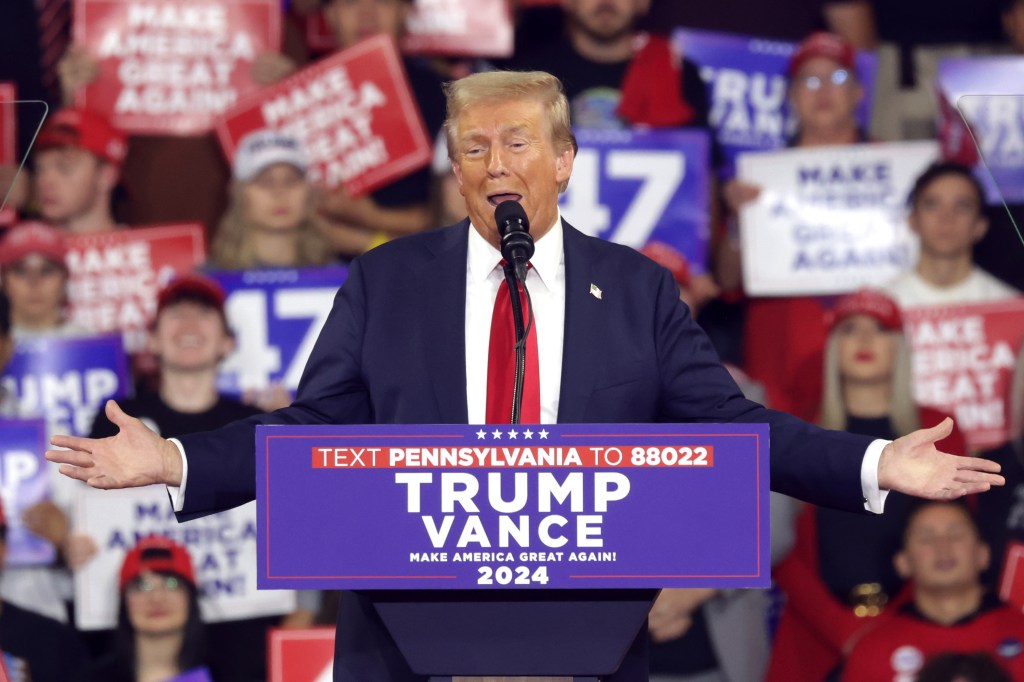
Donald Trump has continued to target the LGBTQ+ community. (Getty)
Criminalize gender-non-conformity in public life
Project 2025 – a hard-line right-wing blueprint for a future Republican president – suggests the use of criminal laws to punish gender-non-conformity in public life, with pornography being the crux of the issue.
The authors of the plan, the Heritage Foundation, inexplicably link pornography with “transgender ideology” and argue that neither has a “claim to First Amendment protection” and therefore should be outlawed.
“The people who produce and distribute it should be imprisoned,” they demand. “Educators and public librarians who purvey it should be classed as registered sex offenders, and telecommunications and technology firms that facilitate its spread should be [closed down].”
That means any discussion of transgender people in schools and libraries could be criminalized, and trans people might face jail time for being themselves.
Trump would only be able to put this into practice with congress’ approval and there is unlikely to be bipartisan support for such a law, but even the slim possibility is terrifying.
Finally – could gay marriage be reversed?
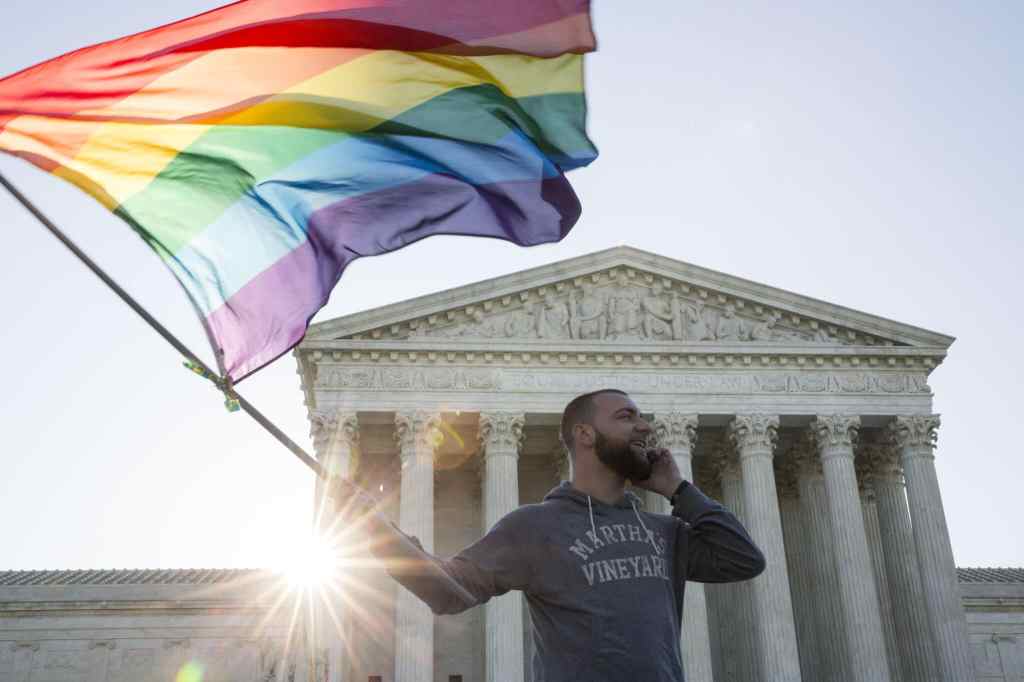
Same-sex marriage supporter Vin Testa, of Washington DC, waves a rainbow pride flag near the Supreme Court. (Drew Angerer/Getty Images)
Unfortunately, yes, it could.
After crucial abortion legislation Roe v. Wade was overturned by the Supreme Court, many people said that next, they would be coming for Windsor and Obergefell and Lawrence – three rulings that unlocked a national right to same-sex marriage.
Whether a same-sex couple could marry varied by state before 2015. With its 5-4 decision in Obergefell v. Hodges, the Supreme Court extended the full federal right to marry to all same-sex couples.
So would – or could it be taken away? Many people think that the Supreme Court wouldn’t dare. Same-sex marriage is now too accepted in American society, they argue. It would cause “legal chaos.”
However, it remains the case that some justices, particularly Samuel Alito and Clarence Thomas, appear to be itching to overturn Obergefell. In 2022, Justice Thomas said the Supreme Court “should reconsider” its past rulings codifying rights to contraception access, same-sex relationships and same-sex marriage.
It’s important to remember in all of this Pride is a protest, and it continues to be. We can fight any and all of these attacks by standing up, speaking out and refusing to stay silent.
My friend Mayvella used to say, “If you woke up, put your feet on the floor, the lights turned on, and the toilet flushed, the day will be OK.” I wish more than that for each of us, but seriously, my friend Mayvella was correct. She was a woman of color, very wise when I met her. I’m fortunate to have had her for a friend. She got up, got around, and went and volunteered at the food bank every Monday, Wednesday, and Friday, and brightened lots of days for many people just by being herself. When she passed, it was suggested we close for a day in observance of love and respect. I’m glad we decided she would have taken that as disrespect, and that she would have gone in and worked if one of the rest of us had passed away. So, rest a bit, and hope. (Then, we organize again.)
What We Know About How Trump Will Approach LGBTQ+ Rights, Abortion, and Other Issues
Much is still unknown about how Trump will carry out some of his big promises on issues like the economy and immigration, or how he may curb abortion access and LGBTQ+ rights. Project 2025 and what he’s said so far offer some clues.
Sign up for The Agenda— Them’s news and politics newsletter, delivered to your inbox every Thursday.
Throughout his campaign, President-elect Donald Trump has made big promises on issues of enormous consequence to Americans, from the economy to reproductive health care — but offered few details on how he would see those promises through.
What he’s said in his campaign and what he did during his first term offer some clues, as does Project 2025, the blueprint for a second Trump term written by the conservative Heritage Foundation. Though Trump has distanced himself from Project 2025, saying he has “no idea who is behind it” and that he has not read it, six of his former cabinet secretaries contributed to it in some form and much of what is in the 920-page document aligns directly with statements Trump has made this year.
Though there are still many unknowns, here is what we know so far about how a second Trump term will approach reproductive rights, LGBTQ+ rights, the economy, education, immigration and aging and disability care.
Abortion
Throughout his campaign, Trump has repeatedly taken credit for the fall of Roe v. Wade. He appointed three of the Supreme Court justices who helped overturn the decades-old case protecting federal abortion rights. His stance on abortion access has wobbled over time between a national ban and state-by-state laws.
Though Trump has said he would not support a federal abortion ban and he’s called restrictive abortion laws like Florida’s six-week ban “a terrible mistake,” it’s unclear how much he will stick to those statements: A day after he said people needed “more time” than six weeks, he said he would vote to uphold the ban in Florida, where he lives. About 57 percent of Floridians voted in favor of an amendment to undo the six-week regulation, but it fell short of the 60 percent threshold it needed to pass.
The biggest question mark heading into the election was his support of a federal ban. During the presidential debate in September, Trump said “there’s no reason to sign a ban, because we’ve gotten what everybody wanted, Democrats, Republicans and everybody else, and every legal scholar wanted it to be brought back into the states,” meaning the issue had been returned to the states. A majority of Americans disapproved of the Supreme Court decision that led to a patchwork of abortion decisions, according to polling from the nonpartisan Pew Research Center.
What Trump will ultimately do will likely come down to who he appoints — and listens to — in his administration. Some of his closest supporters, including Vice President-elect JD Vance, have said they support a national ban on abortion, though during the vice presidential debate in October, Vance acknowledged that his position is not popular with “a lot of Americans.”
Trump has also said he’s open to limiting whether mifepristone, one of the pills used in medication abortions, can be sent by mail.
Economy
Much of Trump’s win Tuesday was likely due to Americans’ view on how he could improve the economy — and particularly their own personal finances. Early exit polls show that the economy was a lead motivator for many after record inflation during the Biden administration brought on by a confluence of factors, including supply chain issues, Russia’s war in Ukraine and coronavirus stimulus checks.
In the end, the reason for the inflation — and how much of it was Biden’s doing — didn’t matter. Trump presented himself as the person to “fix” the economic troubles that have plagued Americans over the past four years, and it appears to have been a salient message.
Trump inherits an economy in repair: Inflation is back down to 2.1 percent from 9 percent, hovering at the Federal Reserve’s 2 percent goal. And the country has been adding jobs consistently for months, though the most recent report shows fewer jobs added in October than expected. Still, the unemployment rate is down to about 4.1 percent from 6.3 percent when Trump left office in January 2021.
The biggest economic showdown of a second Trump term will likely come next year, when parts of Trump’s 2017 tax bill expire. Among those provisions is the child tax credit, which was expanded in 2017 to $2,000 per child. Trump has expressed support for the credit, but has not said what he’d do with it in 2025. Vance has floated increasing the credit further to $5,000 per child. Trump has also called for further lowering the corporate tax rate, which he brought down from 35 to 21 percent in 2017, to 15 percent.
The president-elect has also proposed several tax breaks — on tips, Social Security and overtime pay — but it’s unclear how he would pursue those aims.
Cutting taxes on tips would impact the women who make up the majority of tipped workers directly, but only those who earn enough to be taxed in the first place. Nearly 40 percent of tipped workers already don’t earn enough to pay federal income taxes.
If Trump also eliminates payroll taxes on tips, most workers would see some impact, but could also see their Social Security benefits diminish (payroll taxes fund Social Security and Medicare). The same would happen if taxes are cut on overtime pay, though it’s also unclear what the impact of that would be. Trump has offered no details on how he would approach the policy.
Trump has also called for eliminating taxes on Social Security benefits, a proposal that would impact about half of recipients, most of them higher income, who currently pay taxes. But that proposal alone could make Social Security insolvent three years earlier than predicted, by fiscal year 2031, rather than 2034, according to the Committee for a Responsible Federal Budget, a nonpartisan nonprofit organization.
It is likely that the second Trump administration will vigorously pursue curbing the rights of trans Americans. Trump’s campaign has proposed terminating Medicare and Medicaid funding for hospitals that provide gender-affirming care to trans youth, attempting to charge teachers with sex discrimination for affirming students’ gender identities and ordering federal agencies to “cease all programs that promote the concept of sex and gender transition at any age.” Trump has also pledged to ask Congress to halt the use of federal funds to promote or pay for gender-affirming care, without distinguishing between care for adults or minors.
Leading up to the election, Trump falsely claimed that schools were performing gender-affirming surgeries on children without parental knowledge or consent — a claim divorced from reality that marked a particularly bizarre moment in a campaign littered with anti-trans misinformation. At an October 28 rally, as Trump did at multiple rallies on the tail end of his campaign, he doubled down on framing anti-trans policies as key to his vision for the Republican party, saying: “We’re the party of common sense. That means no open borders, and no transgender operations.”
In October, about 41 percent of the campaign’s ad spending was focused on messaging around trans people, particularly trans athletes and children receiving gender-affirming care.
When polled, most Americans do not rank trans issues highly compared to issues like the economy or abortion rights. It is currently unclear if these ads motivated Trump voters to turn out in 2024 or if they were incidental to issues that voters rank more highly.
Education
Trump has called repeatedly for an end to the Department of Education and presented himself as a champion for school choice, a position that will likely take center stage in a second term.
That stance aligns with details in Project 2025, which also supports eliminating the agency, as well as gutting protections for LGBTQ+ students and what he sees as progressive curriculum. Trump has vowed to cut federal funding for schools that teach lessons related to race or that teach “gender ideology.” Much of the impact will be on trans students, especially in sports.
Under his previous administration, then-Education Secretary Betsy DeVos worked to limit trans women’s participation in women’s sports, arguing it violated the anti-discrimination law Title IX.
DeVos also sparked outrage by revising Title IX regulations to make it harder for sexual misconduct survivors on college campuses to hold perpetrators accountable.
Earlier this year, the Biden administration reversed these controversial DeVos-era regulations and offered protections for LGBTQ+ students in schools, but the incoming Trump administration will almost certainly introduce their own updates to this federal law. Specifically, Trump is expected to go further by defining “sex” to exclude transgender students from playing on teams or experiencing school generally in ways that align with their gender identity.
Gutting the Department of Education would also have a major negative impact on disabled students, who rely on federal enforcement of civil rights laws to protect them from discrimination, lack of access to appropriate education, unnecessary segregation and abuse.
Immigration
Some of Trump’s most divisive rhetoric during his campaign was toward Latinx people and immigrants, who he blamed as the reason for many of the country’s challenges, from safety to job loss to affordable housing. In the final days of his campaign, at a Trump rally in Madison Square Garden, comedian Tony Hinchcliffe called Puerto Rico “a floating island of garbage.”
Throughout his campaign, Trump has called immigrants “the enemy from within,” saying undocumented immigrants are “poisoning the blood of our country.”
His response as president, he said, would be to mount the “largest deportation in the history of our country,” but he has offered very little information on how that would happen, who would be targeted and with what resources.
Much of what Project 2025 has to say about immigration overlaps with Trump’s campaign promises. The document discusses reinstating “every rule related to immigration that was issued” during Trump’s first term, and the president-elect has specifically called for putting back into place his “Remain in Mexico” policy, by which some asylum seekers had to wait out the outcomes of their U.S. immigration cases in Mexico.
Plans laid out in Project 2025 would also make it even more difficult for undocumented students to attend college. It calls for the Department of Education to deny loan access to students who aren’t in the country with authorization and for loan access to be denied to students at schools that offer in-state tuition to the undocumented population. Nearly 20 states, including California, Texas and New York, offer in-state tuition to undocumented students.
Disability and aging
During the presidential debate in September, Trump indicated that he had “concepts of a plan” for replacing the Affordable Care Act, which protects disabled, chronically ill and older Americans from being excluded from standard health insurance coverage.
Opposition to the Affordable Care Act was a centerpiece of Trump’s 2016 campaign, and his first year in office was characterized by a failed, widely unpopular attempt to repeal and replace it, in addition to cutting Medicaid funding. Medicaid, a federal poverty program, funds the majority of long-term care for disabled and older adults in the United States.
Republican House Speaker Mike Johnson has indicated that he is willing to commit to dismantling the Affordable Care Act during a Trump presidency. While Trump promises on his website not to cut Medicare, which provides health insurance for Americans over 65, he has made no such promises about Medicaid.
Affordable drug pricing may also take a hit during a second Trump term. The Biden administration vigorously pursued Medicare price negotiation to lower the cost of some particularly expensive prescription drugs for older adults. While Trump promised to pursue a similar policy during the 2016 race, he never implemented that promise.
Both Vance and Trump have promised a tax credit for family caregivers of older and disabled adults between $5,000 to $6,000 per year. The average cost of home care in the United States, per the most recent data from the Federal Long Term Care Insurance Program, is $42,120 per year. The average cost of a shared room in a nursing home is $100,740 per year.
Nadra Nittle and Orion Rummler contributed to this reporting.
November 5, 1872 Susan B. Anthony and a few other women in Rochester, New York, voted in the presidential election, all of them for the first time. Susan B. Anthony She wrote later that day to her fellow suffragist Elizabeth Cady Stanton, “If only now—all the women would work to this end of enforcing the existing constitution—supremacy of national law over state law—what strides we might make . . . .” Anthony’s vote went to U. S. Grant and other Republicans, based on that party’s promise to consider the legitimacy of women’s suffrage. Elizabeth Cady Stanton Read Susan B. Anthony’s speech On Women’s Right to Vote
November 5, 1949 The Peace Pledge Union in Great Britain set up the Non-Violence Commission to study nonviolent resistance and how the ideas of Gandhi could be used to reach the Union’s goals of getting U.S. troops out of Britain and to end production of nuclear weapons there.
November 5, 1969 Bobby Seale Bobby Seale, a founder of the Black Panther Party, was sentenced to four years in prison on sixteen counts of contempt of court during the federal Chicago Eight trial in Chicago; he was charged for his insistent claims to the right to choose his own lawyer, or to represent himself. After the Chicago Eight verdict, the contempt charges were withdrawn.
November 5, 1982 36 were arrested in a demonstration at Honeywell, Minnesota’s largest defense contractor. The “Honeywell Project,” a local campaign against the arms maker, dogged the company for over three decades, at times with success. It continues today, targeting Alliant Technologies, the arms-making branch of Honeywell that was spun off in the 1990s. Protests at Alliant continue today. Alliant is the manufacturer for the Pentagon of artillery shells made with depleted uranium (DU or U-238, a by-product of uranium enrichment) which have been used extensively in Iraq and Kosovo. The Defense Department denies any health effects from use of DU (though army manuals warn soldiers of its toxicity), and contests accusations of DU’s role in Gulf War Syndrome. More about the Honeywell project from War Resisters’ international
November 5, 1987 Govan Mbeki, an early leader of the African National Congress, was released from South Africa’s Robben Island prison after serving twenty-four years (for treason). He served his sentence alongside Nelson Mandela, Walter Sisulu and many others who fought apartheid. Govan Mbeki His son, Thabo Mbeki, was elected in 1998 (and force to resign in 2008) to succeed Mandela, who was the first president elected following a new constitution which granted the right to vote to the entire non-white population, comprising 85% of the country’s population. Read more about Govan Mbeki
OK, so it didn’t take me this long to eat lunch; I’ve had some other things to do, and wanted to let the first post settle a bit. Since I got that all out, some of my urgency has abated, though I still want to tie the subject up, until/unless there are comments where we can discuss and enjoy however long we want.
Lunch was brunch. My plate was frambled eggs with toast. I know I said it wasn’t a cooking post, and look what I’m doing. When I make frambled eggs, I cook the eggs as if for over-easy (yolks runny, whites cooked.) Turn the eggs when it’s time, let them get a bit of heat on that side, then gently drag your spatula through, to break the yolk and drag the white through the yolk. My personal goal is not a hard-cooked yolk, but what I guess they call a jammy yolk; you get a bit of liquid, even, but it’s not drippy. You just keep gently lifting and turning until you like the consistency of the eggs. I had whole wheat toast, and oatmeal that I apple-pie spiced, and sweetened with honey. We’ve been having a rain “event,” so I’d got the laundry to the laundry room to run and to dry between/before rains.
Our laundry room is at the front of our front carport, front being the direction the front end of the car points; we park in front of the laundry room. Our house is a whole post in and of itself, but not quite as Scottie’s and Ron’s house; they may run theirs by crisis and we rarely have a crisis, but their house is nicer and more modern than ours. Also, while Sat. and Sunday are fitness rest days, I still do 10 min. every hour on the rebounder to get my steps. So, lunch hour took a little while. It’s a rest day! 😎 And the first day of Standard time, so everything’s a little later because our bio clocks are still running on Saving time. 🕰
I wonder if everybody has that one or two commercials that the last time it airs cannot come too soon. For me, right now, (and I know the winter holidays commercials are coming…) it’s that Wegovy commercial. I just want it to stop. Interestingly, while I’m not a big fan of Big Pharma, one of the ads I enjoy, all its versions, is the Jardiance ad! It makes me dance. Well, the newest one’s tempo is too slow for fun dancing, but it’s still a nice ad. This is neither a plug for or against either drug. Those have their place and may be discussed with a person’s doctor. This is just about the ads. The ones that use music from my youth especially tick me off, so I just ignore them and dance to their background music. I hate that King Harvest’s “Dancin’ in the Moonlight” is one that’s been appropriated. It’s been one of my top favorites forever, and they can’t take it away from me!
I turned all the clocks back last night, except one. But our son came out, noticed, and said, “Aren’t we supposed to turn the clocks back? The bathroom clock is an hour fast.” Truly, I’d turned the clocks up. I find the semi-annual time change abhorrent and stupid, but I disdain Saving time the most, because there goes another hour of my life, every year, that doesn’t come back, not really, so I guess changing the clock put me in a negative mindset and I went the wrong way. Anyway, it’s been enough years of my life now that I don’t care which we have, we simply need to pick one and be done. I don’t change the analog clock in the kitchen; it’s over the kitchen table, and I can’t reach it unless I stand on the kitchen table. Some day there could be a reason for me to stand on the kitchen table, but I’m not doin’ it to change the damn clock. The guys will get tired of it sooner or later, and I have the stove clock. And my Fitwitch on my wrist.
Well, that’s a sort of round up of trivia and drift. I hope readers have enjoyed it, at least smiled or giggled, and maybe feel a little better.
We can do this stuff. It’s still way too early to let Republicanism mess with our mental health.
It has struck me that we need a reduce-stress-be-in-the-moment-self-care sort of thing. Some of us have chronic conditions, some are recovering from surgery, some of us are physically fine other than great stress that may be getting the better of us, and some of us may have a combination of some or all, or even something else. I’m pretty sure we’re all aware of tools, but sometimes things are so worrying that we forget about that, as we urgently try to fix things, or even submit to our brains’s workings with cortisol and fear and what all. So. I don’t know what, if any of this, might help someone, but I gotta try. So here’s what’s likely gonna be a long post, with a mixed bag of stuff. Actually, I think it may turn into 2 separate posts, because I see I’ve only got one item covered, and it’s already post-length. So there may be Part 2. And maybe yet another one.
I think I should first refer people to the hotlines where professionals want to and can help. Maybe someone thinks they don’t need or want to call, or maybe someone thinks they’re not there yet. It’s just good to have the resource at hand, is all. Some gain strength from knowing they can call. So, of course, there’s 911, or whatever the 3 digit emergency number is where you live. Then, more specifically, there are numbers for mental health assistance, like 988 where you can text Q to 988 if you want an LGBTQI+ affirming counselor. National Domestic Violence Hotline , (800) 799-7233. Crisis Text Line ,Text HOME to 741741. National Sexual Assault Hotline , (800) 656-4673. SAgE’s Farmer Support Hotline , 833-381-SAGE. Veterans Crisis Line , 988, then PRESS 1 Text 838255, Chat online. Much more at https://www.apa.org/topics/crisis-hotlines . Also, https://glaad.org/resourcelist/ . No doubt I’ve missed something, so please put it in comments.
I will share a bit about myself here. I’ve been diagnosed with generalized anxiety. Could be brain chemistry, could be that my life has not been a calm flow, both, something else. Whatever it is, I have it. Having treated and therapized, I know which tools work for me, and I use them, sometimes unconsciously. Anyway, I don’t like seeing people having trouble, or being troubled, or being hungry, sick, cold, hot, traumatized by war, etc., etc. My mindset has always been to do all I can to fix. Mostly to fix things immediately for the people I’m trying to help, but also the bigger working to fix. We’ve all seen my posts where I’ve shared some of the issues and items on which I work.
The thing about that is, it helps me to feel like I’m doing something that can help somebody else. It overrides anxiety and introversion when I have a reason to be “bothering” people for the greater good.
In regard to current events stress, which is weighing on all people everywhere, there are many of us around the world who are able to do just that one thing that seems so tiny-an hour on the phone, say-to make a difference, and reduce our concerns and stress. So, here is the volunteer page for the Harris-Walz campaign: https://go.kamalaharris.com/ . They still need people to make calls. Making calls to voters in other states is one of my favorite parts of helping a campaign! With a cell phone it’s almost cost and pain-in-the-neck free. Again, I’m aware of various medical issues around the commentary; that’s why I say even one hour will help the campaign, and will also help us. In addition or instead of this, one could contact campaigns of legislative candidates, like Sen. Brown, Sen. Baldwin, Rep. Sharice Davids, Colin Allred, and so many more. An hour of calls will help. And, again, you will feel better having spoken with people to further the greater good.
Now calling is a thing I’m putting forward. To me, it’s personal for each of us, what and how much we’re doing about the stress of the things in the world. I neither need nor want to know if/what anybody’s doing. I’m only putting this out as a thing from which to take our power, to put our power to work.
Since this is this long, I’ll put the first post I read this morning, it inspired me. It’s good-one of those things I needed to read, though I didn’t know it until I got started. It reminded me that while I didn’t necessarily learn or have these experiences in the same way or as early in life, I know these things, and I can do them when needed. I bet we all do, and can. I’m going to share a goodly snippet, but we should read it all if we can. Then, I’ll stop for lunch, then bring back another post part. Well, unless any- or everyone comments that they’re good, and please no more! 🌞 😄 And now from Vixen Strangely:
I tell this about myself because its true and a little weird, but when I was small, my dad taught me how to hook my fingers up and around an eyeball in its socket–just in case I ever had to. I knew what a xyphoid process was at six years old. I knew where to drive the heel of my hand into a human nose. I was taught that I didn’t have the physical strength advantage in life, so I had to have the will. I was taught that you have to walk in awareness. I was taught you watch your drink. I was taught to carry improvised weapons. I was taught to see the world in terms of potential improvised weapons.
I was taught this because some boys never get told what they should never try. Or get told but don’t really learn it. (You don’t use your knee–it’s inexact. You grab them by it. You can squeeze and disrupt a generation of losers. And I never had to do any of that. Not once. Because it’s really only a small percentage of men who are actual monsters–most are reasonable and not actual sociopaths. I like men, really. They are interesting enough and some have valuable skills. They care for the people around them and often are smarter than they think they are. It’s a confidence issue. When you are told to value muscle over brain, you know.)
I was raised to think, more or less, there wasn’t anything I couldn’t do. Math, science, art, politics. Sports. And it simply never occurred to me women were just out there, somewhere, either not voting because their husbands said they couldn’t or voting for exactly what their husbands told them to, until I heard about that in my early adulthood–because why? That’s crazy: we’re fully-fledged adult people, right? Even if I knew I was born just before Roe and just before women generally could even get credit in our own names.
I’ve been married twice. The idea of a man not knowing what he’s even getting politically going into a relationship is weird to me–this is me. We are talking politics. You don’t know me and not know my politics.
I was told to put in the work. Show it. Show up. I learned how to put a little bass in my voice. I learned respect is earned, not one time, but every time.
Donald Trump never had to earn the respect that he has from the bottom up, in any environment where respect wasn’t just his for showing up. Women can see through it. Do you not see his relationship with Jeffery Epstein? The couple dozen claims of sexual harassment or assault? How he speaks about women all the time? The religious right (that he has allied with) desire to end no-fault divorce and the grinning sadist desire to monitor our menses and try to punish us for our fertility and even stop us from travelling to other states to save our lives? (snip-More)
Deep in the forest lies a wildflower that defies expectations. Often mistaken for a fungus, the plant is a pale, translucent white in bloom—sometimes tinted pink or, rarely, a deep red. The ephemeral flower blackens if touched and quickly decays if plucked from the earth.
This month, as we celebrate all things spooky and supernatural, it’s only fitting to spotlight a species that is both ghost and vampire: Monotropa uniflora.
This peculiar plant can be found throughout much of North America, East Asia, and in northern regions of South America. It typically grows in moist, shaded areas of mature forests, springing from the soil to flower between June and September. Each plant has only one cup-shaped flower per stem, which droops toward the ground at first bloom. This downward orientation is thought to protect its nectar and pollen from rain. Carl Linnaeus had these properties in mind when he classified the plant as Monotropa uniflora in 1753. “Monotropa” is Greek for “one turn,” a reference to the arched stem that supports the nodding flower, and “uniflora” means “one-flowered” in Latin. Once pollinated and fertilized, the flower gradually turns upright, eventually maturing into a dry, woody capsule filled with thousands of seeds.
Monotropa uniflora’s hooked appearance has also inspired its common names. “Indian pipe,” for instance, derives from the flower’s resemblance to ceremonial smoking pipes used by many North American Indigenous communities. Other common names are more closely linked to the plant’s eerie coloration, including “ghost pipe,” “ghost plant,” “corpse plant,” and “ice plant.”
Monotropa uniflora’s ghostly presence has just as much to do with what’s happening beneath the surface as above ground. Like any plant, Monotropa uniflora needs sugar to grow and reproduce. Most plants meet this need through photosynthesis, but Monotropa uniflora lacks chlorophyll, the pigment that gives plants their green color and powers the process by absorbing energy from light. It must seek sugar from another source.
The solution? Mycoheterotrophy: a form of plant nutrition in which plants obtain nourishment through networks of mycorrhizal fungi rather than photosynthesis. In this case, tiny threads of fungi in the Russulaceae family act as an underground bridge between the roots of Monotropa uniflora and those of nearby trees. The mycorrhizae deliver water and essential minerals to the trees in exchange for sugar. Monotropa uniflora takes advantage of this relationship by acting as a parasite on the fungal network, taking sugar and nutrients and giving nothing in return.
Monotropa uniflora seed capsules by Ryan Hodnett via Wikimedia Commons
Mycoheterotrophy is a stroke of evolutionary genius. Monotropa uniflora essentially cheats the mycorrhizal fungi and trees from which it receives sustenance.
“The photosynthetic host cannot select against the mycoheterotroph without selecting against its own mutualist mycorrhizal fungi,” explain scientists Sylvia Yang and Donald H. Pfister. Additionally, because mycoheterotrophs aren’t dependent on light for photosynthesis, Monotropa uniflora can flourish in dark environments where many plants would fail.
Monotropa uniflora in Lore and Literature
All of these curious traits have made Monotropa uniflora an object of fascination for generations of storytellers. The plant is woven into oral histories and written narratives across cultures.
Cherokee storyteller Lloyd Arneach chronicles the plant’s creation as a product of human selfishness. As the legend goes, the chiefs of two quarreling nations smoked a pipe together before resolving their weeklong dispute. According to Arneach, “[The Great Spirit] decided to do something to remind all people to smoke the pipe only when making peace. So He turned them into grayish-looking flowers we now call ‘Indian Pipes’ and made them to grow wherever friends and relatives have quarreled.”
Cover of the first edition of Poems by Emily Dickinson via Wikimedia Commons
One of the most prominent storytellers to depict Monotropa uniflora was Emily Dickinson. Although widely recognized for her poetic prowess, Dickinson was also an amateur botanist. While taking botany courses at Amherst Academy and Mount Holyoke Female Seminary, she assembled more than 400 plant specimens in an herbarium that resides in Harvard’s Houghton Library today. Monotropa uniflora is among the hundreds of pressed plants that fill the book’s pages.
Plants provided constant inspiration for Dickinson’s literary works.
“Like flowers in an herbarium, the odd little poems are a faithful inventory of the natural world,” writes Barbara C. Mallonee. Monotropa uniflora is no exception, appearing in a number of Dickinson’s poems and letters. In one quatrain, she writes:
White as an Indian Pipe Red as a Cardinal Flower Fabulous as a Moon at Noon February Hour—
Scholars including Yanbin Kang are working to decipher the symbolism of Monotropa uniflora in Dickinson’s poetry. The plant’s white color could represent purity. Its nodding flower could suggest humility. Its ability to thrive where other plants cannot calls to mind both strength and loneliness—qualities that might have resonated with Dickinson, who lived reclusively at her family’s homestead later in life.
In 1882, Dickinson received a painting of Monotropa uniflora from Mabel Loomis Todd, a family friend who would become the poet’s first posthumous editor. In her letter thanking Todd for the gift, Dickinson wrote “[t]hat without suspecting it you should send me the preferred flower of life, seems almost supernatural, and the sweet glee that I felt at meeting it, I could confide to none.”
Eight years later, Todd shared Dickinson’s words with the world by publishing the first collection of her poems. Todd’s illustration of the poet’s beloved “preferred flower of life” graced the front cover.
Dickinson wasn’t the only poet to pay homage to this otherworldly plant. Sylvia Plath, another Massachusetts resident with botanical interests, mentions Monotropa uniflora in her poem “Child.” She wrote this poem in January 1963, only two weeks before her death. It’s addressed to an infant discovering the world, unburdened by the darkness that casts a shadow over the narrating mother. Immersed in “the zoo of the new,” the child learns of “Indian pipe” along with “April snowdrop”—two white, nodding flowers linked with the fleeting innocence of childhood.
More recently, Christine Butterworth-McDermott’s 2019 poem “Monotropa Uniflora” plays with the plant’s simultaneous embodiment of force and fragility. The employment of bold, active language (“you feast off other hosts”) and softer expressions (“how pale! how delicate!”) reminds us of the complex nature of Monotropa uniflora’s existence. It’s both a skillful parasite and a sensitive species that begins to decompose upon separation from the fungal network that provides its nourishment.
Medicinal Benefits and Modern Use
Monotropa uniflora’s significance isn’t only poetic, it’s practical. Several Indigenous groups in North America used the plant to treat ailments including inflamed eyes, epileptic fits, and toothaches. These properties were later echoed in books on the medicinal benefits of plants. In 1887, Monotropa uniflora was even deemed “an excellent substitute for opium,” easing pain and inducing sleep.
Today, tinctures made with Monotropa uniflora are sold on various online platforms. Foragers have also taken to social media to share the process of gathering the plant and making tinctures of their own. Their posts often advocate responsible harvest practices, namely leaving pollinated flowers untouched and collecting only in regions where the plant is abundant. Monotropa uniflora is at risk of local extinction in states including California, Nebraska, and South Dakota. It faces increasing pressure from wild collection for medicinal use, although more research is needed to determine the scope and severity of this existential threat.
With ties to ecology, poetry, medicine, and more, the ghost of the forest has several stories to tell. If you spot Monotropa uniflora in bloom, bright against the darkness of the forest floor, take a moment to contemplate the many ways in which humans have interacted with it for centuries. This is the mission of the Dumbarton Oaks Plant Humanities Initiative: to appreciate the unparalleled significance of plants to human culture.
OK it happened again. Partly my fault, partly the tech gremlins that live in my computers. See I had 6 open windows, with many tabs each. I depend on the computer saving them. Well yesterday I was trying to pass on some stuff Kamyk wanted me to tell some of his friends. But when I went to open the program to do that it wouldn’t open it just flashed repeatedly. Nothing I could do would work including reinstalling the program would make the program work. In frustration I reset the computer only after realizing I had just lost all my saved open windows and tabs. All I can say is I was stupid to react that fast but also worried about not getting done what my friend in an ICU had asked me. So I will go open all the comments I can access and save them again. Hugs.

 Rep. Marjorie Taylor Greene, R-Ga. speaks during the first day of the Republican National Convention.

 Susan B. Anthony
 Elizabeth Cady Stanton
 Bobby Seale
 Protests at Alliant continue today.
 Govan Mbeki




 Scottie's Playtime
_-_Algonquin_Provincial_Park,_Ontario.jpg)
