
More cult of tRump maga hate, bigotry, and stupid. They specialize in it.

(I wasn’t going to post any news today, but in my interest of world peace, and everyone’s interest in things that are happening, this story is important, and it’s not likely to be in the commercial breaks of the game or whatever. If it comes up again, and/or where regular people see it in regular fashion, something will have already happened. Right now, it strikes me as something of which to be aware. Save reading it till tomorrow, if you like. I just want it here for the record. -A)
The former head of Nato, Jens Stoltenberg, has been named the new co-chair of the influential Bilderberg Group, which convenes a yearly transatlantic policy conference and has long been the subject of conspiracy theories around the extent of its power to shape global events.and/or
After a turbulent decade at the helm of the alliance’s military, Stoltenberg now takes over at its pre-eminent discussion forum: a fiercely private four-day event frequented by prime minsters, EU commissioners, bank bosses, corporate CEOs and intelligence chiefs.
Stoltenberg’s first Bilderberg was back in 2002, a few years before his second tenure as Norway’s prime minister. His decade as secretary general of Nato saw further visits, and he even gave the keynote speech at the group’s Saturday night banquet in Turin in 2018. His appointment as Bilderberg’s co-chair cements the group’s role at the heart of transatlantic strategy.
In February, Stoltenberg will also take over as chair of the Munich Security Conference, another important defence and diplomacy symposium. With a fellow Bilderberg veteran, the former Dutch prime minister Mark Rutte, replacing Stoltenberg at Nato, it marks a concentration of control at the top of the Atlantic alliance at a critical time.
Stoltenberg’s tenure at Nato was dominated by the Russia-Ukraine conflict, which had begun in earnest not long before he took office in 2014. Stoltenberg oversaw what he recently described as “the largest reinforcement of our collective defence in a generation”, noting proudly that “defence spending is on an upward trajectory across the alliance”.
A number of his new colleagues at Bilderberg have been benefiting from this uptick.
Several of the group’s 31-member steering committee have senior roles in the defence industry. The billionaire former Google boss, Eric Schmidt, chaired the recent National Security Commission on AI, and is now busy launching a kamikaze drone company aimed at the lucrative Ukraine market. Meanwhile, the hugely wealthy Swedish industrialist Marcus Wallenberg is chair of defense manufacturer Saab, which enjoyed a 71% boost in orders in the first nine months of 2024, largely due to the war with Russia.
The tech luminary and Donald Trump insider Peter Thiel founded the fast-growing robotics company Anduril and the booming surveillance and AI giant Palantir. His loyal lieutenant Alex Karp, the CEO of Palantir, was voted on to the board of Bilderberg a few years ago. Karp, who claims his company is “responsible for most of the targeting in Ukraine”, recently told the New York Times that the US will “very likely” soon be fighting a three-front war with China, Russia and Iran.
In some respects, the geopolitical mood today is not so different from how it was in the 1950s, when Bilderberg was born. (snip-MORE)
https://www.theguardian.com/world/2024/dec/25/jens-stoltenberg-bilderberg-group-trump-presidency
December 25, 1914 German officer in the trenches with British soldier Just after midnight on Christmas morning, German troops at the front in World War I ceased firing their guns and artillery, and began to sing Christmas carols. At the first light of dawn, many of the German soldiers emerged from their trenches and approached the Allied lines across no man’s land, calling out “Merry Christmas” in their enemies’ native tongues.At first the Allied soldiers suspected it to be a trick, but they soon climbed out of their trenches and shook hands with the German soldiers. The men exchanged presents of cigarettes and plum puddings; the fighting didn’t resume in earnest for several days, and then only at the insistence of the generals.  German and British soldiers fraternize What happened that night A Film | Joyeux Noel: The Christmas Truce Of 1914 watch & listen ========================================= December 25, 1921 President Harding announced the release of Socialist Party leader Eugene V. Debs from prison, unconditionally commuting his 10-year sentence to time served. Debs’s full rights as a citizen, however, were not restored. He had been imprisoned for his vocal opposition to U.S. participation in World War I. Following a meeting with the president and attorney general, Debs commented, “. . . a convict for his principles is always a citizen in good standing. He is a citizen by his own inherent, God-given integrity. The only man who loses his citizenship is the man who renounces his principles and abdicates his manhood.” =============================================== December 25, 1946 The first Christmas demonstration at the White House was held by those seeking amnesty for conscientious objectors convicted of refusing to fight in World War II. =============================================== December 25, 1992 The special prosecutor responsible for investigating crimes committed in the Iran-Contra Affair, Lawrence E. Walsh, denounced the pardons granted the day before by President George H.W. Bush. Mr. Walsh charged that “the Iran-contra cover-up, which has continued for more than six years, has now been completed.” Walsh said, “evidence of a conspiracy among the highest ranking Reagan Administration officials to lie to Congress and the American public” was central to his case against Weinberger. President Bush had been vice president at the time of the arms sales to Iran for hostages, and illegal aid to the insurgent Contras in Nicaragua. Those Bush pardoned: Caspar Weinberger, former Secretary of Defense, soon to go on trial for lying to Congress; Clair E. George, the former head of the Central Intelligence Agency’s clandestine services, who had been convicted twice of perjury; two other CIA officials, Duane Clarridge and Alan D. Fiers Jr.; Robert C. McFarlane, the former national security adviser, and Elliott Abrams, the former assistant Secretary of State for Central America, both of whom had pled guilty to withholding information from Congress. |
https://www.peacebuttons.info/E-News/peacehistorydecember.htm#december25
| December 24, 1865 Months after the fall of the Confederacy and the end of slavery, several veterans of the Confederate Army formed a private social club in Pulaski, Tennessee, called the Ku Klux Klan (KKK). Its first priority, declared in its creed, was “to protect the weak, the innocent, and the defenseless from the indignities, wrongs, and outrages of the lawless, the violent, and the brutal.” In fact, the Klan terrorized and killed former slaves, sympathetic whites and immigrants.  Three Ku Klux Klan members, September 1871. The building where it happened still stands with a bronze plaque reading, “Ku Klux Klan organized in this, the law office of Judge Thomas M. Jones, Dec. 24, 1865.” When the building was purchased in 1990, the new owner, Don Massey, instead of removing the plaque, simply reversed it, showing the smooth back side. More on the Klan |
December 24, 1924 Costa Rica indicated its intention to withdraw from The League of Nations to protest lack of progress on regional issues, particularly U.S. dominance of the hemisphere. The Monroe Doctrine, declared by President James Monroe in 1823, established the U.S. sphere of influence encompassed the entirety of North and South America, as well as the Caribbean island nations. Read more |
| December 24, 1947 President Truman pardoned 1,523 of the 15,805 World War II draft resisters who had been convicted and served time in prison for their offense. Five years later on the same day, shortly before leaving office, he granted full pardon and restoration of civil and political rights to former convicts who had served in the peacetime army or who had not been covered by his earlier pardon, as well as all convicted peacetime deserters. Read more |
| December 24, 1991 Parents of reservists from Grocka protested at Army headquarters in Belgrade, Yugoslavia, worried their sons would be caught up in the war threatened by Serbian nationalist expansionism. |
| December 24, 1992 President George Herbert Walker Bush pardoned six Reagan administration appointees in the Iran-Contra case, among them former Secretary of Defense Casper Weinberger, and Robert McFarlane, the President’s former national security advisor.He did so with less than one month to go in his presidency, and one week before Weinberger’s trial on four felony charges was to begin. These people and others were responsible for selling arms to the revolutionary government of Iran in hope of the release of hostages held in Lebanon, despite then-President Ronald Reagan’s repeated pledge not to negotiate with hostage-takers. The Iran-Contra Boys  Otto Reich /Elliott Abrams /John Poindexter/Edwin Meese George H.W. Bush/Casper Weinberger/Oliver North/Robert McFarlane The money raised through the arms sales was used to fund the Contra insurgents in Nicaragua, who were violently trying to overthrow the government. This support was in violation of an explicit legal ban on such activities under the Boland Amendment [see December 21, 1982]. Text of Bush’s Grant of Executive Clemency U.S. presidential pardon history: More about presidential pardons: |
https://www.peacebuttons.info/E-News/peacehistorydecember.htm#december24
How much fossil carbon is stored in our stuff?
Ellen Phiddian December 21, 2024
Human-made materials – the “technosphere” – are a deep store of fossil carbon – and possibly a ticking time bomb.
That’s according to a fascinating new study published in Cell Reports Sustainability.
“We have no idea of how much carbon has been accumulated in the technosphere, how long it stays and what might happen to it once it is released,” says co-author Professor Klaus Hubaeck, a researcher at the University of Groningen, the Netherlands.
The researchers found that the technosphere accumulated 8.4 billion tonnes of fossil carbon from 1995-2019.
Were all this carbon to be burned and sent into the atmosphere, it would be equivalent to 30 billion tonnes of CO2. The world’s annual greenhouse gas emissions into the atmosphere over that period were roughly 770 billion tonnes.
“Carbon is used as a feedstock everywhere in our daily items, even the laptop I type on, and we were wondering if there is a potential time bomb of all that carbon contributing further to climate heating as it gets released to the atmosphere,” Hubaeck tells Cosmos over email.
Human-made materials are often made from fossil carbon sources like oil and gas. Plastics, for instance, are 74% fossil carbon on average. When these items reach end of life, the carbon makes its way back into the environment via dumping – or into the atmosphere via combustion.
The researchers calculated the amount of fossil carbon stored in the technosphere in the year 2011, using economic data to judge how much was flowing in and out of various industries.
They found that most of this carbon was going into rubber and plastic (30%), while 24% was put in bitumen, and 16% in machinery and equipment.
They found that 9% of extracted fossil carbon was stored in the technosphere in 2011, or about 0.4 billion tonnes of fossil carbon.
The team extrapolated these findings to a 25-year time period (1995-2019), which told them that 8.4 billion tonnes of fossil carbon had been accumulated.
Hubaeck says that the technosphere is nearing the stage where it stores more carbon than the natural world.
“We are not far from that turning point. Indeed, the accumulated fossil carbon is in the same order of magnitude, and indeed already higher than that stored in animals.”
What happens to all of this carbon? The researchers estimate that 3.7 billion tonnes of fossil carbon was disposed of over this time period: 1.2 billion tonnes sent to landfill, 1.2 billion tonnes incinerated and sent into the atmosphere, 1.1 billion tonnes recycled, and the rest littered.
“On the one hand, you can consider it as a form of carbon sequestration if this fossil carbon ends up sequestered in landfill, but on the other hand, it poses an environmental hazard, and if you burn it, you increase carbon emissions,” says co-author Dr Franco Ruzzenenti, also from the University of Groningen.
This means it is very important to make sure the waste is being processed properly, according to the researchers. They say that product lifetimes and recycling rates need to increase, and landfill and waste discharges need to be minimised.
“It’s best to avoid or reduce the throughput in the first place,” says Hubaeck.
“Certainly in rich countries, we have too much stuff (whereas the Global South still needs to catch up), we should question the amount of durable products and (inefficient) infrastructure we produce.
“Shifting to bio-based carbon also has environmental impacts, land requirements, biodiversity, and impacts on food prices.”
The researchers say that circular economy strategies are important for reducing the amount of waste as well, alongside managing waste better after disposal.
(I posted about this earlier, there is success, so I’m posting a funny-serious one about it. Sometimes we win when we step up. -A)
One thing we know Trump was for sure looking forward to for his second term was getting to kill more federal death row prisoners. During the last months of his first term, he went on a full-on killing spree, with his administration carrying out 13 federal executions after a 17-year hiatus.
To put things into perspective, of the 13 prisoners executed prior to his administration, two of them were Julius and Ethel Rosenberg. Only 37 federal death row prisoners were executed between 1927 and 2019, so 13 in six months was quite the bloodbath.
Alas, his dreams have been dashed, for President Joe Biden has announced that he will commute the death sentences for nearly all of the prisoners on federal death row.
“Today, I am commuting the sentences of 37 of the 40 individuals on federal death row to life sentences without the possibility of parole,” Biden said in a statement released Monday morning.
“Make no mistake: I condemn these murderers, grieve for the victims of their despicable acts, and ache for all the families who have suffered unimaginable and irreparable loss,” he continued. “But guided by my conscience and my experience as a public defender, chairman of the Senate Judiciary Committee, Vice President, and now President, I am more convinced than ever that we must stop the use of the death penalty at the federal level. In good conscience, I cannot stand back and let a new administration resume executions that I halted.”
It’s unlikely that this was simply meant to bust Trump’s balls and make him sad — Biden had pledged to “work to pass legislation to eliminate the death penalty at the federal level, and incentivize states to follow the federal government’s example” in his 2020 campaign.
The three prisoners whose sentences will not be commuted are those who committed crimes related to terrorism and hate-motivated mass murders — Dylann Roof, the white supremacist who killed nine people and injured one in a Charleston, South Carolina, church in 2015; Dzhokhar Tsarnaev, one of the two brothers responsible for the Boston Marathon bombing in 2013 (his brother, Tamerlan Tsarnaev, was killed in a shootout with police after the attack); and Robert Bowers, who killed 11 people at the Tree of Life Synagogue in Pittsburgh, Pennsylvania, in 2018.
The other prisoners were given their federal death sentences for far lesser crimes, like killing prison guards or drug trafficking-related murders.
It’s certainly nice to get this news after Biden’s 1,500 commutations of federal prisoners failed to include political prisoners like Leonard Peltier or Mumia Abu-Jamal and did include the kids-for-cash judge. It’s also nice to see, considering the fact that the DNC removed opposition to the death penalty from its platform after eight years of including it. Hopefully we can get back on that one, given the fervor with which Republican governors have pursued the executions of people who were almost definitely innocent in the last few years.
Anti-death penalty advocates, including Martin Luther King III, Sister Simone Campbell, Rev. Ralph McCloud, and exoneree Herman Lindsey made a video thanking President Biden for taking this step.
“President Biden has shown our country – and the rest of the world – that the brutal and inhumane policies of our past do not belong in our future,” Anthony D. Romero, executive director of the ACLU said in a statement. “By commuting 37 federal death row sentences, he has paved the way for other elected officials to build on his legacy of racial justice, humanity and morality by commuting state death rows and passing legislation to abolish capital punishment.”
“Biden has commuted almost all federal death row. This is indeed a good day to do the Lord’s work,” Sister Helen Prejean wrote on Bluesky. I’m thankful to so many religious leaders and justice advocates who helped make this possible. I pray for victims’ families, knowing that wishing for death is not a healing course.”
Personally, as horrible as their crimes were, and as hard of a decision as it would have been, I still think he should have commuted the sentences of all of the prisoners, simply because — to quote a bumper sticker — I don’t believe we should kill people who kill people to show people that killing people is wrong. Also there is evidence that Dzhokhar Tsarnaev was unduly influenced by his brother and also afraid he might kill him if he didn’t go along with his plan, and that the jury was biased against him. (Which would be entirely understandable given that they were all from the Boston area, but also technically unfair.) Family members of those who were killed in the Charleston church shooting have said for years that they don’t want Roof executed, and as loathsome as he is, that ought to be taken into consideration. Two of the families who lost loved ones in the Tree of Life shooting, and the rabbi who was shot himself also asked for Bowers to get a life sentence, due to their opposition to the death penalty. One of the many injustices of the death penalty is that it puts those who oppose it in the position, occasionally, of having to ask for leniency for those who hurt them or have killed their loved ones.
But, you know, optics.
In any case, this is a great day for those of us who oppose the death penalty, and for all Americans who may not oppose it but still do not deserve to be hardened by its application.
| December 23, 1943 A 135-day strike by 23 conscientious objectors (COs) ended dining hall segregation at Danbury Federal Penitentiary in Connecticut. The number of conscientious objectors had increased from 15 in early 1941 to 200 by the time of the strike. |
| December 23, 1944 General Dwight Eisenhower endorsed the finding of a court-martial in the case of Eddie Slovik, who was tried for desertion, and authorized his execution. It was the first such sentence against a U.S. Army soldier since the Civil War, and Slovik was the only man so punished during World War II. He made no secret of his unwillingness to enter combat, but his pleas to be reassigned to noncombat status were rejected. Eisenhower ordered that Slovik’s execution be carried out to avoid further desertions in the late stages of the war.  Eddie Slovik Read more |
| December 23, 1946 University of Tennessee refused to play Duquesne University, because they might have used a black player, Chuck Cooper, in the basketball game [see July 14, 1887]. Cooper went on to be drafted (the first black player ever) by the Boston Celtics, playing his first NBA game on the same day as the debut of head coach Red Auerbach, guard Bob Cousy, and center “Easy” Ed Macauley.  Chuck Cooper, graduate of Duquesne University |
December 23, 1961 James Davis James Davis of Livingston, Tennessee, was killed by the Viet Cong, the insurgents in South Vietnam, and became the first of some 58,000 U.S. soldiers killed during the Vietnam War. Lyndon Johnson later referred to him as “the first American to fall in defense of our freedom in Vietnam.” Over two million Vietnamese would die before the end of the war. |
https://www.peacebuttons.info/E-News/peacehistorydecember.htm#december23
After Building Progressive Power Among House Democrats, Jayapal Passes the Torch
By Jessica Corbett — December 21, 2024
After six years at the helm of the Congressional Progressive Caucus, dedicated to “building the infrastructure” necessary to effectively fight for key policies on Capitol Hill, term-limited Rep. Pramila Jayapal is determined to ensure that the CPC’s incoming leaders “are as successful as possible.”
Jayapal (D-Wash.) spoke with Common Dreams on Wednesday about her time leading the caucus of nearly 100 lawmakers whose legislative priorities include “comprehensive immigration reform, good-paying jobs, fair trade, universal healthcare, debt-free college, climate action, and a just foreign policy.”
She was elected first vice chair of the CPC in June 2017, just months into her freshman term in Congress. Explaining her foray into leadership, Jayapal affectionately said, “I blamed it all on Keith Ellison,” a Minnesota Democrat who was then a congressman and caucus leader and is now his state’s attorney general.
“He was very encouraging,” she said of Ellison. “He knew that the whole reason I was running, because he had heard me talk about it on the campaign trail… was because I wanted to strengthen the power of the progressive movement inside Congress and figure out how we could be more effective working on the inside and the outside, which I was coming from.”
Jayapal, who was born in India and came to the United States as a teenager for college, founded the immigrant advocacy group Hate Free Zone—which later became OneAmerica—after the September 11, 2001 terrorist attacks. Residents of the Seattle area elected her to Congress in 2016, during her first term in the Washington State Senate.
In politics, Jayapal has shared stories from her own life with the world, publicly writing and speaking about her experiences as an immigrant woman of color, a woman who had an abortion, and a mother to her trans daughter. She has welcomed the mentorship of Rep. Barbara Lee (D-Calif.), the first woman of color to co-chair the CPC and, as Jayapal put it on Instagram earlier this week, “one of the most courageous and effective progressive leaders I have had the privilege to know.”
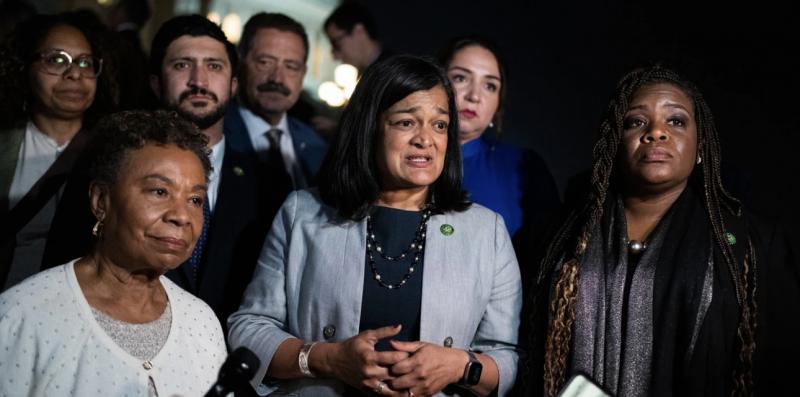 U.S. Reps. Barbara Lee (D-Calif.) Pramila Jayapal (D-Wash.), and Cori Bush (D-Mo.) talk with reporters in Washington, D.C. on May 31, 2023. (Photo: Tom Williams/CQ-Roll Call, Inc. via Getty Images)
Backed by leaders like Ellison and Lee—who is leaving Congress after this session—Jayapal jumped into the CPC hoping to transform it into “a caucus that could really have the power to stand up for working people and deliver.” In 2018, she was elected co-chair with Rep. Mark Pocan (D-Wis.), and following 2020 caucus rule changes, she became a solo chair.
“What I realized when I came in is that we didn’t really have the infrastructure we needed to support us to be powerful as a bloc of votes,” said Jayapal, who utilized the skills and connections she developed as an organizer in the role she is now preparing to leave.
“I was able to come in and not only think about how you build power on the inside, but also how you coordinate with the outside,” she said. “And that inside-outside strategy, and the trust I had, and the relationships I had, were really critical to my success in building the infrastructure here in Congress and sort of coalescing the movement around a set of priorities that we were then able to fight for and stand up for.”
Jayapal recognized the need to hire staff and reform CPC rules to boost meeting attendance and caucus cohesion. She explained that “I felt very strongly about leadership transition to build the bench, and so I put in term limits for the CPC chair as well.”
Thanks to that policy, she will pass the torch to Rep. Greg Casar (D-Texas) early next month. Jayapal, who will be chair emeritus, told Common Dreams, “I’m just really proud to have built an infrastructure that I can pass on to the next chair that just wasn’t there before and will continue to get better, of course, with new leadership.”
The 35-year-old incoming chair will be joined by Reps. Ilhan Omar (D-Minn.) as deputy chair and Jesús “Chuy” García (D-Ill.) as whip. They will face a Republican-controlled Congress and the second administration of President-elect Donald Trump.
“I’m honored to build on the legacy of Chair Jayapal,” Casar said after the caucus election earlier this month. “I’ve fought back against extremist, egocentric autocrats in Texas for my entire adult life. The Democratic Party must directly take on Trump, and it’ll be CPC members boldly leading the way and putting working people first.”
Trump won his first presidential contest the same day Jayapal was initially elected to Congress. On that night in November 2016, before the White House race was called, Jayapal described her victory as “a light in the darkness” and told supporters that “if our worst fears are realized, we will be on the defense as of tomorrow,” according toThe Seattle Times.
After four years of fighting the first Trump administration, CPC members kicked off 2021 with a fresh opportunity to advance progressive policies: Although the Senate was divided, Democrats controlled the House of Representatives and President Joe Biden was sworn in—despite Trump contesting his 2020 loss and inciting an insurrection.
During Biden’s term, which ends next month, the Jayapal-led caucus has successfully encouraged the Democratic president to pursue various executive actions promoting access to contraception, climate action, corporate accountability, higher wages, lower costs for essentials, and relief for immigrants from countries in crisis, among other priorities.
The caucus also played a significant role in enacting major pieces of Democrats’ Build Back Better agenda. In the summer of 2021, Jayapal made clear to Congress and the president that House progressives would withhold votes from what became the Bipartisan Infrastructure Law—also known as the Infrastructure Investment and Jobs Act—unless they also passed legislation on the climate emergency and social issues.
Biden signed the infrastructure bill in November 2021—followed by the Inflation Reduction Act in August 2022. The delay was largely due to obstructionist then-Democratic Sens. Joe Manchin (I-W.Va.) and Kyrsten Sinema (I-Ariz.), who ditched the party in the aftermath and are both leaving Congress at the end of this session.
Although Jayapal wishes the second bill would have passed sooner, and tackled the country’s childcare and housing crises, she said that she is still “particularly proud” of what the caucus was able to accomplish with that battle. As she told Common Dreams, “There would be no Inflation Reduction Act without Build Back Better, and there would’ve been no Build Back Better without the CPC.”
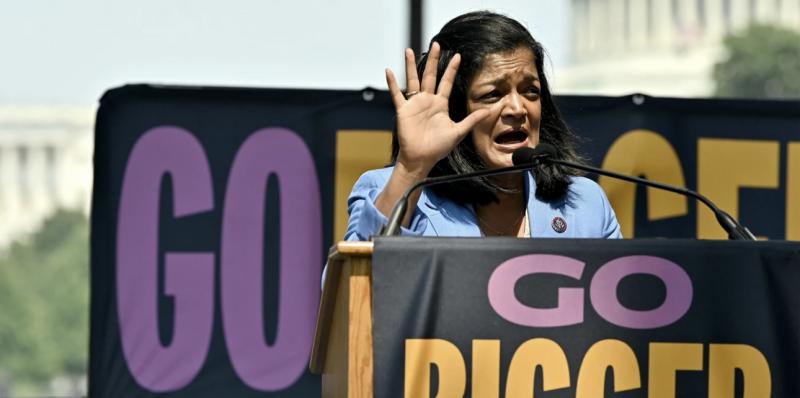 Rep. Pramila Jayapal (D-Wash.) speaks at a “Go Bigger on Climate, Care, and Justice” rally on July 20, 2021 in Washington, D.C. (Photo: Shannon Finney/Getty Images for Green New Deal Network)
Those two legislative packages were “about changing the way that we thought of government’s ability to fight for working people,” she continued. They “were about delivering results to people that would matter, whether it was in terms of great jobs, whether it was in terms of taking on climate change, whether it was in terms of driving down the cost of prescription drugs, [or] unrigging the tax system so that the wealthier began to pay their fair share.”
“All of those things were kind of fundamental and core to an economic agenda that worked for working people and poor people,” said Jayapal, who has personally championed legislation including the College for All Act, Dignity for Detained Immigrants Act, Housing Is a Human Right Act, Medicare for All Act, Transgender Bill of Rights, and Ultra-Millionaire Tax Act—partnering with Senate progressives such as Sens. Elizabeth Warren (D-Mass.) and Bernie Sanders (I-Vt.), the founding chair of the CPC.
While the Congressional Progressive Caucus will have new leadership next year, Jayapal plans to remain engaged by providing advice and support as chair emeritus and by co-chairing the CPC Political Action Committee with Casar and Rep. Maxwell Frost (D-Fla.). Under the PAC’s current heads—Jayapal, Pocan, and Rep. Jamie Raskin (D-Md.)—it “has grown from a $300,000 budget in the 2016 election cycle to raising $12 million over the past three election cycles,” the group said Wednesday.
Jayapal told Common Dreams that she is “really proud of the fact that we’ve had an incredible record” for CPC PAC endorsements. Over the past decade, a majority of pre-primary backed candidates have won their general election races—often “pushing back on big money that came in, dark money that came in, sometimes in the millions,” she said, pointing to Reps. Summer Lee (D-Pa.) and Delia Ramirez (D-Ill.) as examples.
Lee, Ramirez, and Jayapal were all reelected last month, but overall it was a devastating cycle for Democrats, who failed to win control of the White House and both chambers of Congress. The outgoing CPC chair is among those who have responded to the results by urging the Democratic Party to reject super PACs and uplift working-class voters going forward.
In a memo earlier this month, Jayapal, Casar, Frost and fellow CPC member Rep. Chris Deluzio (D-Pa.) called on the next Democratic National Committee chair, whoever it is, to “create an authentic… brand that offers a clear alternative and inclusive vision for how we will make life better for the 90% who are struggling in this economy, take on the biggest corporations and wealthiest individuals who have rigged the system, expose Trump’s corporate favoritism, and create a clear contrast with Republicans.”
Noting Republicans’ aim to use their forthcoming federal trifecta to pass another round of tax cuts for the rich, Jayapal said that “when we fight against the tax cuts, the Trump tax scam 2.0, we should tie it to this: The Democratic Party is not beholden to corporate PACs and dark money. We are fighting for the people.”
“There’s a clear contrast between Trump and his billionaires… and Democrats who are fighting for the vast majority of Americans, the 99% of Americans who are out there struggling every day,” she added. “That’s the contrast we need to be able to draw.”
(snip-embedded tweet)
In her final days as CPC chair, Jayapal is highlighting that contrast by slamming Trump and the billionaires who have his ear, like Elon Musk, for risking a government shutdown—which could begin Saturday—by derailing a bipartisan spending bill this week.
“The past 24 hours is the clearest demonstration yet of what Trump 2.0 will entail: The president of the United States allowing his unelected billionaire friends to control the government and enrich themselves at the expense of working people,” she said in a Thursday statement. “We cannot succumb to a government by billionaires, for billionaires.”
Republished from Common Dreams under Creative Commons (CC BY-NC-ND 3.0).
Topics: House Progressive Caucus, House Progressives, Pramilla
| December 22, 1944 African-American women during World War II had difficulty volunteering to serve in the war effort. Negro enlistment in the Women’s Army Corps (WAC) was limited to 10% of enlistees (reflecting the black proportion of the U.S. population and known as “ten-percenters”). Only the officers were trained in integrated units but all served in racially segregated units, and lived and ate in “colored only” facilities. During the war, 6,520 black women served as WACs.Black women were completely banned from the WAVES (Women Accepted for Volunteer Emergency Service) until the last year of the war. Through the efforts of Director Mildred McAfee and Dr. Mary McLeod Bethune, Secretary of the Navy (and later the first Secretary of Defense) James Forrestal pushed through their admittance. The first two black WAVES officers, Lieutenant Harriet Ida Pikens and Ensign Frances Wills, were sworn in this day. Of 80,000 WAVES, only 72 black women served.  |
| December 22, 1969 The original Radio Free Alcatraz, a pirate radio station, broadcasted for the first time through Berkeley, California’s Pacifica radio station, KPFA. The voice of Alcatraz was Johnny Trudell, an ally of the American Indians who had occupied Alcatraz Island, the site of the former prison in San Francisco Bay.  John Trudell speaks with news media representatives regarding negotiations with the federal government for title to Alcatraz Island. Trudell, known as “the voice of Alcatraz: Listen and learn more |
| December 22, 1993 Operation “Toys for Guns” was begun in New York City through the efforts (and $10,000) of I.M. Rainmaker, CEO of an electronics company. Conceived in cooperation with local police concerned about crime fed by too many guns and the glorification of violence, the program offered a $100 voucher redeemable at Toys ‘R’ Us for a firearm turned in to the police. How it happened |
| December 22, 1997 Paramilitaries associated with the ruling PRI party in Mexico massacred 45 peasants in the village of Acteal in the state of Chiapas. The federal government then occupied the territory with over 70,000 troops and expelled the humanitarian observers who were stationed in the area to monitor the treatment of the indigenous people who lived there. |
https://www.peacebuttons.info/E-News/peacehistorydecember.htm#december22
I’ve sent more than 8 letters to the WH (emails + 1 snail.) I’ve made a couple of calls. The thing I haven’t done is share this video, so here it is. Calling/emailing is easy, doesn’t take much time. I will appreciate all anyone is able to do. That being said, I’m going to appreciate you whether you do anything, or nothing; I’m never going to know what you do, and don’t want to know. I am sharing this because the window is closing, but there are indications that Pres. Biden is very close to commuting federal death penalties. So anything we can do-even simple hope-will help, and push him over the edge to taking the burden of killings in the names of us all off our shoulders.
 Scottie's Playtime