November 19, 1915 Joe Hill, a labor organizer for the Industrial Workers of the World (IWW) was assassinated by firing squad in the courtyard of the Utah State Penitentiary in Salt Lake City. The IWW, or Wobblies as they were known, were advocates of organizing all workers into One Big Union. It is reported that Joe had been framed for murder by copper bosses, the press and government forces. Just prior to his execution, as Joe stood before the firing squad he propelled himself him from organizer to labor martyrdom with these words: “Don’t waste any time in mourning. Organize!“ Joe Hill: The Man Who Didn’t Die, and more The IWW today
November 19, 1969 In an effort to undercut growing opposition to a draft made necessary by the Vietnam War, Congress passed a law requiring random selection of draftees through a lottery. The Selective Service System would call up young men based upon their birthday, first with 19-year-olds and those with expired college deferments.
November 19, 1977 Sadat arrives in Israel In an unprecedented move for an Arab leader, Egyptian President Anwar el-Sadat traveled to Israel to seek a permanent peace settlaement with Egypt’s neighbor after decades of conflict. This action was extremely unpopular in the Arab World and especially among Muslim fundamentalists. Egypt and Israel had fought four wars since 1948.
Sadat on November 9: “ Israel would be astonished when they hear me say this. But I say it. I am ready to go even to their home … to the Knesset and discuss peace with them if need be.” Israeli Prime Minister Menachem Begin on November 11: “ Let us say to one another, and let it be a silent oath by the peoples of Egypt and Israel: no more wars, no more bloodshed and no more threats.” Together in Israel: Sadat: “ I wish to tell you today and I proclaim to the whole world: We accept to live with you in a lasting and just peace.” Begin: “ Everything must be negotiated and can be negotiated. We Jews appreciate courage, and we will know how to appreciate our visitor’s courage.” Sadat’s speech to the Israeli Knesset (parliament):
This story was published in partnership with Them.
Reached by phone in the days following the election, LGBTQ+ movement leaders promised they are more prepared than ever to face off against a second Trump administration.
“We’re ready,” said Heron Greenesmith, deputy director of policy at the Transgender Law Center, a civil rights organization. “We did extensive scenario planning, internal and external. We did safety planning internally. We did scenario planning with partners, cross movement, inter movement, trans specific, LGBT.”
For transgender Americans, the moment feels particularly vulnerable. President-elect Donald Trump has vowed to end what he has termed “transgender insanity” and cut Medicaid and Medicare funding to health providers offering gender-affirming health care on his first day in office.
The result is that many trans Americans are reeling, feeling that the country has elected a man set on wiping them off the face of the earth.
Responding to the election, Sarah Warbelow’s voice broke.
“There’s so much love,” she said. “Love is still out there, and that is not what this election was about.”
Warbelow isn’t transgender. But her daughter is. And as the vice president of legal for the nation’s largest LGBTQ+ rights organization, the Human Rights Campaign, Warbelow will be tasked with shoring up protections for queer Americans as Trump retakes office.
Warbelow’s tone turned from teary to defiant as she talked about a slew of political ads attacking transgender Americans, many of them run by Trump and his surrogates. They don’t represent the feelings of the nation, she said.
“A majority of voters found the anti-trans advertisements were just mean-spirited,” she said.
But Kierra Johnson, president of the National LGBTQ Task Force, one of the community’s largest organizations focused on field organizing and political change, said 2024 is nothing like 2016 when Trump was first elected.
“The strategies are already in motion across movements,” Johnson said.
“Yes, we should be worried,” Johnson said, adding that Project 2025, the blueprint for a second Trump term written by his former advisors, makes extremely concerning suggestions about how to approach LGBTQ+ rights. “They put it in black and white. If we don’t take that as serious, then that’s on us. Whether they execute or not, that’s something else.”
Advocates said there are a number of things trans people can do immediately to protect their rights and safety before January. Here’s how the nation’s LGBTQ+ leaders feel things will go in the top policy areas impacting trans people and how trans folks can prepare ahead of January 2025.
Identification and gender markers
For people who need updated gender markers on their identification or have already obtained them, Greenesmith advised looking at state laws first if there are questions.
“The laws in your state will impact a lot of everything else, including whether or not you can get your name and gender changed to match,” Greenesmith said.
Some have expressed fears that having an “X” gender marker on a driver’s license or passport instead of the formerly standard “M” or “F” will make them a target in the new administration. Advocates advise that deciding on a gender marker is an incredibly personal decision. Some noted that removing the “X” might make one feel safer, but would be unlikely to erase the paper trail of a gender marker change in government records. In other words, if a trans person was trying to change a marker to conceal their gender identity from the federal government, updating gender markers would likely have minimal impact.
Advocates for Transgender Equality has a full ID resources library with a state-by-state drop-down menu, as does Trans Lifeline, to help people navigate local laws. Both are nonprofit civil rights organizations.
The 19th will continue to provide guidance on IDs, documents and other paperwork as organizations release it.
Freedom to be
Perhaps the greatest fear many trans people have is that simply being transgender will be criminalized. While experts acknowledge that it’s reasonable to be scared, they expressed that the federal government doesn’t have the same resources states have to target transgender people individually on the basis of identity alone.
“When you look at the data and the polling, despite what people are pontificating about at this moment, the American public supports the existence of transgender people,” Warbelow said. Because Trump has shown himself to be incredibly fickle, it’s difficult to know at this point exactly what his plans are for carrying out his campaign promises. That said, Warbelow believes that the president-elect does care, on some level, about his popularity with the public.
Warbelow also believes that the administration does not have the levers to target transgender people in the ways that states have aimed to criminalize transgender life.
Greenesmith is quick to add that worst-case scenario fears are already a reality for many of the most marginalized queer people.
“This is why we can’t catastrophize at this moment, because catastrophization is white supremacy,” they said. “All the things that White people fear, Black people, Indigenous folks, migrants have been facing for centuries.”
Andrea Jenkins, a Minneapolis City Council member who made history as the first out Black trans woman elected to public office in the United States, said that for Black trans women, that also means coming together and rising up.
“What I will say to my sisters out there is we got to stand strong,” she said. “We’ve got to organize. We’ve got to build systems of support for each other.”
Moving
As some trans people consider relocating, “it’s not easy for people to just do that,” said Jamison Green, veteran trans organizer and health expert.
Whether people are considering a move out of the country, or out of state, advocates acknowledge that the laws impacting trans lives in real ways differ from place to place. The 19th will be reporting more deeply on these options in the weeks to come, but Green advises that people in states with trans-friendly laws will be far safer than states with anti-trans laws, if they are able to get to affirming states because so many of the policies impacting trans lives are decided at a state level.
No matter what, “get connected to community,” he said.
Organizations on the ground are ready to greet those who do need to move, said Jax Gonzalez, political director at LGBTQ+ statewide equality organization One Colorado.
“We know that we are a sanctuary state, and that there are many families who have been coming here from Oklahoma, Florida, Arkansas, Texas, you name it, Missouri,” Gonzalez said. “We want to ensure that those folks who do come here, that we’re doing everything that we can to ensure that they are protected and can thrive in community.”
Health care
Trump has vowed to cut off federal funding to health providers offering gender-affirming care to transgender people via executive order. Many fear this will mean the end of gender-affirming care like hormones, puberty blockers and surgeries for transgender people on Trump’s first day in office.
Before panicking, experts advise that this will be logistically complicated for the administration to pull off. For one, transgender people are protected by the Supreme Court’s 2020 Bostock v. Clayton County decision, which ruled that gender discrimination and sex discrimination are one in the same, meaning if the government barred gender-affirming care for a trans man, it would have to outlaw that same care (testosterone) for a cisgender man.
Further, Green said the feasibility of the federal government tracking everyone’s prescriptions would get complicated quickly.
“The volume of prescriptions that are written in this country, it would be very difficult and time-consuming and costly to track at a federal level.”
State controls would have more access, he added. Some people have worried that the administration could threaten pharmacists, especially when it comes to prescriptions for testosterone, which is a schedule III class drug. Off-label use would not be allowed. Green, again, thinks this would be challenging for the administration.
“Most drugs are used off label, and that’s a fact,” he added. “Medicine is an extremely complex field. It’s an art as well as a science … this is why we license doctors to use their medical judgment in applying the chemistry of pharmaceuticals to their patients to help them.”
Further, Trump attempted to gut transgender health care protections in the Affordable Care Act during his first term. The fight over those protections wound through the courts, and the repeal was finalized in 2020, only to be reversed by President Joe Biden, another rule-making process and fight that took four years.
In short, advocates said it’s difficult to anticipate how health care policy will play out. But whatever happens is not likely to happen immediately, and all major medical associations back gender-affirming care for transgender people.
Green said there is cause for concern.
“But I think we have to not just roll over and let them do it,” he said. “Whatever, they think they’re going to do, we have to stay fighting for people’s health and rights and social safety.”
Marriage and family planning
Marriage will not immediately be at risk in the new administration because of legal precedent and a 2022 law passed by Congress called the Respect for Marriage Act, which requires states to recognize LGBTQ+ marriages already performed, even those from out of state.
“If something changes in the future, there will still be time to get married,” said Warbelow. “That is not something the Trump administration has the power to undo it any immediate term”
Advocates advise that for LGBTQ+ people who want to marry, now is not a bad time to do it.
“I think people need to do everything they can to fortify their families and their finances, period,” said Johnson, adding that this can be applied to marriages, adoptions, powers of attorney or wills.
It is OK and great to stop the video at the 8:30 mark. After that it gets seriously stupid. But before that it has a lot to say that is true and said in a semi comedic way. Hugs
The FBI is aware of the offensive and racist text messages sent to African American and Black communities around the country and is in contact with the Justice Department and other federal authorities on the matter.
The reports are not identical and vary in their specific language, but many say the recipient has been selected to pick cotton on a plantation.
The text message recipients have now expanded to high school students, as well as both the Hispanic and LGBTQIA+ communities.
Some recipients reported being told they were selected for deportation or to report to a re-education camp. The messages have also been reported as being received via email communication.
Although we have not received reports of violent acts stemming from these offensive messages, we are evaluating all reported incidents and engaging with the Department of Justice Civil Rights Division.
We are also sharing information with our law enforcement partners and community, academia, and faith leaders.
Read the full press release. Re-education = ex-gay torture.
A week after cellphone users across the U.S. reported racist text messages, members of the Hispanic and LGBTQ communities are now receiving text messages saying they have been selected for deportation or to report to a re-education camp, the FBI said. https://t.co/m94niQbu3H
While the new President and new Congress will not take office until early next year, they have already put forward an agenda — through Project 2025, Republican budget plans, and campaign proposals — that would increase poverty and diminish opportunity. Their proposals would raise costs for basics like housing, food, and health care and take health coverage away from people; slash funding for schools where our children learn, roads and bridges we use to get to work, and scientific and medical research that improve our health and strengthen our economy; double down on tax giveaways for wealthy households and corporations while imposing tariffs that fuel inflation; and further widen already glaring differences in people’s well-being and opportunity across income, race, and ethnicity.
These policymakers campaigned on promises to make the economy work better for people without big bank accounts who are trying to get ahead. But their proposals to date seldom match those promises.
Instead, a policy agenda designed to advance economic opportunity and racial justice and help families make ends meet would:
Make it easier for people to afford housing, food, health care, and prescription drugs.
Support children and families with an expanded Child Tax Credit, especially for children who don’t get the full credit today because their families’ incomes are too low; more affordable child care; and investment in our schools so that all of our nation’s children get what they need to thrive.
Invest in the things that will keep the economy strong and growing, including basic building blocks like roads, bridges, and research, as well as protections that keep our communities’ food, air, water, and workplaces safe.
Support these investments with a fairer federal tax system that requires wealthy households and corporations to pay their fair share and strengthens our fiscal outlook.
Create an immigration system that recognizes the critical role that immigrants and their families play in our communities and the economy, eschewing harsh deportation regimes that separate families and embracing reforms that provide people with a workable opportunity to gain legal status and a pathway to citizenship.
This kind of policy agenda would build toward a nation whereeveryone — regardless of their income or their background — can get the health care they need, afford to put groceries on the table, live in safe homes and strong communities, and have the income, education, and child and home care they need throughout their lives. And it would reflect the truth that our nation succeeds only when all of us succeed.
We are eager to work with policymakers who put forward policies that advance this agenda and we — together with our partners — will work hard against policies that make people less economically secure, less healthy, and have less access to opportunity.
November 18, 1910 Hundreds of suffragists marched on the House of Commons in London, England, with reinforcements arriving to replace the “fallen” and arrested. Protesting government inaction on the Conciliation Bill, which would have enfranchised about a million women, they were brutally forced back by London police, leading to a public outcry. Read more
November 18, 1964 FBI director J. Edgar Hoover publicly characterized Reverend Martin Luther King, Jr. as “the most notorious liar in the country.” King replied that Hoover “has apparently faltered under the awesome burden, complexities, and responsibilities of his office.” The FBI vs. Martin Luther King Democracy Now
November 18, 1970 President Richard Nixon asked Congress for supplemental appropriations for the Cambodian government of Premier Lon Nol. Nixon requested $155 million in new funds for Cambodia — $85 million of which would be for military assistance, mainly in the form of ammunition.
November 18, 1989 More than 50,000 people took to the streets of Sofia, the capital of Bulgaria, demanding political reform. In the biggest demonstration in the country’s post-war history, protesters held up banners and chanted: “We want democracy now.” Read more
November 18, 1993 South Africa’s ruling National Party, and leaders of 20 other parties representing both blacks and whites, approved a new national constitution that provided fundamental rights to blacks and other non-whites, ending the apartheid system. South Africa held its first democratic multi-racial election on April 26, 1994.From the preamble: “WHEREAS there is a need to create a new order in which all South Africans will be entitled to a common South African citizenship in a sovereign and democratic constitutional state in which there is equality between men and women and people of all races so that all citizens shall be able to enjoy and exercise their fundamental rights and freedoms….” South African citizens in line to vote. Constitutional history of South Africa (2 separate pages)
November 18, 2001 In London, 100,000 marched against the U.S. and British attacks against Afghanistan.
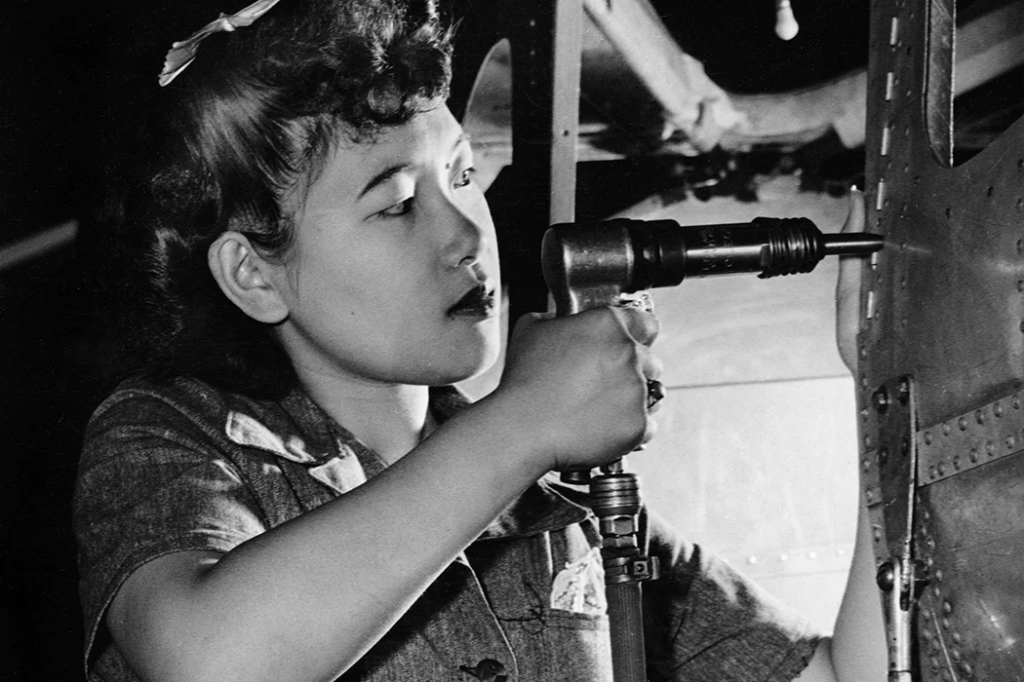
Despite having their citizenship withheld before the war, Chinese American women in the Bay Area made significant contributions to the wartime labor force.
Amid the social upheaval of World War II, women entered the American workforce on an unprecedented level. And, for younger Chinese American women in the San Francisco Bay Area, the war made it possible to smash not just entrenched gender barriers, but racial ones as well.
“Partly because of a scarcity of English-language sources on this topic, some scholars simply have assumed that Chinese American women did not share the experience of ‘Rosie the Riveter,’” she reports. But she uses newspapers, company records, and oral histories to push back on this view.
Many Chinese American women already worked out of economic necessity. Yet racial discrimination and social isolation typically restricted them to jobs in Chinatown enclaves.
“It was difficult for many Chinese American women to go outside their communities to work, even when they wanted to,” Zhao explains. “The decades-long isolation had also limited the ability of immigrant Chinese working women to communicate with the outside world.”
During the war, women were also encouraged to adopt domestic roles—preparing “nutritional food” for their families and “show[ing] our fighting men that we are… absolutely behind them.”
But World War II still marked a major turning point—especially for younger, unmarried daughters of Chinese immigrants. Many of these women had either a high school or college-level education.
“With relatively few household responsibilities, in contrast to their mothers, they had the freedom and independence to work outside the home,” Zhao writes. “Since most of them were already living in the Bay Area before the war, these younger Chinese American women were among the first American women to join the Bay Area’s defense labor force.”
In fact, Zhao’s research turned up only four women who were older than forty during their wartime jobs. Still, those wives and mothers capably juggled their duties at home and on the home front. (snip-More; it’s a worthy click!)
The Emmett Till Memory Project teaches new generations about the tragedy that kickstarted the Civil Rights Movement. Preserving its digital assets is vital.
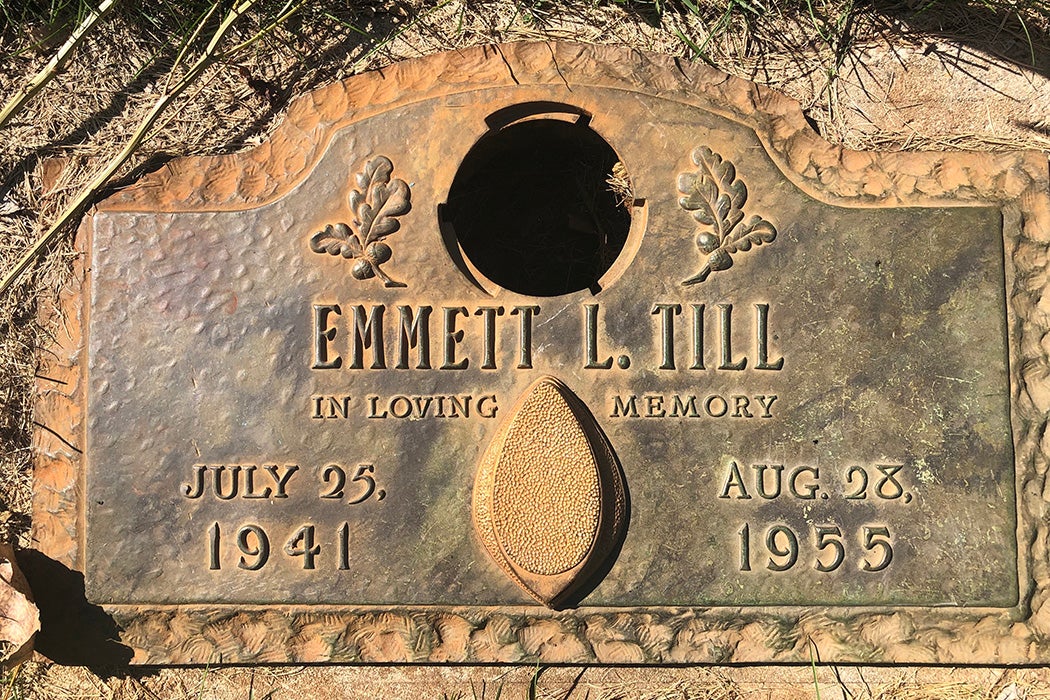
On a late August day in 1955, Emmett Till was murdered in Mississippi. A fourteen-year-old African American from Chicago, Till stopped with his cousins at Bryant’s Grocery & Meat Market to buy chewing gum. There, Till whistled at the clerk, a brazen act that violated the norms of the Jim Crow South and so angered the clerk’s husband and brother-in-law that they killed the boy.
The events and locations that tell the story of Till’s life and death have been memorialized in different ways and forms over the ensuing decades. The Emmett Till Memory Project (ETMP), an app, is one of them. It uses digitized archival documents, photos of those involved and of sites central to that fateful August day, and more so that users may educate themselves about who Emmett Till was and why his death still resonates. The ETMP’s digital assets are vital to ensuring the ongoing preservation of Till’s memory as well as his legacy.
That’s where Portico comes in. Dedicated to digital preservation, Portico has partnered with the ETMP to ensure the safekeeping in perpetuity of these digital artifacts.
Historian Dave Tell, a professor of communication studies at the University of Kansas, as well as the co-founder and director of the Emmett Till Memory Project, spoke with JSTOR Daily’s Sara Ivry about the Project and why its partnership with Portico is so critical.
Sara Ivry: How did you first learn of Portico?
Dave Tell: Kate Wittenberg reached out to me as part of the DEI efforts of her organization, specifically, a pilot project to support the preservation of archival content about under-represented topics that might be at risk. Kate contacted me about the time that we were massively reorganizing the Emmett Till Memory Project. She asked if she could just come along and preserve the site as it existed. I said, “Well, yes, you can, but we’re also trying to make it way better.” She sat in on development meetings over the last few years with us and has been an integral partner, not only in helping us think about preserving the site but helping us make design decisions that would render the site preservable.
Can you describe a little what the site was before you revamped it and what you were trying to do in the renovation?
The short story is we went live in October of 2019, and then in the pandemic, we used our last $10,000 of grant money to pay a DEI consultancy to tell us what we did well and what we did poorly. They did this entire audit, focus groups, they talked to the family, they talked to scholars. They looked at analytics, and they came back to us. Essentially, they told us great content, very bad design, which in retrospect is not surprising. Everyone on the project had been a content expert; we had never had design people on board. We had never had UX people.
The design only works for people who already know the story, they told us, which of course was a devastating blow to us. They also said this reads as if it was written by a middle-aged white guy and I’m like, “Well, I wrote it and I’m a middle-aged white guy—so fair enough.”
So, we hired a woman named Renee Payne out of the Rhode Island School of Design who runs a graphic design firm called included. She specializes in computer design for veterans of the Civil Rights movement; her clients include the families of Andy Young, Harry Belafonte, and family of Malcolm X. She assembled a team of young designers of color, and I said to them, “Nothing is sacred here. Let’s make this as good of a project as it can be,” and they reimagined it from the ground up.
When exactly then did Portico come on board?
Kate came in in the middle of this revamped process, and one of the specific things she encouraged us to do was to avoid third-party dependencies. The example that I understood was if you embed a YouTube video, your content is only as secure as YouTube, which you have no control over.
We really thought long and hard about what technologies we could preserve, and Kate and her colleague Karen Hanson pushed us to think about what exactly we’re preserving. The technologies we are currently depending on do not last forever, right? We changed our mindset. We don’t want to preserve this project so that like it will look the same for everyone into the future, but we want to preserve the assets.
Make images preservable, the text—the component parts.
Eventually we’re going to have a lot of immersive stuff on there. It’s only halfway there now. Portico helped us understand better to preserve the components that make up immersive pieces. In the future, people can use whatever technology is then current, use our same data, and create their own project.
I hadn’t thought about the built-in obsolescence of technology, and that we have to account and plan for that in the design of an app or site as well as in the design of an archive. Had you considered that before Portico got involved?
No, I’m a humanist by training, so when I first started thinking about digital preservation, probably a decade ago now, my gut instinct was we make the website just like a book. It’ll sit there unchanged forever. And Portico has been instrumental in changing the way I think about preservation—that first of all, forever might not be the goal.
Emmett and Mamie Till-Mobley on the exterior of the house they lived in from 1950–1955. Photo by Dave Tell via ETMP
Second, what gets preserved is not necessarily the sort of same experience that our users have today. What really matters and what needs to be preserved is what we have. The Emmett Till Memory Project has amazing artifacts. We have hours of audio with the family that they’ve given us permission to use that no one else has. We can tell the story in incredibly intimate ways and that’s super important. When you open this app, you’ll hear the voice of Reverend Wheeler Parker, Till’s cousin, narrating the story as all this stuff flashes on the screen behind you—I don’t care if the flashy, immersive technologies are preserved forever. But I care deeply that the audio files—and the voice of Rev. Parker—gets preserved. Someone else can build their own tools with that stuff. My ability to make that distinction is a testament to Kate and Portico.
Why is digital preservation of these assets critical in any case?
It’s almost hard to answer this question without going into cliche other than to say: Ignoring the past is a critical component of white supremacy. Full stop. What we want to do and what the family wants to do is tell the story—not that telling the story is sufficient for the change that they and I want to see, but it’s a critical part of the change that they and I want to see.
The Interpretive Center—what’s the first line of their mission statement, “We believe that racial reconciliation begins with telling the truth,” right?—that’s a sentence that accurately describes the vision of the Till family and it certainly describes my vision.
What was the origin of this app?
If you start from the murder of Emmett Till in August 1955 you have to count 49 years and 11 months before the state of Mississippi dropped a single dollar on the Till story. Eighteen citizens of Tallahatchie County thought that was ridiculous; they put up a commemorative sign that got shot, defaced with acid, spray painted.
Tallahatchie Civil Rights Driving Tour sign, ca. 2015. Photo by Pablo Correa via ETMP
In 2014, I got invited to go down, I’d been writing about Till for a decade and a half by then, and the question was: How do we tell Till’s story in the context of vandalism?
It’s easy to shoot a sign in the middle of the country. It’s harder to shoot an app.
What are some of the assets on the app that stand out to you?
My favorite by far are the hours of audio, oral history we have of Reverend Parker that was taken in his church in Chicago. We also drove him from site to site; we put a microphone on his lapel and on the sun visor of the car. And we just asked him what these sites meant to him as we went from place to place. All that audio’s not up yet, but we have it. (snip-a bit More)
November 16, 1928 An obscenity trial began for Radclyffe Hall’s novel, “The Well of Loneliness.” Great Britain banned it for its treatment of lesbianism, though it contained no explicit sexual references. A U.S. court in 1929 ruled similarly, for its sympathetic portrait of homosexuality, and because it “pleads for tolerance on the part of society.” Radclyffe Hall Read more
November 16, 1989 Six Jesuit priests, their housekeeper and her daughter were brutally murdered by U.S.-trained and -supported death squads in El Salvador.In 1995 the United Nations Commission on the Truth for El Salvador linked the slayings to 19 members of the armed forces who were graduates of the School of the Americas (SOA, now known as Western Hemisphere Institute for Security Cooperation), a facility run by the U.S. Army at Fort Benning, Georgia. Over its 59 years, the SOA has trained over 60,000 Latin American soldiers in counterinsurgency techniques, sniper, commando and psychological warfare, military intelligence and interrogation tactics. The graduates have consistently used their skills to wage a war against their own people. Among those targeted by SOA graduates are educators, union organizers, religious workers, student leaders, and others who work for the rights of the poor. The Truth Commission’s report More on the School of the Americas
November 16, 1990 President George H. W. Bush issued Executive Order 12735 which found the spread of chemical and biological weapons (CBW) to constitute an “unusual and extraordinary threat to the national security and foreign policy of the United States.” He declared a state of national emergency to deal with this threat. The order reiterated U.S. policy to lead and seek multilaterally coordinated efforts to control the spread of CW and BW and directed the secretaries of State and Commerce to adopt a variety of export controls.
November 16, 1994 After receiving assurances from the United States, Britain, and France, the Ukrainian Parliament approved Ukraine’s agreement to follow the Nuclear Non-Proliferation Treaty as a non-nuclear-weapons state.
November 17, 1973 President Nixon told an Associated Press managing editors meeting at Disney World in Orlando, Florida, that “people have got to know whether or not their president is a crook. Well, I’m not a crook.” Read more
November 17, 1980 Hundreds were arrested at the Women’s Pentagon Action protest of patriarchy and its war-making. Read more
November 17, 1989 Riot police in Prague, the capital of Czechoslovakia, arrested hundreds of people demanding the resignation of the leader of the Communist-led government. More than 15,000 people, mostly students, took part in the demonstration demanding democratic rights. [see November 18, 1989 below]
November 17, 2000 The Florida Supreme Court froze the tallying of the state’s presidential election returns, forbidding Secretary of State Katherine Harris to certify results of the vote count in the presidential race between Republican George W. Bush and Democrat Al Gore.