Some Resources

They’re accepting support, and offering support. Snippets here; there is more info about each on the page here:

https://www.them.us/story/trans-mutual-aid-funds-donate-support

This year’s Transgender Awareness Week (the leadup to Trans Day of Remembrance on November 19) has felt particularly macabre, arriving on the heels of a presidential election that will be disastrous for trans rights. Still, there’s never been a better time to help trans communities across the U.S. find shelter, obtain medical care, and protect themselves from state violence — and if you’re reading this, you can help by getting involved in mutual aid.

Although there are plenty of well-known LGBTQ+ nonprofit organizations and advocacy groups throughout the country, mutual aid funds prioritize giving directly to marginalized people in need, in order to survive crises and improve their material conditions. Numerous trans-led mutual aid funds exist on local, state, regional, and national scales, and while many may not be tax-deductible, we think that’s a small price to pay in order to help trans folks find safe shelter, obtain gender-affirming care, change legal identity documents, and more.

The phrase “we keep us safe” may have originated in prison abolition organizing, but it definitely applies to LGBTQ+ folks as well. Below, we’ve highlighted just a few trans mutual aid funds that are open to donations — or applications for assistance, if the trans person in need is you — as of November 2024. For more, check out our state-by-state list of mutual aid funds and advocacy groups. You can also search for #TransCrowdFund on your preferred social media platform to find individual trans people fundraising for their own needs.

Black Trans Fund

Organized by the Louisville, Kentucky-based nonprofit Change Today, Change Tomorrow, the Black Trans Fund offers “unrestricted assistance” for Black trans, nonbinary, and gender-nonconforming people. According to organizers, the fund has distributed over $35,000 for “bills, travel, food, medical needs, and recreational needs” over its four years in existence. Donations are tax-deductible. (snip)

Genderbands

Based in Utah, Genderbands offers individual grants for trans people seeking help with medical costs (including surgeries for those over 18), travel, name and identity document changes, and special grants for trans youth with parental consent. Any trans person in the U.S., Canada, or Mexico may apply, although surgical grants are limited to U.S. residents; the application period for 2025 grants, including one dedicated grant for a masculinizing top surgery procedure in Salt Lake City, ends November 30. Donations of gently used binders are also accepted. (snip)

Iowa Trans Mutual Aid Fund

A project of the Iowa Mutual Aid Network, this fund is dedicated to providing aid for gender-affirming medical care throughout the state, and has distributed over $100,000 since 2021, according to its website. Grant seekers may apply every month, and may receive funding for hormone therapy, surgeries, therapy, and some other medical fees, as well as name change costs, travel expenses for medical care, and gender-affirming clothing. (snip)

Point of Pride

One of the largest trans-led mutual aid networks in the U.S., Point of Pride has raised millions for trans mutual aid through its annual TikTok fundraisers. The organization funds gender-affirming surgeries, hormone therapy, hair removal, clothing, and more through its various dedicated funds, and offers free binders and shapewear for those who cannot afford to buy their own. In 2024, Point of Pride reported giving $163,000 to 117 trans people through their HRT Access Fund alone, including 49 Black recipients thanks to funding from the National Black Trans Advocacy Coalition. (snip)

Socialist Trans Initiative (STRIVE)

Based in Pensacola, Florida, STRIVE’s anticapitalist organizers say their mission is to “provide moral and material support to trans people who need it,” in the form of emergency housing, hormone therapy, food support, transportation, and “any other items needed for our survival.” In addition to its aid funds, STRIVE also holds trans community events and weekly political organizing meetings. (snip)

Transitional Justice

Although most of its organizers are based in Missouri, Transitional Justice seeks to facilitate travel and “temporary, transitional housing” for trans people fleeing harmful legislation throughout the U.S., as well as “people who have been evicted from their homes, fired from their jobs, or denied access to healthcare.” Applicants can request assistance by filling out the organization’s web form. (snip)

Trans Love Fund

Founded in 2013 through the South Carolina nonprofit We Are Family, the Trans Love Fund offers microgrants up to $200 for assorted “medical, legal, and emergency living expenses.” Grants are available to trans South Carolinians ages 16 and older, with applications opening one week out of every month (usually the first week, per the fund’s FAQ). We Are Family also operates the “Closet Case Thrift Store,” which offers free gender-affirming clothing to trans and gender-nonconforming youth. (snip)

Got our vaccines and tRump’s admin plan to put migrants in for profit prisons

We got our vaccines and tRump’s plan for mass for profit prison detention camps for migrants.

There are some distortions because I moved a lot due to pain in my hips and back. But it looks OK but if you want just listen to the audio.  I put a lot of effort into the video.  Hugs


Peace & Justice History for 11/15:

November 15, 1917
About 20 women peacefully picketing for universal suffrage (right to vote), who had been arrested in front of the White House a few days earlier, were subjected to beatings and torture at Occoquan workhouse in Virginia.
The National Women’s Party and other organizations had been picketing the White House and President Woodrow
Wilson as he traveled around the country ever since the inauguration of his second term.

Mary Winsor
The incident became known as the “night of terror.”
Wilson had led the country into the European war (later called World War I), by characterizing the U.S. mission as “making the world safe for democracy.” The women demonstrating outside in Lafayette Square called attention to the need for complete democracy at home, where half of its citizens lacked complete voting rights.
Many women, including Lucy Burns and Alice Paul, had been arrested several times, usually for obstructing the sidewalk, and imprisoned before. When a judge learned of the abuse he freed the women. Public outrage over their treatment increased sympathy for the suffrage movement.

left: Lucy Burns in Occoquan Workhouse, Washington, DC. right: Alice Paul, New Jersey, National Chairman, Congressional Union for Woman Suffrage; Member, Ex-Officio, National Executive Committee, Woman’s Party, ca 1915.

Amazing resources from the Library of Congress on women’s suffrage 
November 15, 1940
75,000 men were called to Armed Forces duty under the first peacetime conscription.


Draft inductees leaving Wilmington, Delaware in November, 1941
November 15, 1943
Heinrich Himmler, Adolf Hitler’s head of the SS (Schutzstaffel or protective rank), Gestapo, the Waffen SS and the Death’s Head units that ran the concentration camps, made public an order that Gypsies (more properly the Roma) and those of mixed Roma blood were to be put on “the same level as Jews and placed in concentration camps.”

Gypsy prisoners arriving at a Concentration Camp


Himmler was determined to prosecute Nazi racial policies, which dictated the elimination from Germany and German-controlled territories of all races deemed “inferior,” as well as “asocial” types, such as hardcore criminals. Gypsies fell into both categories according to the thinking of Nazi ideologues and had been executed in droves both in Poland and the Soviet Union. The order of November 15 was merely a more comprehensive program, as it included the deportation to the Auschwitz death camp of Gypsies already in labor camps.
The Gypsies in Germany 
Gypsies: Forgotten Victims of the Holocaust  
November 15, 1957
U.S. Committee for a Sane Nuclear Policy (SANE) was founded. Thirty years later on November 20, SANE merged with the Nuclear Freeze organization (dedicated to freezing all nuclear weapons testing worldwide) at a joint convention in Cleveland to form SANE/FREEZE. Its successor is known as Peace Action, the largest U.S. peace organization.

Sane Nuclear Policy poster, 1960
SANE history  Peace Action
November 15, 1969
Following a symbolic three-day “March Against Death,” the second national “moratorium” against the Vietnam War opened with massive and peaceful demonstrations in San Francisco and Washington, D.C. Organized by the New Mobilization Committee to End the War in Vietnam (“New Mobe”), an estimated 500,000 demonstrators participated as part of the largest such gathering to date. 
It began with a march down Pennsylvania Avenue in front of the White House (while Pres. Nixon watched the Purdue-Ohio State football game on TV) to the Washington Monument, where a mass rally with speeches was held.

Pete Seeger, Arlo Guthrie, Peter, Paul and Mary, and four different touring casts of the musical “Hair” entertained the demonstrators. The rally concluded with nearly 40 hours of continuous reading of known U.S. deaths (to that date) in the Vietnam War.
November 15, 1986
A government tribunal in Nicaragua convicted American Eugene Hasenfus, a CIA operative, of delivering arms to Contra rebels and sentenced him to 30 years in prison. He had been arrested when his plane was shot down by Sandanista troops. He was pardoned a month after his conviction (his last name means “rabbit’s foot” in German).

 Hasenfus under arrest

https://www.peacebuttons.info/E-News/peacehistorynovember.htm#november15

Nice Abolitionist Helper Lady From Your ‘Racism Is Over’ 3rd Grade Textbook

[She] F*cked Plantations’ Sh*t Up For Union Army by Rebecca Schoenkopf

Tinker, Tubman, General, Spy. Read on Substack (Also be careful if reading in a workplace -A)

Mural depicting Harriet Tubman stepping out of a 'broken' brick wall in a city, reaching toward the viewer, as if to guide them into the painting of a Southern wilderness 'behind' the wall. A rowboat waits on a riverbank immediately behind Tubman to aid the 'escape'
‘Take My Hand’ mural by Michael Rosato in Cambridge, Maryland. Photo by Kirt Morris on Unsplash

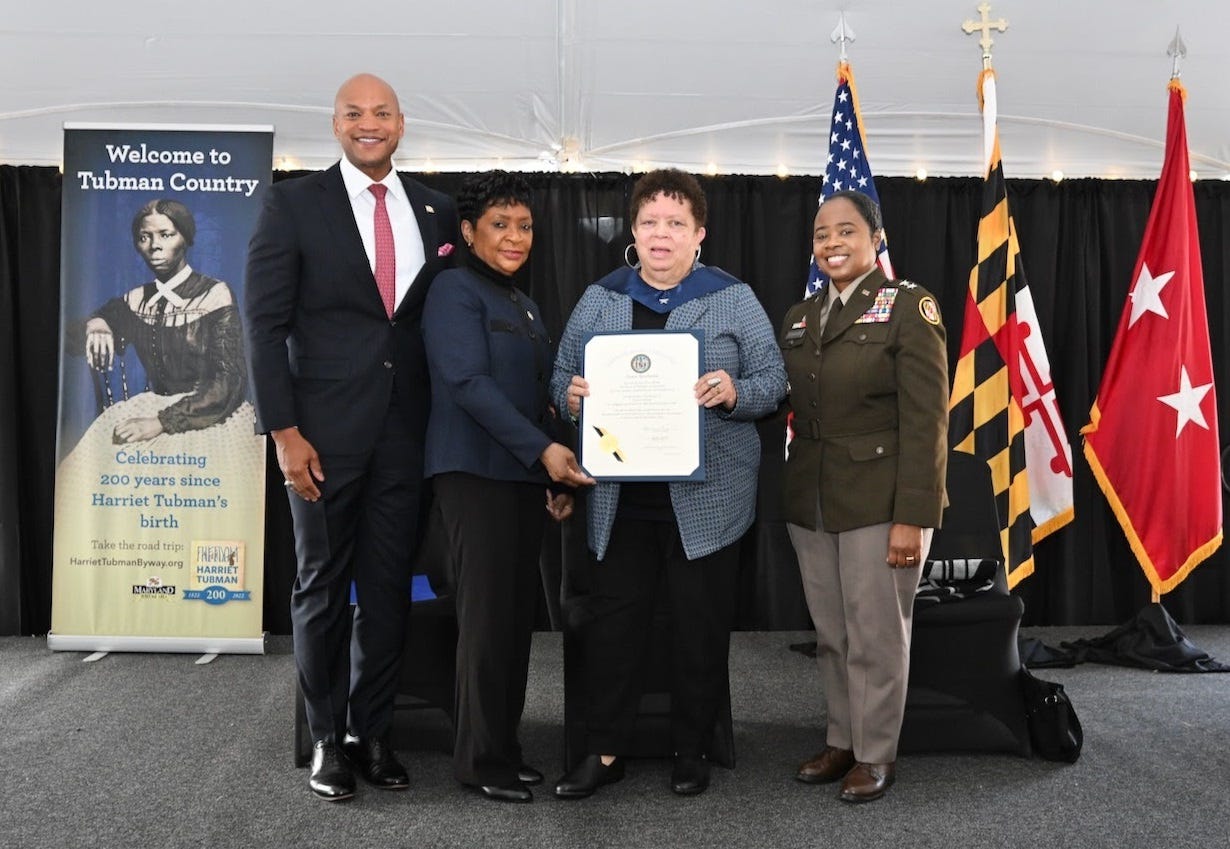
On Monday, Maryland Gov. Wes Moore honored one of his state’s most beloved military veterans, Harriet Tubman, by promoting Tubman posthumously to the rank of brigadier general in the state National Guard. Why yes, that’s General Harriet Tubman, who in addition to being a famous abolitionist and “conductor” on the Underground Railroad was also the first woman to lead a US military operation during wartime.

Tubman’s history of military service doesn’t get the same attention as her activities as an abolitionist and helper of those who freed themselves from enslavement, which was already plenty enough to make her a hero. But after her final expedition to guide escapees from slavery North, she put her skills of disguise, concealment, and familiarity with Southern territory to use for the US Army when the Civil War broke out in 1861, serving as a spy, scout, and eventually, as the joint leader of an 1863 Army raid on plantations in South Carolina, which freed nearly 800 enslaved people and burned several of the plantations.

Here’s a cool thing: A 2022 CIA website article acknowledges that well before she formally became a military operative, her work for the Underground Railroad “applied sophisticated tradecraft including the use of disguises, clandestine communication, and assets and allies, who provided safe houses, transportation, and funding” — genuine praise for an intelligence operative.

Tubman was recruited for the Union cause by Massachusetts Governor John Andrew and sent to Hilton Head, South Carolina, where she was assigned to work under Major General David Hunter, the head of Union operations there and in Georgia and Florida. As the CIA explains, she was trained as a nurse, and worked as one, but that also gave her the documents and funding necessary for her secret work, recruiting a spy ring of Black volunteers in the area, who gathered intelligence on plantations, commerce, Confederate troop positions, and the locations of “torpedoes” — barrels of gunpowder in rivers that could blow up any Union boats. Tubman was unable to read or write, but had an outstanding memory, making her a valuable spy without leaving any notes behind, encrypted or otherwise.

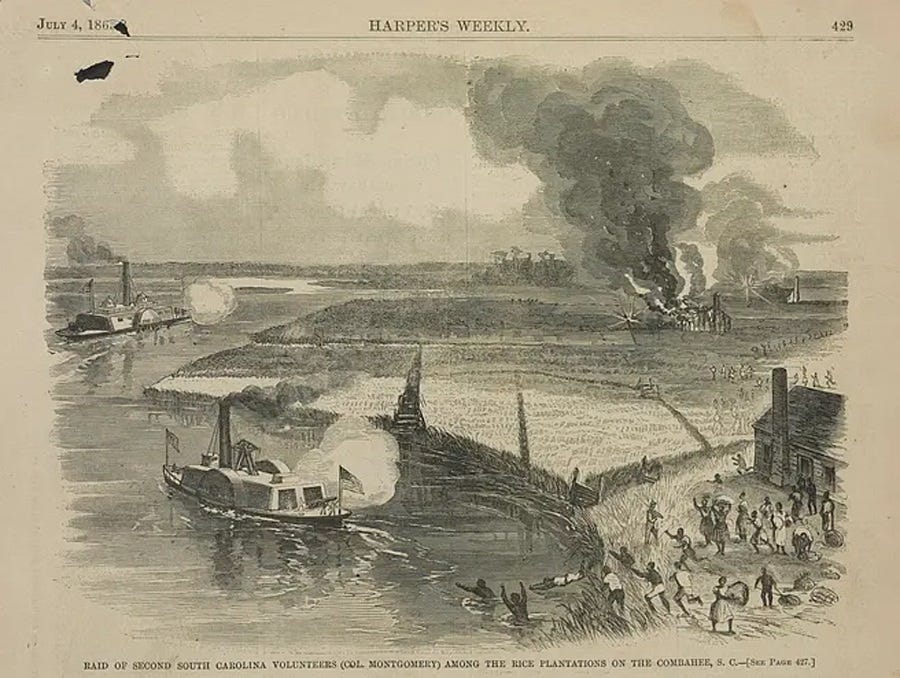
In 1863, Tubman moved from spying and reconnaissance to actually commanding Union troops in a raid on plantations along the Combahee River in South Carolina’s “Lowcountry” region. Although she was not a commissioned officer, she planned and shared leadership duties with Col. James Montgomery, an abolitionist in charge of a Black Army regiment, the Second Carolina Volunteers. The goal of the raid was to rescue enslaved people, recruit the freed men to join the Union Army if they were willing, and to wipe out the rice plantations in the area.

Montgomery commanded about 300 men, and to prepare for the raid, Tubman was in charge of a group of eight scouts who made maps of the area and helped her get news of the coming raid to enslaved people so they could be ready to run for the Union gunboats from which the attack would be launched.

“She was fearless and she was courageous,” said Kate Clifford Larson, historian and author of Bound for the Promised Land: Harriet Tubman, Portrait of an American Hero. “She had a sensibility. She could get Black people to trust her and the Union officers knew that they were not trusted by the local people.”

On the night of June 1, 1863, Tubman, Montgomery, and the troops boarded three Union gunboats to head up the river; on the way, however, one of the steamboats ran aground and the troops had to transfer to the remaining vessels. Tubman’s reconnaissance of the area proved invaluable in avoiding torpedoes in the river, and for guiding the ships close to shore, where they launched smaller boats full of raiders to attack the plantations.

Just before the raid got underway, the gunboats broke formation and headed to different parts of the river, with Montgomery commanding one, the Harriet A. Weed, and Tubman leading the 150 soldiers on the John Adams. Just want to underline this: Tubman wasn’t serving as an adjunct to Montgomery, she was in charge of half the attacking force. In the wee hours of June 2, they attacked their assigned plantations.

Tubman later recalled that when the signal to attack was given, she saw enslaved people running to escape toward the Union boats at the riverside, with women carrying their babies and children and whatever supplies they could take along, including chickens, pigs, and pots of rice. The enslavers tried to chase them down, firing guns on them, reportedly killing one girl. We’ll hand off the narrative here to History.com, and add that we’d watch this movie:

As the escapees ran to the shore, Black troops in rowboats transported them to the ships, but chaos ensued in the process. Tubman, who didn’t speak the region’s Gullah dialect, reportedly went on deck and sang a popular song from the abolitionist movement that calmed the group down.

More than 700 escaped slavery and made it onto the gunboats. Troops also disembarked near Field’s Point, torching plantations, fields, mills, warehouses and mansions, causing a humiliating defeat for the Confederacy, including the loss of a pontoon bridge shot to pieces by the gunboats.

After the raiding gunboats docked in Beaufort, South Carolina, the first press report of the raid didn’t name Tubman, but it did say that the raid was led by a “She-Moses” under the command of Montgomery, and that the raid came off without a single injury to the Union forces. A later report in a Boston newspaper named Tubman as the hero; the editor was a friend of hers. At least 100 men freed during the raid joined the US Army.

An old engraved magazine illustration showing (in not the most realistic scale) Union paddlewheel gunboats firing cannon on plantations from the river, a plantation building on fire, and in the foreground, strangely large black people nearly as tall as a nearby gunboat fleeing slave quarters. Yes, yes, it's meant to be 'perspective,' but not at all realistically so.
Illustration via Library of Congress.

For all the news the story made at the time, Tubman didn’t get paid, and even after the war her petitions to receive a soldier’s pay for the raid were turned down, because women simply weren’t allowed in the Army, you silly goose. She later received a military pension on behalf of her late husband, a Union soldier, but not for herself. But when she died in 1913, she was buried with military honors; the US Army’s Military Intelligence Corps also inducted Tubman into its Hall of Fame in 2021.

Prior to the war, in 1858, abolitionist and eventual insurrectionist John Brown met Tubman and nicknamed her “General” for her courage. That was made official by Gov. Moore’s Veteran’s Day proclamation Monday, naming her a one-star general in the Maryland National Guard.

After Moore read the official order promoting Tubman, he presented the proclamation to Ernestine “Tina” Martin Wyatt, Tubman’s great-great-great-grandniece, as a representative of Tubman’s family.

Photo: Maryland Governor’s office.

Thank you again for your service, General Tubman. Now if we can just get you on the $20 bill to replace that racist fuck-knuckle Andrew Jackson. (Snip)

Peace & Justice History for 11/14

November 14, 1910
Eugene Ely performed the first airplane takeoff from a ship. His Curtiss pusher flew from the deck of the U.S.S. Birmingham in Hampton Roads, Virginia.By January he would execute the first (takeoff and) landing on a warship, the U.S.S. Pennsylvania. Captain Washington I. Chambers of the Navy Department had been interested in the military uses for the seven-year-old invention.
Naval flight training started shortly thereafter.


More of the whole story
November 14, 1954
“Ten Million Americans Mobilized for Justice” began a campaign to collect 10 million signatures on a petition urging the Senate not to censure Senator Joseph McCarthy (R-Wisconsin). The motion of censure against Senator McCarthy was for obstructing a Senate committee and for acting inexcusably and reprehensibly toward a U.S. soldier appearing before his own committee.
McCarthy had used his Senate Permanent Investigations Subcommittee to publicly denounce thousands as subversive, especially within the federal government, many without any justification. The political views of most were painted as treasonable and conspiratorial, rather than differing political views.
The petition effort fell about nine million signatures short.

More on Joe McCarthy 
November 14, 2000
Florida Secretary of State Katherine Harris, simultaneously co-chair of George W. Bush’s Florida presidential campaign organization and the public official responsible for the conduct of the election itself, certified Governor Bush’s fragile 300-vote lead over Vice President Al Gore in the 2000 presidential election.

Katherine Harris
Florida Judge Terry Lewis gave Harris the authority to accept or reject a follow-up manual recount from some counties where the count was open to question. Harris rejected the manual recounts.

https://www.peacebuttons.info/E-News/peacehistorynovember.htm#november14

Reblog from Ten Bears

There is a link within: Laugh Out Loud ~ Hurricane Season May Not Be Over Yet for Florida, (I’m not laughing because Scottie, Ron, and likely readers are in FL, but this is some info for preparation.) The linked page uses Accuweather, who I personally disdain because when they’re timely is when they borrow the info from the National Weather Service, in this case, here. This is no disparagement of Ten Bears, who gives superlative information, especially on the subject of climate, environment, and weather. Anyway, because it’s about FL, there are those links, and below is the blog entry, which is its usual excellence. Recall I mentioned a while back that many links are “Easter eggs”; there are some of those within.

The Warrior’s Plume

Bertrand N. O. Walker 1870 – 1927

On the plains and in the vales of Oklahoma,
     Grew a flower of the Tyrian hue,
The color that is loved by the Redman,
      That tells him light and life,
               And love are true.

Long ago it flamed in beauty on the prairies,
      Lighting reaching vistas with its glow;
Ere advent of the whiteman and his fences,
      Told the care-free, roving hunter
               He must go.

The throng, the herd, and greed have madly trampled
      Prairie, woodland, valley, and the height;
Crushed the feath’ry flower and rudely blighted
      Its pride and life and beauty,
              And its light.

Today ’tis found in silent glades and meadows
      Where by twos and threes it greets the May.
Like the scattered braves who loved its color,
      It has passed, been trodden out
               Along the way.

As the oriflamme it flaunted through past ages
      Went to gladden the fairness of the earth;
So the greatness of the Indian will linger
      In the land that loves them both
               And gave them birth.

This poem is in the public domain. Published in Poem-a-Day on November 10, 2024, by the Academy of American Poets.

More from and about this poet on the page.

Peace & Justice History 11/13:

November 13, 1933
The first recorded “sit-down” strike in the U.S. was staged by workers at the Hormel Packing Company in Austin, Minnesota. When the Independent Union of All Workers (IUAW) went on strike, the company tried to bring in scab (strike-breaking) workers.

“ Four hundred men, many of them armed with clubs, sticks and rocks, crashed through the plant entrance, shattering the glass doors and sweeping the guards before them. The strikers quickly ran throughout the plant to chase out non-union workers. One . . . group crashed through the doors of a conference room where Jay Hormel and five company executives were meeting and declared “We’re taking possession. So move out!” (Larry Engelmann, “We Were the Poor — The Hormel Strike of 1933,” Labor History, Fall, 1974.)

The tactic worked: within four days Hormel agreed to submit wage demands to binding arbitration. The success of this strike reinvigorated the labor movement, which had been in decline throughout the 1920s.
November 13, 1956
The U.S. Supreme Court ruled segregation unconstitutional in public transportation. The case, Browder v. Gayle, was brought by four women, Aurelia Browder, Susie McDonald, Claudette Colvin and Mary Louise Smith, who had refused to surrender their bus seats to whites in Montgomery (months before Rosa Parks had done so), and had been arrested for violating Alabama law which required segregation on public buses.They challenged the law and the Court agreed, finding the law under which they were arrested in violation of the due process and equal protection clauses of the Fourteenth Amendment to the U.S. Constitution.
Aurelia Browder

A roadside monument was dedicated in 2004 to the four plantiffs in the Browder v. Gayle case.
Colvin, a 15-year-old student at Booker T. Washington High School, boarded a bus in 1955 and refused to give up her seat to a white man. She was handcuffed, arrested and forcibly removed from the bus, as she screamed that her constitutional rights were being violated. 
More on Browder v. Gayle 
November 13, 1960

Over 1000 Quakers (members of the Society of Friends) surrounded the Pentagon for a silent vigil to commemorate the 300th anniversary of the first Quaker Peace Testimony issued to King Charles II in 1660.
From the original Peace Testimony: “We utterly deny all outward wars and strife and fightings with outward weapons, for any end or under any pretence whatsoever.
And this is our testimony to the whole world….”

The complete text of the 1660 Declaration
November 13, 1974

Karen Silkwood, a technician and union activist (Oil, Chemical, and Atomic Workers’ Union) at the Kerr-McGee Cimarron plutonium fuels production plant near Crescent, Oklahoma, was killed in a one-car crash.
Read more about her story  
November 13, 1982
Maya Ying Lin
The Vietnam Veterans Memorial was dedicated in Washington, D.C. Carved into black granite are the 58,260 names of those Americans who died in Vietnam. The designer, Maya Ying Lin of Athens, Ohio, a 21-year-old architecture student at Yale University, was the winner of the competition that drew 1,421 design entries: “. . . this memorial is for those who have died, and for us to remember them.” Eventually, the Memorial included three elements, the Wall of names, the Three Servicemen Statue and Flagpole, and the Vietnam Women’s Memorial.

The Wall of Names, the Three Servicemen Statue and Flagpole, and the Vietnam Women’s Memorial

Read more about the memorial

Stunning photo gallery of the Memorial including interactive panoramic images

Interview with Maya Lin and filmmaker Freida Lee Mock, who made the Academy-Award-winning documentary, “Maya Lin: A Strong Clear Vision” (My apologies about Charlie Rose; it’s PeaceButton’s link, and it’s good info, Rose notwithstanding. -A)

https://www.peacebuttons.info/E-News/peacehistorynovember.htm#november13

Peace & Justice History 11/12

November 12, 1969
Seymour Hersh, an independent investigative journalist, in a cable filed through Dispatch News Service and picked up by more than 30 newspapers, revealed the extent of the U.S. Army’s charges against 1st Lieutenant William L. Calley at My Lai, a Vietnamese village.Hersh wrote: “The Army says he [Calley] deliberately murdered at least 109 Vietnamese civilians during a search-and-destroy mission in March 1968, in an alleged Viet Cong stronghold known as ‘Pinkville.'”
The same Seymour Hersh first wrote about abuses of Iraqis held in Abu Ghraib prison by Americans in 2004.


Seymour Hersh

The My Lai massacre by Seymour Hersh
An interview with Hersh on Iraq
November 12, 1982
The Polish government freed the leader of the outlawed Solidarity union movement, Lech Walesa, after 11 months of internment. His release came only two days after riot police used tear gas, water cannon and phosphorous rockets to disperse large pro-Solidarity demonstrations in Warsaw and other cities.
Read more 
November 12, 1989
Tens of thousands of Americans joined “Mobilize for Women’s Lives” in more than 150 cities and towns nationwide. They sought protection of women’s rights to reproductive choice, including abortion. Their focus was on state legislatures in their own states where laws were being introduced to put limits of a woman’s right to choose when she should bear children.
More than 2500 defenders of legalized abortion gathered at the First Parish Unitarian Church in Kennebunkport, Maine, just a few miles from President George H. W. Bush’s summer home, to hold a candlelight vigil.

Watch Helen Reddy lead “I am Woman” at the D.C. rally 
National Abortion Rights Action League / Pro Choice America 

https://www.peacebuttons.info/E-News/peacehistorynovember.htm#november12

The Fight for Native American Voting Rights

Despite the passage of the Indian Citizenship Act in 1924, Native American activists have had to repeatedly take their fight for voting rights to Congress.

In June 1986, Judge Edward Rafeedie handed down a ruling. Indigenous voting rights were being suppressed in Montana’s Big Horn County, where “official acts of discrimination…have interfered with the rights of Indian citizens…to register and vote.” This was a victory for voting equality, but it wasn’t met with open arms. County Commissioner Ed Miller, for example, was dismayed, citing a longing for the “good old days.”

“The Voting Rights Act is a bad thing,” Miller claimed, according to the San Francisco Examiner. “[T]hings were fine around here. Now they (Indians) want to vote. What next?”

Maybe most weren’t as vocal about their opposition to equal rights as Miller was, but the Native American franchise was a hard-fought battle. As historian Matthew G. McCoy writes, “Only through consistent activism and legal action did Native Americans succeed in breaking down these egregious barriers to voting.”

It shouldn’t have been as difficult for Native Americans to vote as it was. The Indian Citizenship Act of 1924, in theory, settled the question of whether Indigenous people were citizens. They were. And they were entitled to vote. However, as historian Orlan J. Svingen explains, this law didn’t prevent discrimination.

“Just as passage of the 15th Amendment precipitated countless barriers for the freedmen, the Indian Citizenship Act also failed to elevate American Indian civil rights on an equal footing with non-Indians,” Svingen writes.

Though there was anger and a number of court battles in earlier years, it may have been the start of World War II that acted as a catalyst for activism

A government study in 1936, for example, found that seven states were actively preventing Native Americans from voting. Much like the laws that prevented Black Americans from voting, these states enacted laws specifically targeting Native American voters, including mandating that all voter registrars be taxpayers (many Native Americans were exempt from certain local taxes, and this law depressed voter registrations on reservations) and literacy tests as a requirement for voting. One Cherokee voter was told by a judge that despite his master’s degree from the University of North Carolina, “You couldn’t read or write to my satisfaction if you stayed here all day.”

Though there was anger and a number of court battles in earlier years, it may have been the start of World War II that acted as a catalyst for activism, McCoy notes. Though Native American soldiers were being sent overseas to fight for freedom, that same freedom eluded them at home.  Navajo soldier Ralph Anderson sent a letter to tribal leaders in 1943 with this exact contradiction on his mind.

“We all know Congress granted the Indians citizenship in 1924,” he wrote, “but we still have no privileges to vote. We do not understand what kind of citizenship you would call that.”

In the following years, Native activists took their fight to Congress several times, meeting denials of their rights most times. But they were undeterred and began leading direct actions. In 1946, for example, Navajo citizens attempted to register to vote in Arizona and were denied, as were two people from the Yavapai tribe. The latter denial led to a court case, Harrison v. Laveen, that overturned a previous ruling that classified Native Americans living on reservations as being essentially wards of the state and ineligible for voting. A case in 1948 successfully took the fight to the federal government, arguing that the denial of voting rights was unconstitutional. And as Svingen writes, in the 1970s, “exemptions from certain taxes no longer limits [Native Americans’] right to vote, and election districts must be apportioned under the ‘one person one vote’ principle,” rules that officials in Big Horn County were simply ignoring.

There have been many subsequent fights for equality, and some experts argue that certain regulations, like voter ID, may still be playing a role in disenfranchising Native American voters. Legal scholar Sally Harrison writes that “one in five eligible Native American voters do not have a [government-issued] photo ID that meets the requirements for ID in strict-photo ID states [and] many states do not allow tribal photo IDs at the polls because a state or federal government did not issue them,” a contradiction that could lead to revisiting past injustices. As Harrison notes, “state and federal legislators should pay special attention to the Native American vote, making sure that it does not face the discrimination and exclusion it has in the past.”