October 22, 1968 More than 300,000 protesters marked International Antiwar Day in Japan. The U.S. war in Vietnam and the ongoing (since the end of World War II) and massive American military presence on the Japanese island of Okinawa helped swell the ranks of the demonstrators; nearly 1400 were arrested.
October 22, 1979 The deposed Shah of Iran, Mohammed Reza Pahlavi, arrived in New York for medical treatment from Mexico. He received permission to do so from the U.S. government (which had installed him as shah in a 1954 coup) despite warning from the newly established Islamic republic in Iran demanding that the Shah be turned over to them for trial. More on the Shah
October 22, 1983 Capping a week of protests, more than two million people in six European cities marched against U.S. deployment of Cruise and Pershing nuclear missiles: 1.2 million Germans, including 180,000 in Bonn; a 64-mile human chain between Stuttgart and New Ulm (and Hamburg, W. Berlin); 350,000 Rome; 100,000 Vienna; 25,000 Paris; 20,000 Stockholm; 4000 Dublin; plus 140 sites in U.S. In London, the Campaign for Nuclear Disarmament (CND) held its biggest protest ever against nuclear missiles with an estimated one million people taking part. Read more
October 21, 1837 Osceola painted by George Catlin, 1838 The U.S. Army, enforcing President Andrew Jackson’s 1830 Indian Removal Act, captured Seminole Indian leader Osceola (meaning “Black Drink”) by inviting him to a peace conference and then seizing him and nineteen others, though they had come under a flag of truce. Under the law, they and the others of the “Five Tribes” (Choctaws, Chickasaws, Creeks and Cherokees) were to be moved, by force if necessary, west of the Mississippi to Indian Territory (Arkansas and Oklahoma).The Seminole had moved to Florida (then under the control of Spain) from South Carolina and Georgia as they were forced from their ancestral lands, then forced further south into the Everglades where they settled. Read more about Osceola
October 21, 1967 In Washington, D.C., more than 100,000 demonstrators from all over the country surrounded the reflecting pool between the Washington and Lincoln monuments in a largely peaceful protest to end the Vietnam War.It was organized by “the Mobe,” the National Mobilization Committee to End the War in Vietnam. Some then marched on, encircled and attempted to storm the Pentagon in what some considered to be civil disobedience; 682 were arrested and dozens injured. This protest was paralleled by demonstrations in Japan and Western Europe, the most violent of which occurred outside the U.S. Embassy in London where 3,000 demonstrators attempted to storm the building. at the Pentagon Read two different accounts of the day with photographs:
October 21, 1983 In the first public action of the new Seattle Nonviolent Action Group (SNAG), 12 people blockaded the Boeing Cruise Missile plant in Kent, Washington; none were arrested.
October 21, 1994 In an “Agreed Framework” to “freeze” North Korea’s nuclear program, the United States and North Korea (Democratic Peoples’ Republic of Korea or DPRK) agreed over the next 10 years to construct two new proliferation-resistant light water-moderated nuclear power reactors (LWRs) in exchange for the shutdown of all their existing nuclear facilities. The DPRK also agreed to allow 8,000 spent nuclear reactor fuel elements to be removed to a third country; to remain a party to the Nuclear Non-Proliferation Treaty (NPT); and to allow inspections by the International Atomic Energy Agency. In the deal negotiated by Ambassador at Large Robert Gallucci, the U.S. agreed to normalize economic and diplomatic relations with Pyongyang and to provide formal assurances against the threat or use of nuclear weapons by the United States. The details of the agreement and what has followed Interview with Robert Gallucci, Dean, Walsh School of Foreign Service, Georgetown U.
This was really difficult to get through. As angry as I get just speaking these words, they don’t express a fraction of my true feelings. I don’t know if there are words for that. I don’t know if this will help, but I feel helpless, so I’m using my platform, which is something most people don’t have. At first, I wondered if it conflicted with my previous video, but after some contemplation, I realized that it doesn’t. My previous video never advocated disregarding injustice and atrocity. It never advocated abdicating righteous indignation. It was an anti-hate video. On the contrary, my commitment against hatred is what compelled me to make this video.
I think I’m done trying to make moral arguments. They all feel like bad faith now, like a waste of time. I guess if I ever do bring them up again, I’ll really have to consider who exactly I’m trying to convince, because some people have proven to be so completely delusional or dishonest, that it would be useless to argue – like talking to a tree.
Thank you, Ten Bears! I keep pointing out that Project 2024, Agenda 47, and the Republican National Party Platform are all cut from the same whole cloth. It’s important to be aware, even though one need not read each document separately.
October 19, 1923 The War Resisters League was founded in New York City. WRL history Above: One of the founders, Jessie Wallace Hughan (r), 1942 photo: WRL/Swarthmore Peace Collection The War Resisters League home
October 19, 1960 Martin Luther King, Jr., and 36 others were jailed after being arrested during a sit-in at the snack bar of Atlanta’s Rich’s department store where they requested service and were refused on account of their race. More about this arrest
October 19, 1980 J.P. Stevens & Co. was forced to sign its first contract with a union after a 17-year struggle in North Carolina and other southern states. The workers, organized by the Amalgamated Clothing & Textile Workers Union, were supported by a widespread boycott of Stevens products by labor, progressive and religious organizations. Read more about the struggle and the movie “Norma Rae”
He’s been flying people to access reproductive care. Here’s how he’s preparing for the election.
Regardless of the outcome of the election, this organization flying people to access abortion and gender-affirming care will have plenty of work. (Emphasis mine, but important-A)
Just two months before the Supreme Court would overturn Roe v. Wade, eliminating the federal right to an abortion, Mike Bonanza launched Elevated Access.
The nonprofit dedicated to helping patients receive reproductive health care would soon find its services more crucial than ever. Since its beginnings in April 2022, Republican-run legislatures have passed near-total abortion bans in 13 states. Conservatives also began pushing bans on gender-affirming care for minors alongside other anti-transgender laws, culminating in 26 states that now prohibit this widely-supported medical treatment, according to the Movement Advancement Project.
As the need has grown, so has Elevated Access. The organization has continued to enlist volunteer pilots and offer free flights to patients who need reproductive health care, such as abortions and gender-affirming care, but who don’t have access to it where they live, whether due to bans or lack of resources. Elevated Access completed 400 flights in its first 18 months, according to Bonanza. In the past 12 months, it’s completed 1,200.
Now, Bonanza and his few staff members are preparing for the results of the November elections, which could have an impact on their work. For Bonanza, there is a “best-case” scenario that sees Vice President Kamala Harris ascend to the presidency, and a “worst-case” that sees former President Donald Trump return to office. But no matter the outcome, there will still be plenty of work for Elevated Access.
“Trump winning alone doesn’t necessarily do all the bad things that could happen. Harris winning doesn’t mean all the good things will happen,” Bonanza said. “So, a likely scenario really is some form of what we see today, where it’s going to vary wildly between states no matter who wins, at least for probably the first year to 18 months [of the next administration].”
While Trump’s campaign has attempted to distance itself from the unpopular idea of a national ban — even claiming recently that he would veto one if it made it to his desk — his running mate, JD Vance, previously expressed the desire to restrict abortion federally, and a road map to implement such a policy is outlined in Project 2025, the blueprint for a second Trump presidency crafted by conservative organization the Heritage Foundation.
Bonanza isn’t quite sure what will happen to Elevated Access in the longshot event of a national ban. While the organization currently enlists its volunteer pilots and other allies through aviation conferences and media coverage, their efforts have remained domestic. He insists that if abortion is somehow outlawed nationally or otherwise restricted, his group will continue to do what they’ve done in the face of increasing state bans, which is “get creative.”
“When I think about what the worst case scenarios are of the future — short of having to shut down because there’s just no legal space for us to operate in — we’ll find a way to help people, whatever that looks like,” Bonanza asserted. “We’re really creative and really nimble, and always ready to find solutions to new challenges.”
While Harris is “certainly” the “better” option, according to Bonanza, the rollback of rights seen at the state level over the past two years has happened under a Democratic president and can continue to happen under another one. There are unlikely pathways a Harris administration could take to solidify access to reproductive health care, such as by expanding the Supreme Court or championing legislation through a Democrat-controlled Congress — which is currently not in place.
Even under Harris, Bonanza explained that “there’s always going to be people that don’t have transportation, don’t have the funds they need to pay for the care they need, don’t have housing and other things they might need in order to get care from the right provider.” Part of this is due to “the state of the American health care system” and lack of universal health care, but “that’s not something we’re gonna fix in the next two to four or even eight years — it’s going to be a long process.”
“The problems that people are facing today are not new. Some of our partners have existed for a decade helping people travel to get access to abortion in particular. That’s because you can’t just walk to any medical provider and get that care, because some providers don’t do it,” Bonanza said. “So, even if President Harris is able to [legally protect] abortion, gender-affirming care, and all the possible scenarios that we would support, legalization does not equal access.”
Ten states will be voting on abortion directly: Arizona, Colorado, Florida, Maryland, Missouri, Montana, Nebraska, Nevada, New York and South Dakota each have a referendum on the ballot that would enshrine abortion access in their state constitutions. So far, every abortion protection referendum that’s previously been brought to vote has passed.
But regardless of whether the ballot measures pass, Bonanza predicts that legal challenges to abortion laws will continue. In Georgia, a six-week ban was recently overturned before the state Supreme Court almost immediately reinstated it. Bonanza said that while providers were “ready to start providing abortions again” in the state, it’s the constant back-and-forth that leaves health care suspended in legal limbo.
“The providers that have been under a state ban the shortest amount of time are going to have the most capability to get up and running again. But there are certainly providers out there that relocated from one state to another after their bans were passed,” Bonanza explained. “I know a provider that relocated both his practice and himself from Ohio to Illinois. I don’t see a scenario where he moves back to Ohio and starts a new clinic again.”
Beyond the election, Elevated Access is preparing for the U.S. Supreme Court’s impending ruling on gender-affirming care and the constitutionality of state restrictions for youth. Bonanza, who is not just the executive director but also a pilot, has personally flown both transgender adults and youth to receive treatment.
He emphasized that there’s “a very broad spectrum of what gender-affirming care looks like,” from altering one’s hair and wardrobe to puberty blocker and hormones. For the transgender youth Bonanza has served, the gender-affirming care they receive is often “as simple as just going to see a talk therapist.” For the adults he serves, many “are traveling just to get access to care because they don’t have a provider locally.”
Surgeries on minors are incredibly rare — a recent study published in JAMA found that there were only 151 breast reductions performed on American minors in 2019, and 146 (97 percent) were performed on cisgender males.
But, Bonanza said, facts and data are no match for “dehumanizing language” from politicians and public figures, which is why he has issued a call to voters ahead of November: “Let’s rehumanize people that have been attacked from certain parts of the spectrum, especially immigrants, trans people, and others that have been targeted by people in politics today.”
“If you listen to the rhetoric of people that are running — and whether they’re in the same party or from one person — you hear the people that use dehumanizing language,” Bonanza continued. “What it comes down to is: If that person in your family, that neighbor that you have, might be experiencing some of these things, do you want them to suffer under these oppressive policies? Or do you want them to be able to live their lives and get access to health care that they need?”


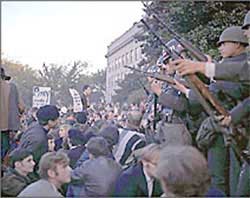 at the Pentagon


