
Tag: Human Rights
The US v John Lennon, The IRA Ceases Military Operations, & More in Peace & Justice History for 8/31
| August 31, 1921 Marcus Garvey, leader of the Universal Negro Improvement Association, often referred to as the Back-to-Africa movement in the U.S., was declared “Provisional President of Africa” in a Harlem (New York City) ceremony.  Black nationalist Marcus Garvey is shown in a military uniform as the ‘Provisional President of Africa’ during a parades up Lenox Avenue in Harlem, New York City, in August 1922, during the opening day exercises of the annual Convention of the Negro Peoples of the World. Hear one of his speeches recorded that summer |
August 31, 1965 Draft card burning, 1967 U.S. President Lyndon Johnson signed into law a bill criminalizing destruction of draft cards. Although it could result in a five-year prison sentence and $1000 fine, the burnings became common during anti-Vietnam War rallies and often attracted the attention of news media. |
August 31, 1974 In federal court, John Lennon of The Beatles testified the Nixon Administration had tried to have him deported because of his involvement with anti-war demonstrations at the 1972 Republican convention in Miami. The U.S. v John Lennon trailer |
| August 31, 1994 The Irish Republican Army (IRA) declared a permanent and “complete cessation of military operations” after 25 years of bombing and 3000 deaths (both republican and unionist) intended to end British control of Northern Ireland.  |
https://www.peacebuttons.info/E-News/peacehistoryaugust.htm#august31
Catching Up With Clay Jones & Open Windows
We were out for a while yesterday, so I didn’t get as much done here. I have a trove, and here it is:
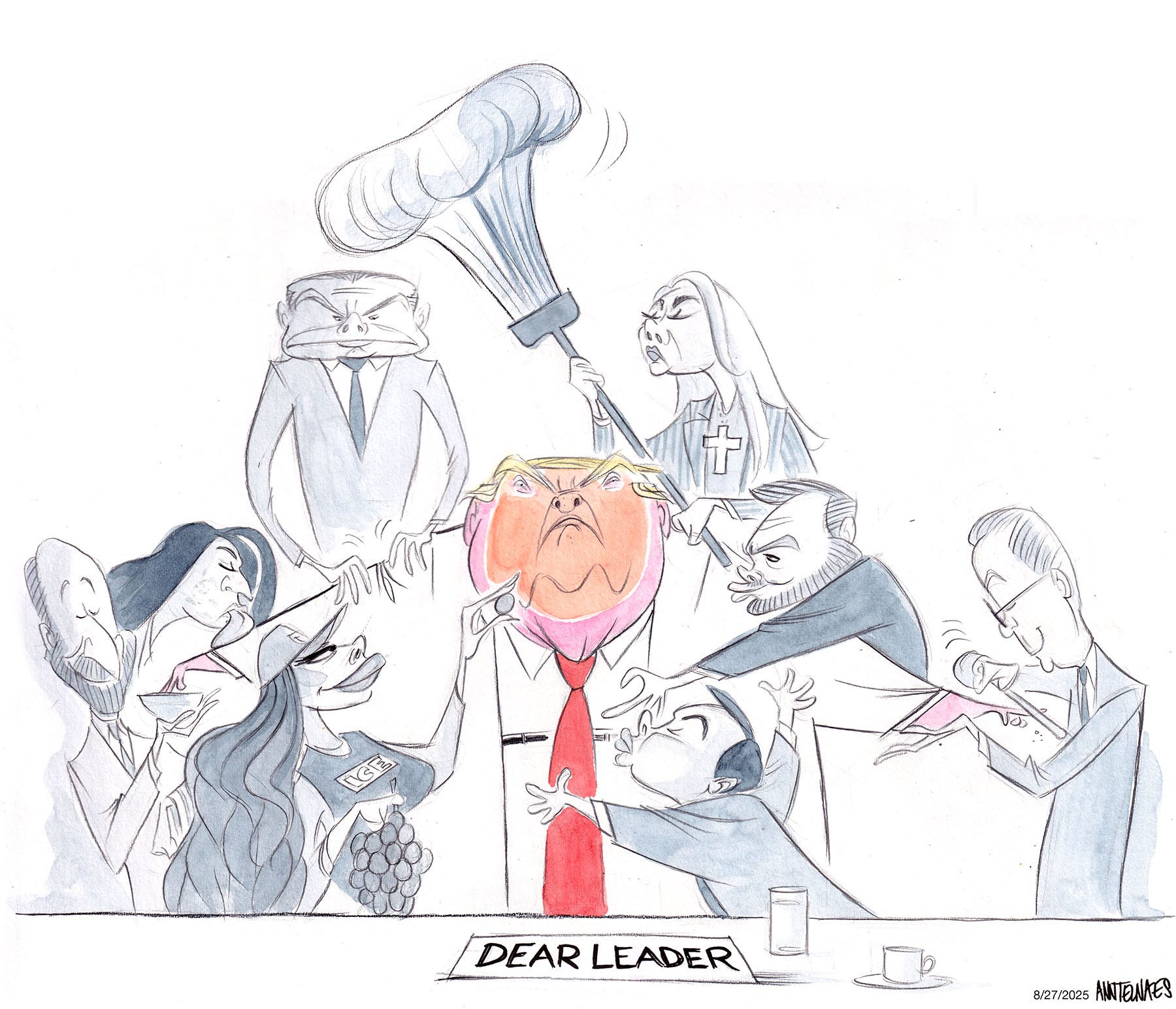
Dear Leader’s cabinet meeting by Ann Telnaes
A three hour marathon of flattery and groveling Read on Substack
I didn’t think the outright ass-kissing could get any worse than his first term’s cabinet meetings…
====================
Your Favorite Dictator by Clay Jones
Trump engages in dictator talk…again Read on Substack
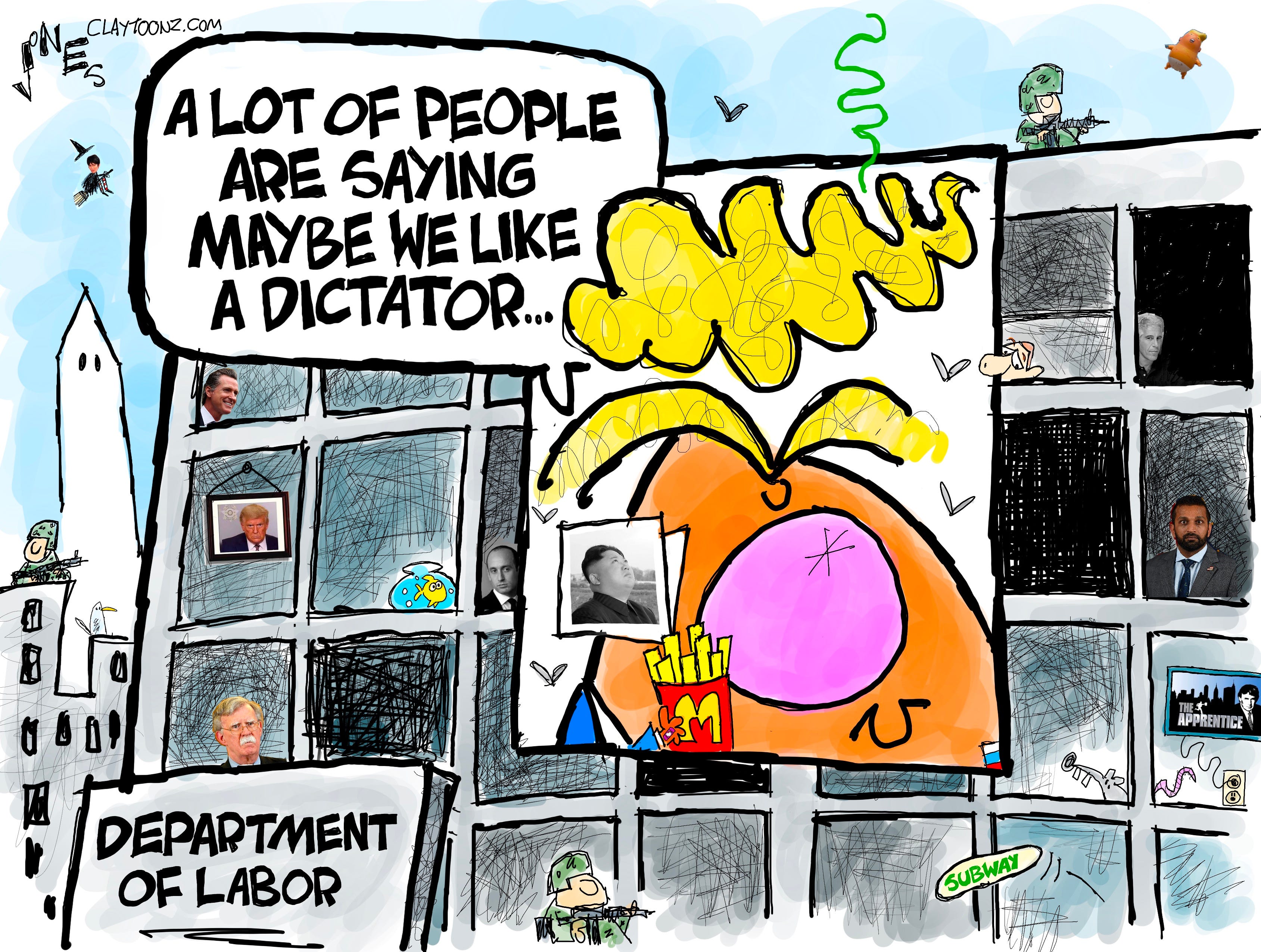
Why would Donald Trump talk about becoming an American dictator…again?
NBC News reporter: Before signing a series of executive orders aimed at reducing crime in D.C. and across the nation, Trump referred to his critics bashing him for sending the National Guard to D.C., claiming that some people think they might “like a dictator.”
Referring to militarizing our cities, Trump said, “They say, ‘We don’t need him, freedom freedom. He’s a dictator. He’s a dictator.’ A lot of people are saying, ‘Maybe we like a dictator’…You send in troops, and instead of being praised they’re saying you’re trying to take over the republic. These people are sick.”
Before the election, Trump talked about “deleting” parts of the Constitution he doesn’t like. Then, he talked about becoming a dictator for one day. Now, he says some people in this country want a dictator, but to whom is he referring to that would be that dictator? I think we all know the answer. The dictator talk is so disturbing that everyone missed that part where he whines that he’s not being praised. (snip-MORE; go read it!)
Mass Mass Shooting by Clay Jones
And another school shooting Read on Substack
(The money graf: “Even the shooter offered “thoughts and prayers” to the intended victims. So, quite frankly, every single Republican’s answer to this isn’t any better than the shooter’s solution.”)
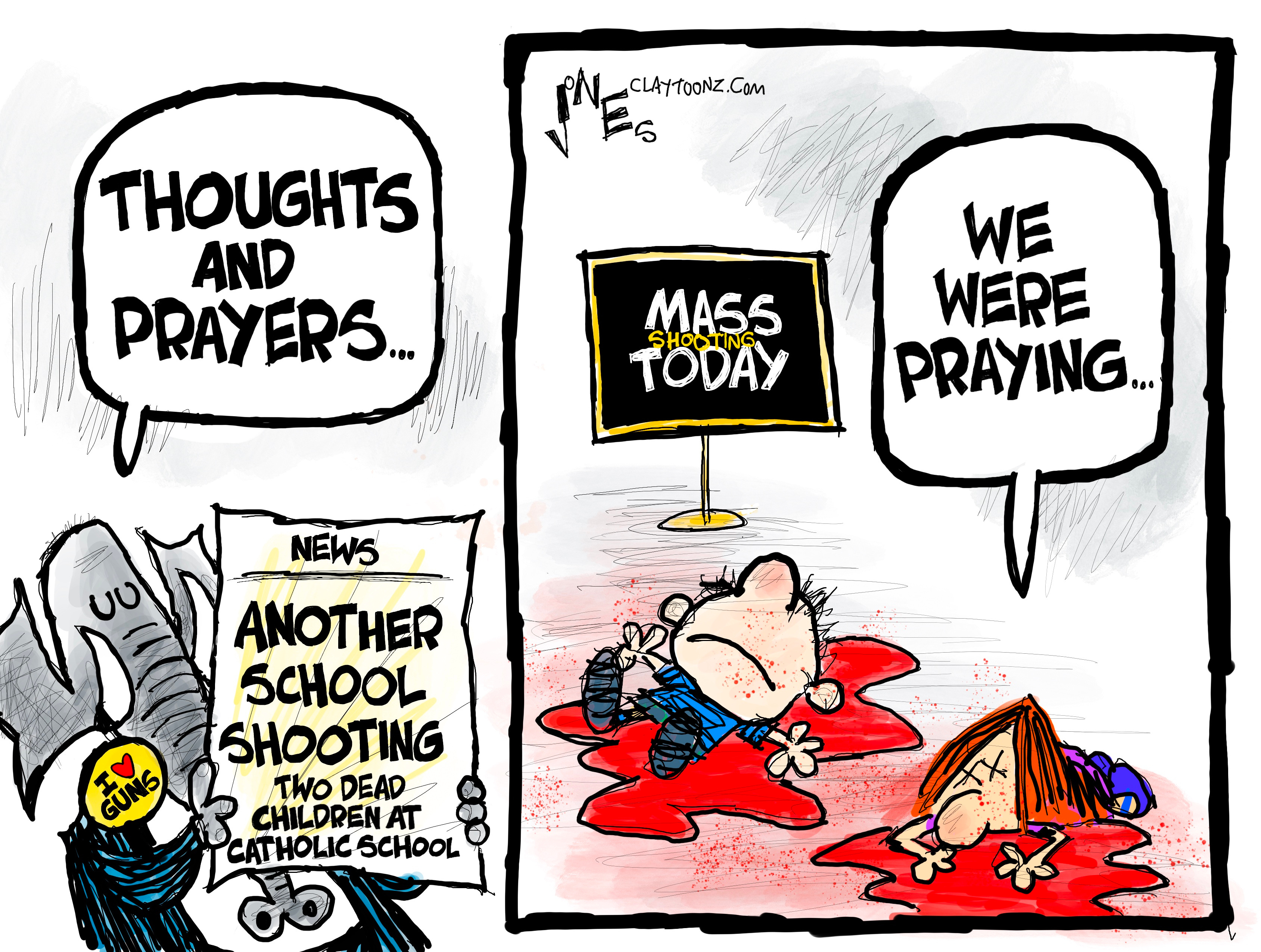
Another mass shooting and another opportunity for Republicans to give us empty thoughts and prayers instead of real solutions. You can’t find a solution when you can’t even identify the problem.
Today’s mass shooting just so happened to take place during a Mass.
An 8-year-old and a 10-year-old were killed while sitting in pews during a Mass at the Annunciation Church in Minneapolis, Minnesota. At least 17 people have been injured. The students were from the adjacent Annunciation Catholic School.
Robin Westman, a 23-year-old, has been identified as the shooter and shot through the windows from outside the church. Westman identified as a woman and had changed her name from Robert to Robin. The right-wing fucknuts are going to love this, but they’ll ignore the parts about the mental issues and racism.
The shooter left a manifesto that called for the destruction of Israel and included racist slurs. Westman flashed a white supremacy sign in a video that showed the shooter’s massive gun collection. The shooter admired those responsible for the massacres at Sandy Hook Elementary School, the Tree of Life Synagogue in Pittsburgh, and the mosque shootings in Christchurch, New Zealand, among others. (snip-MORE, and it’s good info)
Assault Sandwich Ban by Clay Jones
Anything to avoid the truth. Read on Substack
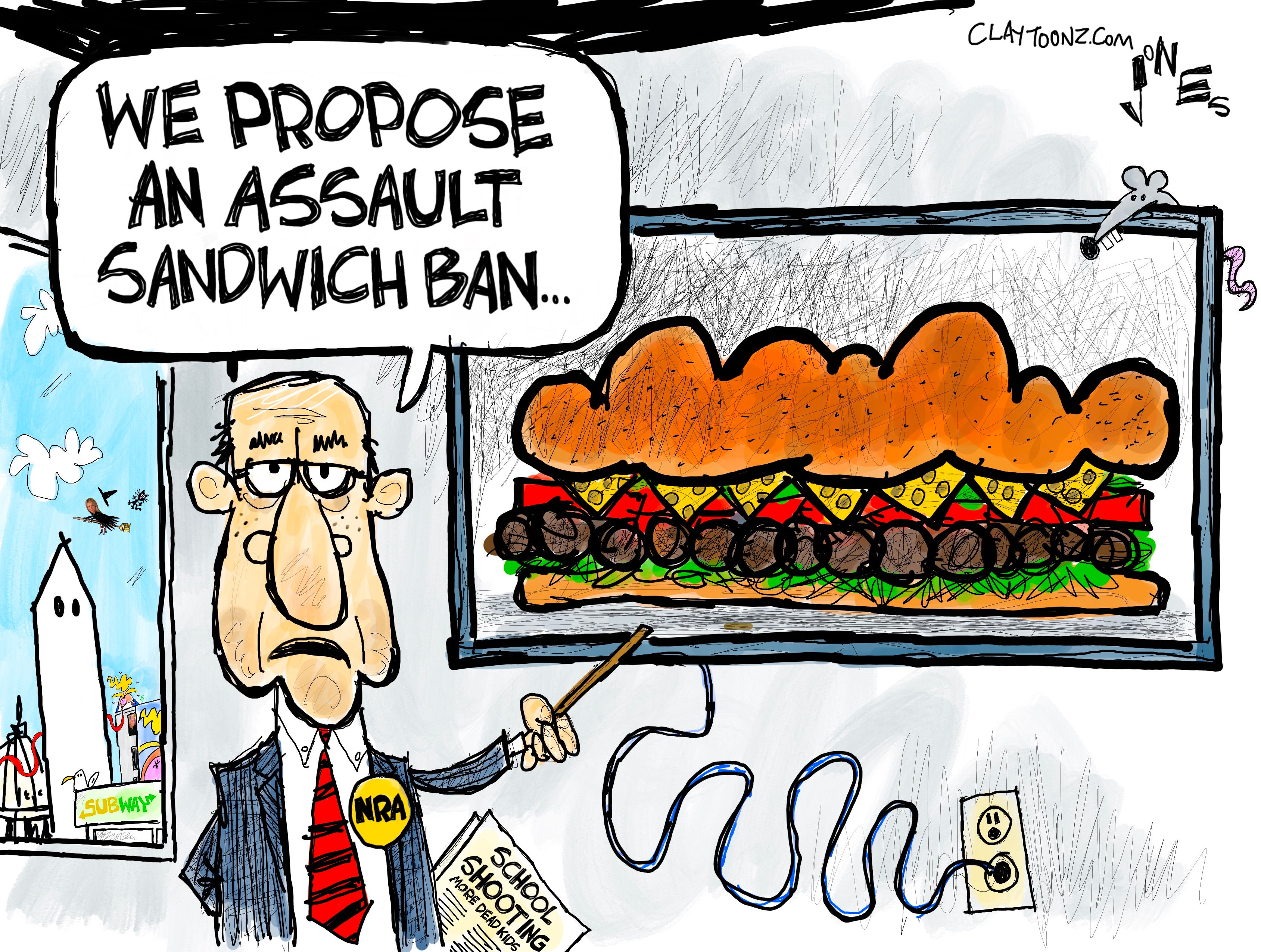
There’s a saying in the legal system that a good prosecutor can get a grand jury to indict a ham sandwich. It’s a criticism of the prosecutorial system because a prosecutor has near-total control of the evidence presented to a grand jury, the defense is not present, and the jury only has to be convinced a crime was committed without a real burden of proof, and on the flimsiest charges.
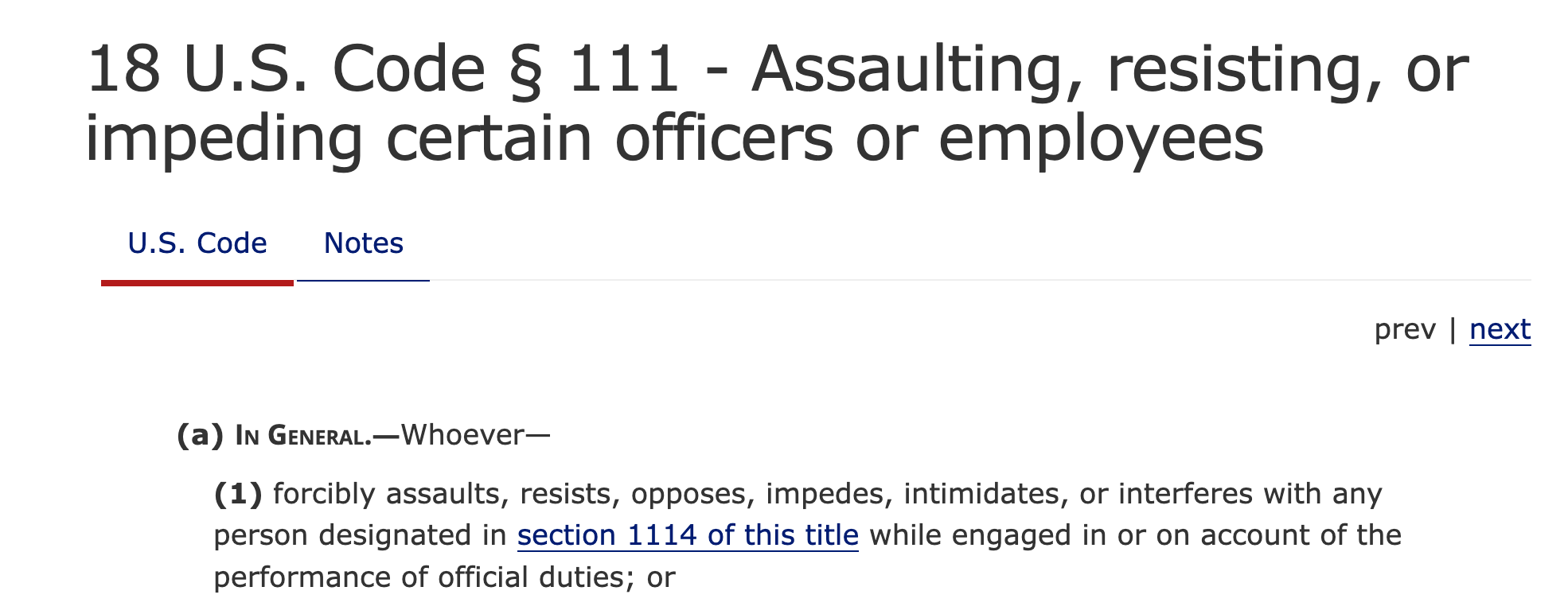
On Tuesday, a grand jury in Washington, DC, refused to indict Sean Charles Dunn, who is accused of throwing a Subway sandwich at a Border Patrol agent. This is a huge loss for US Attorney Jeanine Pirro, who was hired only because Donald Trump liked the way she looked on Fox News. She’s very hateful and always outraged. This is also a failure for Attorney General Pam Bondi, who declared the sandwich attack was part of the “deep state.
I don’t think we have to worry about a “deep state” if the worst they can do is throw sandwiches at cops.
Anyone charged with a federal felony must be indicted by a grand jury. The problem for Trump’s regime is that the voters in Washington, DC, are some of the most intelligent, most educated, and most aware of the issues. These are not West Virginia voters. You would think that if you wanted to indict someone with a felony, you wouldn’t call a grand jury while the city is occupied by the military.
You would think that with the government’s reaction to the sandwich attack, the accused had used one of the weapons used to murder children at a Catholic Church in Minneapolis this week. The Trump regime and Republicans have more outrage over an assault by a sandwich than outrage over a school shooting. (snip-MORE if you can handle it)
Reblog Of A Reblog: Resist!
Brotherton, The “Joe 1”, & More, in Peace & Justice History for 8/29
| August 29, 1758 The first Indian reservation, Brotherton, was established in New Jersey. A tract of three thousand acres of land was purchased at Edge Pillock, in Burlington County. The treaty of 1758 required the Delaware Tribes, in exchange for the land, to renounce all further claim to lands anywhere else in New Jersey, except for the right to fish in all the rivers and bays north of the Raritan River, and to hunt on unenclosed land. History Of The Brotherton Reservation |
| August 29, 1949 The Soviet Union detonated its first atomic bomb in a test at Semipalatinsk in eastern Kazakhstan. It was known as Joe 1 after Josef Stalin, then General Secretary of the Communist Party.  ” Joe 1, the first Soviet atomic bomb Andrei Dmitrievich Sakharov, key developer of the Soviet bomb, later worked for peace The Semipalatinsk test site |
| August 29, 1957 Following consultations among the NATO allies and other nations, the Western (non-Communist) countries presented to the United Nations a working paper entitled, “Proposals for Partial Measures of Disarmament,” intended as “a practical, workable plan to start on world disarmament.” The plan proposed stopping all nuclear testing, halting production of nuclear weapons materials, starting a reduction in nuclear weapons stockpiles, reducing the danger of surprise attack through warning systems, and beginning reductions in armed forces and armaments. |
August 29, 1957 African Americans in Milledgeville, Georgia, wait in line to vote following the Civil Rights Act of 1957. The U.S. Congress passed the Civil Rights Act, the first such law since reconstruction. The bill established a Civil Rights Commission which was given the authority to investigate discriminatory conditions. A Civil Rights Division was created in the Department of Justice, allowing federal prosecutors to obtain court injunctions against interference with the right to vote, among other things. In an ultimately futile attempt to block passage, then-Democrat, former Dixiecrat, and later Republican Senator Strom Thurmond of South Carolina set the all-time filibuster record: 24 hours, 19 minutes of non-stop speaking on the floor of the Senate. A filibuster is the deliberate use of prolonged debate and procedural delaying tactics to block action supported by a majority of members. It can only be stopped with a 60% majority voting to end debate.  Senator Strom Thurmond with his 24-hour filibustering speech |
August 29, 1961 Robert Moses,leader of SNCC The Student Nonviolent Coordinating Committee (SNCC) was pursuing its voter registration drive in Amite County, Mississippi. Of 5000 eligible Negro voters in the county, just one was registered to vote. SNCC leader Robert Moses was attacked and beaten this day outside the registrar’s office while trying to sign up two voters. Nine stitches were required but the three white assailants were acquitted. Bob Moses recorded the incident Hear Moses recall the time |
| August 29, 1970 Between 15 and 30 thousand predominantly Chicanos (Americans of Mexican descent) gathered in East LA’s Laguna Park as the culmination of the Chicano National Moratorium. It was organized by Rosalio Munoz and others to protest the disproportionate number of deaths of Chicano soldiers in Vietnam (more than double their numbers in the population).  There had been more than 20 other such demonstrations in Latino communities across the southwest in recent months.  Three died when the anti-war march turned violent. The Los Angeles Police Department attacked and one gunshot, fired into the Silver Dollar Bar, killed Ruben Salazar, a Los Angeles Times columnist and a commentator on KMEX-TV (he had been accused by the LAPD of inciting the Chicano community). The Chicano Moratorium Ruben Salazar LA Times |
https://www.peacebuttons.info/E-News/peacehistoryaugust.htm#august29
Slavery Abolition, & More, In Peace & Justice History for 8/28
| August 28, 1833 The Abolition of Slavery Act was passed by the British Parliament. As early as 1787, members of the Society of Friends (Quakers), particularly Thomas Clarkson and Granville Sharp, organized to end the slave trade.Since Quakers were barred from serving in the House of Commons, the cause was led by a member of the Evangelical Party, William Wilberforce, ending the international trade in slaves in 1807. By 1827 slaving was considered piracy and punishable by death. The complete ban on slavery itself through the British Empire didn’t happen until this day; Wilberforce was informed of the Act’s passage on his death-bed.  William Wilberforce ============================================ August 28, 1963 Reverend Martin Luther King, Jr. delivered his “I Have a Dream” speech from the steps of the Lincoln Memorial to a crowd of half a million gathered on the Mall in Washington, D.C. They gathered there for jobs and freedom.  The speech   organizing to build the march Film of the March and the speech 1983: Three hundred thousand marched in Washington on the 20th anniversary of MLK’s “I Have A Dream” speech for the second “March on Washington for Jobs, Peace and Freedom.” ============================================== August 28, 1976 60,000 joined the Community of Peace People demonstrations in Belfast and Dublin, Ireland. Peace People was founded by two women, Betty Williams and Mairead Corrigan to decry the painful violence between Catholics and Protestants, between unionists and republicans, and to move the peace process forward in Northern Ireland.  Betty Williams  Mairead Corrigan They jointly won the Nobel Peace Prize for 1976. More about Betty Williams and Mairead Corrigan From the Declaration of the Peace People: “ . . . We want to live and love and build a just and peaceful society. We want for our children, as we want for ourselves, our lives at home, at work and at play, to be lives of joy and peace. We recognize that to build such a life demands of all of us, dedication, hard work and courage . . . We dedicate ourselves to working with our neighbors, near and far, day in and day out, to building that peaceful society in which the tragedies we have known are a bad memory and a continuing warning.” The Peace People’s website |
https://www.peacebuttons.info/E-News/peacehistoryaugust.htm#august28
Chef Jose Andres publicly mocks Trump’s claims about D.C. restaurants

Chef Jose Andres with World Central Kitchen visits a temporary shelter for the victims of the Southern California wildfires at the Pasadena Convention Center in Pasadena, Calif., Thursday, Jan. 9, 2025. (AP Photo/Damian Dovarganes)
Celebrity chef and local D.C. icon Jose Andres is pushing back against Trump’s claim that his federal takeover and law enforcement surge in the nation’s capital has resulted in a “boom town” for the city’s restaurants.
Trump on Monday rejected reports that the flood of federal agents and National Guard troops had hurt D.C. restaurant and nightlife industry.
“Half the restaurants closed, because nobody could go, because they were afraid to go outside,” Trump said. “Now those restaurants are opening and new restaurants are opening up. It’s like a boomtown.”
Andres, in a Tuesday post on X, directly and sarcastically addressed Trump, saying: “I understand why you are confused…all your time in DC you haven’t eaten ONCE outside the White House or your own hotel. I’ve lived here for 33 years, and it’s a flat out lie that half the restaurants have closed because of safety…but restaurants will close because you have troops with guns and federal agents harassing people…making people afraid to go out.”
The Spanish-American restaurateur and founder of the global food charity World Central Kitchen and Trump have exchanged public hostilities in the past.
https://apnews.com/live/donald-trump-news-updates-8-26-2025#00000198-e816-d22d-ad9e-ec165b060000
A school shooting.
Bright Lights In The Dark
I read about this in a few places yesterday, then last night, Joyce Vance’s came in, so here it is. She’s expert and dependable. -A.
No Bill! by Joyce Vance
The Good News You Need Read on Substack
When a grand jury returns an indictment, it’s called a true bill. On those exceedingly rare occasions where they decline to sign off on an indictment prosecutors present to them, it’s called a no bill. In 25 years at DOJ, I never had a grand jury no bill one of my cases. And I can only recall a couple of instances where it happened in the entire district.
Donald Trump’s new U.S. Attorney in the District of Columbia can’t say that. Former judge, Fox News host, and defendant in a defamation case where she is accused of spreading false information about voter fraud, Jeanine Pirro, recently received three no bills—all in the same case. The U.S. Attorney’s Office tried to charge Sydney Lori Reid with felony assault on three separate occasions this month, but the grand jury declined to do so. CNN reports that “In one case this month — related to an FBI agent and an immigration officer allegedly scrapping with a detainee — the federal grand jury in Washington voted ‘no’ three times.”
Proceedings inside of the grand jury are conducted in secret, so there is no way of knowing why the grand jury rejected the charge. Typically, if a grand jury expresses some hesitation over a case, prosecutors will bring in additional witnesses or offer counsel about relevant laws to help alleviate their concerns. To fail to indict not once, but three times, indicates a failure of both competence and judgment.
When asked about her failure, Pirro responded, “Sometimes a jury will buy it and sometimes they won’t. So be it, that’s the way the process works.” But that’s not true. The standard for obtaining an indictment is a low one: The prosecution need only persuade the grand jury that probable cause to proceed on the charges exists. That’s a far lower bar than the requirement that the government prove a crime was committed beyond a reasonable doubt before a trial jury can convict. Any prosecutor who doesn’t back off of a case where they can’t even convince grand jurors that probable cause exists, knowing that much more will be expected of them at trial, is wasting taxpayer resources. Prosecutors have plenty of cases. Move on and do a righteous one. But apparently, that’s not how the D.C. U.S. Attorney’s Office operates these days.
Prosecutors, who have 30 days following an arrest like Reid’s to obtain an indictment, told a judge they now plan to bring misdemeanor charges against Reid. Misdemeanor charges can be brought by prosecutors without the need to present them to a grand jury for approval. But we already know at least some of the facts in the case, because a statement of facts was filed in support of the arrest warrant.

The affidavit alleges that Reid assaulted FBI agent Eugenia Bates. Reid was video recording agents outside of the D.C. jail, where at least two individuals were being arrested as “known gang members” and transferred into ICE custody. Reid was directed to step back, and according to the affidavit, she “got in Officer Lang’s face.” He said she smelled of alcohol and tried to interfere with the transfer of custody. According to the government, an officer pushed her against a wall, but she continued to struggle after being told to stop.
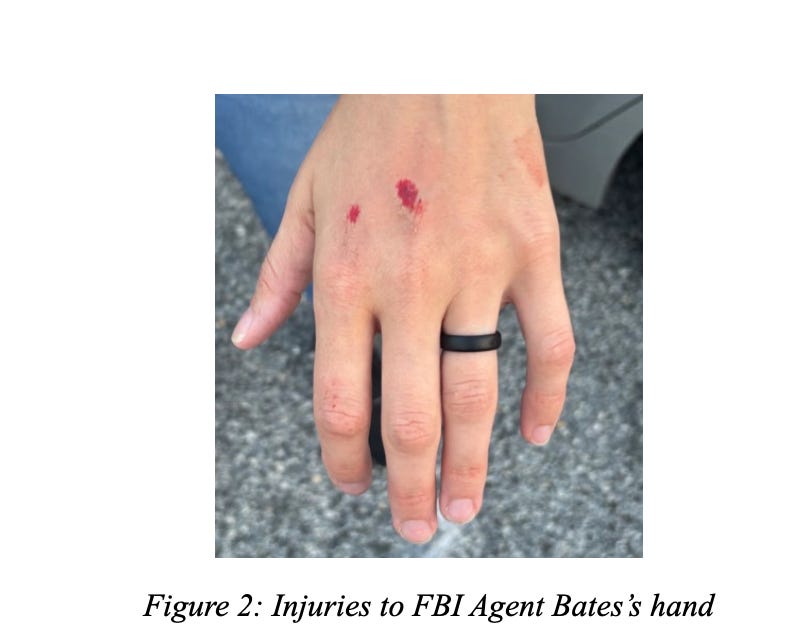
Here’s the heart of the allegation against Reid: “Agent Bates came to Office[r] Lang’s assistance in trying to control REID. REID was flailing her arms and kicking and had to be pinned against a cement wall. During the struggle, REID forcefully pushed Agent Bates’s hand against the cement wall. This caused lacerations on the back side of Agent Bates’s left hand.”
To convict on the federal felony assault charge, the government would have to establish that Reid forcibly assaulted a federal agent. A “forcible assault” is an intentional threat or attempt to cause serious bodily injury by a person who has the apparent ability to do so, including any intentional display of force that would cause a reasonable person to expect immediate and serious bodily harm or death. The statement of facts alleges that Reid “intentionally and forcibly obstructed the transfer of suspects into FBI custody and made physical contact with FBI Agent Eugenia Bates and inflicted bodily injury in violation.” The grand jury didn’t buy, despite having three opportunities to do so, that there was probable cause, let alone proof beyond a reasonable doubt, to believe that some or all of that happened.
The lacerations, which were pictured in the statement of facts and presumably shown to the grand jury, seem relatively minor. And it’s difficult to see, at least with this statement of the facts, how a grand jury could conclude, as it must, that Reid was the cause of those “lacerations” or even acting voluntarily when they happened. Assuming they could prove all of that, even small cuts like these could hypertechnically constitute assault. But it’s easy to imagine a grand jury viewing charging it as a felony as overreaching.
Judge Sparkle L. Sooknanan will hold a hearing in the matter on Thursday morning at 11:30.
The grand jury process still works as a check and balance on prosecutors, as the Constitution intends. Trump may want you to think he’s all-powerful, but guardrails are still in place. His administration can’t bring felony charges without a grand jury’s approval, an important protection not just for Ms. Reid but for others, as DOJ’s portfolio of revenge investigations continues to grow.
We talked previously about a grand jury in Los Angeles that declined to indict. Now, it’s spread to D.C. And grand juries are only the first layer of guardrails in the criminal justice system, where they are joined by trial juries, judges, and the appellate process.
You’ve heard the line—the one that says prosecutors can indict a ham sandwich, that it’s just that easy. Next stop in D.C., seeing whether they can indict a Subway sandwich. They should think twice after their experience in Ms. Reid’s case with bringing marginal prosecutions to please the president. That’s not justice.
(snip)
We’re in this together,
Joyce
W.E.B. DuBois, & The Peace Torch in Peace & Justice History For 8/27
August 27, 1963 DuBois in Ghana W.E.B. DuBois, the black American sociologist, scholar, author, pan-Africanist, communist, and one of the founders of the NAACP, died in Accra, the capital of Ghana, where he had expatriated. He had been charged and tried in the U.S. for being a “foreign principal” in 1951 because he chaired the The Peace Information Center. The Center was dedicated to banning nuclear weapons but Secretary of State Dean Acheson designated it a Communist front group. W.E.B. DuBois background |
August 27, 1967 The Peace Torch Marathon arrives at the Mall. The San Francisco Peace Torch began its two-month journey to Washington, D.C. for a demonstration against the Vietnam War. |
https://www.peacebuttons.info/E-News/peacehistoryaugust.htm#august27
 Scottie's Playtime