A High Court in India has ruled that trans women are women. (Getty)
A court in India has decreed that trans women are women.
In a landmark ruling for the country, after rejecting claims that womanhood was preserved only for those who can bear children, the High Court of Andhra Pradesh ruled that trans women were “legally entitled” to recognition as women.
Presiding over the case, justice Venkata Jyothirmai Pratapa decided that tying the definition of women to pregnancy was “legally unsustainable” and contradicted India’s constitution, which emphasises equality before the law.
Quoting a Supreme Court decision from 2014, which legally recognised the rights of “third gender” individuals, Pratapa said that prohibiting trans women’s right to identify as women “amounted to discrimination”.
The case was brought to the high court in 2022 after transgender woman Pokala Shabana looked to use a section of the Indian penal code to seek protection from her in-laws, whom, she said, had been abusive towards her.
The court sided with trans women. (Getty)
Her husband’s parents petitioned the court to deny her use of Section 498A, which protects women from cruelty by a husband or relatives, arguing that it only applied to cisgender women. They claimed that trans women don’t meet the legal definition of women under Indian law because they cannot get pregnant and said Shabana’s allegations of harassment lacked evidence.
However, the judge said that articles 14, 15 and 21 of the constitution, which guarantee a variety of discrimination protections, including the right to life and personal liberty, meant trans women’s rights to be recognised as women superseded the law.
“A trans woman, born male and later transitioning to female, is legally entitled to recognition as a woman,” he wrote in his ruling. “Denying such protection by questioning their womanhood amounts to discrimination.”
Trans activist and artist Kalki Subramaniam told the Washington Blade that she was relieved and delighted to see the court “upholding our basic human right to be identified as what we want.” She went on to say: “For [the] transgender community, especially trans women, this verdict means a lot.”
The Indian government has been under mounting pressure to modernise its laws and policies on LGBTQ+ rights. Same-sex marriage is still illegal, despite growing support for its legalisation.
Prime minister Narendra Modi’s government have previously labelled same-sex marriage an “elitist” viewpoint that “seriously affects the interests of every citizen”.
An affidavit establishing the government’s views on same-sex unions, in 2023, proclaimed that marriage was valid only between “biological males and females [and that] this definition [was] socially, culturally and legally ingrained into the very idea and concept of marriage and ought not to be disturbed or diluted by judicial interpretation”.
Share your thoughts! Let us know in the comments below, and remember to keep the conversation respectful.
June 29, 1925 The South African parliament passed a bill excluding black, coloured (mixed race) and Indian people from all skilled or semi-skilled jobs.
June 29, 1963 A mass “walk-on” (trespass) was organized at a chemical and biological warfare facility in Porton Down, England. These weaponized agents had been researched and produced there since 1916; it’s now known as the Defence Science and Technology Laboratory. Protesters demand an end to germ warfare in 1963 at Porton Down (Getty) Unconscionable activities at Porton Down (From 2004)
Before the establishment of the Hollywood Production Code in the 1930s, filmmakers deployed gender and sexuality stereotypes for glamour, humor, and drama alike.
With Pride month in full swing, it’s an ideal moment to look at historical queer representation, particularly in the early days of Hollywood cinema. The first few decades of the twentieth century were not only an active time for a growing medium, but also one in which crises of confidence, economy, masculinity, and culture changed how filmmakers presented queer characters and how (or if) audiences received them. Film professor David Lugowski summed up queer representation in early film neatly, writing that “[a]s cinema learned to talk, so did it also ‘speak’ about the gender roles so crucial to Hollywood film.”
Cinema moved from silent film into “talkies” in the late 1920s, with Al Jolson’s The Jazz Singer typically credited as the first feature to integrate sound and dialogue (it may, however, be a more complicated exercise to locate a true “first”). The late twenties also saw the onset in America of the Great Depression, and, at least as far as entertainment is concerned, many scholars link displays of sexuality and queerness in films in the late 1920s and early 1930s to a larger crisis in masculinity. Economic collapse, the story goes, leads to a broader crisis of identity and gender role. “In short,” Lugowski writes, “men found their gender status, linked to notions of ‘work’ and ‘value’ promulgated by capitalist structures and ideologies, in jeopardy.”
As film became more pervasive and culturally integrated under these circumstances, stereotypes started to be read as evidence that gender performance was equivalent to sexual orientation. Basic types in Hollywood films were clear. For men, queer types were usually either the “dithering, asexual ‘sissy,’” writes Lugowski, or “the more outrageous ‘pansy,’ an extremely effeminate boulevardier type sporting lipstick, rouge, a trim mustache and hairstyle, and an equally trim suit, incomplete without a boutonniere.” Lesbian representation favored masculine drag—tailored suits, hair cut short or slicked back, and sometimes male-coded accessories like a monocle or a cigar. “Objections arose,” Lugowski explains, “because she seemed to usurp male privilege; perhaps the pansy seemed to give it up.”
Prior to the 1930s, these stereotypes appear to have been commonly understood and deployed, for glamour, humor, and drama alike. Audiences may have responded variably—with titillation, acceptance, or shock, depending on the individual—but no one could say the film industry wasn’t inclusive of different relationship story arcs.
In a Code world, no film should risk lowering an audience’s moral standards nor should evil or immorality be presented except as a cautionary tale.
In Pandora’s Box (1929) Louise Brooks wooed a father and son as well as a countess in a tuxedo. Greta Garbo portrayed the title character Queen Christina in a 1933 film about the seventeenth-century Swedish monarch, widely assumed to have been queer. Garbo, along with Marlene Dietrich and other leading ladies such as Joan Crawford, Myrna Loy, and Barbara Stanwyck, were members of a private professional group of Hollywood women—all of them quietly bisexual or lesbian—known as the “Sewing Circle.” Palmy Days (1931) features not only a proud flower-wearing “pansy” character, but drag, donuts, and a sexy Busby Berkeley dance number.
These portrayals took on new weight and context with the passage of the Hollywood Production Code. The Code, a set of self-regulatory guidelines applied to film production, was begrudgingly accepted by film execs, writes Steven Vaughn. That industry figures would accept content restrictions seems strange, until you consider that it was a hold-your-nose solution preferable to either intrusive government regulation or control by investment banks or funders, who preferred their investments be as stable as possible. The Production Code of 1930 therefore came into being, heavily influenced by religious collaborators and proclaiming two linked truths: “Motion pictures are very important as Art,” and “The motion picture has special Moral obligations.” In a Code world, no film should risk lowering an audience’s moral standards nor should evil or immorality be presented except as a cautionary tale.
The Production Code embraced a list of “don’ts” and “be carefuls.” On the “don’ts” list, films were to eliminate blasphemy and profanity, depictions of drug use, miscegenation, and “any inference of sex perversion,” which implied homosexuality. “Be carefuls” enumerated in the 1956 version of the Code urged “the careful limits of good taste” around bedroom scenes, hangings, liquor, childbirth, and “third degree methods.”
The well-known English critic Anthony Slide explains that the Code particularly targeted queer representation in film.
At first, to be honest, not much changed. Hollywood cinema remained as queer as ever, and during the harshest years of the Depression, the industry engaged in some of its most boundary-pushing and queer storytelling efforts.
“Not only does the number of incidents increase,” writes Lugowski,
but we also see more explicit references, longer scenes, and sometimes surprisingly substantial characters. Perhaps most important, the pansy and lesbian characters of the period remain, respectively, effeminate and mannish but become increasingly sexualized in 1933–34.
To wit: in 1934, Jack Warner (of Warner Brothers Studio) felt perfectly comfortable ignoring enforcer Joseph Breen’s firm letter and repeated phone calls about that year’s Wonder Bar. Starring Al Jolson and based on a Broadway musical of the same name, the film included a scene in which a tuxedo-clad man glides onto a busy dance floor and taps the shoulder of another man dancing with a blonde in finger waves and a white gown. He asks, “May I cut in?” The woman answers, “Why, certainly!” and reaches out her arms expectantly, at which point the two men embrace each other and whirl off down the dance floor. Jolson, from the bandstand, observes the exchange and quips, “Boys will be boys. Woo!”
By the end of 1934, though, the Code was more than just a feel-good document for moralists. It was enabled with specific enforcement machinery in response to religious lobbying and the threat of significant industry opposition from the Catholic church.
“[R]ather than risk possible state and federal censorship,” notes Chon Noriega, “as well as anticipated boycotts by the ten-million-member Catholic Legion of Decency, Hollywood studios proferred [sic] strict self-regulation, empowering the Hays Office—now under Joseph Breen—to enforce its four-year-old Production Code.”
Once the Production Code had teeth, filmmakers were restricted in what they could include in their work. If they violated Code standards, the Production Code Administration (PCA) could withhold its seal of approval, making distribution difficult. The possibility of appeal was slim to none, with a board of PCA directors making the call, not fellow filmmakers. In 1947, with the Code not even fifteen years in effect, writer and censor Geoffrey Shurlock noted with some pleasure that
Queer characters and storylines were less common, or circumscribed, until the Code weakened and ultimately fell in the 1960s (the success of boundary-pushing films like Some Like It Hot only helped in this regard). It remained true in film that villains, especially, were more likely to be accepted with queer coding. But a large number of films—more than perhaps one might expect—remain a testament to Hollywood’s longtime engagement with queer characters and themes. (snip)
June 28, 1916 A one-day strike by 50,000 German workers was organized to free Socialist anti-war leader Karl Liebknecht, charged with sedition for his criticism of the government and the war later known as World War I. He was the first ever to be expelled from the Reichstag, the German parliament, voted out for his opposition to Germany’s role in the war. ——————————————————————————————————— June 28, 1969 Patrons at the Stonewall Inn, a gay bar in New York City’s Greenwich Village, being subjected to routine anti-homosexual harassment by the New York City police raiding the bar, spontaneously fought back in an incident considered to be the birth of the gay rights movement. Riot veteran and gay rights activist Craig Rodwell said: “A number of incidents were happening simultaneously. There was no one thing that happened or one person, there was just . . . a flash of group, of mass anger.” About Craig Rodwell A group of drag queens, who had been mourning the death earlier in the week of Judy Garland, mocked the police and threw things at them, and police were forced to retreat into the bar as the crowd of supporters grew; disturbances continued for days. The bar is now on the National Register of Historic Places. Stonewall and all it has inspired —————————————————————————————————- June 28, 1987 The Iranian Kurdish town of Sardasht was attacked by Iraqi aircraft with chemical weapons during the Iran-Iraq War. Saddam Hussein had started the war expecting an easy victory against the new Shiite Islamic republic, even though Iran had three times the population. Victims of the mustard gas attack on Sarsasht, Iran ——————————————————————————————————- June 28, 2005 Seen in New York City on June 28, 2005
I’ve had this idea for a few days, but I wasn’t sure about it. Then Defense Secretary Pete Hegseth unfairly exploded on a reporter for merely doing her job, so I decided he deserves this. Fuck Pete Hegseth (but not literally).
Stinky Pete attacked a reporter, from Fox News of all places, for doing her job. Her crime was asking Pete a question.
Jennifer Griffin of Fox News asked about whether there was any certainty that highly enriched uranium was stored at the mountain bunker bombed by the US, given that satellite photos showed more than a dozen trucks were seen there two days in advance.
Pete replied, “Of course, we’re watching every single aspect,” Hegseth said. “But, Jennifer, you’ve been about the worst, the one who misrepresents the most intentionally what the president says.”
How did Griffin misrepresent anything that Trump has said with that question? The question was based on the fact that satellite photos showed trucks at the site days before the bombing,” and while Trump was publicly mulling over whether or not to bomb it. In fact, it’s a very important question and there’s nothing wrong with it, even to the point that it shouldn’t piss anyone off, even a goose-stepping drunky fascist who can’t keep his dick in his pants. But, I guess the question does challenge the talking points and propaganda the regime has put out. This question was apparently worse than the time Sean Spicer was asked about crowd sizes. How dare you!!!!
After the bombing, Trump said Iran’s nuclear program was “totally obliterated.” As it turns out, not so much unless “totally” doesn’t mean totally anymore. Maybe they could say it was slightly obliterated. This is like the time when the military killed ISIS leader Abu Bakr al-Baghdadi, and Trump said he “died like a dog,” while telling other huge lies about the operation.
An early intelligence assessment leaked to media outlets on Tuesday suggested that the strikes only set Iran’s enrichment program back by a few months and did not destroy its core components.
Any challenge to the narrative that the sites weren’t “totally oblitereated” pisses TACO off nearly as much as being called TACO.
The preliminary analysis was produced by the Defense Intelligence Agency, the Pentagon’s intelligence arm, and reportedly found that the bombing of Iran’s nuclear sites sealed off the entrances to two facilities but did not collapse their underground buildings. Basically, Trump bombed the fuck out of their doors.
One of the idiot trolls at GoComics claimed the media was following Iran’s talking points, but no…we’re following US intelligence on this. By the way, US intelligence, or any other intelligence, doesn’t include Donald Trump. This is not the first time Trump has had issues with American intelligence. He once sided with Putin over US intelligence.
I don’t know which makes the regime angrier, the analysis or the leak. It sure pissed off White House SpokesBarbie Karoline Leavitt.
Leavitt rejected the intelligence report and accused CNN, which first revealed it, of “fake news.” She later sent a tweet. (snip-MORE, tweet’s on the page)
June 27, 1905 The IWW (Industral Workers of the World) was founded in Chicago.
June 27, 1954 The first atomic power plant opened at Obninsk, Russia, near Moscow, and could generate up to 5 megawatts. The plant was ordered by Josef Stalin and—being graphite-moderated and water-cooled—could be switched to plutonium production in case it was needed. The facility was shut down in 2002.
June 27, 1954 Military action directed and funded by the CIA (Operation PBSUCCESS) forced the resignation of the Guatemalan President, Jacobo Arbenz Guzman. Winner of the country’s first election under universal suffrage, and having taken office in the country’s first peaceful transition of governments, he was accused by the U.S. of Communist influence. Following the coup d’etat, hundreds of Guatemalans were rounded up and killed. Jacobo Arbenz Guzman Between 1954 and 1990, human rights groups estimate, the security forces of successive military regimes murdered more than 100,000 civilians, including genocide against Guatemalan native peoples. More about Arbenz The CIA’s own documents on the action
June 27, 1973 President Nixon’s former White House counsel, John W. Dean, III, told the Senate Watergate Committee about Nixon’s “enemies list.”He released a 1971 memo, written by presidential advisor (now Rev.) Charles Colson, proposing the use of “available federal machinery to screw our political enemies.” John Dean Twenty persons were to be subjected to IRS audits, litigation, prosecution, or denial of federal grants, and an additional list contained 200 names of other individuals and organizations considered enemies of the administration. The complete Enemies List and memos from Colson The president’s misuse of government agencies and powers, in pursuing those he saw as his political enemies, was the basis for one of the articles of impeachment that forced Nixon from office.
June 27, 1978 Seven citizens of the Soviet Union sought refuge in the American Embassy in Moscow as escape from government oppression of religious minorities. The Pentecostal Christians, known as the Siberian Seven, from two families, the Vashchenkos and Chmykhalovs, spent months in the basement of the embassy awaiting permission for all family members to emigrate to the U.S. One of their sons was already in prison for defying the military draft, and another was about to reach conscription age. Recently released from prison, Baptist Pyotr Vins was twice assaulted by police after trying to arrange his family’s emigration. His father Georgi, national leader of dissident Baptists, though due for release from a labor camp, faced five additional years of Siberian “exile.” The leader of a breakaway Seventh-day Adventist group was sentenced to five years of hard labor at age 83.
June 27, 1980 President Jimmy Carter signed a measure that required approximately 4 million U.S. men age 18 to 25 to register for the military draft, and all 18-year-old males thereafter. If there were to be a crisis, registered men would be inducted as determined by age and a random lottery.
June 27, 1986 The International Court of Justice (“World Court”) decided that the United States violated international law as well as its bilateral Treaty of Friendship, Commerce and Amity with Nicaragua through its use of force against the Central American country. This included a trade embargo, the mining of harbors and bombing of airfields, as well as furnishing financial, military and logistical support to the so-called Contra insurgents. The Contras’ goal was to overthrow Nicaragua’s popular left-wing government. The Court also ruled that the U.S. should compensate the country financially.The Reagan administration had originally contested the standing of the Court to rule on such an issue, and it had walked out of Court after losing the ruling on jurisdiction, despite its treaty obligation to appear. The Court’s judgment to act had been decided 11-3 on almost all counts, those voting for the U.S. position being an American, a British and a Japanese judge. THE WORLD COURT IN ACTION by Howard N. Meyer More about the Court’s decision
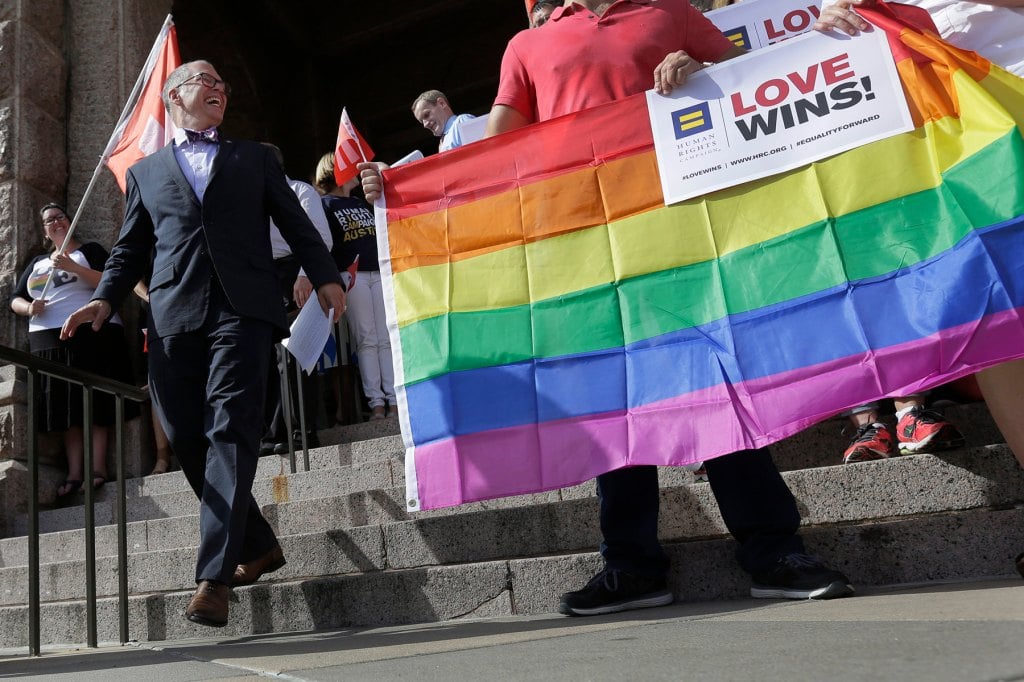
It happened just a few weeks ago: Jim Obergefell was moving things in his office when he came across the ashes of his late husband, John Arthur, now 12 years gone. Arthur had last wishes for his ashes. Obergefell had yet to fulfill them.
“And it struck me that, oh, I am actually now mentally, emotionally ready to take care of John’s ashes,” Obergefell told The 19th. “It was the first time that I had that feeling so clearly and so strongly.”
Obergefell, 58, is ready to move on. Not exactly from the love of his life or the history-making Supreme Court decision that came after Arthur died. But certainly from the insecurities straight America was grappling with a decade ago about same-sex unions.
Obergefell is that Obergefell: the named plaintiff in the landmark lawsuit that extended marriage equality to every state in the nation in 2015. Ten years later, he celebrates that win and the many ways it rewrote his life. And in a time when LGBTQ+ rights are again under assault, he is looking to the future — of the queer rights movement and also his own.
A journey to the Supreme Court
Obergefell’s journey to the Supreme Court was hardly destined. It began 12 years ago, on June 26, 2013, when the Supreme Court struck down the Defense of Marriage Act, a federal law that prohibited the government from recognizing same-sex marriages.
Obergefell and Arthur had been together for 21 years at the time. The two had discussed getting married before. But they wanted it to be legal, and their home state of Ohio didn’t offer same-sex marriages.
Arthur was gravely ill with ALS, a progressive neurodegenerative disease, and he barely left his home hospice bed.
After the ruling, Obergefell leaned over to Arthur, hugged, then kissed him.
“Let’s get married,” he said.
Arthur agreed.
The logistics were not easy. Arthur was in no shape to travel, and the couple could not wed in Ohio. Obergefell researched and found that Maryland would let him get a marriage license even with only one of them present. But both would need to arrive in the state for the ceremony.
When friends and family learned about their predicament, they pooled together money to charter a medical jet for Arthur. The two flew to Baltimore. Over the course of 45 minutes, they exchanged vows on the tarmac before flying home.
“In the days that followed, we said the word ‘husband’ hundreds of times a day,” Obergefell said on the Decidedly Podcast in 2023.
But just five days later, their joy was muted when civil rights attorney Al Gerhardstein informed them that because of Ohio’s ban on same-sex marriage, Arthur would be listed as single in death.
Arthur and Obergefell were angry. The couple sued the state of Ohio in federal district court and won. Three months later, Arthur died.
The following year, Obergefell, still in mourning, lost on appeal. But he refused to believe he might lose altogether.
“I just kept going,” Obergefell said. “It was the right thing to do.”
On June 26, 2015, he won. For the country, the win was immensely practical. Many told Obergefell it gave them so much hope it saved their lives. For Obergefell, it meant a legacy for the man he loved.
“I made promises to John to love, honor and protect him, and I was going to keep doing that,” he said.
In the decade since Jim Obergefell won his Supreme Court case that made same-sex marriage federally legal, hundreds of thousands of same-sex couples have married in the U.S. (Eric Gay/AP Photo)
Changing history
It’s difficult to overstate the impact of Obergefell’s case on the nation or the world. Since the 2015 ruling, the Williams Institute at the UCLA School of Law estimates, 591,000 queer couples have wed, generating an estimated $5.9 billion in wedding spending for state and local economies.
It has also radically transformed Obergefell’s life. Introverted and unassuming, he has spent the last decade campaigning for LGBTQ+ rights. He helms Equality Vines, a wine company that donates its proceeds to advancing civil rights causes.
It’s a position that makes him deeply proud if not a little fatigued.
“I’m not tired of talking about it,” he said of the 10-year anniversary of the ruling. “I’m just physically tired from all of the interviews and the photographers and the speaking gigs and the events. Yes, I’m exhausted.”
For 12 years, Obergefell has kept Arthur alive through retelling their story countless times in courtrooms and for the media. That exercise, of telling and retelling, helped Obergefell process his profound loss.
But he has never recoupled. It wasn’t that Arthur didn’t want him to. In fact, Arthur told him regularly that he wanted him to find love again. He asked his friends and family to tell Obergefell that he wanted him to find love after he was gone.
“I know it was sincere, because he told me that he had other people tell me that,” Obergefell said.
It isn’t about the pressure he feels as the face of marriage equality, he said, though part of him wonders what it would be like to date after making history.
“I don’t know how to date,” he confessed. “I’m clueless when people flirt with me, and as much as I hate it, and I don’t go into any conversation or anything like this, but you know, there’s that part of me that sometimes wonders, you know, are they interested in me as a person, or are they interested in me as Jim Obergefell, named plaintiff?”
Obergefell’s name has become synonymous with marriage equality in the United States, an issue that has not always united the LGBTQ+ community. Some queer activists have argued that same-sex marriage was a misguided goal for the movement as queer youth continue to face high rates of homelessness and transgender people grapple with police violence and incarceration, among other issues.
More work to do
Obergefell, too, is worried that the needs of the community’s most vulnerable have gone unmet. He has watched horror-struck over the last five years as state legislatures have moved to restrict transgender rights.
“We need to fight for every marginalized community, because the queer community includes every marginalized community, and equality for one is pointless without equality for all,” he said. “I didn’t go to the Supreme Court just so White, cisgender, gay men like me could get married.”
Despite all of the setbacks in LGBTQ+ rights, and even threats to Obergefell’s game-changing victory, he is hopeful — and feels stronger than ever. People assume his case was difficult for him. It was, but the path was also obvious, to him and to Arthur. They loved each other.
“If we weren’t willing to fight for each other and for what was right, then what’s the point?”
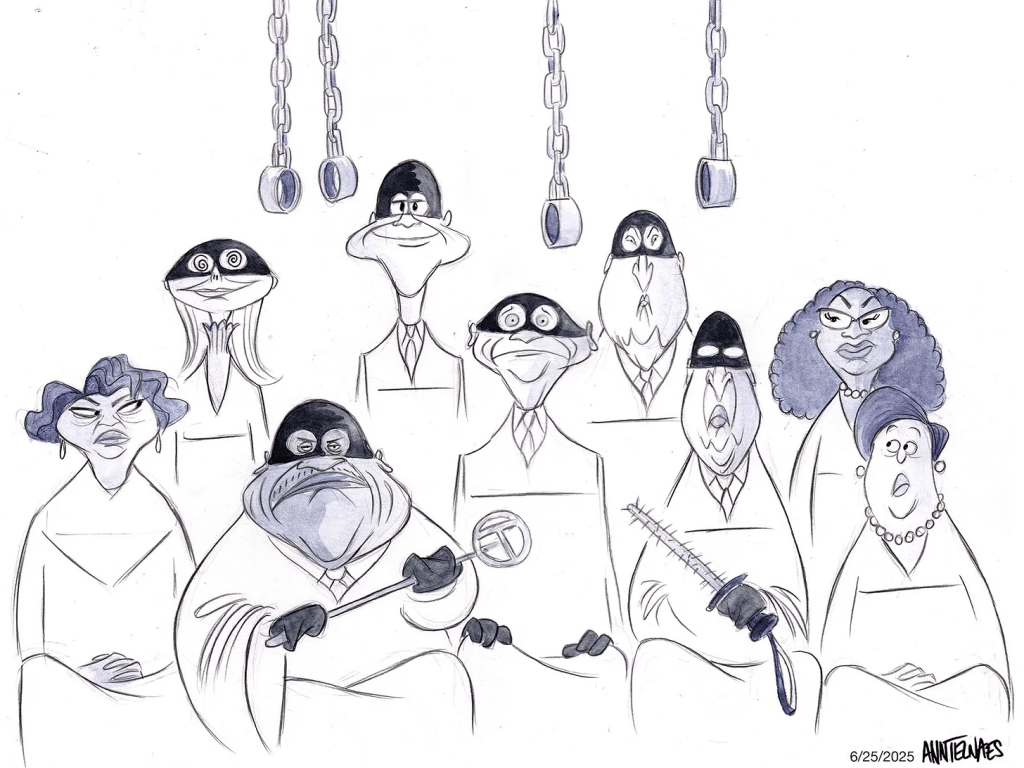
SCOTUS allows deportations to “third party countries” by Ann Telnaes
The Supreme Court justices pauses a federal judge’s ruling Read on Substack
Justice Sonia Sotomayor dissented and was joined by Justices Elena Kagan and Ketanji Brown Jackson. Sotomayor wrote, “the Court finds the idea that thousands will suffer violence in far-flung locales more palatable than the remote possibility that a District Court exceeded its remedial powers when it ordered the Government to provide notice and process to which the plaintiffs are constitutionally and statutorily entitled.”
I gotta be honest with you. I didn’t think Trump’s F-bomb was anything unique or scandalous in the New Normal. Sure, it’s not presidential for a president to say, “They don’t know what the fuck they’re doing” to reporters while standing in the White House driveway, but none of this has been presidential.
So, I didn’t think it was cartoon worthy, but then I saw one yesterday, and another one today, and then another one, and then another one, which means there are going to be at least 12 more by the end of the day. I decided to use it myself in doing a cartoon on the New York City Democratic mayoral primary, but put a little twist on it.
Political Cartooning 101 lesson: Use the F-bomb in your cartoon as a tool, but don’t make the cartoon about the F-bomb…unless it’s too funny to resist.
Former New York Governor Andrew Cuomo was and maybe still is trying to resurrect his political career after resigning in disgrace after being accused of sexual harassment by at least 11 women, which is less than half the number of women who have accused Donald Trump, yet his political career is still going. And former senator Al Franken is now playing a fictional senator in a limited Netflix series.
Cuomo was the favorite to win the Democratic primary, but unfortunately for him, it was rank-choice voting, where voters rank candidates for office in order of their preference. This system gave the nomination to young upstart Zohran Mamdani, an Islamic democratic- socialist state assemblyman with very few legislative accomplishments. And this is what I meant when I said Cuomo was/is trying to resurrect his political career.
Of course, Cuomo’s bid to become the Democratic nominee for NYC’s mayor is over, but not his bid to become mayor…unless he changes his mind and removes himself from the ballot, as Cuomo is now running as an Independent.
Previously, victory in the Democratic primary all but guaranteed a move to Gracie Mansion, as Democrats outnumber Republicans 6-1 in the Big Apple. But now, it may be a five-way race.
Rank-choice will not be implemented in the general election, where Mamdani will have to compete once again against Cuomo, but also against current mayor and bribe-taker Eric Adams (who will have Donald Trump’s support), Guardian Angels founder and Republican nominee Curtis Sliwa (who had no opposition for the nomination), and former federal prosecutor Jim Walden, who is also running as an Independent. And I’m sure there are a few dozen other never-heard-of-before dingbats on the ballot.
While some pollsters may predict that Mamdani will win the general election, you can’t be too sure with his socialist platform, that Cuomo’s still in the race, and NYC has the largest Jewish population in the world outside Israel. If Cuomo does drop out, I’d predict Mamdani to win.
One thing you can expect during the race is chaos, and more of this… (snip-MORE, and though well-written, the story is not pretty)
June 26, 1894 Mohandas Gandhi (center) as a young lawyer in Durban, South Africa in 1894 Mohandas Gandhi, a young Indian lawyer from Porbandar in Gujarat province, urged the Natal (a province in South Africa) India Congress to run a campaign of education and peaceful noncooperation to assert and protect their rights as ethnic Indians in South Africa. Within days of Gandhi’s arrival in South Africa the previous year, though he was a British subject and South Africa was under British rule, he had been thrown off a train, assaulted by a white coachman, denied hotel rooms, and pushed off a sidewalk because his skin color defined his status and limited his rights. “Truly speaking, it was after I went to South Africa that I became what I am now. My love for South Africa and my concern for her problems are no less than for India….” – Mohandas Gandhi, 1949
“Gandhiji was a South African and his memory deserves to be cherished now and in post-apartheid South Africa. The Gandhian philosophy of peace, tolerance and non-violence began in South Africa as a powerful instrument of social change . . . This weapon was effectively used by India to liberate her people.” – The Rev. Martin Luther King, Jr. [King used the same techniques to combat racism in the U.S.]
“We must never lose sight of the fact that the Gandhian philosophy may be a key to human survival in the twenty-first century.” – Nelson Mandela, in his speech opening the Gandhi Hall in Lenasia, South Africa, September 1992 [source: anc.org.za] Mohandas Gandhi, 1949]
Also known as Mohandas Karamchand Gandhi was born on October 2, 1869, in Porbandar, India. He was known to the Indian people as Mahatma, meaning great-souled, a person revered for high-mindedness, wisdom and selflessness. Ghandiji adds a suffix to the last name to show respect. He was also known as Bapu which means great father.
June 26, 1918 Pacifist and socialist organizer Eugene V. Debs was arrested for having given an anti-war speech in Canton, Ohio, ten days earlier. He was charged with “uttering words intended to cause insubordination and disloyalty within the American forces of the United States, to incite resistance to the war, and to promote the cause of Germany,” This last was despite his repeated and vehement criticism in the speech of Germany and its landed aristocracy, known as the Junkers. “And that is war in a nutshell. The master class has always declared the wars; the subject class has always fought the battles.The master class has had all to gain and nothing to lose, while the subject class has had nothing to gain and all to lose — especially their lives.”
June 26, 1945 On the stage of San Francisco’s Veterans Auditorium (now known as the Herbst Theatre in the center of the War Memorial Veterans Building), delegates from 50 nations signed the United Nations Charter, establishing the world body as a means of saving “succeeding generations from the scourge of war.” The U.S. Post Office issues a commemorative envelope. The Germans had just surrendered to the Allied forces in April; the war in the Pacific continued. Read the Preamble (included is full text of the Charter) Collection of photos from Founding of the UN – San Francisco Conference (I love looking at these photos! -A.)
June 26, 1955 Flyer used to promote the Freedom Charter The South African Freedom Charter was adopted at the Congress of the People at Kliptown near Johannesburg. “We, the People of South Africa, declare for all our country and the world to know that South Africa belongs to all who live in it, black and white, and that no government can justly claim authority unless it is based on the will of all the people . . . .” The Congress of the People in Kliptown Text of the Charter:
June 26, 1963 President John F. Kennedy addressed 120,000 West Berliners and concluded his speech, “All free men, wherever they may live, are citizens of Berlin, and, therefore, as a free man, I take pride in the words: “Ich bin ein Berliner!” The East German government had stopped all travel and commerce between the Soviet-controlled and the American/British/French-controlled parts of the city in 1961. west. John F. Kennedy, West Berlin, June 26, 1963 They then built a 166 km-long (103 miles) wall to separate the two Berlins and to stop emigration from east to west. Watch the speech
June 26, 2003 The U.S. Supreme Court found a Texas “anti-sodomy” law unconstitutional, overruling, and apologizing for, the 1986 Bowers v. Hardwick decision. The 6-3 decision in Lawrence v. Texas said that citizens have the “right to liberty under the Due Process Clause gives them the full right to engage in private conduct without government intervention.” Text of the decision









 Scottie's Playtime