May 24, 1774 The Virginia House of Burgesses declared this a day of “fasting, humiliation and prayer” in reaction to the British closure of the Port of Boston.
May 24, 1906 Dora Montefiore British suffragist Dora Montefiore protested the lack of women’s right to the vote by refusing to pay taxes, and barricading her house against bailiffs sent to collect. Dora Montefiore biography
May 24, 1917 An Anti-Conscription Parade was held in Victoria Square, Montreal, Quebec, in resistance to a Canadian draft to send soldiers to the European war. Riots nearly a year later resulted in the death of four demonstrators in Quebec City. Anti-Conscription Parade, Victoria Square
May 24, 1964 Senator Barry Goldwater (R-Arizona), running for the Republican Party nomination for president, gave an interview in which he said he would consider the use of low-yield atomic bombs in North Vietnam.
May 24, 1968 Four protesters, including Phil Berrigan and Tom Lewis, were sentenced in Baltimore, Maryland, to six years each in prison for pouring blood on draft records.
May 24, 1971 At Fort Bragg, North Carolina, an anti-war newspaper advertisement, signed by 29 U.S. soldiers supporting the Concerned Officers Movement, resulted in controversy. The group had been formed in 1970 in Washington, D.C. by a small group of junior naval officers opposed to the war. The newspaper advertisement at Fort Bragg was in support of the group’s members, who had joined with anti-war activist David Harris and others in San Diego to mobilize opposition to the departure of the carrier USS Constellation for Vietnam. No official action was taken against the military dissidents, though many were forced to resign their commissions. GI resistance to the Vietnam War
May 24, 1981 (since 1981) International Women’s Day for Disarmament was declared, calling for the peaceful resolution of conflict, and an end to the horror and devastation of armed conflict. IFOR’s Women Peacemakers Program
May 24, 1982 More than 200,000 people participated in a massive anti-nuclear demonstration in Tokyo, Japan.
May 24, 2000 Israeli troops completed their withdrawal from southern Lebanon, ending 18 years of occupation. Prime Minister Ehud Barak: “From now on, the government of Lebanon is accountable for what takes place within its territory, and the Lebanese and Syrian governments are responsible for preventing acts of terror or aggression against Israel, which is from today deployed within its borders.”
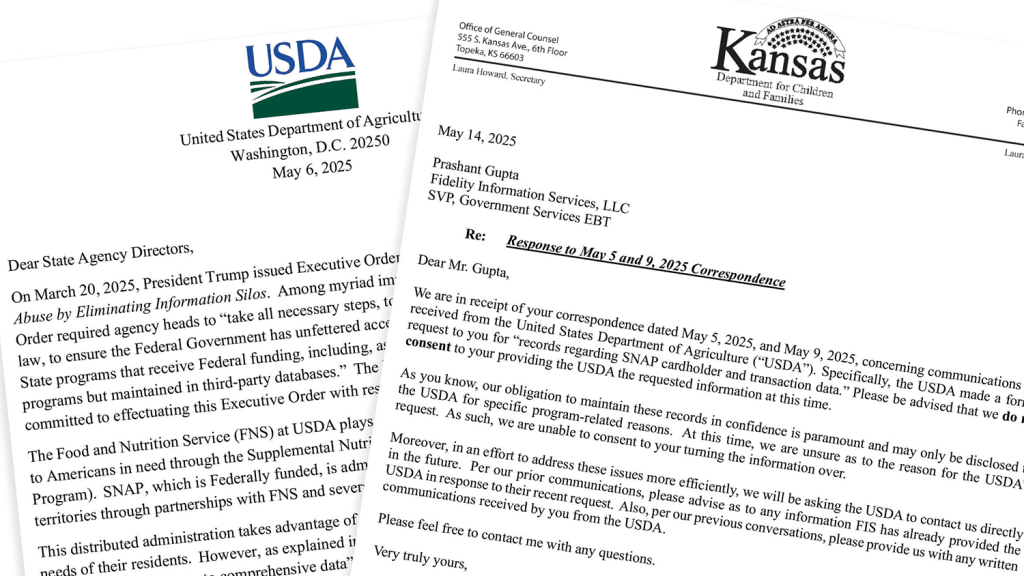
Kansas Department for Children and Families denied a request by the federal government for access to personal data of a food assistance program. (Submitted)
TOPEKA — State officials have denied a federal request to disclose personal information of Kansans using the Supplemental Nutrition Assistance Program.
On May 6, the Kansas Department for Children and Families received a letter from the U.S. Department of Agriculture that demanded “unfettered access to comprehensive data from all State programs that receive federal funding.” DCF spokeswoman Erin LaRow shared a copy of that letter and other communications in response to an inquiry from Kansas Reflector.
The USDA letter specified that information to be collected for each SNAP applicant or recipient included name, Social Security number, date of birth, personal address and records to calculate the amount of SNAP benefits participants received over time. It was signed by Gina Brand, senior policy advisor for integrity at USDA’s Food, Nutrition and Consumer Services division.
The requested data would cover the time period from Jan. 1, 2020, to the present, the letter said.
DCF’s SNAP data is held by a third-party database administrator, Fidelity Information Services LLC. That company notified DCF on May 9 that a formal request for Kansas SNAP records had been made from USDA and that because of federal guidance, they were required to disclose that information.
“As such, FIS intends to fully cooperate with the USDA in facilitating its request for information, as required by applicable law and the guidance,” wrote Prashant Gupta, FIS senior vice president. He then asked for DCF’s written consent.
DCF stopped the process in a letter dated May 14, sent by Carla Whiteside Hicks, the DCF director of economic and employment services.
“Please be advised that we do not consent to your providing the USDA the requested information at this time,” Whiteside Hicks told FIS. “As you know, our obligation to maintain these records in confidence is paramount and may only be disclosed to the USDA for specific program-related reasons. At this time, we are unsure as to the reason for the USDA’s request. As such, we are unable to consent to your turning the information over.”
Whiteside Hicks also said DCF will be asking the USDA to contact DCF directly in the future. She asked FIS to turn over any information that they may have already provided to the USDA and to also provide DCF with any written communications the company has received from USDA.
LaRow said DCF is reviewing the request from USDA related to the personally identifiable data of Kansans.
“Security of Kansans’ personal information is paramount to the agency, and we are committed to maintaining confidentiality consistent with state and federal law,” she said.
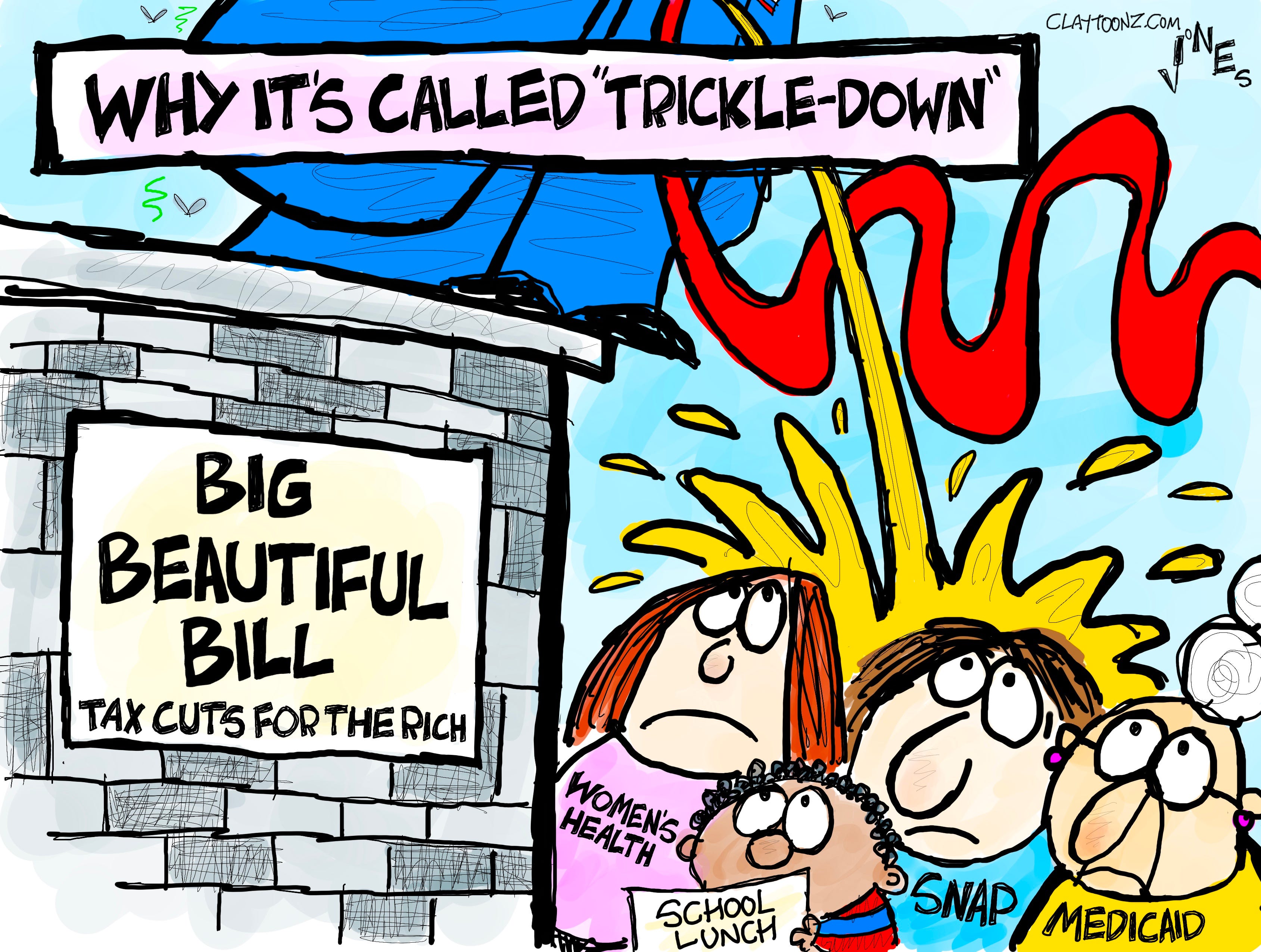
The so-called “Big Beautiful Bill,” as Harry from Resident Alien would say, is some bullshit. And this is some bullshit.
First, it’s projected to add nearly $4 trillion to our debt, but that is a very conservative estimate. Even some Republicans believe it’ll add more than $10 trillion. I have a question that’s harder than defining Habeas Corpus. How do you reduce the deficit by adding $4 trillion to it? And don’t give me that DOGE bullshit as it’s not even going to cut $1 trillion from our debt, which is currently around $36 trillion, partly thanks to Trump’s 2017 tax cuts, which just got extended as part of this huge bill.
Yeah, that’s right. Trump’s 2017 tax cuts added trillions to our debt, which they extended last night shortly after Trump pronounced himself a “deficit hawk.” He’s more of a hawker of cheap goods made in China, like his shitty shoes, shitty caps, shitty guitars, etc, etc.
Trump is demanding that Apple make all its iPhones in America, or Tim Cook (who Trump used to think was Tim Apple) is going to have to pay a 25 percent tariff on them. This means that Trump finally realizes that China does not pay the tariffs, and Trump rules don’t apply to Trump. He’s NOT demanding that his shitty shit be made in America.
There’s a bunch of stuff in this so-called “Big Beautiful Bill.” Every newborn will get $1,000 invested into what Congress has named a “Trump account.” Yeah, they named it after Trump. It’s complicated. The newborn gets $1,000, which he can’t withdraw from the account until he’s an adult, which can only be spent on buying a home, tuition, or other stuff like that. Anyone else can invest in the newborn’s Trump account, but only up to $5,000 a year, and the accounts don’t gain interest like a typical savings account. The money isn’t taxed until it’s withdrawn. But if this is such a great idea, why is it only for the next four years?
That’s like getting rid of taxes on tips. It’s only for the next four years, which means it’s not supposed to help people in the service industry. It’s only supposed to help Trump, because he’s supposed to leave office in four years. Right? Right? And why isn’t every getting a tax-free income up to $20,000?
Personally, I think America’s political cartoonists should have their first $20,000 tax-free, for the ones who make over $20,000. Seriously.
And then there are the cuts to Medicaid and stricter requirements. There are work requirements, so tell Grandma to scour the help wanteds. Medicaid recipients also have to reapply every six months, which is how often Trump has to reapply the orange glaze on his face. Harry would say, “This is some bullshit.”
There’s too much bullshit in this bill for me to go through it all (like sneaking in a law that courts can’t hold members of the Trump regime in contempt), but it’s typical that Republicans are more interested in helping rich people than helping poor people. And they still haven’t learned that trickle-down economics doesn’t work.
It’s not like Republicans have to remember as far back as the 1980s when Ronald Reagan proved they don’t work, or back to the 2000s when W. proved they don’t work. They only have to remember back to the first Trump term (sic) when he proved they don’t work. Republicans don’t use the term “trickle-down” as often these days for two reasons. They know it doesn’t work, and the term may make people think of Trump and those Moscow prostitutes.
No matter what they call this scam, it’s the same thing. It’s trickle-down economics, and it doesn’t work. At least you can shower it off after the Russian hookers but in this situation, we’re going to get pissed on indefinitely. (snip-MORE)
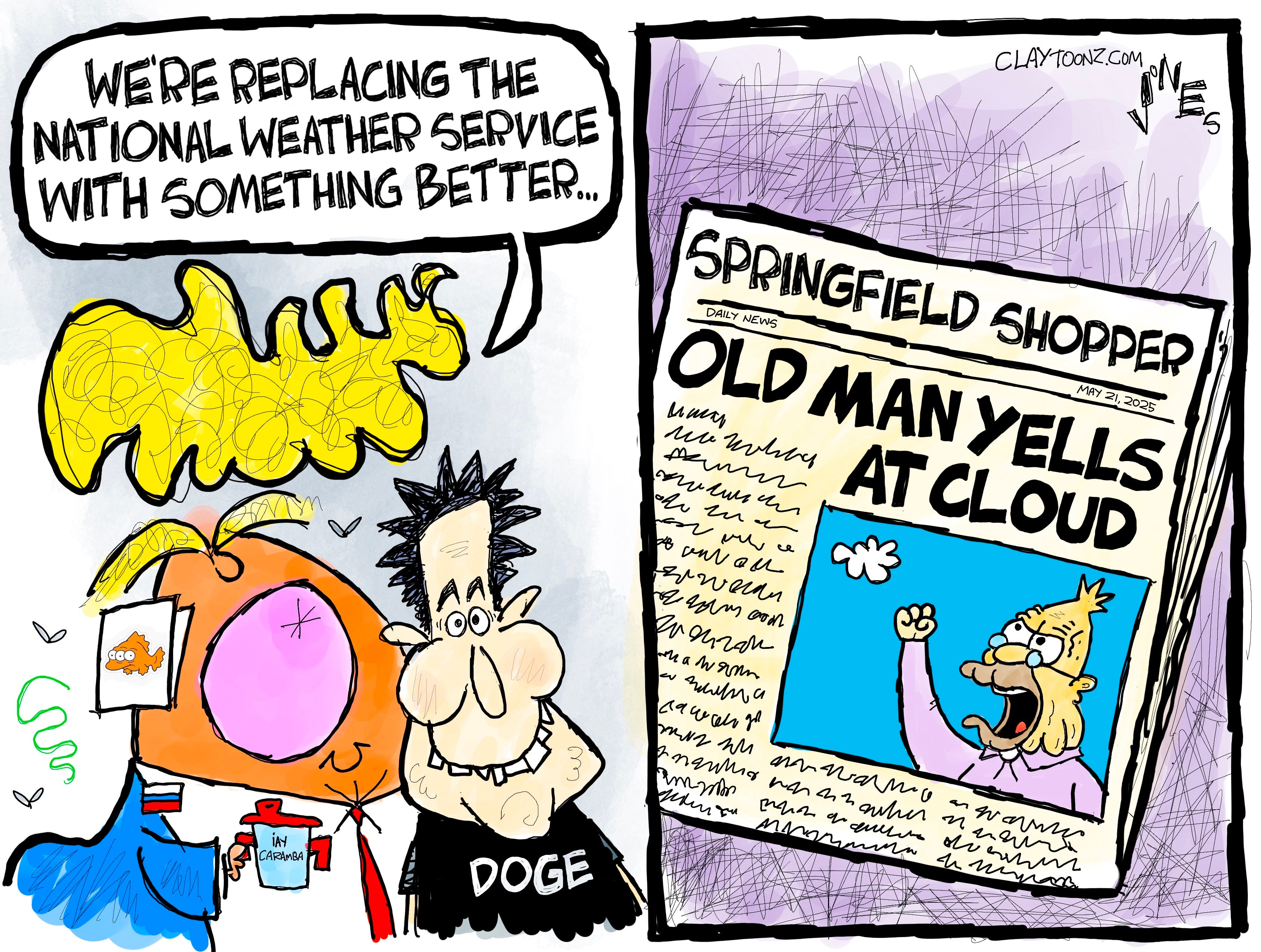
Of course, Donald Trump doesn’t take weather forecasting seriously. He thinks you can move a hurricane with a Sharpie. Or, he thinks only he can move a hurricane with a Sharpie, because everyone’s supposed to listen to the Almighty Trump, even hurricanes.
Naturally, the National Weather Service isn’t going to be spared from DOGE cuts. Who cares if we’re only about two weeks from hurricane season? Last season, there were 18 named storms, 11 hurricanes, and five major hurricanes. It was the first since 2019 to feature multiple Category 5 storms. Hurricane season 2024 also closed the most Waffle Houses (I made that up, but it’s a thing).
And it’s tornado season, bringing 42 deaths to Missouri, Kentucky, and Virginia over the weekend. Would there have been as many deaths if there hadn’t been cuts to our weather systems? The National Oceanic and Atmospheric Administration (NOAA) and the National Weather Service (NWS) are crucial for the nation’s emergency-response system. Hurricanes are easier to track, but tornadoes don’t give much time at all to prepare. And now, the offices that track them are understaffed because of Trump and Elon (an unelected billionaire bureaucrat).
Five former NWS directors from both Democratic and Republican administrations wrote an open letter on May 2, stating, “Our worst nightmare is that weather forecast offices will be so understaffed that there will be needless loss of life.”
Climate scientist Daniel Swain said, “The net result is going to be massive economic harm. As we break these things, eventually it will become painfully and unignorably obvious what we’ve broken and how important it was. And it’s going to be unbelievably expensive in the scramble to try and get it back—and we might not be able to get it back.”
After the NWS’s first wave of firings and early retirements under the Trump regime, staffing at the service’s 122 field offices across the country has dropped to a 19 percent vacancy rate. Fifty-two offices are now considered “critically understaffed,” meaning a shortage of more than 20 percent. Some branches are down by more than 40 percent. The good news is that the budget for White House Sharpies has gone up.
There has also been huge reductions and cancellations of weather balloon launches, which are supposed to happen twice a day at every forecast office across the country. According to reports, they’re being saved for Trump’s birthday parade on June 14, which also explains the nation’s shortage of cakes and hot dogs (joke, but the parade is real). (snip-MORE, along these lines that should be read.)
Donald Trump set another trap for a foreign leader in the Oval Office. This time, it didn’t go like the trap set for President Volodymyr Zelensky (where Trump and JD harangued him for not surrendering to Putin), but more like the trap he set for a reporter, claiming a doctored pic of Abrigo Garcia with MS-13 labeled on his fingers was real.
This time, Donald Trump was trying to lecture South African President Cyril Ramaphosa about White genocide in his nation. This would be like me going to New York City and lecturing the locals that C.H.U.D.s are real.
I could tell them that I saw a documentary hosted by John Goodman on HBO back in the 80s proving that Cannibalistic Humanoid Underground Dwellers are living in their sewers, leaping out at the right opportunities to grab old ladies while they’re walking their dogs for a late-night snack. The reason you’re not hearing about the C.H.U.D.s is that the liberal media and the Deep State are working together to hide it until you and your Schnauzer or C.H.U.D. meat. Why should they think they know NYC better than I do, because they actually live there? Hmph!
Did you know that last April, C.H.U.D.s ate 27,687 human beings, three Schnauzers, two poodles, and one of those skinny hairless cats that nobody is sure is an actual cat? I haven’t actually researched or verified these numbers, but someone on the internet said it’s true (that was me). And, most of those eaten were White people, because White people are the most persecuted segment of civilization in world history.
That has to be true because people like Donald Trump, Elon Musk, Stephen Miller, Tucker Carlson, and crazy old White guys wearing MAGA caps on the city bus keep warning us about the Great Replacement theory, where White people are being replaced by Mexicans and other people with suspicious skin tones. It has to be true because I saw another documentary, this one hosted by Mel Brooks, showing a Black man screaming, “Where all the White women at?”
I’m telling ya, White people can’t catch a break anymore, especially the White billionaire president (sic). Just this week, he was forced to listen to a Black man in the Oval Office refuse to be browbeaten to agree with his conspiracy theory. What next? Is someone going to park a Venezuelan food truck in front of the White House on what was White Lives Matter Plaza (there’s one near L’enfant station and it’s amazeballs)?
Ramaphosa was sitting next to Trump, engaging in fake pleasantries, talking about golf and other assorted bullshit, knowing he was sitting in a trap. Fortunately for the South African prez, the trap springer is a moron (person, woman, man, camera, TV). Ramaphosa said “listening to the stories” of South Africans would help Trump better understand the bullshit he was talking about, except Trump doesn’t listen. But then, Trump had the lights dimmed (It’s a trap!), as a MAGAt aide turned on the TV and played a video of South African opposition politicians singing apartheid-era songs about shooting Boers, a term that refers to farmers or Afrikaners (the term for White South Africans). The video was several years old.
Drone footage showed supposed Afrikaner graves marked by white crosses. Then Trump whipped out newspaper clippings (probably all from Breitbart) about recent killings in South Africa, muttering, “Death, death, death, horrible death.” My gosh. It sounds like there might be an agenda here.
It must have been tough for Ramaphosa to sit still when Trump said White genocide is “sort of the opposite of apartheid.” Read the room, Grandpa.
Trump got distracted when he called NBC reporter Peter Alexander a “jerk” for asking why he accepted a $400 million plane from Qatar.
Trump said rhetorically, “Why did a country give an airplane to the United States Air Force? So they could help us out, because we need an Air Force One. That’s what that idiot talks about, after viewing a thing where thousands of people are dead,” that Trump had made up. He’s so touchy when called out for taking a bribe.
Seizing the moment and embarrassing Trump, Ramaphosa said, “I’m sorry I don’t have a plane to give you.” Not realizing that Ramaphosa basically said, “I’m sorry, I don’t have a bribe for you,” Trump said, “I wish you did. I would take it. If your country offered the United States Air Force a plane, I would take it.”
Trump is an idiot.
There is no White genocide. It’s a lie that racist Elon Musk (who was in the room with Trump and Ramaphosa) has been pushing for years. (snip-again, MORE along the same lines; it ought to be read.)
May 23, 1838 U.S. General Winfield Scott began the forced removal of the Cherokee Indians from North Carolina, Georgia, Alabama, and Tennessee, and their detention in forts built for that purpose. He was implementing the Treaty of New Echota, signed by a few members of the tribe relinquishing their lands for a payment of $5 million, under orders from President Martin VanBuren. 16,000 Cherokee were then driven on foot to “Indian Territory” (what is now Oklahoma). Of those who set out on the forced march known as the “The Trail of Tears,” nearly one-quarter died along the way or as a result of the relocation. Detailed history of the Trail of Tears Cherokee letter protesting the Treaty of New Echota from Chief John Ross
May 23, 1982 10,000 marched in London protesting British Prime Minister Margaret Thatcher’s Falklands War. The Falklands are islands off the coast of Argentina (known there as the Malvinas), and Great Britain was fighting to maintain colonial control over them, which they originally claimed in 1833. an anti-war demonstration in Argentina
May 23, 1982 400,000 demonstrated for peace and disarmament in Tokyo, Japan.
May 23, 1992 Belarus, Kazakhstan and Ukraine, which had inherited strategic nuclear weapons from the Soviet Union, ratified the START I treaty and joined the Nuclear Non-Proliferation Treaty as non-nuclear states. Through the Lisbon Protocol, Belarus, Kazakhstan, Russia and Ukraine became parties to START I as legal successors to the Union of Soviet Socialist Republics. The breakup of the Soviet Union delayed START’s entry into force nearly three-and-a-half years. The Strategic Arms Reduction Treaty (START I)
May 23, 1997 Khatami in 2009 Iranians elected a new president, Mohammad Khatami, with 70% of the vote, over hard-liners in the ruling Muslim clergy. Khatami won largely due to young people and women, who voted for him because he promised to improve the status of women and respond to the demands of the younger generation in Iran. Political situation in Iran before and after Khatami’s election Khatami today
May 23, 2003 Congress passed a third major tax cut proposed by President George W. Bush in his first two years in office: $330 billion. The budget deficit in the following year was the largest ever and a record percentage of the Gross Domestic Product.
Mary Robinson (center), former president of Ireland, shares her views on human rights at a Carter Center event in March. From the Center, CEO Paige Alexander (right) participated in the discussion, and Nicole Kruse, VP, Development, moderated.
Human rights pioneer Mary Robinson shares life lessons at Carter Center event
When Mary Robinson began her term in 1990 as the first female president of Ireland, she didn’t let her gender take a back seat to the office. She wanted to convince people that “I would actually do a better job because I was a woman,” she told an audience at The Carter Center in March.
Robinson went on to blaze trails not only in politics but human rights, women’s rights, and climate advocacy. She offered insight on her remarkable life during a public conversation and Q&A with the Carter Center’s Paige Alexander, CEO, and Nicole Kruse, vice president of development, following a screening at the Center of “Mrs. Robinson,” a new biographical documentary.
Robinson has several ties with the Center, including a long friendship with co-founders President Jimmy Carter and Rosalynn Carter. She also helped lead the Carter Center’s election observation mission to Myanmar in 2015.
But perhaps her strongest connection to the Center is a shared commitment to bolstering human rights around the world. “The universal values of human rights are indispensable,” Robinson said. “They are as valid today as they ever were, and they are more relevant today than they ever were.”
During her tenure as U.N. High Commissioner for Human Rights from 1997 to 2002, she traveled to many dangerous places — Chechnya, Kosovo, and Goma in the Democratic Republic of the Congo. “I always came back energized because I was meeting people on the ground,” Robinson said.
The world celebrated the 75th anniversary of the Universal Declaration of Human Rights last year and its 50th anniversary while Robinson was high commissioner. The document is as “relevant today as it was in 1948,” she said. “We have learned so much about how, hopefully, to do better in creating more understanding but also embedding it in the cultures of people.”
Despite her belief that “countries go up and countries slide” in their commitment to human rights, she remains optimistic about the future and the young people who will be inheriting the world older generations created.
As a member of the Elders, a group of former world leaders to which President Carter also belonged, Robinson said she has been involved in conversations about climate and energy that span several age groups. “Younger people are insisting at being at the table,” she said. “I’ve had incredible conversations with 13-, 14-, and 15-year-old climate activists.”
The motivation of younger generations will lead to sea change soon, Robinson believes, because they want the world to move faster. “We’re on the cusp of this much healthier clean energy, renewable energy, no-waste circular economy,” she said. Robinson marveled at the difference such innovations will make for people in Africa who have never had electricity.
Although Robinson has spent her career addressing societal ills across the globe, she believes joy and hope can be found anywhere and are essential components for a well-lived life. She once heard her mentor, Archbishop Desmond Tutu, describe himself as a “prisoner of hope.” It made an impression on Robinson. She thought, “what he’s saying is the glass may not be half full. There may be only a tiny bit in the glass. But hope is action. You work with that.”
Forum Participants Provide Perspectives on Human Rights
As a former U.N. High Commissioner for Human Rights and member of the Elders, Mary Robinson has fought for human rights around the world. Similarly, the Carter Center’s Human Rights Program works to advance the rights of protected groups. Last year, the Center hosted the Human Rights Defenders Forum, where activists and scholars came together to learn from and support one another. Below are perspectives from four participants, working on different aspects of a broad human rights agenda.
Colette Pichon Battle Vision and Initiatives Partner, Taproot Earth “One way for us to understand the climate crisis is to understand everybody’s going to be impacted.… The worst part of climate change is not the big hurricanes. It’s not the big storms that you can predict. It’s global temperatures that are going to take out more people than any storm ever could.”
Vincent Warren Executive Director, Center for Constitutional Rights “States talk a lot about their rights, but states don’t have rights. What states have are power. And who has the rights? People have the rights.… What we have to do as human rights defenders is shift power to the people from the state.”
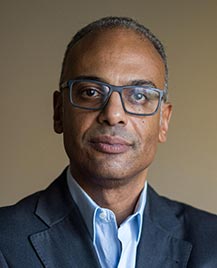
Hossam Bahgat Founder, Egyptian Initiative for Personal Rights “Our work can only succeed if we think of ourselves and execute our activities as a movement, not as a group of individual organizations working in individual countries, and not as a group of visionary individuals exercising leadership. To really make change, you need to build.”
Hina Jilani Pakistani Lawyer and Women’s Activist, Member of the Elders “I cannot afford the luxury of either pessimism or cynicism or frustration, so I always have hope. I respect my struggle more than I expect achievement. I believe in my struggle. And because I have that belief, I have hope.”
A meeting in the Oval Office turned sour after President Donald Trump ambushed South Africa’s President Cyril Ramaphosa with claims of a “white genocide.” But one white man standing in the back of the room stood up to Trump, and though the world might not recognize him, he continues to play a vital role in mending the countries’ shaky relationship.
Growing tensions between the two countries began after Trump’s reelection. That’s when the president cut off trade to South Africa and recently gave 59 white South Africans— better known as Afrikaners— refugee status, as we previously reported. Trump falsely argued the Afrikaners were being targeted based on their race, but in fact the amount of Black murders in the country drastically outweigh that of white killings.
The issue comes down to South Africa’s immigration and crime problems. Ramaphosa came to Washington, D.C. in hopes of refocusing his relationship with America and also get Trump’s help tackling crime.
He even brought famous guests with him to cool off the temperature in the room: Two well-known golfers and— most importantly— the second richest man in South Africa. Johann Peter Rupert is one of 22 billionaires on the entire continent of Africa and one of only seven billionaires in South Africa, according to Forbes’ 2025 report.
The 74-year-old is an international business mogul, so his appearance with Ramaphosa holds more weight than you can imagine.
Rupert got real with Trump after President Ramaphosa’s attempt to refocus the conversation to technological and trade needs was disregarded. While the president perpetuated claims that Afrikaners— the most privileged ethnic group in South Africa— are being targeted, Rupert echoed Ramaphosa’s words saying, “We have too many deaths, but it’s across the board.” The billionaire continued, “It’s not only white farmers… We need technological help.”
Experts told PBS that although white farmers have been murdered in South Africa, those killings account for less than one percent of the total 27,000 annual nationwide report— most of them being murders of native, Black South Africans. “The idea of a ‘white genocide’ taking place in South Africa is completely false,” said Gareth Newham, head of a justice and violence prevention program at the Institute for Security Studies in South Africa.
Rupert even added that he’s building cottages for his grandchildren, but despite his wealth and his status as an Afrikaner, he doesn’t feel unsafe. “I often go to bed without locking the door,” he said. The 74-year-old even tried to level with Trump and Vice President JD Vance saying South Africa’s immigration and gang issues are more pressing than the fake genocide Trump continues to claim. (snip-news video on the page)
Inside the White House Meeting
What the public saw was only the meeting before the two leaders got together in a private discussion. But according to New York Times reporter, Jon Elligon, who was in the Oval Office during the media blitz, the pre-meeting not going as planned could lead to further tensions.
“The [pre]meeting essentially turned into an ambush of the South African president,” Elligon said. “It was very tense and it broke down quickly.” According to him, if there’s any hope of patching the relationship between the two countries, “a lot of it is going to depend on whether the South African delegation can successfully get Trump to not focus on the Afrikaner issue anymore.”
There should be a test before seeking public office. I understand there’s on-the-job training, but this isn’t Taco Bell.
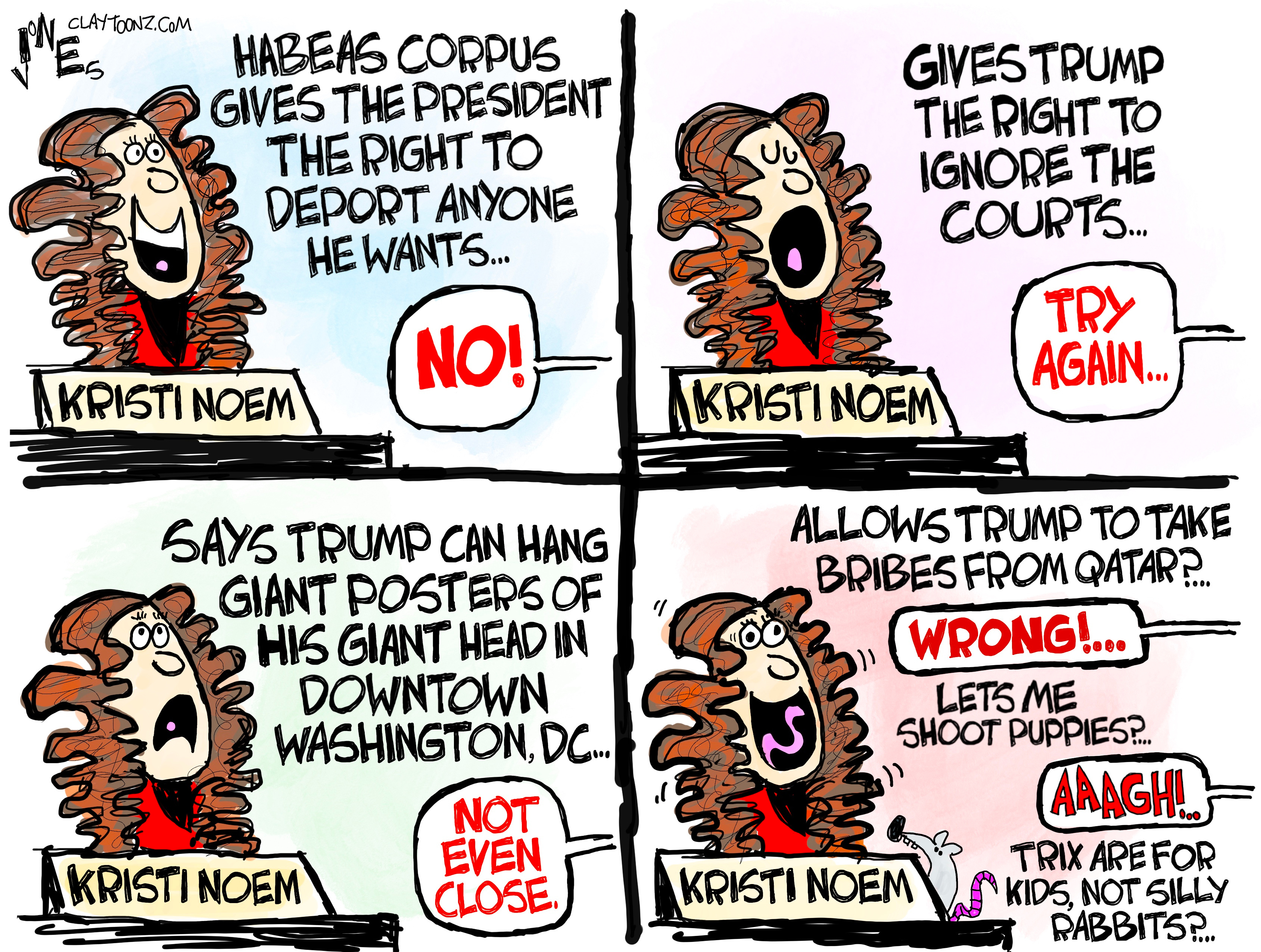
Even before Kristi Noem was the Director of Homeland Security, she was a governor. No governor in this nation should be as ignorant of the Constitution as Noem displayed yesterday. Don’t we already have too many Jeff Sessions in government? Even college football coaches should know what the three branches are.
Even at Taco Bell, I’m sure you’d eventually get shit-canned if you couldn’t keep track of the difference between a Chalupa and a Gordita. Fuck. Now I want some Taco Bell. Anywhos…
Democratic New Hampshire Senator Maggie Hassan is considered one of the mildest members of the U.S. Senate. I bet at least a quarter of my blog followers couldn’t name what state she represented until they read the previous sentence. Honestly, I might have fumbled it. Despite being one of the nicest in the Senate, Hassan still scorched Kristi Noem during a hearing yesterday. And Hassan wasn’t even trying. It’s Noem’s fault for not knowing her shit.
Hassan asked Noem a question a simple question. It wasn’t like she asked something difficult, like how many women have accused Donald Trump of rape and sexual assault. You don’t have to be a genius to know the answer either. Hassan didn’t hit her with a Navier-Stokes equation.
The question was: What is habeas corpus? Her answer was more embarrassing than that time Katie Porter asked Ben Carson about REO rates, and he thought she was talking about Oreo cookies. Dammit. Now I want some Oreos.
Noem’s reply was, “Habeas corpus is a constitutional right that the president has to be able to remove people from this country.”
Wrong. Not even close. It’s not even a nice try. If you asked this question as a part of a bar bet, you’d probably get a better answer and still win a beer. Hassan should have made this a bar bet, because at least she would have won a beer. My go-to question in a bar bet is: Name the only American president who was never elected.
Noem got her bachelor’s degree by taking online courses and earning college intern credits from her position as a member of Congress. That’s still better than Sarah Palin.
They say there are no stupid questions, but there are some real dumbass answers. Kristi Noem is a fucking moron.
Habeas corpus is a bedrock constitutional legal principle that safeguards individuals from unlawful imprisonment by enabling them to petition the court to review the legality of their detention. Or the short version, it’s the right to due process. That’s an acceptable answer. It’s an easer answer, and it’s definitely isn’t that Donald Trump doesn’t get to do whatever the fuck he wants.
Noem thought the answer was specific about deportations. It’s not.
After explaining habeas corpus to Noem, Hassan asked her if she supported it. Noem answered wrong again.
Noem said, “Yes, I support habeas corpus,” but she couldn’t stop there. She went on to say, “I also recognize that the President of the United States has the authority under the Constitution to decide if it should be suspended or not.”
Wrong again, Dumbo. That doesn’t even make sense if she believed in her first answer. She thought habeas corpus was the right of the president to deport people, and the Constitution gave him the right to suspend that right. What? It’s not surprising she’s dumb enough to carry $3,000 in her purse, and then to have it stolen right from under her in a cheeseburger restaurant. Shit. Now I want a cheeseburger. Anyways.
Article I, Section 9of the U.S. Constitution prohibits the suspension of habeas corpus “unless when in Cases of Rebellion or Invasion the public Safety may require it.” That’s not happening. And, the president needs the approval of Congress to suspend habeas corpus.
Trump is violating due process, he’s ignoring court orders, there was another ruling today that he’s violating court orders, he has placed a giant image of his face in the capital which surprises me that there hasn’t been a sudden rash of car crashes in the city, he’s taking bribes, and Kristi Noem is a puppy killer.
I believe that if you gave a citizenship test to assholes like Trump, JD Vance, Stephen Miller, Marco Rubio, Kristi Noem, or any of the other idiots in this regime, they would all flunk.
If you have to take a test to be a citizen of this nation, then there should be a test for people who want to represent the citizens of this nation.
These tests are not difficult unless you’re a MAGAt dumbass.
Creative note: I’m kinda going through a fit this week with ideas. No, it’s not writer’s block, but too many subjects. I have several subjects I believe are nearly equal in importance, but I don’t have enough days. And no, I don’t want to draw several cartoons a day. When you draw too many cartoons a day, they will start to look like you drew too many. I can burn out.
I went with this one today because it’s timely, funny, I really liked it, and I’ll take almost any opportunity not to draw Trump.
I used five layers in Procreate to draw this cartoon. I hate using lots of layers while other cartoonists love them.
Today I want to introduce you to a friend of mine from years ago, a community leader in Beirut Lebanon, a man named Kamal Mouzawak.
Kamal and me at Souk el Tayeb a couple of years ago (photo Thomas Schauer)
I’m proud to know Kamal and his team, and to have spent time with them after the horrific 2020 explosion that rocked Beirut and destroyed so many lives. The World Central Kitchen team, who arrived in Beirut to help with the recovered, joined up with Kamal’s team at Tawlet, a kitchen in the city serving foods from around Lebanon (more about that later), along with our mutual friend Aline Kamakian—a brilliant chef, food writer, and culinary advocate. Together, we worked to feed the people of Beirut who were the ones cleaning up the streets. It was a difficult time, but also an amazing one, to see the incredible efforts of Beirutis helping their neighbors get back on their feet, to clean up their neighborhoods, and to make sure they were all fed. (snip-a little video I can’t get a link or embed.)
Kamal has for many years been a leader in the community. In 2004 he started a farmers market in Beirut called Souk el Tayeb, working with farmers from around the rural areas of the country to reach the people of the city. From there his mission has expanded…well, why am I telling you, when I could let Kamal do it? My team had a moment to talk to him recently, since Kamal and Souk el Tayeb were the recipients of a grant from my Longer Tables Fund—specifically to support a new vision for the market, transforming it into a community space. I am so thrilled to be able to support my dear friend Kamal in his work to bring fresh produce to more of his community.
So friends, now I want to give the floor to the super thoughtful Kamal:
Longer Tables: First of all…what is Souk el Tayeb, and what is Tawlet?
Kamal: The whole story has been an evolution since the beginning, in 2004.
Souk el Tayeb is what we call a farmers’ market and Tawlet we call a farmers’ kitchen (“Souk el Tayeb” means “good market” and “tawlet” means “table” in Arabic). That naming is intentional, to stress the fact that this is not another store, and it’s not another restaurant. It’s not about selling vegetables. It’s not about cooking food and serving food in a restaurant or in whatever we want to call it. It’s about changing the world, making the world a better place.
And it was for people to understand is that food is not just a commodity that you buy on a supermarket shelf but something that someone planted, produced, cooked, transformed—and it’s an exchange between you and him or her through money, but the idea is Why not meet the producers of our food? It was a move for farmers to come from rural to urban in order to be where there’s a demand and purchasing power. It was about farmers coming to meet people who would buy their produce. (snip-MORE, and it’s really nice)
No, really, it is. The history of the Tenth Amendment explains [almost] everything happening in politics and government today.
But before I get to the [scintillating] topic of the Tenth Amendment, I have an announcement: Today is the birthday of Rebels, Robbers, and Radicals: The Story of the Bill of Rights.
(I have created birth announcements on publication day for every one of my books beginning with my firstborn novel in 2001.)
And now . . . all about the Tenth Amendment.
* * *
The Tenth Amendment consists of a single sentence:
The powers not delegated to the United States by the Constitution, nor prohibited by it to the States, are reserved to the States respectively, or to the people.
The Supreme Court has described the Tenth Amendment as stating a simple “truism”—“all power is retained which has not been surrendered.”
The problem with calling the Tenth Amendment a “truism” is that, since the start of the nation, there has been bitter disagreement over how much power has been retained by the states, and how much has been surrendered to the federal government. In fact, we fought a Civil War over that question. The Confederacy’s slogan “states’ rights!” was grounded in the Tenth Amendment.
* * *
The drafters of the Constitution debated whether to insert the word “explicitly” into the Tenth Amendment, so that it would read like this:
The powers not explicitly delegated to the United States by the Constitution, nor prohibited by it to the States, are reserved to the States respectively, or to the people.
The anti-Federalists (the party of Thomas Jefferson), wanted to insert the word “explicitly,” which they understood would sharply limit the power of the federal government. At one point during the early debates on the Constitution, Thomas Jefferson suggested that the federal government should consist of a committee. The Federalists (the party of George Washington and Alexander Hamilton), on the other hand, didn’t want to place such a limitation on federal power because they worried that a situation requiring a national response might arise that they could not foresee.
The Federalist won. The word “explicitly” was not included. Had the word “explicitly” been inserted, the United States most likely would have become a loose coalition of independently governed states sharing a Post Office, armed forces, and not much more.
* * *
Shortly after George Washington was elected president, he appointed Alexander Hamilton as secretary of the Treasury. This was a key post because the Revolutionary War left the nation almost bankrupt, and Hamilton understood commerce and finance. As a teenager in the Caribbean, he worked as a clerk in a trading company. After the Revolutionary War, he and a handful of other New Yorkers helped establish the Bank of New York, which allowed New York to grow into a hub of commerce and trade.
One of Hamilton’s first acts as secretary of the Treasury was to propose a plan that would allow the federal government to assume state debt. There was much resistance to the idea, even by the states that were heavily in debt from the Revolutionary War. Many saw this as a federal power grab because it gave the federal government powers not “delegated” and thus violated the Tenth Amendment.
Hamilton got his way. The federal government assumed state debt. He next proposed a national bank to help the United States prosper the way the Bank of New York helped New York prosper.
The resistance to Hamilton’s proposed national bank was fierce. At stake was the kind of nation the United States would become. Thomas Jefferson and the other anti-Federalists believed a national bank would turn the United States into another Great Britain, which at the time was a vast and powerful financial empire governed by a strong central government. Jefferson believed the way to liberty was for power to reside locally. For Jefferson, the point of the Revolutionary War was for Americans to free themselves from a faraway, out-of-touch, commerce-oriented government.
Slavery, of course, was the underlying issue. The economy of the South and the wealth of people like Thomas Jefferson was built on slave labor. They were afraid that if the federal government grew too powerful, it would end slavery.
It’s Really All About John Locke
To understand how Jefferson reconciled his demand for freedom as an unalienable right with his belief that local governments should decide whether to legalize slavery, we need some John Locke, who — like Thomas Jefferson — was full of contradictions. At the time of his death in 1704, Locke was the most famous philosopher in Europe. Thomas Jefferson took his ideas and much of his famous language from John Locke. The idea that it is a self-evident truth that we all possess unalienable rights is pure John Locke, as is the idea that, to prevent a tyrant, power should be divided between independent branches of government. To quote Steven B. Smith, a political science professor at Yale, “Locke’s writings seem to have been so completely adopted by Thomas Jefferson in the Declaration of Independence that Locke is often thought of as almost an honorary member of the American founding generation.”
Recall Thomas Hobbes’s theory about how government evolved: According to Hobbes, in the state of nature before government, there was violence and chaos. Government arose as a way to create order. For Hobbes, absolute monarchy is the best form of government because only a ruler with absolute power can maintain order. Government arises as a kind of social contract: People give up their freedom and submit to the rule of a king in exchange for protection and order.
John Locke offered a competing theory. In his view, in the state of nature before government, people lived in perfect freedom with unalienable rights. Moral law (or natural law) reigned supreme.
Among our inalienable rights, according to Locke, is the right to own property and a chief function of government is to protect private property rights, which, according to John Locke, derive from natural law. This immediately raises questions. In a state of nature without government, how do we know which property belongs to which person? Can I just claim the river for my own? Locke’s answer is that, “Our claim to property derives from our own work; the fact that we have expanded our labor on something gives us title to it. Labor is the source of all value.”
Okay, so I suppose this means that if a person in the state of nature gathers natural materials and uses their labor to make the material into a house, the person owns the house and has title to that property. But what if one person finds minerals in the earth and uses their labor to extract the minerals. Does the person then own the minerals? What about a forest? If I expend labor to cut down all the wood, does that mean I own it all? What about the servant who expends labor cleaning the master’s house. Does that servant now have claim to the master’s property? As Karl Marx later pointed out, the factory worker does not own the product of his own labor.
Liberty for John Locke was another unalienable right. Here is how Jefferson (and others) reconciled slavery with the belief that all people are born with an unalienable right to liberty: They believed it was part of natural law that Black people were inferior and best suited to laboring for others, which brings us to another problem with the entire idea. Different people will have different ideas of what is ‘moral.’ Locke’s answer is that rational people will all see things the same way, and irrational people are the ones we need government to protect us from.
See the problem? See how this leads to “Some people have unalienable rights and others do not.” It also leads to, “People who agree with me are rational. The purpose of government is to protect our freedom and property rights from those who are irrational.” This, combined with an ‘if I grab it first, I have title to it’ mentality, leads to the idea that one purpose of government is to protect the property rights of the wealthy.
Make no mistake — the idea of unalienable rights and checks on governmental power was a liberal idea and a step toward self-determination and dignity. My point is that the specifics of how this might be applied in the real world wasn’t very well thought out.
Another Lockean innovation is the movement away from feudalism — with its emphasis on a static social hierarchy — toward a market economy with opportunities for all. Locke said, “The world was created in order to be cultivated and improved” and “the world was given to the industrious.” He also believed that government should not stand in the way of industriousness, which you could say makes him the original free market capitalist. The problems here are the same: The idea that in the state of nature people lived happily in an unregulated market economy is fantasy.
Locke also says that people have the right to rebel against a tyrannical government, which raises even more questions. How do the people decide when rebellion is appropriate? What if people have different ideas about what is tyrannical? Wouldn’t this put us in an almost constant state of rebellion and civil war?
Locke’s ideas are naive, but, he did not have the benefit of modern neuroscience and modern psychology. He didn’t know what we know today about brain differences, and how these brain differences lead to personality differences. What is more important: Locke had never seen what actually happens in a world without positive law. Hindsight is always clearer.
And now . . . Back to the Story of the Tenth Amendment
Because George Washington and most members of Congress agreed with Hamilton about the need for a national bank, Hamilton got his way again. Hamilton’s bank did indeed allow the country to recover from years of war, but it remained controversial. Andrew Jackson, the country’s seventh president, dismantled the national bank because he believed it was unconstitutional under the Tenth Amendment. The national bank was reinstated in 1863 to help the North with the Civil War effort. In 1913, the Federal Reserve—the national bank we have today—was established. (In the end, Hamilton won.)
* * *
On December 20, 1860—less than two months after Lincoln was elected—South Carolina declared itself no longer part of the United States. The leaders of South Carolina ordered the U.S. Army to abandon its forts and military bases within South Carolina’s borders. The U.S. Army refused to budge. Within four months, the Civil War broke out. Mississippi, Florida, Alabama, Louisiana, Texas, and Georgia also seceded.
The leaders of the Confederate States of America argued that the Constitution says nothing about whether states have the power to secede or whether the federal government has the power to stop them. Under the Tenth Amendment, any powers not delegated to the federal government are retained by the states. Therefore, they argued that whether to remain part of the United States is up to the states.
Locke’s ideas thus underpinned some of the rationale of the Confederate States of America.
The Civil War ended after the South surrendered, but defeat on the battlefield did not persuade many of the Confederates that they were wrong as a matter of constitutional interpretation. Legal historian Cynthia Nicoletti suggested that the idea of “trial by battle” was inherently problematic. To this day, people believe self-governance means that states should be able to secede if their values cease to align with the nation.
* * *
In 1900, approximately two million children were working in mines, fields, and factories across the United States, often doing hard labor and performing dangerous jobs. As people became aware of the conditions children worked under, activist groups formed to address the problem. In 1908, a group called the National Child Labor Committee hired a photographer to visit fields, factories, and mines to report on child labor. More people became aware of the problem and pressured Congress to do something about it.
The Constitution gives Congress the power to regulate commerce between the states, so in 1916 — under the power of the commerce clause — Congress passed a law known as the Keating-Owen Child Labor Act, which sought to prevent child labor by banning the sale of any products that were produced by children under the age of fourteen, or by children between fourteen and sixteen who were forced to work more than eight hours per day.
The Supreme Court struck down the Keating-Owen Act as unconstitutional on the grounds that regulating how products were created was reserved by the Tenth Amendment to the states. Specifically, the Court said, “It was not intended as an authority to Congress to control the States in the exercise of their police power over local trade and manufacture, always existing and expressly reserved to them by the Tenth Amendment.”
The idea was that if states wanted to allow child labor, that was up to the states, and the federal government did not have the power to interfere. If people didn’t like it, they could refuse to buy products produced by child labor. Obviously, this was a poor solution. What would prevent the factories from exporting their goods to markets where people didn’t know the goods had been produced by child labor?
Some see the late 19th and early 20th century as a glorious time when industry and the economy boomed. There were almost no federal regulations. Business tycoons could do as they pleased. Tycoons — also called robber barons — grew wealthy. Income inequality widened. There was no minimum wage, no 40 hour workweek, no social security.
You might say that the business tycoons of the late 19th century lived in a state of nature without government. Did they follow natural law and behave rationally? Of course they didn’t. They cheated. Their wealth then gave them power. They monopolized huge industries through the formation of trusts, exploited workers, and engaged in unethical business practices. For example, a group of well-respected investors would agree to buy a lot of a particular company’s stock on a given day. Others would see what they did, assume the stock was valuable, and also buy it, pushing the price higher. When the price was artificially high, the speculators would sell their stock at a large profit. Soon the prices would fall again. The people who had been duped into buying when the price was artificially inflated would lose their money, and the people who duped them would grow wealthy.
Then in 1929 the market crashed, ushering in the Great Depression. Franklin D. Roosevelt believed that the solution to the nation’s financial woes, and the way to prevent future financial crises, was to regulate businesses and commerce to create fairness and protect investors. He ran for president in 1932 promising what he called a New Deal—a series of federal laws designed to get the United States out of the Depression, offer protections for workers, and regulate commerce to stop unfair business practices such as manipulating markets and fixing prices.
After Roosevelt was elected, he and Congress set to work to enact his New Deal.
During Roosevelt’s first several years in office, the Supreme Court repeatedly invalidated the New Deal legislation as unconstitutional under the Tenth Amendment. Then, in 1938, the Court did an about face and stopped invalidating New Deal legislation. Congress tried again to outlaw child labor and, in 1938, passed the Fair Labor Standards Act, which established among other things a minimum working age of sixteen, except in certain industries outside of mining and manufacturing. In a case called United States v. Darby, the Supreme Court held that the new labor laws were constitutional under Congress’s power to regulate commerce between the states. The Supreme Court thus overturned its previous 1918 case that had declared federal child labor laws unconstitutional.
Historians and scholars have offered various reasons for the Supreme Court’s sudden change of mind. It appears that the Court saw that Roosevelt and the New Deal were exceedingly popular and that Roosevelt was looking for ways to get around the Court, so the Court finally gave in.
The New Deal legislation created numerous federal regulatory agencies including the Securities and Exchange Commission, an independent federal agency designed to protect investors by regulating the sale of financial products such as stocks. Roosevelt signed into law the Public Utility Holding Company Act of 1935, which allowed the government to regulate utilities such as electricity and water to make sure those companies didn’t unfairly raise prices for people who depended on their services. Roosevelt’s 1935 Social Security Act offered a way for workers to pay into a pension so that they would have something to live on in their old age. The nation got a forty-hour workweek and worker protection laws.
Among the most far-reaching of Roosevelt’s programs was the G.I. Bill, formally known as the Servicemen’s Readjustment Act of 1944. It gave soldiers returning from duty the right to a government-paid college education, allowing ten million soldiers over a twelve-year period to attend college, thus helping lower-income families break out of poverty.
The New Deal had its critics. Right-wing activist Elizabeth Dilling denounced the New Deal as a piece of communism. One of the most famous journalists of the era, H.L. Mencken likened Roosevelt actions to a dictatorship. The New Deal critics not only despised the expansion of the federal government, they saw the New Deal as redistributing wealth, which — as they saw the situation — meant taking wealth from the people who expended their labor and were “industrious” and gave it to people who were not. This is the “makers and the takers” argument. The makers, of course, are business owners. Takers are those who accept government assistance.
Indeed, if your view is that, in the natural state, people lived free and happy, and government regulations infringe on liberty (which they do) you will despise the New Deal. You will hate agencies such as the CDC or the FDA. You will resent vaccine mandates because they infringe on your “liberty.” (You won’t consider the liberty of others not to be infected in public places and schools, because Locke’s idea that “each person is free” and the purpose of government is to protect our personal liberty was appealing, but not well thought out. One person’s “freedom” will often infringe on another’s.)
Roosevelt’s New Deal dramatically increased the size and complexity of the federal government and marked the beginning of what has been called the federal administrative state—a vast network of federal departments and regulatory agencies that has grown steadily since Roosevelt’s time.
* * *
While Roosevelt’s legislation helped create America’s first true middle class, the new suburbs were mostly white because of racial segregation. Among other things, legalized segregation meant that Black Americans found it difficult to get loans from banks, making it impossible for them to buy houses. Some sellers simply refused to sell them homes. Some neighborhoods made it clear that Black people were unwelcome.
Then, in 1954, the Supreme Court sent shock waves through the American South when it declared racial segregation unconstitutional. There was massive resistance on the grounds that the federal government, in telling people how they must live, was overreaching its authority.
A decade later, President Lyndon B. Johnson signed into law three key pieces of legislation: the Civil Rights Act of 1964, the Civil Rights Act of 1965, and the Voting Rights Act of 1965. This legislation further enlarged the size and power of the federal government because they gave the federal government the task of ensuring that all Americans were offered the opportunity to participate in civil and public life. Racial discrimination continued, but it was now illegal, so people who were wronged could bring their cases to federal court.
Those opposed to these new laws argued that the federal government overstepped its authority under the Tenth Amendment. In fact, when the Supreme Court invalidated part of the Voting Rights Act decades later, it did so by finding that the required procedures violated the Tenth Amendment.
The Republican Party’s opposition to the New Deal solidified in the 1930s. During the decades since, the opposition to the New Deal has been steadily gaining power. And here we are. A president — backed by Congress — working to roll back the authority of regulatory agencies.
Most of this material is from Chapter 10 of my new book, Rebels, Robbers, and Radicals.
And now a moment of reflection on my latest book’s birthday: After so many books (and several decades of writing) I understand that writing books is my way to leave my footprint on the earth. My contribution: Books that go to schools and libraries.
(Not that I am going anywhere. I intend to live forever. But occasionally I suppose we all think about mortality.)
May 21, 1930 Sarojini Naidu, a renowned Indian poet, was arrested as a leader of the nonviolent “raid” on the Dharasana Salt Works, a salt production facility. She had assumed leadership of the effort to break the salt monopoly after the arrest of Mahatma Gandhi. She and as many as 2500 filled the local jails for their civil disobedience. Column after column of Indians advanced toward the gates and had been severely beaten by the native police under British direction. Not one satyagrahi (one who works for justice with courage and sacrifice but without violent force) raised a hand to defend himself; many lost consciousness, and some died. The British Raj, the ruling colonial authority, controlled all production of salt, a dietary necessity in the tropics; the government taxed it as well. Gandhi decided to focus attention on salt as an example of unfair British oppression in his effort toward national independence for India. British public opinion was deeply affected by the Dharasana nonviolent movement, which revealed the violence inherent in the British colonial system. Sarojini Naidu More on the Dharasana Salt Works The Pinch Heard “Round the World”
May 21, 1956 The United States conducted the first airborne test of an improved hydrogen bomb, dropping it from a B-52 bomber over the tiny island of Namu, part of the Bikini Atoll in the Pacific Ocean. The United States first detonated a hydrogen bomb in 1952 in the Marshall Islands, also in the Pacific. This bomb was far more powerful than those previously tested and was estimated at 15 megatons or larger (one megaton is roughly equivalent to one million tons of TNT). Observers said that the fireball caused by the explosion measured at least four miles in diameter and was “brighter than the light from 500 suns.”
May 21, 1981 The U.S. Senate approved a $20 billion program to return the U.S. to full-scale production of chemical and nerve-gas weapons (CW). President Reagan’s Special Envoy to the Mideast Donald Rumsfeld meeting Saddam Hussein in 1983. Rumsfeld had become a member of the President’s General Advisory Committee on Arms Control the previous year. Though the U.S. maintained a public policy opposing chemical weapons, it extended financial and military assistance to Iraq in its war against Iran (1980-88), despite the Iraqi military’s frequent use of such weapons. Iraq had developed its “CW production capability, primarily from Western firms, including possibly a U.S. foreign subsidiary” (from a memorandum to Secretary of State Alexander Haig). Watch a video on the U.S./Saddam Hussein partnership





 Mary Robinson (center), former president of Ireland, shares her views on human rights at a Carter Center event in March. From the Center, CEO Paige Alexander (right) participated in the discussion, and Nicole Kruse, VP, Development, moderated.




 Scottie's Playtime