October 18, 1648 I. Marc Carlson The Shoemakers Guild of Boston became the first labor union in the American colonies. Labor organization in colonial times —————————————————– October 18, 1929 The Persons Case, a legal milestone in Canada, was decided. Five women from Alberta, later known as the Famous Five, asked the Supreme Court of Canada to rule on the legal status of women. Some decisions of Magistrate Emily Murphy had been challenged on the basis that she was not a legal person, and she was a candidate for appointment to the Canadian Senate. After the Supreme Court ruled against them, they appealed to the British Privy Council.The Privy Council found for the women on this day (eight years after the case began and eleven years after women received the federal vote), declaring that women were persons under the law. October 18 has since been celebrated as Persons Day in Canada, and October as Women’s History Month.
Sculpture by Barbara Paterson of the Famous Five in Ottawa, first on Parliament Hill to honor women The other women activists in the Famous Five: Henrietta Muir Edwards, Nellie McClung, Louise McKinney, and Irene Parlby. The Persons Case
Despite repeatedly promising not to cut Social Security, the Trump Administration is reportedly preparing a proposed rule that could reduce the share of applicants who qualify for Social Security Disability Insurance (SSDI) by up to 20 percent, according to an Urban Institute report that cites writing by a former Trump Administration official and interviews with former staff at the Social Security Administration (SSA). This would be the largest cut in SSDI history.
SSDI is an integral part of Social Security. It provides essential benefits to workers who cannot support themselves through earnings due to severe and long-lasting disabilities that significantly impede their ability to work, and it helps to prevent beneficiaries and their families from experiencing poverty.
The rule would make it much more difficult to qualify for both SSDI and Supplemental Security Income (SSI). Because it would dramatically change the eligibility criteria for older applicants, the losses among people over age 50 would be much deeper.
The rule is likely to be the largest-ever cut to Social Security Disability Insurance. A 20 percent cut in the share of applicants who qualify for SSDI would be larger than any previous change to the program. It would be even larger than the Reagan-era disability cuts, which the Reagan Administration was forced to reverse amid fierce opposition from governors, courts, beneficiaries, and advocates. According to an Urban Institute analysis, even a cut half the size of what the Trump Administration is considering would mean 750,000 fewer people would receive SSDI benefits within ten years. In addition to reducing the share of applicants who receive benefits, some current beneficiaries could see their benefits taken away when their eligibility is reviewed.
The rule would particularly hurt older workers. Like the rest of Social Security, SSDI serves largely older people; nearly 80 percent of disabled workers are aged 50 or older. SSDI benefits provide vital support to people whose careers are cut short by severe medical impairments. The rule is expected to target older applicants already determined to have significant medical impairments by discounting the barriers they face due to their age in continuing to do substantial work — despite the law’s requirement that the Social Security Administration (SSA) consider how age, education, and skills might make working harder, in addition to considering health conditions.
It’s already difficult at any age to qualify for disability benefits, given their stringent rules. Research shows applicants whose impairments are not severe enough to qualify for SSDI fare poorly in their attempts to return to work — especially if they’re older. Rejecting more older applicants will cause more hardship for people who would be eligible for benefits under the existing rules.
The rule will likely cause disproportionate harm to people living in the South and Appalachia. Some states have a higher share of people receiving disability benefits, particularly those with more older workers with fewer years of formal education, and who are more likely to have worked in physical jobs like manufacturing or mining. That is true of many Southern and Appalachian states, as well as Maine and the Rust Belt states of Michigan, Ohio, and Pennsylvania. The proposed rule drafted during the first Trump Administration would reportedly change the way SSA considers education as well as age, and because residents of these states are on average older and less educated, these changes will hit them doubly hard.
In addition to cutting Social Security and SSI, the rule would threaten retirement security, access to health care, and other supports. Workers who become disabled and qualify for SSDI are significantly worse off in retirement: they are poorer, experience more hardship, and have lower savings. Disabled workers will fare even worse in retirement if their eligibility for disability benefits is stripped. They would be forced to spend any retirement savings faster and claim their Social Security retirement benefits at a younger age, permanently reducing their — and possibly their family’s — monthly Social Security retirement benefits by up to 30 percent. For hundreds of thousands of older people, this rule would create long-term financial insecurity as they age.
In addition, applicants who do not qualify for disability benefits may face significant challenges accessing health care. SSDI recipients typically receive Medicare 24 months after they begin to receive benefits; if someone no longer qualifies for these benefits, they won’t be able to get Medicare until they turn 65. And, SSI recipients receive Medicaid, so those who lose SSI benefits may also lose Medicaid (particularly in states that have not adopted the Medicaid expansion). Most rejected applicants under the new standard will have very significant medical impairments, and many will struggle to access health care without those benefits — particularly after the steep Medicaid cuts in the Republican megabill.
Finally, restricting eligibility for disability benefits will make it more difficult for rejected applicants to access other key supports, such as food assistance, which has increasingly strict time limits for most non-elderly individuals without younger children who are not receiving disability benefits. New Medicaid work requirements could also pose significant impediments to people who lose disability benefits.
This rule is the latest in a series of harmful actions by the Trump Administration that threaten access to Social Security. This year, the Administration has forced SSA through a radical downsizing that has disrupted services for the largely older and severely disabled people who rely most on the agency, indiscriminately pushing out 7,000 workers in the largest staff cut in SSA’s history. This realignment has resulted in fewer staff serving Social Security applicants and beneficiaries, and huge cuts to staff supporting the agency’s customer service mission. These cuts have been coupled with inexplicable new restrictions — some of which have already been partially rolled back — for how the public can engage with SSA for assistance, creating additional access barriers.
At the same time, the Administration is working to advance changes that would make it harder for hundreds of thousands of eligible people to receive or continue receiving SSI, creating additional red tape for beneficiaries and more work for depleted and overburdened SSA staff.
I am not trans even though I have been asked because of my super strong support of trans people. I have lost friends who wouldn’t accept trans people using a public bathroom with them even though all private functions happen in enclosed little stalls. I do have distant family members who are trans and fully supported by family. More important I can clearly see the same negative vile things said about trans people are the same things pushed against gay people when I was a struggling gay teen being pushed by the same groups on the same ideas of victimhood. They were mostly driven by hyper Christian Nationalist religious groups and those who demanded that traditions along with society never change from when they were young and happy. These same groups and feelings are in play against trans people. They are simply the homosexual aids scare of the 1980s. Just as I as a young gay person needed allies and support so do trans people today. Please give as much vocal and upfront support for trans people you can. It is easier to make progress as a society if we don’t have to undo hateful laws outlawing our very existence. Hugs
is today in Peace & Justice History. Feeding people is my main “thing,” so I’m featuring it today. There is so very much that has happened on October 16, and it can all be seen on this page.
October 16th every year
United Nations’ World Food Day is recognized every year.
As I’ve said before, please feel free to use my cartoons for your posters (just no altering text or images, please). Contact me either in the comments or email for the hi-res file (atelnaes@anntelnaes.com) . Here’s also a few suggestions from my archives if you don’t have a particular one in mind.
Stay safe and be loud with your First Amendment Rights.
UPDATE: Thank you for all your requests and my apologies for not being able to respond to your added kind messages. Even if you’re only getting the attached file, I’ve read and appreciated them all.
***Liza Donnelly and Steve Brodner are both offering their excellent editorial cartoons to download for posters.
There is a brutal video at the link that shows her detainment / arrest. She was peacefully protesting. At one point ICE agents rushed out of the gates, jumped the woman who was just playing her clarinet. She was not doing anything wrong. She was in a public space exercising her 1st amendment rights. Then ICE took her across state lines and put her in a jail with no charges and no bail. She is being held incommunicado not allowed to talk to anyone which means no lawyer. The video reporter says that the peaceful protestors were hit with pepper balls. The US is being run by a mob boss wannabee racist white nationalist authoritarian who doesn’t want any rights for anyone not white and wealthy. The people of this country have lost all civil rights. One of the people arrested was white so it doesn’t matter race. Please watch the video. We are at a point where any protest against the government can get you disappeared Russia style. Hugs
A clarinet player is apparently being held without bail on no specific charges at the Clark County Jail in Vancouver after her husband said she was arrested Sunday during a protest across the street from the ICE facility in South Portland. The woman’s husband — who asked KOIN 6 News not to identify either of them for safety reasons — said his wife was tackled by federal agents while she was playing her clarinet around 5 p.m.
“It is a beautiful party atmosphere. Everybody’s really excited. Then the band hits into ‘Ghostbusters’, and then at ‘Ghostbusters’, that’s when ICE start storming in,” the husband said. “Why are they targeting a clarinet player? A clarinet player standing on the sidewalk far away from the street, following instructions.” Video of the arrest obtained by KOIN 6 News shows the woman face down in the mud with her clarinet on the ground next to her.
Following public outcry, the Department of Education has reversed its decision to cut funding for students who have both hearing and vision loss, opting instead to reroute grants to an organization that will provide funding to these students.
Following public outcry, the U.S. Department of Education has restored funding for students who have both hearing and vision loss, about a month after cutting it.
But rather than sending the money directly to the four programs that are part of a national network helping students who are deaf and blind, a condition known as deafblindness, the department has instead rerouted the grants to a different organization that will provide funding for those vulnerable students.
The Trump administration targeted the programs in its attacks on diversity, equity and inclusion; a department spokesperson had cited concerns about “divisive concepts” and “fairness” in explaining the decision to withhold the funding.
ProPublica and other news organizations reported last month on the canceled grants to agencies that serve these students in Oregon, Washington and Wisconsin, as well as in five states that are part of a New England consortium.
Programs then appealed to the Education Department to retain their funding, but the appeals were denied. Last week, the National Center on Deafblindness, the parent organization of the agencies that were denied, told the four programs that the Education Department had provided it with additional grant money and the center was passing it on to them.
“This will enable families, schools, and early intervention programs to continue to … meet the unique needs of children who are deafblind,” according to the letter from the organization to the agencies, which was provided to ProPublica. Education Department officials did not respond to questions from ProPublica; automatic email replies cited the government shutdown. (snip-MORE)
ICE is a totally out of control rogue government agency that is simply lawless thugs. This was a civilian in medical distress in the ambulance. In a worse medical emergency the person could have died. The person was not in custody and a citizen but ICE demanded to be allowed to control them. Wake up people we have crossed all the lines. We barely have a functioning democracy. We all need to do what we can to fight this. Incredibly scary. ICE did not have the authority to hold the ambulance up but they did so at the point of a gun. What does that say about where the US is as “a nation of laws” and the republicans who for 50 years called themselves the party of law and order? Hugs
Late on Oct. 5, a Portland ambulance crew informed dispatchers over the radio that it was attempting to transport a patient from U.S. Immigration and Customs Enforcement to Legacy Emanuel Medical Center but that ICE officers were impeding its departure. Six minutes later, at 9:40 pm, according to publicly archived radio records, the medic driving the vehicle delivered an update: “We are still not being allowed to leave by ICE officers.”
Two confidential incident reports obtained by WW offer insight into what was going on inside the South Portland ICE facility at the time. The written accounts were filed by the ambulance crew members shortly after the incident—one report to their employer, American Medical Response, and another to a union representative—as documentation, as one report puts it, of a “conflict with federal agents.”
The two reports, filed by different medical workers, mirror each other’s accounts, and are consistent with publicly available audio recordings of emergency medical services radio communications, as well as 911 calls and dispatch reports obtained under public records law.
Both reports say that federal agents, in an effort to block the ambulance’s departure, stood directly in front of the vehicle. As the delay dragged on, according to the reports, the ambulance operator put the vehicle into park, causing it to lurch forward slightly.
The reports indicate the federal agents did not like this—so much so that an agent threatened to shoot and arrest the driver. The driver, frightened, asked why. An agent, according to the reports, responded that the driver had attempted to hit him with the ambulance.
“I was still in such shock,” the driver later wrote, “that they were not only accusing me of such a thing, but crowding and cornering me in the seat, pointing and screaming at me, threatening to shoot and arrest me, and not allowing the ambulance to leave the scene. This was no longer a safe scene, and in that moment, I realized that the scene had not actually been safe the entire time that they were blocking us from exiting, and that we were essentially trapped.”
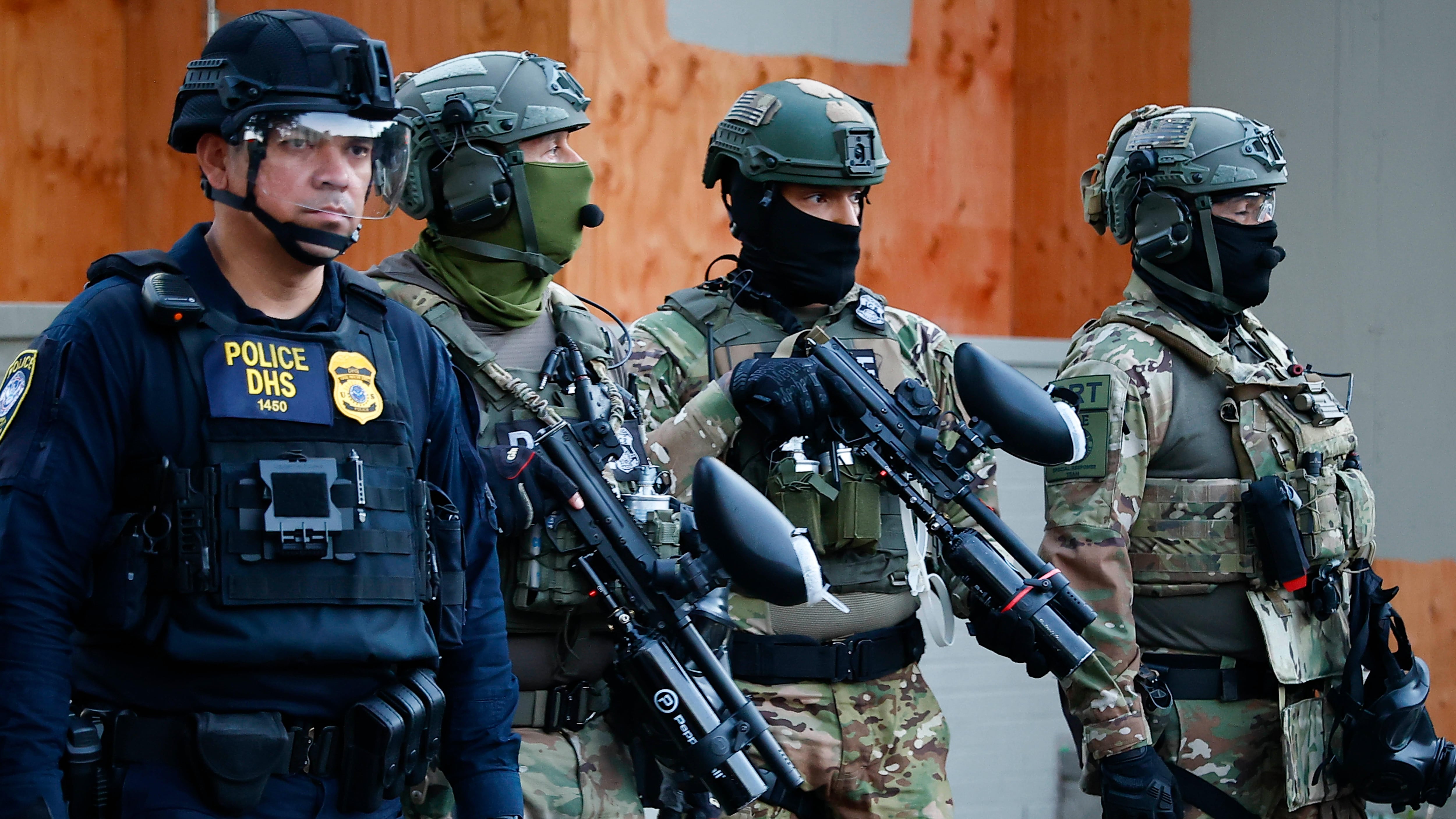
The incident occurred at a contentious spot in the city. The ICE facility on South Macadam Avenue has in recent months been the scene of frequent and persistent protests, typically small in scale, which President Donald Trump has lately used to justify his effort to deploy military troops to Portland to protect federal facilities and the personnel that work in them.
Meanwhile, many, including Portland city officials, have alleged that federal agents have in several cases needlessly intensified situations that might have easily remained far more calm.
The incident described in the crew members’ two reports suggests that such hostility has been directed not only at demonstrators, but at first responders who were asked by the feds to assist. The ambulance was eventually allowed to leave the building with the patient. But the crew’s written reports of the preceding minutes offer a small but revealing sign of how on edge some federal agents working in the ICE facility are feeling—and how quick they are to take an aggressive posture when they perceive a physical threat, even from a fellow emergency worker.
WW first contacted U.S. Immigration and Customs Enforcement about the incident early last week. When WW followed up Friday, Oct. 10, with more details about what it planned to report, an ICE spokesperson wrote: “Please contact the Federal Protection Services for response.”
A subsequent email that day to the U.S. Federal Protective Service went unanswered. A media contact for the U.S. Department of Homeland Security, which contains FPS and ICE, did not respond to a request for comment either. None of the agencies responded to a follow-up email Oct. 11 asking for comment.
WW also sought comment from the ambulance crew members, the ambulance company, and the union representing the workers. None denied that the incident had occurred as described in the documents. The union added that when armed agents interfere with medical transport, they “cross a moral line.”
Public records provide greater context to the incident detailed in the crew members’ reports. The ambulance was called late in the evening on Oct. 5 to the ICE facility at 4310 S Macadam Ave. According to a publicly available dispatch document, the crew was responding to a medical call for a protester with a broken or dislocated collar bone.
By 9:13 pm, the ambulance was en route. According to a dispatch document, federal officials suggested at first that the ambulance enter the ICE facility through a side door, but then determined it should come in the main gate. The ambulance arrived on scene at 9:19. By 9:22, it had entered the building.
AMR ambulance on NE 82nd Avenue (Brian Burk)
A two-member crew was aboard. Both later documented the event in confidential reports. One record, reviewed by WW, appears on an event summary form produced for American Medical Response—the company that contracts to run ambulance services in Multnomah County. The document lists Oct. 5—the same day as the incident in question—as the “date submitted.” The other document is an email, sent by a crew member to a union representative. It is time-stamped the evening of Oct. 6.
The reports indicate that when the ambulance arrived, the patient was transferred into the vehicle without issue, and soon the crew was preparing to depart. This is consistent with other publicly available records. At 9:30 pm, the ambulance operator indicated plans over the radio to head to Legacy Emanuel Medical Center. Around 9:33 pm, dispatch records say, the ambulance seemed to be getting ready to bring the patient out.
And yet it was not emerging. What was going on? One crew member worked largely in the rear of the ambulance, while the other was sitting in the driver’s seat. Their respective reports offer consistent accounts from different vantages.
An initial delay, the driver’s report indicated, stemmed from federal agents’ desire to ride in the ambulance to the hospital. The driver recalls responding that, in the absence of arrest paperwork, officers could not ride in the ambulance, and that an agent responded this was OK—that agents would follow the ambulance to the hospital instead.
But the point was evidently not resolved. Before long, a report says, an agent again said the ambulance needed to wait for an agent who would ride along.
“I repeated again,” the driver’s report recounts, “that no officer is permitted to ride in the ambulance and that they can meet us at the hospital and that we needed to be let out of the facility. Officers then began walking away from me whenever I spoke. At that point, a group of 5-8 civilian-dressed men walked into the garage and just stared at me. No identification on any of them. I walked back to the ambulance and got into the driver’s seat. I flipped the emergency lights on and put the car into drive. I inched forward slowly out of the garage.”
At this point, a report says, a man in civilian clothes with a neck wrap covering the lower part of his face stepped in front of the ambulance and told the driver to halt. The ambulance driver, in the report, recalls telling the man not to stand in front of the ambulance, and that the man then yelled at the driver to stop, citing the risk of hitting federal agents.
The driver recalled expressing skepticism about the risk of hitting the large group of officers in full riot gear, in plain view, about 15 feet in front and to the left of the ambulance. Sensing that departure was imminent, the driver inched forward further: “The group of about 30 officers in front of the ambulance were lining up in what I assumed to be preparation for the gate to open so they could escort the ambulance off of the property,” the report says.
Time went by. The crew was anxious to get the patient to the hospital. But they were still being impeded. Several federal agents, many in riot gear, moved to stand “incredibly close” to the front of the ambulance, the driver’s report recounts. An agent approached to inform the driver of the presence of “violent protesters” outside—a new reason the ambulance could not yet leave.
Around this time, dispatchers received one of the crew’s radio messages: The ambulance was still being held up.
Public records document this period as well: “50-60 fed agents completely blocking the road,” a dispatch report said at 9:39 pm, “but AMR still not driving out yet.”
The gate to the ICE facility had opened and dozens of officers in riot gear had marched out, revealing a clear exit path. Still, according to an incident report, the smaller group of officers continued to stand directly in front of the ambulance.
Around this time, the crew member in the rear, having determined, as a report says, that the “yelling and aggressive nature of the officers had created a scene safety issue,” exited the ambulance to have a word with them.
“My partner was still in the driver’s seat,” the crew member wrote, “and I left the ambulance to attempt to calm and deescalate the situation.”
In the other report, the driver recalled observing this and moving to secure the vehicle before also getting out: “I then placed the ambulance into park, took my foot off the brake, undid my seat belt and opened the driver’s side door. I looked up and suddenly the entire group of officers…were crowded around the open car door, some of them leaning forward towards me, inches from my face.”
An agent, the driver recalled, “pointed his finger at me in a threatening manner and began viciously yelling in my face, stating, ‘DON’T YOU EVER DO THAT AGAIN, I WILL SHOOT YOU, I WILL ARREST YOU RIGHT NOW.’”
According to the driver’s report, the crew member who had been in the rear of the ambulance told the agent that the vehicle rolled forward when the driver put it in park, and that no one was trying to hit him.
To this, the report recounts, another agent replied that this was not the first time this had happened.
According to the medics, the agents continued to yell. There was also further chatter of riding in the ambulance, but in time an accord was reached: Feds would follow along in their own car.
By 9:42 pm, a crew member radioed in: They were finally en route to the hospital. The driver, in the report, recounts making this radio call, and that dispatch copied. The report says an unmarked vehicle with state license plates followed closely behind the ambulance, and upon arriving at the hospital, multiple men in civilian dress exited the vehicle and walked in.
Presented by email with details of this story, a spokesperson for Global Medical Response, the parent company of American Medical Response, did not answer WW’s questions, but said, “We are reviewing the specifics of the situation and committed to a thorough review.”
WW reached out to the two ambulance crew members. Both declined to comment.
Asked for incident reports tied to the medical call, Austin DePaolo, a spokesman for Teamsters Local 223, which represents the ambulance workers, said in an email that the union “doesn’t have any incident reports that members have given us permission to share.”
DePaolo added: “Our Teamster EMS workers answer every call with courage and compassion. When armed agents interfere with medical care, they cross a moral line that could put lives at risk. We stand firmly behind our members who work in EMS.”
Andrew Schwartz writes about health care. He’s spent years reporting on political and spiritual movements, most recently covering religion and immigration for the Chattanooga Times Free Press, and before this as a freelancer covering labor and public policy for various magazines. He began his career at the Walla Walla Union-Bulletin.
Willamette Week’s reporting has concrete impacts that change laws, force action from civic leaders, and drive compromised politicians from public office.
The American Federation of Labor (AFL) voted to boycott all German-made products as a protest against Nazi antagonism to organized labor within Germany.