May 16, 1918 The U.S. Congress passed the Sedition Act, legislation designed to protect America’s participation in World War I. Along with the Espionage Act of the previous year, the Sedition Act was orchestrated largely by A. Mitchell Palmer, the United States attorney general under President Woodrow Wilson. The Espionage Act, passed shortly after the U.S. entrance into the war in early April 1917, made it a crime for any person to convey information intended to interfere with the U.S. armed forces’ prosecution of the war effort or to promote the success of the country’s enemies. Aimed at socialists, pacifists and other anti-war activists, the Sedition Act imposed harsh penalties on anyone found guilty of making false statements; insulting or abusing the U.S. government, conscription, the flag, the Constitution or the military; agitating against the production of necessary war materials; or advocating, teaching or defending any of these acts. The Sedition Act of 1918
May 16, 1943 The Nazis crushed the Jewish uprising in the Warsaw ghetto after a month of bloody fighting. 56,000 died in the struggle. Read more
May 16, 1967 Nhat Chi Mai immolated herself in Saigon, the capital of South Vietnam, to protest the war. “I offer my body as a torch / to dissipate the dark / to waken love among men / to give peace to Vietnam.” The flower known as Nhat Chi Mai. Read more
May 16, 1998 Tens of thousands of Britons supporting Jubilee 2000 formed a human chain around the meeting place of the G7 Summit (an annual meeting of the leaders of the largest industrial countries) in Birmingham, England. Jubilee 2000 urged the major international lending countries to relieve terms of and forgive the massive indebtedness of poor countries around the world. Jubilee 2000 by Noam Chomsky
May 15, 1870 Julia Ward Howe Julia Ward Howe, suffragist, abolitionist and author of the “Battle Hymn of the Republic,” proposed Mother’s Day as a peace holiday. She had seen firsthand some of the worst effects of war during the American Civil War—the death and disease which killed and maimed, and the widows and orphans left behind on both sides and realized that the effects of the war go beyond the killing of soldiers in battle. Mother’s Day did not become a national holiday until declared by President Woodrow Wilson in 1914. “… Disarm! Disarm! The sword of murder is not the balance of justice.” Blood does not wipe our dishonor, Nor violence indicate possession. As men have often forsaken the plough and the anvil At the summons of war, Let women now leave all that may be left of home For a great and earnest day of counsel.”
May 15, 1935 The National Labor Relations Act was passed, recognizing workers’ rights to organize unions and bargain collectively with their employers. Read more
May 15, 1957 Britain tested its first hydrogen bomb over Christmas Island in the South Pacific, after just two years of development. Mushroom cloud over Christmas Island
May 15, 1965 A National teach-in to oppose the Vietnam War was held in Washington, D.C.
May 15, 1966 The American Friends Service Committee, SANE (The Committee for a Sane Nuclear Policy), and Women March for Peace, along with four other organizations, sponsored a 10,000+ person anti-war picket at the White House and a 60,000+ rally at the Washington Monument to oppose the Vietnam War. . . . elsewhere the same day . . . Buddhist altars were placed in streets to impede troops arresting dissidents in South Vietnam.
May 15, 1969 Governor Ronald Reagan sent in the National Guard to reclaim People’s Park from 6,000 protesters in Berkeley, California, who had occupied the space and created the park. Police gunfire killed a bystander, James Rector, blinded another, and injured dozens. People’s Park March, Friday May 30, 1969, at the intersection of Haste Street and Telegraph Avenue, in Berkeley
May 15, 1970 In response to the U.S. invasion of Cambodia (an expansion of the Vietnam War) and the killings at Kent State and Jackson State Universities, several million U.S. students held campus strikes to oppose the Vietnam War.
May 15, 1970 The Native American Rights Fund filed suit on behalf of the Hopi tribe to prevent strip-mining on sacred Black Mesa in Arizona.
May 15 (since the 1980’s) International Conscientious Objectors Day, established to honor those who leave or refuse to enter their country’s armed forces for reasons of principle. Conscientious Objector Day history
This post is about a case that could be easily overlooked with so much Trump news spewing through the fire hose these days. But Florida’s continued aggression in the culture wars has the potential to affect all of us. So, as here, when a brave plaintiff takes its case to court and wins, it’s news we all need to know about.
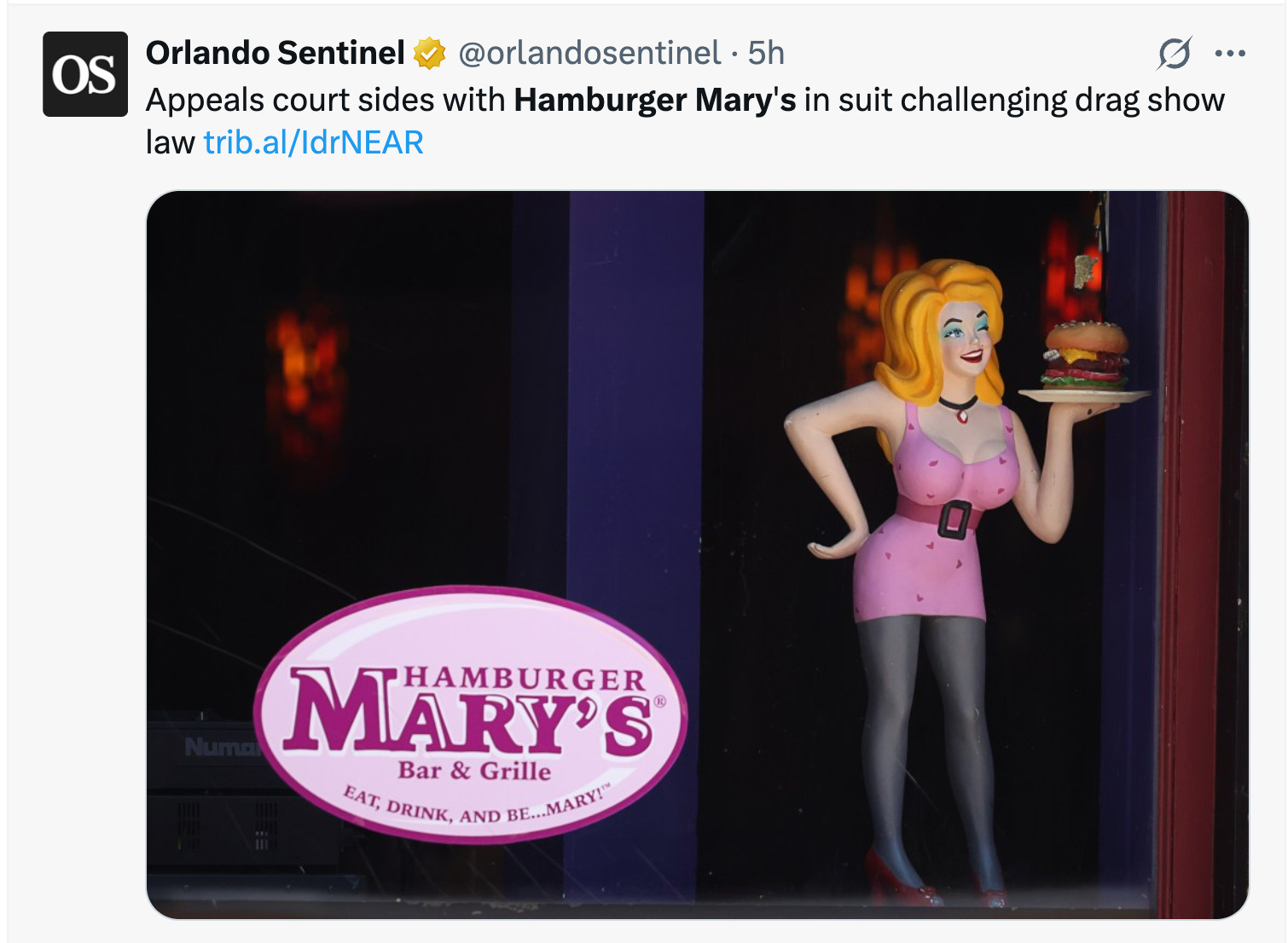
On Tuesday, the Eleventh Circuit Court of Appeals decided HM Florida-ORL, LLC v. Sec. of Florida DBPR, a case involving Hamburger Mary’s, a restaurant and bar in Orlando that regularly hosted drag performances, including family-friendly shows. When the Florida legislature passed SB 1438 in 2023, Hamburger Mary’s canceled its family-friendly drag shows and prohibited minors from attending any of its other shows out of fear of losing its business and/or liquor license. As a result, Hamburger Mary’s lost 20% of its bookings.
The new law gave state agencies the power to target LGBTQ+ friendly businesses in two major ways:
It gave the Department of Business and Professional Regulation discretionary authority to fine, revoke liquor licenses, and even shut down establishments.
It made it a crime to admit young people to any performance, exhibit, play, or show that the state deems inappropriate, even if the child’s parents think it is appropriate for their family.
The bill was an effort by conservative politicians, led by Florida Governor Ron DeSantis, to impose their beliefs on the entire state. It was a major salvo in the culture wars. Their too-clever-by-half mechanism was to punish private businesses that included or supported the LGBTQ+ community in order to exclude that community from being a public presence in Florida. The law’s language was so vague that businesses had no realistic way of knowing what it prohibited, meaning they had to take the extreme steps Hamburger Mary’s took to pull back their offerings in order to avoid the risk they’d be put out of business.
So, Hamburger Mary’s filed a lawsuit against Florida, its governor, and Secretary of the Florida Department of Business and Professional Regulation (FDBPR) Melanie Griffin, seeking a preliminary injunction that would keep the state from enforcing its law while the litigation proceeded. The district court granted the preliminary injunction and the Secretary appealed to the Eleventh Circuit.
The issue in the case involves the First Amendment, as you’ve probably figured out by now. Although the technical legal issue was whether the district court had been correct to grant the injunction, the substantive issue is whether Florida’s Senate Bill 1438 (“The Protection of Children Act”), which prohibits children from attending “adult live performances,” is unconstitutional under the First Amendment, because it is both vaguene and overly broad.
The Eleventh Circuit ruled in Hamburger Mary’s favor, keeping the injunction against enforcement of SB 1438 in place, because the panel believed the law was likely unconstitutional—both too vague for people to understand what they could and couldn’t do to remain in compliance with it and overbroad in its supposed efforts to protect children without regard to their parents’ views.
It’s significant that this decision comes out of the conservative Eleventh Circuit, although admittedly, the composition of this panel, which included both an Obama and a Biden appointee, is unusual. Florida could seek en banc review from the full court, in hopes of getting a more favorable hearing. The decision was 2-1. The third judge on the panel, Senior Judge Gerald Bard Tjoflat, was appointed by President Gerald Ford. His objection to the majority’s decision primarily involved a belief that the injunction came too early, and the courts should have demurred until they saw how the state enforced the law in practice.
Among the most interesting points made in the opinion:
The Court found the penalties for violations under SB 1438 “grievous.” The penalties for violations include a $5,000 fine for a first offense or a misdemeanor prison sentence of up to a year.
On protecting First Amendment rights, they noted that “The government cannot shroud rules in foggy language and then blame would-be speakers for their fears of what may lurk in the fog.” Laws like this use vagueness as a means to get private individuals and businesses to obey in advance, staying as far back as possible from the line of conduct the law prohibits in order to avoid the consequences of violating it. In this way, the state restricts far more First Amendment-protected conduct than they are legally entitled to. The panel wasn’t having any of it. It noted the importance of securing “breathing room for free expression” in a case like this.
We’ve seen injunction cases before, so we know that Hamburger Mary’s had to demonstrate it was likely to succeed on the merits of its claim in order to get the injunction. The court underscored the point above when it found that they met this burden, discussing the“chilling effect” laws like this have, and the way they discourage people from speaking their minds, even if their speech doesn’t fall squarely within what the law prohibits. They noted that “[T]he Act’s vagueness…means it is likely to stifle a substantial amount of protected speech,” explaing that at oral argument, the state had been unable to explain, for instance, how to decide what kind of performances would be acceptable for kids of different ages, which the law requires venues to do to avoid penalties. They concluded, “If the Secretary’s attorney can’t articulate the difference, it’s hard to imagine how we could expect performance proprietors to know what the Act means.”
At least for now, the First Amendment is still alive and kicking in Florida. The majority in this case held that the state was trying to “empower those who would limit speech” but that “the First Amendment empowers speakers instead.” “Requiring clarity in speech regulations,” the court wrote, “shields us from the whims of government censors.” This case is important for Floridians and for the LGBTQ+ community. Beyond that, in a time when our rights are under attack, it’s important for all of us.
When it feels like progress isn’t happening, a force field analysis can reveal where the status quo is shifting and point to other strategic leverage points.
If you try to track every piece of news, you may find it impossible to mentally survive the onslaught of these times. Donald Trump and Elon Musk have unleashed a barrage of civil rights rollbacks, weaponized institutions and passed off idiotic/dystopian spectacles as governance. The sheer velocity can numb the senses, tempting us to shut down, turn off the feed and retreat.
But you also cannot be good to the world (or yourself) if you keep your head down and pay attention to nothing. Withdrawal is understandable, even necessary at times — but permanent disengagement only cedes ground to the authoritarian momentum, while reinforcing our image of ourselves as powerless.
With that in mind, an important question emerges: How do we observe what’s happening without being crushed by its weight?
This is where the work of social psychologist Kurt Lewin becomes a powerful tool. Lewin — a Jewish intellectual who fled Nazi Germany — developed force field analysis to understand how power, behavior and transformation occur in real social systems.
He saw that any given situation is held in place by a dynamic equilibrium between forces pushing for change and those resisting it. To shift the status quo, you don’t necessarily need to move everything at once — you can focus strategically on specific forces or actors that influence the whole.
In activist training, I was taught force field analysis as follows: First you make a list of forces and organizations pushing towards the dreary authoritarian oligarchy-controlled vision. Then you make a list of forces pushing towards a reordered society that’s deeply democratic and where wealth is shared.
There’s a tension between these two forces. For example, on the authoritarianism side right now, Trump’s FBI ordered the arrest of a state judge for allegedly trying to prevent ICE from detaining a man in her courtroom or the arrest of New Jersey’s gubernatorial candidate Ras Baraka. On the democracy side, judges, lawyers and plaintiffs have defeated Trump 93 percent of the time in court because his orders are sloppy and patently illegal. What’s more, the Trump administration has quietly followed the judge’s orders most of the time.
While all authoritarians favor loyalty over competency, this regime is particularly extreme in its mistakes. And Trump is still fighting Harvard, and trying to take over now museums too. But again, new frontline resistance is appearing in the arts community and amongst librarians and museum leaders.
There can be an impulse to want to ask, on any given day, “Are we winning? Or are we losing?” Like a basketball game, many of us do a kind of score keeping about how many points we are down. But, just to continue with the sports analogy, our situation is more like soccer — where a lot of the game isn’t about immediate scoring but positioning, repositioning, quick advances and quick retreats. Progress may not always be visible or immediate, but that doesn’t mean it isn’t happening.
A Colombian elder — who has lived her whole life in the shadow of war — recently told me, “People in the U.S. are obsessed with winning, and it’s very unhealthy in moments like this. You keep wanting to know if it’s going well or not — and these times can’t be analyzed in headlines or moments. Sometimes it just is what it is. It’s losing and winning. The yardstick is measured in hearts, and the timeline is generations of work on people’s attitudes and views.”
Lewin’s brilliance was in recognizing that we don’t have to act on everything all at once just because we see the bigger picture of what’s happening. We can begin by identifying the different forces at play: forces for good, forces against and some forces that are mixed. Crucially, in his analysis, you then assess which of these forces can be strengthened or weakened.
This is where it’s helpful to get practical. Courage anywhere begets courage everywhere. Because Trump has picked a strategy of everywhere all at once — nearly every group has a chance to stand up and support each other to be more bold. We’re already seeing great examples of this, such as the hundreds of nonprofits signing on to support Harvard’s fight, the lawyers retaking their oaths to the Constitution in public, and the government workers resisting unauthorized access by DOGE and continuing their important work.
In practical terms, the best strategy might be not focusing on Musk or Trump directly, but on amplifying local election protections, funding investigative journalism, or supporting tech workers organizing against misuse of platforms. You don’t need to tackle the entire regime to weaken its foundation. You need leverage points — clear, concrete places to act.
Using Lewin’s tool helps prevent burnout. It turns despair into direction. It gives structure to what might otherwise feel like flailing.
So, yes: These are hard days. But it’s not all bad or good — it’s a force field in motion. Even small acts, strategically placed, can shift the balance. We are not powerless — we are participants.
I have bitterly wondered why people wouldn’t just go vote for whoever they had to, but to just vote, especially in the 2024 election. I’ve had a hard time with the non-voters. But, turns out, some of them have legitimate reasons (I’ve spoken with none,) but it turns out that not all the non-voters are asses. -A
Political tension and fears of violence may have depressed voter turnout in 2024
Women and gender-nonconforming people were more likely than men to fear violence and harassment while voting in the 2024 election, and those who expressed concerns about safety were more likely not to vote at all, new research shows.
The study, released Monday and shared first with The 19th, was conducted by States United Democracy Center, a nonpartisan organization focused on promoting fair and secure elections and upholding the rule of law.
“Tens of millions of Americans ultimately cast their ballots in 2024 without incident,” the report said. “But voting was not straightforward and safe for all Americans. Many were harassed, and a limited number were subjected to physical violence.”
The study found that the 2024 election was, as a whole, safe, fair and securely conducted, with voters overwhelmingly reporting feeling safe at the polls and confident in the safety and security of the election. But rising incidents of political violence, heightened political polarization and gender-based harassment had a measurable impact on how women and gender-noncomforming people especially viewed the safety of voting in the 2024 election — and whether they turned out to vote at all, the study says.
Researchers surveyed voters before and after the 2024 election in partnership with research data and analytics group YouGov and held a series of seven focus groups before the election — with three groups of White women, three groups of women of color and one made up of gender-nonconforming participants. They also fielded surveys of state lawmakers, election administrators and law enforcement officials in partnership with the nonprofit CivicPulse. The study is also one of the first of its kind to study the voting experiences of gender-nonconforming voters, who are subject to gender-based discrimination and harassment at the polls.
Women, people of color and gender-nonconforming people were more likely to have perceived the election environment as being unsafe, reported experiencing higher rates of voting-related harassment and were more likely to take precautionary measures when going to the polls. The study also compared pre-election survey responses to voting records and found that higher expectations of experiencing violence or harassment at the polls was correlated with lower voting rates.
“Concerns about violence or harassment depressed turnout, likely turning millions of voters into non-voters,” the report said.
The pre-election survey, conducted September 23 to 30, 2024, surveyed 4,016 American adults with a margin of error of plus or minus 1.7 points. The post-election survey, conducted November 7 to 19, surveyed a separate group of 4,017 registered voters with a margin of error of plus or minus 1.6 points. The researchers asked a series of questions to identify gender-nonconforming respondents in its surveys with YouGov, resulting in a sample of 81 gender-nonconforming voters in the pre-election survey and 103 in the post-election survey.
To measure fears of harassment and violence, researchers asked respondents how likely they thought it was to experience events ranging from verbal or written harassment to property damage and acts of physical violence. While all gender groups provided average responses of “somewhat unlikely” across all five, gender-nonconforming respondents had a higher expected likelihood of harassment or violence.
Overall, 91 percent of men, 89 percent of women and 73 percent of gender-nonconforming respondents said in the post-election survey that they felt safe voting. But respondents’ perceptions and feelings of safety varied by race among women and gender-nonconforming people. In the post-election survey, 92 percent of White respondents said they felt completely or mostly safe voting, compared with 85 percent of Black voters and 84 percent of Hispanic voters.
In pre-election surveys, women and voters of color were more likely than men and White respondents to view voting as unsafe and to say they were taking precautions as a result. Among women, the most common safety precaution respondents said they were likely to take was not bringing their children to the polls (32 percent), while the most common safety precaution for gender-nonconforming people was not interacting with others at the polls (46 percent). About a quarter of women and gender-nonconforming respondents said they were likely to vote by mail.
Several women voters in focus groups cited the potential of gun violence as a concern.
“I don’t go to the polls, because you never know what you will encounter there,” said a White independent woman voter who participated in one of the focus groups. “It seems like everybody in Arizona has a gun. We vote by mail, because it’s safer. Everybody has an opinion; you get in line, and you hear it all. You never know, if they don’t agree with you, they’ll shoot you. People are crazy.”
Others spoke to the heightened political climate and general political tensions around the election as a reason they feared threats, harassment and even heated conversations in line.
“I go early, or late, when I won’t run into anybody I know, and there won’t be any conversation,” said a Black Republican woman focus group participant. “I don’t want to deal with the emotional, ‘Who did you vote for?’ And me saying, ‘I don’t want to discuss it.’ So there are no issues, fighting, cussing, yelling. Save my peace of mind.”
People who feared violence and harassment at higher levels were less likely to vote, researchers found by comparing survey responses to verified voting records. When controlling for turnout differences based on demographic considerations, the study still found an average three percentage point decline in the likelihood of voting.
“For context, differences in voter behavior based on education level, one of the strongest predictors of turnout, are only half as large as differences explained by expectations of violence or harassment,” the report said. “Put another way, generalizing our results to the nationwide electorate, roughly 6 million Americans may have decided not to vote in 2024 because of concerns about violence or harassment.”
Gender-nonconforming voters face particularly unique challenges and barriers when it comes to voting.
A rise in anti-transgender political rhetoric from the right has been accompanied by a slew of laws targeting transgender people in Republican-controlled states. Some of these laws have sought to create strict definitions of gender and bar transgender individuals from changing the sex listed on their official identification to align with their gender identity. In states that require voters to show photo identification at the polls, that could open up transgender and gender-nonconforming individuals to scrutiny and potential harassment. In the pre-election survey, a third of gender-nonconforming voters said they were likely to dress differently at the polls.
“I’ve been a registered voter for decades. When I attempted to vote last time, they had a hard time ‘finding’ my registration,” said a gender-nonconforming Black independent who participated in a focus group. “I could tell I was being judged. The attitude of the person looking at your information to give you the voting packet can be intimidating. My documents have been submitted, I have my ID, what’s the problem? I felt there was judgment as far as was my information correct or was it fraudulent.”
In the post-election survey, over half of gender-nonconforming respondents said they took at least one safety precaution when voting, compared with about a third of men and women who said they took at least one precaution. Thirteen percent of gender-nonconforming respondents reported experiencing verbal harassment, intimidation and threats compared to 5.2 percent of men and 4.8 percent of women. In all, 18 percent of gender-nonconforming voters reported experiencing violence or harassment during the 2024 election season.
“I am obviously queer when you look at me, and I’ve been harassed for it,” said another focus group participant, an Asian-American Democratic voter. “Depending on how I do my hair or what I wear [on election] day, it’s a higher chance I’ll get harassed. If I was girly, I would be afraid someone could see through that and do me harm.”
This story has been updated to clarify support and funding for the report.
May 14, 1941 The first groups of WWII conscientious objectors (COs) were ordered to report to camp at Patapsco, Maryland. They and others formed the Civilian Public Service (CPS) during the war. They performed various duties, among others being trained as smoke jumpers dealing with forest fires. World War II COs Conscientious objection in America ACLU More on the CPS ======================================== May 14, 1954 In the “Yankee” nuclear weapons test in the atmosphere above the South Pacific, a single detonation, expected to yield 9.5 megatons of force, actually yielded 13.5 megatons (equivalent to thirteen and a half million tons of TNT), the second largest ever by the U.S. The resultant mushroom cloud extended 25 miles up and spread 100 miles across. “Yankee” ======================================== May 14, 1970 Phillip Lafayette Gibbs Two African-American students were shot to death and 30 others wounded by local police and state troopers and national guardsmen at primarily black Jackson State University in Mississippi. The two were watching demonstrators protesting the invasion of Cambodia and racial discrimination from a nearby dormitory tower. James EarlGreen This happened shortly after the shooting of students at Kent State University in Ohio. Two days of riots ensued in Jackson resulting in curfews and sealing off of the city. Read more about Jackson State
May 13, 1888 Brazil, which had imported more African slaves than any other country (nearly 40% of the 11 million Africans shipped to the western hemisphere), abolished slavery.
May 13, 1932 “We Want Beer” marches were held in cities all over America, with 15,000 unionized workers demonstrating in Detroit. Prohibition (the 18th amendment to the U.S. Constitution barring “the manufacture, sale or transportation of intoxicating liquors”) was repealed the following year.
May 13, 1954 Natives of the Marshall Islands pleaded for an end to atmospheric H-Bomb testing in the south Pacific. A ground zero forgotten The Washington Post
May 13, 1958 During a goodwill trip through Latin America, Vice President Richard Nixon’s limousine was attacked with rocks and bottles by an angry crowd and nearly overturned while traveling through Caracas, Venezuela. The crowd was angered by U.S. Cold War policies and their effect on Latin America. Five days earlier in the trip, the Vice President had been shoved, stoned, booed, and spat upon by protesters in Peru.
May 13, 1967 250 Chicano students from Los Angeles colleges & universities met to form the United Mexican American Students (UMAS).
May 13, 1968 “We are the power” Workers joined Paris students’ protest in a one-day general strike calling for the fall of the government and protesting police brutality. The protest by French students included occupation of The Sorbonne; by the end of the month over 10,000,000 French citizens had been involved in school and workplace occupations. View and read about the great poster art from Paris ‘68
May 13, 1992 Ecuador’s government granted 148 native communities legal title to more than three million acres (slightly less than the size of the state of Washington) in the Amazon Basin.

 CHRONOLOGY-Who banned slavery when?




 Scottie's Playtime