to spread brightness in as much space around us as we can, especially if we’re in an area endangered by the Trump enforcement brigades we’re seeing. But even if we’re not, we can extend these actions locally to build community so we’ll be safer when it is our turn.
“We, at Wrecktangle, at all locations for the rest of the weekend, are going to donate one pizza for every single pizza sold, to families and friends that are affected by the increased ICE presence in Minneapolis,” one representative said.
In the caption, they noted that they are “set on volunteers” who would deliver pizza and other goods to people unable to leave home, but added: “We could really use some help raising funds to keep the momentum and keep people safe inside during these disturbing and uncertain times.”
Wrecktangle leaders said they started with $2,000 in donations from family and friends, and figured if they posted their Venmo information, they might be able to double that.
The support exceeded their expectations.
In addition to the collection of non-perishable foods and home essentials, two days later, they announced that they had received over $83,000 in donations.
Along with the donations, the local chain sold 2,291 pizzas between Thursday and Sunday.
During this time, they distributed 600 pizzas, non-perishables, and toiletries to vulnerable families, adding that “we have been working only with volunteers we personally know and trust to ensure the safety of our community.”
But thousands more meals are being made and prepared for free delivery as quickly as possible.
Wrecktangle co-owner Breana Evans told Bring Me The News that nearly every local restaurant in their area has been negatively impacted by the presence of ICE.
“We have staff, coworkers who are directly affected and scared to come to work,” Evans said. “It’s not fair for our friends to be scared to provide for their families and make a living. We know how to make food. So, we said, let’s just start making food.”
The company began donating their 13-inch frozen pizzas privately by connecting with their network of neighboring businesses and organizations. But then they realized the community could expand their efforts even wider.
Trusted volunteers were sent off to deliver free pizzas and meal kits, and others came to the shop to help assemble the goods.
“I think that’s a testament to our community and that there’s more good in the world than this horrible bad that they’re making us go through,” Evans said.
After meeting an immediate need to distribute food, Wrecktangle owners are working to figure out how to best use the funds they raised to help the community.
A screenshot of an Instagram story from Wrecktangle, sharing a weekend total of donated pizzas. Photo courtesy of Wrecktangle/Instagram
“We are working hard with nonprofit organizations to make sure these funds do the most good. We have not yet touched a cent,” they shared on social media. “As soon as we have updates as to specifically where your kindness is going, outside of purchasing food and home products, we will keep you thoroughly updated.”
And on Sunday, to finish out the campaign, Wrecktangle encouraged supporters to spend their money with other local restaurants. For one day only, they accepted emails containing a photo of a receipt from any Minnesota restaurant, and an additional meal was donated on their behalf.
“A lot of our community wants to come back to work, and we need to make sure these restaurants can help support their staff,” Evans said in a social media video. “We need you to be there.”
s of Monday morning, Wrecktangle shared on an Instagram story that they received 176 emailed receipts, which translates to 176 more meals for vulnerable community members.
“This week has spread so much love and friendship,” the company added in an Instagram story. “And we couldn’t be more grateful.”
Again we see the institutionalized casual racism in the US. This was the basis of the CRT higher education classes were about. All the media latched on to and went into great detail over a white woman’s shooting by ICE but only report vaguely and sporadically on the shooting of the black / brown people shot by ICE. But when you read the report below think on how racist ICE gang thugs are, the fact that they have broken other laws and assaulted other people with impunity as they are defended by the power of the US government. One last thing to think on. The ICE thug was clearly angry and he had his gun out, ready, and pointed in front of him allowing him to shoot the man without raising his gun. The reported statements from the government never mention him drawing his gun nor raising it, just that he fired his weapon defensively. If he felt threatened why openly approach the man with the long gun? Why no call for back up? Depending on the time was the ICE thug wakened up by the noise of gun fire? Hugs
Friends and family of the 43-year-old man who was fatally shot by a Department of Homeland Security agent in Northridge on New Year’s Eve gathered on Sunday to demand accountability and hold a candlelight vigil for their lost loved one.
They identified the victim as Keith Porter, who they say was a well-known and well-liked person in the community.
“If I could say anything to the ICE agent, it’s that you’re a murderer,” said Jasané Tyler, Porter’s cousin. “You stole my cousin from me. You stole their father from them. You stole Francine’s son from her.”
Porter’s loved ones are demanding justice after the father of two died on New Year’s Eve. He was shot by an off-duty U.S. Immigration and Customs agent at the apartments where they both lived.
Keith Porter, the 43-year-old man fatally shot by a DHS agent in Northridge on New Year’s Eve. Porter Family
His family contends that he was shooting a gun in the air to mark the new year. A statement from DHS on the incident contends that it was an “active shooter situation.”
“On December 31st, an off-duty ICE Officer bravely responded to an active shooter situation at his apartment complex,” the statement said. “In order to protect his life and that of others, he was forced to defensively use his weapon and exchanged gunfire with the shooter.”
Another statement from DHS Assistant Secretary Tricia McLaughlin provided further details. She said that the agent was “in his apartment, when he heard what he suspected were multiple gunshots. The suspected gunfire grew progressively louder, indicating to the officer that whoever was firing a gun was approaching his apartment. The officer took his ICE-authorized firearm and left his apartment to investigate. He moved to the ground level and went outside, where he believed the suspected gunfire was coming from.”
McLaughlin’s statement says that the officer rounded the corner of the building, where he encountered Porter, who they said was allegedly armed with a long rifle.
“The ICE officer identified himself as law enforcement. In response, the individual pointed his weapon at the ICE officer. The officer ordered the subject to put the weapon down, McLaughlin said. “When the subject refused to comply, the officer fired defensively with his service weapon at the subject to disarm him. The subject fired at least three rounds at the officer.”
Porter’s friends and family don’t buy it, especially with members of law enforcement in their own family.
“Every one of them says this is not standard, this is not protocol,” Tyler said.
Black Lives Matter leaders, who hosted the Sunday night vigil, are outraged by what happened.
“Were this anyone else, there would’ve been an arrest,” said Dr. Melina Abdullah, with BLM. “You don’t get to just murder people because you don’t like what they’re doing or how they’re celebrating.”
Los Angeles Police Department officers tell CBS LA that their investigation into the shooting is still ongoing. They also told the LA Times on Sunday that they haven’t yet spoken with the ICE agent due to protocol on how deadly force investigations are conducted when they involve federal law enforcement officers.
The lawless tRump and criminal gang Gestapo thugs in ICE do not want to be held accountable. They are demanding they have the right to lie and you must believe it. They think they would be allowed to get away with everything and anything to harm and terrorize people if no can see what they do. So they try to convince you it is a crime to record them. It is not a crime. But remember how racist cops tried to do the same thing after the George Floyd murder? We must not let them take our rights away from us and we must fight against the tyrannical dictatorship of a lawless government ruling a powerless public. Hugs
The Trump Administration Says It’s Illegal To Record Videos of ICE. Here’s What the Law Says.
The Trump administration believes you don’t have the right to record Immigration and Customs Enforcement (ICE) officers in public. This stance is both factually wrong and an attempt to chill free speech by conflating it with violence.
At a July 2025 press conference in Tampa, Florida, Department of Homeland Security (DHS) Secretary Kristi Noem said, “Violence is anything that threatens them and their safety, so it is doxing them, it’s videotaping them where they’re at when they’re out on operations, encouraging other people to come and to throw things, rocks, bottles.”
In September 2025, DHS Assistant Secretary for Public Affairs Tricia McLaughlin called “videotaping ICE law enforcement and posting photos and videos of them online” a form of doxing. She added, “We will prosecute those who illegally harass ICE agents to the fullest extent of the law.”
These aren’t idle threats. The Trump administration strong-armed Apple into removing an app from its mobile store that tracked ICE activity and threatened criminal investigations into its creators.
The most aggressive application of this policy has come in Chicago under “Operation Midway Blitz,” where ICE officers have relentlessly targeted protesters, reporters, and clergy engaged in protected First Amendment activity.
In October, a group of journalists and protesters filed a lawsuit alleging “a pattern of extreme brutality in a concerted and ongoing effort to silence the press and civilians.”
In court filings, the plaintiffs stated that federal officials’ own testimony illustrated their point. For example, when ICE field director Russell Hott was asked if he agreed “that it’s unconstitutional to arrest people for being opposed to Midway Blitz,” he answered “No.”
“Similarly, [U.S. Customs and Border Protection Commissioner Greg] Bovino testified that he has instructed his officers to arrest protesters who make hyperbolic comments in the heat of political demonstrations, even though such statements—which do not constitute true threats—are protected speech,” the motion argued. (Hott and Bovino’s depositions were filed under seal, and those comments were later redacted in a corrected filing by the lawsuit plaintiffs, but not before others took screenshots of them.)
Based on voluminous evidence that feds in Chicago ignored her previous orders to curb their use of force, U.S. District Court Judge Sara Ellis issued a preliminary injunction against DHS in early November 2025, saying the government’s conduct “shocked the conscience.”
Ellis found much of the officials’ testimony not credible. Bovino, for instance, testified that he never used force against a protester he was filmed tackling, and in another instance, Ellis said, he lied about being hit with a rock before firing tear gas at demonstrators. Nor did evidence support the government’s claims that federal officers issued warnings before firing less-than-lethal projectiles at those protesters.
“Describing rapid response networks and neighborhood moms as professional agitators shows just how out of touch these agents are, and how extreme their views are,” said Ellis.
The Trump administration responded by calling Ellis an “activist judge,” but it is squarely wrong when it comes to recording and protesting the police. Cato Institute senior fellow Walter Olson points out that, “While the Supreme Court itself hasn’t yet faced the issue squarely, the sevenfederalcircuitsthathavedoneso…all agree that the First Amendment protects the right to record police performing their duties in public.”
Likewise, federal circuits have upheld the right to use vulgar language to oppose police without fear of retaliation, and to warn others of nearby police checkpoints or speed traps.
As Olson writes, the administration’s “attempt to alter reality by establishing new legal facts on the ground” ultimately serves as a green light for informal repression. “If the agents come to believe that they have blanket immunity [for] whatever they do, or that citizens have no right to record them, they are more likely to take aggressive informal action, such as grabbing phones or taking news reporters into custody on charges of obstruction (perhaps later quietly dropped).”
It’s not hard to find examples of this rotten agency culture in practice. In late October 2025, ICE officers broke out the window of a U.S. citizen’s car and detained her for seven hours after she followed and photographed their unmarked vehicles. DHS accused her of reckless driving, attempting to block in officers with her car, and resisting arrest—all claims that she and her lawyer deny. Prosecutors did not charge the woman with a crime.
Recording government agents is one of the few tools citizens have to hold state power accountable. Any attempt to redefine observation as “violence” is not only unconstitutional—it’s authoritarian gaslighting. When a government fears cameras more than crimes, it isn’t protecting the rule of law. It’s protecting itself.
Oh how this cartoon resinates with me. A decade ago one of my main abusers contacted me. He told me he knew my siblings had abused me and let their boyfriends do so. But he wanted my help for something. When I informed him that he also was one of my main sexual abusers who used me for his own needs … he responded that I couldn’t blame him for that as he was a black-out drunk at the time. Yes I know his drinking was voluntary but mine was forced on me. A drunk kid is easier to maneuver and rape. He was the only one of “the family” that got some of the beatings I did. But it never caused him to draw closer to me but he took his hurts and rage on my little body. Sorry for this but right now my chained chest of bad memories are trying to overwhelm me. Hugs
I put these here in order as the author wrote them. I will say that many of the people I have read on Male Survivor were made to dress and act as female while they were male so their abusers got more thrills. That was never one of my issues. I wouldn’t have minded and the few times my “female siblings” dressed me up as a female only to be raped by the males the prepared me to be used by. I never felt unempowered or upset wearing skirts or other bits of their clothing. It was unimportant to me. I knew my place was to provide the best sexual experience of raping orally and anally as a preteen kid for who ever they had farmed me out to. For those who want to know why a 3 to 9 year old boy did not fight back, I would ask you to think of what the adults in my life were doing to me. Now about clothing. It means nothing. I was used no matter what I wore and I found skirts when I was dressed in them as feeling really great. I am not trans, but I fail to see how clothing makes a person one thing or another. Hugs
Billionaire Toby Neugebauer laughed when the Amarillo City Council asked him how he planned to handle the waste his planned datacenter would produce.
“I’m not laughing in disrespect to your question,” Neugebauer said. He explained that he’d just met with Texas Governor Greg Abbott, who had made it clear that any nuclear waste Neugebauer’s datacenter generated needed to go to Nevada, a state that’s not taking nuclear waste at the moment. “The answer is we don’t have a great long term solution for how we’re doing nuclear waste.
(snip-you can hear a 404 Media podcast if you click through to the story on 404, up there in the post title.)
The meeting happened on October 28, 2025 and was one of a series of appearances Neugebauer has put in before Amarillo’s leaders as he attempts to realize Project Matador: a massive 5,769 acre datacenter being built in the Texas Panhandle and constructed by Fermi America, a company he founded with former Secretary of Energy Rick Perry.
If built, Project Matador would be one of the largest datacenters in the world at around 18 million square feet. “What we’re talking about is creating the epicenter for artificial intelligence in the United States,” Neugebauer told the council. According to Neugebauer, the United States is in an existential race to build AI infrastructure. He sees it as a national security issue.
“You’re blessed to sit on the best place to develop AI compute in America,” he told Amarillo. “I just finished with Palantir, which is our nation’s tip of the spear in the AI war. They know that this is the place that we must do this. They’ve looked at every site on the planet. I was at the Department of War yesterday. So anyone who thinks this is some casual conversation about the mission critical aspect of this is just not being truthful.”
But it’s unclear if Palantir wants any part of Project Matador. One unnamed client—rumored to be Amazon—dropped out of the project in December and cancelled a $150 million contract with Fermi America. The news hit the company’s stock hard, sending its value into a tailspin and triggering a class action lawsuit from investors.
Yet construction continues. The plan says it’ll take 11 years to build out the massive datacenter, which will first be powered by a series of natural gas generators before the planned nuclear reactors come online.
Amarillo residents aren’t exactly thrilled at the prospect. A group called 806 Data Center Resistance has formed in opposition to the project’s construction. Kendra Kay, a tattoo artist in the area and a member of 806, told 404 Media that construction was already noisy and spiking electricity bills for locals.
“When we found out how big it was, none of us could really comprehend it,” she said. “We went out to the site and we were like, ‘Oh my god, this thing is huge.’ There’s already construction underway of one of four water tanks that hold three million gallons of water.”
For Kay and others, water is the core issue. It’s a scarce resource in the panhandle and Amarillo and other cities in the area already fight for every drop. “The water is the scariest part,” she said. “They’re asking for 2.5 million gallons per day. They said that they would come back, probably in six months, to ask for five million gallons per day. And then, after that, by 2027 they would come back and ask for 10 million gallons per day.”
During an October 15 city council meeting, Neugebauer told the city that Fermi would get its water “with or without” an agreement from the city. “The only difference is whether Amarillo benefits.” To many people it sounded like a threat, but Neugebauer got his deal and the city agreed to sell water to Fermi America for double the going rate.
“It wasn’t a threat,” Neugebauer said during another meeting on October 28. “I know people took my answer…as a threat. I think it’s a win-win. I know there are other water projects we can do…we fully got that the water was going to be issue 1, 2, and 3.”
“We can pay more for water than the consumer can. Which allows you all capital to be able to re-invest in other water projects,” he said. “I think what you’re gonna find is having a customer who can pay way more than what you wanna burden your constituents with will actually enhance your water availability issues.”
According to Neugebauer and plans filed with the Nuclear Regulatory Commission, the datacenter would generate and consume 11 gigawatts of power. The bulk of that, eventually, would be generated by four nuclear reactors. But nuclear reactors are complicated and expensive to make and everyone who has attempted to build one in the past few decades has gone over budget and they weren’t trying to build nuclear power plants in the desert.
Nuclear reactors, like datacenters, consume a lot of water. Because of that, most nuclear reactors are constructed near massive bodies of water and often near the ocean. “The viewpoint that nuclear reactors can only be built by streams and oceans is actually the opposite,” Neugebauer told the Amarillo city council in the meeting on October 28.
As evidence he pointed to the Palo Verde nuclear plant in Arizona. The massive Palo Verde plant is the only nuclear plant in the world not constructed near a ready source of water. It gets the water it needs by taking on the waste and sewage water of every city and town nearby.
That’s not the plan with Project Matador, which will use water sold to it by Amarillo and pulled from the nearby Ogallala Aquifer. “I am concerned that we’re going to run out of water and that this is going to change it from us having 30 years worth of water for agriculture to much less very quickly,” Kay told 404 Media.
The Ogallala Aquifer runs under parts of Colorado, Kansas, Nebraska, New Mexico, Oklahoma, South Dakota, Texas, and Wyoming. It’s the primary source of water for the Texas panhandle and it’s drying out.
“They don’t know how much faster because, despite how quickly this thing is moving, we don’t have any idea how much water they’re realistically going to use or need, so we don’t even know how to calculate the difference,” Kay said. “Below Lubbock, they’ve been running out of water for a while. The priority of this seems really stupid.”
According to Kay, communities near the datacenter feel trapped as they watch the construction grind on. “They’ve all lived here for several generations…they’re being told that this is inevitable. Fermi is going up to them and telling them ‘this is going to happen whether you like it or not so you might as well just sell me your property.’”
Kay said she and other activists have been showing up to city council meetings to voice their concerns and tell leaders not to approve permits for the datacenter and nuclear plants. Other communities across the country have successfully pushed datacenter builders out of their community. “But Texas is this other beast,” Kay said.
Jacinta Gonzalez, the head of programs for MediaJustice and her team have helped 806 Data Center Resistance get up and running and teaching it tactics they’ve seen pay off in other states. “In Tucson, Arizona we were able to see the city council vote ‘no’ to offer water to Project Blue, which was a huge proposed Amazon datacenter happening there,” she said. “If you look around, everywhere from Missouri to Indiana to places in Georgia, we’re seeing communities pass moratoriums, we’re seeing different projects withdraw their proposals because communities find out about it and are able to mobilize and organize against this.”
“The community in Amarillo is still figuring out what that’s going to look like for them,” she said. “These are really big interests. Rick Perry. Palantir. These are not folks who are used to hearing ‘no’ or respecting community wishes. So the community will have to be really nimble and up for a fight. We don’t know what will happen if we organize, but we definitely know what will happen if we don’t.”
About the author
Matthew Gault is a writer covering weird tech, nuclear war, and video games. He’s worked for Reuters, Motherboard, and the New York Times. More from Matthew Gault
“O.K., I’ll put that on my calendar and we’ll just keep an eye on the weather and the fall of democracy.”
Peaceful tourists, even if Trump and his MAGA supporters try to whitewash over Trump’s violent history against his own people, will never be successful. Eyewitnesses, archives, and the internet preserve the memories – it is impossible to erase all the evidence. History remains.
ICE are killing blonde white women now. Every act of violence is a message meant to intimidate us. Trump and his ICE storm troopers first came for the people of color and immigrants while few resisted. Now they’re coming for anybody and everybody. Total fascism stage of the game where nobody has privilege anymore and it’s open season on anyone who resists or happens to be in the wrong place at the wrong time.
















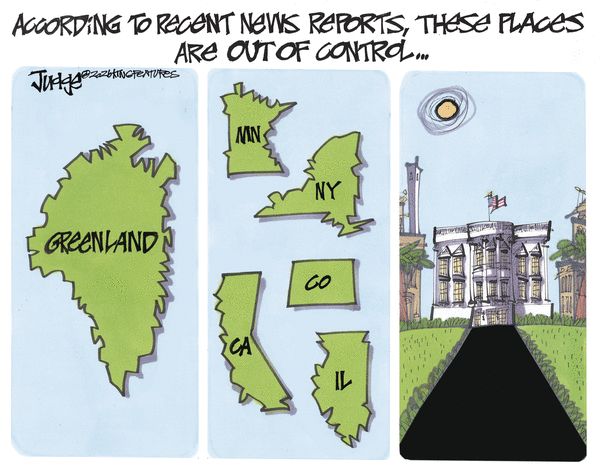









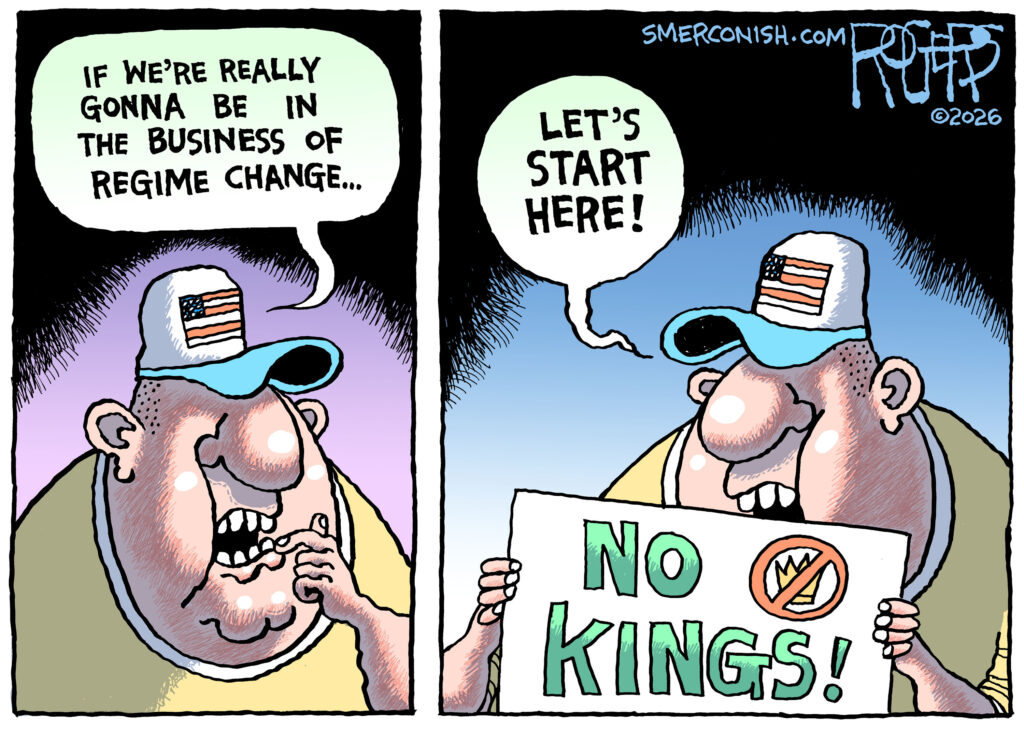






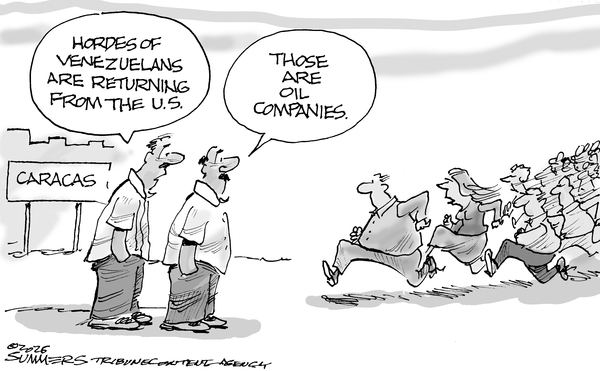


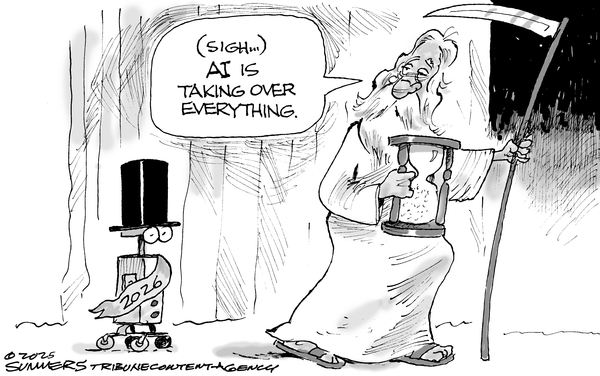













 Peaceful tourists, even if Trump and his MAGA supporters try to whitewash over Trump’s violent history against his own people, will never be successful. Eyewitnesses, archives, and the internet preserve the memories – it is impossible to erase all the evidence. History remains.