“Put simply, Patel responded to The Atlantic’s questions about the FBI’s election investigations by referring to a graphic that appeared on an unrelated news story on another media company’s website” https://t.co/W1I6huX9SF
Erick Erickson: "I do think they're going to lose Ohio … the polling in Ohio for the GOP is pretty bleak. You have the white nationalists who don't want to support Vivek Ramaswamy for governor. You have the Max Miller situation that is actually dragging down the ticket." pic.twitter.com/JeFSVNsgUY
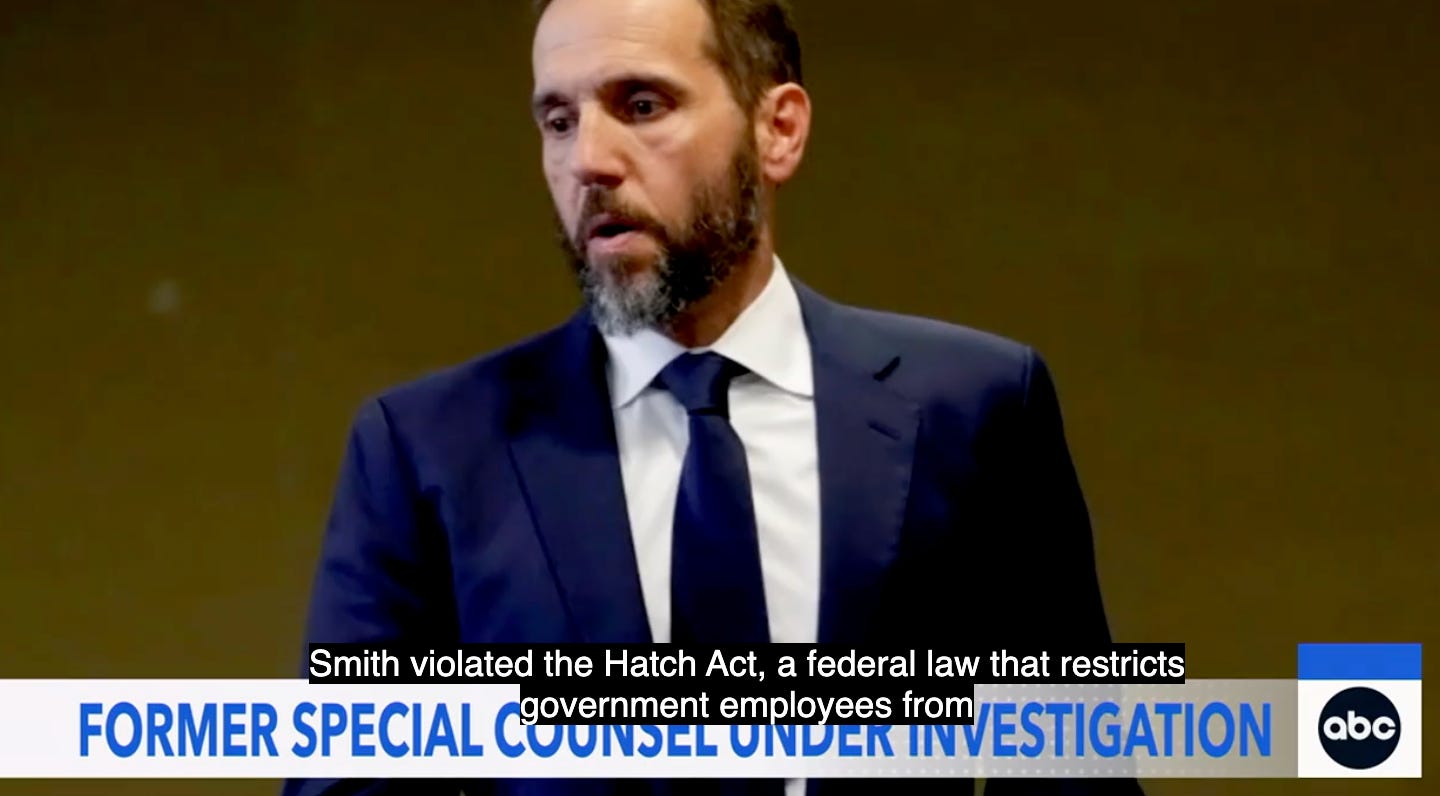
ABC reported today that the House Judiciary Committee wants to have former special counsel Jack Smith testify—behind closed doors—about investigating the Mar-a-Lago, January 6, and Donald Trump. Jim Jordan, the Ohio Republican who chairs the Committee, wants an interview by October 28. He is calling for Smith to turn over documents and communications too.
Why now? Last week, there was reporting (very unsurprising to anyone who has ever investigated a federal case) that Smith’s probe obtained phone records regarding a number of Republican lawmakers as part of the January 6 case investigation. Jordan wrote to Smith, “As the Committee continues its oversight, your testimony is necessary to understand the full extent to which the Biden-Harris Justice Department weaponized federal law enforcement.”
Republican Senator Josh Hawley of Missouri complained that “The F.B.I. tapped my phone.” He said he’d been wiretapped.
Not so fast, though. Obtaining phone records means getting call information—that can mean which phone number called which other phone number, when, and possibly, how long the call lasted. It’s easy to understand why prosecutors would want that information in virtually any case they’re investigating. Here, given reports that Trump had numerous calls leading up to and on January 6 (for instance, one with brand new Alabama Senator Tommy Tuberville), it would be surprising if they hadn’t done so. The New York Times reported that “The calls were scrutinized because at the time, prosecutors were trying to identify relevant communications between the president and his inner circle with members of Congress on the key days surrounding the violence.”
Call information, which frequently produces investigative leads, is acquired routinely by investigators. But it is not the same thing as a wiretap, which lets law enforcement listen in on a target’s phone calls. To get a wiretap, prosecutors and agents have to get an order from a federal judge in compliance with the strict requirements of Title III of the Omnibus Crime Control and Safe Streets Act of 1968. They have to establish probable cause and show that less intrusive investigative methods were tried and failed. A wiretap only lasts for 30 days, and prosecutors must go back to the judge, with fresh proof, in order to reup the wiretap for an additional 30 days.
Jordan’s allegation that this is the weaponization of the DOJ should fall on deaf ears. Jack Smith was investigating one of the most serious situations our country has ever faced—an effort to interfere with the smooth transfer of power between two American administrations, with involvement by the outgoing president who had lost the election—using routine investigative techniques. Jordan and other Republicans should be able to differentiate between that and wiretaps, since these are statutory creatures and Congress sets the requirements for when they can be used.
Jordan admonished Smith that he was “ultimately responsible for the prosecutorial misconduct and constitutional abuses of your office,” a comment that is a not-too-veiled threat in the era of revenge prosecutions.
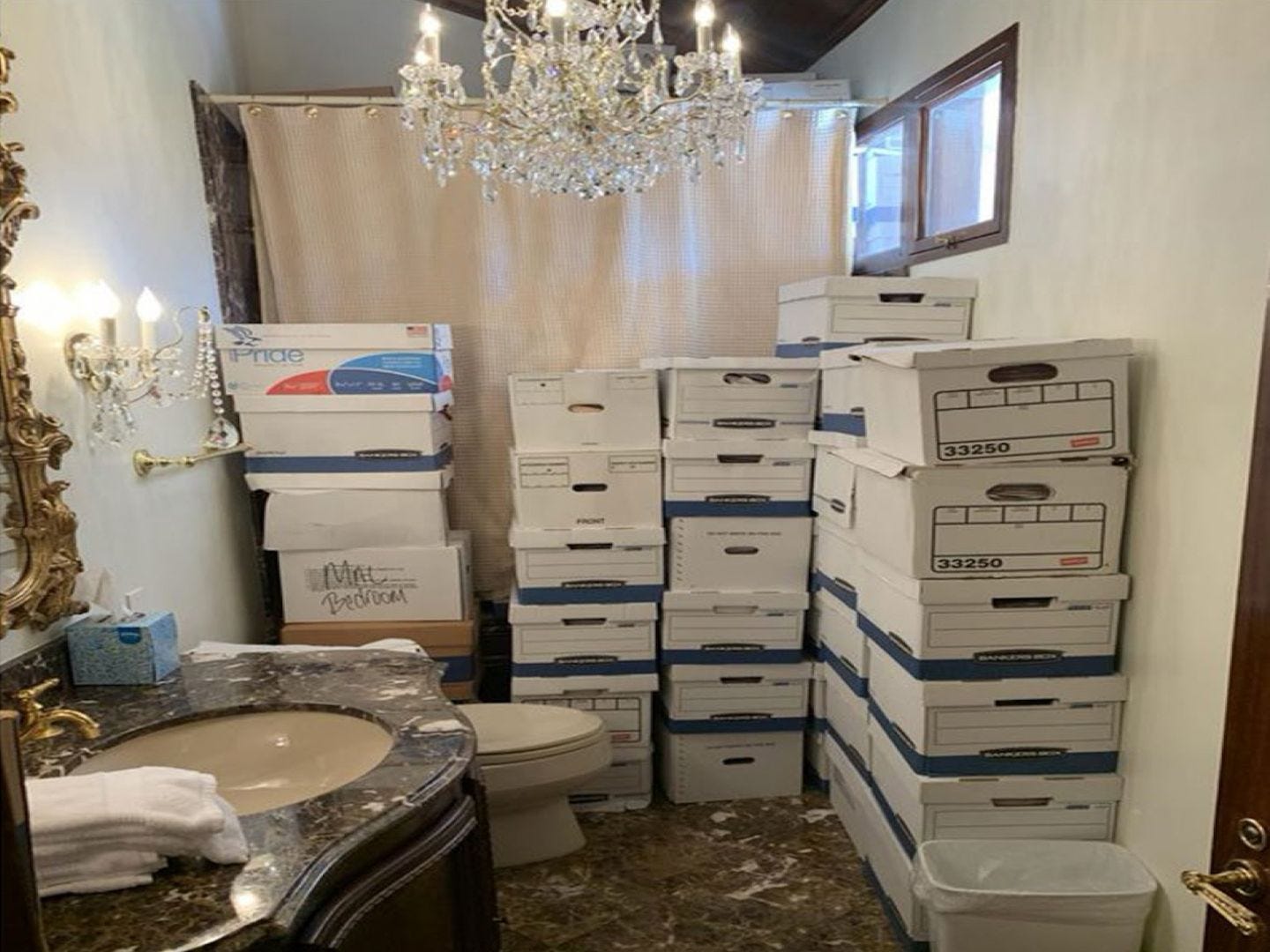
Smith spoke out earlier this week, in an interview in London with Andrew Weissmann. Smith praised the integrity, competence, and selflessness of professionals at DOJ and the FBI—many of whom were subsequently fired by the Trump administration. Why prosecute Trump for classified documents when Biden didn’t get prosecuted, Smith was asked. He responded that it was simple because the facts were starkly different; with Trump, there was evidence of willfulness and intent to violate the law regarding protection of classified documents. Trump obstructed justice, even lying and saying he had returned all the documents he retained. Of course, when the search warrant was executed at Mar-a-Lago, it conclusively proved that was a lie.
At a talk he gave last month at George Mason University in Washington, D.C., Smith said, “The heart of the Rule of Law is treating people equally under the rule of law. Good prosecutors do not care about politics. They bring cases that are supported by facts.”
That’s what good prosecutors do. What is the difference between the prosecution of Donald Trump for possessing classified documents and the decision not to prosecute Joe Biden? It’s evidence. Evidence of willfulness and intent and of Trump’s effort to obstruct justice by keeping classified documents from being recovered by the government after claiming his lawyers claimed he’d returned everything in his possession. What makes the prosecution of Jim Comey a perversion of our criminal justice system? It’s the absence of evidence that he committed a crime and the clear direction from the President of the United States to his Attorney General to go after him. We do not need to engage in bothsidesism here; one of these things is not like the other. The people who are complaining that the prior administration weaponized the Justice Department are, in fact, the ones who are doing exactly that, but all of the noise can get confusing and exhausting.
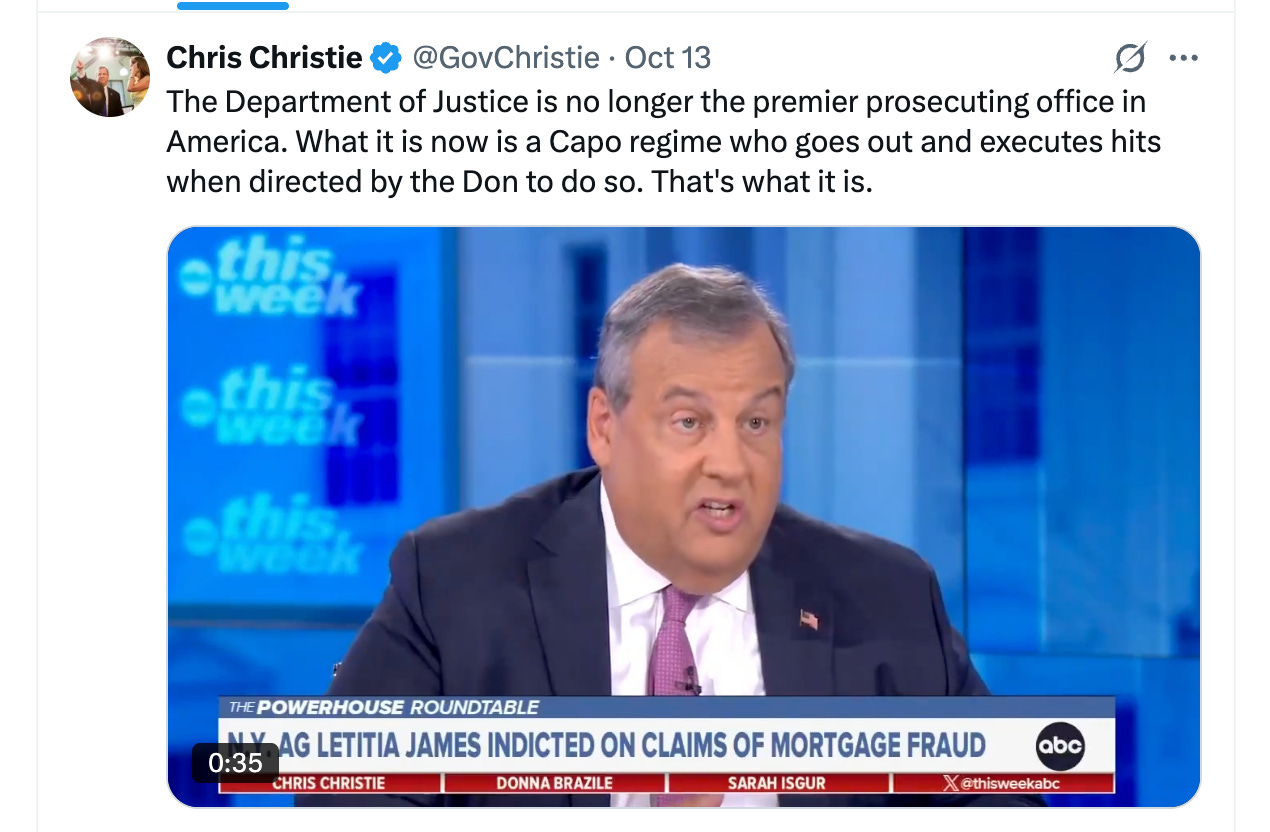
But this is no “he said, she said” controversy. When even Chris Christie, the former New Jersey U.S. Attorney and Governor, who is no stranger to legal controversy like the Bridgegate Scandal, condemns what is happening in this administration, there is every reason to pay attention.
It was the ranking Democratic member of the House Judiciary Committee, Maryland Representative Jamie Raskin, who got it just right, as he so frequently does. With his sarcasm font on full blast, Raskin congratulated Jordan for also “demand[ing] the release of Smith’s full report, and all accompanying records, from his investigation into Donald Trump’s hoarding of classified documents and obstruction of justice at Mar-a-Lago” after “an extraordinary years-long MAGA cover-up has deprived the American public of the opportunity to read this special counsel report that the taxpayers paid for.” Republicans, of course, have not. This is not about a commitment to transparency. This is not about being the party of law and order. It’s certainly not about following the rule of law.
The details about the documents Trump took with him to Mar-a-Lago, and for all we know, keeps there to this day, remain largely undisclosed. Just like the Epstein files are still being kept secret. Donald Trump is committed to an all-powerful presidency. It’s easy to understand why he thinks that’s so desirable—it’s not about doing justice.
Special counsel Jack Smith delivers remarks about an unsealed indictment against former President Donald Trump on Aug. 1, 2023, in Washington, D.C.
Drew Angerer/Getty Images
Donald Trump started this year fighting two federal prosecutions that threatened to send him to prison. But he will end it free and clear of his most significant criminal legal problems.
With his resounding victory at the polls, and a longstanding Justice Department policy against prosecuting a sitting president, the key question is not if, but when, prosecutors move to dismiss or delay his federal election interference case in Washington, D.C.
Trump recently said he would fire special counsel Jack Smith “within two seconds” after he returned to the White House. Now, that won’t be necessary to bring his federal criminal troubles to an end.
Smith is taking steps to end both federal cases against Trump before the president-elect takes office, according to a source familiar with the Justice Department deliberations.
1. What are the outstanding cases the federal government has lodged against Trump?
A grand jury in Washington indicted Trump this year on four felony charges in connection with his effort to cling to power in 2020, culminating in the violent siege on the U.S. Capitol on Jan. 6, 2021.
Judge Tanya Chutkan had set a trial date for March 2024, but that date came and went, after the Supreme Court accepted the case and ultimately handed Trump significant immunity from prosecution for official actions he took in the White House.
The judge is just now beginning to consider what parts of the prosecution’s case amount to official acts, and which are private conduct of a person seeking rather than holding office.
The Justice Department has appealed in a separate criminal case against Trump that accuses the former president of hoarding classified documents at his Mar-a-Lago resort and refusing to the return them to the FBI.
Judge Aileen Cannon, who was appointed to the bench by Trump, dismissed the documents case on July 15, the first day of the Republican National Convention this year, reasoning that the way the special counsel had been appointed violates the Constitution. The Justice Department has been seeking review by a higher court, the U.S. Court of Appeals for the Eleventh Circuit.
2. What does Trump’s election victory mean for these cases?
They’re on life support and likely to end even before the inauguration in January.
On the campaign trial, now President-elect Trump has vowed to fire the special counsel, Jack Smith, on his first day in office. But Trump would not need to dismiss Smith or order any new DOJ officials to fire Smith in order to end the criminal prosecutions.
President-elect Donald Trump delivers remarks during the Georgia state GOP convention in June 2023 after a grand jury indicted him on 37 felony counts in Special Counsel Jack Smith’s classified documents probe.
Anna Moneymaker/Getty Images
In 2000, a lawyer in the Justice Department’s Office of Legal Counsel, which advises the federal government on its powers and boundaries, concluded that a sitting president could not be indicted or prosecuted because that “would unconstitutionally undermine the capacity of the executive branch to perform its constitutionally assigned functions.”
Administrations led by Republicans and Democrats have adopted the DOJ policy against prosecuting presidents.
The Florida case involving classified documents is a bit more complicated. DOJ could file notice with the appeals court that it is abandoning the appeal. But that case involves two other defendants, Walt Nauta and Carlos de Oliveira.
Dismissing the appeal outright would also mean walking away from cases that prosecutors built against those two defendants, Trump’s personal aide and the property manager at Mar-a-Lago.
What’s more, the federal government may have a broader interest, because Cannon’s reasoning could upend the way special prosecutors have been appointed for decades.
But one DOJ veteran who wasn’t authorized to speak publicly told NPR that Cannon’s ruling would not be considered binding precedent, so the stakes could be lower.
Former Attorney General William Barr says voters have evaluated the allegations against Trump—and decisively rendered their own verdict.
“Further maneuvering on these cases in the weeks ahead would serve no legitimate purpose and only distract the country and the incoming administration from the task at hand,” Barr said in a written statement first reported by the Guardian.
3. What happens to the special counsel, Jack Smith?
Special counsels are obligated to file a report on their actions with the Attorney General when they finish their work. The current attorney general, Merrick Garland, has pledged to make most of those reports public.
If Smith’s written report is not complete by Inauguration Day, it will be up to new DOJ leaders to decide its fate.
Mike Davis, a Trump ally, told a conservative interviewer this week that the attorney general “is probably President Trump’s most important appointment.”
Davis told the interviewer that Smith’s entire office should be fired and said, “After today, Jack Smith, you’re going to be the hunted: legally, politically and financially. So lawyer up, buddy.”
4. Trump also faced criminal charges in two states, New York and Georgia. How will the election reshape those cases?
A jury in New York this year convicted Trump on 34 criminal charges related to bookkeeping for an alleged hush money payment to an adult film actress shortly before the 2016 election.
Justice Juan Merchan scheduled a hearing for Nov. 12 to assess how the Supreme Court’s immunity decision might affect that case. It’s not clear whether the criminal sentencing for Trump set for Thanksgiving week will occur. Trump’s lawyers may seek to stop it given the election results.
The case against Trump in Fulton County, Ga., over alleged election interference, has been on pause for months while a higher court considers possible conflicts of interest involving District Attorney Fani Willis. There’s a hearing scheduled in that appeal Dec. 5.
It, too, could be overtaken by events — and a strategy of delay and deflection by Trump’s lawyers that appears to have succeeded beyond imagination.