May 17, 1919 The Women’s International League for Peace and Freedom (WILPF) was formally established in Zurich, Switzerland.
May 17, 1954 In a major civil rights victory, the U.S. Supreme Court handed down a unanimous decision in Brown v. Board of Education, ruling “separate but equal” public education to be unconstitutional under the 14th Amendment, which guarantees equal treatment under the law. The historic decision, bringing an end to federal tolerance of racial segregation, specifically dealt with Linda Brown, a young African American girl denied admission to her local elementary school in Topeka, Kansas, because of the color of her skin. Read more and more Above: Nettie Hunt and her daughter Nickie on the steps of the U.S. Supreme Court, 1954. George E. C. Hayes, Thurgood Marshall and James M. Nabrit (left to right), the successful legal team, celebrate the Brown decision. . . three years later . . .
May 17, 1957 Martin Luther King, Jr. led 30,00 on a Prayer Pilgrimage to Washington, D.C. to mark the third anniversary of Brown vs. Board of Education decision in which the Supreme Court declared racial segregation in education unconstitutional.
May 17, 1968 A group of anti-war activists who came to be known as the “Catonsville Nine,” including Philip and Daniel Berrigan, broke into the Catonsville, Maryland, draft board center and burned over 600 draft files. The Catonsville Nine in a picture taken in the police station minutes after the action. From left to right (standing) George Mische, Philip Berrigan, Daniel Berrigan, Tom Lewis. From left to right (seated) David Darst, Mary Moylan, John Hogan, Marjorie Melville, Tom Melville. photo Jean Walsh Read more about the Catonsville Nine
May 17, 1970 100 protesters staged a silent “die-in” at Fifth Avenue and Pine Street in downtown Seattle to protest shipment through their city of Army nerve gas being transported from Okinawa, Japan, to the Umatilla Army Depot in eastern Oregon. Outrage and Rebellion
May 17, 1973 In Washington, D.C., the Senate Select Committee on Presidential Campaign Activities, headed by Senator Sam Ervin of North Carolina, began televised hearings on the escalating Watergate affair. One week later, Harvard Law Professor Archibald Cox was sworn in as Watergate special prosecutor. Flashback: On June 17, 1972, five men were arrested for breaking into the Democratic National Committee headquarters in the Watergate complex in Washington, D.C. with the intent to set up wiretaps. One of the suspects, James W. McCord, Jr., was revealed to be the salaried security coordinator for President Richard Nixon’s reelection committee.
May 17, 2004 Marcia Kadish, 56, and Tanya McCloskey, 52, of Malden, Massachusetts, were married at Cambridge City Hall in Massachusetts, becoming the first legally married same-sex partners in the United States. Over the course of the day, 77 other such couples tied the knot across the state, and hundreds more applied for marriage licenses. The day was characterized by much celebration and only a few of the expected protests materialized. Read more
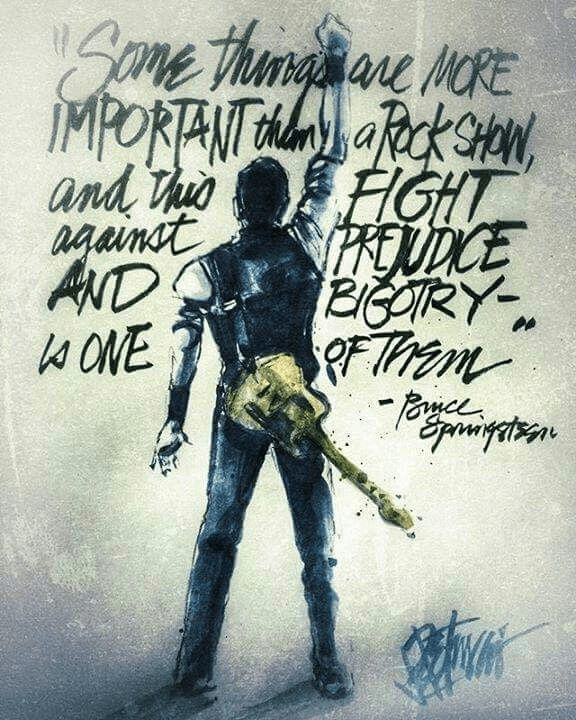
Trump bashed the Boss — once known as the “embodiment of rock & roll” — due to Springsteen’s criticism of the drumpf administration.
“I see that Highly Overrated Bruce Springsteen goes to a Foreign Country to speak badly about the President of the United States,” Trump wrote. “Never liked him, never liked his music, or his Radical Left Politics and, importantly, he’s not a talented guy.”
Trump went on to accuse Springsteen of being a “pushy, obnoxious JERK” and “dumb as a rock” for having previously supported President Joe Biden, before attacking Springsteen’s appearance.
“This dried out ‘prune’ of a rocker (his skin is all atrophied!) ought to KEEP HIS MOUTH SHUT until he gets back into the Country,” the president wrote, adding, “Then we’ll all see how it goes for him!”
That, to me, sounded like a threat! It sounded like the President of the United States just threatened a citizen because he exercised his 1st Amendment Right to Free Speech. I mean, I’m surprised he didn’t say “Nice guitar you gots there. Shame should somthin’ happen to it”.
Management at a Kid Rock-themed restaurant and bar in Nashville reportedly rushed non-citizen employees off the premises during the weekend over fears of an impending ICE raid.
Hey, isn’t it illegal to hire people who you know are not legal to work in the United States? Why, that’s a crime!
During the busy Saturday service, non-citizen employees at three restaurants owned by Nashville businessman Steve Smith were told to leave, including Kid Rock’s Big Ass Honky Tonk Rock N’ Roll Steakhouse.
Hey, didn’t someone just arrest a judge for not turning over non-citizens to ICE?
“We were already understaffed because of the ICE raids throughout the weekend,” an employee at one restaurant told the outlet. “Then, around 9:30 p.m. on Saturday, our manager came back and told anyone without legal status to go home.”
I mean, it’s almost like they don’t mind breaking the law whenever it suits them. Who would ever have thought it?
Did you ever get the feeling that this whole immigration issue is nothing more than a bullshit issue used to divide us? Asking for a friend.
I think there’s a blurb about this on Peace History, but I could be misrecalling. Anyway, here is far more of the story. Language alert, from the beginning.
Queer History 111: Before the Stonewall Riots, There Was Compton’s Cafeteria by Wendy🏳️⚧️🏳️🌈🌈 Read on Substack
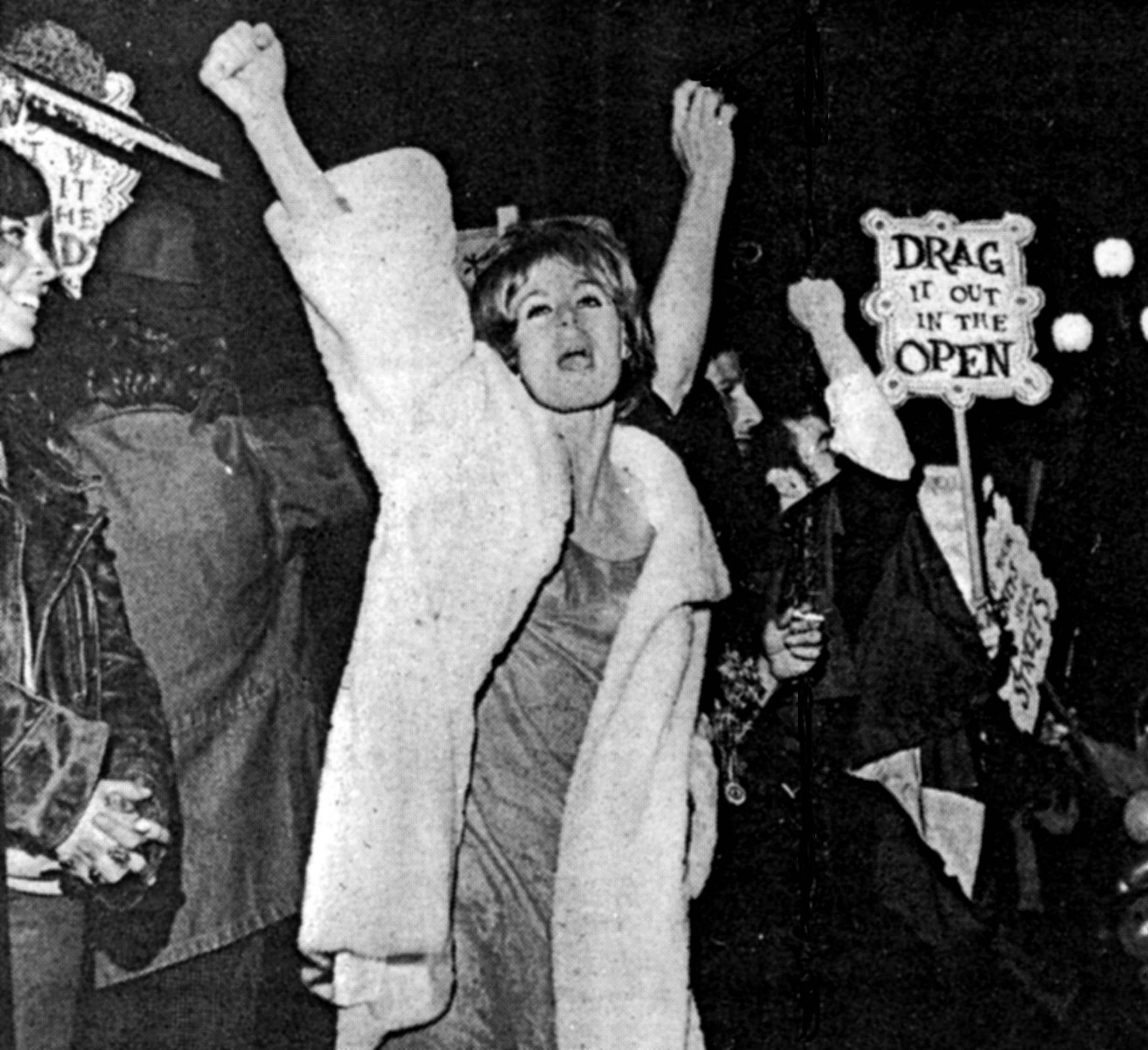
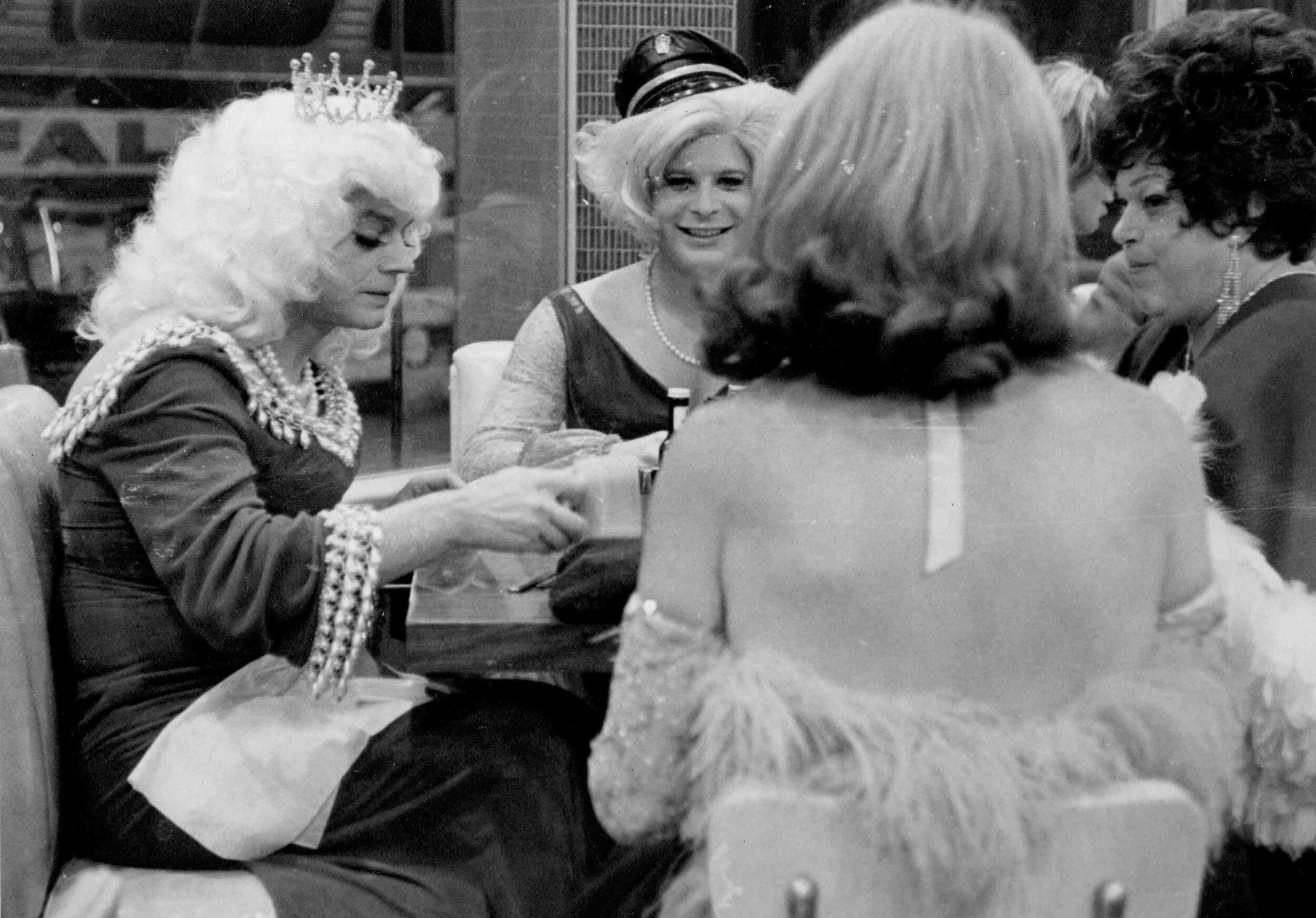
You’ve heard about Stonewall—everyone has. It’s become the sanitized, rainbow-washed origin story of the LGBTQ+ rights movement that gets trotted out every Pride month by corporations selling overpriced merchandise. But three years before Stonewall rocked New York City, a group of fierce-as-fuck transgender women and drag queens in San Francisco’s gritty Tenderloin district had already thrown the first punch in the fight for queer liberation. The Compton’s Cafeteria Riot of 1966 wasn’t just a footnote in history—it was a goddamn declaration of war against police brutality and societal oppression that’s been deliberately erased from our collective memory.
Let me tell you something straight up: these women weren’t politely asking for their rights with carefully worded petitions. They were fighting for their very existence in a society that treated them like garbage. And when pushed to their absolute limit one hot August night, they didn’t just push back—they burned the whole system down. Literally throwing coffee in cops’ faces, smashing windows, and lighting a police car on fire. This wasn’t a “disturbance” or an “incident”—it was a motherfucking riot, and it’s time we remember it for what it was.
The Tenderloin: Where Society Dumped Its “Undesirables”
San Francisco’s Tenderloin district in the 1960s wasn’t the gentrified hipster paradise it’s becoming today. It was a last-resort neighborhood—the only place that would accept the people society had discarded. Transgender women, particularly trans women of color, found themselves with precious few options for survival. Denied employment, housing, and basic human dignity, many turned to sex work simply to eat and keep a roof over their heads.
“We couldn’t get jobs, couldn’t get housing, couldn’t even walk down the street without being arrested,” recalled Amanda St. Jaymes, a trans woman who lived in the Tenderloin during this era. “The cops would book us as ‘female impersonators’ and throw us in the men’s jail. Do you have any fucking idea what happened to us in there?”
The brutal reality was that transgender women faced constant police harassment under California’s “masquerade laws,” which made it illegal to dress in clothing of the “opposite sex.” Cops could and did arrest trans women for the crime of simply existing in public. These weren’t occasional incidents—this was systematic persecution backed by the full force of the law.
Gene Compton’s Cafeteria, a 24-hour diner at the corner of Taylor and Turk, was one of the few places trans women could gather safely—or so they thought. Open all night, it became an unofficial community center for transgender women, drag queens, gay hustlers, and other marginalized folks who had nowhere else to go. But the management often called the police when too many “queens” gathered, leading to regular harassment and arrests.
“The Night I Got Tired of Being Bullied”
On a hot night in August 1966 (the exact date has been lost to history), the simmering tension finally boiled over. When police attempted to arrest a transgender woman at Compton’s for the “crime” of being there, she threw her coffee in the officer’s face. What followed was an explosion of rage that had been building for decades.
“It wasn’t planned,” said Felicia Elizondo, a transgender activist who frequented Compton’s. “It was just the night I got tired of being bullied. We all got tired at the same fucking moment.”
The cafeteria erupted. Cups, saucers, and trays became projectiles. The plate glass windows of the restaurant were smashed. A newsstand was set on fire. The women fought back with everything they had—high heels, heavy purses, and righteous fury. When a police car pulled up outside, it was immediately surrounded, its windows broken and, according to some accounts, set ablaze.
“Those queens fought like hell,” remembered one witness. “You’d think a bunch of ‘girls’ couldn’t do much damage, but honey, when you’ve been beaten and raped by cops, when you’ve been refused medical care, when your own family has thrown you out like trash—you fight like someone with nothing left to lose.”
The riot spilled into the streets and continued through the night. Unlike at Stonewall, there were no photographers present, no reporters to document what happened. The next day, more transgender women and supporters returned to picket the cafeteria, which had banned transgender customers in response to the riot. This marked one of the first known instances of organized transgender direct action in U.S. history.
The Cover-Up and Erasure
Here’s where the story gets even more fucked up: this watershed moment was almost completely erased from history. No major newspapers covered it. Police records of the incident mysteriously disappeared. For decades, Compton’s Cafeteria Riot existed only in the memories of those who were there, many of whom didn’t survive the AIDS crisis of the 1980s and ’90s.
“They didn’t want people to know we fought back,” explained historian Susan Stryker, whose groundbreaking documentary “Screaming Queens” finally brought the riot to public attention in 2005. “Transgender resistance didn’t fit the narrative they wanted to tell about passive victims who needed saving.”
The erasure was so complete that even many LGBTQ+ historians were unaware of the riot until nearly 40 years after it occurred. When Stryker discovered a brief reference to the “uprising of drag queens” in the archives of gay liberation periodicals, she had to piece together what happened through painstaking interviews with survivors and witnesses.
Why was this history buried? Simple: it centered transgender women—particularly trans women of color—as the vanguard of the LGBTQ+ liberation movement. It challenged the comfortable narrative that the movement began with Stonewall and was led primarily by white gay men. The Compton’s story was inconvenient for those who wanted to sanitize queer history for mainstream consumption.
The Aftermath: Real Fucking Change
What makes the Compton’s Cafeteria Riot even more remarkable is that it actually led to concrete changes in San Francisco. In the aftermath, a network of transgender support services emerged. The city established the Tenderloin Health Clinic, which provided hormones and healthcare to transgender people—the first of its kind in the nation. The police department even initiated the first-ever training on interacting with transgender people.
Sergeant Elliott Blackstone, the SFPD’s first liaison to the “homophile community,” became an unlikely ally. After the riot, he worked with transgender activists to stop police harassment and helped establish programs to support transgender residents. “I just treated them like human beings,” Blackstone later said, “which nobody else was doing.”
The riot also galvanized the formation of organizations like Vanguard, one of the first gay youth organizations in the U.S., and the National Transsexual Counseling Unit, the first peer-run support organization for transgender people. These laid the groundwork for the transgender rights movement that continues today.
“We built something from nothing,” said Tamara Ching, a Tenderloin activist who lived through this era. “We created community when the whole damn world wanted us dead or invisible.”
The Women Who Led the Charge
The heroes of Compton’s didn’t get streets named after them or Hollywood biopics made about their lives. Many died in obscurity, their contributions uncelebrated. Women like Alexis Miranda, who later became an influential transgender activist; Tamara Ching, who fought for the rights of transgender sex workers; and Amanda St. Jaymes, who established support services for transgender women in the Tenderloin.
“Some of the fiercest women I ever knew didn’t live to see their impact,” recalls Felicia Elizondo, one of the few surviving veterans of the Tenderloin scene. “They died from violence, from AIDS, from the sheer exhaustion of fighting every day just to exist.”
Unlike Stonewall, where key figures like Marsha P. Johnson and Sylvia Rivera eventually received some recognition (though still not enough), many of the women who fought at Compton’s remain nameless in historical records. Their revolutionary act was nearly lost to history, remembered only by those who were there.
The anonymity of many Compton’s participants speaks to the precarious nature of transgender life in the 1960s—and still today. Many lived under assumed names, without identification documents, invisible to official records. They existed in the margins, which made their uprising all the more remarkable and all the more easily erased.
Why This Matters Now More Than Ever
If you think this is just ancient history, wake the fuck up. In 2023, we’re seeing the most aggressive legislative assault on transgender rights in modern history. Over 500 anti-trans bills have been introduced in state legislatures in recent years. Access to healthcare is being restricted. Transgender people are being banned from public spaces. Sound familiar?
“It’s the same playbook,” says Miss Major Griffin-Gracy, a transgender elder who has been fighting for rights since the 1960s. “Criminalize our existence, push us out of public spaces, make it impossible to live authentically. They’ve just dressed it up in fancier language.”
The courage of the women at Compton’s Cafeteria provides a powerful template for resistance in the face of overwhelming oppression. They didn’t wait for permission to fight back. They didn’t seek respectability. They recognized that when a system is designed to destroy you, sometimes you have to break the whole damn thing and start over.
“We’ve been here before,” warns historian Jules Gill-Peterson. “And the lesson from Compton’s isn’t to write polite letters to politicians. It’s that direct action gets the goods. It’s that sometimes you have to throw the first punch—or the first coffee cup.”
The Legacy: From Shadows to Celebration
Today, the corner of Taylor and Turk in the Tenderloin bears a plaque commemorating the riot. In 2017, the city of San Francisco renamed a section of Turk Street as “Compton’s Transgender Cultural District”—the first legally recognized transgender district in the world. It’s a belated recognition of the community that has called this area home for over half a century and the uprising that marked its coming of age.
But the real legacy of Compton’s isn’t in plaques or street names—it’s in the radical tradition of transgender resistance it established. From Compton’s to Stonewall to the modern movements against police brutality, the thread of transgender leadership in liberation struggles remains unbroken, even when unacknowledged.
“Those girls didn’t have Twitter or TikTok or any way to document what they did,” reflects contemporary transgender activist Raquel Willis. “But they changed the world anyway. Imagine what we can do now with all the tools and visibility we have.”
The next time you celebrate Pride, remember that it wasn’t born from corporate sponsorships and rainbow capitalism. It was born from a coffee cup thrown in a cop’s face by a transgender woman who had decided she wasn’t going to take any more shit. It was born from the broken windows of a cafeteria in the Tenderloin and the fiery determination of women who fought back when the world told them they shouldn’t even exist.
That’s the legacy of Compton’s Cafeteria Riot—not just a historical footnote, but a battle cry that still echoes today: We have always been here. We have always fought back. And we’re not going anywhere.
References
Stryker, S. (2008). Transgender History: The Roots of Today’s Revolution.
Stryker, S., & Silverman, V. (Directors). (2005). Screaming Queens: The Riot at Compton’s Cafeteria [Documentary].
Transgender Law Center. (2017). Compton’s Transgender Cultural District Report.
Dzodan, F. (2021). Before Stonewall: The Trans Women Who Sparked a Revolution.
Armstrong, E. A., & Crage, S. M. (2006). Movements and Memory: The Making of the Stonewall Myth.
Williams, C. (2014). Transgender History in the United States: A Special Unabridged Version of a Book Chapter.
Elizondo, F. (2015, August 26). Personal interview by Nicole Pasulka for Vice: “Ladies in the Streets: Before Stonewall, Transgender Uprising Changed Lives.”
May 16, 1918 The U.S. Congress passed the Sedition Act, legislation designed to protect America’s participation in World War I. Along with the Espionage Act of the previous year, the Sedition Act was orchestrated largely by A. Mitchell Palmer, the United States attorney general under President Woodrow Wilson. The Espionage Act, passed shortly after the U.S. entrance into the war in early April 1917, made it a crime for any person to convey information intended to interfere with the U.S. armed forces’ prosecution of the war effort or to promote the success of the country’s enemies. Aimed at socialists, pacifists and other anti-war activists, the Sedition Act imposed harsh penalties on anyone found guilty of making false statements; insulting or abusing the U.S. government, conscription, the flag, the Constitution or the military; agitating against the production of necessary war materials; or advocating, teaching or defending any of these acts. The Sedition Act of 1918
May 16, 1943 The Nazis crushed the Jewish uprising in the Warsaw ghetto after a month of bloody fighting. 56,000 died in the struggle. Read more
May 16, 1967 Nhat Chi Mai immolated herself in Saigon, the capital of South Vietnam, to protest the war. “I offer my body as a torch / to dissipate the dark / to waken love among men / to give peace to Vietnam.” The flower known as Nhat Chi Mai. Read more
May 16, 1998 Tens of thousands of Britons supporting Jubilee 2000 formed a human chain around the meeting place of the G7 Summit (an annual meeting of the leaders of the largest industrial countries) in Birmingham, England. Jubilee 2000 urged the major international lending countries to relieve terms of and forgive the massive indebtedness of poor countries around the world. Jubilee 2000 by Noam Chomsky
May 15, 1870 Julia Ward Howe Julia Ward Howe, suffragist, abolitionist and author of the “Battle Hymn of the Republic,” proposed Mother’s Day as a peace holiday. She had seen firsthand some of the worst effects of war during the American Civil War—the death and disease which killed and maimed, and the widows and orphans left behind on both sides and realized that the effects of the war go beyond the killing of soldiers in battle. Mother’s Day did not become a national holiday until declared by President Woodrow Wilson in 1914. “… Disarm! Disarm! The sword of murder is not the balance of justice.” Blood does not wipe our dishonor, Nor violence indicate possession. As men have often forsaken the plough and the anvil At the summons of war, Let women now leave all that may be left of home For a great and earnest day of counsel.”
May 15, 1935 The National Labor Relations Act was passed, recognizing workers’ rights to organize unions and bargain collectively with their employers. Read more
May 15, 1957 Britain tested its first hydrogen bomb over Christmas Island in the South Pacific, after just two years of development. Mushroom cloud over Christmas Island
May 15, 1965 A National teach-in to oppose the Vietnam War was held in Washington, D.C.
May 15, 1966 The American Friends Service Committee, SANE (The Committee for a Sane Nuclear Policy), and Women March for Peace, along with four other organizations, sponsored a 10,000+ person anti-war picket at the White House and a 60,000+ rally at the Washington Monument to oppose the Vietnam War. . . . elsewhere the same day . . . Buddhist altars were placed in streets to impede troops arresting dissidents in South Vietnam.
May 15, 1969 Governor Ronald Reagan sent in the National Guard to reclaim People’s Park from 6,000 protesters in Berkeley, California, who had occupied the space and created the park. Police gunfire killed a bystander, James Rector, blinded another, and injured dozens. People’s Park March, Friday May 30, 1969, at the intersection of Haste Street and Telegraph Avenue, in Berkeley
May 15, 1970 In response to the U.S. invasion of Cambodia (an expansion of the Vietnam War) and the killings at Kent State and Jackson State Universities, several million U.S. students held campus strikes to oppose the Vietnam War.
May 15, 1970 The Native American Rights Fund filed suit on behalf of the Hopi tribe to prevent strip-mining on sacred Black Mesa in Arizona.
May 15 (since the 1980’s) International Conscientious Objectors Day, established to honor those who leave or refuse to enter their country’s armed forces for reasons of principle. Conscientious Objector Day history
This post is about a case that could be easily overlooked with so much Trump news spewing through the fire hose these days. But Florida’s continued aggression in the culture wars has the potential to affect all of us. So, as here, when a brave plaintiff takes its case to court and wins, it’s news we all need to know about.
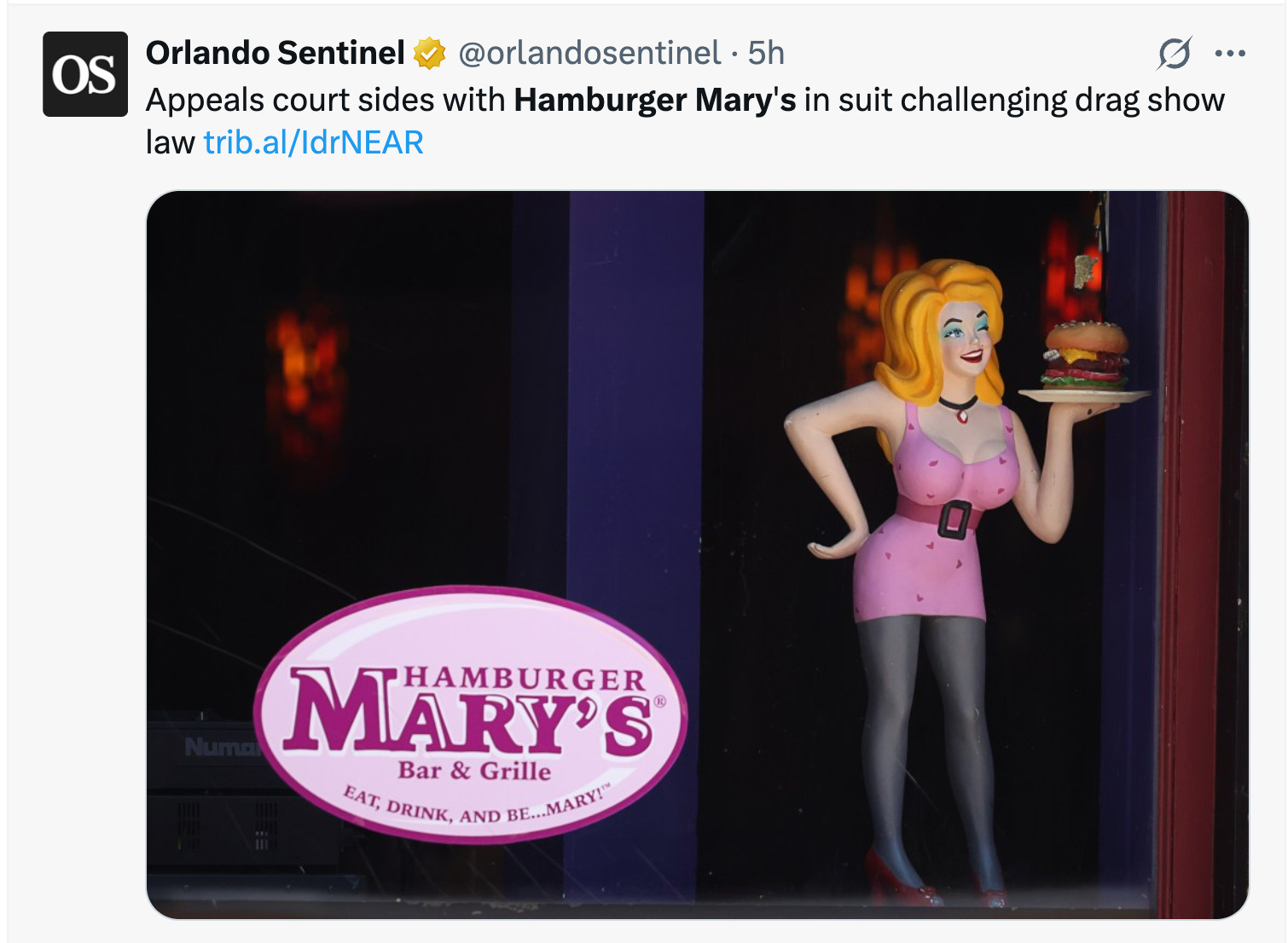
On Tuesday, the Eleventh Circuit Court of Appeals decided HM Florida-ORL, LLC v. Sec. of Florida DBPR, a case involving Hamburger Mary’s, a restaurant and bar in Orlando that regularly hosted drag performances, including family-friendly shows. When the Florida legislature passed SB 1438 in 2023, Hamburger Mary’s canceled its family-friendly drag shows and prohibited minors from attending any of its other shows out of fear of losing its business and/or liquor license. As a result, Hamburger Mary’s lost 20% of its bookings.
The new law gave state agencies the power to target LGBTQ+ friendly businesses in two major ways:
It gave the Department of Business and Professional Regulation discretionary authority to fine, revoke liquor licenses, and even shut down establishments.
It made it a crime to admit young people to any performance, exhibit, play, or show that the state deems inappropriate, even if the child’s parents think it is appropriate for their family.
The bill was an effort by conservative politicians, led by Florida Governor Ron DeSantis, to impose their beliefs on the entire state. It was a major salvo in the culture wars. Their too-clever-by-half mechanism was to punish private businesses that included or supported the LGBTQ+ community in order to exclude that community from being a public presence in Florida. The law’s language was so vague that businesses had no realistic way of knowing what it prohibited, meaning they had to take the extreme steps Hamburger Mary’s took to pull back their offerings in order to avoid the risk they’d be put out of business.
So, Hamburger Mary’s filed a lawsuit against Florida, its governor, and Secretary of the Florida Department of Business and Professional Regulation (FDBPR) Melanie Griffin, seeking a preliminary injunction that would keep the state from enforcing its law while the litigation proceeded. The district court granted the preliminary injunction and the Secretary appealed to the Eleventh Circuit.
The issue in the case involves the First Amendment, as you’ve probably figured out by now. Although the technical legal issue was whether the district court had been correct to grant the injunction, the substantive issue is whether Florida’s Senate Bill 1438 (“The Protection of Children Act”), which prohibits children from attending “adult live performances,” is unconstitutional under the First Amendment, because it is both vaguene and overly broad.
The Eleventh Circuit ruled in Hamburger Mary’s favor, keeping the injunction against enforcement of SB 1438 in place, because the panel believed the law was likely unconstitutional—both too vague for people to understand what they could and couldn’t do to remain in compliance with it and overbroad in its supposed efforts to protect children without regard to their parents’ views.
It’s significant that this decision comes out of the conservative Eleventh Circuit, although admittedly, the composition of this panel, which included both an Obama and a Biden appointee, is unusual. Florida could seek en banc review from the full court, in hopes of getting a more favorable hearing. The decision was 2-1. The third judge on the panel, Senior Judge Gerald Bard Tjoflat, was appointed by President Gerald Ford. His objection to the majority’s decision primarily involved a belief that the injunction came too early, and the courts should have demurred until they saw how the state enforced the law in practice.
Among the most interesting points made in the opinion:
The Court found the penalties for violations under SB 1438 “grievous.” The penalties for violations include a $5,000 fine for a first offense or a misdemeanor prison sentence of up to a year.
On protecting First Amendment rights, they noted that “The government cannot shroud rules in foggy language and then blame would-be speakers for their fears of what may lurk in the fog.” Laws like this use vagueness as a means to get private individuals and businesses to obey in advance, staying as far back as possible from the line of conduct the law prohibits in order to avoid the consequences of violating it. In this way, the state restricts far more First Amendment-protected conduct than they are legally entitled to. The panel wasn’t having any of it. It noted the importance of securing “breathing room for free expression” in a case like this.
We’ve seen injunction cases before, so we know that Hamburger Mary’s had to demonstrate it was likely to succeed on the merits of its claim in order to get the injunction. The court underscored the point above when it found that they met this burden, discussing the“chilling effect” laws like this have, and the way they discourage people from speaking their minds, even if their speech doesn’t fall squarely within what the law prohibits. They noted that “[T]he Act’s vagueness…means it is likely to stifle a substantial amount of protected speech,” explaing that at oral argument, the state had been unable to explain, for instance, how to decide what kind of performances would be acceptable for kids of different ages, which the law requires venues to do to avoid penalties. They concluded, “If the Secretary’s attorney can’t articulate the difference, it’s hard to imagine how we could expect performance proprietors to know what the Act means.”
At least for now, the First Amendment is still alive and kicking in Florida. The majority in this case held that the state was trying to “empower those who would limit speech” but that “the First Amendment empowers speakers instead.” “Requiring clarity in speech regulations,” the court wrote, “shields us from the whims of government censors.” This case is important for Floridians and for the LGBTQ+ community. Beyond that, in a time when our rights are under attack, it’s important for all of us.
“This is a once-in-a-century brain gain opportunity.”–Australian Strategic Policy Institute, urging its government to woo U.S.-based scientists and researchers caught in the Trump II attack on research and development
When it feels like progress isn’t happening, a force field analysis can reveal where the status quo is shifting and point to other strategic leverage points.
If you try to track every piece of news, you may find it impossible to mentally survive the onslaught of these times. Donald Trump and Elon Musk have unleashed a barrage of civil rights rollbacks, weaponized institutions and passed off idiotic/dystopian spectacles as governance. The sheer velocity can numb the senses, tempting us to shut down, turn off the feed and retreat.
But you also cannot be good to the world (or yourself) if you keep your head down and pay attention to nothing. Withdrawal is understandable, even necessary at times — but permanent disengagement only cedes ground to the authoritarian momentum, while reinforcing our image of ourselves as powerless.
With that in mind, an important question emerges: How do we observe what’s happening without being crushed by its weight?
This is where the work of social psychologist Kurt Lewin becomes a powerful tool. Lewin — a Jewish intellectual who fled Nazi Germany — developed force field analysis to understand how power, behavior and transformation occur in real social systems.
He saw that any given situation is held in place by a dynamic equilibrium between forces pushing for change and those resisting it. To shift the status quo, you don’t necessarily need to move everything at once — you can focus strategically on specific forces or actors that influence the whole.
In activist training, I was taught force field analysis as follows: First you make a list of forces and organizations pushing towards the dreary authoritarian oligarchy-controlled vision. Then you make a list of forces pushing towards a reordered society that’s deeply democratic and where wealth is shared.
There’s a tension between these two forces. For example, on the authoritarianism side right now, Trump’s FBI ordered the arrest of a state judge for allegedly trying to prevent ICE from detaining a man in her courtroom or the arrest of New Jersey’s gubernatorial candidate Ras Baraka. On the democracy side, judges, lawyers and plaintiffs have defeated Trump 93 percent of the time in court because his orders are sloppy and patently illegal. What’s more, the Trump administration has quietly followed the judge’s orders most of the time.
While all authoritarians favor loyalty over competency, this regime is particularly extreme in its mistakes. And Trump is still fighting Harvard, and trying to take over now museums too. But again, new frontline resistance is appearing in the arts community and amongst librarians and museum leaders.
There can be an impulse to want to ask, on any given day, “Are we winning? Or are we losing?” Like a basketball game, many of us do a kind of score keeping about how many points we are down. But, just to continue with the sports analogy, our situation is more like soccer — where a lot of the game isn’t about immediate scoring but positioning, repositioning, quick advances and quick retreats. Progress may not always be visible or immediate, but that doesn’t mean it isn’t happening.
A Colombian elder — who has lived her whole life in the shadow of war — recently told me, “People in the U.S. are obsessed with winning, and it’s very unhealthy in moments like this. You keep wanting to know if it’s going well or not — and these times can’t be analyzed in headlines or moments. Sometimes it just is what it is. It’s losing and winning. The yardstick is measured in hearts, and the timeline is generations of work on people’s attitudes and views.”
Lewin’s brilliance was in recognizing that we don’t have to act on everything all at once just because we see the bigger picture of what’s happening. We can begin by identifying the different forces at play: forces for good, forces against and some forces that are mixed. Crucially, in his analysis, you then assess which of these forces can be strengthened or weakened.
This is where it’s helpful to get practical. Courage anywhere begets courage everywhere. Because Trump has picked a strategy of everywhere all at once — nearly every group has a chance to stand up and support each other to be more bold. We’re already seeing great examples of this, such as the hundreds of nonprofits signing on to support Harvard’s fight, the lawyers retaking their oaths to the Constitution in public, and the government workers resisting unauthorized access by DOGE and continuing their important work.
In practical terms, the best strategy might be not focusing on Musk or Trump directly, but on amplifying local election protections, funding investigative journalism, or supporting tech workers organizing against misuse of platforms. You don’t need to tackle the entire regime to weaken its foundation. You need leverage points — clear, concrete places to act.
Using Lewin’s tool helps prevent burnout. It turns despair into direction. It gives structure to what might otherwise feel like flailing.
So, yes: These are hard days. But it’s not all bad or good — it’s a force field in motion. Even small acts, strategically placed, can shift the balance. We are not powerless — we are participants.






 Scottie's Playtime