4th Amendment Workplaces

When ICE Shows Up, These Businesses Will Be Ready

Across the U.S., training, resources and hotlines have emerged to help workplaces exercise their rights in the case of an ICE raid.

By: Emily Nonko

Last April, at the James Beard Foundation’s Chef Action Summit, food industry leaders gathered to discuss the political and economic landscape with one concern hanging grimly in the air: undocumented and immigrant workers were increasingly afraid to come into work after ICE raids ramped up at the outset of Trump’s second term. 

But it just so happened the summit took place in Asheville, North Carolina, where activists had already asked, “What would it take to make this the safest state for immigrants in the south?” as Andrew Willis Garcés, senior strategist with the immigrant justice organization Siembra NC, puts it.

One answer: 4th Amendment Workplaces, a framework developed by Siembra NC and launched at the summit to help restaurants and other businesses train up on legally vetted protocols to defend employees against ICE. The idea quickly took hold — there are now over 1,000 4th Amendment Workplaces across North Carolina, with 4th Amendment Workplace resolutions passed in three cities and similar efforts underway across 12 states. 

It’s emerged as perhaps the most powerful workforce training to help businesses prepare for ICE raids, but it is not the only one. Across the country, training, resources and hotlines have been developed for workplaces, alongside an effort to harness the wider labor movement as a force against ICE. 

Though the ICE raids that make the news often take place on the street, workplaces are in fact a frequent target. “We’ve seen ICE this year go into workplaces more than a lot of other kinds of places where people are gathered,” Willis Garcés explains. “With workplaces, there’s usually an open door you can walk through.”

According to the American Immigration Council, ICE publicly reported at least 40 worksite enforcement actions resulting in over 1,100 arrests within the first seven months of the current Trump administration. Businesses employing noncitizen workers — restaurants, car washes, automotive shops, bakeries, nail salons — are typically targeted. ICE has also scaled up large raids at workplaces like meatpacking and manufacturing plants. 

These raids often represent legal violations, which 4th Amendment Workplaces raise awareness around. The Fourth Amendment to the U.S. Constitution guarantees “the right of the people to be secure in their persons, houses, papers and effects, against unreasonable searches and seizures” without a warrant based on probable cause — that is, reason to believe that a crime may have been committed.

In North Carolina, volunteers canvas businesses across the state to share what it means to be a 4th Amendment Workplace: identify invalid ICE warrants, secure private employee areas, document unconstitutional actions and defend all workers, no matter their immigration status. Resources include a workplace guide, organizing toolkit, posters signaling opposition to unconstitutional search and seizures, employee handouts and tips for designating private employee areas. 

Workplaces can request dedicated training, in which organizers help business owners and employees develop workplace-specific protocol, and lead them through roleplaying scenarios. “We help you think through … what would you do right after the fact? What would you do to preserve footage, how do you support families left behind, what’s the immediate triage that needs to happen [after a raid]?” explains Willis Garcés.

Scuppernong Books of Greensboro was an early adopter, participating in training, promoting itself as a 4th Amendment Workplace, hiring a lawyer, regularly keeping staff informed of ICE response protocol, even publishing a book on how to resist ICE. Co-owner Steve Mitchell says it is “absolutely essential” for business owners to step up on behalf of employees, especially if the owners are white and legally protected residents: “It’s important for people like us to say that this isn’t right, and we’re going to stand on this side of the issue.”

Even though there hasn’t been a heavy ICE presence in Greensboro, the bookstore’s work with Siembra NC “gives us some sense of confidence,” Mitchell says. “Whether that’s misplaced or not, it at least helps us know what our rights are in that situation.” He adds that using Siembra’s model has made the business feel connected to a broader network of activists.

Willis Garcés describes that model as “plug and play,” easily adaptable outside the state and across a variety of workplaces. Siembra NC recruited small businesses first, with the goal of expansion into higher-targer workplaces like factories and farms.

Today, some North Carolina farmers display giant vinyl banners about their constitutional rights, a riff on Siembra NC’s signage. In Oregon, organizers dubbed themselves “Baddies for the Fourth.” In Minneapolis, the 4th Amendment Workplace was a central demand in a public-pressure campaign around Target

There have been other efforts to develop localized training. In New York, Nonviolent Peaceforce trains mostly within the city’s Asian American community, which it has worked with since the pandemic. Last year, ICE raids erupted across the city’s Chinatown.

Nonviolent Peaceforce’s in-person training happens with trusted community partners and focuses on de-escalation and self-regulation tactics, alongside scenario and role-playing. “We came to develop scenarios really at the request of community members who felt that they really needed to know what it was like to be in the moment,” says Roz Lee, head of the organization’s U.S. efforts. She says simple tactics to slow things down — like introducing yourself, asking ICE agents their name, asking for a warrant and taking time to inspect it — can shift a potentially intense and traumatic interaction. 

Other groups have tied the urgency around ICE to larger labor organizing efforts. Emergency Workplace Organizing Committee (EWOC) emerged to help non-unionized labor organize in response to COVID-19. More recently, EWOC developed resources for resisting ICE, which are tied to broader workplace organizing tactics like facilitating conversation among employees, building a committee and planning collective action together. 

“These steps are very universal, whether you work in an office, in a kitchen, at a nonprofit,” says Wes Holing, an EWOC organizer. “If you’re talking about bread-and-butter issues, or you’re talking about a workplace that’s safe from ICE, you’re still ultimately fighting for a place that respects you as a person.” 

This January, EWOC partnered with Twin Cities Democratic Socialists of America to hold a No-Work Workshop to train workers on their rights and protections to participate in the Anti-ICE General Strike. It was part of a much larger mobilization among Minneapolis residents and businesses responding to Operation Metro Surge.

The city mobilized far beyond one-off trainings; instead, an entire ecosystem emerged. “The sheer volume, the sheer magnitude of mobilization … it felt like every single person I knew was extremely active,” says Mike Urbanski, who helps lead legal observer training with Monarca. Monarca is a project under the immigrant justice organization Unidos MN, which canvassed businesses in Twin Cities’ immigrant communities. They’d then direct people to Monarca’s ICE hotline as well as its two-hour, in-person training, which focuses on “upstander” legal observation tactics.

Monarca’s trainings were also shared through social media, word of mouth and within community spaces and houses of worship. “We could post a training with 1,000 people in Minneapolis and fill it within four or five days,” Urbanski says, “And most of those people would come, and another 100 people would just show up.” 

The Workers Solidarity Circle also canvassed and shared resources among Twin Cities businesses, channeling that energy into the Minneapolis Worker’s Assembly this February, which brought together over 300 unionized and non-unionized workers across sectors. “It was about building working class power and coordinated strike action, to really push people into action and not wait on managers, bosses or labor officials to save us,” says organizer Aminah Sheikh.

Now that Operation Metrosurge has wound down, organizers have turned their attention to this upcoming May Day: organizing strike committees, holding strike trainings, conducting labor education and committing unions and community organizations to strike on May 1st. Sheikh says there is a growing realization that workers must build political power far beyond their workplace. 

“Listen, in order for us to really stop — abolish — ICE, like people are saying, from the grassroots,” she says, “then we need to do economic disruption.” 

It Is Earth Day, 2026

https://peacebuttons.info/orderpp-the-ecology-corner.htm#geac

And Trae Says-

And Now, From The Onion, About Its New Acquisition:

At Long Last, InfoWars Is Ours

By Bryce P. Tetraeder, CEO, Global Tetrahedron

Published: April 20, 2026

Let me tell you a story. When I was a child, I suffered from night terrors. It was always the same dream: I could hear my family and neighbors wailing in the street outside as they were pursued and then destroyed by a nameless malevolent force, something neither I nor anyone else could control, a great darkness that was, somehow, all my fault.

Today, that childhood dream is finally coming true. Today I can finally say the sweetest nine or 10 words in the English language: Global Tetrahedron has completed its plan to control InfoWars.com.

I’ve had a lot of time to think about InfoWars in the last year and a half. As the seasons have changed, my ambitions for the project have grown grander, crueler, better aligned with market data. Come, friends, and imagine with me…

Imagine a roaring arena packed to the rafters with pathological liars. High above you in the nosebleeds are podcasters, screaming that you’ll die if you don’t buy their skincare products. Below, on the floor, imagine demonic battalions of super-influencers physically forcing people into home fitness devices designed to dismantle their bodies bone by bone and reassemble them into a grotesque statue of yourself. Out of the throngs, an extremely sick looking man approaches you. He puts his hands on your shoulders. He explains that he is your life coach and that you owe him $800.

Such is the InfoWars I envision: An infinite virtual surface teeming with ads. Not just ads, but scams! Not just scams, but lies with no object, free radical misinformation, sentences and images so poorly thought out that they are unhealthy even to view for just a few seconds. The InfoWars of old was only the prototype for the hell I know we can build together: A digital platform where, every day, visitors sacrifice themselves at altars of delusion and misery, their minds fully disintegrating on contact.

With this new InfoWars, we will democratize psychological torture, welcoming brutal and sadistic ideas from everyone, even the very stupidest among us. It will be like the Manhattan Project, only instead of a bomb, we will be building a website. 

The InfoWars of tomorrow will converge into a swirling vortex of content about content, talent acquiring talent, rings of concentric media mergers processing all human artistry into one endlessly digestible slurry. This will be a dank, sunless place, one where panic and capital feed on each other like twins in the womb of a hulking, unknowable monster—a monster known by many names, but which I like to call modern-day America.

All of this is to say that I believe in us. I believe that with the new InfoWars, we can alchemize the pioneering spirit of amateur inquiry, the profit-maximizing drive of corporations, and the cold mental clarity that comes only with disciplined daily ingestion of mind- and body-altering chemicals. Ifwe can do that, what other great things can we do together? (snip-MORE)

All About That Shadow Docket

221. Chief Justice Roberts and the Clean Power Plan

Remarkable reporting from the New York Times provides a peek behind the curtain of the February 2016 rulings that ushered in the modern emergency docket. And what it reveals is pretty discouraging.

Steve Vladeck

Welcome back to “One First,” a newsletter that aims to make the U.S. Supreme Court more accessible to lawyers and non-lawyers alike. I’m grateful to all of you for your continued support, and I hope that you’ll consider sharing some of what we’re doing with your networks.

(snip)

Back in February, I wrote about the tenth anniversary of the Supreme Court’s unsigned, unexplained February 2016 rulings blocking President Obama’s “Clean Power Plan,” and how they ushered in what might be called “the modern emergency docket.” In my earlier post, I raised a series of questions about what had led the Court to do something that, in 2016, was completely unprecedented (blocking an executive branch program then under review in the lower courts), and whether the justices had any idea of the Pandora’s Box they were opening. As I wrote, “because the Court didn’t write then, and hasn’t explained itself since, we’ll never know (at least, until our grandkids can read the justices’ internal papers from that time period).”

It turns out, thanks to some truly remarkable reporting from Jodi Kantor and Adam Liptak for the New York Times, that we didn’t have to wait quite that long. On Saturday, Kantor and Liptak published 16 pages of (leaked) internal memoranda from six of the justices providing a window into how and why the Court did what it did on February 9, 2016. And the memos are, at least to me, a remarkable combination of eye-opening and sadly unsurprising. As I explain below, I think there are at least five significant takeaways from these materials—none of which paint the Court in an especially flattering light. And at the heart of most of them is Chief Justice Roberts.

Behind the scenes, Roberts led the charge for the Court to blaze a new trail—relying on statements outside the record; invoking the wrong standard for the kind of relief the applicants sought; failing to even acknowledge the irreparable harm the government (and the environment) would suffer from the Court intervening; and pushing back aggressively when Justices Breyer and Kagan both urged a compromise that should have accounted for his ostensible concerns. I’ve suggested before that the real acceleration of the Court’s modern emergency docket behavior can be traced to 2018, right around when Justice Kavanaugh succeeded Justice Kennedy. But in the first major case in which the Court granted emergency relief as a means of shaping nationwide policy, it turns out that the justice who led the charge was the one who was doing quite a bit more than calling balls and strikes. (snip-the rest is on the page)

Open Windows & Clay Jones

Yes!

Virginia votes tomorrow

Clay Jones

Republicans are upset because tomorrow, they could lose at their own game.

After Texas redistricted in the middle of the decade to give Republicans more congressional seats, which Donald Trump demanded, Virginia decided to add more blue seats. This upset Republicans because, dammit, they invented this game.

Now, the same groups that want to add more red seats in Texas are spending big money to argue against adding more blue seats in Virginia. The commercials have been wild, with some of them warning that Richmond Democrats are engaged in a “power grab.” Some of the ads warn that this disenfranchises Black voters. Others state that if you vote, yes, that means more “illegals” will invade the state to commit crimes. It’s getting nasty, but Republicans don’t know how to win any other way. They use this information, and they cheat. (snip-MORE)


Kash Patel sues The Atlantic for defamation

F.B.I. director is seeking $250 million in damages

Ann Telnaes

Under the influence and unqualified.


The Book of Sam

I have been waiting since 2006 to get this movie quote into a cartoon.

Clay Jones

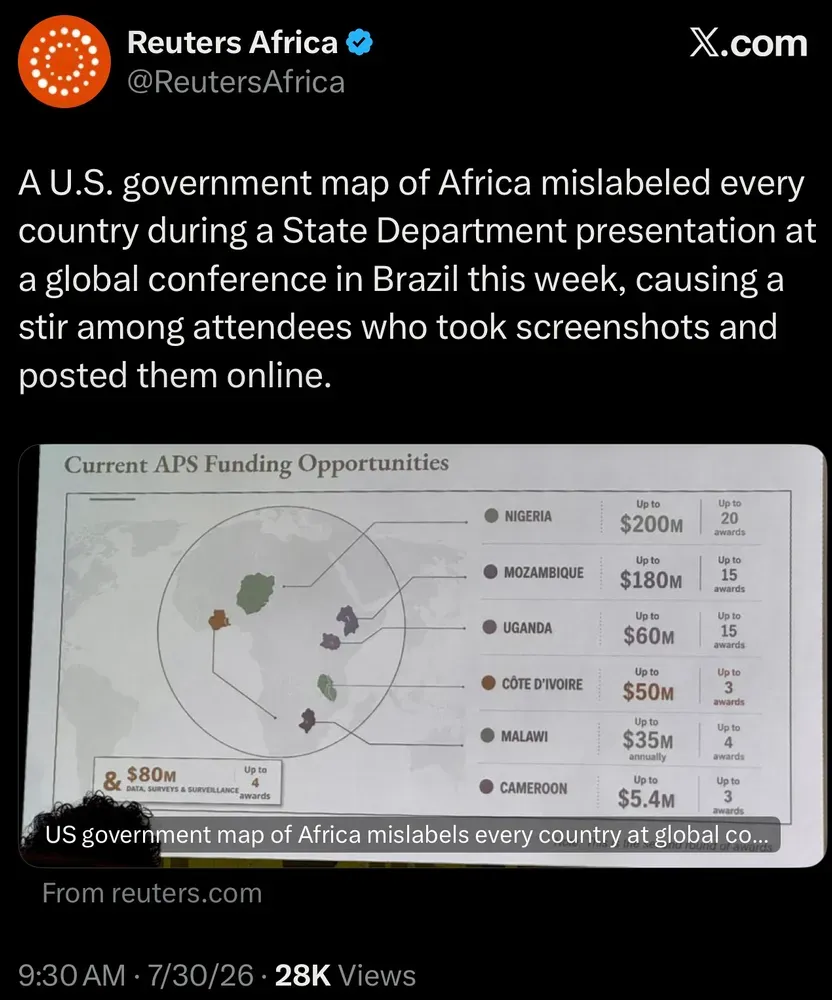
Last week in Cameroon (in case you are a Republican, that is a nation on the continent of Africa), Pope Leo quoted a Bible verse, which was, “Jesus told us, ‘Blessed are the peacemakers, but woe to those who manipulate religion in the very name of God for their own military, economic, or political gain, dragging that which is sacred into darkness and filth.’” And then, Defense Secretary Pete Hegseth, while claiming that God is on his side to wage war, quoted a fake Bible verse at a prayer breakfast.

The verse was inspired by Ezekiel 25:17 and comes from one of my favorite movies, Pulp Fiction. It was delivered brilliantly and forcefully by one of my favorite actors, Samuel L. Jackson. (snip-MORE, also deliberate and forceful!)

The 5-Year FISA Sec. 702 Vote:

In a dramatic scene that unfolded in the wee hours this morning, members of the House defeated a ploy by the administration and Speaker Johnson to ram through a 5-year reauthorization of FISA Section 702. Here’s what happened, and what will/should happen next. 1/20— Liza Goitein (@lizagoitein.bsky.social) April 17, 2026 at 10:34 AM

A Good Reason To Question The Propriety Of Capital Punishment

Can Penn & Teller Magically Get SCOTUS To Consider Wrongful Conviction Appeal?

Charles Flores has been on Texas’s death row for over two decades for a crime the state knows he didn’t commit.

Robyn Pennacchia

Charles Don Flores has sat on Texas’s death row for 27 years for the murder of Elizabeth “Betty” Black in 1998, during the commission of a robbery. The problem is, he did not kill Elizabeth “Betty” Black. That’s not just conjecture or me believing in someone’s innocence; even the state of Texas does not claim that he killed her. The man who actually did kill her was also sent to prison for the crime and was released over a decade ago, but Flores was sentenced to the death penalty for supposedly participating in the crime. Texas, you see, has a law called the “law of parties” that holds every participant in a crime responsible for everything that happened during its commission. So, for instance, if you drive the getaway car and your accomplice kills someone during the commission of a robbery, you are held equally responsible, even if you didn’t even know it happened.

There was no physical evidence, no DNA connecting Flores to Black’s murder. There is, in fact, no evidence whatsoever beyond his identification by a single neighbor who didn’t pick him out of two photo line-ups and initially said both men she saw where white with an average build and long hair, while Flores, clearly Latino, was a bigger guy with short hair.

So why is he there again? Because that neighbor, Jill Barganier, was later “hypnotized” by a cop who had never hypnotized anyone before. A cop who hinted, repeatedly, at the suspect having short or shaved hair, who told her she would continue to remember even more things about the robbery after the hypnosis. By the time she made it to court — after she had seen Flores’s picture on TV and in the news on many occasions — she was able to point to him in court as the accomplice of the the man who killed Betty Black.

There’s a lot that’s wrong with this case, obviously, but the hypnosis part is what caught the attention of magicians Penn & Teller, who recently submitted an amicus brief to the Supreme Court asking them to consider Flores’s case. Why? Because, they say, what the officer did is no different than what they do in their Vegas show every night.

“I am bringing this to you with the utmost humility,” Penn Gilette told The New York Times. “I am carny trash. I am uneducated. If you want to say I have a position of expertise, it is that I have lied to people onstage and gotten them to believe it. And I think I could do what that police officer did.”

The brief reads:

Despite the fact that Mrs. Barganier described the passenger in the car she saw at the scene of the crime as a white man with long hair, she was fed repeated suggestions by law enforcement that the passenger had “neatly trimmed” or “short, shaved” hair; she was told by the officer-hypnotist that she would remember more after the hypnosis session; and months later— after photos of Mr. Flores appeared in the press and she saw him seated at the defense table at trial— suddenly she identified him as the passenger. It is of little surprise that she was confident in her in-court identification when she saw this now-familiar face and believed she had produced it from her memory: That is exactly what the officer told her would happen. But it was not real. Some of the same cognitive techniques Penn & Teller use on stage to trick audience members’ memory and alter their perception explain how the investigative hypnosis session induced Mrs. Barganier to abandon all previous descriptions of the suspect and instead point to Mr. Flores.

On the tape, the officer keeps telling her that her memory is like a videotape that she can rewind and fast-forward at will. And it’s very tempting to believe that. It’s very tempting and comforting to believe that our brains are always recording whether we are aware of it or not and that, with the help of something like hypnosis, we can access those recordings. Certainly no one wants to believe that someone can more or less just jump into your brain and make you believe you saw things you didn’t see.

Our minds have a tendency to fill in the gaps if we don’t remember everything that happened in a particular situation, they explain, and memory retrieval process distorts memories — things they take advantage of as magicians.

By manipulating an audience’s memory—both in its formation and its recall—Penn & Teller get the audience to convince themselves that things have happened when, in reality, those things never occurred. That is all well and good for purposes of entertainment. But the same suggestion-based memory manipulation was also on display in the investigative hypnosis of Mrs. Barganier. And the officer-hypnotist left her believing that new things that came to mind later were true “memories” she could testify about, not merely things her brain subsequently filled in.

They can tell you exactly how he did it, as well.

The suggestion inherent in the investigative hypnosis of Mrs. Barganier is obvious: The officer/hypnotist asked her multiple questions about whether either suspect had short, shaved, neatly cut, or trimmed hair—even as Mrs. Barganier reiterated that both had long, wavy hair. The officer then showed Mrs. Barganier a photo lineup in which every photo was of a Hispanic male with short hair. Mrs. Barganier again did not identify Mr. Flores from that photo lineup. But she then also saw his photo in news coverage of the case prior to trial. Combined with the assurances of the officer-hypnotist that she would remember more as time went on, she was primed to “remember” Mr. Flores at trial. And she was particularly primed to do so because she was understandably motivated to assist police in finding the person who had committed a violent murder next door to her home. Pet. 6. Moreover, Mrs. Barganier’s certainty that her belated, in-court identification of Mr. Flores was correct (“over 100%” positive, as she testified), is not surprising. As Penn & Teller have observed, it is “very difficult for the audience to contradict the ideas that they themselves have constructed.”

The truly appalling thing about all of this is that the state of Texas actually knows that they are right about hypnosis being junk science. Just a few years ago, the state banned investigative hypnosis from being submitted as evidence in court. Of course, that was well after Flores was convicted and it had been used in over 1,800 trials over the course of four decades. In 2013, the state also enacted a “junk science” law, allowing for individuals to appeal for a new trial if the forensic science used to convict them has been found, upon further study, to be bullshit. This includes “evidence” like bite mark analysis, fiber analysis, bloodstain pattern analysis and 911 call analysis (one of the scariest ones, in my opinion, given that people have such wildly varying reactions in any kind of emergency).

It has not been going well.

Yet, Texas is fighting against Flores’s appeal and still hopes it will get to execute him. Because it’s Texas, and they really, really like executing people there.

There is a lot that is frustrating about our criminal justice system, but somewhere near the top is definitely the stubborn refusal of many involved with it to correct things when they’ve made a mistake. We see it over and over again, and it’s bad enough when it happens with someone serving any kind of sentence, especially a long one, but it’s unconscionable when we’re talking about the death penalty. There are no take-backs with the death penalty, and nothing anyone, even a magician, can fix once someone is dead.

Looking At This Week With Joyce Vance

The Week Ahead

Joyce Vance

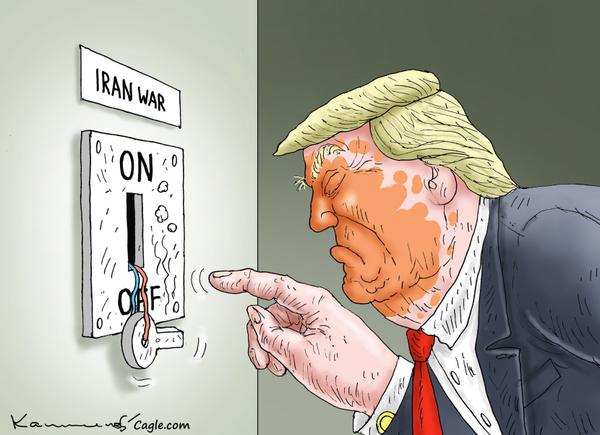
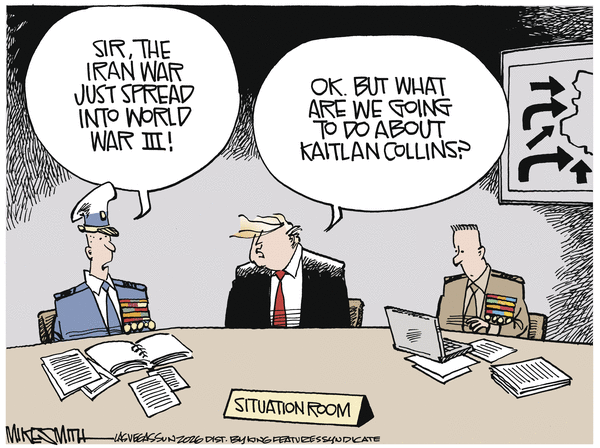
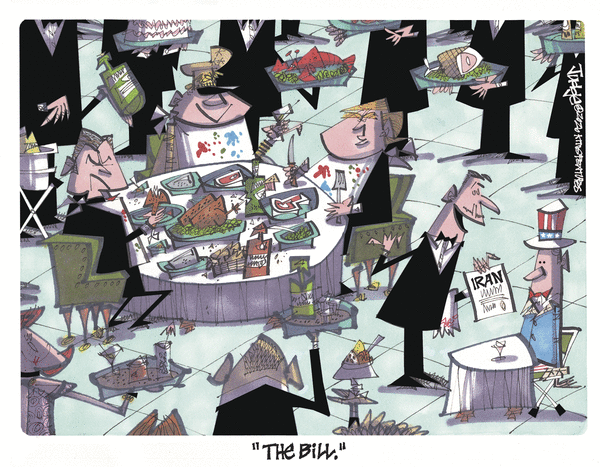
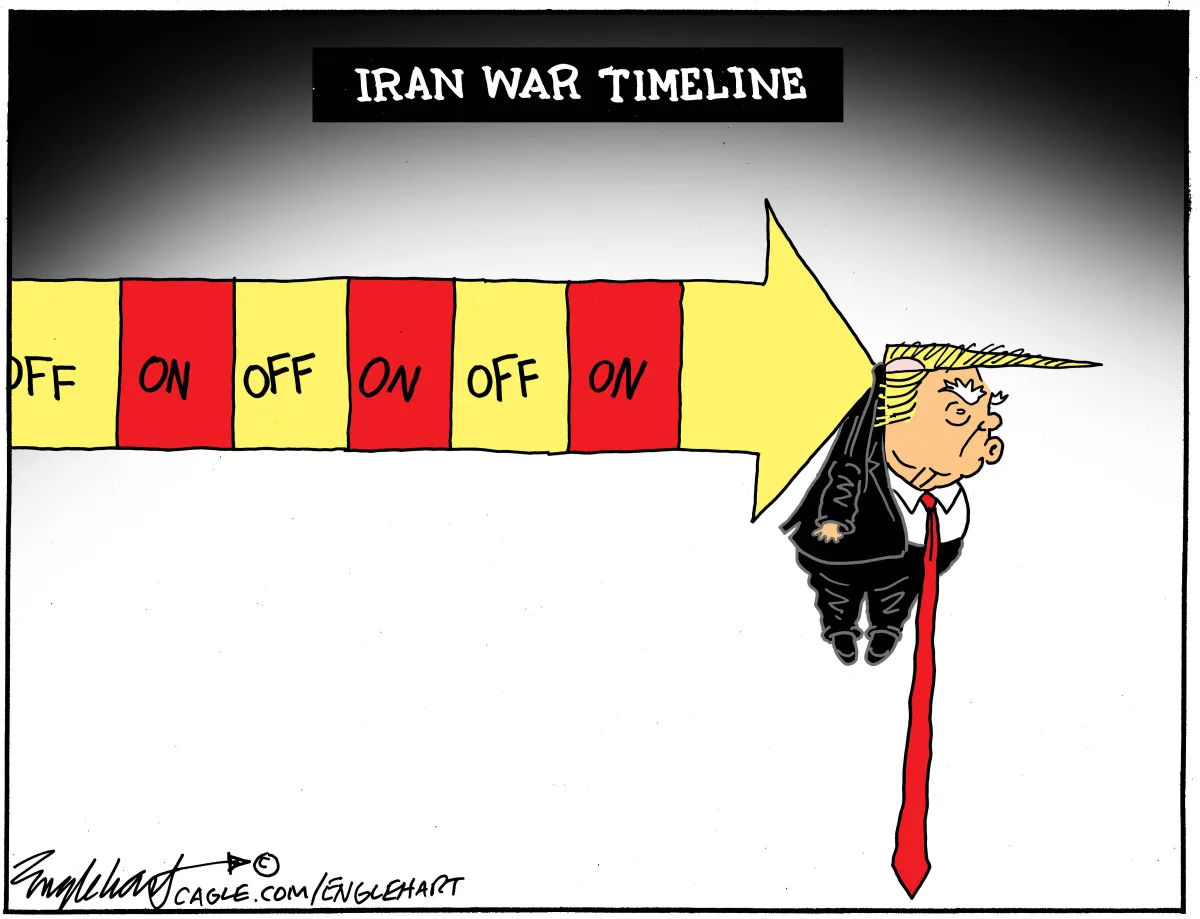
We seem doomed to another week of war news. On Sunday, Trump announced on Truth Social that the U.S. military seized an Iranian-flagged ship that he said tried to run the U.S. blockade in the Strait of Hormuz. Marines boarded the cargo ship Touska after it was disabled. Trump posted that the USS Spruance “gave them fair warning to stop,” but that “The Iranian crew refused to listen, so our Navy ship stopped them right in their tracks by blowing a hole in the engineroom.”

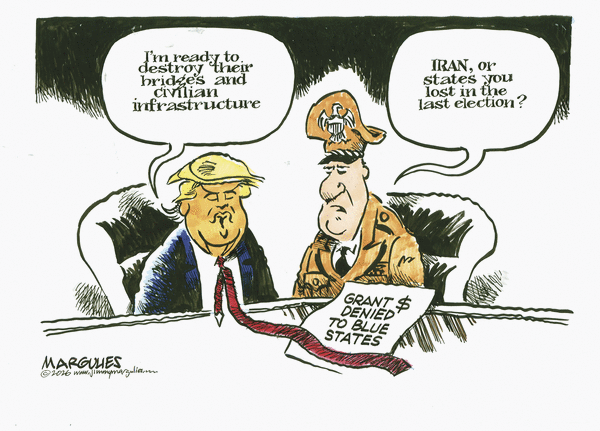
But what’s happening with the president as he conducts his war is now completely out of bounds. This morning, just after 8 a.m., he had a long rambling post on Truth Social that concluded, “if they don’t, the United States is going to knock out every single Power Plant, and every single Bridge, in Iran. NO MORE MR. NICE GUY!”

Notice how Trump speaks in the language of an all-powerful businessman, a CEO without a board to tell him what to do. He is sending “My Representatives” to Pakistan and “if they (Iran) don’t take the DEAL,” he’ll do “what has to be done.” It’s crazy on steroids, and well past the point where even his own party should be giving him a pass. The president of the United States is threatening to bomb civilian targets and devastate a civilian population. War crimes, plain and simple.

All of this from the candidate who, in November of 2024, in the closing days of his campaign for the White House, said that “If Kamala wins, only death and destruction await because she is the candidate of endless wars. I am the candidate of peace.”

Every accusation is a confession. And the Truth Social posts happened after Trump called NATO and our allies “absolutely useless” at a Turning Point USA event Friday night. If you’re exhausted, and honestly, at this point, who isn’t, take a deep breath, plan for a little extra fellowship with friends (more on my plans at the end), and remind yourself that we cannot afford to put our heads in the sand and that the effort to overwhelm us in intentional—that’s how authoritarians do it. It’s a good week to talk with people about what’s going on, to encourage them to stop and think, and then to make sure they’re registered to vote.

The U.S. Ambassador to the U.N., Mike Waltz, was on ABC’s “This Week,” Sunday morning, and he chimed right in with the president. Host John Karl asked if Trump was prepared to go back to “full-on war” and Waltz responded, “all options are on the table. We could take that infrastructure out relatively easily. The Iranian air defenses have been absolutely decimated.”

He continued, without being prompted, “And just to get ahead of a lot of the critics and hand-wringing, throwing out irresponsible terms like ‘war crimes’, attacking, destroying infrastructure that has clearly and historically been used for dual military purposes is not a war crime.”

Then Waltz did it again on NBC’s “Meet the Press,” where volunteering to Kristen Welker, who hadn’t asked about it, that the U.S. could still target civilian infrastructure in Iran if a ceasefire deal wasn’t reached, again claiming that wouldn’t amount to war crimes. “We have a long history of taking down bridges, power plants and other infrastructure that is powering Iran’s military,” Waltz said, as though that somehow made it acceptable. “In the laws of land warfare and the rules of engagement, any type of infrastructure that is co-mingled is absolutely a legitimate target.” He reiterated on CBS, appearing on “Face the Nation,” that because the IRGC is running bridges and power plants, they are “legitimate military targets,” again rejecting the notions that bombing them would be “some type of war crime.”

So bombing civilian targets seems to be top of mind for the president and one of his key spokespeople on these issues, which should concern all of us.

Waltz is a former Army Special Forces Officer, decorated for his bravery. He graduated from Virginia Military Academy, according to his bio from his time in Congress, but he is not a lawyer. Apparently, concerns about launching attacks against civilian populations didn’t stick. Waltz was Trump’s first National Security Advisor this term, but he resigned following Signalgate after serving for just 101 days. (Tonight’s trivia: That’s the second shortest tenure of any NSA. Mike Flynn, who was Trump’s first NSA in 2017, resigned after just 24 days, two Scaramuccis, and was ultimately convicted of lying to the FBI before Trump pardoned him.) Trump nominated Waltz to serve as the U.N. Ambassador the same day he stepped down.

Today, the United States struck yet another vessel in the Caribbean. Three people were killed. The U.S. Southern Command account on Twitter said they were narco-terrorists. These attacks used to be shocking. Now, they barely garner notice. As of the last strike, four days ago, Reuters reported the death toll was “over 170.” Three people were killed in that strike last Wednesday, as well.

Also appearing on the Sunday shows, FBI Director Kash Patel said he would file a defamation case on Monday against The Atlantic, which reported last week, in a story headlined, “The FBI Director Is MIA,” that Patel’s colleagues are “alarmed” by “episodes of excessive drinking and unexplained absences.” Two dozen people interviewed for the story “described Patel’s tenure as a management failure and his personal behavior as a national-security vulnerability.”

Nominees for important government positions, and Director of the FBI is among the highest because of access to national security information, are heavily vetted before they take office. But as with so many other norms in the time of Trump, Patel’s questionable personal choices have continued to come to light since he took office. The report says that Patel is “drinking so heavily that meetings need to be rescheduled and his security detail has trouble waking him up. Among the report’s most chilling revelations, “Current and former officials told me that they have long worried about what would happen in the event of a domestic terrorist attack while Patel is in office, and they said that their apprehension has increased significantly in the weeks since Trump launched his military campaign against Iran. ‘That’s what keeps me up at night,’ one official said.”

Screen grab of Patel “celebrating” with the U.S. Men’s Hockey team after their Olympic victory.

This morning, Fox host Maria Bartiromo asked Patel, “So you’re gonna sue them?” “Absolutely,” he responded. “It’s coming tomorrow.” He added that it would be for defamation.


I’m looking forward to discovery. Especially the part where Patel is deposed, under oath. Expect the lawsuit, which he probably has to file to look tough for the audience of one, to be dismissed before it gets that far. Patel would face questioning about his drinking and other misconduct while in office. And he would be exposed to penalties of perjury.

The Atlantic’s report concludes with this story: “Patel has publicly proclaimed that the FBI needs to demonstrate that it is ‘fierce,’ and officials I spoke with said that he is fixated on that image in private as well.” So what is he doing about that? Apparently, Patel “recently expressed frustration with the look of FBI merchandise, complaining that it isn’t intimidating enough.” The Atlantic explains that “Officials have grown accustomed to such behavior, and they have learned to roll their eyes at it. But they said that the absurdity masks real concerns about what Patel’s leadership has meant for an institution that the country relies on for national security and the safety of its citizens. ‘Part of me is glad he’s wasting his time on bullshit, because it’s less dangerous for rule of law, for the American public,’ one official told me, ‘but it also means we don’t have a real functioning FBI director.’”

It’s likely that Patel has little support inside of the building, and that could mean this is just one of many stories that get launched in an effort to ease him out before it’s too late. When the “that” in “That’s what keeps me up at night,” is the Director of the FBI, not a foreign terrorist or criminal threat, then it’s highly likely the career folks, and maybe even some of the politicos, want a “real functioning FBI director” in place.

I started out by saying we’re entering this week already exhausted and it’s important to keep taking care of ourselves. My plan this week involves spending time in person with my #SistersInLaw cohosts Kimberly Atkins Stohr, Barb McQuade, and Jill Will-Banks, when we do the podcast live in Denver on April 23rd. If you’re in Denver, I hope I’ll see you there! If you’re in Atlanta, we’ll be live there on May 3. There is nothing as important as being with the people that we love right now.

We’re in this together,

Joyce

Monday, Back To It!