In the sun-scorched landscape of Spanish politics, where machismo runs deeper than olive oil and Catholic conservatism clings like barnacles to a ship’s hull, Carla Antonelli emerged like a fucking phoenix from the ashes of Franco’s repressive regime. Born Carlos Álvarez-Malvar in 1959, she didn’t just transition from male to female—she transformed from a society that wanted her dead into a political force that would reshape Spain’s understanding of transgender existence. This wasn’t some gentle evolution; this was a goddamn revolution with lipstick and legislative power.
Carla Antonelli represents more than just political firsts and broken barriers. She embodies the visceral struggle of transgender people in post-Franco Spain, where the ghost of fascist oppression still haunted every street corner and the Catholic Church’s influence seeped into every crack of social life. Her journey from underground actress to regional parliamentarian reads like a masterclass in survival, authenticity, and the raw power of refusing to be erased.
Let’s be brutally fucking honest about what Carla faced: a Spain that had spent decades under a dictator who considered LGBTQIA+ people degenerates worthy of imprisonment or worse. Franco’s regime didn’t just criminalize homosexuality and gender nonconformity—it tried to erase these identities from existence entirely. When Franco finally had the decency to die in 1975, his ideological progeny didn’t magically disappear. They lurked in institutions, in families, in the collective psyche of a nation that was slowly, painfully learning to breathe freely again.
The Making of a Revolutionary in Franco’s Shadow (snip-MORE)
Queer History 892: Ben Barres – The Badass Brain Scientist Who Fucked Up Gender Bias Forever by Wendy🏳️⚧️🏳️🌈🌈
In the testosterone-soaked world of academic neuroscience, where brilliant minds wrapped in fragile egos compete to unlock the secrets of the human brain, Ben Barres stood as a goddamn force of nature who revolutionized not just our understanding of neural circuits but the entire fucking structure of scientific academia itself. Born Barbara in 1954, Ben didn’t just transition from female to male—he transformed from a marginalized outsider fighting for recognition to one of the most respected neuroscientists on the planet, all while wielding his unique perspective like a scalpel to dissect the sexist bullshit that infected his field.
Ben Barres wasn’t just another transgender scientist who happened to make discoveries. He was a revolutionary who used his lived experience of gender bias to expose the systemic discrimination that had been hiding in plain sight for decades. His story reads like a masterclass in how authenticity and scientific rigor can combine to create change that extends far beyond laboratory walls. When he died in 2017, he left behind not just groundbreaking research on glial cells and neural development, but a legacy of advocacy that continues to reshape how academia treats women, minorities, and anyone who doesn’t fit the traditional mold of what a scientist should look like.
This is the story of a brilliant mind who refused to be diminished by a world that couldn’t understand him, who channeled the fury of marginalization into scientific excellence and social change. Ben Barres proved that the best revenge against discrimination isn’t just success—it’s using that success to burn down the systems that tried to stop you in the first place.
The Early Years: A Brilliant Mind in the Wrong Package (snip-MORE)
I just ran across this in my SBTB email. It belongs here. Doesn’t look like it embedded (it didn’t on SBTB, either,) so click through on “View this post…” and make sure the sound is on. A very worthy click.
July 3, 1835 Children employed in the silk mills at Paterson, New Jersey, went on strike for an eleven-hour workday and a six-day workweek rather than 12-14 hour days. With the help of adults, they won a compromise settlement of a 69-hour week. More on the Baby Strikers
July 3, 1966 4000 Britons chanting, “Hands off Vietnam,” demonstrated in London against escalation of the Vietnam War. U.S. warplanes had recently bombed the North Vietnamese capital of Hanoi as well as the port city of Haiphong. Police moved in after scuffles broke out at the demonstration outside the U.S. Embassy in Grosvenor Square; 31 were arrested. Actress Vanessa Redgrave joins 25,000 two years later at Anti-Vietnam war protest, Grosvenor Square. Read more
July 3, 1974 At the Moscow Summit talks between President Richard Nixon and President Leonid Brezhnev, the United States and the Soviet Union agreed to hold bilateral talks on the prohibition of chemical weapons.
July 4, 1776 The United States declared its independence from King George III and Great Britain, thus beginning the first successful anti-imperial revolution in world history. Signed in Philadelphia by 56 British subjects who lived and owned property in thirteen of the American colonies, the document asserted the right of a people to create its own form of government. The signers of the Declaration of Independence were members of the 2nd Continental Congress which had voted two days earlier to separate from the British crown. Read the Declaration see some quotes on nationalism and patriotism
July 4, 1827 Slavery was outlawed in New York State as the result of the Gradual Emancipation law passed ten years earlier. This freedom applied only to those who had been 18 at the time of its passage. Enslaved children born during the subsequent ten-year period were not be freed until they reached the age of 21. At the urging of Reverend William Hamilton, a freedman and carpenter, and others, the end of slavery was celebrated in churches. The Fourth of July had in the past been marred by young white men attacking black Americans. More on William Hamilton and others
July 4, 1829 Speaking at Boston’s Park Street Church, newspaper editor and abolitionist William Lloyd Garrison gave a seminal speech on “Dangers to the Nation.” Though Massachusetts had banned slavery in 1781 and there was strong anti-slavery sentiment, most understood that a national ban of slavery would threaten the union of the states. Compensation to slaveholders and return of the enslaved to Africa was considered the best solution. Garrison, on the other hand, called attention to the hypocrisy of celebrating the the day the document was signed declaring, “All men are created equal” while two million were in bondage. He proposed four propositions that day to guide the abolitionist movement: 1. Above all others, slaves in America deserve “the prayers, and sympathies, and charities of the American people.” 2. Non-slave-holding states are “constitutionally involved in the guilt of slavery,” and are obligated “to assist in its overthrow.” 3. There is no valid legal or religious justification for the preservation of slavery. 4. The “colored population” of America should be freed, given an education, and accepted as equal citizens with whites. William Lloyd Garrison
July 4, 1894 The Republic of Hawaii was proclaimed with Sanford B. Dole as president. It was recognized immediately by the United States government under President Grover Cleveland. This was the result of the successful overthrow of the Hawaiian monarchy, then held by Queen Lydia Liliuokalani, and the support by white Americans involved in the sugar trade on the islands for annexation by the United States. Shortly after she had come to office, she had promulgated a new constitution which increased the power of the monarchy and that of native Hawaiians.
July 4, 1965 Barbara Gittings at the Philadelphia picket The first of an annual picket in front of Philadelphia’s Independence Hall was held by gay and Lesbian Americans. Jack Nichols and Frank Kameny and members of the New York and Washington Mattachine Society and the Daughters of Bilitis had earlier demonstrated in Washington, and wished to change the general perception that homosexuals were perverted or sick.
“By those protesters coming out publicly, and placing themselves very strategically in front of the building that evoked the Declaration of Independence and the idea that all men are created equal, it suggested it [gay rights] was no longer a moral or national security or psychiatric issue … it was a civil-rights issues,” David K. Johnson wrote in The Lavender Scare: The Cold War Persecution of Gays and Lesbians in the Federal Government.
July 4, 1966 The Freedom of Information Act, P.L. 89-487, became law. It established the right of Americans to know what their government is doing by outlining procedures for getting access to internal documents.
July 4, 1969 “Give Peace a Chance” by the Plastic Ono Band was released in the United Kingdom. The song was recorded May 31, 1969, during the “Bed-In” John Lennon and Yoko Ono staged at the Queen Elizabeth Hotel in Montreal as part of their honeymoon. John and Yoko stayed in bed for 8 days, beginning May 26, in an effort to promote world peace. Some of the people in the hotel room who sang on this were Tommy Smothers, Timothy Leary, Allen Ginsberg, and Petula Clark. Smothers also played guitar. This event promoting peace received a great deal of media attention.“All we are saying . . .” watch & listen – give it a chance
July 4, 1969 A national anti-war conference in Cleveland, Ohio, mapped out activities against the Vietnam War and resulted in the founding of New Mobe (mobilization). More about the Mobes
July 4, 1983 The Women’s Encampment for a Future of Peace and Justice began an eight week stay on a farm just outside the Seneca Army Depot near Romulus, New York. The purpose of the gathering was for the women to learn about and together protest the escalation of militarism and the weapons build-up being led at the time by the Reagan administration. visit PeaCe eNCaMPeNT HeRSToRy PRoJeCT
July 4, 2007 The first of several Peace Caravans (Caravanes de Paix) set out from South Kivu and traveled across Africa’s Great Lakes region, including the Democratic Republic of the Congo, Burundi and Rwanda. The Scout Associations of the countries in the violence-ridden area trained hundreds of young people in conflict resolution through their focus on education for peace. Members of the Caravan for Peace in Burundi The classes and the caravans included hundreds of young people in Scouts and Girl Guides from many ethnic groups (often with a history of mutual hostility) who act as community mediators.
CINCINNATI — The Ohio Lesbian Archives in Cincinnati’s Over-the-Rhine neighborhood started with a friendship.
Phebe Beiser said that when she and co-founder Victoria “Vic” Ramstetter met in the 1970s, they bonded over being “hidden, secret, teenage lesbians,” growing up in what was then a conservative city and region where there were few gay role models. For a time in their 20s, they shared group houses in Clifton, where they now joke that they “survived the lesbian commune together.” They were young and idealistic. They wanted to “turn being an activist lesbian into something fun and interesting, and maybe help change the world.” Beiser, now in her mid 70s, told The 19th that they had a mantra: “We never wanted to be invisible again.”
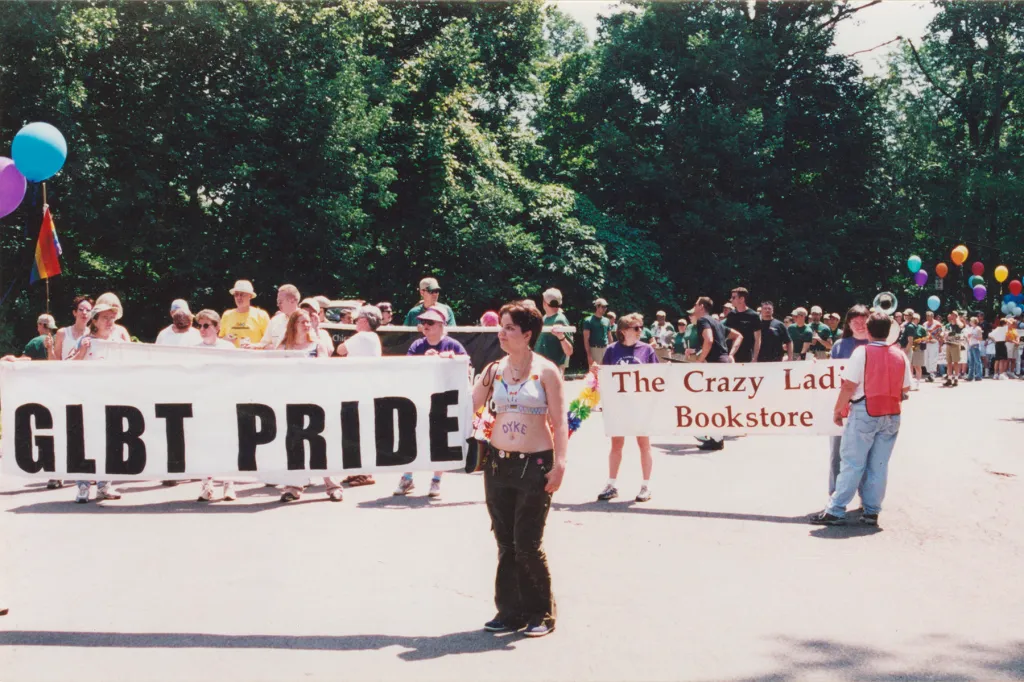
When the Crazy Ladies Bookstore, named for the women who history brushed off as “crazy,” opened in Northside in 1979, it became the center of gravity in the Cincinnati lesbian community of which Beiser and Ramstetter were a part. Women bought homes in the neighborhood, gathering at the feminist bookstore for coffee, tea and conversation about being women, and about being gay. In 1989, the Archives opened on an upper floor.
It seemed that the visibility of the Crazy Ladies Bookstore and the Ohio Lesbian Archives — and of the women who made them happen — would be cemented in history in 2023, when the Ohio History Connection, the state’s nonprofit historical society, “embarked on a three-year project to diversify Ohio’s historical markers to include ten new stories of LGBTQ+ Ohioans” via its Gay Ohio History Initiative, or GOHI. At the time, there were roughly 1,800 historical markers in Ohio’s program, but only two commemorated places, events or people from the state’s queer history. A third, recognizing Summit Station, a lesbian bar in Columbus that operated from 1970 to 2008, was dedicated during Pride Month that year. The Archives and bookstore were selected for joint recognition.
That long-overdue acknowledgement has been derailed by the Trump administration’s sweeping war on DEI, which extends beyond diversity, equity and inclusion programs to seemingly include anything that acknowledges the country’s diversity of experience. But the archives — and the volunteers who sustain it — are undeterred, carrying on as the queer community has throughout history, documenting their existence.
We never wanted to be invisible again.” Phebe Beiser
The Ohio Lesbian Archives first began in 1989 in a small room on the third floor above the Crazy Ladies Bookstore in Cincinnati, Ohio. (Cincinnati & Hamilton County Public Library)
The Marking Diverse Ohio program was financed by a $250,000 grant from the Institute of Museum and Library Services, an independent agency created by a Republican-led Congress in 1996 that is the main source of federal funding for libraries and museums. Beiser and Branstetter were interviewed for an oral history. Ohio History Connection researchers visited the Archives to peruse the collection. A location was secured in a city park near where the since-shuttered Crazy Ladies Bookstore once was. By early this year, preparations to forever commemorate the Archives and bookstore with a plaque were all but complete. Its installation was expected in June, Pride Month.
Then, in late March, President Donald Trump issued an executive order regarding “The Continuing Reduction of the Federal Bureaucracy,” singling out seven agencies for elimination — including the Institute of Museum and Library Services, or IMLS. Nearly all of its employees were put on leave and their emails were disconnected. Days later, his administration’s Department of Government Efficiency, or DOGE, canceled $25 million worth of already-awarded IMLS grants, including the $250,000 for Ohio History Connection’s Marking Diverse Ohio program. The federal agency’s seemingly final Instagram post stated: “The era of using your taxpayer dollars to fund DEI grants is OVER.” The last photo listed erecting “LGBTQIA+ historical markers across Ohio” among the alleged government excesses that would be cut.
Svetlana Harlan, a former project coordinator for Marking Diverse Ohio, recalled that when she looked at the list, and saw the program with other projects she admired, “it almost seemed like a positive thing, I was like, ‘Oh yeah, these are nice initiatives!’”
“And it turns out that [DOGE] was just taking over the account. So then I was like, ‘Oh, they’re cutting those. Oh, our name is on the list,’” she said.
DOGE’s cancellation of the $250,000 IMLS grant to Ohio History Connection threw into question the future of the markers that were supposed to ensure that Ohio’s public displays of its history include LGBTQ+ people. Along with the Ohio Lesbian Archives and the Crazy Ladies Bookstore, there were markers in the works for an LGBTQ+ district in Akron; the first professor of gay and lesbian studies at Kent State University; 19th-century sculptor Edmonia “Wildfire” Lewis; LGBTQ+ journalism in Ohio; Toledo’s first LGBTQ+ member of city council; a Columbus hospice care center for HIV and AIDs patients; an open lesbian pastor in Athens; the screen-printing company Nightsweats and T-Cells in Lakewood; and the Rubi Girls, a Dayton-area drag group that has raised more than $3 million for HIV/AIDs and LGBTQ+ causes since the 1980s.
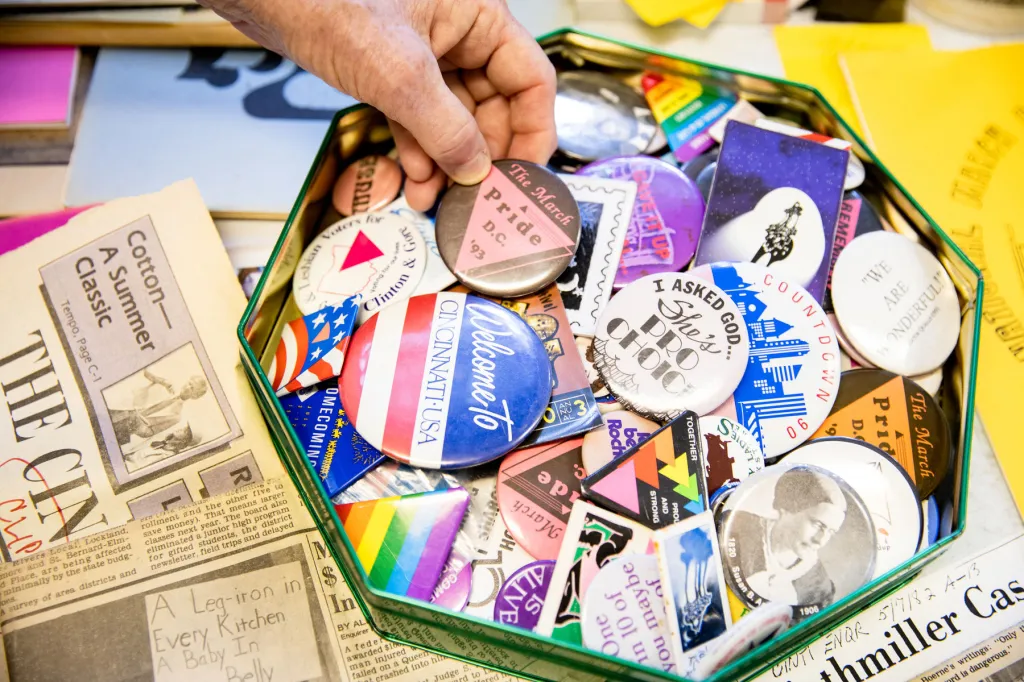
Ephemera collected at the Ohio Lesbian Archives include buttons from past Pride marches, political campaigns and other symbols of lesbian life. (Courtesy Ohio Lesbian Archives)
Preservation on hold
Marking Diverse Ohio and other programs recognizing specific communities weren’t the only programs impacted in the state when DOGE cut IMLS grants and the federal agency essentially shuttered. And, given that more than $250 million is granted annually to libraries and museums nationally, the economic chaos at the country’s museums, libraries and historical institutions wasn’t confined to Ohio.
In Ohio, other entities that received recent IMLS funding include the Frank Lloyd Wright-designed Westcott House in Springfield, for post-pandemic, on-site programming; the Cincinnati Zoo for a big cat breeding program; Dayton Metro Library programs that helped low-income Ohioans secure Internet access; and Cincinnati’s Contemporary Arts Center, which lost $175,000 slated for programming aimed at the 3,000 or more teens it serves each year.
Institutions in Pennsylvania warned the economic upheaval could scuttle the digitization of The Rosenbach museum’s collection of rare books and manuscripts; the Woodmere Art Museum was mid renovation on a building to house its collection and expected to be reimbursed. In Wisconsin, small-town libraries said without the $3 million from the IMLS they’d received the year before they would have to reduce staff and therefore services. The American Library Association, or ALA, and the American Federation of State, County and Municipal Employees, or AFSCME, the labor union representing government workers, sued the Trump administration. ALA President Cindy Hohl said at the time that, “Libraries play an important role in our democracy, from preserving history to … offering access to a variety of perspectives.” AFSCME President Lee Saunders added: “Libraries and museums contain our collective history and knowledge.”
Earlier this month, a federal judge ruled that the Trump administration could continue dismantling the Institute of Museum and Library Services as the case continues.
For now, Ohioans who want LGBTQ+ history represented among the 1,800 markers in the state will not get the federal funding that was granted and must search for alternative resources in their communities. A couple of the markers look poised to move forward with outside funding from community foundations and other organizations. Others, like the Ohio Lesbian Archives and the Crazy Ladies Bookstore, are still waiting. The remaining cost to install the marker would likely be $3,000-$5,000.
When The 19th reached out to Ohio History Connection to ask if any alternative funding sources were being explored to install the Archives’ marker, spokesperson Neil Thompson said that he was “not able to provide any additional information for an Ohio Historical Marker application that is not in the public domain” and that it is only considered in the public domain once “the markers are finalized, cast and ready to be installed and dedicated.”
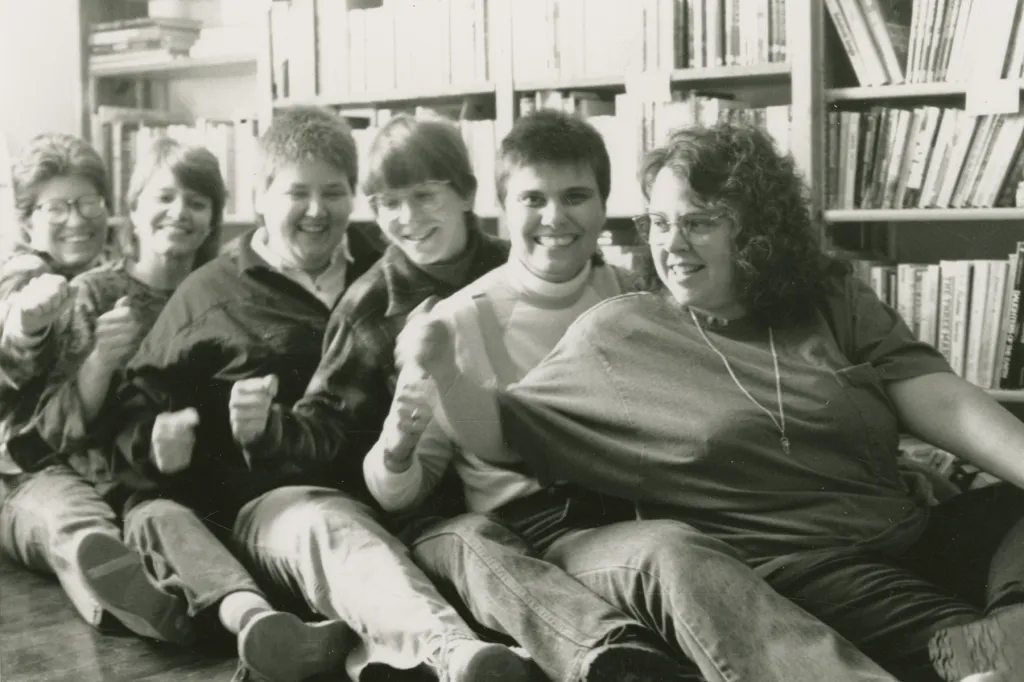
Phebe Beiser (far left), who co-founded the Ohio Lesbian Archives with her longtime friend Victoria ‘Vic’ Ramstetter, with Janice Uhlman, Elizabeth Van Dyke, Cathy McEneny, Morgan Kronenberger, and Ruth Rowan (left to right) at the Ohio Lesbian Archives in 1989. (Cincinnati & Hamilton County Public Library)
‘A reflection of themselves’
The Ohio Lesbian Archives has always been a DIY endeavor, powered by a group of passionate volunteers. When the Crazy Ladies Bookstore’s founder, Carolyn Dellenbach, moved out of the area, she handed it over to its patrons to be run as a feminist collective. A lesbian newsletter called Dinah operated out of the upper floor — they referred to the National Organization for Women’s Task Force on Sexuality and Lesbianism, established in 1973, as FOSAL, or fossil, and Dinah was a play on dinosaur. Beiser laughed explaining the name: It was the 1970s; maybe there were drugs involved. For a time she wrote for Dinah and loved interviewing famous arrivals from the “women’s music circuit” when they came to town.
At some point, the women working shifts at the bookstore, writing for Dinah and organizing talks and other events related to feminist and lesbian issues, realized that the community they had built, and the ephemera they were collecting and creating, were an important part of history — theirs, lesbians,’ Ohioans,’ and women’s.
“We held on to them because we knew they could not be replaced,” Beiser said of the collection. “It’s proof of our existence … so we held on to these things to never be invisible again.”
We held on to them because we knew they could not be replaced. It’s proof of our existence.” Phebe Beiser
Books on lesbian history line the shelves of the Ohio Lesbian Archives. (Courtesy Ohio Lesbian Archives)
In a 1991 issue of Dinah, letters to the editor included one from “Ma” who updated the “wimmin” in the community — they often spelled variations of their gender in ways that did not include “man” — that she was homesteading outside the city with her partner and building a log cabin. Another was from a woman who said she was “shocked” to find out that her being fired for being a lesbian was not a violation of civil rights laws and she was disappointed that the LGBTQ+ community did not come out to support her recent picket, writing: “I hope that in my lifetime I will see the gay and lesbian community get off their asses and together start fighting for their rights.”
Across from the metal filing cabinet at the Archives that houses the Dinah issues, a modern-looking poster from before the Supreme Court decided Bostock v. Clayton County in 2020, which extended employment protections to LGBTQ+ Americans, reminded Ohioans that it was still legal for them to be fired for their sexual orientation or gender identity. Today, Trump’s Equal Employment Opportunity Commission is aiming to curtail those hard-won workplace protections established by Bostock.
Lüdi Rich, a 27-year-old librarian, was working a recent Sunday afternoon at the Archives’ twice-weekly open hours, organizing books and research materials while the space was open to members of the community to drop in.
When Rich moved to Cincinnati nearly two years ago, she didn’t know anyone in the area, so she looked online for queer spaces so she could start building her community. When she attended a panel on local queer history, one of the speakers was Beiser, a longtime librarian herself in the country’s second-largest public library system.
Beiser mentioned at the panel that the Ohio Lesbian Archives would be having an open house that night at its new location next to Over-the-Rhine’s Washington Square Park, where Beiser was among those who met to march in Cincinnati’s first Pride Parade in April 1973. Rich asked Beiser how she could volunteer.
A couple months later, Rich showed up for her first shift, “And I’ve been here working ever since,” she said.
Nancy Yerian, the 34-year-old president of the Archives’ board, said that when she graduated from college in Massachusetts, she didn’t know if she could return to Cincinnati, where she grew up — until she discovered the Archives. “I thought that to live the kind of life I wanted to lead, I had to get out of what I thought was a very conservative place,” said Yerian, who has been volunteering at the Archives in some capacity since shortly after she finished school.
“Finding the Archives and the people I’ve met through the organization and the community we’re creating, as well as the history we’re preserving — it gave me a lot of hope that I could create a life for myself here,” she added.
It really is just us, preserving our history.”Lüdi Rich
The Crazy Ladies Bookstore marched in a Cincinnati, Ohio Pride parade. (Cincinnati & Hamilton County Public Library)
The Archives’ volunteers have helped digitize old photos, some of which are now in a collection at the Cincinnati Public Library. They organize the books, arranged by first names instead of last, since so many women, especially in those early years, published works after taking on their husbands’ surnames. There are filing folders of Dinah newsletters. A cabinet holds multiple VHS and DVD copies of the early aughts television drama “The L Word.” A collection of buttons includes those from past Pride marches; supporting Hillary Clinton’s presidential campaigns; and one with “REMEMBER” and an inverted pink triangle, the Nazi symbol that Adolf Hitler used to identify gay and trans people. There is also one with the logo of the Crazy Ladies Bookstore, the silhouette of a woman reading while reclined in a chair, a cat by her side.
“Many people who are coming to the archives are looking for a reflection of themselves and in many ways that’s why Vic and Phebe started it. It shows models of ways to be in the world and a feeling of not being alone and not being the first queer person or lesbian,” Yerian said.
The Ohio Lesbian Archives, marker or not, is and will keep doing what it always has: making sure that lesbian Americans are visible in the country’s historical record.
“It really is just us, preserving our history,” Rich said.
Feeling overwhelmed by the news? The 19th is considering new ways to keep you informed. But we need your input! Fill out this quick survey to share your thoughts.
Also, to commemorate the final day of PRIDE month 2025, here’s an historic dance music video to celebrate. No matter what, we should never not dance again! 🎶 🌈 🎶 🫶
June 30, 1966 The first GIs—known as the Fort Hood Three, U.S. Army Privates James Johnson, Dennis Mora and David Samas—refused to be sent to Vietnam. All were members of the 142nd Signal Battalion, 2nd Armored Division stationed at Fort Hood, Texas. The three were from working-class families, and had denounced the war as “immoral, illegal and unjust.” They were arrested, court-martialed and imprisoned. The Pentagon reported 503,926 “incidents of desertion” between 1966 and 1971. 1961-1973: GI resistance in the Vietnam War View their pamphlet Ballad of The Fort Hood Three Pete Seeger
June 30, 1971 The 26th Amendment to the U.S. Constitution, lowering the minimum voting age to 18 in all elections, was ratified after ¾ of the 50 state legislatures had agreed to it, a mere 100 days after its passage by Congress.
June 30, 1974 The Selective Service law, authorizing the draft, expired, marking the official end of conscription in the U.S. and the beginning of the all-volunteer armed forces.
June 30, 2005 Spain legalized same-sex marriage by a vote of 187-147 in parliament. Such couples were also granted the right to adopt and receive inheritances. Prime Minister Jose Luis Rodriguez Zapatero spoke in support of the bill, “We are expanding the opportunities for happiness of our neighbors, our colleagues, our friends and our relatives. At the same time, we are building a more decent society. Read more
A High Court in India has ruled that trans women are women. (Getty)
A court in India has decreed that trans women are women.
In a landmark ruling for the country, after rejecting claims that womanhood was preserved only for those who can bear children, the High Court of Andhra Pradesh ruled that trans women were “legally entitled” to recognition as women.
Presiding over the case, justice Venkata Jyothirmai Pratapa decided that tying the definition of women to pregnancy was “legally unsustainable” and contradicted India’s constitution, which emphasises equality before the law.
Quoting a Supreme Court decision from 2014, which legally recognised the rights of “third gender” individuals, Pratapa said that prohibiting trans women’s right to identify as women “amounted to discrimination”.
The case was brought to the high court in 2022 after transgender woman Pokala Shabana looked to use a section of the Indian penal code to seek protection from her in-laws, whom, she said, had been abusive towards her.
The court sided with trans women. (Getty)
Her husband’s parents petitioned the court to deny her use of Section 498A, which protects women from cruelty by a husband or relatives, arguing that it only applied to cisgender women. They claimed that trans women don’t meet the legal definition of women under Indian law because they cannot get pregnant and said Shabana’s allegations of harassment lacked evidence.
However, the judge said that articles 14, 15 and 21 of the constitution, which guarantee a variety of discrimination protections, including the right to life and personal liberty, meant trans women’s rights to be recognised as women superseded the law.
“A trans woman, born male and later transitioning to female, is legally entitled to recognition as a woman,” he wrote in his ruling. “Denying such protection by questioning their womanhood amounts to discrimination.”
Trans activist and artist Kalki Subramaniam told the Washington Blade that she was relieved and delighted to see the court “upholding our basic human right to be identified as what we want.” She went on to say: “For [the] transgender community, especially trans women, this verdict means a lot.”
The Indian government has been under mounting pressure to modernise its laws and policies on LGBTQ+ rights. Same-sex marriage is still illegal, despite growing support for its legalisation.
Prime minister Narendra Modi’s government have previously labelled same-sex marriage an “elitist” viewpoint that “seriously affects the interests of every citizen”.
An affidavit establishing the government’s views on same-sex unions, in 2023, proclaimed that marriage was valid only between “biological males and females [and that] this definition [was] socially, culturally and legally ingrained into the very idea and concept of marriage and ought not to be disturbed or diluted by judicial interpretation”.
Share your thoughts! Let us know in the comments below, and remember to keep the conversation respectful.
In the shadowy underground of mid-20th century America, where being anything other than a straight, cisgender conformist could land you in prison, a mental institution, or a shallow grave, Virginia Prince emerged like a goddamn hurricane wrapped in a dress. Born Charles Virginia Prince in 1912, she didn’t just challenge the rigid gender binary of her era—she fucking obliterated it, creating the conceptual framework and language that would eventually give birth to the modern transgender movement. But here’s the complicated shit: Virginia was also a product of her time, carrying baggage that would make her legacy as messy and contentious as it was revolutionary.
Virginia Prince wasn’t just another cross-dresser hiding in the shadows of American respectability. She was a visionary who saw the possibility of living between genders at a time when society insisted only two existed, period. Her creation of the term “transgender” and her decades of activism laid the groundwork for every rights battle we fight today. But she was also a deeply flawed human being whose views on sexuality, surgery, and identity would later put her at odds with the very communities she helped create.
This is the story of a brilliant, frustrating, essential figure who gave us the language to describe ourselves while simultaneously trying to police how we used it. Virginia Prince: the complicated badass who launched a revolution she couldn’t fully control and gave birth to ideas that would outlive her prejudices.
The Making of a Revolutionary in Repressive Times
Growing up in the early 20th century as a child who felt a profound disconnect from assigned gender was like existing in a psychological prison where the guards spoke a language you couldn’t understand. Virginia’s early years were marked by the crushing realization that the gender role society demanded didn’t match the internal reality she experienced. But unlike many of her contemporaries who internalized this disconnect as shame or pathology, Virginia began to see it as evidence that society’s gender categories were bullshit.
The 1920s and 1930s were decades of supposed liberation and progress, but that freedom didn’t extend to people who challenged fundamental assumptions about gender and sexuality. Virginia came of age during an era when cross-dressing was criminalized, when psychological theories pathologized any deviation from gender norms, and when the mere suggestion that gender might be fluid could destroy careers, families, and lives.
Her early experiments with feminine expression required incredible courage and strategic thinking. This wasn’t just about putting on women’s clothes—it was about reimagining the entire concept of gender identity in a society that had no framework for understanding such complexity. Every time Virginia dressed as a woman, she was conducting a radical experiment in human possibility that challenged centuries of binary thinking.
The psychological toll of living this dual existence cannot be overstated. Virginia had to navigate professional life, family relationships, and social interactions while maintaining a secret that could have destroyed everything she had built. The constant vigilance required to maintain this double life would have broken weaker spirits, but it forged in Virginia a determination to create spaces where others wouldn’t have to endure such isolation.
The War Years: Finding Community in Darkness
World War II created unexpected opportunities for gender experimentation as social roles shifted and traditional structures loosened. Virginia’s service during the war exposed her to broader networks of people who challenged conventional gender expression, providing her first real sense of community around these issues.
The war also introduced Virginia to the underground networks of cross-dressers and gender-variant people who had been operating in secret for decades. These connections were crucial for her psychological survival and her future activism. For the first time, she realized she wasn’t alone in her experiences and that there were others who shared her vision of gender as something more complex than society acknowledged.
Her wartime experiences also revealed the arbitrary nature of gender roles when social necessity demanded flexibility. Women working in factories, men in traditionally feminine support roles, the blurring of boundaries that peacetime society rigidly enforced—all of this provided evidence that gender categories were social constructions rather than biological imperatives.
The psychological impact of finding community during this period was transformative for Virginia. The isolation and shame that had characterized her earlier years began to give way to a sense of purpose and possibility. She started to see her gender variance not as a personal pathology but as evidence of human diversity that deserved recognition and respect.
The Publishing Revolution: Creating Visibility
Virginia’s decision to publish “Transvestia” magazine in 1960 was an act of revolutionary courage that created the first sustained platform for transgender voices in American media. This wasn’t just a hobby publication—it was a lifeline for isolated individuals across the country who had never seen their experiences reflected in print.
The magazine provided more than just information; it created community among people who had been atomized by shame and secrecy. Readers could finally see that their experiences were shared, that their feelings were valid, and that there were others working to create understanding and acceptance. The psychological impact of this visibility cannot be overstated for people who had spent their lives believing they were alone and abnormal.
Virginia’s editorial approach was strategic and careful, emphasizing respectability and education rather than sensationalism or sexual content. She understood that changing public opinion required presenting transgender people as sympathetic figures rather than freaks or perverts. This respectability politics approach was both necessary for the times and limiting in ways that would later create tension within transgender communities.
The magazine also served as an educational tool for families, medical professionals, and allies who were struggling to understand transgender experiences. Virginia’s clear, rational explanations of gender variance helped combat the pathological narratives that dominated medical and psychological discourse of the era.
Coining “Transgender”: The Power of Language
Virginia’s creation of the term “transgender” in the 1960s represents one of the most significant contributions to LGBTQIA+ liberation in the 20th century. Before this linguistic innovation, people like her were forced to use medical terms like “transvestite” or “transsexual” that carried pathological connotations and didn’t capture the full range of gender-variant experiences.
The word “transgender” was revolutionary because it suggested that gender identity existed on a spectrum rather than in discrete categories. It implied that crossing gender boundaries was a legitimate form of human expression rather than a medical condition requiring treatment. This conceptual shift was crucial for moving transgender experiences from the realm of pathology to the realm of identity and civil rights.
Virginia’s linguistic innovation also provided a political tool that would prove essential for organizing and advocacy. Having a term that encompassed diverse gender experiences allowed for coalition building that wouldn’t have been possible using the more narrow medical terminology of the era. The word became a rallying cry that united people across different experiences of gender variance.
The psychological impact of this linguistic shift was profound for transgender people who finally had language to describe their experiences without resorting to pathological or derogatory terms. Language shapes thought, and Virginia’s creation of “transgender” literally gave people new ways to think about themselves and their possibilities.
The Philosophy of Gender: Virginia’s Complex Vision
Virginia’s understanding of gender was both revolutionary and limited by the constraints of her era. She rejected the binary categorization of male and female while simultaneously maintaining traditional ideas about gender roles and characteristics. This contradiction would later put her at odds with more radical transgender activists, but it was essential for gaining mainstream acceptance during conservative times.
Her concept of “femmephilia”—the love of femininity—suggested that attraction to feminine expression was natural and healthy rather than deviant or pathological. This idea challenged both psychiatric orthodoxy and social conventions that insisted masculinity and femininity were fixed, essential characteristics tied to biological sex.
Virginia’s insistence that transgender people could live full, authentic lives without medical intervention was radical for an era when medical gatekeeping dominated transgender experiences. She argued that social transition was sufficient for psychological well-being and that surgical intervention was unnecessary and potentially harmful.
However, her views on sexuality and transgender identity were more conservative and exclusionary. Virginia insisted that “true” transgender people were heterosexual and that homosexuality was a separate, unrelated phenomenon. This position would later be criticized as transphobic and homophobic, but it reflected strategic thinking about respectability politics in an era of extreme social conservatism.
Building Networks: The Organizational Genius
Virginia’s creation of transgender social networks and support groups represented a crucial step in community building that laid the foundation for later political organizing. Her “Tri-Ess” organization (Society for the Second Self) provided safe spaces for transgender people to gather, share experiences, and build relationships that sustained them through difficult times.
These gatherings were psychologically transformative for participants who had spent years or decades in isolation. Being able to present authentically in supportive environments provided relief from the constant stress of hiding their true selves. The social connections formed at these events often became lifelong friendships that provided ongoing support and validation.
Virginia’s organizational approach emphasized discretion and safety, recognizing that most transgender people of her era faced severe consequences if their identities were exposed. Her networks operated with careful attention to privacy and security that protected participants while still providing community and support.
The leadership skills Virginia developed through this organizing work would prove essential as the transgender rights movement gained momentum. Her ability to bring people together, facilitate discussions, and build consensus became a model for later activists who expanded on her foundation.
The Medical Establishment: Challenging Professional Authority
Virginia’s relationship with the medical establishment was complex and often contentious. While she worked with sympathetic doctors and researchers to advance understanding of transgender experiences, she also challenged medical authority in ways that were radical for her time.
Her rejection of the medical model that pathologized transgender identity put her at odds with professionals who insisted that gender variance was a mental illness requiring treatment. Virginia argued that transgender people were mentally healthy individuals whose distress came from social rejection rather than internal pathology.
This position was psychologically liberating for transgender people who had been told by medical professionals that they were sick, deviant, or delusional. Virginia’s insistence that transgender identity was a natural variation of human experience provided an alternative narrative that emphasized health and authenticity rather than illness and cure.
Her advocacy for informed consent and patient autonomy in transgender healthcare was decades ahead of its time. Virginia argued that transgender people should have the right to make their own decisions about their bodies and their treatment rather than being subjected to arbitrary medical gatekeeping.
International Impact: Spreading the Revolution
Virginia’s influence extended far beyond American borders as her publications and ideas spread to transgender communities around the world. Her magazines were smuggled into countries where transgender expression was even more severely criminalized, providing hope and information to isolated individuals globally.
Her correspondence with transgender people from different countries helped create an international network of support and advocacy that transcended national boundaries. These connections were crucial for sharing strategies, resources, and emotional support across diverse cultural contexts.
The conceptual framework Virginia developed for understanding transgender identity proved adaptable to different cultural contexts while maintaining its core emphasis on human dignity and self-determination. Her ideas influenced transgender organizing in Europe, Asia, and other regions where local activists adapted her strategies to their specific circumstances.
Her international visibility also helped establish transgender rights as a human rights issue rather than a local cultural phenomenon. By demonstrating that transgender people existed across all cultures and societies, Virginia’s work laid groundwork for later international human rights advocacy.
The Generational Divide: Evolution and Conflict
As younger transgender activists emerged in the 1970s and 1980s with more radical political agendas, Virginia’s conservative approach to respectability politics came under increasing criticism. Her emphasis on working within existing social structures clashed with activists who wanted to challenge those structures more directly.
The generational divide was particularly acute around issues of sexuality and medical transition. Younger activists rejected Virginia’s insistence that transgender people should be heterosexual and her opposition to surgical interventions. They argued that her gatekeeping was as harmful as medical gatekeeping in limiting transgender self-determination.
Virginia’s response to this criticism was often defensive and sometimes dismissive, reflecting her investment in approaches that had required enormous personal sacrifice to develop. She had spent decades building respectability and acceptance through careful strategic choices, and she feared that more radical approaches would undo that progress.
The psychological impact of this generational conflict was painful for Virginia, who saw her life’s work being criticized by the very communities she had helped create. However, this tension was also productive in pushing the transgender rights movement toward more inclusive and radical positions.
The Sexual Revolution: Changing Contexts
The sexual revolution of the 1960s and 1970s created new opportunities and challenges for transgender advocacy. Increased openness about sexuality and gender made transgender issues more visible but also more controversial as conservative backlash intensified.
Virginia’s conservative approach to sexuality became increasingly problematic as the broader LGBTQIA+ rights movement embraced more radical positions on sexual liberation. Her insistence that transgender identity was separate from sexuality clashed with emerging understanding of the interconnected nature of gender and sexual oppression.
The rise of gay liberation and feminist movements provided both allies and competitors for transgender advocacy. While these movements sometimes supported transgender rights, they also sometimes marginalized transgender concerns in favor of their own political priorities.
Virginia’s response to these changing contexts was mixed, as she struggled to maintain her strategic approach while adapting to new political realities. Her ability to evolve was limited by her deep investment in the respectability politics that had defined her earlier activism.
Legacy Complications: The Price of Pioneering
As Virginia aged, the contradictions in her legacy became more apparent and more problematic for younger transgender activists. Her groundbreaking contributions to transgender visibility and organizing were undeniable, but her conservative positions on sexuality and identity were increasingly seen as harmful and exclusionary.
Her opposition to transgender people who didn’t conform to her narrow definitions of legitimate transgender identity created gatekeeping that mirrored the medical gatekeeping she had originally challenged. This irony was particularly painful for transgender people who found themselves excluded from the very communities Virginia had helped create.
The psychological impact of Virginia’s gatekeeping was significant for transgender people who experienced rejection from someone who should have been an ally and advocate. Her insistence that only certain types of transgender experiences were valid reproduced the marginalization that many had hoped transgender communities would escape.
However, Virginia’s contributions to transgender liberation remained essential even as her limitations became more apparent. Her creation of language, community, and visibility provided the foundation for all subsequent transgender organizing, even when that organizing moved in directions she didn’t support.
The Final Years: Reflection and Resistance
Virginia’s later years were marked by increasing isolation from transgender communities that had moved beyond her conservative framework. While she continued to advocate for transgender rights, her influence waned as younger activists took leadership roles in the movement.
Her resistance to change reflected both personal investment in her lifelong approach and genuine concern about the directions of transgender advocacy. She worried that more radical positions would provoke backlash that would undo decades of progress toward social acceptance.
The psychological toll of this marginalization was significant for someone who had devoted her life to transgender advocacy. Watching the movement she had helped create evolve beyond her influence was both gratifying and painful as she grappled with the limitations of her own vision.
Despite these challenges, Virginia maintained her commitment to transgender advocacy until her death in 2009. Her persistence in the face of criticism demonstrated the same determination that had driven her pioneering work decades earlier.
Psychological Analysis: The Costs of Pioneering
From a psychological perspective, Virginia’s life illustrates both the tremendous strength required for pioneering social change and the personal costs of such leadership. Her ability to maintain authenticity while navigating extreme social hostility demonstrates remarkable resilience and strategic intelligence.
The psychological mechanisms Virginia developed for survival—careful boundary maintenance, strategic respectability, community building—became tools for broader transgender liberation even when they also created limitations and exclusions. Her survival strategies were both adaptive and restrictive, helping her navigate danger while also constraining her vision of possibility.
Her later conflicts with younger activists can be understood partly as trauma responses to decades of marginalization and partly as realistic concerns about the risks of more radical approaches. The psychological investment required to build acceptance through respectability politics made it difficult for her to embrace strategies that seemed to threaten that hard-won progress.
Virginia’s legacy demonstrates how pioneering figures often become both inspirational models and cautionary tales as movements evolve beyond their founding visions. Her contributions remain essential while her limitations serve as reminders of the ongoing need for growth and inclusion.
Social Impact: Transforming American Gender
Virginia’s influence on American understanding of gender extends far beyond transgender communities to broader social recognition of gender complexity and fluidity. Her visibility and advocacy helped plant seeds of change that would eventually blossom into mainstream acceptance of gender diversity.
Her creation of transgender terminology and concepts provided intellectual frameworks that influenced academic research, medical practice, and legal advocacy for decades. Scholars, activists, and professionals continue to build on foundations she established even when they disagree with her specific positions.
The social networks Virginia created became models for community organizing that influenced not just transgender advocacy but broader LGBTQIA+ organizing. Her emphasis on mutual support, education, and strategic communication became standard practices for social justice movements.
Her international influence helped establish transgender rights as a global human rights issue that transcended local cultural differences. The universal applicability of her core insights about human dignity and self-determination provided tools for advocates working in diverse cultural contexts.
The Philosophical Revolution: Expanding Human Possibility
Virginia’s fundamental contribution to human understanding was her demonstration that gender categories were social constructions rather than biological imperatives. This insight was philosophically revolutionary in its implications for human freedom and self-determination.
Her concept of transgender identity challenged not just gender binaries but broader assumptions about fixed identity categories. By showing that people could successfully live between or beyond conventional categories, she opened intellectual space for reimagining human possibility more broadly.
The philosophical framework Virginia developed for understanding gender variance influenced later thinking about sexuality, race, class, and other identity categories. Her insights about the constructed nature of social categories became foundational for intersectional analysis and identity politics.
Her emphasis on self-determination and personal autonomy in gender expression provided philosophical grounding for broader movements for individual freedom and authentic self-expression. These ideas continue to influence contemporary debates about identity, liberty, and human rights.
The Ongoing Revolution: Virginia’s Living Legacy
Despite the controversies surrounding her conservative positions, Virginia’s fundamental contributions to transgender liberation continue to shape contemporary activism and advocacy. Her linguistic innovations, organizational strategies, and philosophical insights remain relevant even as the movement has evolved beyond her original vision.
Current transgender rights advocates continue to grapple with the tensions Virginia identified between respectability politics and radical change, between strategic pragmatism and principled authenticity. Her example provides both inspiration and cautionary lessons for contemporary activists navigating similar challenges.
The institutional changes Virginia advocated for—medical reform, legal recognition, social acceptance—remain central to transgender rights agendas even as the specific approaches have evolved. Her strategic focus on concrete improvements in transgender people’s lives continues to guide effective advocacy.
Her international influence persists as transgender advocates around the world build on frameworks she established while adapting them to local circumstances. The universality of her core insights about human dignity continues to provide tools for global transgender liberation.
The Fucking Truth About What Virginia Achieved
Let’s cut through the academic bullshit and acknowledge what Virginia Prince actually accomplished. She took a world that insisted only two genders existed and forced it to confront the reality of human gender diversity. She created language, community, and visibility for people who had been erased from public consciousness and gave them tools to fight for recognition and rights.
Virginia’s creation of the term “transgender” alone represents one of the most significant contributions to LGBTQIA+ liberation in the 20th century. Without her linguistic innovation, we wouldn’t have the conceptual framework that makes contemporary transgender rights advocacy possible. She literally gave us the words we needed to describe ourselves and demand recognition.
Her decades of publishing, organizing, and advocacy laid the foundation for every transgender rights victory we’ve achieved since. The marriage equality, employment protections, healthcare access, and legal recognition that contemporary transgender people enjoy were built on groundwork Virginia established when such victories seemed impossible.
But here’s the complicated shit: Virginia was also a product of her time whose conservative positions on sexuality and identity created gatekeeping that excluded many people from the communities she helped create. Her respectability politics approach was necessary for survival in her era but became limiting as the movement evolved toward more inclusive and radical positions.
The psychological impact of Virginia’s work extends far beyond transgender communities to broader social understanding of gender complexity and human diversity. Every person who questions gender norms, challenges binary categories, or demands recognition for non-conforming identities owes something to the path Virginia blazed through hostile social terrain.
She wasn’t perfect—no pioneer is—but she was authentic in ways that transformed American culture. In an era when gender variance was criminalized and pathologized, Virginia’s insistence on dignity and self-determination was revolutionary. Her vision of transgender people as healthy, capable individuals rather than sick deviants provided alternative narratives that saved lives and changed minds.
Virginia Prince died in 2009, but her revolution continues every time someone uses the term “transgender,” every time a support group meets, every time an activist demands recognition rather than tolerance. Her legacy isn’t just in the organizations she founded or the publications she created, but in the transformed understanding of human possibility that makes contemporary gender diversity visible and valuable.
The fucking truth is this: Virginia didn’t just create the transgender rights movement—she created the conceptual foundation that makes all contemporary gender liberation possible. She took the notion that gender categories were fixed and immutable and torched it so thoroughly that even conservative backlash can’t restore the old certainties.
That’s the kind of revolutionary the world needed, transgender people deserved, and human progress required. Not because she was perfect, but because she was persistent. Not because she had all the answers, but because she asked the right questions. Not because she made everyone comfortable, but because she made it impossible to ignore transgender existence and dignity.
Virginia Prince: the complicated badass who gave us our fucking name and showed us that the only limits on human identity are the ones we accept. May her linguistic innovations keep evolving, her organizational strategies keep adapting, and her fundamental insight about human dignity keep expanding until every person can live authentically without apology or fear.
Before the establishment of the Hollywood Production Code in the 1930s, filmmakers deployed gender and sexuality stereotypes for glamour, humor, and drama alike.
With Pride month in full swing, it’s an ideal moment to look at historical queer representation, particularly in the early days of Hollywood cinema. The first few decades of the twentieth century were not only an active time for a growing medium, but also one in which crises of confidence, economy, masculinity, and culture changed how filmmakers presented queer characters and how (or if) audiences received them. Film professor David Lugowski summed up queer representation in early film neatly, writing that “[a]s cinema learned to talk, so did it also ‘speak’ about the gender roles so crucial to Hollywood film.”
Cinema moved from silent film into “talkies” in the late 1920s, with Al Jolson’s The Jazz Singer typically credited as the first feature to integrate sound and dialogue (it may, however, be a more complicated exercise to locate a true “first”). The late twenties also saw the onset in America of the Great Depression, and, at least as far as entertainment is concerned, many scholars link displays of sexuality and queerness in films in the late 1920s and early 1930s to a larger crisis in masculinity. Economic collapse, the story goes, leads to a broader crisis of identity and gender role. “In short,” Lugowski writes, “men found their gender status, linked to notions of ‘work’ and ‘value’ promulgated by capitalist structures and ideologies, in jeopardy.”
As film became more pervasive and culturally integrated under these circumstances, stereotypes started to be read as evidence that gender performance was equivalent to sexual orientation. Basic types in Hollywood films were clear. For men, queer types were usually either the “dithering, asexual ‘sissy,’” writes Lugowski, or “the more outrageous ‘pansy,’ an extremely effeminate boulevardier type sporting lipstick, rouge, a trim mustache and hairstyle, and an equally trim suit, incomplete without a boutonniere.” Lesbian representation favored masculine drag—tailored suits, hair cut short or slicked back, and sometimes male-coded accessories like a monocle or a cigar. “Objections arose,” Lugowski explains, “because she seemed to usurp male privilege; perhaps the pansy seemed to give it up.”
Prior to the 1930s, these stereotypes appear to have been commonly understood and deployed, for glamour, humor, and drama alike. Audiences may have responded variably—with titillation, acceptance, or shock, depending on the individual—but no one could say the film industry wasn’t inclusive of different relationship story arcs.
In a Code world, no film should risk lowering an audience’s moral standards nor should evil or immorality be presented except as a cautionary tale.
In Pandora’s Box (1929) Louise Brooks wooed a father and son as well as a countess in a tuxedo. Greta Garbo portrayed the title character Queen Christina in a 1933 film about the seventeenth-century Swedish monarch, widely assumed to have been queer. Garbo, along with Marlene Dietrich and other leading ladies such as Joan Crawford, Myrna Loy, and Barbara Stanwyck, were members of a private professional group of Hollywood women—all of them quietly bisexual or lesbian—known as the “Sewing Circle.” Palmy Days (1931) features not only a proud flower-wearing “pansy” character, but drag, donuts, and a sexy Busby Berkeley dance number.
These portrayals took on new weight and context with the passage of the Hollywood Production Code. The Code, a set of self-regulatory guidelines applied to film production, was begrudgingly accepted by film execs, writes Steven Vaughn. That industry figures would accept content restrictions seems strange, until you consider that it was a hold-your-nose solution preferable to either intrusive government regulation or control by investment banks or funders, who preferred their investments be as stable as possible. The Production Code of 1930 therefore came into being, heavily influenced by religious collaborators and proclaiming two linked truths: “Motion pictures are very important as Art,” and “The motion picture has special Moral obligations.” In a Code world, no film should risk lowering an audience’s moral standards nor should evil or immorality be presented except as a cautionary tale.
The Production Code embraced a list of “don’ts” and “be carefuls.” On the “don’ts” list, films were to eliminate blasphemy and profanity, depictions of drug use, miscegenation, and “any inference of sex perversion,” which implied homosexuality. “Be carefuls” enumerated in the 1956 version of the Code urged “the careful limits of good taste” around bedroom scenes, hangings, liquor, childbirth, and “third degree methods.”
The well-known English critic Anthony Slide explains that the Code particularly targeted queer representation in film.
At first, to be honest, not much changed. Hollywood cinema remained as queer as ever, and during the harshest years of the Depression, the industry engaged in some of its most boundary-pushing and queer storytelling efforts.
“Not only does the number of incidents increase,” writes Lugowski,
but we also see more explicit references, longer scenes, and sometimes surprisingly substantial characters. Perhaps most important, the pansy and lesbian characters of the period remain, respectively, effeminate and mannish but become increasingly sexualized in 1933–34.
To wit: in 1934, Jack Warner (of Warner Brothers Studio) felt perfectly comfortable ignoring enforcer Joseph Breen’s firm letter and repeated phone calls about that year’s Wonder Bar. Starring Al Jolson and based on a Broadway musical of the same name, the film included a scene in which a tuxedo-clad man glides onto a busy dance floor and taps the shoulder of another man dancing with a blonde in finger waves and a white gown. He asks, “May I cut in?” The woman answers, “Why, certainly!” and reaches out her arms expectantly, at which point the two men embrace each other and whirl off down the dance floor. Jolson, from the bandstand, observes the exchange and quips, “Boys will be boys. Woo!”
By the end of 1934, though, the Code was more than just a feel-good document for moralists. It was enabled with specific enforcement machinery in response to religious lobbying and the threat of significant industry opposition from the Catholic church.
“[R]ather than risk possible state and federal censorship,” notes Chon Noriega, “as well as anticipated boycotts by the ten-million-member Catholic Legion of Decency, Hollywood studios proferred [sic] strict self-regulation, empowering the Hays Office—now under Joseph Breen—to enforce its four-year-old Production Code.”
Once the Production Code had teeth, filmmakers were restricted in what they could include in their work. If they violated Code standards, the Production Code Administration (PCA) could withhold its seal of approval, making distribution difficult. The possibility of appeal was slim to none, with a board of PCA directors making the call, not fellow filmmakers. In 1947, with the Code not even fifteen years in effect, writer and censor Geoffrey Shurlock noted with some pleasure that
Queer characters and storylines were less common, or circumscribed, until the Code weakened and ultimately fell in the 1960s (the success of boundary-pushing films like Some Like It Hot only helped in this regard). It remained true in film that villains, especially, were more likely to be accepted with queer coding. But a large number of films—more than perhaps one might expect—remain a testament to Hollywood’s longtime engagement with queer characters and themes. (snip)
June 28, 1916 A one-day strike by 50,000 German workers was organized to free Socialist anti-war leader Karl Liebknecht, charged with sedition for his criticism of the government and the war later known as World War I. He was the first ever to be expelled from the Reichstag, the German parliament, voted out for his opposition to Germany’s role in the war. ——————————————————————————————————— June 28, 1969 Patrons at the Stonewall Inn, a gay bar in New York City’s Greenwich Village, being subjected to routine anti-homosexual harassment by the New York City police raiding the bar, spontaneously fought back in an incident considered to be the birth of the gay rights movement. Riot veteran and gay rights activist Craig Rodwell said: “A number of incidents were happening simultaneously. There was no one thing that happened or one person, there was just . . . a flash of group, of mass anger.” About Craig Rodwell A group of drag queens, who had been mourning the death earlier in the week of Judy Garland, mocked the police and threw things at them, and police were forced to retreat into the bar as the crowd of supporters grew; disturbances continued for days. The bar is now on the National Register of Historic Places. Stonewall and all it has inspired —————————————————————————————————- June 28, 1987 The Iranian Kurdish town of Sardasht was attacked by Iraqi aircraft with chemical weapons during the Iran-Iraq War. Saddam Hussein had started the war expecting an easy victory against the new Shiite Islamic republic, even though Iran had three times the population. Victims of the mustard gas attack on Sarsasht, Iran ——————————————————————————————————- June 28, 2005 Seen in New York City on June 28, 2005
It happened just a few weeks ago: Jim Obergefell was moving things in his office when he came across the ashes of his late husband, John Arthur, now 12 years gone. Arthur had last wishes for his ashes. Obergefell had yet to fulfill them.
“And it struck me that, oh, I am actually now mentally, emotionally ready to take care of John’s ashes,” Obergefell told The 19th. “It was the first time that I had that feeling so clearly and so strongly.”
Obergefell, 58, is ready to move on. Not exactly from the love of his life or the history-making Supreme Court decision that came after Arthur died. But certainly from the insecurities straight America was grappling with a decade ago about same-sex unions.
Obergefell is that Obergefell: the named plaintiff in the landmark lawsuit that extended marriage equality to every state in the nation in 2015. Ten years later, he celebrates that win and the many ways it rewrote his life. And in a time when LGBTQ+ rights are again under assault, he is looking to the future — of the queer rights movement and also his own.
A journey to the Supreme Court
Obergefell’s journey to the Supreme Court was hardly destined. It began 12 years ago, on June 26, 2013, when the Supreme Court struck down the Defense of Marriage Act, a federal law that prohibited the government from recognizing same-sex marriages.
Obergefell and Arthur had been together for 21 years at the time. The two had discussed getting married before. But they wanted it to be legal, and their home state of Ohio didn’t offer same-sex marriages.
Arthur was gravely ill with ALS, a progressive neurodegenerative disease, and he barely left his home hospice bed.
After the ruling, Obergefell leaned over to Arthur, hugged, then kissed him.
“Let’s get married,” he said.
Arthur agreed.
The logistics were not easy. Arthur was in no shape to travel, and the couple could not wed in Ohio. Obergefell researched and found that Maryland would let him get a marriage license even with only one of them present. But both would need to arrive in the state for the ceremony.
When friends and family learned about their predicament, they pooled together money to charter a medical jet for Arthur. The two flew to Baltimore. Over the course of 45 minutes, they exchanged vows on the tarmac before flying home.
“In the days that followed, we said the word ‘husband’ hundreds of times a day,” Obergefell said on the Decidedly Podcast in 2023.
But just five days later, their joy was muted when civil rights attorney Al Gerhardstein informed them that because of Ohio’s ban on same-sex marriage, Arthur would be listed as single in death.
Arthur and Obergefell were angry. The couple sued the state of Ohio in federal district court and won. Three months later, Arthur died.
The following year, Obergefell, still in mourning, lost on appeal. But he refused to believe he might lose altogether.
“I just kept going,” Obergefell said. “It was the right thing to do.”
On June 26, 2015, he won. For the country, the win was immensely practical. Many told Obergefell it gave them so much hope it saved their lives. For Obergefell, it meant a legacy for the man he loved.
“I made promises to John to love, honor and protect him, and I was going to keep doing that,” he said.
In the decade since Jim Obergefell won his Supreme Court case that made same-sex marriage federally legal, hundreds of thousands of same-sex couples have married in the U.S. (Eric Gay/AP Photo)
Changing history
It’s difficult to overstate the impact of Obergefell’s case on the nation or the world. Since the 2015 ruling, the Williams Institute at the UCLA School of Law estimates, 591,000 queer couples have wed, generating an estimated $5.9 billion in wedding spending for state and local economies.
It has also radically transformed Obergefell’s life. Introverted and unassuming, he has spent the last decade campaigning for LGBTQ+ rights. He helms Equality Vines, a wine company that donates its proceeds to advancing civil rights causes.
It’s a position that makes him deeply proud if not a little fatigued.
“I’m not tired of talking about it,” he said of the 10-year anniversary of the ruling. “I’m just physically tired from all of the interviews and the photographers and the speaking gigs and the events. Yes, I’m exhausted.”
For 12 years, Obergefell has kept Arthur alive through retelling their story countless times in courtrooms and for the media. That exercise, of telling and retelling, helped Obergefell process his profound loss.
But he has never recoupled. It wasn’t that Arthur didn’t want him to. In fact, Arthur told him regularly that he wanted him to find love again. He asked his friends and family to tell Obergefell that he wanted him to find love after he was gone.
“I know it was sincere, because he told me that he had other people tell me that,” Obergefell said.
It isn’t about the pressure he feels as the face of marriage equality, he said, though part of him wonders what it would be like to date after making history.
“I don’t know how to date,” he confessed. “I’m clueless when people flirt with me, and as much as I hate it, and I don’t go into any conversation or anything like this, but you know, there’s that part of me that sometimes wonders, you know, are they interested in me as a person, or are they interested in me as Jim Obergefell, named plaintiff?”
Obergefell’s name has become synonymous with marriage equality in the United States, an issue that has not always united the LGBTQ+ community. Some queer activists have argued that same-sex marriage was a misguided goal for the movement as queer youth continue to face high rates of homelessness and transgender people grapple with police violence and incarceration, among other issues.
More work to do
Obergefell, too, is worried that the needs of the community’s most vulnerable have gone unmet. He has watched horror-struck over the last five years as state legislatures have moved to restrict transgender rights.
“We need to fight for every marginalized community, because the queer community includes every marginalized community, and equality for one is pointless without equality for all,” he said. “I didn’t go to the Supreme Court just so White, cisgender, gay men like me could get married.”
Despite all of the setbacks in LGBTQ+ rights, and even threats to Obergefell’s game-changing victory, he is hopeful — and feels stronger than ever. People assume his case was difficult for him. It was, but the path was also obvious, to him and to Arthur. They loved each other.
“If we weren’t willing to fight for each other and for what was right, then what’s the point?”




 At the urging of Reverend William Hamilton, a freedman and carpenter, and others, the end of slavery was celebrated in churches. The Fourth of July had in the past been marred by young white men attacking black Americans.








 Scottie's Playtime