Also, to commemorate the final day of PRIDE month 2025, here’s an historic dance music video to celebrate. No matter what, we should never not dance again! 🎶 🌈 🎶 🫶
June 30, 1966 The first GIs—known as the Fort Hood Three, U.S. Army Privates James Johnson, Dennis Mora and David Samas—refused to be sent to Vietnam. All were members of the 142nd Signal Battalion, 2nd Armored Division stationed at Fort Hood, Texas. The three were from working-class families, and had denounced the war as “immoral, illegal and unjust.” They were arrested, court-martialed and imprisoned. The Pentagon reported 503,926 “incidents of desertion” between 1966 and 1971. 1961-1973: GI resistance in the Vietnam War View their pamphlet Ballad of The Fort Hood Three Pete Seeger
June 30, 1971 The 26th Amendment to the U.S. Constitution, lowering the minimum voting age to 18 in all elections, was ratified after ¾ of the 50 state legislatures had agreed to it, a mere 100 days after its passage by Congress.
June 30, 1974 The Selective Service law, authorizing the draft, expired, marking the official end of conscription in the U.S. and the beginning of the all-volunteer armed forces.
June 30, 2005 Spain legalized same-sex marriage by a vote of 187-147 in parliament. Such couples were also granted the right to adopt and receive inheritances. Prime Minister Jose Luis Rodriguez Zapatero spoke in support of the bill, “We are expanding the opportunities for happiness of our neighbors, our colleagues, our friends and our relatives. At the same time, we are building a more decent society. Read more
It happened just a few weeks ago: Jim Obergefell was moving things in his office when he came across the ashes of his late husband, John Arthur, now 12 years gone. Arthur had last wishes for his ashes. Obergefell had yet to fulfill them.
“And it struck me that, oh, I am actually now mentally, emotionally ready to take care of John’s ashes,” Obergefell told The 19th. “It was the first time that I had that feeling so clearly and so strongly.”
Obergefell, 58, is ready to move on. Not exactly from the love of his life or the history-making Supreme Court decision that came after Arthur died. But certainly from the insecurities straight America was grappling with a decade ago about same-sex unions.
Obergefell is that Obergefell: the named plaintiff in the landmark lawsuit that extended marriage equality to every state in the nation in 2015. Ten years later, he celebrates that win and the many ways it rewrote his life. And in a time when LGBTQ+ rights are again under assault, he is looking to the future — of the queer rights movement and also his own.
A journey to the Supreme Court
Obergefell’s journey to the Supreme Court was hardly destined. It began 12 years ago, on June 26, 2013, when the Supreme Court struck down the Defense of Marriage Act, a federal law that prohibited the government from recognizing same-sex marriages.
Obergefell and Arthur had been together for 21 years at the time. The two had discussed getting married before. But they wanted it to be legal, and their home state of Ohio didn’t offer same-sex marriages.
Arthur was gravely ill with ALS, a progressive neurodegenerative disease, and he barely left his home hospice bed.
After the ruling, Obergefell leaned over to Arthur, hugged, then kissed him.
“Let’s get married,” he said.
Arthur agreed.
The logistics were not easy. Arthur was in no shape to travel, and the couple could not wed in Ohio. Obergefell researched and found that Maryland would let him get a marriage license even with only one of them present. But both would need to arrive in the state for the ceremony.
When friends and family learned about their predicament, they pooled together money to charter a medical jet for Arthur. The two flew to Baltimore. Over the course of 45 minutes, they exchanged vows on the tarmac before flying home.
“In the days that followed, we said the word ‘husband’ hundreds of times a day,” Obergefell said on the Decidedly Podcast in 2023.
But just five days later, their joy was muted when civil rights attorney Al Gerhardstein informed them that because of Ohio’s ban on same-sex marriage, Arthur would be listed as single in death.
Arthur and Obergefell were angry. The couple sued the state of Ohio in federal district court and won. Three months later, Arthur died.
The following year, Obergefell, still in mourning, lost on appeal. But he refused to believe he might lose altogether.
“I just kept going,” Obergefell said. “It was the right thing to do.”
On June 26, 2015, he won. For the country, the win was immensely practical. Many told Obergefell it gave them so much hope it saved their lives. For Obergefell, it meant a legacy for the man he loved.
“I made promises to John to love, honor and protect him, and I was going to keep doing that,” he said.
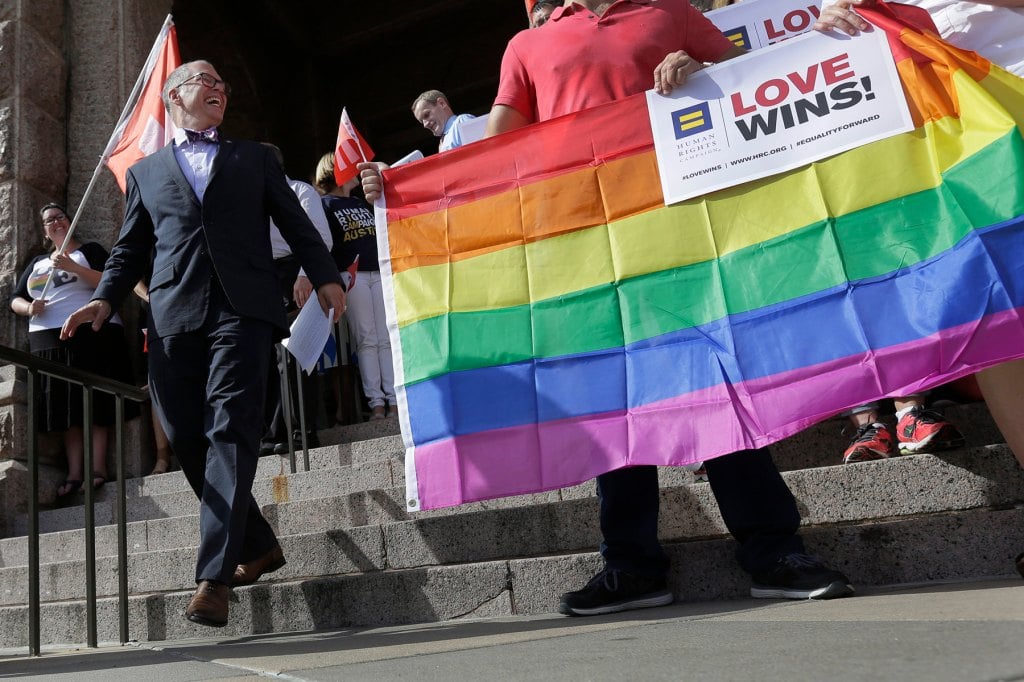
In the decade since Jim Obergefell won his Supreme Court case that made same-sex marriage federally legal, hundreds of thousands of same-sex couples have married in the U.S. (Eric Gay/AP Photo)
Changing history
It’s difficult to overstate the impact of Obergefell’s case on the nation or the world. Since the 2015 ruling, the Williams Institute at the UCLA School of Law estimates, 591,000 queer couples have wed, generating an estimated $5.9 billion in wedding spending for state and local economies.
It has also radically transformed Obergefell’s life. Introverted and unassuming, he has spent the last decade campaigning for LGBTQ+ rights. He helms Equality Vines, a wine company that donates its proceeds to advancing civil rights causes.
It’s a position that makes him deeply proud if not a little fatigued.
“I’m not tired of talking about it,” he said of the 10-year anniversary of the ruling. “I’m just physically tired from all of the interviews and the photographers and the speaking gigs and the events. Yes, I’m exhausted.”
For 12 years, Obergefell has kept Arthur alive through retelling their story countless times in courtrooms and for the media. That exercise, of telling and retelling, helped Obergefell process his profound loss.
But he has never recoupled. It wasn’t that Arthur didn’t want him to. In fact, Arthur told him regularly that he wanted him to find love again. He asked his friends and family to tell Obergefell that he wanted him to find love after he was gone.
“I know it was sincere, because he told me that he had other people tell me that,” Obergefell said.
It isn’t about the pressure he feels as the face of marriage equality, he said, though part of him wonders what it would be like to date after making history.
“I don’t know how to date,” he confessed. “I’m clueless when people flirt with me, and as much as I hate it, and I don’t go into any conversation or anything like this, but you know, there’s that part of me that sometimes wonders, you know, are they interested in me as a person, or are they interested in me as Jim Obergefell, named plaintiff?”
Obergefell’s name has become synonymous with marriage equality in the United States, an issue that has not always united the LGBTQ+ community. Some queer activists have argued that same-sex marriage was a misguided goal for the movement as queer youth continue to face high rates of homelessness and transgender people grapple with police violence and incarceration, among other issues.
More work to do
Obergefell, too, is worried that the needs of the community’s most vulnerable have gone unmet. He has watched horror-struck over the last five years as state legislatures have moved to restrict transgender rights.
“We need to fight for every marginalized community, because the queer community includes every marginalized community, and equality for one is pointless without equality for all,” he said. “I didn’t go to the Supreme Court just so White, cisgender, gay men like me could get married.”
Despite all of the setbacks in LGBTQ+ rights, and even threats to Obergefell’s game-changing victory, he is hopeful — and feels stronger than ever. People assume his case was difficult for him. It was, but the path was also obvious, to him and to Arthur. They loved each other.
“If we weren’t willing to fight for each other and for what was right, then what’s the point?”
As other countries with much smaller fundamentalist Christian influence over the government are working steadily towards equality and full legal rights of the LGBTQ+ communities the US is falling backwards in a regressive retreat of minority rights. Again for some reason driven by fundamentalist Christian religious groups who create problems that never existed and use lies to promote disinformation creating hate towards the minorities they target. You ask why the republicans have partnered with these fundamentalist Christians? Because both groups seen the lost of group power over society they banded together to force society back to a time and culture when they did have majority power. It comes down to power over others, and control of society. I did not think that Christians believed in that. At least I know Rev. Ed Trevors doesn’t. But for far too many tradition, what was done by my grandparents, done by my parents, should be done by me also. That is wrong because time, cultures, and the understandings change. Hugs.
2017 MAY 08. TOKYO JAPAN. LGBT rainbow flag covered on back of a man
The Fukuoka High Court of Japan has become the third of Japan’s eight high courts to rule that the government’s policy against same-sex marriage is unconstitutional. However, the court upheld a lower court ruling that dismissed three same-sex couples who had sought 1 million yen ($6,540) each for being denied their constitutional rights to gender and legal equality, individual dignity, and the pursuit of happiness.
The couples, who live in the southwestern cities of Fukuoka and Kumamoto, had their damage claims dismissed by the Fukuoka District Court in 2023 after the court ruled that the government wasn’t obliged to compensate them or legalize marriage equality legislation despite being in “state of unconstitutionality,” The Mainichi reported.
Trans people just scored an important win for bodily autonomy and freedom.
High Court Judge Takeshi Okada ruled that civil laws forbidding same-sex marriages violate the nation’s constitution, saying, “There is no longer any reason to not legally recognize marriage between same-sex couples.” However, he noted that any change in national marriage laws must be decided by Japan’s legislature, known as the National Diet.
As the judge read his ruling, a 35-year-old plaintiff identified in the media as Kosuke couldn’t stop crying. Despite this, his 37-year-old partner Masahiro said “[the judge] understood our suffering, and I felt very reassured.”
Opponents of marriage equality in Japan have noted that Article 24 of the Japanese constitution specifically states, “Marriage shall be based only on the mutual consent of both sexes and it shall be maintained through mutual cooperation with the equal rights of husband and wife as a basis.”
However, marriage equality advocates have also pointed out that the constitution’s other articles state, “The people shall not be prevented from enjoying any of the fundamental human rights,” and, “All of the people are equal under the law and there shall be no discrimination in political, economic or social relations because of race, creed, sex, social status or family origin.”
Regardless, in October the Tokyo High Court ruled similarly, echoing another one made by the Sapporo High Court in March, which said that limiting marriage to couples of the opposite sex is “unconstitutional” and “discriminatory.” Despite the rulings, the country’s judiciary doesn’t have the power to overturn existing civil marriage codes.
Marriage equality has divided the country’s court system in opposing rulings over several years. Meanwhile, Japan’s conservative government lags behind increasingly supportive public opinion. Seventy percent of the Japanese public supports marriage equality, but it faces opposition from the ruling Liberal Democratic Party of Prime Minister Fumio Kishida.
The party lost its parliamentary majority in last Sunday’s election and will likely have to compromise on more liberal policies pushed by the opposition parties, like marriage equality, the aforementioned publication noted.
Right now, Japan doesn’t offer national LGBTQ+ non-discrimination protections or same-sex marriage. As a result, LGBTQ+ people in Japan often face inequities in employment, housing, education, and health care.
More than 200 Japanese municipalities offer some form of recognition for same-sex couples. Such recognition can help same-sex couples rent apartments together, visit each other in city hospitals, and receive other services that married heterosexual couples enjoy.
Though several jurisdictions offer “partnership certificates,” they’re entirely symbolic and don’t offer federal benefits given to married heterosexual couples.
LGBTQ+ advocacy groups have pushed for a national bill that would enshrine equal civil rights and non-discrimination protections into law. However, the conservative party of Prime Minister Fumio Kishida helped defeat the effort in the lead-up to the 2021 Olympic Summer Games.
Japan remains the only country in the G7, a political and economic forum of seven of the world’s most advanced economies, that has not legalized marriage equality. Currently, the only Asian countries that have legalized same-sex marriage are Taiwan, Nepal, and Thailand.
Subscribe to the LGBTQ Nation newsletter and be the first to know about the latest headlines shaping LGBTQ+ communities worldwide.


 2017 MAY 08. TOKYO JAPAN. LGBT rainbow flag covered on back of a man
 Scottie's Playtime