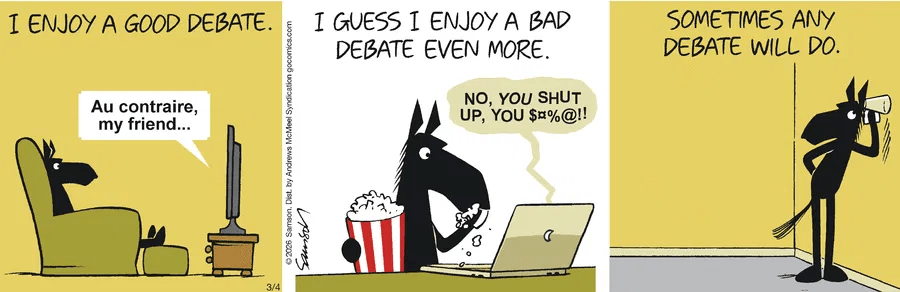
https://www.gocomics.com/darksideofthehorse/2026/03/04

Waiting for lunch to digest so I can go work on the driveway while the temp is over 10 degrees, I’m reading my weekly Literary Hub newsletter. And what to my eyes should appear, but them saying today is National Florida Day! I’d still rather not be in Florida (too humid for my sinuses,) but the idea is pretty good, in and around the doom and violence in some of the day’s events. There is all sorts of stuff on this page, including Dave Barry, but skip to following pages for better bits of escape. I’m going to post a snippet about FL literature (yes, literature comes from FL, too, and it’s darned good! I love Carl Hiaasen!)
Snippet:
Today, January 25, is National Florida Day.
Despite being the epicenter of contemporary American book banning, Florida has a lush literary history, and is the subject of ongoing fascination for both writers and readers across the country. To celebrate the literary pedigree of the Sunshine State, and to combat the winter weather that is burying pretty much everyone else this weekend, we present to you a Florida reading list. This is by no means meant to be complete, of course. Just a little something to get you warmed up:
Joy Williams, Ill Nature
Amy Hempel on Ill Nature: Joy Williams lived for years in Florida, in the Keys, and was lucky to have known parts of it that no longer exist. This is one of the occasions on which her anger is also a form of mourning. “Neverglades” chronicles the destruction of an enormous percentage of this singular ecosystem, leaving it “a horror show of extirpated species.” Of Big Sugar’s role in its destruction, Williams suggests we “think of the NRA with a sweet tooth.” “That the Everglades still exist is a collective illusion,” she writes, “shared by both those who care and those who don’t.” She describes the state as “attuned to growth, on autocatalytic open throttle.”
Zora Neale Hurston, Dust Tracks on a Road
Richard Deming on Dust Tracks on a Road: Hurston’s hometown, Eatonville, located outside Orlando, was one of the first towns in the United States to be incorporated and run by African Americans. She described it as “a pure Negro town— charter, mayor, council, town marshal and all.” Zora’s handsome father, John Hurston, a rugged, physically commanding Baptist preacher with a gift for lyric turns of language—perhaps the one gift he passed down to his daughter—would even become a three‑ term mayor in the town.
Eatonville had been a defining place for her, and although she would be forced to leave it as a teenager, it stayed with her for as long as she lived. The town and its habits, its inhabitants, all pressed knowledge and lore into the topographic folds of her mind. On benches and apple boxes and milk crates sat people at Joe Clarke’s store, the “heart and soul” of the town. When it was really humid, they gathered on the porch, shirts loosened, shooing big Florida flies, and fanning gently their foreheads. Inside and out, people talked and gossiped, telling tales large and small, real and invented.
Lauren Groff, Florida
Grace Flahive on Florida: Some books are books. Other books are places. More than any story collection I’ve read in my life, Lauren Groff’s Florida feels like tearing through the page and stepping into a fully realized portrait of the state, living and breathing and dangled with Spanish moss, as panthers pass through the shadows. In “The Midnight Zone,” a mother staying in a remote cabin with her two young boys falls from a stool and hits her head and finds herself traveling outside of her body, amongst the thick of the trees. In “Eyewall,” a woman hunkers down as a hurricane slams her home, and when the storm passes, a miracle is revealed: a single, intact chicken egg sits, gleaming, where the front steps had been.
These stories are rich, at times hallucinogenic, and unforgettable.
Carl Hiaasen, the whole oeuvre
Neil Nyren on the works of Carl Hiaasen: The books are all set in Florida, because of course they are. Besides being the place where Hiaasen was born and raised, and lives in and loves, it is a place utterly unique in both its natural beauty and its level of venality. “Every pillhead fugitive felon in America winds up in Florida eventually,” muses a detective in Double Whammy (1987). “The Human Sludge Factor—it all drops to the South.” Another detective in Skinny Dip (2004), who is originally from Minnesota, concurs: “[In the upper Midwest] the crimes were typically forthright and obvious, ignited by common greed, lust or alcohol. Florida was more complicated and extreme, and nothing could be assumed. Every scheming shithead in America turned up here sooner or later, such were the opportunities for predators.” Tied to that, gloats a crooked (and entirely uncredentialed) plastic surgeon in Skin Tight (1989), “One of the wondrous things about Florida was the climate of unabashed corruption. There was absolutely no trouble from which money could not extricate you.”
Dantiel W. Moniz, Milk Blood Heat
Grace Flahive on Milk Blood Heat: Each of the stories in Dantiel W. Moniz’s collection are the type you experience twice. First, you inhale the story (Moniz’s spellbinding prose doesn’t offer any slower option). Then, each story lingers within you, as your mind digests the inflection points, the double meanings, the emotional dynamics that Moniz has laid bare.
Set primarily in Jacksonville, Moniz’s stories trace the contours of her characters’ inner lives, including private pains and unspeakable secrets, showing us ordinary people with extraordinary things broiling just beneath the surface. Each protagonist grapples with something too dark and unwieldly for one person to carry—girlhood grief, the loss of a pregnancy, hate spun from faith, and a near-death experience, just to name a few. But Moniz’s characters find agency in the impossible—in “Tongues,” a young girl defies her community’s hypocrisy, and in “The Hearts of Our Enemies,” a mother delivers a delicious act of retribution. The collection’s title hints at the visceral stories within, and the prose delivers—as well as milk, blood and heat, this is a fully embodied world of sweat, tears, ocean water, and tiny, haunting limbs. As a reader, I let myself be swept away. As a writer, I was taking notes on Moniz’s endless skill.
The Naked Pastor’s art has been posted here more than once. I receive newsletters since he got off Substack, (I think that’s how it happened? Or someone on Substack linked him.) Anyway, today’s newsletter is really nice to post with today’s news. I don’t have a link for the newsletter, so I’ll copy-paste it below. This is the link to his About page on his site. His site where all the art is!💖
Now here comes the letter. Many of the links go to his art pages, or authors’s Amazon pages, and he does sell his art to sustain his work (his work is not on Amazon, to be clear.) It doesn’t hurt to windowshop, but it’s perfectly fine to not click the links (except his About page!) I wanted to say something just in case going to a page might put someone off that this is all about advertising; it’s not. Again, here’s the newsletter! (And Bless The Badass is a fine piece of art!)
=====
| I’ve been thinking a lot lately about how deep some of our cultural assumptions run, especially the ones that have shaped how women are treated. Some of these ideas are so old, so embedded, we don’t even notice them. But they are still here, quietly shaping how we build our systems, our theology, our science, and even our car seats. Let me show you what I mean. Cartoon: Bless The Badass!  Dad Joke: ‘Jod’  Quote: Violence against women  Original: All I Need is a Sliver of Light  Merch of the Week: Question Everything T  |
| Cartoon of the Week Bless the Badass! I bless the badass that you are! I am so inspired by so many women to be a badass myself! (BTW… several people have commissioned me to draw “Badass” for a loved one to make the person look like them.) Dad Joke What if God just came down one day and said, “It’s pronounced ‘Jod’! and then left? Quote From an expert criminologist on violence against women: “Statistically, we know now that once the hands are on the neck, the very next step is homicide… They don’t go backwards!” – Kate Manne, Down Girl: The Logic of Misogyny. This next one is a fascinating book because it exposes just how thoroughly embedded is the patriarchy in our thoughts, attitudes, and treatment of women. “… if a woman became pregnant following her rape, it meant she had ultimately enjoyed herself.” – Eleanor Janega, The Once and Future Sex: Going Medieval on Women’s Roles in Society. Women Suffer The above quote about a woman getting pregnant from her rape meant that she enjoyed it is based on the “two seed theory”. This theory, which lasted more than 2,000 years, taught that the man and the woman each contributed a seed when they both orgasmed, that these two seeds mixed, and that the dominant one determined the formation of the child. The only way a woman could get pregnant then was if she orgasmed. How condemning! I believe the residue of that bad theology and science is still deeply embedded in the patriarchal psyche. Janega’s research also reveals that whenever women began to succeed, men would attempt to put an end to it. For example, it was believed that embroidery was a woman’s task. But when women began to build successful businesses by embroidering clothing for the wealthy… that is developing a fashion industry… the men took over the businesses, and put the women to work as labourers. There are so many stories like that. Interestingly, though, all of this patriarchal maneuvering is rooted in philosophy, theology, and even science. It wasn’t just the ancient philosophers who proposed and espoused the two-seed theory, but theologians like Tertullian and Augustine, and scientists like Hippocrates. The assumption was that man was the gold standard of what it meant to be a person, and women were a spin-off of that ideal and therefore second-rate. This, of course, is rooted in the creation story of Adam and Eve. But once this assumption of supremacy is embedded in our thinking, then it determines every other thought that follows. I have a personal story. Lisa and I finally got a new car… something we’ve needed for a long time. It’s a Toyota Rav4. We need a reliable All Wheel Drive because Lisa often drives to work as a nurse before the plows clear the roads of snow. I want her to be safe and secure. We love it. Or, I should say, I love it, and Lisa isn’t so sure anymore. Why? Because she can’t get the driver’s seat comfortable. I was talking to a neighbour about her work car, also a Rav4, and she said she wouldn’t get one. Why? Because she can’t get the driver’s seat comfortable. I’ve heard of a few other women with the same complaint. I googled it, and it is a thing. This reminded me of another book I read by Caroline Criado Perez, Invisible Women: Data Bias in a World Designed For Men. As the title suggests, the book is filled with data illustrating how the world is designed by men for men. It’s not necessarily malicious. But when a car seat used to be designed, manufactured, and tested by men, women inevitably suffered. (Is this still going on?) This included seatbelts, especially for pregnant women. As well as little things like lower temperature settings in offices where men warmly wear suits or at least sleeves, while women are expected to bare their arms, upper chests, and legs. Like I said, it’s not necessarily malicious, but women suffer as a result. Just like science believed that women could only get pregnant if they orgasmed. It wasn’t necessarily malicious, but women suffered for centuries. This is why I think it is so important to question everything, including our most cherished assumptions, and to consider the consequences these assumptions have on those around us. |
So my friend, if we want to build a more just, compassionate world, we have to be willing to ask hard questions about where our ideas come from and who they are leaving out. It is not just about our personal beliefs. It is about recognizing the ripple effects those beliefs have on others. Sometimes the harm was not intentional. But it is harmful nonetheless. I say, let’s ask more questions!!!
With love,
David
I indulge in this every year. Maybe there are others here who haven’t, but would like to enjoy the Mystery Science Theatre 3000 marathon on Shout! TV, so here’s the scoop:
Snippet:

In the not-too-distant future, next Sunday A.D., there was a guy named Joel, not too different than you or me…
Originally airing for 11 seasons from 1988 to 1999, Mystery Science Theater 3000 became one of the most beloved cult TV shows of all time. In 2015, fans united behind a record-breaking Kickstarter campaign to revive the show for two new seasons, followed by another successful campaign in 2021. Learn more about MST3K here.


=====

All the usual keyboard protection alerts. Hip, hip, hooray!
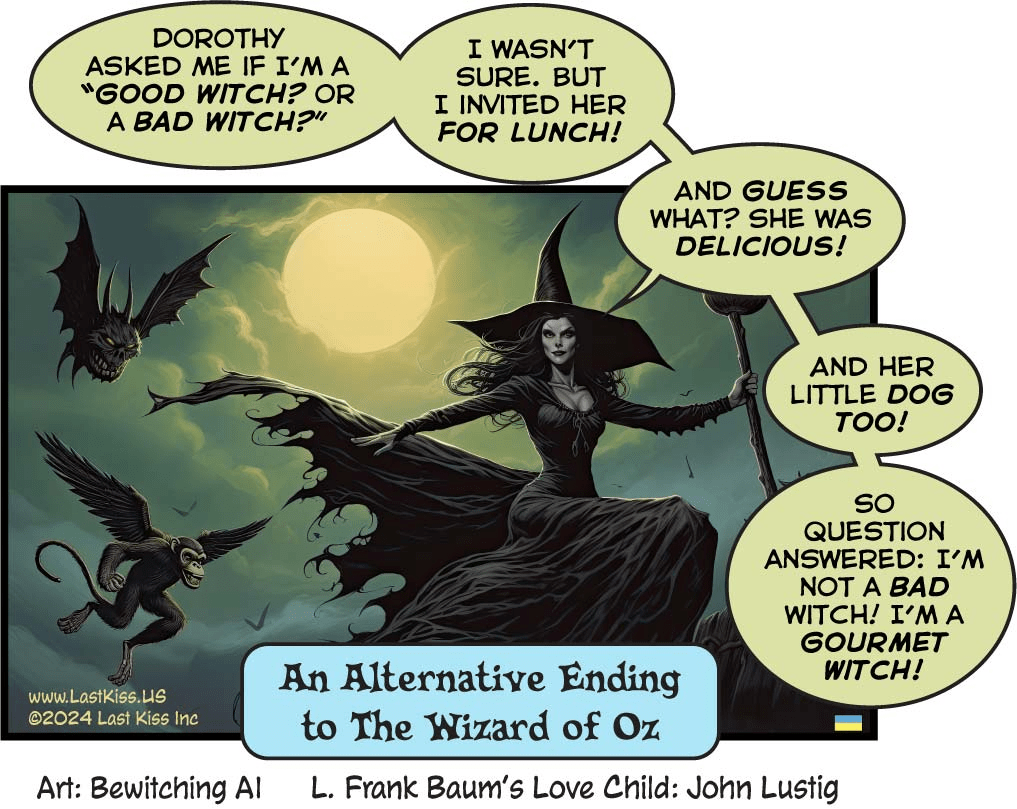
 Scottie's Playtime