NEW YORK, NEW YORK – SEPTEMBER 05: Kate Harrison (L) and Chloe Grace Moretz are seen at the 2023 US Open Tennis Championships on September 05, 2023 in New York City. (Photo by Gotham/GC Images) Gotham
Moretz and her partner, Kate Harrison, were married in a private ceremony over the weekend, as they confirmed to Vogue. The magazine also published exclusive photos and videos of the couple’s final fittings. Rather than a traditional white gown, Moretz went with a pale blue number with elbow length opera gloves. “It just feels like me. It feels like an extension of what I would have always hoped for,” she told Vogue. The actor added that she “never really envisioned a wedding dress” in her mind, so when the time came to figure out her actual wedding look, she knew that she “wanted to do something non-traditional and not wear white and have it feel different.”
After the couple got engaged, Moretz told Vogue that she knew that she wanted to reach out to Nicolas Ghesquière, women’s creative director of Louis Vuitton, to ask if he would be interested in making her dress. He went a step further and made both Moretz and Harrison’s dresses, as well as their afterparty looks. Rather than going with another dress for the festivities, Moretz decided on a white cutout suit accessorized with a cowboy-esque hat. She explained to the magazine that the hat was partially inspired by the activities of the wedding itself — “fishing, horseback riding, and poker.” “Our second day is going to be line dancing and everything,” she added.
In an Instagram post, Moretz thanked Louis Vuitton and Ghesquière for the dress, writing, “Your generosity, artistry, dedication and kindness knows no bounds. We feel so incredibly grateful. Thank you doesn’t even begin to cut it, but, thank you. Your vision made our day all the more meaningful.”
Moretz casually came out as a “gay woman” in November 2024 via Instagram, when she shared that she had voted for Kamala Harris in the presidential election. But even before formally coming out, she’s been seen with Harrison for years, including in a 2023 Instagram post of the two of them at the New York City Dyke March. Per Cosmopolitan, the two have seemingly been linked since 2018, but they’ve kept their relationship very private. Still, we’re glad that we at least get a glimpse into what was surely a stunning wedding. Congrats to the newlyweds!
September 3, 1783 The Paris Peace Treaty between the U.S. and Great Britain — formally ending the American War for Independence — was signed by John Adams, Benjamin Franklin and John Jay. In addition to giving formal recognition to the U.S., the treaty established U.S. boundaries, specified certain fishing rights, allowed creditors of each country to be paid by citizens of the other, restored the rights and property of Loyalists, opened up the Mississippi River to citizens of both nations, and provided for evacuation of all British forces. The Treaty of Paris
September 3, 1957 Elizabeth Eckford was blocked from becoming the first black student at Little Rock’s Central High School in Arkansas.
September 3, 1970 Representatives from 27 African nations, the Caribbean nations, four South American countries, Australia, and the U.S. met in Atlanta, Georgia, for the first Congress of African People. Read more about CAP in historical context
September 3, 1997 The Musa Anter, or Kurdish Peace Train (named after an assassinated Kurdish writer) was organized by peace activists to call attention to the oppression of the Kurdish people in Turkey by their own government. At the time, the Turkish words for Kurd, Kurdish, guerilla and torture were banned, and it was illegal to speak the Kurdish language. The Peace Train was to leave London and travel through Europe to Diyarbakir in eastern Turkey to celebrate International Anti-War Day there. Germany disallowed passage of the Train through its territory (the Germans and Turks have strong military ties). The group then flew to Istanbul, intending to take a fleet of busses to the Kurdish region. Turkish troops stopped them from reaching Diyarbakir, forcing them back to the capital. On this day they tried to hold a press conference to discuss the Kurdish issue. The police arrested or beat all present, including foreign diplomats. The story of the Musa Anter Peace Train
September 2, 1885 A mob of white coal miners, led by the Knights of Labor, violently attacked their Chinese co-workers in Rock Springs, Wyoming, killing 28 and burning the homes of 75 Chinese families. The white miners wanted the Chinese barred from working in the mine. The mine owners and operators had brought in the Chinese ten years earlier to keep labor costs down and to suppress strikes. Chinese fleeing Rock Springs The unfortunate story and illustrations of the scene (scroll down)
September 2, 1945 note: Ho Chi Minh translates to ‘He Who Enlightens’ Revolutionary leader Ho Chi Minh declared Vietnam a republic and independent from France (National Day). Half a million people gathered in the capital of Hanoi to hear him read the Vietnamese Declaration of Independence, which was modeled on the U.S. Declaration of Independence. Read about how it was influenced by the U.S. Declaration
September 2, 1966 On what was supposed to be the first day of school in Grenada, Mississippi—and the first day in an integrated school for 450 Negro children—the school board postponed opening of school for 10 days because of “paperwork.” Nevertheless, the high school played its first football game that night. Some of the Negro kids who had registered for that school tried to attend the game but were beaten and their car windows smashed.
September 2, 1969 Vietnamese revolutionary and national leader Nguyen Tat Thanh (aka Ho Chi Minh), 79, died of natural causes in Hanoi. Uncle Ho Ho Chi Minh Ho and his struggle for Vietnamese independence
Teaching new Americans culinary skills…and beyond by José Andrés
At Emma’s Torch, refugees get the skills to work in kitchens and make a life for themselves Read on Substack
Hello friends, today I want to tell you about a really special organization here in Washington, DC as well as in Brooklyn, New York. It’s called Emma’s Torch, a non-profit organization that provides culinary training for refugees. Kerry Brodie, the founder of Emma’s Torch, named it after the famous poem written on the Statue of Liberty (“Give me your tired, your poor…”) by Emma Lazarus. The organization runs culinary programs for small groups of students to learn kitchen skills as well as life skills—and they have a network of partners to support students and graduates find housing, seek employment, connect with local communities, and find mental health support.
Soon, the DC program will be expanding to a much larger facility in Silver Spring, opening the door for even more students to be supported. My Longer Tables Fund has given a grant to Emma’s Torch to support this growth as a lead partner as they grow across the DC region, starting with the flagship Silver Spring hub in 2026…building a stronger future where more students can train for meaningful careers, more employers can connect with incredible talent, and more neighbors come together around the table. I’m excited to see the development of the new space and hopefully one day to attend a future graduation!
The Emma’s Torch culinary training program is 11 weeks total, and includes time in a classroom, in a teaching kitchen, in professional kitchens, and in a café that the organization runs. The Emma’s Torch team teaches culinary skills like knife skills, food safety, and recipe execution, as well as training outside the kitchen, like how to write a resume, how to interview, conflict resolution skills, coping methods, and language—mostly focused on culinary vocabulary and kitchen-specific language. Just imagine how important it is to be able to understand the difference between “you did cook that” and “you will cook that”…!
Emma’s Torch also has a relationship with José Andrés Group restaurants in Washington and New York—a program coordinated by our director of people, Eduardo Maia—and some of the program’s students work in our kitchens for a few days…as we say in kitchens, a “stage.” Students have worked at Zaytinya, Oyamel, Jaleo, China Chilcano, as well as minibar in DC, and Mercado Little Spain and Zaytinya in New York…and our teams have been so proud to work with them.
The organization partners with local nonprofits in DC and New York, organizations that support refugees like the International Rescue Committee, the Ethiopian Community Development Council, and other resettlement organizations…many of which have seen a decline in funding, so now more than ever, we need to be thinking about how to support people coming to our country. Today of all days, this week of all weeks, this year of all years, I think we should all be thinking about what longer tables means to us—and how the work of organizations like Emma’s Torch can make our communities, and our country, stronger.
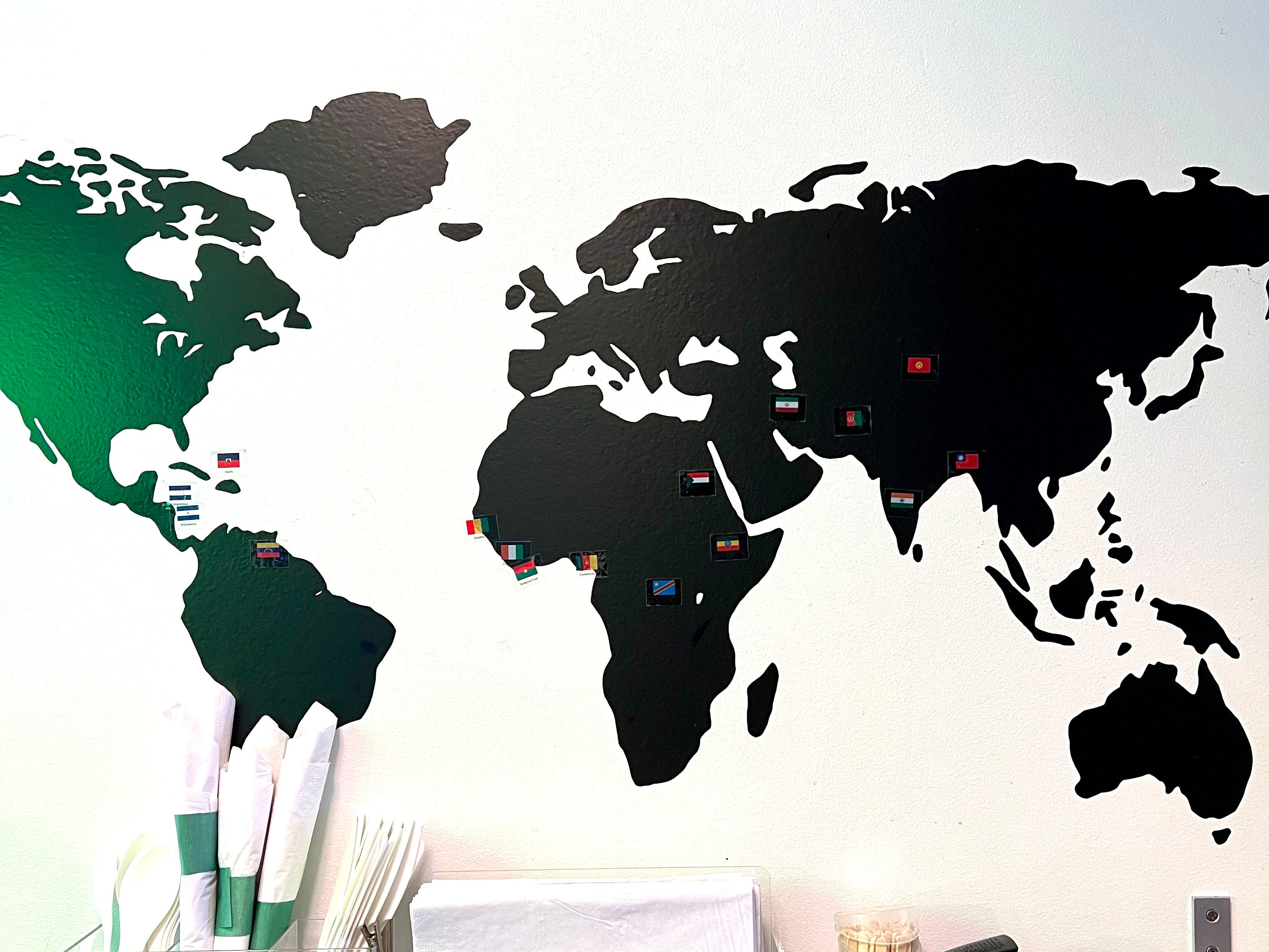
A map on the wall of the Emma’s Torch café in DC showing all the countries that graduates have come from.
My team had the opportunity to visit the DC cafe and meet some of the team members and students from Emma’s Torch (and had an amazing lunch at the café, of course!). Here are some thoughts from Kerry Brodie, the organization’s founder, Justin Edwards, the lead culinary trainer, and two recent graduates, Clara and Mamaissata.
Kerry Brodie is the founder of Emma’s Torch. She created the organization in 2016 after seeing the challenges of the day—a growing refugee crisis and increasingly hostile attitudes to new Americans, as well as restaurants struggling to find good workers. She’d had difficulty understanding how major change could happen through public policy—so instead, she decided to take matters into her own hands, and start a program training refugees to cook and to enter the workforce. Here’s more in Kerry’s own words.
Refugee resettlement is a long process because there’s the immediate trauma that a person might be escaping, but there’s also the trauma of building something entirely new—something that you didn’t plan for, that might not be plan B for you, but plan Z. Like, this is not where you thought you would be. And so many of our students have a shared experience of coming to terms with that, processing the loss as well as seeing the future with optimism, and working to build something.
And now, that trauma is paired with the constant harassment of headlines telling you that you’re not welcome here, and that you’re a drain on society, or that you are an other.
I think the loss of agency is something that becomes a huge problem because fundamentally, many people who leave their homes as refugees are taken from place to place and no longer given choices…Like, start here, go there, do this class. Instead, we like to frame everything as terms of a choice. We have our program and we’re clear with potential students about the parameters of it: this is what might be possible for you if you want to do it, but it is your choice to show up here, it is your choice to participate. It’s also your choice to accept or not to accept a job on the other end, at one of our employment partners.
We’ve seen more and more situations where families are separated, which leads to a lot of social isolation. It means we need to help people build a whole new social network for themselves, to establish a whole new social capital structure. So of course we’re teaching culinary skills, but we’re also teaching about employment. I like the phrase “knife skills and life skills”—but it’s not just language skills and how to write a resume, but also about equity and empowerment, how to speak up for yourself, to have agency over your life, despite the huge headwinds. (snip-There Is More-Please go read it!)
September 1, 1939 Nazi Germany invaded Poland, overwhelming the Polish Army with 58 German divisions and air cover from the German air force, the Luftwaffe. This action started the second world war, prompting England and France to declare war on Germany two days later.
September 1, 1945 The Emperor of Japan surrendered unconditionally to the U.S. and its allies in a ceremony on the deck of the battleship U.S.S. Missouri, ending the second world war.
September 1, 1986 Angelo (Charlie) Liteky & George Mizo, both Vietnam veterans, began an open-ended Fast For Life on the steps of the U.S. Capitol.They were calling attention to their opposition to U.S. support of the Nicaraguan contras and repressive regimes in El Salvador and Guatemala. Charles Liteky “our expression of a deeply felt desire to do everything and anything we can . . . to stop the war with Nicaragua.” George Mizo Liteky was a Catholic chaplain in the Vietnam War and had received the Congressional Medal of Honor. Charles Liteky and his subsequent peace efforts
September 1, 1987 During a nonviolent protest at the Concord (California) Naval Weapons Station, a Navy munitions train ran over Brian Willson. An Air Force and Vietnam veteran, Willson and the other protesters were attempting to stop shipment of weapons to Nicaragua and El Salvador. Brian Willson bird-watching California, 1997. They considered U.S. policy in Central America a violation of the Nuremberg Principles. (Here is a link to those principles.) Willson lost both legs and suffered other injuries but has remained an active and articulate leader in the anti-military movement. Ron Kovic (author ‘Born on the Fourth of July’) and Brian Willson (also born on the Fourth of July) Willson’s testimony before the U.S. House Armed Services Subcommittee on Investigations
September 1, 1989 White House staffers decided to purchase some crack cocaine so President George H.W. Bush could hold the illegal drug in his hands during a national address. On the first attempt, the drug dealer didn’t show up. On the second try, an undercover drug agent’s body microphone didn’t work. Trying for the third time, Bush’s team managed to purchase the crack, but the camera operator videotaping the deal missed the action as a homeless person assaulted him.
September 1, 1997 Kurdish and British activists blockaded an arms trade exhibition outside London. 89 members of Campaign Against the Arms Trade (CAAT)were arrested for protesting the presence of Turkish, Chinese and Indonesian government representatives in Britain to purchase weapons. The Labour government had pledged “[We will] not permit the sale of arms to regimes that could use them for internal repression or external aggression . . . .” Great Britain is the world’s second largest arms manufacturer (by dollar volume) after the U.S.. Campaign Against the Arms Trade home
September 1 – International Day of War Tax Resistance. “Refusing to pay taxes for war is probably as old as the first taxes levied for warfare…” War Tax Resistance Coordinating Committee
August 31, 1921 Marcus Garvey, leader of the Universal Negro Improvement Association, often referred to as the Back-to-Africa movement in the U.S., was declared “Provisional President of Africa” in a Harlem (New York City) ceremony. Black nationalist Marcus Garvey is shown in a military uniform as the ‘Provisional President of Africa’ during a parades up Lenox Avenue in Harlem, New York City, in August 1922, during the opening day exercises of the annual Convention of the Negro Peoples of the World. Hear one of his speeches recorded that summer
August 31, 1965 Draft card burning, 1967 U.S. President Lyndon Johnson signed into law a bill criminalizing destruction of draft cards. Although it could result in a five-year prison sentence and $1000 fine, the burnings became common during anti-Vietnam War rallies and often attracted the attention of news media.
August 31, 1974 In federal court, John Lennon of The Beatles testified the Nixon Administration had tried to have him deported because of his involvement with anti-war demonstrations at the 1972 Republican convention in Miami. The U.S. v John Lennon trailer
August 31, 1994 The Irish Republican Army (IRA) declared a permanent and “complete cessation of military operations” after 25 years of bombing and 3000 deaths (both republican and unionist) intended to end British control of Northern Ireland.
August 29, 1758 The first Indian reservation, Brotherton, was established in New Jersey. A tract of three thousand acres of land was purchased at Edge Pillock, in Burlington County. The treaty of 1758 required the Delaware Tribes, in exchange for the land, to renounce all further claim to lands anywhere else in New Jersey, except for the right to fish in all the rivers and bays north of the Raritan River, and to hunt on unenclosed land. History Of The Brotherton Reservation
August 29, 1957 Following consultations among the NATO allies and other nations, the Western (non-Communist) countries presented to the United Nations a working paper entitled, “Proposals for Partial Measures of Disarmament,” intended as “a practical, workable plan to start on world disarmament.” The plan proposed stopping all nuclear testing, halting production of nuclear weapons materials, starting a reduction in nuclear weapons stockpiles, reducing the danger of surprise attack through warning systems, and beginning reductions in armed forces and armaments.
August 29, 1957 African Americans in Milledgeville, Georgia, wait in line to vote following the Civil Rights Act of 1957. The U.S. Congress passed the Civil Rights Act, the first such law since reconstruction. The bill established a Civil Rights Commission which was given the authority to investigate discriminatory conditions. A Civil Rights Division was created in the Department of Justice, allowing federal prosecutors to obtain court injunctions against interference with the right to vote, among other things. In an ultimately futile attempt to block passage, then-Democrat, former Dixiecrat, and later Republican Senator Strom Thurmond of South Carolina set the all-time filibuster record: 24 hours, 19 minutes of non-stop speaking on the floor of the Senate. A filibuster is the deliberate use of prolonged debate and procedural delaying tactics to block action supported by a majority of members. It can only be stopped with a 60% majority voting to end debate. Senator Strom Thurmond with his 24-hour filibustering speech
August 29, 1961 Robert Moses,leader of SNCC The Student Nonviolent Coordinating Committee (SNCC) was pursuing its voter registration drive in Amite County, Mississippi. Of 5000 eligible Negro voters in the county, just one was registered to vote. SNCC leader Robert Moses was attacked and beaten this day outside the registrar’s office while trying to sign up two voters. Nine stitches were required but the three white assailants were acquitted. Bob Moses recorded the incident Hear Moses recall the time
August 29, 1970 Between 15 and 30 thousand predominantly Chicanos (Americans of Mexican descent) gathered in East LA’s Laguna Park as the culmination of the Chicano National Moratorium. It was organized by Rosalio Munoz and others to protest the disproportionate number of deaths of Chicano soldiers in Vietnam (more than double their numbers in the population). There had been more than 20 other such demonstrations in Latino communities across the southwest in recent months. Three died when the anti-war march turned violent. The Los Angeles Police Department attacked and one gunshot, fired into the Silver Dollar Bar, killed Ruben Salazar, a Los Angeles Times columnist and a commentator on KMEX-TV (he had been accused by the LAPD of inciting the Chicano community). The Chicano Moratorium Ruben Salazar LA Times






 Scottie's Playtime