December 6, 1849 Harriet Tubman, a slave in Maryland, escaped her owners. More about Harriet Tubman
December 6, 1865 The state of Georgia provided the final vote needed for the 13th Amendment to become part of the U.S. Constitution, abolishing slavery. Slave auction “Neither slavery nor involuntary servitude, except as a punishment for crime whereof the party shall have been duly convicted, shall exist within the United States, or any place subject to their jurisdiction.” first vote Two days before, Mississippi’s legislature had voted to reject ratification; Mississippi didn’t ratify the anti-slavery amendment until 1995. More on the ratification
December 6, 1978 The voters of Spain approved a new constitution in a popular referendum by nearly 8-1. It proclaimed Spain to be a parliamentary monarchy and guaranteed its citizens equality before the law and a full range of individual liberties, including religious freedom. While recognizing the autonomy of seventeen regions, it stressed the indivisibility of the Spanish state.
Transcendental poses are fractured by migration In Rafael Soriano’s chimeras dreams transpire through the electric human A body can pitch several lingams— there is only one home as it returns from another journey a new sunrise an orange memory hand pointing the indigo way inward A conjurer throws a fistful of lips five teeth tell the sunburst story . . .
When we search for an object there is only finding the quest it is after all like that— you merge you speak there is art & you find your way home inside the infinite
(Barfbag alert for the 2002 entry. But it is US history.)
December 5, 1955 Five days after Rosa Parks was arrested for refusing to give up her bus seat to a white man, the African-American community of Montgomery, Alabama, launched a boycott of the city’s bus system. The Montgomery Improvement Association (MIA) was formed to coordinate the boycott with Dr. Martin Luther King, Jr., elected as its president. Out of Montgomery’s 50,000 black residents, 30,000-40,000 participated. They walked or bicycled or car-pooled, depriving the bus company of a substantial portion of its revenue. The boycott lasted (54 weeks) until it was agreed the buses would be integrated. Waiting at a transportation pickup point during the Montgomery bus boycott – 1955-1956 < What was the Montgomery Bus Boycott? >
December 5, 1955 The American Federation of Labor, which had historically focused on organizing craft unions, merged with the Congress of Industrial Organizations, an organization of unions largely representing industrial workers, to form the AFL-CIO with a combined membership of nearly 15 million. George Meany was elected its first president. AFL-CIO history
December 5, 1957 New York became the first city to legislate against racial or religious discrimination in housing (Fair Housing Practices Law).
December 5, 1967 Dr. Benjamin Spock 264 were arrested at a military induction center in New York City during a Stop the Draft Week Committee action. Dr. Benjamin Spock and poet Allen Ginsberg were among those arrested for blocking (though symbolically) the steps at 39 Whitehall Street where the draft board met. 2500 had shown up at 5:00 in the morning to show their opposition to the draft and the Vietnam War. Allen Ginsberg
December 5, 1980 The United Nations adopted the charter for the University for Peace in Costa Rica. Its purpose would be “promoting among all human beings the spirit of understanding, tolerance and peaceful coexistence, to stimulate cooperation among peoples and to help lessen obstacles and threats to world peace and progress . . . .” The monument sculpted by Cuban artist Thelvia Marín in 1987, is the world’s largest peace monument. It also established short-wave Radio for Peace International (RFPI)which was shut down by the University in 2004 when RFPI exposed a plan between the University for Peace and the U.S. to hold anti-terrorist combat training on campus. Interview with James Latham, CEO of RFPI when it was under siege
December 5, 2002 President George W. Bush with Sen. Lott and Sen. Thurmond At the 100th birthday celebration for Senator Strom Thurmond (R-South Carolina), Senate Republican leader Trent Lott (R-Mississippi) praised Thurmond’s Dixiecrat Party 1948 presidential campaign (official slogan: “Segregation Forever!”). “I want to say this about my state. When Strom Thurmond ran for president, we voted for him. We’re proud of him. And if the rest of the country had followed our lead, we wouldn’t have had all these problems over all these years, either.” The reaction to this sentiment led to Lott’s resignation as Senate majority leader.
December 3, 1833 Oberlin College was founded in Ohio. It was the first college to enroll men and women on equal terms, and to accept African-American men and women on equal terms with white students.
December 3, 1965 An all-white jury in Alabama convicted three Ku Klux Klansmen for the murder of white civil rights activist Viola Liuzzo. Viola Liuzzo The mother of five from Detroit was shot and killed while driving a young black activist, Leroy Moton, back to the town of Selma following a protest march to the state capital in Montgomery. It was later learned that another Klansmen in the car, Gary Thomas Rowe, was an FBI informant. Klansmen Collie Wilkins, Eugene Thomas and William Eaton at their trial
December 3, 1969 Files were destroyed at eight New York City draft boards in protest of the Vietnam War.
December 3, 1984 In the early morning hours, one of the worst industrial disasters in history began when American-owned Union Carbide’s pesticide plant located near the densely populated city of Bhopal in central India leaked a highly toxic cloud of methyl isocyanate into the air. Estimates of the fatalities vary widely, but of the approximately one million people living in Bhopal at the time, 2,000 were killed immediately, at least another 8,000 within a short time, and hundreds of thousands were injured, many still suffering today. The U.S. blocked extradition of Union Carbide officials facing criminal prosecution in India. Union Carbide has since been purchased by Dow Chemical which continues to refuse responsibility for the incident or its victims, and has yet to clean up the site. Contemporary news report on the incident bhopal.org
December 3, since 1992 The International Day of Disabled Persons was declared by the United Nations. “The annual observance of the International Day of Disabled Persons … aims to promote an understanding of disability issues and mobilize support for the dignity, rights and well-being of persons with disabilities . . . .” 2020 Theme: Building Back Better: toward a disability-inclusive, accessible and sustainable post COVID-19 World. more info
December 3, 1997 An international treaty banning land mines was signed by 122 countries. It comprehensively prohibits the use, production, trade or stockpiling of antipersonnel mines. Buried landmines kill about 15,000 people every year worldwide. The dangerous and time-consuming process of removal would take centuries at the current rate of landmine clearance.The United States and approximately forty other countries have yet to sign the treaty, and fifteen countries continue to produce land mines. The Pentagon requested $1.3 billion for research on and production of two new landmine systems—Spider and Intelligent Munitions System—between fiscal years 2005 and 2011, but Congress has resisted funding the programs under pressure from nearly 500 U.S.-based organizations opposing the weapons. Comprehensive information from the International Campaign to Ban Landmines Recent U.S. policy on land mines:
Good morning! Time to go to work, if we don’t want to go back. First, it is time to call and write our Congress critters to let them know we want no human thrown under the bus in the Republican rush to pick on people they think are less than or “other.” Their majorities in our federal legislative houses are thin; razor thin; so if we will let those legislators know what we want, enough of them will see to at least stemming the damage. They have their ways; plus, the Dem minority numbers are big enough to toss rocks in the works, especially with a few Republicans. For more on this, please see this Substack that Janet passed to me:
For the click-adverse, here’s the snippet from which I’m working here today:
I am but one person and cannot speak for our entire community. But here’s what I propose in the spirit of Queer Nation, who in the 1990s carried out myriad protests under the same banner but with no singular leader or directive.
I propose that on Tuesday, December 3rd, 2024 (the first day that both the House and Senate are back in session), all of us who are invested in this issue and have a platform (whether it be a blog, newsletter, column, podcast, YouTube, TikTok, Instagram, etc.) publish a piece with the shared title: “LGBTQ+ People Are Not Going Back.” Yes, I know, it’s a cheesy title, but it holds Democrats accountable to their own talking points and makes it clear that backsliding on LGBTQ+ rights is nonnegotiable for us.
What you write or say or express in your op-ed or article or video or podcast etcetera is up to you. I encourage you to make it personal and feel free to tailor it to your audience. My only request (other than all of us using the same title) is that you implore people to contact their Congressperson and Senators (and perhaps even local politicians) and tell them that 1) you will not tolerate any backpedaling on LGBTQ+ rights whatsoever, and 2) if they fail to strongly stand up against these attacks on LGBTQ+ rights, then you will take your vote elsewhere next election. (snip-More)
So, as to allies going back. For myself, if my friends are somehow rolled back, I will have to resist in different ways than I did in the past, except for the bothering of Congress critters, which continues apace. The past was fun and dangerous and sometimes more fun because it was dangerous but none of us got hurt or even threatened with arrest, unlike some places we read about in history and more recent times. I wrote a whole thing about those experiences, but it seemed to overshadow this, so some other time. Meanwhile, I’m going to schedule this, then copy it to my Substack, then letter blast some Congress critters, then Go To Bed. I’ve stayed up late most of the long weekend, but that doesn’t work well for me, so.
I encourage Scottie and Randy to post something with this title, and to make a call or send an email if they have time. I encourage any other blogger who reads this to please post something with this title, and also to bother your Congress critters about treating people the way they want to be treated, and opposing bills and resolutions that divide and “other” We the People. I hope we all have a great day, and get something done! And, thank you Janet, for passing this along!
It’s Monday. There are 700 days until the midterm elections. The FBI is about to get way scarier, a warning from a monster’s mommy and Dark Brandon goes Dark Daddy.
Be advised: This newsletter uses profanity. And it’s been saving that shit up for like a week.
Note: Sexy Patriots! Holy shit we sure missed your hot asses. How the hell are you?! How was your Thanksgiving? Does Uncle Trump Trash have third-degree burns on his crotch thanks to an “accidental” gravy boat spill? Oh that’s a shame. Well we sure are glad to be back with you, and we’re damn grateful to you for letting us take some time off to recharge. Lots of scary fucked up shit happened while we were away. But right now we need to talk about this…
Um… We don’t really know what to say here. There’s weird, there’s fuck-a-couch weird and then there’s whatever the hell that is. We kinda like that Jello Diddler (JD) Vance has gone missing, but when he pops up just to do shit like this it really freaks us the eff out. It’s like there’s a roomful of horrifying serial killers but the one you really gotta worry about is the guy who keeps disappearing. We like to think Trump traded him out for Elon Leon or he’s just off defiling a sofa, but we all know he’s probably up to something stupid and evil. Whatever it is, dude, it ain’t worth it if you’re posting shit like that on Thanksgiving. Yikes. Y’all have a blessed day.
Note two: We’d just like to take a second to congratulate all the dumbshit mainstream media reporters who bought Trump’s bullshit denials about Project 2025. More: AP News
Note three: Jamie Raskin is making a move to replace Nadler on the House Judiciary Committee. Nadler is a nice man, but this needs to happen. We need warriors in key places, and few people fight like Raskin does. More: Axios
Note four: Ex-convict Charles Kushner, who was pardoned by his son’s father-in-law, will be our next ambassador to France because the only thing Trump loves more than criminals is nepotism. More: AP News
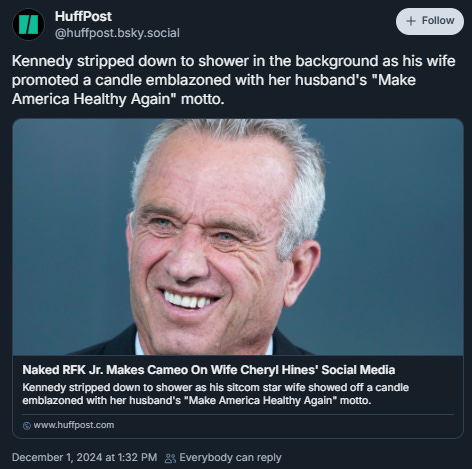
Note five: We like y’all too much to show you the clip of RFK Jr. in the shower while Cheryl Hines sells her crap. So here’s the story without the video. You’re welcome.
Note six: We understand there are people who wish Biden hadn’t done what he did for Hunter (more in the news section), but watching Colorado Gov. Jared Polis try to cozy up to the right every chance he gets is really pissing us off. Go ahead and run for president, asshole. More: The Hill
Note seven: You’re not gonna believe this but pardoned criminal Dinesh D’Souza is totally full of shit. Ok so you will believe it. This weekend Dinesh apologized for the lies in his movie, 2,000 Mules, which was about voter fraud in the 2020 election. He should have kept lying. He might have gotten elected president. More: Independent
Note eight: Did y’all watch “A Man on the Inside” over the break? Isn’t it wonderful?
Note nine: Elon Leon Musk has like 50 kids of his own, but he spent Thanksgiving with Baron Trump. How fucking weird is that? More: CNN
Note 10: Politico and other kiss-asses just don’t understand why normal decent people are leaving Elon Leon’s nazi playground Twitter for Bluesky. (snip-MORE)
==================
OK. Now for the message from Ali. Can you tell I watched a lot of PBS this weekend, with the interruption of a perfectly good and funny bit of work to remind people that democracy and freedom are not free? I feel like I’m doing that.
The thing is better and more succinctly explained here, but very briefly, tomorrow the US legislature opens a session, and we want to meet them with the message that “LGBTQ+ People Are Not Going Back.” And neither are your allies-we aren’t going back, but we are going with you wherever you need us to, and many of us have free mom hugs to go along with that. After you wash your hands. Anyway, my bit, which I’m working on and is saved in drafts, will be to encourage all of us to write to our Congress critters, and any other Congress critters to whom we’re moved to write. I’m likely to do the Congress critters writing tonight, so they see it in the morning first thing. As the draft post here will be.
We can fight like Jamie Raskin! (See above; Parkhomenko has that bit of great news up there. It could be a great idea to write to him, and encourage him to make the move.)
His funeral had been attended by more than 15,000 mourners, not including the thousands who were turned away by the police. He had been arrested for writing inflammatory pamphlets and “inciting unrest” among the black community. Steve Biko
The news story ————————————- December 2, 1980 Maryknoll Sisters Ita Ford and Maura Clarke, Ursuline Sr. Dorothy Kazel, and lay missionary Jean Marie Donovan were raped, murdered, buried outside San Salvador, and unearthed shortly thereafter.
American Nuns Maura Clarke, Ita Ford, Dorothy Kazel and Jean Marie Donovan- killed in El Salvador in 1980.
U.S.-trained and -supported Salvadoran national guardsmen, widely known to act as death squads, were suspected.The Reagan administration, taking office seven weeks later, and relying in part on the Salvadoran military to rid Central America of communism, denied the National Guard’s involvement. General Alexander Haig, the president’s secretary of state, explained the churchwomen’s deaths to Congress as an accident caused by nervous soldiers who “misread the mere traveling down the road (of the nuns’ van) as an effort to run a roadblock.” The FBI and CIA later reported this as a total fabrication, and five national guardsmen were later convicted of murder. More about the Maryknoll Sisters
December 1, 1891 The International Peace Bureau was launched in Rome, Italy, “. . . to coordinate the activities of the various peace societies and promote the concept of peaceful settlement of international disputes.” The organization won the Nobel Peace Prize in 1910 for its work, and is headquartered in Bern, Switzerland.
December 1, 1948 Following a brief but bloody civil war in 1948, Costa Rican President Jose Figueres helped draft a constitution that abolished the military and guaranteed free election with universal suffrage (all adult citizens can vote). Money not spent on a military allowed the country to adequately fund health care and education, yielding one of the highest literacy rates on the continent, ninety-six percent. This is judged to be a factor in the nation’s never having fallen prey to corruption, dictatorships, or the bloodshed that has marred the history of much of the region. Costa Rica stands apart
December 1, 1955 Rosa Parks, a black seamstress active in the local NAACP, was arrested by police in Montgomery, Alabama, after refusing to give up her seat on the bus to a white man. Mrs. Parks faced a fine for breaking the segregation laws which said blacks had to vacate their seats if there were white passengers left standing. The same bus driver had thrown her off his bus twelve years prior for refusing to enter through the rear door. Rosa Parks Mrs. Parks had not been the first to defy the Jim Crow (the system of legalized or de jure segregation) law but her arrest sparked the year-long Montgomery Bus Boycott, organized by a young Baptist minister named Martin Luther King, Jr. The Montgomery bus company couldn’t survive without the revenue from its black passengers who, for the next year, created car pools and other means to avoid using the city busses. The bus restored in Henry Ford Museum The boycott was successful and Mrs. Parks became known as the “mother of the civil rights movement.“ The story of the bus Rosa Parks biography Arrest record of Rosa Parks
December 1, 1959 Representatives of 12 countries, including the United States and the Soviet Union, signed a treaty in Washington setting aside Antarctica as a scientific preserve, free from military activity. President Eisenhower said the treaty and its guarantees “constitute a significant advance toward the goal of a peaceful world with justice.”
December 1, 1966 Comedian Dick Gregory was convicted in Olympia, Washington for his participation in a Nisqually Native American fishing rights protest. Interview with Dick Gregory
December 1, 1969 A lottery was held to determine which young men would be drafted into the armed services for the ongoing Vietnam War. A large glass container held 366 blue plastic balls each marked with a birth date. The drawing determined the order of induction for draft-eligible men between 18 and 26 years old, and was broadcast live nationally. The first draft lottery was held in 1942. Rep. Alexander Pirnie, R-NY, draws the first capsule in the draft lottery held on December 1, 1969. The capsule contained the date, September 14.
December 1, 1997 A silent march of women in Khartoum, Sudan, protesting conscription, was met by a police attack and the arrest of 37 women.
Queer artists have always subverted musical boundaries, shaping the sound of culture itself. That truth is the guiding ethos behind TRANSA, an astounding new compilation from the nonprofit production company Red Hot that puts a spotlight on trans, nonbinary, and queer artists, celebrating the unique gifts they have brought to the world. Artist, model, and trans activist Massima Bell, who produced this compilation alongside senior Red Hot producer Dust Reid, puts it best. “I see in the quality of music trans people make this ability to create a portal out of their music and take you to a different place in a way that is really powerful,” Bell tells me.
TRANSA provides precisely that kind of transporting experience. Featuring 46 collaborative tracks with over 100 contributing artists, the compilation was inspired by Bell and Reid’s love of the music of Beverly Glenn-Copeland and the natural world. The passing of trans musical visionary SOPHIE in 2021 prompted the pair to focus on a project which they now describe as a “spiritual journey in eight chapters.” Individual chapters with titles like “Womb Of The Soul,” “Awakening,” and “Reinvention” serve as a blueprint for a winding musical narrative with multiple missions, one of which is to be a living document of contemporary music by trans and nonbinary artists. “We often don’t get to understand our history and the long legacy of trans people,” Bell says, “both in music, but throughout time and human culture.”
Queer artists and makers work hard all year long, but due to the seasonality of product sales, many only make the majority of their income during the final three months of the year. So this holiday season, instead of buying from mega-retailers who love to slap rainbows on their merchandise for Pride month, you can put your dollar to better use by shopping small and buying direct from LGBTQ+ sellers.
Plus, with your house being such an important space for relaxation and recharging, what could make a better gift for queer loved ones in your life than handmade home decor? It’s a win-win: Your friends and family will get quality things to beautify their abodes, and you’ll help pay a queer person’s bills.
If you want to help your friends and loved ones jazz up their space, here are some incredible options for handmade home decor made by queer artists. (Buy something for yourself, too. We won’t judge.)
For plant parents
The thing about adopting plants is that it’s too easy to go from having a few here and there to an apartment full of aloe, monstera, and pothos. If you know someone whose home is overrun with greenery, you can never go wrong with the gift of a new container, so get the plant parent in your life a bright, 3D-printed flower pot to really make those leaves look good.
Made by the completely queer-owned design shop Object Lover, these pots are constructed from recyclable, biodegradable corn-based plastic, so your eco-conscious friends can feel good knowing their plants are helping the planet.
For candle lovers
Nothing is more synonymous with the holidays than a good candle, especially as the days get shorter and darker during winter. But there’s no one-size-fits-all candle, so here are two very different options:
Queer Candle Co. is your go-to if you’re buying for someone whose style is a little more subtle. The glass jar and black-and-white label are both fairly nondescript, but the scents spill the tea. You’ll find blends like their astrological bundles for Fire Signs, Water Signs, and Air Signs as well as decadent scents like dark plum — all of which are tastefully designed by a queer-owned company who wanted to “promote visibility and amplify the voices of members of our community.” The company contributes 10% of their profits to the Sylvia Rivera Law Project.
If you’re looking for another candle company with product names that elicit some queer rebellion and cheekiness, look no further than Violet&Jade. With scents like Leather Daddy, Campfires & Carabiners, and Drag Brunch, these candles will make a great addition to any queer person’s mantle or side table.
For people who like to burrow in a nest of blankets
Please click through to read more about this poet, and her poem (especially in light of some terms she used in her work. It is fine history.)
My Forest Brave, my Red-skin love, farewell; We may not meet to-morrow; who can tell What mighty ills befall our little band, Or what you’ll suffer from the white man’s hand? Here is your knife! I thought ’twas sheathed for aye. No roaming bison calls for it to-day; No hide of prairie cattle will it maim; The plains are bare, it seeks a nobler game: ’Twill drink the life-blood of a soldier host. Go; rise and strike, no matter what the cost. Yet stay. Revolt not at the Union Jack, Nor raise Thy hand against this stripling pack Of white-faced warriors, marching West to quell Our fallen tribe that rises to rebel. They all are young and beautiful and good; Curse to the war that drinks their harmless blood. Curse to the fate that brought them from the East To be our chiefs—to make our nation least That breathes the air of this vast continent. Still their new rule and council is well meant. They but forget we Indians owned the land From ocean unto ocean; that they stand Upon a soil that centuries agone Was our sole kingdom and our right alone. They never think how they would feel to-day, If some great nation came from far away, Wresting their country from their hapless braves, Giving what they gave us—but wars and graves. Then go and strike for liberty and life, And bring back honour to your Indian wife. Your wife? Ah, what of that, who cares for me? Who pities my poor love and agony? What white-robed priest prays for your safety here, As prayer is said for every volunteer That swells the ranks that Canada sends out? Who prays for vict’ry for the Indian scout? Who prays for our poor nation lying low? None—therefore take your tomahawk and go. My heart may break and burn into its core, But I am strong to bid you go to war. Yet stay, my heart is not the only one That grieves the loss of husband and of son; Think of the mothers o’er the inland seas; Think of the pale-faced maiden on her knees; One pleads her God to guard some sweet-faced child That marches on toward the North-West wild. The other prays to shield her love form harm, To strengthen his young, proud uplifted arm. Ah, how her white face quivers thus to think, Your tomahawk his life’s best blood will drink. She never thinks of my wild aching breast, Nor prays for your dark face and eagle crest Endangered by a thousand rifle balls, My heart the target if my warrior falls. O! coward self I hesitate no more; Go forth, and win the glories of the war. Go forth, nor bend to greed of white men’s hands, By right, by birth we Indians own these lands, Though starved, crushed, plundered, lies our nation low . . . Perhaps the white man’s God has willed it so.




 Biko’s funeral
 Steve Biko


-Yana-Yatsuk.jpg)


